Lionel Richie is wrong, we are dancing on the floor.
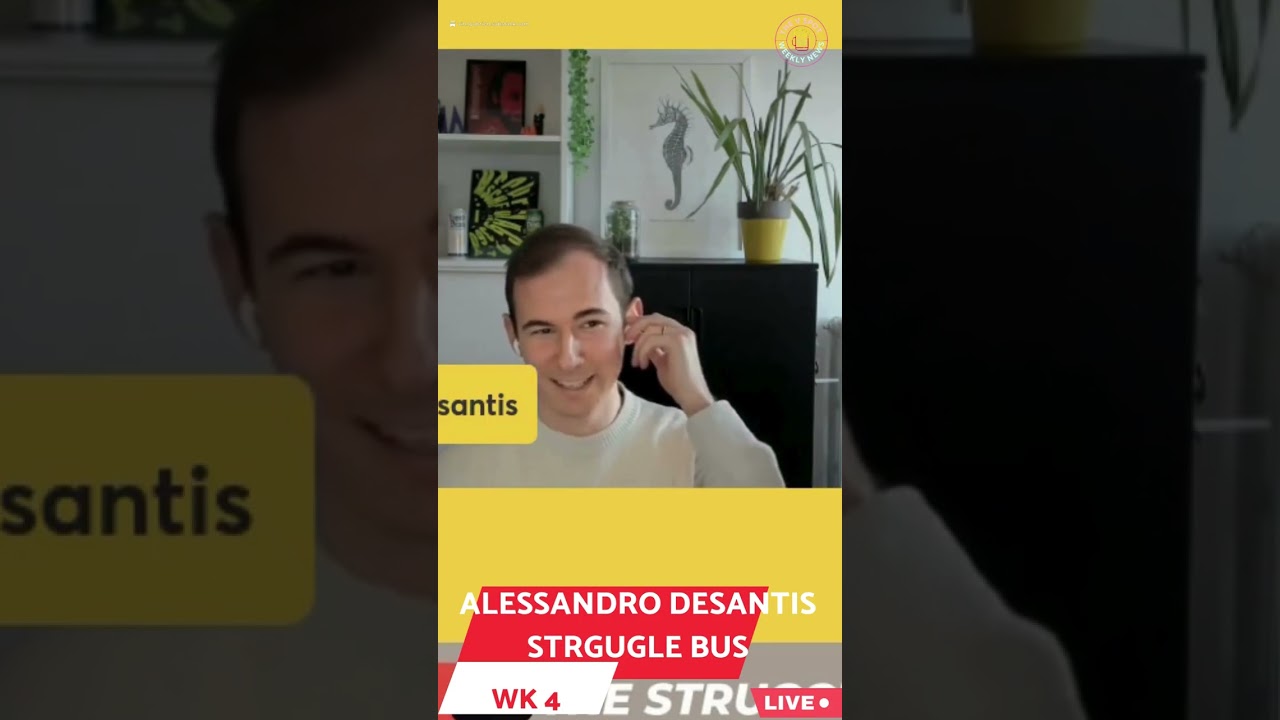
Vinny O Brien talks with Alessandro De Santis, chief strategist at Nebula in Rome, about e-commerce strategy and the tension between beautiful design and conversion optimization. They discuss how A/B testing works as learning, not just short-term wins, and why European and US brands think differently about customer experience.
Chapters
Welcome to The Struggle Bus. I am your host Vinny O Brien, as, or as my friends like to call me, hey you in the bushes. As an agent journeyman in e-commerce, I wanted to create The Struggle Bus to give us a space to allow empathy manifest into something happy through shared experience. E-commerce is not a lonely place, but sometimes our stories remain untold. Today, I want you to feel uncomfortable with the mirror that I want our guest to hold up to us. Alessandro De Santis is one of the few LinkedIn thought leaders demonstrating the how and not theorizing. He is partner and chief strategist at Nebula and is based out of Rome. Welcome, Alessandro.
Hi, Vinny. Thanks so much for having me.
Yeah, I've— look, I've been a fan of your content for a number of years now. And as I said, you tell us a lot about the the how to do things, which is ballsy in itself. But there was something striking about your content this year, and I wanted to start there. You seem to develop a much stronger opinion, or decided that the old way of talking on LinkedIn was a thing of the past, and there is something more authoritative and almost, dare I say, aggressive in the way you put things across. I know it's not aggressive, but there's this brilliant confidence about your content in the last 4 or 5 months. What changed?
Yeah, um, the— I would say the confidence is all for show, but thank you. It's good to know that it's working.
It works.
That's great. So I think it's been, uh, it's been a number of things really for me. Um, so my background, I won't give you the whole story, uh, but just give you a little bit of context of where I'm coming from. My background is not in e-commerce. It's actually in software engineering. And so I started—
sorry to go—
yeah, so it's been a journey. I started writing code when I was 11 and I kept at it for a very long time. And so I worked with a number of companies, currently Runbase, then I worked for a few European startups and US startups as well. And then I landed at Nebula in 2018. If I'm not mistaken. And basically, Nebula back then was— it was defining itself as an e-commerce agency, but the reality is we were for the most part just a software house. And so we would work primarily with e-commerce brands, but those brands would come to us to get software engineers and outsourcing, and we became very good at that. And then over the years, that has changed a little bit, or it has changed quite dramatically, I would say so. Nowadays we're much more holistic, much more full service. We do strategy, we do design, we do engineering, which is still a huge part of what we do. And so we have, as we transitioned into this new identity and all of the leadership transitioned into this new identity along with the company, we started to realize that we had, I would say, maybe a privileged point of view on some of the things that were being discussed. In the industry. And we basically have tried to understand, is it possible to zag while everyone else is zigging and bring that perspective to the market in a way that is useful and interesting? And so that has been part, I think, of that shift that you've seen. So we had an initial phase where we were basically just trying to say what everyone else was saying. We were trying to align ourselves to the best practices and the status quo. And then we became more and more confident in the fact that we had something original to say. And that I think is just a function of experience. And for me as well, personally, of being exposed to some of the operators at the brands that we work with, which are all incredible. But I also realized at the end of the day that they are human beings, and they struggle with some of the very same problems that we struggle with. And some of the thought leadership out there ends up being very hollow and vague and empty. So that is one part of the equation. The other part for me is, honestly, I find thought leadership in general to be quite boring. It is not something that I naturally enjoy. And so the best way for me to enjoy it is to try and put a little bit of myself into it. And so I tend to be very long and long-winded in the way that I explain things. I tend to make a lot of jokes. I am sarcastic a lot. And as I said, it's all for show for the most part. Some of those things I actually believe, but it's a way for me to also keep things fresh and interesting and also just remind myself that we shouldn't take ourselves too seriously because there's no point really.
Yeah, I couldn't agree more. The, the interesting thing for me is that you, you're not held back by the legacy of e-commerce, and I wonder, do you feel that that's an advantage to you? And a follow-on from that, you've said recently, I think, that beauty wins over functionality, which is kind of contrary to how I think about things, and that, that's why I wanted to bring it up. I'd love to hear your experience with better design over function because Amazon has been this horrible standard in function for so long. It's hardly even changed since '97, and yet it still dominates. But there's a better way, and reading through your materials, you demonstrate this. So that's kind of a long-winded question to, uh, to your answer. But, but I think the question is, do you think, one, that you're better because you're not in the— or not held back by being in the e-com space? And then two, How much effort and time does it take you to come up with concepts that are not function over form?
Yeah, so to the first part, I don't know if we are or if I'm better. To be honest, I would never say that I'm better.
So let me reframe that because it's an uncomfortable statement maybe, but do you think you have as an organization? Maybe you've got a different approach because you're not in e-commerce.
Yeah, um, yes, I do like to think that we are different. And we are, um, if I had to unpack it, we're probably different in two ways. Uh, one is, uh, because we come from that software engineering background, um, we tend to bring a lot of, uh, practices and opinions and concepts that are more from the realm of digital product development than they come from the realm of e-commerce. And in some cases—
can I jump in on something there? Because software engineers have a lot of opinions in general, and yes, because it's more of a science than an art, right? You get in, you think something, you prove it or you disprove it. So it either works or it doesn't. Is that where that comes from?
Um, I think it comes from realizing that we can— so I think e-commerce is a very short-term oriented industry. That is something that I've been saying over and over again over the last couple years. Um, and technology, um, and tech companies tend to have a bit of a, um, a more open and longer-term view of where they want to go. And I think a lot of what we try to do is inject that long-term thinking into e-commerce while still trying play nice with the constraints and the goals that we have, if that makes sense. I don't know if I'm explaining myself very well.
Yeah, I think e-commerce has been almost destroyed because we think in terms of accountancy periods. We no longer think, am I building a business to last for 30 years and how do I support that through long-term thinking? So I'm 100% with you on that one.
Yeah, exactly. And it's like one very common example that I always make has to do with A/B testing. And that also partially answers the first part of your question, like, are we better or different because we don't bring a legacy along with us? So we were not born in e-commerce. It's something that we as an organization, and I personally, because I'd never done any e-commerce work before Nebula, I had to learn from scratch. And so as I started learning about some of that things and the processes and the practices these brands put in place, I realized that there is a huge disconnect between what people say you should be doing and what you should actually be doing once you're in the field. And one very common example of this, I think, is A/B testing, for example. Um, so when you look at how tech startups operate, for example, A/B testing is, uh, very often, in the vast majority of cases, more about learning something than it is about optimizing performance. So optimizing performance is actually a byproduct of having learned something, but you can't really escape the learning, you have to live through that. When you look at e-commerce brands, the way that they approach A/B testing is actually with an optimization mindset, which unfortunately means that because they're looking for that short-term gain, it very often invalidates the tests and the experiments that they're trying to run and makes them much less effective over the long term at what they're trying to accomplish. And so I think there's— A/B testing is one example, but there's a number of these things where by not having that legacy, by not having that background, by coming from a very different industry that operates in a different way, I and we have had the privilege of trying to inject a better way of doing things. And I think in some cases we have been arrogant because there are reasons why things are done in a certain way and there are constraints that you need to work within those constraints. But in other ways, we've very often felt a sense of gratitude from our clients because we were presenting a different way of going about things. And so I think that there is a huge advantage of being an outsider in that sense.
And yeah, just two things on that. Again, sorry, I keep interrupting you, but you're saying so many interesting things that I kind of feel I have to pause you. One, do you think being Italian and European gives you a different mindset? And I'd love to explore the cultural side of this. You're nodding. I think yes, it's kind of clear, but I'd love to hear more about it. And then the follow-on To that is the idea of A/B testing is always outcome-based. You've described this from a learning perspective that maybe doesn't have an outcome, maybe has what is it we want to uncover, or do we try something not knowing what it is we're going to do? How do you create that culture and how do you earn that culture with a customer? You kind of talk about privilege and gratitude. There must be an enormous amount of free work or discovery or education along the way. They all sound like clichés, but how do you earn the right to do that?
Yeah, so to your first point, yes, I do think that there are good things and bad things about being a cultural outsider. Our clients still make fun of us because so many people go on PTO and on holiday in August, for example. That's becoming a little bit— We, we live longer. Yes, I, I also like to think we have better food, but I wouldn't say absolutely.
That's, that's not a disagreeing that one.
Um, but yes, I think that more than anything technical, uh, what being Italian or European maybe, um, affords us is, uh, again, the ability to disconnect ourselves from the work, which seems like it would be something that doesn't play in your favor. But actually, counterintuitively, if you use that in the right way, I think it really makes you much more effective at what you do. There is a, there's a wild connection that I'm making right now. So hopefully it lands. But there is a stand-up comedian that I really like, and he's actually American. His name is Bill Hicks. I don't know if you're familiar with him. Okay. Yeah. So he's, uh, he and George Carlin are one of the, uh, two comedians that I started listening to when I was, uh, I think like 14. Um, and the piece that I love the most from Bill Hicks, uh, is called, uh, It's Just Right. Uh, I think it's one of his most famous, uh, pieces, uh, where he basically says that all of life is just like a ride in an amusement park and our minds choose to believe that the ride is real. Uh, but actually it's not and you can change it however you want and whenever you want. And I think there is a problem with that kind of hustle culture that we sometimes see in the US where you get laser vision and you get so fixated on the ride and on the end objective that you completely lose sight of how you're executing against that objective because you're not thinking about anything else. You're only thinking about winning. You're not thinking about how you play the game. And when you have the privilege of disconnecting yourself from the work, first of all, because you're consultant, and you realistically have less skin in the game than the founder or the CEO or even a VP.
Yeah.
And secondly, because you're Italian and you think work is important, but you also realize that it's not all there is to life, you actually ironically become much more effective at work because you still care about your craft.
Yeah.
But you also have the time and the mental space to look at how you're executing and then try to optimize that. And that requires It requires slack, basically. It requires that you spend time actually thinking about things, rather than just working and working and grinding and grinding towards the end goal. And so yeah, I do think that there is, that there are advantages in that. And then your, sorry, your second question was, how do we earn the right?
It was about creating the space for A/B testing, and let's call it learning, where there's no defined outcome. Is that— have I described that properly? I don't want to be putting words in your mouth.
Yeah, that's more or less correct. I think more in general what we try to do, um, is when we approach brands, um, so when we— to take a step back— when we decided that we wanted to get a bit more strategic as a consulting company, uh, we also Well, I don't think that all agencies are unique, honestly. I think that there is a lot of overlap. The process is still the same, the delivery is still the same. I think the whole narrative that you have to be unique and find your niche is really overrated and overblown. But still, you do want to have some kind of unique thing and positioning. And our unique thing has always been to try and sell that long-term view. And so A/B testing is one piece of that puzzle. We also have our own process called Experience-Led Commerce, where brands We help them collect the qualitative and quantitative data that they have at their disposal, or if they don't have it, we help them start collecting it. And then we help them understand how to use all that data in a recurring way to create their digital roadmap. And so again, it's about trying to get them not to just think about the weekly trade meeting and revenue goal for the month, but also look at the next 12 or 18 or 24 months. And honestly, to your point, I can't say that it's a wild success. Like, there are very often situations where we try to do it and it either doesn't work or it seems to work, but then the brands still struggle with being disciplined enough to execute on it. Um, but in terms of how you earn that right, I think part of it is just portfolio, to be honest. Like, we have some great brands that we've worked with, and that really helps sell the narrative that what we're doing works. But also, as I said before, it's about realizing that there are constraints, and you can't just go headfirst into those constraints. You need to work your way around them, which is— I think if I remember correctly, my Beauty Over Function LinkedIn post, the point was exactly that. You can try to bulldoze your way over the challenge, or you can try to understand where the brand is coming from and help them sell that narrative and that change internally. And so, for instance, if you're working with a luxury brand, they will be very, very resistant to the concept of doing CRO because they think that they're selling out. They think that it's too commercial. They think that it doesn't work with their target customer. But actually, everyone needs CRO. It is just that every brand needs a different form of CRO, and you need to understand exactly what they mean when they think about optimizing conversion rates and business performance. And so whatever we do, we always try— rather than having a copy-paste process, we do our very best to adapt that process, um, to how the brand operates and the people that we work with and the goals that they and what they can do and what they cannot do. And I think that has been a key realization for us. We just need to help them help us, if you will.
It's a shame in one way that you, when I look at your content or see other podcasts you've been on, it's around CRO, because I feel it's almost like a cultural revolution that you're trying to put through businesses and And CRO is not a dirty word. It's one of the best things we can do right now and will continue to be in the near future. I mean, conversion rates, I've done a study on pre- and post-COVID conversion rates and they're kind of static for nearly 20 years. We have done very little to say as an industry, here's how we can do better or how we can understand how we can do better. And we haven't really challenged that. So I still think we have a long way to go before conversion rate is something that we feel that we've got quite a grasp on. I'm going to move things forward. I always try to keep this to like 18 to 25 minutes. I'm going to ask you one question before I ask the two key ones, which we know what they are going to come. How do you feel about the next generation of e-com operator? Because I've got this— maybe it's just an old middle-aged angry man view— that the younger people that are coming through operating businesses are doing it without that kind of legacy and they're not held back by 20 years of industry bullshit. Arguments about Magento on LinkedIn seem like it's like old man yelling at the cloud and that kind of stuff. I take a little bit of hope that the way that business is being done now, we're starting to see conversion rates of 8% or 11% amongst these young brands that operate on TikTok only and they run their business in their hand. I find it incredible. How do you feel about the next generation coming through?
I think overall I'm positive. I think the industry has, like all industries, it has to go through enough stuff to get disenchanted with the idea that one solution will solve all of your problems. And I think we're slowly getting there. So it's, uh, when we started working in e-commerce, for instance, um, Shopify was not nearly as popular. Um, we were doing a lot of custom e-commerce work, not with Magento but other open source frameworks that we used. And every company out there thought of themselves as a technology company first and a consumer brand second. They really thought that they were changing the world and that they would be the new Amazon and all that. And then Shopify came along and they kind of reset that narrative and they did a 180 on that. So Shopify's narrative is, no, you're not a technology company, you're just a consumer brand. Don't you ever worry about technology. We will worry about the technology. You just worry about making the thing and then distributing the thing.
Yeah.
Um, and we went through a period where the industry got fixated on this narrative. Now I think we're slowly landing in the middle where brands are understanding that depending on who you are, who your audience is, what you're selling, how you want to position yourself, you do have different levers at your disposal and you need to have a very good understanding of how to pull those levers. And we're also understanding that a lot of the playbooks and the best practices are basically a floor, uh, if you want to be kind, and they're not a ceiling. If you want to be unkind, I would say that's All of that is just us looking back and then trying to reconnect the dots and say, that's what works. And actually, it's not like that's what worked in that specific scenario. But it cannot be replicated. There is very little that I've seen in this industry that can actually be replicated on a consistent basis. And I think that is a key realization. And I think people are starting to get there, to be honest, like based on my conversations. Everyone starts, they have informed opinions. But there's also this feeling that you are starting from a clean slate for the most part. And you're trying to slowly find your way towards wherever it is that you want to go. So I am confident, I'm an optimist. I think that industries improve over time. And it's also happening here.
I love your expression that it's a floor, not a ceiling, because that That gives me hope, but it also creates some great visuals and so on for me. But just to anyone who's listening to your content or reads it, you talk about cultural nuance really, really well. And I'd love to bring you back on to talk about this at some point because I'm a believer that when products became so ubiquitous, no matter what country you went to, they were the same. You couldn't get different products anywhere. That was the beginning of the challenge that retail now faces. It's not a technology challenge. It's not an operating model challenge. It's product market fit, but because we have the same things available everywhere, we have this race to the bottom. That's ultimately where I think we've ended up. You talk about it slightly differently and comment on cultural nuance and country nuance, and you talk about it in a way that makes it seem digestible and easy. Speaking of which, you let me into a little secret before we jumped on here, and you said that you liked Irish folk music. Now, I'm not going to hang you out over that one, but what I would love to know, and it's the question that I love getting to, if your career was a song right now, would it be an Irish folk song? Would it be something different? Enlighten me.
Uh, yeah, uh, that's a great question. To be honest, I can't say I've ever thought about it. Um, I do, ever since I started listening to Irish folk music. So I started with Celtic Woman, which is a bit more of a commercial ensemble, and then I went to the more traditional stuff like Anu Na and Klanada. I'm probably butchering the pronunciation. And I do think that there is something like primordially true about it and that it speaks about very— it's like it's music from first principles. I don't know if I have a good way to express it, but it speaks about very basic and yet very nuanced and sophisticated human needs for connection and community and love and belonging. And so yeah, based on what we discussed over the last 30 minutes, yes, maybe it would be Irish folk music because I always, like, whatever I do, my goal is to always try and bring it back to those first principles and try to find the human piece and then work my way backwards from that to achieve whatever it is that we want to achieve. I do believe that business is just a way for us to pass our time in the best possible way. So Yeah, musically speaking, I think Irish folk music might be the closest to what I think.
Incredible. You talk in a way that is consistent with everyone I'm speaking to here week on week, which is very self-aware. They have needs that are deeper than the things that we do between 9 to 5 every day. And it makes for better work, I think, better thoughts, brings a lot more richness to our industry and Look, I hope when we all get together to celebrate the Struggle Bus in quarter one next year that we get to listen to some Irish folk music. And the, the whole theme here is about the Struggle Bus, and I asked you beforehand why, or what does it mean to you, but you've kind of described it to me throughout the entire podcast. I think in, in talking to Alessandro, I got a much better sense of who you are, the things that shape you. I'd love to go back and speak to you some more about that young 11-year-old growing up in Rome who gets who gets kind of taken out of the culture and football and all the things you'd normally associate with Rome and ends up in software engineering. And there must be something very unique about the way your head works and you get into US comedy. So I'd love to have you back in a few months and maybe we can revisit some of these topics and talk some more.
I'd love that. Thank you so much.
Well, you've been an absolutely wonderful guest. I've enjoyed every second of listening to you and, uh, let's Let's hope we get to do it again soon. Thanks so much, Alessandro.
Thank you. Thank you for having me.
Pleasure.
More from Vinny







Where is the consumer now? Reagan took to the field for the V Spot news .. #ecomm #ecommerce



Shopify's $4bn Loan Book and the Winter of Discounts | The Ostrich Report Live
