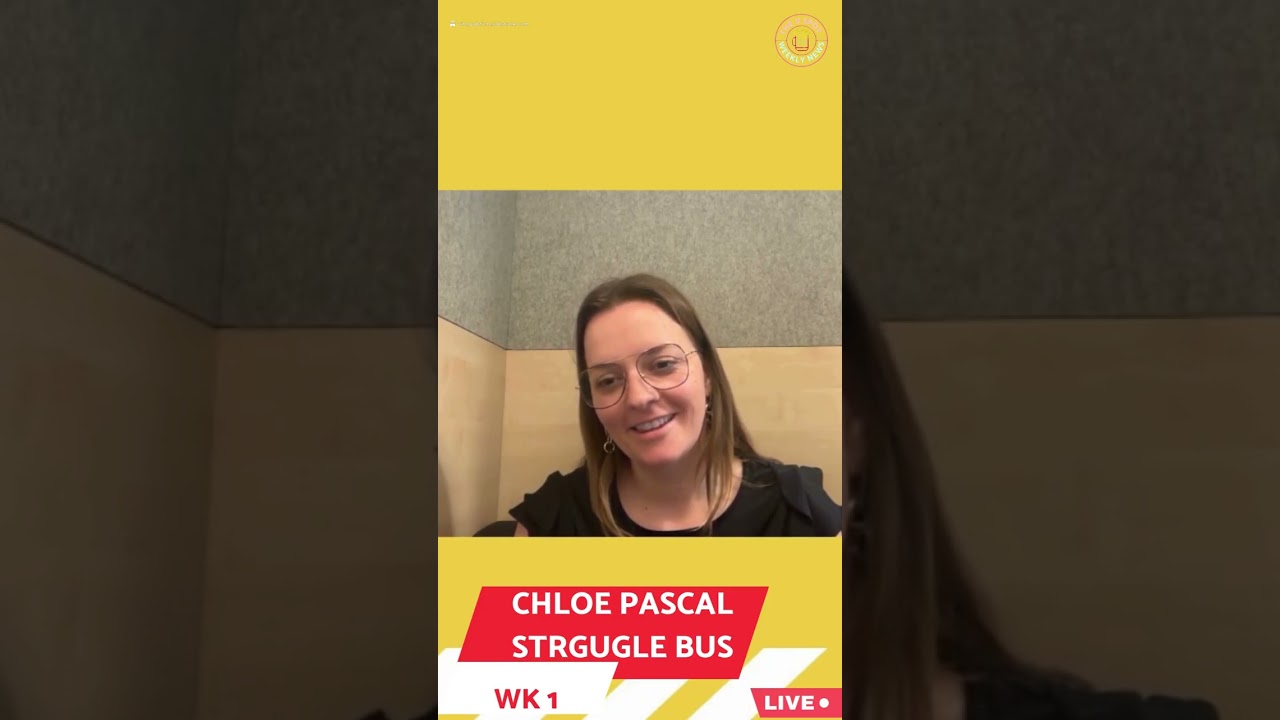
This content was created by Vinny O Brien. This content was uploaded by Vinny O Brien. This is a YouTube interview episode titled "Slowing Down to Go Fast" (uploaded November 4, 2025). It is a conversational/podcast-style transcript in which host Vinny O Brien interviews Chloé Pascal (Global Head of Marketing at Nosto). The discussion covers e-commerce marketing and brand positioning, team workshops and leadership practices (active listening, creating safe spaces), Chloé's personal mindfulness and self-discovery journey, her connection to a remote region in France (La Lozère), and industry topics including AI/agentic commerce, product–marketing alignment, and the health and future of e-commerce. Metadata: contenttype=YOUTUBE, title="Slowing Down to Go Fast", createdtime=2025-11-04T12:00:14Z, thumbnail_url provided.
Chapters
Welcome to the Struggle Bus of the eSpot Show, the home of the e-com daily news. I'm your host, Vinny O Brien, or as my friends like to call me, hey you in the bushes. As an aged man in e-commerce, I wanted to create the Struggle Bus to create a space to allow empathy to manifest itself into something happy through shared experience. E-commerce is not a lonely place, but our stories sometimes remain untold until now. Today, I want you to sit back, relax, and enjoy the thoughts and the voice of my highly esteemed guest, Chloé Pascal, Global Head of Marketing at Nosto, someone who's turned being the underdog into a career muscle. Nosto are an experience platform for e-commerce with over 1,500 customers serving 100 countries under their control. That is a lot of responsibility, Chloé. How does that make you feel?
Hi Vinny, thanks for having me. How does it make me feel? Energized, excited. I don't do this on my own, so I have like a team of great cadets that I work with. We actually just did a 3-day workshop, which was amazing. So I feel good. You're never really alone enough, you know, as long as you have I really believe in like, um, team support, connectivity. I think we— there's incredible things that happen when you work, um, in a group. So I felt good.
As a leader going into like a 3-day event like that, what do you feel you got to bring to a team? And then on the converse, what do you take away from something like that?
I think for— to get the most of a position like this, you want to create a space where everyone is going to have a voice. It doesn't matter if you're a junior or if you're a senior. It doesn't matter if you're a solo contributor versus like a head of a team. That means that you don't want to be sat listening to hours and hours of presentation. You want to create a space for like collaboration where you're brainstorming, you're bringing up ideas and so on. So that's what we did. We did a lot of some brainstorming session. And the way I do this is I build them on that specific theme. I break people into small groups. They work with people they may not be used to working with, kind of gather like friendships and so on. And then I try to hold the space. I can create a space where there is safety. No ideas is anyone's. Anyone can speak. I want respect. I want people to listen to each other. That means like, you know, active listening is something that is so important where you're really listening to what someone is saying and you're not having an idea of what they are going to say, which is kind of hard to do because we always have things that come up, you know, when someone starts to speak and we already make a judgment. So trying to stay open to what people are saying and so on. So no, it's a lot of listening and kind of tying the loose ends, bringing people back together, like guiding them to one, one thing, one direction. So I love doing that. I've been doing those for like a long time. I brought those type of workshops when I started kind of leading the team like a few years ago. They've evolved, they are still on. I used to push the team too hard and I used to have them work too many hours on those 2 meetings and they were just exhausted after day 1 and we had 3 days and they were just like, please don't do this again. So now there's more like team bonding activity. Yeah, no, it was great. It was really good.
Part of active listening, I think, involves being very self-aware and from listening to your podcast and looking at your writing and so on, it feels like you're someone who has evolved this self-awareness in themselves. Was there a moment in time that this happened, or was this moving through leadership and recognizing what your team needed from you?
I think I've always been someone that has a lot of empathy. I've always been someone who is very sensitive. This came From a very young age, I think I was feeling a lot of things and probably at some point felt that I was a little crazy, maybe, because there was a lot going on. And as I went through life and, you know, I went through difficult things, like everyone has, like, things that happen to them that teach them a big lesson. And for me, when I was in my late 20s, I think I had to find ways to understand myself better. And I started really investing through mindfulness therapy, finding ways to slow down my mind, to really understand what was going on, where my anxiety was coming from, where the BPD and cluster syndrome were coming from. I was really curious to learn and to understand. So I had this thing of like, I wanted to seek to understand always. Was happening. And that led me to a journey of discovery, self-discovery, that changed so many things for me. And I think the way I show up for myself, show up for my family, show up at my work is completely different because of those 10 years of work that have gone. So it hasn't been one thing specifically. I think there's been lots of different things I've done. And the more I've The more I've realized that nothing, even though I was really clear, like, what was going on. And I think, um, specifically, a couple of years ago, it was very interesting to have those tools where I tend, when everyone wants to go fast, to slow down. And that really helps me, that helped me also deal with my anxiety and stuff like this. But also in the way I start, you know, in a fast-paced tech environment. I think I have both in me. I'm very driven. I can go really fast, but I also have this thing where I just like, I slow down. I just—
There was something about COVID and I don't say it lightly. I love the pace of life. I loved how much it did slow down. And the way I describe it to myself is that the world got narrower for me. It got smaller. And meant I had to interact in so many less ways and it really suited my personality. And I'm not like you in that I'm not self-aware. I think I'm self-conscious. I think I then subconsciously go through some of these changes in life that you've described, which puts me at a disadvantage because I don't stop and pause and listen. And when I was listening to your podcast, there was a lot of things in there that I thought were interesting. There's a clue in your accent as well, though. You're not from North America. You're French. You said that you have this great place that you go to that's rooted in ancestry. Where is this wonderful place? You allowed to share that with us?
Yes, I am French. This place is in one of the most remote parts of France, called La Lozère, which is— it's not where I grew up. This is where my ancestors on my dad's side from. And so I actually went— so before moving to New York, I was living in the UK for like a long time, like 12 years. And this is at that time when I was like, um, figuring out life and figuring out who I was and what I needed. There was a moment where I realized I wanted to go back and spend more time in Annobio, which I used to go a lot as a kid on holiday with my family. And I started going back there. Um, something magical happened where I just felt lots of peace being there. And so now I spend a lot of time working with Nosto. We can be remote working for 8 weeks per year. So we use that, maybe 6 of those 8 weeks every year to be there in the summer. And it's a very remote, very rural, very rural part of the world. It's kind of, yeah, it's, if you're from Switzerland, you may not feel like this is the mountains, but it is like a hilly Yes, it's like 2 hours north of Montpellier for people that know. So towards the south of France, but more inland, very, very beautiful, very simple life. It's such a magical way to slow down because everything is very simple there.
It's amazing. And there's so many questions that spring to my mind. And when I was thinking about getting you on the show, there was kind of a few inflection points it went through. But the first thing Growing up watching sports and France was a great rival to Ireland and lots of different things always beat us. So we weren't really a good rival to you. But even today, when the Marseillaise comes on in the Six Nations, my father-in-law puts it up full volume and we almost stand up as though we're French. It's such a great feeling to hear it sung in Parc des Princes or in any stadium really. But it's just such a a powerful expression. And when I was thinking about you and coming on the show, the song that was in my mind actually was not La Marseille. It was a song by Sting. I sent it on for you to maybe get a listen. You might not get to do today, but there was a line in it. It was like, I like, I drink coffee. I don't drink coffee. I drink tea, my dear. I like my toast done on one side. And I'm thinking of you being French, working in New York. And having those challenges of bringing European mentality to a tech business in the US, it feels like you've successfully done that and manifested this culture of subtle confidence. You bring a lot of variety to the type of marketing that you do. And in a world where technology marketing is quite shouty and quite in your face, Nosto has a very different approach. And I feel like that It's almost like your inner voice transcending through the organization. How do you describe it? Sorry, that wasn't a sentence. It was a—
No, no, no. It's good. It's good. I'm thinking as you say this, I think I can take credit for all of this because I think some of the nostalgi heritage, you know, coming from Finland is really strong in the culture. And I think it really makes a lot of the identity of the brand because if you ever met Chinese people, they are very humble. They work really hard. They are smart, very smart. They're also very humble. And so, you know, as we work on our brand positioning and like different ways of doing things within the marketing team, uh, we've evolved over the years and now we're trying to be a bit more bold. But still within that, I guess, European hobby, like a framework. So I think we, I believe in, I believe in strong identity and strong marketing, but I don't want my marketing to be called bullshit. So that's not what you're trying to flex, you know, we're the best in the world. That's exactly what exactly, you know, who are we and what do we do? Who do we do this for?
Humility is probably a good expression of how the marketing feels. And does that come from the active listening piece? Because you do have a big customer base. And I think particularly as we move through agentic commerce and the evolution of AI being present everywhere, it's so easy to push marketing at people where I don't feel that that's where Nosto is. And as an experience platform, that means ultimately you have to be guided in product development by what your customers are telling you? How does that feedback cycle work? Or is it an intuitive thing that you listen to your product team or your sales team or customers? How do you develop that ability to turn messaging into marketing or signal into marketing?
I think there is lots of cross-collaboration, right? Because we So the way we build every year, we have the same kind of system. The way we build the coming year always starts by a commercial slide. And this is where like the head of commercials are coming together with the leadership team and we gather all the feedback from local markets about what has been happening for the past 12 months. Based on this, we kind of build like what we want to do for the next 12 months like commercially. Once we've done that, next month, we go into a product offsite. And this is where we do the same. This time, we've taken the feedback from Colin Shaw, we take all the learning from the product team and the product adoption and all the feedback on the product side, and then we build a roadmap for the next month. And then the month after that, we do the marketing offsite. And so we take in the commercial and the product feedback and learning, and then we build our marketing plan. So that is really helping us shaping something that's super aligned and collaborative. But then of course, throughout the year, there is lots of feedback from our customers. When we do big positioning updates, we do lots of customer interviews. We do consumer surveys, customer surveys. So all of that comes like feedback into what we do. And I think like, even though it's multiple people, we really try not to operate in silo, which means like on a weekly basis, multiple people in my team have weekly meetings with the commercial team, the CSN team, the product team. So there is back and forth constantly on like what's in the— what's happening, what's resonating, and so on.
And being so close to customers and having so much data accessible to you and seeing experience, how would you say the health of the e-commerce marketer is right now? Both metaphorically speaking and from an ability point of view, because I go back to your advertising days, that culture of test and learn, should be something that's embedded in every e-com business and it's not, frankly. So how do you view the health of the industry from a capability point of view? And then where is everyone at with this overwhelming culture that we have right now?
Um, right now, specifically with the increase of AI and like, um, we talk about agency, you know, at least from the tech providers, and there's so much conversation about agency. What I'm realizing is that a lot of customers don't actually know that much about all those things they can do with AI, and a lot of them feel a little bit overwhelmed about like how to make sure they're not missing, missing the, not just the trend, but maybe like a different way of working. I know that from some of the conversations we've had, only maybe 10% of them actually understand a little bit what's going on with agent AI. There's so much education and learning to do. And speak up for us as well. We are learning as we run towards that. And so I think the next few years are going to be so interesting. I think we're going to go through chaos before it gets good. So I do believe that it's a bit of a difficult path right now for a lot of, it's an extremely exciting path, but also a difficult one, I think, for a lot of people, because with the innovation that AI is bringing, that lots of jobs and positions and ways of doing things are going to be changed, if they are not already having changed. And people need to embrace it, not be too scared. And that's where you're going to see different people succeed a lot, because if you feel that AI is going to replace you, you're probably going to not get where you need to be. If you're excited about AI and you embrace innovation, you realize that your job is just going to evolve, and actually you can just make a difference by using so many cool stuff. To me, like, it's crazy to think where we're going to be in 12 months. I think talking to some of my peers, you also realize that many people in tech generally speaking are not doing much, but they are talking a lot about AI. AI, they actually haven't implemented that much and it's still like very simple level. So there is like a huge opportunity for people that just really want to embrace that.
Yeah, it's interesting. I think the 10% number probably feels a little bit high.
Yeah.
And that's not to be disparaging to anyone, but I agree it's such an evolving topic and the pace at which it's come at us has been like nothing we've ever seen. A couple of things that I really like about your background and it equips you well. One is that test and learn culture I mentioned a little time ago. So from my perspective, I think curiosity is one of those cultures that we need to develop more of in the industry. I think that's going to change the relationship, and I'd be keen to hear your opinion on this. I think it needs to— the relationship we have on the merchant side needs to change with technology vendors and agencies, and there needs to be more trust built in and part of our thought process that we've got to hand the keys of the car over and say, okay, look, We're going to get there together. How we get there might not be the Google Maps way, but we're going to find our way. Do you feel that there's a need for that change, or am I overstating the need for maybe a shift in not power, but the way that the balance of responsibility is shared? Responsibility between merchant and software vendor or agency partner or technology provider.
Well, it would be interesting to hear what an agency has to say in this because I think the, right now the agency role is changing a little bit because of the evolution of the technology that we're seeing. So I know some people like all over Europe, in the US, there's some agencies, for example, I find this transition a bit difficult because some of their, like, responsibilities being taken away, which means that some brands may rely less on that.
Can I ask, do you see a massive difference between EU and US and rest of world, or is it similar?
I, I would say, well, I think there is what's happening in the industry, but then there's what's happening sometimes on a bit of a geopolitical level, you know, politically. There's often differences when you look at, you know, some things have been happening in the UK, the Brexit and like all of that, like huge inflation, like some key food markets all over Europe. You also see this in like some places in the US. So There is definitely some differences that we see. Yeah, for sure.
I'm conscious of time. We try to keep this to 18 to 25 minutes or so, and we're kind of hitting the 20-minute mark now. So I'm going to get to my really important questions. There's loads more I'd love to ask you, but I want to make sure I look after your time as well. So at this point in the conversation, I always ask my guests, if your career was a song at this moment in time, what would it be? The long pause is deliberate, folks. Chloe's giving this a lot of thought.
Um, I don't know, I'm trying to think. Uh, I'm not really good with dog names.
Would you like to sing it for us? I mean, I'm, I'm open to that. Maybe if you want to You definitely don't want me to sing to you. If you want to come back to me, you can. I could ask you this.
Maybe instead of getting you a song, I can, I can ask you a different way, if that's okay with you.
Please do.
At this moment in my life, what I'm feeling is It's weird because I'm feeling a lot of confidence, like a quiet confidence with so much, probably the most unknown I've ever felt in my life. I think that what I learned watching and like realizing even though there's unknown, I feel so strong and confident about what's going to Enfants de Loulou, I don't know what it is. And to me, that's like, I feel so grateful that I'm at a place in my life where I can just feel like that. Before, you know, 6, 7 years ago, this would have led to full anxiety. And right now, I feel good about the fact that I'm not too sure what's going to happen next 3 to 6 months.
So it's incredible because so many people I talk to, myself included, we all have those anxious feelings and knowing how to place them or how to feel good or bad about them and not feel guilty about those feelings is something I think we all struggle with. So what I'm taking from you is kind of a lot of hope. And I'm going to go into my final question on the back of that. I love the sentiment, by the way. What optimism can you share with the rest of the listeners? You talked a little bit about opportunity in all of this chaos. Where do you see it emerging and where are you hopeful for a better future for e-commerce?
Look, I think, um, I think it— AI, agent AI is going to create incredibly exciting, innovative way of working. Um, I think embracing this is really exciting. While we embrace more AI, I think we also need to make sure we connect very closely to our human side. And that's why I think embracing both for me is super important. On one side, you really want to go and learn as much as possible and equip yourself, enable yourself to thrive in that environment. On the other side, I would really focus on listening slowing down, understanding what's happening for you, connecting with people. If you're not part of a community, finding your community, spending time with great people so you don't suddenly have such a crazy disconnect and only have to run.
That's amazing. And for anyone who wants to pick up on any more of that information, Connect with Chloe's podcast is a brilliant listen. It's calming and it gives you a good framework for getting in the right headspace to do all the things that Chloé's been kind enough to share with us today. But I just want to say thank you. Where can people find you? What's the best way to connect or find out more about Nosto?
Nosto.com. They can find me on LinkedIn. They can listen to the podcast. They can find me on Instagram at Connect with Chloé Perkins.
And I highly recommend it. I love the marketing that you guys do. We've been lucky enough to work with you over the last 12 months as well. It's been pleasure and a privilege and one of those active listening sessions every time that we get together. So look, I hope we get to do it again in the future at some point. But thank you so much for taking time out today, Chloe. It's been a pleasure.
Thank you.
Thank you.
More from Vinny







Where is the consumer now? Reagan took to the field for the V Spot news .. #ecomm #ecommerce



Shopify's $4bn Loan Book and the Winter of Discounts | The Ostrich Report Live
