The Devils Haircut - Ep 1 The Ostrich Report Season 2
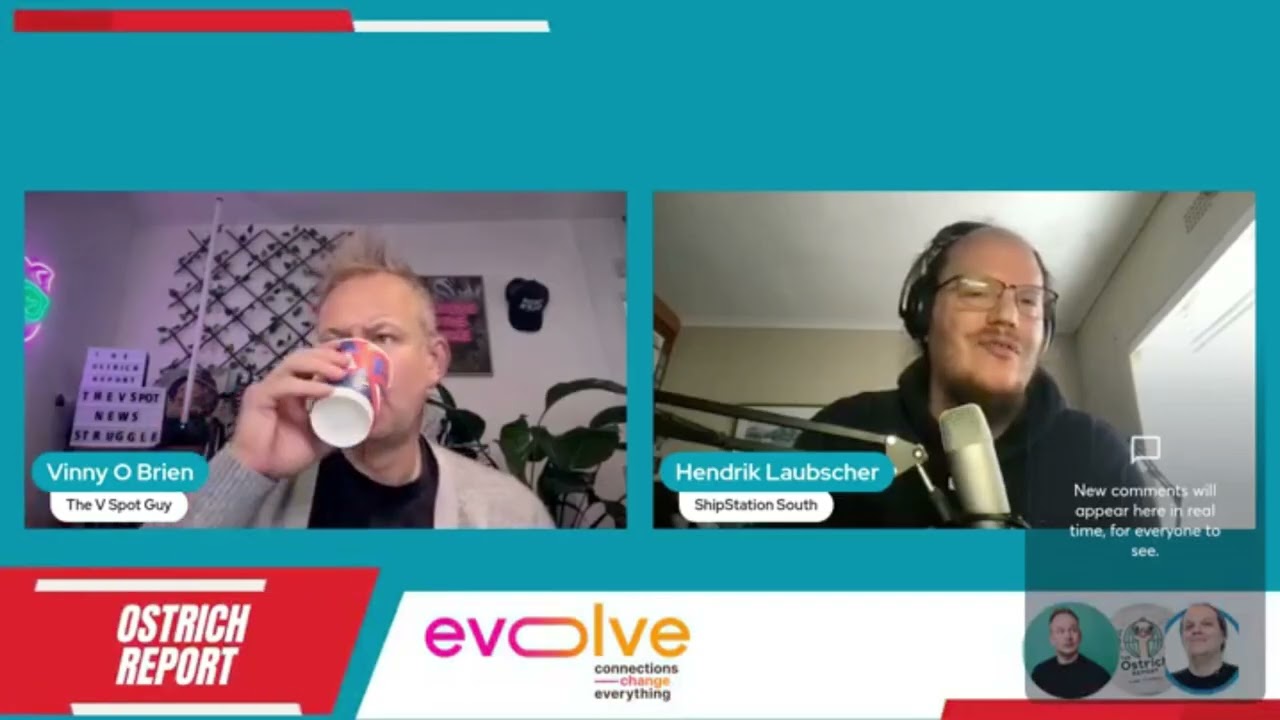
This content was created by Vinny O Brien. This content was uploaded by Vinny O Brien. This is a YouTube livestream/podcast episode titled "The Devils Haircut - Ep 1 The Ostrich Report Season 2" (recorded/posted June 15, 2026). It’s an informal, diarized discussion between hosts Vinny O Brien and Hendrik Lobster covering current e‑commerce and retail industry topics: a recent Shopify/Cloudflare outage, retail media monetization and consolidation, SaaS market pressures and down‑round/’devil’s haircut’ acquisition dynamics, the Anthropic vs OpenAI IPO race and capital constraints, cross‑border marketplace trends and recent deals (Passport/Globally, Contentful/Salesforce), the events/exhibitions business (Hive/Lead Summit) and broader economic signals affecting commerce. Casual livestream format with back-and-forth commentary and industry anecdotes.
Chapters
What can go wrong? Uh, welcome to this crazy livestream Hendrik and I decided we do yesterday, but in the wrong time this morning, and yet here we are. 5 minutes after the fact, but 55 minutes before when we said we would go live. Um, welcome to the Ostrich Report special edition with me, Vinny O Brien, and my good friend Hendrik Lobster, all the way in Cape Town. Hendrik, how is your winter?
So in simple terms, it feels like I stay in Miami, Florida, in the sense that we, we clearly have some version of, uh, global warming happening here. Um, So there's that. Um, Vinny, it feels like I haven't spoken to you in years, and most probably dog years. Dog years. Um, so, oh yes, sorry, sorry, sorry, sorry. Um, yes, I'm— yes, so I am interested in today's conversation because there's a lot going on, but I don't hear lots of people talking about it, which has me kind of confused.
Yeah, loads going on, and that's kind of why we jumped on. No one might join this, but we will send out the post-recorded version as well. Um, yeah, there's loads of crazy stuff going on, and we just said, you know, rather than talking to our own echo chamber, why don't we jump out there, expose ourselves to the world in the most safe possible way by just talking about stuff. Um, and this is an interesting starting point. Yesterday Shopify went down, Shopify and Cloudflare went down. I just checked the status checker sites this morning. It's green ticks everywhere. But was this the day that Toby and his team were vindicated finally for getting rid of so many of their sales support and customer success staff? Because no one was there to pick up the phone to listen to any of the complaining that didn't happen. Why were people not up in arms about this? Because by my count, this is the fourth time this year that this has happened.
Because this is what happens. Why doesn't— because there's, there's no competition. You have penny stock BigCommerce, sorry, um, you have, uh, Salesforce, I don't know if that currently is Fileforce, and then you have who else, um, and unfortunately the thing for me about all these like websites where you can see the statuses, just, just read yesterday's status. These 4 different hours saying, we are currently— we fix this, but we are monitoring. When did it actually end? When, when were people actually able to sell to customers?
This is the same people that are building the children's hospital in Ireland that's, uh, started at €800 million. It's now a near €3 billion, uh, cost to the state and is—
ouch—
it's 4 years late. Same team building this, I'm pretty sure. But yeah, you're right, the competition thing becomes really interesting because what else is there anymore? So commerce has boiled down to do you use Shopify POS? Is it headless? Is it not? Is it composable? What does mock mean? And who's going to ship your products? I think they're kind of the interesting factors here. But the point you make, I think, is kind of the main one. Whilst all that's going on, we have the world of marketing who are going to be sipping their rosé getting ready for Cannes, getting your spray tan, whatever it is that they do. Amidst all of that, this used to be kind of a cool advertising event, we're gonna have the world of retail media who have been incredibly quiet up to this point this year. Where is the world of retail media at, Hendrik?
Um, so I think we have a problem. Houston. And the problem is that unless you're a CPG brand that is moving shopper marketing budgets to it, there's nothing else. There's no other use case for it.
It was kind of like this bastion of hope for everyone just after COVID. There was a lot of money went into what Miracle have done an incredible job of positioning themselves as the infrastructure, but they have moved very heavily into monetization as of 2025, and they're quietly doing what Amazon have done to brands for years. It's death by a thousand cuts. When do we see this market start to consolidate and what are the things that will start happening? And my kind of follow-on to it, like this is a 3-part question for Ariel Bateman.
It's easy in the morning, early in the morning, dude. Keep it one question at a time, please. Okay, make it easy.
Where, where does retail media go from here?
So to answer your question that you kind of gave the answer to, I think one of two things happen. Either you have companies be acquired, so consolidation. So the one company that I keep an eye on just out of interest is Criteo, I think that's how it's pronounced. Yeah, um, they have been hoovering up companies like there's nobody else's business. Um, I also think that once Miracle IPOs, we will actually have an actual signal, not called agencies, for people to understand actually what happens in the market. Um, and thirdly Um, what is the one thing you always tell me? Ah, yes, problem looking for a solution.
Yeah. And is this a precursor to agentic? Like, is the runway a lot longer than we think it's going to be? I read something by Kelly Gatch yesterday. He's one of my favorite commentators in the world of agentic, but he said it's going to take longer to happen, but it will be far beyond the expectations of anyone.
Today. So to answer that question, we can say what we want. So Kelly, I agree with you, has become one of my most interesting reads. I think he's one of the few people that actually spends hours and hours and hours and hours in building things. Um, he's also a very funny guy that has a good sense of humor. He stays in the middle of nowhere, so he doesn't get all the echo chambers, which I think helps him just, just, uh, Kelly, you can send me the check in the mail, just by the way.
Um, I thought you were a digital transfer guy, but anyway, crypto, some one of those things.
No, no, no. So, so to answer your question, I think the next big situation that I don't— I, I saw this on Bloomberg and on CNN. Yes, I'm sad, that's what I watch when I'm working on the background. I think the general consensus in the market is who IPOs first between Anthropic and OpenAI. Yeah. Think about it like this. When you IPO, you generally IPO at a larger valuation than what your last round of private funding was. In OpenAI and Anthropic's case, that's going to be at over a trillion dollars, Vinny. So I have a simple question for you. If there is a lot of billions, not the TV series from the US, which I've kind of gotten into a rabbit hole.
Great.
Um, yes, it is. But if there is, there's only so much money available. So what happens to, so no, hang on, hang on.
You said this to me and I want to I want to show you I was thinking about what you say, because I'm sure you say these great things to me and you go away going, oh, that's great value, and then an hour later you realize what an idiot I am and this is all over my head.
Ah, come on, give yourself—
we had things like quantitative easing during COVID Like, we, we literally did what children said, which was print more money, right?
Yeah.
So there, there's this scenario through which we also have a political cycle in the US that is committed to making AI a real bastion of, um, growth in North America, whether we like it or not. You, you go back to that inauguration day and the people who were surrounding President Trump on, on stage. It was quite a— you, you talk a lot about signals. That was a huge signal.
Yeah.
Does, does— will the lack of money impact this, or will they just create more instruments and debt and find money from somewhere to keep this ship on the road.
So the answer is yes. So, so the answer is yes. It's been kind of in the public, for public realm, for almost 18 months. It's called, um, Less Protection for the US Investor. So taking safeguards away so that index funds can, you know, essentially offer access to anything and anything. Uh, just another news flash: SpaceX, uh, Anthropic, and OpenAI— I, I do not see a world in which either one of them three is, uh, prof— is unprofitable. So, uh, news flash, other third news flash of the morning, um, yes, good morning, I hope you're having your cup of coffee still, um, is in order to IPO in the United States, you need to be a profitable entity for years, otherwise you get taken off the listings, the exchange. Uh, well, if you read the SpaceX, um, prospectus, which I did, which was— it was a great read. It was full of illustrations. It felt like an Art Deco, you know, coffee table book. But the point is, these businesses are not profitable because they're burning capital like we've never seen. So my point is, to go back to my long-winded, winded answers, there is only so much capital available. Whoever IPOs first between Anthropic and OpenAI has a structural advantage because there's going to be less capital available. I don't care what you tell me now, Vinny, Just go read Anthropic Series H funding round information. They have literally taken money in their last funding round from every possible hedge fund that I follow on both coasts of the United States to essentially be part of it. Because remember, when we were much younger and better looking, people essentially asked for millions of funding. This new thing, this hyperscaler thing, does billions. So my point is, according to the law of supply and demand, there's going to be less capital available. I don't care what anybody tells me. The other thing that's important is that whoever IPOs first will give us the next signal about what's really happening inside these businesses? Are they actually giving and making the numbers that they leaking to the press? Because remember when we were all worrying and why, thinking about, um, you know, the one of the world's weirdest IPOs ever, you know, that Office company that we all thought was Yes. What did they do? They created new financial metrics to ensure that they could show profits. My point is, my point is, is that yes, I understand quantitative easing. I understand all the financial things, but this is about who gets to market first. I believe, I think Anthropic has basically once again made OpenAI look like they are behind. But I don't want to drag on the story. For me, we are at the moment in a phase where there's lots of paper going to regulators so that people can look at finances and accounting and all this stuff that makes me just sad and gives me a lot of work, which is fine. And I'm always looking for workers, by the way. But the point is, is that we need a real signal about what's happening in the agentics space. Because if you listen—
let me pause you there because you've given a lot of info there to people. And all this, I feel sorry for Sam Friedman Bank because all he was trying to do was create this new crypto exchange, create this smoke and mirrors situation, and poor guy's in prison. Sam, sorry, sorry for your troubles. I'm kidding. It was a crazy story as well. But the stories are kind of not dissimilar. So with all that in mind, you talk about getting to market quickly. All this has forced SaaS companies into a situation. There's some really good articles right now around— oh, don't shake your head. We have to talk about it. For those listening, that was just a lucky segue. This is clearly not planned. The SaaS market's in a bit of flux, right? You have most of the leaders in SaaS world. They all know Podcast Studios. They jump on LinkedIn, which is a shit show right now anyway, but they are starting to talk in a little bit of an echo chamber effect. And I don't mean this to sound poking fun at anyone, but it's happening because go-to-market now is so challenging for people. And go-to-market is almost a product, which is what OpenAI did really, really well was GTM strategy. Anthropic were slower to get to it, but now that they've They've kind of nailed it. Their release cycle is way better. And it's just got such a better user base as well. So what's happening in the world of SaaS right now? You talk about Signal, you talk about, you know, road to IPO, the ability to make metrics appear whatever you want. It feels like, like we talked about SaaS-mageddon. We're not quite at that phase, but the way that SaaS is now delivered and consumed and used is, is going to change dramatically over the next 18 months.
So one of the things that I've noticed on a lot of the podcasts that I listen to, and they're quite a few, and it feels like the same thing, it also has made appearances in conversations that I have with entrepreneurs. In most cases, startups and brands and retailers have just decided we are not going to pay premium amounts of money to certain companies based on whatever they offered us. We'll much rather rebuild this in Claude code and hope, um, you know, in whatever, in Agentic Software, they can build it. So, so we have that. Secondly, I think we also have to be very mindful of that we have had lots of companies taking money when they didn't need to take money. Remember, we, we went through an age where Everybody wanted to be a headline on TechCrunch or wherever you read your tech news. And I always say to you, and I always sometimes wonder if you roll your eyes at it, but remember, the moment you take a dollar, a euro, or a pound from somebody, the clock starts. And in most cases, investors are going to be saying to entrepreneurs, you took money from us 5, 6, 7 years ago. We now need exits so that we can pay our limited partners on what we promised them. I find— I'll just say something to you that I find really interesting. I always, when large public companies like Salesforce, Oracle, Amazon, whoever acquires companies, I read the press release and then in the next tab on my, my, my laptop, I then have a tab open going to the SEC filings of that company to try and determine, you know, how much money is being paid to buy the company. Well, this week, a trend I'm starting to see essentially came out, but it didn't come out with an SEC filing. So the news of the— one of the pieces of the news of the week that kind of got me thinking, like, your Armageddon comments not far off, is Salesforce buying Contentful, which, which raised capital at a $3.3 billion valuation. Yeah, let's say 5 years ago. And they were acquired this week. There was no—
2021, I think they raised that time.
Yes. Okay. So that's 5 years ago. And Salesforce decided that we're not going to mention the price. And we're not going to file an SEC filing for it. What is that the normal situation for? Ah, yes, this is a down. This is down. This is not something we want to talk about. And then what came out a couple of days later, the information which normally finds things out that nobody else can. God bless their reporting people. They are that good. They are worth a subscription. Yes, thank you. Jessica Lesson, please forgive me, a free affiliate-based, uh, subscription. But the point is, is that what did we see, uh, Vinny? They were sold for— drum roll, drum roll— between $1 and $1.5 billion. What does that say? Haircut. So on the one hand, what was the multiple there in the valuation?
I know we talked about it offline. We talked about 2 billion being about 10x. Is this what, about 6?
I, I was seeing, I, I was seeing anything between 4 and 6 in multiple private communities I'm in.
Let's come up with an expression for this because if it's going to be a trend, we need to, we need to classify it somehow. I'm going to call it the Devil's Haircut after that great song by Beck, if you can remember. So when we see this happening, we're going to now call it the devil's haircut. And if you're listening to this, that's what you're going to say when you see this.
So when you listen to this, why don't you create a meme, tag me and Vinny on LinkedIn? We'd love to see it. Yeah, because this is going to be happening more. So Vinny, just before we go from the story away, so on the one hand, you have SaaS companies talking to themselves in echo chambers with go-to-market And then on the other side, we have investors saying, ah, ah, we need to, uh, be sold, we need to sell you because we need money. For me, the other company that I think is in the same conversation is a company that I thought was going to potentially do better than what they did, was Passport Shipping being acquired by Globally. Raise, let's say, $70 million.
Let's pause right now and let's explain to people what passport and globally are, because we've worked in marketplaces for years. Cross-border trade is another expression for it. It's in a dark place right now. And this—
dark? Yeah, where's the flashlight?
Just ask Jim. Um, no, it's, it's in a tough place, tougher than it's been for quite some time yet. In Europe alone, 84% of all traffic is marketplace traffic. The, the GMV volume is around the 60% mark depending on who you listen to, who reports it. So it's not an unhealthy place. Um, yes, it's in this really, really difficult place. Is this a very US-centric story and valuation given the profile of both companies and their operating geographies, or is, is again, is this another signal of the unhealthy state of the market? And, um, again, is it a signal for how this is going to play out? Because both of them operate in the space of cross-border trade, providing very different services. Um, but yeah, I'd love to hear how you feel the world of marketplace cross-border trade sits and what does this deal represent to those who are looking at it.
So one, um, let me just start off saying, by Alex Janscho, the one of the founders of Passport, he's arguably one of the most interesting people to read on LinkedIn. Alex, if you're listening to this or somebody tells you, please continue to write on LinkedIn. Your cross-border stuff is gold.
I always find tons of value from it because you're the one with stronger opinions.
Yeah, yeah, I'm kidding.
He's got huge opinions.
But, but, but Vinny, so, so let's— so let me answer your question for you. Passport dripping is part of a trend at the moment. Unfortunately, we globally is just hoovering up any business in the cross-border space, um, because they can. They have, with the exception of eShopWorld, or ESW as they now are called, um, they have essentially an infinite amount of capital that they can leverage to buy whoever. So we have that. Then we have, um, I think what I'm currently— I'll just say this out loud— I'm currently looking for cross-border startups that are not headquartered in the United States. That are doing interesting things to move inventory from, uh, China, Africa, Latin America to other parts of the world. I, I have a few companies that I watch, not going to mention any names because I think it's not fair to them because in most cases they are young companies, but there are some of those businesses. So your US, your US and US, you US to the world situation is very valid. What was impacted by that? Tariffs. So let's just mention that. Thirdly, I think we also just need to be mentioning here that I, I said this to you yesterday, yesterday privately, um, somebody that we both know said to me in a conversation off the record that you have to understand that these businesses have a certain place where they kind of hit a plateau, and once they hit the plateau, you need to essentially create systems and solutions that can only be found by large logistics companies. So, so the point is, is that I'm concerned about the cross-border sector. Um, at the moment, I don't feel there's enough content out there about it. Um, I think the— we, we are missing the Global E-Commerce Forum, um, significantly. Um, I know Jim Okamura is working on getting it back to where it was, but, um, that's one situation. I think brands are increasingly in a place where they are either in the decision-making phase of what are we going to do, so are we either going to go with Shopify, or we're going to, you know, go with Global-e or whatever. And in most cases, this decision leads to, you know what, screw it, we're not going to make this decision, we'll just, you know, do this in certain markets where we think we have a shot, which is not good. And then fourthly, I, I think we need to be really honest here in the sense that, you know, certain of these businesses What if you're a large public company like Globally? What are you doing? Essentially, you are buying growth. You are saying to the market, we believe that a startup that we acquire has a feature or a business line that we don't have. So Passports was essentially not being— so they had a solution that was not merchant of record. Which, which I thought was a really interesting value prop because of the importance of merchant of record. But the point is, is that that's where they were acquired.
So just to pick that up, because again, you've given a pretty comprehensive view, the decision globally by— and they're at a stage now where innovation in this category doesn't come around too easily for someone as big as they are. So it's easier to acquire than it is to build, right? So you hoover up market share by doing that. It's a great protectionist strategy, and we're seeing a lot of this. We're seeing a lot of consolidation for protection and for defensive purposes rather than offensive gain, right? Um, in that instance, Shopify's next acquisition will be an interesting one to watch, just to see what way that they're pivoting in, in that space. I've got two more things kind of to say, um, along that and get to our final story. Um, but, but, but when it comes to cross-border trade. I just want to pose the scenario for people to think about. In the UK this year, IMRG have reported that the fashion category is squeezed. Conversion rates down about 1.5% over 18 months. Yeah, customer acquisition is down and overall demand generation is down by about 9%. If you are a brand, you were looking at a growth strategy and you think you're going to get that in the UK where it's a very concentrated market, to me, the only way you get long-term growth is by expanding your proposition internationally. That opens up new product lines, new pricing structures, yeah, um, localized markets. And the final part I'll get to on this conversation is a broader consideration for our industry. We have gone to this place where product ubiquity is killing our ability to price differentiate. So we can get the same thing anywhere in any country, anywhere in the world. The only difference is the delivery cost and the price, right? So when it was easier to do international trade, we had localized offerings, recognizing that each part of the market behaves differently. And now we have to serve that market. That is our job as brand leaders. I think that's how we start winning in the long term again, is by relocalizing for markets, and that means developing product sets for it. So with that in mind, we take all of our news from different places. We have this other story showing further consolidation in the market. I'm going to read out the statement to you and then see what you think. Hive, who are the group that runs Shoptalk, they bought the Lead Summit. Oh, don't say that. Come on, hear me out. And these are the places we go to get our news. Hive has delivered 3 consecutive years of double-digit organic revenue growth and has expanded EBITDA beyond $100 million. And this week we learned a private equity firm, Hellman Friedman— I thought Hellmans were just a good mayo, but apparently they're not— they have agreed to acquire them, um, to manage the next phase of Hive's growth and evolution. So PE buying from PE, what does that tell you about this market and what are the signals you are reading from this one, Hendrik? Because Hive is where we all go to get our news, right? All those great events, yachts, beach clubs.
Sorry, sorry. Oh yes, yes. So I think what we are seeing here is— I view this as an economic signal that, um, the previous owners of Hive took the business to the place that they believe that this is a good enough place to sell the business. So newsflash, folks, PE, everything is always for sale. But also, in most cases, you have a shorter capital life cycle than venture. So you have to get in, get out in shorter time before you— so that's number one. Number two, the fact that at— in the last sentence, I, I know, I, I know this is sad, but you wait for the last sentence in the press release to drop this nugget about we have grown EBITDA for single digits, um, and we've grown— I think what this tells me is that I think the events business is in a kind of a tough place, um, one I think most folks don't understand, that signing sponsors for webinars or, uh, events is, is really hard because most people's budgets have been basically put under lock, stock, and barrel, um, number one. Number two, uh, I think we will hear that, um, you have, uh, the exhibition floors at all of these places, I think with the exception of the LEAD, which is owned by somebody else They were acquired by Hive this year, aren't they? Weren't they acquired by somebody else? I'm almost convinced it's somebody else, not Hive.
Let me just confirm that while you're talking. Um, but I thought it was Hive.
So the point is, is that in order for the 19 Group— so the point is, is that remember, if PE buys an asset, it's because they want the growth of the asset support an existing asset. That's just— that's the, the very simplified place for this. So to answer your question, Vinny, I think the event— the events business is in a tough place. I genuinely believe that. Um, I think it's also— there's this major urge that everything on an agenda needs to be AI. I know I've told you repeatedly in 2026 that Marketplaces kind of are not cool, uh, cross-border is not cool. You just don't see it on agendas. You see AI and all the, the magnificence on agendas. So in, in summary, maybe I'm in a dark place because we went through a massive storm here down south. But it almost feels to me like the economic signals are telling us that we are going into a really rough second part of the year.
Yeah, and that's kind of why we wanted to get out here and talk about it. The Ostrich Report is going to be coming back to you full-on from next week. We're going to be announcing a couple of sponsors as well, um, and we're going to be bringing in more industry commentary because to some of these areas we want to talk about. Just on the point about economic signals, I mean One, you could say that it's a sign of maturity that, that all these markets are consolidating at this one time, but it feels more like it's a contraction where price control is really the goal of the larger groups. And we see that in many industries, not just isolated to our own world of e-com and retail. But look, Hendrik, we've bored people enough for this morning. That one person that was listening all this time, we really do salute you. But Look, these are sort of topics.
One, one. Yeah, we have one person.
Wow.
I— whoever you are, thank you. You have made my day because I thought we were talking in, in an echo chamber the size of the African continent this morning.
Well, look, we're going to do this again, um, and along with our scheduled shows, we're going to do a lot more ostrich reporting from the bushes, uh, because that's where some of the better conversations happen. But look, We are at these really— we're at this really interesting juncture in commerce right now. Um, things are changing really quickly, um, but some of the patterns, some of the trends, some of those shifts that we see are things we've seen before. So there's signals everywhere. And Hendrik, I'm lucky enough to be able to have you to call on to put some sense around all of this so that I can sleep better at night, usually accompanied by a bottle of red South African wine.
So I was actually hoping, or I was thinking that you were going to tell me that it's not— it's actually a bottle of Irish malt whiskey that is also sometimes in your hand, or it could be a glass of Guinness.
No, I'm a man of international taste.
That's what I'm trying to say. So essentially what you're telling me before we go is that you're a sophisticated human. You have made my day. You have made my day with it.
It's a Pinotage from Stellenbosch. That's why I said I'd let you know. I purposely had a glass of it last night just so I'd be prepped and ready for this call this morning. Hendrik, always good to chat to you, my friend. Mind yourself in the harsh Cape Town winter, and you can join me here in Ireland when we get together for Camp Trulli, which we're going to talk about over the next few weeks as well, in January 2027, the place to go when all the other events get acquired by Hive.
Uh, yes, news flash, folks, just so that, uh, I'll just let you in on a little secret. Um, Vinny will most probably put these long hands through various microphones and screens. Uh, the camp will not be advertised. There will not be tickets sold.
It will not. It will be invite only. The passport is a guest spot on one of the podcasts that I produce and appear on. So if you want to do that, you can look up camtruly.com, get yourself on the list to see can you appear on a podcast, and we will talk to you then. But we will be getting together in January 2027. We will release some details about what we want to do, but the themes for this year, before we let people go, are running fast to stand still. It's okay to want to survive or try to, uh, outbox, don't outbox, do better with what you have effectively. Yeah, I knew you'd like that one. And Six Degrees of Kevin Bacon, making relationships count, developing friendships from within the industry that go beyond the Slack group or WhatsApp group, not controlled by someone like me. These are your friendships to cultivate and help you navigate this crazy world we call e-com. Um, till the next time, Hendrik, I will bid you farewell. Thanks for joining me this morning.
Let's do this again, please. This was a lot of fun. Bye, Vinny.
You're a legend.
You're indeed— you are a legend, sir. You have made both of our days.
We love you, folks.
We will be doing this more often because this was fun.
See you later.
Bye.
More from Vinny







Where is the consumer now? Reagan took to the field for the V Spot news .. #ecomm #ecommerce



Shopify's $4bn Loan Book and the Winter of Discounts | The Ostrich Report Live
