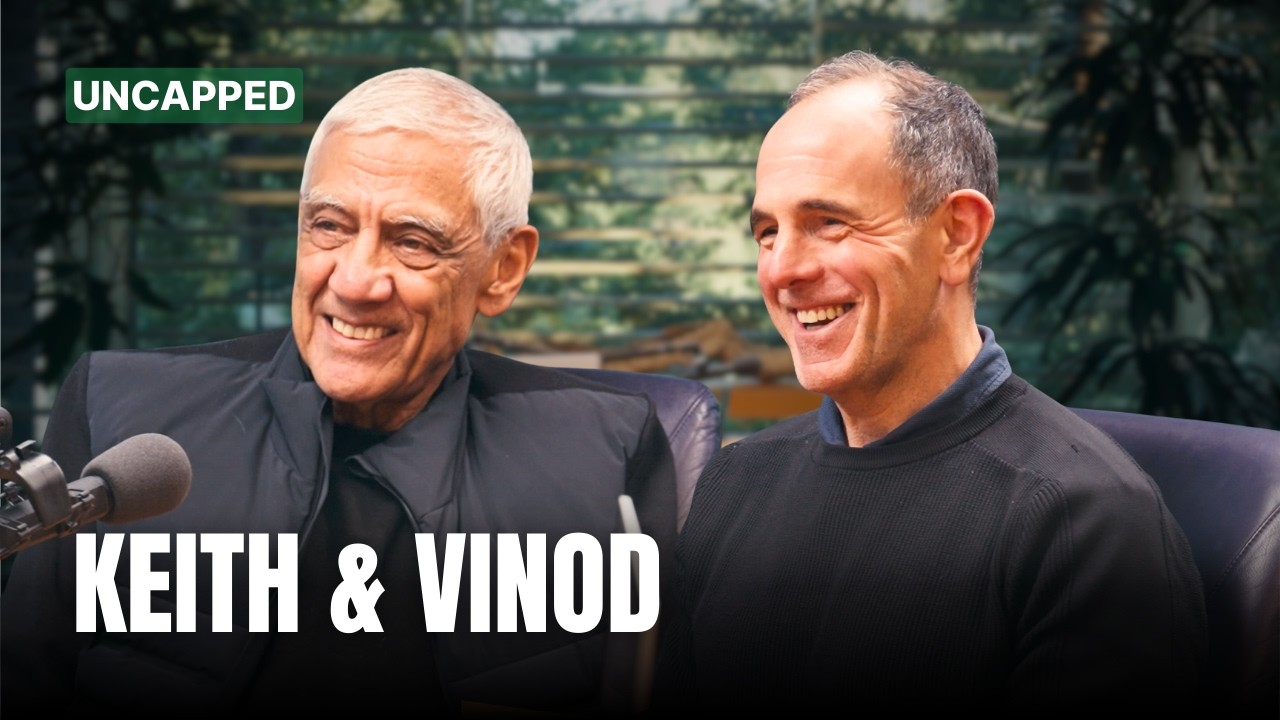
In a June 2026 podcast, venture investor Vinod Khosla discusses the economic, social, and political implications of rapidly advancing artificial intelligence. He argues that AI will soon surpass human cognition in most tasks, leading to large‑scale job displacement that could push unemployment or underemployment to about 50% by 2035 if left unchecked. Khosla sees political resistance—particularly from populist or authoritarian leaders—as the biggest obstacle to deploying AI for societal good, more so than technical or capital constraints. While he acknowledges traditional AI alignment concerns, he assigns them negligible probability and instead worries about strong AI falling into the hands of regimes like Russia or China. He predicts a deflationary economy where many utility services (healthcare, education, legal advice) become near‑free, potentially provided by governments. In this scenario, corporate employment shrinks dramatically, but a new class of 50 million micro‑entrepreneurs emerges, offering goods and services valued for human provenance and personal preference. Khosla highlights the ethical challenge of wealth concentration among investors and calls for radical redistribution mechanisms, criticizing current political ethics and tax loopholes. Throughout, he frames his perspective as driven by curiosity about technology’s possibilities rather than traditional business motives.
Chapters
Back a long time ago, we did the steam engine and then the electric motors, and they amplified human muscle. And everything else since has amplified the human brain. But when the external AI brain is better than the human brain in almost every function, I don't think we can say the future will be the same as the past. If we let things happen, just happen to be most efficient in a capitalist sense, we'd probably get to 50% unemployment or underemployment by 2035 or so.
I am here with Vinod Khosla. Vinod, it's great to see you. Thanks for coming on the podcast.
It's great to be here.
So how would you describe your background in business and tech before we jump into all things in your wheelhouse here?
You know, I can do the business part, but I've never really had an interest in business. I'm sort of just very curious about tech and the impact it can have. So most of my focus is what technology is coming down the line and what impact can it have and what does it take to do that? So it's more about making things possible. I like to say, I like to imagine the possible and then try and make that happen. That's sort of my main goal in life.
But you were a technologist first and then a venture capitalist second, correct?
Yeah. In fact, funny thing is I've never actually in 40 years called myself a venture capitalist.
Oh, sorry to insult you to your face. Vinod Khosla. So what do you call yourself?
I'm in the—
An investor?
I'm in the business of helping entrepreneurs build companies with new technology, and I'm only curious about technology. The other business applications don't interest me very much, or business-only applications.
So we're going to talk about AI and its social and even political implications. I guess a big picture question for you to start. What most concerns you about the economy at this moment? Is there anything you're worried about?
When I look forward 10 years from today, two big things stand out. One, we have AI progressing rapidly, and I'm not worried about its capability. Almost anything we wanted to do that's economically valuable, it'll be able to do over the next 10 years. And it doesn't matter whether we are talking about robotics or AI or any, frankly, function that the human brain can do. Uh, what worries me a lot is if you're going to maximize the impact of that AI for good purpose, societal good. We are going to have a lot of disruption and change. And my biggest worry, to get to your question, is AI may not be permitted because of that disruption. So politics is most likely the biggest impact on AI the next decade, then more than anything to do with technology or capital or Data centers are power.
So you're fearing regulation that proves unwise. Does that summarize this concern?
I would say a simple idea for AI to be fully effective, we should have large-scale job displacement. If we let things happen, just happen to be most efficient in a capitalist sense, We'd probably get to 50% unemployment or underemployment, uh, by 2035 or so. Uh, that obviously cannot happen without a lot of political pushback. So the, the answer is we have to do something radically different for, uh, for us to accept the level of disruption And that worries me because politicians will take short-term advantage of things like job displacement. My nightmare would be Bernie Sanders or AOC get elected president. Um, that, that'd be about as bad as Trump getting elected president. Um, so you could get AI being slowed down by politics. Of job displacement and fear. AI is as feared, as popular among general people as ISIS. And if you look at that perspective, then it's worrisome.
So if memory serves, and I think this is implicit in what you just said, you're not very concerned about the so-called alignment problem, the idea that we'll build superhuman AI that could be unaligned with our interests and pose some kind of existential risk to us?
I wouldn't say I'm not concerned. First, there's two versions of the alignment problem. The way it's traditionally defined, which is you align with human interests, and this is what all the labs are trying to do. The more egregious version of that is an AI gets so dominant it decides to take over the planet. Look, none of these risks can be completely discounted, so I won't dismiss that. But my much bigger concern would be strong AI in the hands of Putin or President Xi. On a relative basis, which is the larger risk, maybe even the largest expected value in terms of impacts clearly I worry about the West falling behind what we would consider bad actors on AI and them using it to dominate us.
Right. Well, but in order to weight the risk in that way, you must put a pretty low probability on the existential concern because, I mean, if you— we're clearly in an arms race with China. But if you thought there was a reasonable chance that we were racing toward a cliff, you probably wouldn't be worried about China winning. But it sounds like you think that the expected value on China winning is worse than the expected value on the low probability that we're headed toward a cliff.
I assign no probability to existential risk. Right.
Okay. Let's just launch into it and let's talk about these concerns. So in Success, you're not somebody, it sounds like, who's given to the usual economic happy talk that AI will not be job-displacing or job-canceling because everyone will just find new jobs. By analogy, the Industrial Revolution moved everyone into the you know, from the farm into the factory. And then the information revolution moved everyone from the, you know, the factory into the service economy, and everyone found better jobs, and nobody's, you know, nobody's putting horses to work anymore, and we're all better for it. You seem to agree with many people, including myself, that if we build AI that truly is general, which is to say that it is a replacement for human cognition across the board, well then by definition, these crazy productivity gains are labor-canceling.
I absolutely agree. I think the thing to keep in mind is everything we've had before, and people say it's always happened that more jobs get created. My personal view, everything we've had before, is a tool for humans to use and to leverage. Back a long time ago, we did the steam engine and then the electric motors and they amplified human muscle. But, uh, and everything else since has amplified the human brain. But when the external AI brain is better than the human brain in almost every function, Uh, I don't think we can say the, the future will be the same as the past. We'll invent new jobs. Now, there's a finer version, nuanced version of that we can talk about. If in fact we get large-scale job displacement, which I think is likely within a decade, and every corporation in America will be failing if they haven't quadrupled their revenue per employee, or for a given amount of revenue, have one quarter the number of employees. There is another version. So in that world, what do humans want? I think the key driver will not be utility. I can buy this coffee mug I have in my hand from China. Pretty cheap, it'll be for human preference. That means if it's made by a human, I have provenance, I have a story attached to it, I'll prefer it. So human preference may play a large role, in which case we might end up— and I think the most likely scenario for 2035 is far, far fewer corporate jobs, but 50 million more micro entrepreneurs in the US. Let's just take one geography. And these micro entrepreneurs, because of AI, don't have to know anything other than their skill. I grow the best flowers. I carve the best wood. I bake the best muffins. I'm best with dog walking. And humans will prefer that. And so human preference, not utility, starts driving it because all utility is in a hugely deflationary economy going to zero. And so you have this human preference element, which will allow many more people to be their own boss, be a micro entrepreneur, do the thing they love most. I think that's one and probably the most likely scenario. There's other scenarios possible, but lower probability, I would guess.
So, but under those conditions, you're still talking about fewer jobs and an economy wherein many people have lost their jobs, not to find them replaced. So then, so there has to be some redistribution of wealth. I mean, I want to talk about wealth inequality here specifically, but This is a picture of a vast concentration of wealth. What is the unemployed radiologist or the unemployed truck driver to do under these conditions when they want to hire all of these bespoke services where human provenance is still so attractive?
So let's talk about two separate things. Where will income come from to survive? Separate from what will humans want to do. Humans will want to produce goods and services that other humans prefer because their provenance, because of that human skill at baking or pick your favorite. Now, that will be a source of income. It'll be a source of pride and dignity for every human being because they're their own boss. And we know people are happier when they are their own boss. Uh, let's look at the other side. The first thing I would say, the vast majority of jobs in the US, and these jobs are better than jobs in most other parts of the world, like India, uh, are not really jobs. I call them servitude to survivals. And That servitude, if you're working as a farm worker for 40 hours a week for 40 years, or assembly line worker for 40 hours a week for 40 years, or till your back gives out and you have injuries, is not human dignity. People like to equate it to that, but dignity comes from doing what you love. Not the servitude to survive. It's just a new form of slavery to capitalism. Uh, it is better than no other job, but it's not exactly human dignity or the most respectable job or one that gives purpose or meaning to these human beings. If there are these micro entrepreneurs, there will be dignity, there will be pride in doing that job. So that's that part of it. So let's talk about the income side of it. There's two periods to talk about, the 2030s and the 2040s. Starting 2030s, there's a lot of services that become free. An AI doctor will be a dollar an hour, which is compute costs., AI robot, maybe $2 an hour, add an extra dollar an hour for hardware. So almost all labor trends to that cost, resulting in free doctors for most people, free AI education or tutors, personal tutors, free legal services, free financial advisory services. All these things become near-free services. And I think we have a hugely deflationary economy for utility goods. That's my best guess today. And the government may actually provide that. In fact, I have a project to start providing some of these services for free in India because the cost is so low. You develop them once and then they're the cost of tokens, which is declining very, very rapidly. So basic services, with the one exception of housing, which we can get to, are going to be very free and accessible, I believe. Then there's the question of—
But in this kind of picture, again, just tell me how a massively deflationary consequence to unlimited free intelligence How do we navigate that with respect to the initial massive concentration of wealth that's going to go to all the investors such as yourself who funded this technology? How do we navigate from where we are now with that concentration seeming to begin across a landscape of— Yes. Let me get really of labor displacement.
If the president can exempt himself from tax audits, there's just no ethics. You can easily buy this president with a few million dollars. Values globally have been destroyed. Protocols of international behavior is completely dead.