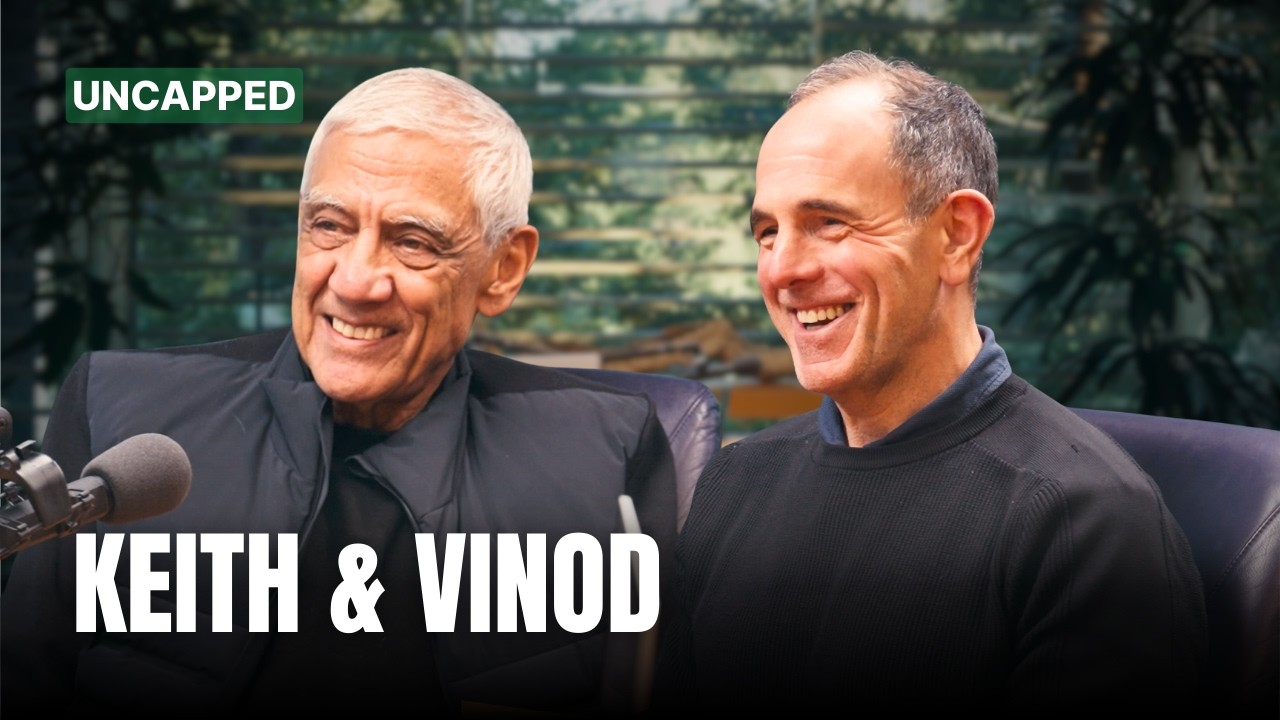
In a March 24, 2026 Hill & Valley Forum panel, Vinod Khosla argues for an aggressively hawkish U.S. stance toward China, insisting that even limited semiconductor exports create a vacuum that China will fill through state‑backed effort and theft. He dismisses the notion that short‑term commercial gains for firms like Nvidia’s Jensen Huang justify loosening export controls. Khosla also discusses the potential capital vacuum from Gulf LPs amid geopolitical tensions, noting that his venture fund’s capital base is diversified and not materially dependent on any single region. The conversation shifts to AI, where Khosla critiques Anthropic’s principled red‑line stance, defends OpenAI’s Pentagon engagement, and stresses that AI must deliver tangible public benefits—free 24/7 primary care, AI tutors—to win public acceptance. He warns that AI will dramatically disadvantage labor relative to capital by 2035, proposing a revenue‑neutral reform that levels capital‑gains tax with ordinary income and exempts 125 million low‑income Americans, arguing this will mitigate labor anxiety and support a fairer economic transition.
Chapters
Principally, the Hill and Valley Forum is about the intersection of technology as an industry and politics. And, you know, prior to the war in Iran and doing business with the Pentagon, probably the mainstay of that, Vinod Khosla, was to what degree America should export its technology to the world, but principally China. And you have some views on that.
So to the world broadly, yes. To China specifically, very little. I don't think there's much room for collaboration with China. They are our adversaries and we are in a techno-economic war with them. And war is the right term to use.
You consider yourself a China hawk. Yes, but there are different extremes and grades of hawkishness. You know, those that consider themselves a China hawk might also argue if you do not export— we're talking about semiconductors as one technology to China— there's a vacuum and It empowers, it provides opportunity for Chinese domestic companies and players to occupy the vacuum.
No question about it, it creates a vacuum for them. But let's not be fooled. They are wholeheartedly, with full effort and the power of the government behind them, going after filling those holes, whether we supply them with technology or not. It's not going to slow down that hole or that incentive incentive to push further on chips, on AI, just because we supplied them technology. In fact, they will steal it, distill it, replicate it.
Please continue.
They will push full force forward whether we like it or not, whether we supply them technology or not. So I don't think it's to our advantage to give them anything that they can further distill. Right. As you know, in Tropic has accused them of stealing or distilling.
I think that OpenAI has as well.
Yes.
But has that ship sailed? You're still here making the conversation, trying to reinforce your views. But at the same time, Jensen just last week is saying that China demand is back and he's getting orders and people seem to be celebrating that.
He is celebrating that. It's in his short-term economic interest. I don't believe it's in the interest of the country as a whole to to do that. Of course, he's got whatever deals he can. He's a great guy. He's a very visionary guy. But it's good for his business. And that's his responsibility as CEO. That doesn't mean everything he does is good for America. It's good for his global business.
Do you think there's a chance that we change policy, change tack, decide to cut off?
I think we absolutely should. And I'm in the camp of being as hawkish as possible. And it's the right policy. Policy for America. And I thought this administration was on that bandwagon, but they seem to have changed course. Don't know what the influences were. There are probably some that I don't understand.
The middle ground— middle ground is not the right term. The other consideration are countries in the middle, principally the Gulf. That you export the technology to the Gulf. If you don't, same vacuum, China comes in. But equally, there are still so-called diffusion considerations around, well, would China have access to that technology through Gulf nations? Where do you stand on that, Vinod Khosla?
That middle ground? You know, look, there's no clear answers to all these questions. That's a place where if we don't fill the vacuum, they will. China will. Yeah. And I think it's important to have global use of our technologies. So it's a balancing act. How much you allow is, excuse me, an open question.
The vacuum is an interesting turn of phrase when we think about— there's worries that there might be a capital vacuum coming from the Middle East or lack thereof of money because suddenly it's going to need to be spent elsewhere. As someone who's thinking about the next fundraising or next fund that you want to launch, Vinod Khosla Ventures, the idea that maybe Middle Eastern money was helping some of the companies that you supported go on to do gargantuan rounds. Is that a concern that you're hearing, that you're believing?
Look, what the consequences of the Iran war are and what it does to capital flows and the need for capital inside the Gulf areas A little hard to predict. It's too early to predict, but it could have an impact for sure. I'd be worrying about my own spending needs internally. So it, it does matter. However, globally, we're pretty well distributed. We don't take money from China or Russia or Russian.
This is in the context of who your LPs are or are not.
Yeah.
Yeah.
So our LPs are pretty broadly distributed. The Gulf is an important component, but not a huge material component. So I suspect somebody like us will be okay as long as we— our crux is if we perform well, we get the capital inflows. And so that's on us to perform well. I think if that money dried up, I'd it would not materially affect us. It may affect some of the much larger projects that need billions of dollars.
Well, for your fund to perform well, maybe we get some extraordinary outcomes in 2026 if the capital markets open up, if OpenAI goes public, if we see some other public debuts. Is that going to happen? Are you worried about— do you have a timing concern in that respect?
You know, I never worry about timing in our business. You know, when we invest, we don't know what the markets will be like in the usual period of liquidity. It'd be like trying to predict 2026 in 2018, which is when we committed to OpenAI.
Right.
Like, there's no possible way. So you really have to take a resilient view of if it takes longer or shorter What do you do and how do you manage? And every company has to have that plan. We try and do that. Not always possible, but mostly it can be done pretty well because we have no idea today when we are making an investment what the market is like in 2032. Now you tell me if you know.
Not, not in the business of predictions. I would like to talk a little bit about OpenAI, but in a slightly different context. You wrote the first real institutional check into OpenAI, if you will. You are not an investor in Anthropic. That's right.
We are not an investor in Anthropic.
The conversation here at Hill and Valley in part has been, of course, Anthropic's relationship with the Pentagon. And what I had heard from a number of Anthropic investors is that they actually cheered Dario Amodei taking not a moral high ground per se, but basically saying having that niche of having red lines is good commercially. Now, the consequence of that action is that OpenAI came in and had an opportunity to do business with the Pentagon. And I'd be grateful, Vinod, drawing on your experience in the Valley and as an investor, on how you feel Anthropic handled that and then what OpenAI did coming into it.
Yeah, so I had a tweet on Dario's comments. It was very simple. I, I I said I admire him for sticking to principles, his principles, and I admire anybody who sticks to principles, uh, but I think he had the wrong principles. He should not be the one deciding what technology the department of war should use, uh, in the battlefield or anywhere else. Uh, I think he can mandate things like no illegal uses like mass surveillance and others. That's a reasonable position to take. But to understand what the Department of War can or cannot do with the technology should require all the knowledge that the Department of War has and their knowledge of what President Xi would do in Taiwan or what President Putin would do. I don't think Dario is in a position to do that or judge that. And I think so the principle of sticking to principles is great. He just happened to have the wrong principles. And it's reasonable for him to explain what the technology is capable of and not capable of. The capabilities which he's qualified to do. Qualified to then judge how that technology is used? That's just being arrogant.
Dario Amadei almost started this year with the adolescence of technology and the idea of we should contemplate some of the negative sides of artificial intelligence, not just—
I think everybody agrees with that.
But it has almost felt like the public opinion, the battlefield for public opinion every day in America right now. People are nervous about AI, what it does for their jobs, what it does in the state of war, what it does for ethics, what it does for their children. You're a man out there saying this is what it could do for your healthcare. This is what it could do in terms of a rich, abundant life. But that message isn't getting across right now. Vinod Khosla.
Well, I think it's very important for policymakers in D.C. to make sure for AI to be accepted. And AI is going to be the principal weapon on which nations win or lose the economic war and hence the social war that we win. And for people to be supportive of it, we have to give them the benefits first. So it's pretty easy, easy in the next year or two to make every citizen have free primary care 24/7. So if you're a mother somewhere and your child is sick at 1:00 AM, you get an AI doctor who can help you, usually at a higher level of performance than the median physician, human physician you're likely to get who got his medical degree 25 years ago. So clearly that benefit has to happen. Every child in America should have an AI tutor. Once they see these benefits, they're much more accepting of the use of AI in business, in other places. It's also imperative. The single biggest fear is everybody's worried about their jobs, including possibly you. It can do most jobs.
No comment.
So I think we need to take care of that situation. I talked at the Hill Valley Forum. AI will hugely disadvantage labor relative to capital.
Yeah.
Right.
That's going to be true and be abundantly clear by 2035. I suspect it'll be a major factor in the 2028 presidential election. So what can we do? Why do we advantage capital with a lower capital gains tax rate than ordinary income? There should be one income tax rate. And I've suggested we do a revenue-neutral increase in the capital gains tax. Capital gains tax, levelize it with ordinary income, and exclude 125 million Americans from any tax rolls. If you make less than $100,000, there's no reason for you to be on the tax rolls. If capital gains and ordinary income are levelized with a few details added on—
Vinod Khosla, yeah, just some employee bases and maybe not so much capitalists right now.
Well, think about it. Labour's worried about job losses. The first thing you can do is stop worrying about taxes.
Yeah.
The second thing you can do is say 40% of capital gains tax is paid by people making more than $10 million a year. Why they should get an advantage tax rate, I just don't understand. We want a level playing field between the labour component of the US GDP is about $15 trillion, give or take a few trillion. That will be hugely disadvantaged over the next 10 years. It should be given an advantage and much more support like free healthcare, free education. There's many other services that could be free under the— under good AI.