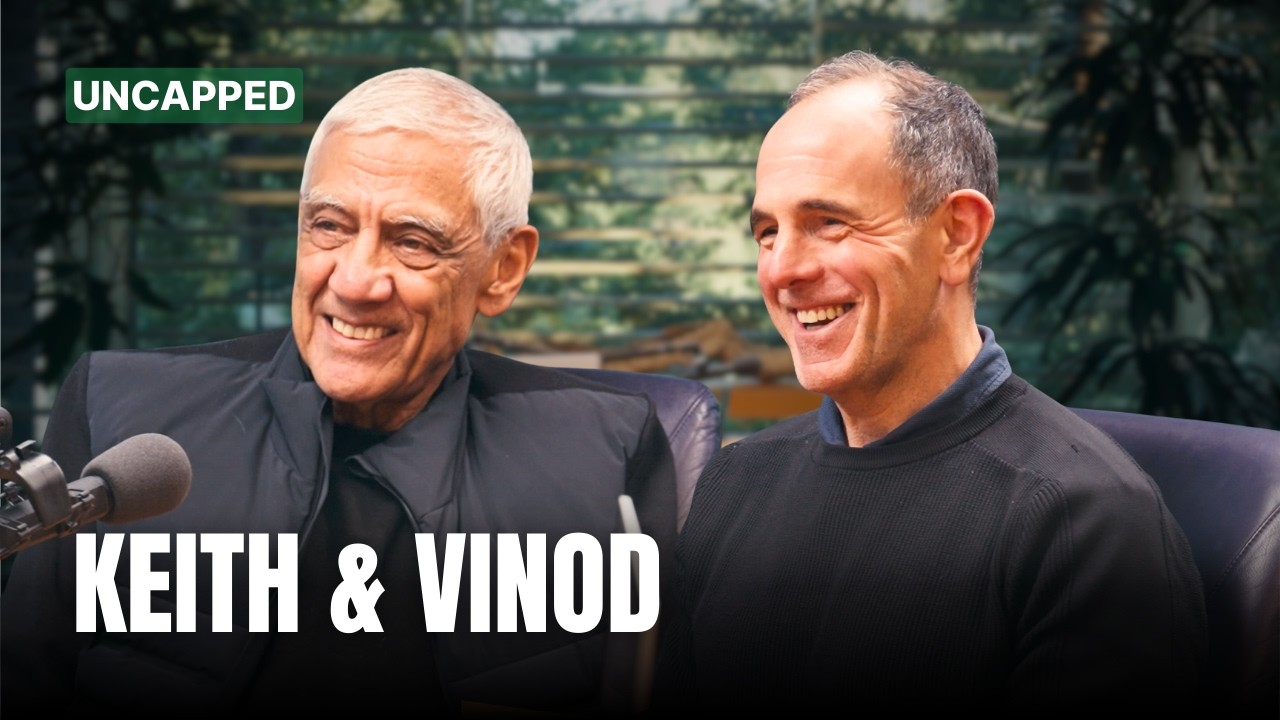
Vinod Khosla proposes three AI services for India's 1.5 billion people: personal tutors already used by millions of students, 24/7 AI doctors providing primary care and mental health at near-zero cost, and PhD-level agronomists for farmers. All three would integrate into Aadhaar/UPI infrastructure through a nonprofit model.
Chapters
Good afternoon. I am going to talk to you about some applications of AI that should be done immediately. I'm not going to talk about business or technology or where it's going. I'm going to talk to you about what can be done today. If I can, if I can get my slides on the screen. Oh, okay. So I'm going to talk to you about what can be done today in the next year or two to reach 1.5 billion people in this country with really impactful immediate benefits. And unless AI benefits the bottom half of the Indian population, we're not going to see a huge amount of impact. So the first thing I'm going to talk to you that's possible today, and in fact millions of kids in India are using today, is AI-based personal tutors. And I'm going to talk to you about 24/7 almost free doctors available to everybody through AI. This is not helping a doctor. This is building a doctor. And of course, every farmer should have AI-level PhD agronomist available to them in their local small plot. This is all possible. They don't even need to know how to read and write, just speak and look and take pictures. So let me start with AI tutors. There's a lot of children in India who don't get much help in their education. In fact, in rural India, teachers don't often show up. So it's very important that this kind of a service be available so every child has their destiny in their own hands. Thank you. The screen wasn't showing my slides. My wife has been running a nonprofit, ck12.org, that offers it now. These are worldwide usage. About 400 million students have already used this service. Of AI content, which is all free, and AI tutors. In India, 4 million students have benefited by using the AI tutor. More than 12 million have used it constantly. So it is already in widespread use. This already CBSE compatible, the National Education Policy compatible. The curriculum's available in English or Hindi or Odisha or Meghalaya in these state standards. Plenty of studies to show that they can be very efficacious. Does a student learn better with AI than without? In fact, I would venture to guess a student learns better with AI than if they had a personal tutor. Rich people can afford personal tutors. They won't do as well as people who have access to this AI. It's a holistic kind of approach. I won't go into much. It's a pretty complex system that— and, and I won't go into the complexity of the system, but this is not just a chatbot. This is not just a key sort of use AI simply. This has been built based on, and we've been working with Sarvam here in India to propose Diksha, which is a large collection of content in India, which is mostly unusable, to be honest, and build a 3.0 version of Diksha, which is an AI-first experience. This is built on billions of student questions that have already been asked on the CK-12 website. Billions. That is used to train the model to know how to teach a student. So it also has a pre-teacher professional development curriculum. So teachers can keep up with it and keep up with most modern education, again compatible with the national education standards in India and the CBSE curriculum. Uh, before I go talk about AI doctors, I'm going to make a couple of comments. Uh, the AI tutors I'm talking about are far superior to human tutors. Here's what they can do. They can quickly assess a student where they are in minutes, 10 minutes or 15 minutes, and then teach and tutor to the gaps in what the student doesn't know through a complex process called tracing, knowledge tracing, or keeping their, uh, tracing what they don't know. Moving on to AI doctors, which are also entirely possible today. In fact, these will make available 24/7 to every Indian for almost trivial or no cost. Full primary care expertise, full disease management— chronic disease in India has been going up very, very dramatically. Free mental health therapy, free physical therapy, and health and nutrition coaching. A level of comprehensiveness in, in AI to help that isn't available with— to the people who have the highest, most best-paid doctors in the world. None of this is available at this level even in, in in the US or most Western countries. More than that is possible here for almost no cost. So, and of course, these AIs will be smart enough to know when to triage up to a human to do whatever functions only humans can do. But let me not delude you. There's very little a human can, doctor can do that this AI can't do today, other than the physical parts. If they have to feel your stomach, of course an AI can't do that yet. I also fundamentally believe these services, AI-based doctors and AI-based personal tutors, should be part of the Aadhaar system. Aadhaar allowed us to offer UPI, There's no reason we can't offer on the same identity-based system where the hard work has already been done within a year or two to every Indian, this, these services. So what I'm specifically proposing, to build a Section 8 nonprofit company to build, operate, and transfer into the Aadhaar ecosystem such such systems. I think they're relatively simple to do. They need many cycles of iteration to adapt specifically to Indian conditions, all the Indic languages, all the difference in diseases in each part of India. So, I'm very, very excited about this. And what you can do for not only education, healthcare, the third element I want to talk about is agronomy. Having every farmer have a PhD-level agronomist available locally 24/7 alongside a UPI-like service as part of the Aadhaar system. A tutor that can gauge students It can find and teach the gaps in students and make the current diksha system much more useful, much more friendly, and leverage all the great content that is in the diksha system in India today, but is not really usable because there's no way to organize it and have an AI tell you what part of this vast library is relevant to you. On the day you're trying to do your homework or prepare for a test. You can multiply India's doctors' resources. So many years ago, I looked at the question of what— how you could scale the doctor-patient ratio in India to the same level that is in the West, like in the United States. And it wasn't possible, even if you had a trillion dollars and decades to do this. That's how far behind we are. But this will get us, get us in India an opportunity to get well far ahead of the level of care available in a country like the United States, at least at the doctor level. There's still surgeries, there's still drugs. Those are separate matter, all areas in which AI can help.. But that's sort of my hope. So, you talk— AI talks directly to patients. It diagnoses, prescribes tests, prescriptions. We are using technology from a company that's been developed over the last 5 years and with Sarvam's help and adaptation to Indian languages using the Sarvam model.. And you start with physician approval of the dialogue. So, you oversee the AI with the doctor initially for the first couple of years. So, think of AI as an intern, fresh graduate, an MBBS graduate who works for the doctor. They let them do a lot of things, but then they oversee them and watch that. And that's the model I propose is possible in the next year or two. And within 2 or 3 years, I think that need for supervision will go away. And of course, there's emergencies and times you have to send somebody to the emergency room or the hospital. So AI can do that. The same is possible with agronomy. This is the third service. I won't go through the details of this. I will try and finish up here. But I want to finish by saying the future is here today. These massive impact services that couldn't be done with hundreds of billions of dollars can be done very, very cheaply. Scale medicine, scale teaching, scale education, scale agronomy. And these services impact the bottom half of the population more and they need it more than almost anybody else. That's exciting. If we don't do that, it is a massive opportunity loss for us. Thank you. If you like the video, do like, comment, share, and subscribe.