Let's Share the Journey with Holly Hotchner and Virginia Littlejohn
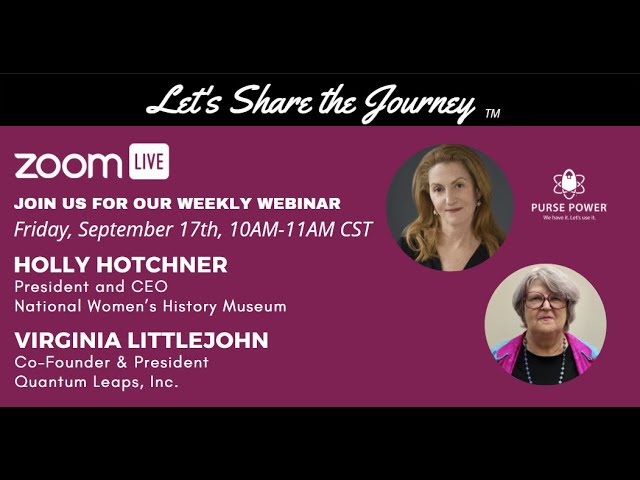
Holly Hotchner, president of the National Women's History Museum, and Virginia Littlejohn, co-founder of Quantum Leaps Inc., discuss women's history and entrepreneurship. Littlejohn authored the 1988 Women's Business Ownership Act and founded the Global Banking Alliance for Women. The pandemic forced women out of the workforce and boosted the museum's virtual programming by 300 percent.
Chapters
Good morning, everyone. Glad you're here today. Thank you so much for being here. My guests are Holly Hotchner. She is the president and CEO of the National Women's History Museum. And Virginia Littlejohn is the co-founder and president of Quantum Leaps Incorporated. Please share your information via chat, and my apologies for the bobble at the beginning here. Please share who you are and what you do. And we're in webinar format today so that we can go ahead and tape the program and share it with others. We've had up to about 1,200 people watch the video after the fact. We'll be providing a chance for you guys to get to know each other on October 1st. We do a networking meeting once a month. And please have friends join you. The bigger it gets, the more beneficial it is for everyone. So quickly, Purse Power is working to help women use their massive purchasing power to drive positive change. We believe that if women who make 80% of all purchasing decisions would choose to buy from the companies that actively promote women, and we would do that en masse, and we could create a funding stream for battered women's shelters in the process, that we could shatter glass ceilings and change lives. So that's what we're trying to do with Purse Power. The purpose of the calls is we want to connect you guys with each other, connect you with national leaders. You're going to hear from some terrific leaders today and hopefully just help us all get through this pandemic. I want to shout out to any of my investors that are on the line. Thank you so much for being here and let's go ahead and get started. So I'll introduce Holly and Virginia. Again, please comment via chat and then we'll do the questions a little later on in the broadcast. And I know you're going to have a lot of them. They've got a lot of interesting things to talk about. So Holly is the president of the National Women's History Museum, and she has extensive experience in creating institutional advancement and new and interesting experiences for museum visitors. She was the first museum director at the New York Historical Society, one of the country's oldest museums, and she's involved with the Luce Study Center for the Study of American Material Culture and has helped the New York Historical Society take its place as a world-class museum of history and culture. And of course, she does run the museum now for women. She also has worked with nonprofits as a consultant on strategic growth and held positions with the Princess Grace Foundation, Metropolitan Museum of Art, and the Tate Gallery and Modern Museum of Art. Virginia and I met several years ago. She is a history maker herself. We met in a cafe where she said a bunch of women's movements had started, and this was years ago. She's a co-founder and president of Quantum Leaps Incorporated, and she was just named to Forbes 50 Over 50 for investment. She's a U.S. delegate to the Women's 20 of the G20 countries and the co-coordinator of the Women's Entrepreneurship and Finance Working Group and the co-head of the U.S. delegation. She's a co-founder of Future Forward to drive women's innovation and the global editor-in-chief of Ignite, which is creating an innovation ecosystem that works for women. She's also a global strategic advisor, catalyst for women entrepreneurs in India. So welcome, you guys. Thank you so much for being here. What an amazing panel I've got.
Thank you for having us. All right.
So to begin, what I'd like you to do is introduce yourselves. We want to get to know you. So, so tell us a little bit about your background, and how you arrived at this point in your life and career. So So I'm going to start with Virginia, if you don't mind. Virginia, would you give us a little bit about your background?
I will be happy to. First of all, I had a pretty amazing mother. She started off as what she considered less than a full human being, more of a socialite in New Orleans and the life of every party. But by the time that my father was transferred to occupied Germany after the Second World War, Mom got involved with some really important historical initiatives as the wife of an Army colonel. She got very involved with the Marshall Plan, with an initiative for German children, the denazification of German youth, and she particularly worked with girls On denazification through teaching them about various things that American kids did. So they did everything from a girls club for 221 girls to learning English, discussion group, playing sports, etc. And this was during a time where There was very little food in Germany, and people didn't really socialize very much between Americans and Germans. In terms of my own background, I had been a political science major. I then— my first job out of college, I was the Mademoiselle guest editor. Then I became the college competitions editor. Mademoiselle, then managing editor and editor-in-chief of Louisiana Magazine. Then I was a college dean, and then I moved into entrepreneurship and entrepreneurial advocacy, which I started doing in the U.S. and then internationally. That's it in a nutshell.
Wow. Okay, thank you so much. I appreciate it. Okay, Holly, your turn.
Well, I too had a very inspiring and pioneering mother who I could go on about, but just, I think many of us did who were encouraged to aspire to anything that we thought we could set our minds to. So my background is completely coming from the arts, art history. I was a practicing artist for a while. and then needed to actually work. So I worked at the Museum of Modern Art in New York.
Very—
it was an honor in a way, but on the other hand, we were considered lucky to be working in a world-class institution. And I began at a whopping salary of $6,500 a year. A year. And of course, the male counterparts who mostly ran departments and the women did the work, which is quite typical of many organizations, you know, were highly compensated. So that's just a little sidebar. I then decided to kind of save the world and save the collection of the New York Historical Society. That's a whole other chapter, but I will say when I was made director, I was pressured to take a much lower salary. I'm just tying this to what we're going to be talking about later, than all of my male counterparts and just held out and would not take the position. I mean, the board was in one room, I was in another room, and I absolutely wouldn't accept that. And the other thing that was kind of humorous, I was the first woman to be in a senior position at that time, was I was told I had much bigger hair then, that if I was going to take that role, I needed to wear a bun. Which I thought was another great example, which I also said absolutely not.
So sorry.
But anyway, lots of funny anecdotes along the way. Subsequently, I built the museum— really was the founding director of the Museum of Arts and Design in New York, which is an extraordinary institution on Columbus Circle. And doing anything in New York is quite a feat, especially creating a new institution. But I will say there that my greatest— one of my greatest accomplishments was to beat out Don Donald Trump, who wanted the site as well. And it was a big— and his quote in the New York Times was, what a terrible waste to give that site to a museum. So it's one of my fun anecdotes along the way. But anyway, how did I come to be here? Just because my whole life has been shaped around experiences of leadership as a woman. And I just couldn't believe there was no women's history museum in this country. It just seemed Inconceivable to me. And I am not a woman's historian by training, but I am very passionately interested in the subject matter. So anyway, that's a brief background. Very good.
I want you to go ahead and take it. Let's continue that conversation. So about the National Women's History Museum, what difference are you trying to make for women? What's the impact of what you're doing?
The idea really is to— is about public history, creating community, a place where people can come together and exchange ideas and not think of it as a static, here's what history is, but really talk about contemporary history. Who are the people making change? How can we become involved? And we really believe that visceral examples of women who are doing things for women, boys, and this is very much about men as well, to see what women have achieved, to open people's minds to that, both in the past, present, future, I like to think, maybe we'll change things dramatically. But to have tangible examples to motivate and inspire women and girls and boys. So our hope really is to inspire the next generation that women can do anything they set their minds to. And perhaps even influence the relationship of women and men when that thinking infiltrates. So it's a big, a very big aspiration. We want to work nationally with many areas of the United States. We're starting national. I hope one day to be global. It's my personal aspiration. But to go to communities to uncover their local history. People are really, have sense of local pride. Who are the women right there who were really important and did major interesting things in their community? So that is part of our idea, to go out and give people the tools to uncover their own women in their backyards. So very nice, very brief idea, but we'd love everyone to get involved with us.
Perfect. And I know we're going to talk about that current history a little later as a question.
That's a Excellent.
Wonderful.
And I just want to add one thing. We do have an enormous membership for a museum standard. We have about 55,000 members, which is really considered extraordinary. And why? Because all— so many women, and very few in D.C., this is very national and international, want to have a place that records and celebrates women. So it's a very strong indicator of the interest.
Congratulations. That's amazing. And we want to help you grow that list. Okay. All right. So, Jenny— Virginia, pardon me. In our society, in so many ways, it feels kind of like we've gone back in time a bit. I'm feeling like we're sort of in the world that I grew up in. And you've been a history maker, particularly for entrepreneurial women. What do you think we need to do to really change things for women and girls in the future?
Well, I'll do a quick walkthrough of some of the things that I've worked on that have related to women entrepreneurial history. In 1984, I was president of the National Association of Women Business Owners, and then some years later, I was vice president of an organization called Les Femmes Chefs d'Entreprise Mondiale. The World Association of Women Entrepreneurs, which was started in France right after the Second World War. But we became extremely aware of all of the impediments that we had in the United States. And in 1988, we organized congressional hearings with the House Small Business Committee. This was through NABO. And out of that, we worked on developing legislative language that we thought would make an enormous difference. So basically, we wrote the Women's Business Ownership Act of 1988 based on the learnings from the congressional hearings. So that act, which was signed by President Reagan in October of that year, required that the government count all women-owned businesses because before they had not counted corporations. And so they thought we all made macramé and candles in our basements and no one earned more than $10,000 a year. We created what we call demonstration projects to create 5 women's business centers in the United States. There are now more than 100. One of the biggest components was at that point many states required that there be a male signatory on a business loan. And one of our witnesses who was carefully selected to be a witness reported that since she did not have a husband or a father who could co-sign the loan, her 18-year-old son had to co-sign the loan.
Holy moly.
That was like the electric buzz of the entire hearings. And she later sold her business, if I'm recalling correctly, for $22 million. African American woman, when she was a witness, her name was Lillian Lincoln. I believe Lambert is now added to the surname. But it's one of the big stories in history, Holly, on the financial side. So that was one of the biggies. Also extremely important, we created the National Women's Business Council to provide policy recommendations to the Congress, to the administrator of the Small Business Administration, and to the President of the United States. So I was one of the first members of the National Women's Business Council. We've continued it every year since then. It's been enormously important. I also created the Global Banking Alliance for Women, which is now called the Financial Alliance for Women, and they are in 140 countries now doing wonderful work getting women access to bank loans and so forth. And then I co-incubated WeConnect International to facilitate corporate procurement internationally. They're now working in 100 countries under the magnificent Elizabeth Vasquez as CEO, who used to work with Quantum Leaps for many years. I'm talking more about some of the specific issues that I think need to happen at the national levels of different countries a little later on, so I won't go into that right now, Donna, if that's okay with you.
Of course, of course. The one thing I was thinking as you were talking is you have made history, you have made change, and the initiatives you've driven have been successful. It'd be interesting to know how we can capitalize on that going forward, and maybe you can talk about that later or now, either one.
Well, I'll talk about it some now. One of the most exciting things— well, I've worked on many exciting things. In fact, I mostly only like to work on exciting things, but things that really create systemic change. But, uh, the Women's Business Ownership Act was one of those things. I also had the opportunity to work for a number of years with the OECD in Paris. Uh, that is the developed democracies. And I organized with them 3 global best practice conferences on women's entrepreneurship. The very first one in the world was in 1997. The second one was 2000 when we launched the Global Banking Alliance for Women, which is in now 140 countries under its new name. And then now the Women's 20 is what I put a great deal of my time into right now. So we're working on sharing a number of best practices across countries. We're going to be working with the International Trade Center, which I've also done a lot of work with. We'll be working on driving public procurement for women at the global level. We're looking at e-commerce, which is a huge growth field, especially through the— during the pandemic, you know, so much was just radically transformed. We're looking at digital transformation. We're looking at how We really, in a systemic and scalable way, are able to move more women into angel investment and venture capital investment opportunities, both with people working within those industries and with providing money to women-owned businesses or women-founded businesses. We are looking at how we get male champions of change who are really interested in this. That's often men who have only daughters. We discovered that in the United States back in the '80s, and 2 very prominent male business leaders we turned into our champions. One had 4 daughters, only daughters, and one had 5 daughters, only daughters. And they really helped us get the banking community interested in what we were doing. So those are the kinds of things we're working on in the W20 related to women's entrepreneurship. sharing best practices around the world, creating peer learning networks on particular issues. And one of our big issues this year will, we hope, be women's public procurement at the global level. Women receive less than 1% of government procurement at the global level.
Oh my gosh. Oh my gosh. So part of it is finding allies. It's also about connection and sharing best practices. Are those kind of the kernels of what's enabled you to be so successful?
And partnerships. Partnerships make all the difference in the world. And having people with global platforms who can talk about these issues, who can charismatize other people on them. I don't know if that's a word.
I love that word.
Anyhow, finding those partners and simpatico organizations and people who are doing cutting-edge research on things that we can use to help make the case, being able to tell stories instead of just statistics. But you've got to have the statistics to buttress your stories.
The data too. Sure, sure, absolutely. All right, great. Thank you, Holly. Um, what do you think the biggest impacts to women have been of the pandemic? Um, and I also know that you're capturing women's history as it's happening. Can you talk about that?
Sure. You know, the statistics of the effects of the pandemic are just being evaluated. It's all very new. And clearly, we all know that many more women than men left the workforce. There are statistics about that. Many more women had to shoulder the responsibility of education for their kids, a huge percentage more than men. A tremendous amount of women stepped— were not eligible for promotions after this period due to the fact that they had to spend more time taking care of the economics and health and safety of their families. It was much more devastating in many, many ways to women than men. We know about that through the studies and statistics that are being compiled right now, including that unemployment is up much more for women at this point than for men as a result of the pandemic. We decided an interesting way to look at this unparalleled part of our history, this COVID epidemic and its effect on women, would be to announce a public call for journals that women were keeping during this period, or anyone identifying as a woman. And we've had an enormous reaction to that, and we now are committed to having all of these journals up on a microsite, which is about to launch through a grant. And I will say the variety of experiences, many of them very poignant, very painful, many of them from first responders, many from people in different situations. But it gives a vast idea of the personal experiences during the pandemic. And it's something that I think we as a museum can do. We're going to archive these works. We're going to have them accessible to the public. And then we'll do some interesting interpretation when we have a little distance, I think. But hopefully that will have a really first-person kind of impact. And as I say, very personal impact for people to experience what people experienced during the pandemic. And these, by the way, are global. This was open to women around the world. They are still being submitted. still a program that's up and running. That is one example. We also pivoted. We're a virtual museum right now, so we are very good at supplying education information and everything virtually. Most places had to pivot and learn how to do that, but we increased our programming by about 300% in response to primarily to mothers and elderly being at home, being secluded and wanting programming to help either with education of kids or with just community interactivity. And we, of course, used the topic of women to do that, but there was tremendous response and wonderful youth book club that happened during that time and other tangible programs. that we will keep going in response to public need. So I think— and teachers, of course, had an astronomically difficult time figuring out what to do with their classes. And we did a lot of lesson plans and classwork with teachers. So I think, you know, it was interesting to be— when you Google women's history, we're one of the first organizations that come up. So there was tremendous outreach for us to help, and we tried in every way. And I want to echo what Virginia said. Partnerships are everything. So we are not an academic institution. We don't, you know, aspire to be that, but we have an incredible scholarly advisory group of people in every field of women's studies. And we really rely on them to help with specific deep historic requests. And so we have many, many other partners, including a lot of the National Association of Businesswomen and so forth that we work with. So it allows us to direct people in areas that that they can get information they're looking for. So all of those things were enormously— and it's ongoing. Obviously, we're not through this tunnel, and many, many more programs will result from this. I think, you know, people ask— this is a little bit of a pivot— of why more progress hasn't been made. And Virginia, you've done so much entrepreneurial entrepreneurially with so many efforts to— but, you know, we still see that. I don't know, Melinda Gates has been doing a lot of studies, but, you know, it will take until 2058 to get any kind of pay equity in this country. And I am focusing on America because, you know, one thinks that we should be farther along than we are because we're such a developed country. And while women represent an overwhelming majority of essential workers in this country, they get paid a very small portion of what their male counterparts are. You know, you look at the Forbes 500 and Fortune 500 lists of women running, women CEOs in this country, and it's made tiny, tiny progress over the years. I think we're at an all-time high of 23 women or something. And it, you know, it just requires enormous persistence is what I want to say, because it's taken us 25 years to get to the point where we are now. And I can tell you it's because we're a women's organization. If we were any other kind of organization, we would be farther along. It is, it's a, it's a, I don't want to go into the politics of this country at the moment, but, you know, there's the perception that we are activists and, you know, all of those things. And of course we are in certain ways, but we are here to tell the story of everybody. And so it's, it's a long haul.
Yeah, absolutely. Absolutely. I wanted to tell you, when the pandemic first hit, I literally went to the journals from 1918 and I looked at that. I was going, okay, what's coming? What are people thinking? What's going to happen? So I think this is going to be useful in the future. Somebody will be using this 100 years from now. Yeah.
And some of them are drawings and photographs, and most of them are written, but there are other art forms too.
Okay. All right. So the next question I want to ask both of you is—
Wait, could I interject, Donna?
Yeah.
I wanted to say, in terms of the impact on women-owned businesses around the world, A number of countries have lost a percentage or a significant percentage of their women-owned businesses.
Mm-hmm.
And some countries have had better systems for providing funding, whether it's grant funding or whatever. But building back, we're looking at within the Women's 20, not just building back better, which is, you know, one of the terms of art, but building forward better. And one of the things we're very interested in is the opportunities that come out of awful crises. So the ability to see around corners, to anticipate what is going to be happening, where the new opportunities are, that is another piece of what we'll be focusing on within the Women's 20 as we work on The peer learning side of things, the sharing of best practices, etc. And there's a wonderful book by a Columbia professor, Dr. Rita McGrath, called Seeing Around Corners, which I highly recommend.
Ah, very good, very good. Yeah, we were talking about Lou Kerr this morning. That's her, her skill. Okay, absolutely. Thank you. Thank you. I want to talk about those transformational women, women And who are the transformational women that you see, and what are they doing that you think will have an influence in the future?
Let's start with Tonalee.
Yeah, okay, sounds good.
Uh, well, I'll just pull out a few. I mean, one could go crazy with this question, but, um, I'm— because we are a historic museum, I'll, I'll start with someone who was very important historically. who many people have very little knowledge of. We create 5 original biographies every month, and it's probably one of our great— most demanded resources of the institution. And we just recently did a biography of Annie Jump Cannon, who died in 1941, born in 1863. And she was a brilliant astronomer. and she actually revolutionized the way scientists classified stars. She was the first woman to receive a doctorate in astronomy, and one of the things that's very— she classified over 350,000 stars in her lifetime, but one of the things that was extremely interesting about her is that she was part of a group of women, uncredited women, who were called computers, and they earned 50 cents an hour. I just like to tie to all contemporary issues too. Um, and she persevered because of her mother, who really had encouraged her, like all— many of us, to pursue this field of science and physics and so on, that at the time really was very unusual for a woman. Um, of course, she was also fought for for women and suffrage and did many, many other things during her lifetime. But she was voted one of the 12 greatest living women in America by the League of Women Voters. And I would bet if you asked people about her name, they— I frankly, sadly, had never heard of her. So, you know, it's the kind of thing that we can do to shine a light on women in all kinds of professions and walks of life. Then just very quickly, recently, Dr. Kizzmekia Corbett, who is a scientist at— with the NIH, who really led the whole coronavirus vaccine effort, she's in immunology, and her group designed the first vaccine for COVID with Moderna as the industry. And so she and her colleagues will probably historically be credited with that. They live in Virginia. You know, these are the kind of people that can slide beneath the boards if we aren't there to really make sure that people understand what women have risen to the occasion to do. And then just very quickly, someone like Rosie Rios, who— it's Hispanic Heritage month, so I wanted to call out a Latina. But she was our— the 43rd Treasurer of the United States and, of course, the first Latina woman and so forth. She was the first Latina to graduate from a PhD in business school at Harvard. The first. And she is the first woman to have a portrait painted in the 380 years of Harvard which I always thought was kind of interesting. But more importantly, she's now advocating to have women and girls on currency. She is the one who has led all of that. And even more importantly, she is a great— put a huge amount of time for women to go into STEM, women and girls, and has spent a good portion of her time working on that. She's an extraordinary woman, and we were lucky to have her on our board for a while. But so I just wanted to give a variety of people, but again, you could write an encyclopedia on Absolutely.
Absolutely. How about Virginia? What do you think?
Well, I'm going to focus more on international people. So, and policymakers and people focused on capital. So Christine Lagarde, who had been the managing director for the International Monetary Fund, she's now president of the European Central Bank. She's almost always the only woman in the room when she is in these environments. And she is a breathtaking advocate on behalf of entrepreneurship and finance for women, equal pay, etc. And I was on a small call with her, with the Women's 20, which I'm not able to go into the details of, but I was just practically yelling hooray every third sentence. she delivered in terms of the things she was recommending. And she recommends those things regularly to many guys who can help us implement them. Angela Merkel, of course, the Chancellor of Germany, she will be going out of office very shortly. But with the Women's 20 and the G20, the Group of 20 countries that Women's 20 is Part of, uh, during Germany's presidency— every year there's a different country in the G20 that has the presidency— we had more issues adopted at the Global Leaders Summit of the G20 by far under Merkel's leadership of the G20 that year. I mean, by a factor of well more than 10. So it can really make a difference having women leaders at the highest level of the government. The next person I'm going to mention, Michelle Bachelet, was president of Chile. She also was head of UN Women, and now she is the UN High Commissioner of Human Rights. But she, like Lagarde and Merkel, pushes for things all the time for us. She's enormously well regarded. And I will add 2 youthful voices who are not policymakers per se, but advocates. Malala on education.
Oh yeah.
And Greta Thunberg on climate change issues. Other areas to call out, important things happening with STEM and STEAM, with angel investment and venture capital. There's some amazing women in that space. And organizationally, Queen Máxima of the Netherlands is absolutely gung-ho on the financial piece. She is also the UN Secretary-General's Special Advocate for Inclusive Finance for Development. Every opportunity she gets when she's speaking to heads of state or heads of major organizations. She's talking about women and access to finance and just absolutely phenomenal people working on our behalf.
Outstanding. Outstanding. Holly, I want you to talk about the History Museum and your mission and how we can help you in just a second. Why don't I go ahead and continue your thought, Virginia, if I could? So you, as a representative on the Women's G20, what are the trends you're seeing on the horizon that you think are going to have the biggest implications for women? And how do we take advantage of them?
Okay. There's a huge focus on women's economic empowerment post the pandemic. And that was what my session with Lagarde and Bachelet earlier this week was about. And everybody feels like if not now, When the hell are we going to really move forward on it?
Absolutely.
So that is huge. Climate change, which is going to impact so much more than we think right now. It's not just flooding of the coast and a few islands that are going to go underwater. As the glaciers melt, there are really serious threats to places like New York, Miami, etc. Another area that's really important is the impact on the environment writ large. So it's the impact on the insect population, the bee population, the ramifications in terms of the food supply chain. There's so many things we need to be looking at strategically, not in how we do right now, You know, we waste so much food, not just in the United States, but so much food spoils and goes into the trash can, perhaps a third in some countries, 40% in other countries. So looking at alternative ways of dealing with food, including horizontal— sorry, including vertical food production that can be done in urban areas, issues around supply chain, You know, we've already had enormous impact on supply chain chips, for example. That's why cars are so expensive, and especially used cars. You know, they've gone up 26%, 27% because they don't have the chips to go into the high-end cars and trucks. But so much of the supply chain has been devastated, and that's going to continue happening in the food area. Huge growth in green jobs that is going to have a global impact. So that's one of the seeing around corners areas that we're looking at. Equal access to education, finance, and power. So Greta is dealing with pieces of the environmental issue. Malala is pushing like mad on The education side of things. I mentioned a series of people looking at empowerment, equal pay, and finance, especially finance for women-owned businesses. Gender medicine is another really important issue. It's a sleeper issue. Almost nobody knows about it. But norming of medicine has historically been done in many countries, including the U.S., with research on male humans, and almost all of the research has been done with male mice. So if you're talking about uniquely female organs of the body, systems and processes, weight, with, you know, the shots that are normed, medical devices, all sorts of things, they've been normed with only part of the population. Enormously important. And then the issue of getting more women involved with STEM and STEAM. STEAM is A standing for the arts and the humanities. Women are, I would say, somewhat more right-brained. Women have a very large corpus callosum, a larger corpus callosum in their brain, which connects the left and the right sides of the brain than is true of men. And so many women, if the arts and humanities and education and things like that are part of STEM à la STEAM, they're much more comfortable in that particular environment. So we're pushing STEAM very much within the W20 and getting more women involved with algorithms, because algorithms are so critical in terms of decisions that are made on many different things. And if we don't have women as part of that, we're going to end up getting really damaged by a lot of things that happen in technology that don't consider women and girls. If you've been reading the Wall Street Journal the last 2 days, with the higher suicide rates and horrible body image issues and so forth that 1/3 of the girls on Instagram are dealing with. Wow.
Wow.
Very impactful stuff. Really important. Okay, guys, be thinking of your questions. Please go ahead and put them in the Q&A block. So let me go ahead and take this back to you, Holly. Around the museum, what can we do to best support support you with your mission?
Well, our interest is in most of what Virginia was talking about. We get asked a lot, and I don't want to open a whole discussion about this, of why America has not had female leaders. When you were talking about Angela Merkel— excuse me, Merkel— and Christine Lagarde, I mean, it remarkable that, yes, we have a female Vice President, but, you know, New York State just got its female— first female governor by default. We certainly have lagged in that regard, and it is an interesting conversation of the difference between this country and many others. But putting that aside, our interest is really in engaging as many people from as many walks of life to be part of our community. We want to grow the community to represent every issue, every kind of issue for people identifying as women. And, you know, there's a very large conversation going on right now in the LGBTQIA+ community of how we can represent all of the new issues going on in that community, and we're going to engage there as well. But I think, you know, joining as members, helping us on this crusade to get every woman to understand that their personal story is important, the story of their families, the people in their communities, because it's so easy to lose this history. And when we try to uncover now, you know, people who have particularly people of color and other people where there are so few records, it's very, very difficult to understand the past and what we're— the shoulders we're standing on today. And our theme really for the next couple of years is On Whose Shoulders We Stand. So who are the women that, that have created us? And we would like to create and encourage women of the future. So we're a very inclusive kind of organization. We do not feel that we have one story to tell from one source. We are using a great deal of our community to input our content. And we'd like to continue to do that. And it, as the saying goes, it takes a village. This is not a small group of staff and trustees. It really is very much, to begin with, a national movement and should become attached globally. There are only 4 women's history museums globally. I mean, this is—
Oh, wow.
This is a very, very small group. And interestingly, in Scandinavia, which you would imagine, but in Nigeria, which is very interesting, and in Ireland, which one might expect. But so we're trying to create a sisterhood, shall we say, there. But it would be interesting to, you know, have a bigger connection of how you can get started doing that grassroots ways of just you know, exhibiting stuff in a community center, a school, a church. It doesn't have to be a building called a museum. It's really more about the work, and we're very dedicated to the program. So everybody can help contribute to our program, I think.
Very good.
That would be my plea there.
The other thing is, is you had mentioned that you're doing something. There's going to be a Is there a physical facility or you're doing something with the Martin Luther King? Why don't you talk about that?
We've created a really unique partnership for a museum and a library anyway. So we are going to, instead of building a building right now, we have created a partnership with the Martin Luther King Library in Washington, D.C., which is the only Mies van der Rohe or one of the few modern pieces of architecture in D.C. And it's an extraordinary history. It was one of the first, if not the first monument to Martin Luther King. Coretta came and asked that it be named after him. And it's been dedicated to activism since its inception. And so we will create a space within the library, but also all the spaces of the library, which has just undergone a $250 million rethink renovation. as to what a library can be in a community now that checking out books isn't really the main occupation of a library. So there's a children's library, there's a teen floor, there's workshops for how to, how to record your history, how to make a movie, 3D printing, woodworking, dance. I mean, it's a very expansive look at how to interact with the community and We are thrilled to start next year, hopefully during Women's History Month in March, with a really big program both in the 300-seat brand new auditorium but in many, many spaces around the building. And we will continue to have everything available virtually. But this is a first great chance, our opening exhibition will be on African American women and their connections to D.C. because of our partnership. And it's a place to start, and it couldn't be more timely, frankly. And then we will go to other cities in the U.S. to look at their African American women and sort of tie that into one big project. It's, it's a very aspirational project, but we're going to be get there.
Okay, good. Remind us, and we'll try to help get the word out about it.
Yeah, that would be great.
Yeah. All right, Virginia, I'm going to come back to you. Could you please summarize what you think the top 3 things you want people to learn from you are today, and the top 3 actions you want to have people take?
Okay. From a US context, I would say try to get the political system in the United States to work better. I just weep with where we are right now.
Yeah.
I feel like we're on, like, the precursors of the Civil War, or what I would compare it to in my own life would be what happened immediately before my living in Germany during the occupation. Because what happened before that was a cosmic clash between the communists and the fascists. And that's that, you know, absolute hatred. I feel so much hatred in the United States right now. And the work that my mother did on trying to help the Germans and the Americans come more together after the war. I'm actually working on a memoir about that right now. But I just really feel we've got a lot of work to do at home to create a healthy country again. Another thing is to engage with big issues like the future of work, including the appropriate role and compensation for women, which is critically important, uh, the impact of AI, climate change, and how we leave a better legacy for our children. And I've always sensed that within the women's entrepreneurship community, that there's really a strong focus on the world we leave behind for our kids. We're the mothers, not just of girls, but we're the mothers of boys. And we need to step up to what we do to make both of them— help both of them become whole human beings and people who feel that they are stewards of the earth, stewards of the community, stewards of the planet. And we need to have a better legacy for our kids than what we're currently providing.
Mm-hmm.
And the final thing I would say is, to get engaged with policy and advocacy because women can bring so much strength and richness to the world, so much humanity, so much caring. And if you look at the impact of women on the environment, women on food supply, so many different things in developed countries, and developing countries. You know, we are the mothers of the earth, and that's pretty impressive, pretty important. And that's why we need to be heavily represented, not only in your museum, Holly, but in museums of every sort, whether it's art, history, encyclopedias, Wikipedia, STEM, STEAM. Women are it. Thank you.
Yes, and we also need students to point—
I say hear, hear to that. And of course, we aren't the only source, of course. And when you— I didn't have time, but when you look at women in the arts, it's— and, you know, represented in art museums, it's a horrifying fractional number. But that's a whole other conversation.
Well, and the other thing we need to do is support each other. To your point, we are very powerful when we act together. We We need to act together and support one another.
Exactly.
Yeah. Okay, Holly, your turn. Key learnings, key things you want us to do.
Well, I can't reinforce everything Virginia said enough. There's so much to do in terms of— I'll first focus on what we have going on at home in our backyard in terms of the extremely toxic environment and how we can create conversation and community around that. One of our roles is to bring people together, and we've done it pretty successfully over the years to have meaningful conversations about differences. And we've bridged— managed to bridge quite a number of divides in our history. I hope we can have more of a role there, but of course it's a much bigger issue, and we We want to encourage everyone, as Virginia said, women particularly because they are so so much humanitarians and compassionate and various other qualities to come together and try to talk about how to fix a lot of what isn't working in our country, both for women and men. But in terms of the stories, there are so many uplifting stories, and we want to also bring fun and engagement, and particularly after the pandemic, to bring people back together physically when we can. Because I believe very strongly, as do many, that while we can accomplish so much in this Zoom format or these kinds of formats, people still really crave visceral experiences, and that's why I went into museum work. The power of an object to tell a story is enormous, and how you can convey so many ideas through that. And, but anyway, so our— I'm hoping we can bring people together. I'm hoping we can get out the word to create you know, a better world for our kids at the moment. I would say it's a big aspiration for a museum, but since we're telling the story of women's— women, all women, we'd love to be involved in that story.
Absolutely.
Absolutely. You're a great resource for that. Okay. Any final thoughts, Virginia? Anything else you want to say?
What I try to do every day when I wake up, and I'm a morning person, Is how can I make a difference today and what can I do to advance women's entrepreneurship? And those are the 2 things that I focus on every single day.
Wow, you have accomplished a lot. You have accomplished a lot in your life. That really must work.
The other thing I focus on is my 9-year-old granddaughter, and it all ties together with the boat. Yeah, you betcha.
You betcha. Okay, Holly, anything from you? Any final thoughts?
Well, what I wake up at the moment every day thinking is, how can we get this museum up and running to honor the people who founded it? And, you know, we're not going to wait another 25 years. It's been a long journey. And so I am completely dedicated to a start. I think just starting, and I'm known for overcoming obstacles. So I think we need to start. We need to get the oar in the water and see what comes of it and how we can engage other people across our country and eventually the world to do the same.
Yeah, very good.
Starting is important.
It sure is. Thank you so much for being here, you guys. You've been amazing, and I think we've got some great thoughts from you, and absolutely we're behind you all the way. Let's see, I just want to remind everybody of some upcoming meetings. First of all, on September 24th, we're going to have Dr. Terry Neese, and, and I know, Virginia, you know Terry very well. She started the Institute for the Economic Empowerment of Women, and she has been working with the women entrepreneurs in Afghanistan for 15 years. So I, I'm hoping that she can really give us some insight into what's going on over there and how to help them. On October 1st, we're going to have our networking meeting, and again, that's a, that's a live meeting where we put you in small groups and you get a chance to get to know each other. And then I'm very excited that on October 22nd, I'm going to have Gretchen Carlson on the show.
Oh, great.
And Gretchen, of course, is trying to deal with NDAs. She's trying to tackle the fact that NDAs are signed, signed that silence women from talking about sexual harassment. So I think she's going to be a fantastic guest. And that's on October 22nd. We have some services on our site. If you have a business that you're wondering how you look in cyberspace, please go to to pursepower.com, register your business, and we'll give you a free report that tells you how you look in cyberspace. I know it's really hard to get attention these days. We want to help you. We're looking for sponsors for this program if you ever have an interest. And please do go and download our Google Chrome extension. If you put it on your Google Chrome browser, as you shop, you'll be able to see the companies that are in our directory. We want you to buy from women-owned and women-led companies. We want you to buy from those businesses, please. Like and share our social media posts, and please let your friends know about this webcast every Friday at 10 o'clock Central. Okay, any final thoughts, you guys, before we go?
Just, it's been so much fun talking with both of you.
You too, you too.
And we're creating a new little community here, or bigger community.
There we go. All right, you guys, well, have a wonderful weekend, and thank you again for being here. And remember, everybody, Purse power. We have it. Let's use it. Take care. See you next Friday.
Thanks.
Bye.
Bye, guys.
Thank you. Thank you.
Thank you.
Thank you.
More from Virginia

A Conversation With Trailblazing Advocate For Women's Entrepreneurship Virginia Littlejohn
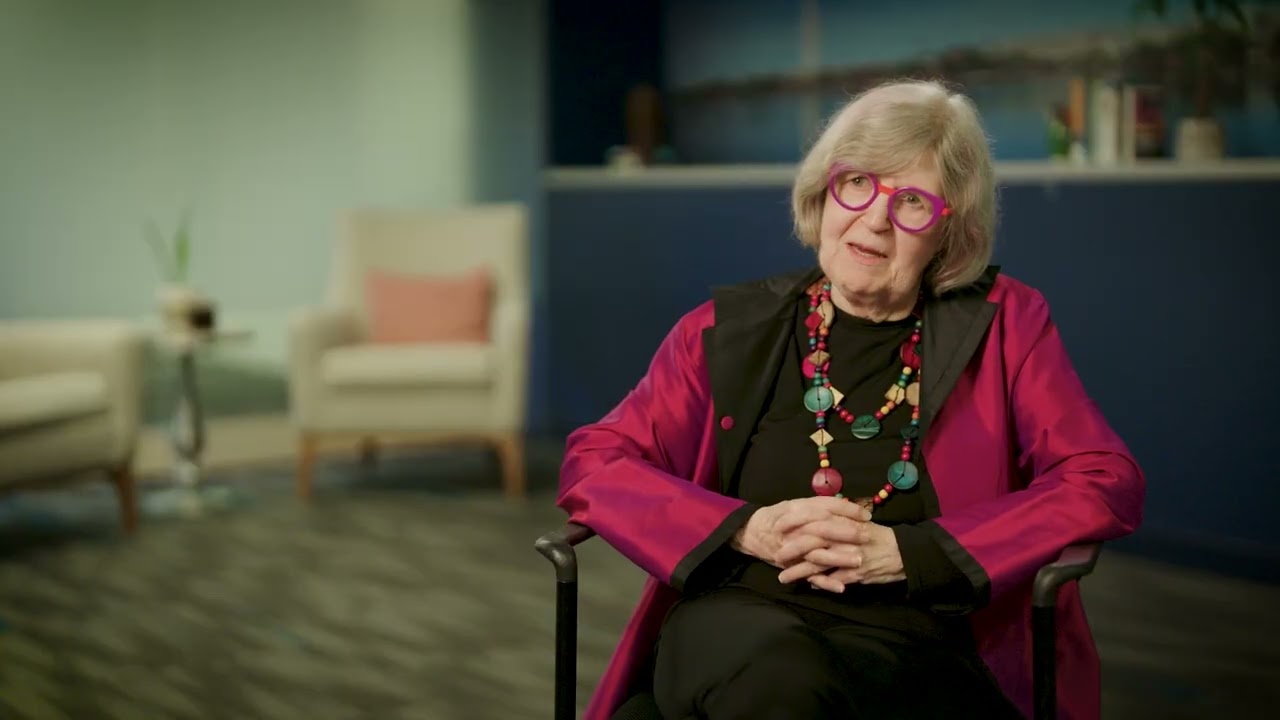
Virginia Littlejohn: Co-Founder and President, Quantum Leaps; Former President, NAWBO
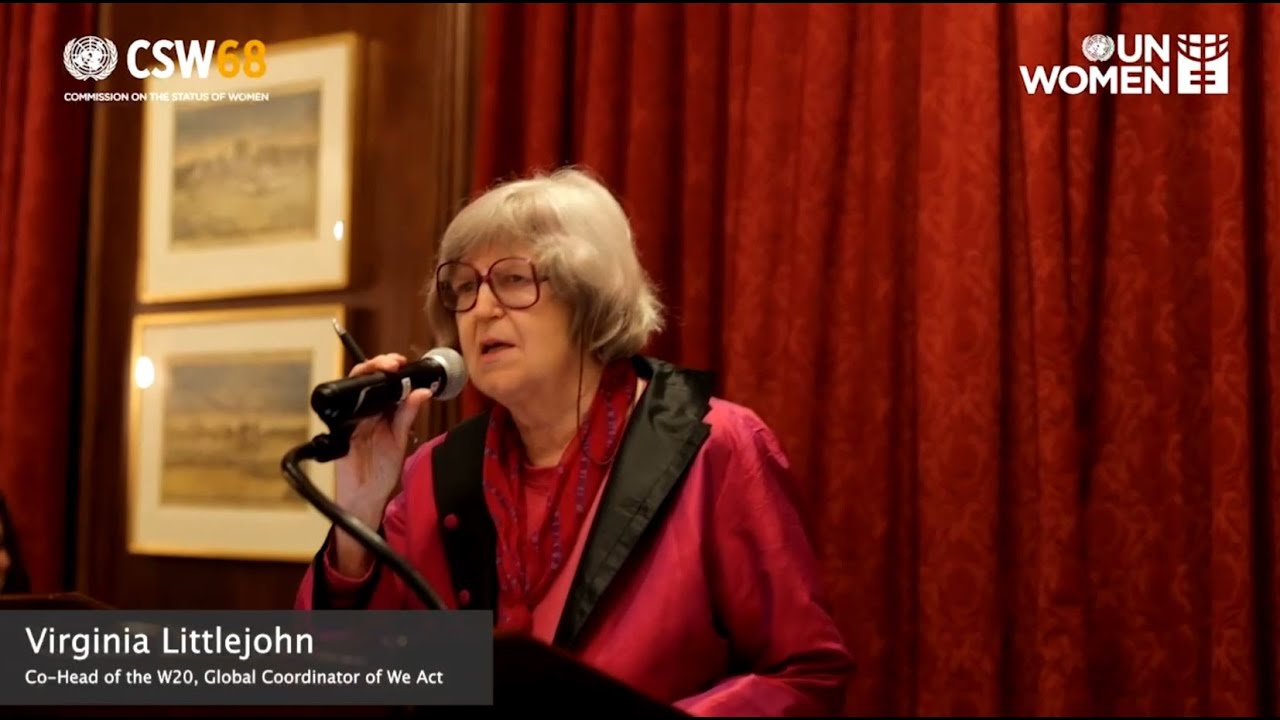
Virginia Littlejohn, Partnering for Impact: Advancing Women Entrepreneurship at CSW68


WOMEN'S ECONOMIC EMPOWERMENT, ACCOUNTABILITY AND NATIONAL OWNERSHIP - Virginia Littlejohn speech.wmv
