A Playbook for Modern Communities | Marta Kondryn | TEDx University of Malaya
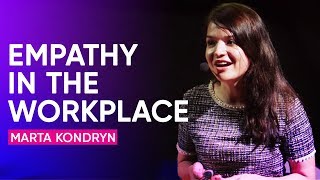
Marta Kondryn argues universities and workplaces need to rebuild as healthy communities. She offers a three-part playbook: establish trust through vulnerability, create shared rituals like Mindvalley's "code of awesomeness", and treat capitalism as teamwork where people support each other in hard times.
Chapters
I think today you will. I hope that you will remember what I'm going to talk about forever. I found an answer on how can we have better universities and workplaces now to do this talk in the walls of an actual university is quite nerve wracking today to say the least. But I promised my mom, who is also a university professor, that she won't be ashamed by her daughter. I come from a very small town in Western Ukraine with the long name Ivana Frankivsk. And to give you an idea on what kind of town it is, it's actually everyone says hi to each other on the street. Even if you don't know the people, they will just say hi to you. In fact, I just returned a few days where I spent and everyone was still saying hi to each other. My neighbors would come and greet me for my birthday. This feeling of a very close knit community was with me throughout my entire life. Times passed and I moved cities and I live right now in Kuala Lumpur. And honestly, to be very honest with you, the feeling of community diminished and became smaller. And it's no wonder because the most recent research on the cities, especially big cities, confirms that the idea of home becomes less permanent and more transient. We no longer think of our homes as self expression. We look for this feeling somewhere else. Maybe it's our university, like we are all here today, or maybe this, our workplaces. They say that in the past the jobs were about the muscles, right now they're about the brains. In the future they will be about the heart. And because this has been said by the director of the London School of Economics, it gives me a lot of hope that we are on the right path to reach that. If you visit any of the bookstore in KL you will see that every second book on relationship is about belonging, loneliness, empathy. The social connection is the number one solve for the trauma, for the pain, for the hurt that we experience. Yet our universities don't talk about love, they don't talk about belonging, they don't talk about empathy. Instead they teach us to be perfect, to reach high scores, to be the best and at the end to end the perfect career. Today I believe we all have the right and the opportunity to change it. And maybe it's going to be that we will have to celebrate on the same level as we are celebrating high performance and achievements and innovation. We should be celebrating love, caring and empathy. The same as we are celebrating the high achievers. We should be celebrating the healthy teams. Business shouldn't be only, shouldn't be a zero sum Game. It should be a community sum game. And I believe, and it's been already my mission for so many years, to make sure that people are the same at their workplaces as they are at their homes. In fact, they would bring their hearts to whenever they are or maybe any other institutions. I became fascinated by the work of this man. Does anyone know who he is? No one knows. And the name of this man is Martin Novak. He is the famous biologist and evolutionist. All his life he dedicated to studying on what is actually causing the evolution. Is the fact that we've been told that only the strongest survive, Is it true? He manages to confirm that not only the strongest are the driving force of the evolution and not mutation as well. In his study he confirms that cooperation is the driving force of the evolution, in his words, as he says, the nicest guy finished first. This also causes me to think about my own story. Because I'm standing here today is actually a hard work, as I think and as I find of a generation of a Ukrainian family who survived many, many hard things. In fact, just two generations ago, there was a World War II in Ukraine and it was the most horrible famine that we could experience. Yet my family managed to survive it and actually appeared to be quite well after that. And when I asked my grandma, what is it that helped them? What is the reason? In her words, she calls it the help and support and the love of her friends, family, neighbors, or in other words, it's corporation. So me being a true HR professional and I like to create different guides. I take her words, I take her advice and turn it into playbook, the one that I want to share with you all today. And the first page of this playbook will be trust. Spending my summer holidays with my grandma in my village, I noticed that people don't close the doors to their houses. And it was a very common thing for me until I realized recently that people have such a big level of trust that they never close their houses. So whenever, if you need any, maybe an instrument that you don't have and you want to borrow it from your neighbor, you can walk in, borrow it and return it. Or maybe you don't have an ingredient to your soup, you can go to your neighbor house, pick it, use it and return it back again. That's how they live. The feeling of trust in that community is so overwhelming that you even stop noticing it. If you arrive at 6am to my hometown, there will be only a few places where you can eat really good food. And one of them is called Urban Space. Well, besides having good food, it's well known to the fact that it was started by 1,000 active citizens who each collected $1,000 and created and built a public restaurant. And now 80% of its profit is goes into community back, be it educational, musical, arts, educational or any other projects that the community thinks the city needs. At this point of time, this idea became very, very popular to the point that it's now being opening in Germany, in US it's also now in the capital. Trust is something that requires a lot of vulnerability from all of us. It requires vulnerability from the organizations. It also requires vulnerability and permission and responsibility from all of us. I would like us to experience today the trust by doing this little experiment. I would like each of you to take a phone out of your pocket. Can I have my phone, please? Take your phone, take out of your pocket, unlock it and pass it to the person on your left. How does it feel? It feels strange, right? Someone is holding the most precious data. All your SMS, all your WhatsApp messages. Messages. Your notes are there, right? It's a very vulnerable moment. Now think about to the person who is holding the phone. You actually feel. Most of you will feel a very high level of responsibility for the things that you are holding in your hand. I believe that the trust became such an important currency nowadays that it drives economy. Think of Airbnb. Think of Airbnb and how they built their business model. Okay, you can now return back. I feel that it's very, very awkward. But you did it. That's great. But think about Airbnb. If you are a host, you are allowing someone to enter your house and you actually showing some of the most vulnerable parts of your house. You show in your bedroom, you show in your bathroom. Think about it. And you're okay with that. And someone is entering your space and living there. This is the level of trust that is actually driving right now our world and our economy. And we all should be celebrating that. This moves me to the second page of the playbook and that is rich culture and traditions. I think I was able to connect to as many countries and nationalities as possible because I can identify myself with my own culture very well. Five years ago, we at Mindvalley where I work, in fact with 55 nationalities at the moment, we created something that we call called the code of awesomeness. In a regular company, it's a code of conduct. Think of it. And usually an HR department would create it, sign it and hide it somewhere so no one sees it. We decided to go completely different path. It not only was co created by the team, entire team contributed to each line here. It also used everywhere. It's public, everyone can question it, everyone can rewrite it. In fact, when the time has come to rewrite it again, we saw people coming to us and crying and saying please don't change it. So I urge you today to ask in your organizations, how do you operate? How do you define your culture? What are the rules that you've created that are so well known and written and passed through the generations? I was lucky to be a part of this organization called ISPEC for many years. And it's such a unique organization in its own way. It already exists for around 80 years. And the interesting thing about them is that every year it changes leadership on every level. International, national, local. Can you imagine any organization that changes their managers every year? I didn't meet any such before I met Isaac. And they do change it. And they are able to do it only because they have a very strong culture and rituals that are passed through generations over and over again. Culture matters because you will come back to it when times are tough and there are good times. And rituals will be something that will make the community to come back to it over and over again. This leads me to the third and final page of the playbook. And that is capitalism is a teamwork. When the Soviet Union collapsed in 1989, my family's finances collapsed with it. I remember the times when there was no electricity because we didn't have money to pay for the electricity. And we would be sitting in the kitchen, four of us, my sister, me and my parents. And the only luxury that we would be sharing would be a piece of dark of chocolate that we would be just didn't want to finish because it was the only thing luxurious thing that we would eat at that day. But there were so many stories, there were so many connections made on those most difficult times. But with the help of my neighbors and friends and family, my family managed again as same as my grandma. They managed to come well off and crushed these hard times. If you were in trouble, would your company come to support you? Think of it. If you were in trouble, do you know that your company would come and support you in those difficult times? And would you do the same? If you were in trouble, would you do the same for your company or for your university? For the employees of the company, LinkedIn Electric, the answer is absolute yes. For already 70 years of its existence, it has never laid off any single employee. Because when times are tough, everyone gets to share the burden, be it a CEO, starting actually in fact from the CEO and ending with someone at the entry level position. We must think of the community as the way to experience the teamwork that we might not experience in our universities or workplaces. Because when times are tough, the only thing that will give us strength back is our community. I urge you today to come back, to go back to your workplaces, to go back to your universities and start emphasizing the trust, start implementing the culture that is rich of traditions and rituals and some things that are only unique to you. And lastly, act as a team. I stand here today as the product of a past generation of Ukrainians who ran things in their lives through love and care and support. I truly feel that I stand on the shoulders of the giants. And because of that mindset, because of this belief that I have in me, I've come to realize that actually helped me to get an amazing education, to travel the world, to be an isec. I work in business right now. All these have shaped me who I am and helped me to become who I am. And so can you. I ask you today to start thinking of your workplaces and universities as healthy communities. And I believe with that, we can change so much. And it's not going to be only for you. It's not going to be for individual, but also for collective. With that, thank you very much.
More from Vishen






Brown Noise for Deep Focus and Concentration (Best with Headphones) | Gabriel Loynaz



Your Appointment With the Eternal | Guided Meditation with Michael Bernard Beckwith