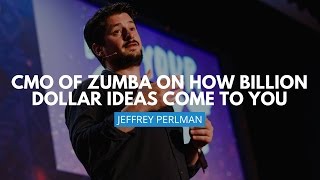
Jeffrey Perlman (CMO of Zumba) describes three stages for turning an idea into an inevitable success: 1) listen and let a truth find you (recognize a small emerging idea and commit to it), 2) have the courage to step into that truth even when partners or feedback resist (example: in 2006 Zumba adopted the slogan “ditch the workout, join the party”), and 3) stay in that space by embodying the vision internally and resisting models or feedback that would dilute it (examples: painting office walls, selectively incorporating fan feedback). He cautions against over-reliance on business models, consumer research, and excessive feedback, arguing the brand must be protected like a child’s authentic identity.
Questions this video answers
2006
Chapters
So there are really three stages to this kind of stepping into inevitability. The first stage is letting it come through you, because I don't believe that you can, or at least it hasn't been my reality, that you can just say, hey, you know, I want a big house in a Ferrari, and I'm gonna manifest that, and it's gonna happen. It's just not that simple to me. You have to latch onto a truth. It's kind of like this background. There's all these little truths floating around in the world. And Zumba was one tiny little speck. And we took it and we said, okay, there's something here, and we're gonna harness it. We're gonna listen to it. It's very much like parenting. It's what your kid wants to be. You're supporting your kid. And we harnessed it and harnessed it and harnessed it until it became what it was. So the first thing is listen and find your truth. And you don't even find your truth. Actually, your truth kind of finds you. It kind of hits you, and then you just have to commit to it and stay with it. The second is phase of it is having the courage to actually step into your truth or step into this field of inevitability. That's not easy. In 2006, we created the slogan for Zumba was ditch the workout, join the party. And our gym partners were going to stop doing business with us if we're going to stick to that slogan. But it was the truth. It was what the brand wanted to be. And we said, you know what? Whatever happens, happens. We have to put the brand first. And today, Zumba's in virtually every gym in the world. Nothing really bad happened, and we stuck. We were true to what the brand wanted to be. So it takes a little bit of courage to actually step into it. And then the hardest thing is, is to stay there and to stay in that space of inevitability where your distorted reality is more real to you than the real world, where it takes a lot of things. One of the things that we did was we painted our walls. That was a very simple thing we went into. It was our. You know, Zumba was real in our office, at least if it wasn't real in the rest of the world. Yet we took feedback every time there was feedback. You know, a person tattooed the logo or whatever. We put it on the wall. We wanted that to continue to build the resonance. Greg Braden talks about a form of prayer that is not a prayer, where you ask for something, it's a prayer where you actually step into it and you feel it and you are it. And that's, I think, the same thing. What else? Models. Business models. Business models are great to get inspiration from them, but they can also box you up if you're trying to do, you know, the same thing that Zumba did, but for, you know, something else, it's not going to work. You have to listen to it, to what it wants to be, not, you know, the stuff that you learn, and then you superimpose it and then it's kind of lopsided and you're trying to fit a square hole in a round peg or whatever, however that goes. So be careful. Be very wary of models. Be very worried of feedback. Again, remember, it's like parenting. You want your kid to be whatever your kid, whatever his truth is, not whatever you want to impose on him or whatever the world wants to impose on him, and you want to protect that space. So models, consumer feedback, research, all that has a place, and be very wary of that.