Egyptian Model & Actress Tara Emad on How to Make the World a Better Place
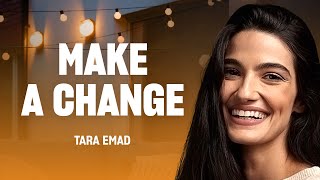
Interview (YouTube) between Vishen Lakhiani and Egyptian model/actress Tara Emad (recorded July 4, 2022). Covers Tara's background and fame in Egypt, daily grounding routines (meditation, Headspace, yoga, faith), views on manifestation (anecdote of collective healing), dealing with fame and privacy, a transformational 1,000+ km cycling trip (Cairo→Aswan) that rebuilt body image/confidence, and her anti-bullying work (podcast 'Bullying Explained' in Arabic and English; graduation project) with plans for curricula and a book.
Chapters
I want something and I want it so bad. I don't think of how am I going to get that.
Hi, everyone, and welcome back to the mindvalley podcast. Today we can have an interesting discussion. And I'm really excited about today's discussion because I just got back from the country of Jordan where Mindvalley held its a fest festival. So a fest is a festival with just incredible people from all around the world. And we chose the Middle east for the. For the first time as our destination for a fest. And so the Middle east has been in my mind, and I've been really impressed with the level of people I've been meeting there. When I was in a fest, I met remarkable people from the Jordanian royal family. I met Princess Rim, who was awarded the Journalist of the year prize in 2011. I met a woman called Mary who runs the Landmark hotel in Jordan and was on the COVID of Entrepreneur magazine. And. And one of the things that all of these people had in common is that they were all powerhouse women making a massive impact in the Middle East. And I'd never really been exposed to this region. And I was intrigued at how different the reality is in terms of the Middle east versus what we perceive of it in the west, which is why I'm so excited about our guest today, Tara Imad. Tara Emad is calling in and she's on the podcast with me right now from Cairo. And before I read out Tara's bio. Tara, give us a quick hello from Cairo and let us know what you're experiencing there in terms of the weather.
Hello. Hi. Hi, everyone. The weather here is pretty hot. The degrees are rising. I think the degrees started to rise about two, three days ago. It was just a heat wave all of a sudden, and I was actually outdoors in the desert with my friends, and you just feel the wave. It was super intense. But honestly, I'm happy the summer is here.
So thank you, Tara. So, as I said, Tara's dialing in and talking to us from Cairo. I'm here in Croatia right now, and everything is good. I'm really excited to be here. I'm looking out at the wide open sea, but I'm also in a heat wave. And the air conditioner in my hotel room is completely busted, which is why if you're watching the video version of it, you will see me dripping with. With sweat right now. Okay, so now away from the heat wave, back to Tara. So Tara is an Egyptian actress with a charming, distinguished Eastern European background as well. She started a career as a model. She became One of the of the most sought after faces in commercials and fashion shows in Egypt and France. She's been in numerous TV and film productions. She recently got named to play Meghan Markle's character in the Arabic remake of Suits, the TV show. She's one of the been one of the top cover models and brand ambassadors for Bulgari. She's been styled by Gucci. And one of the wonderful things about her is that she is also an environmentalist and an anti bullying activist. She launched her own podcast, Bullying Explained as part of a project at German University Egypt to offer research based advice and to talk about the serious consequences of bullying. She's opened up about being bullying, about being bullied herself when she was young and it's in a mission to use her platform to help others experience mindset. Mindset shifts when they go through any type of trauma. So this is going to be a really interesting conversation with an interesting person and we're going to be talking about a wide variety of different things. Tara is a celebrity in Egypt. You know Tara, when some of my Egyptian programmers who work at mindvalley knew that I was interviewing you, one of them message me. His name is Amir and he just told me to tell you that he has such a big crush on you.
Oh my God, thank you.
So, so Amir. Amir, if you're listening, Tara, Imad said thank you.
Yes, hi. And thank you. Oh my God, thank you for that lovely introduction. Thank you so much.
So Tara, first off, you've gained incredible, incredible fame in Egypt. I believe your Instagram itself is close to 2.4 million followers. And for those of you who want to Tara, it's taraiman.com T A R A E M A D Tara, let's start with the first question. When I interview someone who's a celebrity, the first thing I want to understand is to get to the level that you're at. To be able to work in TV production, in film, to be a cover model, it takes a big balancing act. There's so much pressure on you and at the same time, you always have to show up as your best self. You're constantly under scrutiny. You constantly have to look good and be in radiant health. I'd love for you to share with us what are some of the routines, the processes, the systems that you put in your life to stay healthy mentally and physically?
I guess in the recent years I started to realize how important mental health is. I wasn't really aware of it early on, when I was a teenager. It wasn't something that was openly, I guess, discussed. There was not much awareness as there is at this moment. Social media really has helped with raising awareness towards how important mental health is, emotional health, your own being, how important it is to realize the amount of effort that you put into making your own self better and how it affects your work, your relationships, and your entire life. So I do have a few things that I do basically more or less every day, but I'd like to narrow them down to. First thing is meditation really has helped me come a long way. And simple practices, my faith, my. My daily routines that keep me grounded, that keep me settled, that keep me feeling that I can take decisions rationally and not with, like, I'm a very, I'd say, like a firecracker person. So I do sometimes take or make hasty decisions. So grounding in general in my life has helped me a lot with my relationships with friends, with family, with colleagues. So I guess just every single time after a specific like or a lengthy time of work, after I. I'm done with filming for about two, three months, series or a movie, I really like to take some time off to just go back to my own self, go back to my practices, go back to cleansing my own energy. Because all forms of work do take a lot from you. And honestly, acting is my biggest passion. But I do need to take care of myself because I do get affected. I do feel that sometimes the characters do affect me, even though I'm really trying not to have that relationship after I'm done with filming. But inevitably I'm a human, so it's not always easy. But I guess small and simple practices that put me on track. And also going back to my roots and my family, bonding with my family, bonding with relatives that I care about, my friends. I still have my very small and very tight circle from school, so they always, always keep me in check, keep me grounded. I have my feet on the ground whenever I'm with them, so it always kind of just makes you feel safe. And this safety pushes me later on to be able to explore more work, to give more, to push through harder for different kind of roles, for bigger challenges. So I guess it depends on every single person, but this is like what I try to do.
I see Tara. So a question just came in from Lisa Wang, who is. Who's one of the live mindvalley members with us on this recording. And Lisa asks, what type of meditation do you do?
Well, I've been honestly back and forth on so many things, but I have a lot of. Actually, I tried a Lot of applications. And I tried an application called Headspace, and they have really, really cool, simple, guided, small meditations. And these are the ones that I enjoy because they're. You have five minutes, you have 10, you have 30 minutes. They're very different. And anything that is related to breath or breath work, it helps me calm down, it helps ground me in the morning. So I do like to transition from, like, transition and try different types of meditations because I do get bored easily. So I always like to keep it exciting.
Headspace is definitely a very, very useful tool. And I want to touch on what you just said. Getting bored easily, right? So this is very true for many people. Many people try meditations and they. They get bored of doing the same meditation. And. And I know this may sound surprising for me for those of you mindvalley who are listening, because I advocate doing the six phase, but what Tara is doing is actually really cool because if you have an app, and right now, if you're a MindValley member, there are 500 meditations on the MindValley app. I often like to alternate. So six face one day, and then I might pick a Sonia Shaket meditation, and then back to six days, and I might pick a Paul McKenna meditation. So if you are MindValley member, just know that we have 500 meditations on the MindValley app and not a MindValley member. There's still about 30 or 40 free meditations. Just download the app and check it out. And Headspace, like Tara said, is also a great, great, great service. Tara, I want to go to something else you said. You said. I also go back to my faith, my beliefs. I'm curious to know, how do you integrate your culture and your faith into your spiritual practice? Most of our audience here is coming from Asia or Europe or North America, and I think it'll be really interesting to hear it from your perspective.
Well, I guess both are very similar. I mean, spirituality for me has been a journey, and it is going to continue being a journey for as long as I can think of, because you keep learning every single day and you keep improving, and then you have a setback, and then you learn more, and then you try different tools and try different ways to feel connected, to feeling rooted, to feel that you have a connection with something that is so much greater than you, that keeps you humbled, and that keeps you in line with what your beliefs are. So I guess that growing up, I've been exposed to a lot of different beliefs and exposed to a lot of different ways of how People pursue their beliefs and faiths. And that was extremely eye opening for me. And it was, honestly speaking, it was beautiful to see how different beliefs, all at the end of the day, all gathered the exact same point is do good, be a good person, do no harm, have a connection with God, have a connection that is greater than anything else is. And those connections have helped me along the way. And I've seen those very simple yet beautiful connections help people out of so much misery and so much trouble. So I do try and keep it always with me. It's something that I, that I do no matter where I am, how busy I am. And at the same time, I practice yoga, I do meditation, I do like to learn every single day about new ways and how to stay on, how to actually expand my spirituality, my spiritual journey, be it traveling, be it reading, be it learning more, be it having conversations about different spiritual journeys and how each journey was different from the other journey and how it affected those people. So I guess it's just the process. It's a never ending process. And it's not like a place I'm going to go to, let's say country eight to get my spiritual awakening there. It's journey. And every single day there's something that adds up to your awakening, to your, to your inner rise. That's how I call it.
So I want to ask you a series of quick questions to understand, to understand how you view the world. And there's no right or wrong answer, right? There's absolutely no right or wrong answer. But I've always found that asking these questions to celebrities is really interesting because everybody has a completely different opinion. So the first question is this, and I hope you don't mind that some of these questions might be a little bit controversial, but this audience is really, really understanding. The first question is this. Do you believe, to what extent do you believe your mind can influence reality?
I do believe that our minds can influence reality. Honestly. I mean, I believe our minds are super powerful. And sometimes, I mean, not sometimes, most of the times I realize how powerful our minds are and how little we know about it and how little of the capacity we, like, we use, we use a very small amount of what we actually could be using, but we're not. So I have seen minds change reality because I believe that when you set your mind to something, even though you could be, for instance, having God forbid, a very bad illness, but through meditation, through manifestation, through so many spiritual guidings, through many spiritual actions, you could change what is happening with you. And I have Seen things like this firsthand. Maybe in the beginning, I wasn't so sure of it working, of it being real. But when I saw it firsthand, it was completely, honestly, mind blowing.
What. What was it that you saw firsthand? I'm serious now.
It was. Okay, so a very close relative was extremely sick. And the whole process was extremely painful for the whole family. And it was. I mean, near the end, doctors were saying that the person is saying goodbye, basically, and those were his last days. And later on, I. I was very young, but in the recent years, I came to realize. And I was talking to my mom and she told me what actually happened was that the mind of the. The that person and the two, three people around that person, they manifested his healing in ways that no one up until this point understands. But it was a collective manifestation and collective energy that was around that person, and it healed him in one night. And doctors were, wow, I mean, shocked. They did not know what was happening because he was gonna die. And it was completely mind blowing. And whenever I hear the story and whenever my mom says the story, I mean, she says it in a much more beautiful way, but whenever she says it, she gets goosebumps. And I do too, because, I mean, I was very young. I was about 7 or 8. But I do remember that they were all shocked and they all came back from the hospital and they're like, he's alive. And it was. It was quite something. So. I do believe in manifestation, and I do manifest. And I do always try to keep a mindset where I want something and I want it so bad. I don't think of, how am I going to get that. I just do my best. But then I just leave it to the universe, to God, to a greater energy, to something that is so much more powerful than my actions. And if it's truly meant for me, and if I truly do deserve that, it is going to happen. And this manifestation has led me to wonderful places, has guided me through incredible, incredible journeys. And the more you believe in it, the more you listen to yourself, the more you listen to your gut, the more you trust your own mind to be able to guide you to what you really need and what you deserve. So, yes, I mean, from my opinion, I do believe that your mindset and your mind can change your reality. But if you're completely attuned and in tune with yourself and with the world, so that makes a big difference.
I like that. I like that. And there were a couple of things that you said that I want to. I want to examine Further, but I just want to add some comparison answers. Okay. To other people. I've asked this to you. So I asked this to Richard Branson. Do you believe in the law of attraction? And you know what he said? He said, I've never given it much thought. It was completely new to him. Now, this was 10 years ago, but he had never given it thought. But I remember also asking this question to Matthew McConaughey when he was on the Mindvalley podcast. And he is a firm believer. And in his book he has a picture of a note he wrote to himself in 1991 when he was sitting on the top bunk of a bunk bed in college saying, I, Matthew McConaughey, I'm going to be a world class actor and win an Academy Award for best actor. And 20 years later, 20 or 22 years later, he did just that. He said, the target brings, pulls the arrow. In short, your goal will pull you towards it. So it's interesting to compare these different beliefs. And Richard Branson doesn't even think about Law of Attraction yet. He is wildly successful. And so I guess there is no one way, but I want to go to something you said. You said something which was really interesting and there's a key spiritual idea there. You said, yes, you believe the mind can influence reality, but you also said something along the lines of if it is right for me or if it is aligned with me. What was the language you used, Tara?
I'm sorry, cut off. What was the last part you said?
You said if it is. If it is right for me or aligned for me or if I am deserving. You said something like that. Like, yes, it's not like I can just get what I want. There's a. Could you elaborate on that?
Of course. I'm a firm believer that if something is meant for you, it is going to come anyway. You chasing it or not is really not going to make a difference. And if something is truly not meant for you and it's not yours to have at this point, or it's not right for you at this point, there's a reason why it's not happening. Sometimes it happens that I'm dying to get a role and there's this role that I really want to get and I'm doing everything. I am taking more workshops, I'm learning more, I'm making the right connections, I am engaging with the right people. I'm going to the exact auditions that I should go to. I'm doing everything and I'm even talking with a director and I'm here, but it's not meant for me. It could be for so many reasons. And as the years passed, I mean, in the beginning, when I started my acting career, I would throw tantrums. It would be like, why is this not my opportunity? Why am I not getting it? Why am I not good enough? Why is this not something that. Why, why this role did like, why did I not get it? I'm good for it. But I came to realize that that's going to keep on happening and not everything that I want is going to happen, and that is okay. And just realizing that it's okay and being completely fine with it not being yours at the time that you want it to be yours is a huge leap for me. I mean, it was a huge leap for me. And. Because sometimes you don't realize. But for instance, if I take on a specific role, maybe that role is not meant for me at this age. It's not meant for me at this. I don't have the capacity to do it, and it won't be good. So that's why I did not get it. I mean, there's always a reason why something don't work out. And I also always, always tell myself, there's always a good reason. There's always a good reason. Even if something bad happens, there's always a good reason. You might know it after 10 years, but that's how I keep myself motivated. That's how I keep myself continuing to grow more to understand that I did not get this. But that's not a setback. It's just a little pebble that I gotta step on and continue thriving.
I like that attitude. I like that attitude. And it reminds me of Marie Diamond's philosophy. So Marie diamond is a spiritual teacher on mindvalley. And she. She says when it comes to manifesting, we all think, we are all seduced by that. That documentary. The secret thoughts create a reality. But, you know, think about it like, if there is one role, okay, like you're about to play almost Meghan Markle's character in the Egyptian version of Suits, that's one role. I bet there's like countless people who want that role. It's not. Not everyone is going to get it. Marie diamond says manifesting has three parts. One part, one third is your mind, one third is the power of your intention, one third is actually destiny. Some cultures call it destiny, some cultures call it God. You know, like. Like Muslims say God willing, and that's really destiny. Sometimes it's just not meant for you. It is not in your soul path. Imagine you're like driving down a highway. Like all of us have this highway that often destiny puts us on. And you have the freedom to change lanes, but you cannot get off the highway. You need to move on that highway. You can change lanes, but. But you cannot get off the highway. In short, part of our life is destiny. Part of our life, we have free will to manifest. Now, there's also a third part which is really, really, really interesting. And this is the part I'm still trying to understand. Marie diamond says it is the feng shui, or the consciousness of the space around us. So it is the consciousness of our home, the place we live. Sometimes somebody could move homes or move cities or move into a different relationship, and everything just changes. There's the consciousness of the vibrations around us. So anyway, for whatever it takes, I think that is a pretty interesting picture. And it explains why we sometimes don't get what we want.
True. Absolutely true.
How do you deal with those moments, Tara, when there's so much expected of you to be a celebrity, to be a person at your level, there's so much expected of you, and then at the same time, the camera is always pointed at you, you know, and so if you don't look your best that all of a sudden people comment, if you are curt to someone, people might say, oh, you know, she's. She's rude. How do you stay in the public light? And at the same time with all of that pressure on you? Be calm and gentle and be your best self. What's your secret?
Well. Well, to burst the bubble. Honestly, it's not easy and it's scary, and sometimes it does get harder. And sometimes I seem to be pulling it off because it's just flowing. But it depends. I mean, when I was a kid, I was a very shy person. I was an extremely shy person in spotlight with completely throw me off guard. And getting into acting and being a celebrity and having the spotlight on me mostly always has led me to realize that I really need to deal with my shyness. And I really need to deal with the fact that I'm an extremely private person. And with the rise of social media, with the rise of my career, that was something that I had to understand that it's going to be completely open to the public. It hasn't been easy. I do tend to be a very calm person in my work life. And that calmness, I guess, helps me just absorb everything that's happening, absorb the spotlight, absorb the expectations, absorb my feelings, understand that what I'M feeling is something that is now. It's not who I am. It's something that's material. It's. At this point, I'm feeling, let's say, extremely overwhelmed. And I do get overwhelmed a lot. I'm. There's a lot of things that I want to do, you know, I want to see my friends, see my family, go to work, workout, clean, be with my pet. Like, so many Things. Answer my WhatsApps, answer my Instagrams. Like, you know, there's a lot of stuff and everyone has that. Everyone has a million things they're juggling. So it just depends how we're dealing with it. So I'm not definitely undermining anyone who's doing more or less, but it's really dependent on where I am as a person and how I'm able to deal with that. Sometimes I get completely overwhelmed. I just shut myself in the house. I'm like, okay, I need to just be by myself, breathe, just so that I can recharge and go out to the world. And sometimes I'm fine with being super busy and doing five things at the same time. So it depends. When I recharge, I'm so much more able to engage and be present and be aware and to go back to the part of expectations. I mean, I guess now looking back at a teenage me, I started working when I was 14. That's when I started my modeling career. Before that, I did a few ads around the age of 9, 10, 11, and then my modeling career kicked off at 14. So I've always been in front of the camera. And I always remember all my family tells me that I was always super ready to smile and be ready for the camera when it looks my way. So I guess I was never shy of the camera. I was my complete, confident, best version of myself in front of it. So that honestly helped a lot. And that's where my passion and love for acting, for modeling, for being in front of a camera came from. But I. I never realized that my acting passion is going to come with fame. And no one prepares you for fame. No one tells you, like, hey, so listen, you're going to be doing a TV series now, but expect, like, people waiting at your door tomorrow. So no one tells you that. And that did come for me as a shock because I was a teen, you know, still struggling with my image, with how I look at myself, with how I feel about myself. I didn't feel pretty. I didn't feel that I'm maybe, yeah, pretty. I guess I didn't feel that I didn't love my body at that age. And then you just get a lot of attention and people. And that was crazy. I was like, why? Why is there fame with acting? And it took me a while to understand that it's a part of it. It's not. It's. I don't like to shed bad light on it. I grew to appreciate it. I can't say that it's something that I love. Fame is not to be loved. If I love fame, then I'm doing. Then I'm in this career for the wrong reasons. I appreciate the fame I get because it helps me extend the threads of my work into different places that I really genuinely care about. So fame for me is a tool that I use for causes, for things that I want to shed light on, to raise the voices of the people that are not heard. Because I have that privilege and I have that capacity. I have those people that listen to me and I can engage them with the people that are not being heard. So getting into this space has led me to love my work even more and appreciate my work even more, love myself even more, because I feel that I could do something. I could create a change, I could create a wave of change and I could, you know, change the narrative for some people. So I guess, like, if I'm ever asked, what's the best part of your job? I guess that would be it.
That's beautiful. So the next question. And again, this is just a question to understand how. How your mind thinks. If you could play any historical or living figure, who would you play?
There are so many. But I guess, honestly speaking, I love Queen Rania of Jordan.
Oh, wow, right.
Yeah. Speaking of Jordan early on. So I do think she's incredible and I would definitely love to play her if there is ever a movie or a series. And I guess she's on the top of my list at this moment. If I remember anyone else, I'll let you know.
Yeah, the Jordanian royal family is amazing. They were amazing hosts. When we did Mindvalley in Jordan, we were just in awe at how wonderful and kind it is. So, yes, Queen Rania, definitely an amazing woman. Now, who is the person in the world or historically that if you could wave a magic wand and have a meal with this person and learn from them or tap their brain, it could be someone alive, it could be someone long gone. Who would that person be?
I would say there is an Egyptian actress that I'm completely in love with. She passed away. Her name is. I would absolutely Love to just have lunch with her and have a conversation. Her roles were incredible. She tackled a lot of topics that at that time, I guess 60s, 70s were not easy to tackle. And she talked a lot about women and the role of women and the sufferings and so many things that I think now, even looking back at those movies, they're so super powerful and they changed a lot of narratives and she did make a difference. So I would love to sit with her and hear her thoughts.
That's beautiful. And I love that you mentioned the local Egyptian actress. It's always interesting for me to discover all of these personalities and all of these things happening outside the US centric world. Right. The more I travel, the more amazingness I discover that you just don't learn about when you are, when you are in the, in just that one part of the world. Next question is this. You've obviously gone through moments in your life of doubt, of self esteem issues. What were the practices or the incidents that help you build confidence or self esteem or believe in yourself or self love? All of these qualities are related in a way. How did you learn to develop these qualities as you went through life?
I did have a very, very low confidence growing up and I never realized that up until I gained confidence and I was like, oh, this is different. I'm looking at myself in a different light. When I'm looking at myself in the mirror, I'm kinder, I am more empathetic with my own self and I'm more engaged to. Why am I feeling this? Why am I feeling, why am I self loathing now? What's happening? Is this a projection? Is this situation? Is this something that I should dig deeper? So it took me a while to reach the stage where I'm conscious of when I'm not really kind or not really being understanding with my own thoughts and not being, you know, I, I just stick to kind. I guess that's the best description. Not kind of myself. But there are so many incidents. But there's this specific incidence where growing up also as a model, unfortunately, I really did not like my body. I completely hated it. I hated so many things in it. I was not in tune with it. I did not like it. There was not a single thing that I felt that, oh, this is nice, I like this. So it was always something. It did not feel like a tool that was working with me. My body felt like it was working against me. If I want to lose weight, I'd be gaining. If I want to gain, I'd be losing and I was never in tune with what it needs, what it wants. Does it need rest? I didn't understand that when I'm in pain, I should rest when I sprained an ankle, that it needs to rest. Like, there's so many things that I was not aware of up until I think it was three or four years ago, I signed up for a crazy cycling trip in Egypt from north to south. We cycled for about 11, 25 kilometers from Cairo to Aswan. Aswan is in Upper Egypt, which is downwards. This cycling trip for me has changed so much. It has changed the way that I perceive myself, the way I communicate with my body, the way that I hear my body and listen to it, the way I. The way I just see myself when I look in the mirror, and the way that I want to be perceived. It has completely changed the narrative that I have with myself. And this cycling trip, it was completely out of the blue. I never cycled honestly before, maybe when I was a kid, but it was something that I saw on Facebook. A random person said, hey, I'm going on a cycling trip. Who wants to join? I'm like, yeah, I'll do it. Sounds good. And it took me so much training and so much discipline to reach those 1,000 plus kilometers. It took me three months of physiotherapy, Pilates, yoga, CrossFit, all sorts of trainings just to make my body stronger, make my body have more endurance, to stay, to be, to become more fit, to gain that strength that I need to continue that crazy cycling trip. When I reached ASWAN after those 1,000 plus kilometers, I was in awe of myself because no one believed that I could reach that. No one believed that I could cycle all that way. It is a big cycling trip. It was for 11 days. It's a lengthy cycling trip. And not every day in my circle you hear a person say, hey, I'm gonna go on this crazy cycling trip. So I was very proud of myself because I put my mind to something and I was able to work towards that goal persistently and with incredible discipline every single day. I would train five times a week, rest one day, and I was so focused on my nutrition. I was focused with my body. I would dress when I needed, I would work out when I can. It was a complete change of how I look at my hands, my legs, my feet, my arms, everything. So after that, my goal was never to lose weight, to gain weight, to look thinner, to look fatter, to whatever the labels were that I was putting on. Before that, it was to be healthy. It was to be. Well, it was to be strong. I was proud of myself that I was able to lift a box. I was proud of myself that I was able to move furniture around the house because I've gained that strength and I worked towards that strength. I was able to run a few laps. I was, it just completely changed how I see myself. And this, this just, it was a switch. And I was like, this is what I want. This is what I want to advocate. I want to advocate the self image in the most beautiful ways that I have seen it happen with me. And it was not a one day thing. It was three, four months of discipline, education, routine, visualizing this goal that I want to reach and just working towards it. How am I going to get there? I did not know everyone was making fun of me. They're like, are you seriously going to cycle all that? Like, sit down, calm down.
1,000, 1,000 kilometers from Ashwan to Cairo. That's incredible. Now I'm thinking, because I live in tiny little Estonia, I don't even own a car, but I own two bicycles. I'm thinking I need to do me a thousand kilometer cycling trip just to see what happens.
Amazing things happen. Amazing things happen. I made friendships. I. I was 11. Those 11 days I didn't have any music with me because I forgot to download music on my phone and there's no network. So it was me, my thoughts and my bicycle. And that was epic. It's all I needed.
I like what you said earlier, right? When I asked you how did you build self confidence, self esteem? You said, it's about being kind, Kind. And let's go on to the topic of bullying because I think what, what you were saying is you were being kind to yourself. Why is bullying an issue that you are so passionate about? Because you run a podcast called Bullying Explained. And for those of you who want to check out the podcast, you can find it on listennotes.com podcast Bullying Explained. Tara Imad, tell us about the podcast and what drives you to do that.
I never thought of creating a podcast and honestly speaking, I started listening to podcasts exactly two years ago. So I was a complete newbie in the podcast world. But I was fascinated. It felt amazing to be able to hear conversations, visualize, hear people that I love, that I think they're incredible and love their work and appreciate what they do and just be exposed to so much more through those podcasts. And that podcast was my bachelor's degree graduation project and it was Corona. I was at home. So it was all I was focused on. So I put it like, I put the 1000% effort in it. And it was a crazy and incredible learning experience. I did everything from scratch, literally. I had help with some. I had help with designing the logo. A friend of mine did it, and I did get help with creating or making the sound clear. Also a friend of mine who's a musician, he also cleaned the sound. But everything else, from uploading, from editing, from recording, from marketing, everything was something that I was teaching myself, and it was crazy. And why did I do this podcast? I honestly believe that bullying is one of the topics that I. I really, really care about. And I was exposed to bullying throughout my school years, and it did change a lot in me, and it did affect me, and it did create this feeling of no safety zone in school. And there were a lot of incidents in school that were related to bullying that did unfortunately scar me and did take a lot of time to dig deeper and clear that scarring. So growing up also, I was like, with the spotlight that I was getting, I was engaged in several different campaigns related to bullying in schools and universities, several campaigns that were on social media. But when I was doing my bachelor's degree, I realized that there is no guidelines. There is no, hey, you can do 1, 2, 3 to prevent bullying. You can do 1, 2, 3 if you see someone's getting bullied. And you can do 1, 2, 3 if your kid, nephew, niece, daughter, anyone, son are getting bullied. How can you help them? What can you do? There was no action plan. So this podcast for me was my baby project that I was so invested in. And I interviewed some incredible people. I interviewed people who told stories of them bullying other people. Why did they do it when they were kids? How did they stop it? Who helped? Who did not help? What could have changed the way that they interacted with those students? I talked to therapists, I talked to teachers. I talked to victims of bullying. And later on, we didn't want to call them victims. We called them people who were comfortable enough to share their stories. And it was a big step for them to publicly share the story of them getting bullied in school or in workplace or at home or on the streets. And the more I was talking and engaging and learning, the more it felt that this topic really needs to take up the space that it deserves, and it is an important topic. And I did pause my podcast because I got work after it and I had to go filming. But I do have some. Some really cool plans that I want to expand with the podcast. I Do want to create different versions of it. And I do want to, like, I did have a plan to make a book, to make a curriculum and to discuss how can we make curriculums in schools that teach students about bullying, that teach teachers how to deal with bullying, and at the same time that how to connect teachers and parents. Because it's not always a good idea to tell the parents on the kids, hey, your kid is bullying. And then the parent goes and talks to the kid and then the kid bullies once again. So there's a different way how you can approach this. And there are so many incredible ways that I've learned on the Internet that you can approach this topic. So hopefully I'll focus more on it in the coming year or two.
Awesome. That. That's great. And such a good service. I have two kids and so bullying is definitely something that I think it's so important as a conversation for parents to have with their kids. And I'm glad you have this podcast available. Tell me, English or Arabic?
It's in both. There are episodes that are in English and there are episodes that are in Arabic. Yes.
Amazing. So the final question is, let's talk about the part of the world that you're in. What do you think is the most important advice you would give to the mindvalley community is mostly women. The community is about 60, 65% women. And in the Middle east especially, we are gaining a huge following. But what we're noticing about our following in the Middle east is that it's overwhelmingly woman. It's 70 to 80% women. What would be your advice to women of the Middle east in terms of the change that they can help create in the world?
That's a good question. I would say.
And by this, sorry, I mean, I mean Middle east and North Africa, which is where you're at.
Of course. I would say know your power. Know every woman needs to know her power. The power of her passion, the power of her awareness, the power of her voice, and the power that she has on other women. And I always say that one woman succeeding is all women succeeding. So sharing your knowledge, seeking to learn more, seeking to grow, seeking to make a change, to create a change, to have an impact. It affects you and it affects all other women who look up to you, who inspire to be you. So I would never say that one d just goes unnoticed. Especially now. No good deed goes unnoticed. So make use. If you have a platform, if you have a voice, even to one person, don't be afraid to shake the ground. Make a change. Be loud. Be visible with your voice, with your. With your energy, with your work, with your dreams. I guess that would be something that I'd like.
I like that. I like that. That's actually. That is very quotable. I like that. I'm just thinking I want to put that up on social media as a quote. It's beautifully said. Thank you. Tara. This was a fascinating conversation. I love the way you come across and so really enjoyed this conversation. Thank you so much for joining us here on the mindvalley podcast.
Thank you so much for having me and thank you for everyone that's listening.
So. And, Tara, if you ever want to go to Jordan, I'll connect you to the royal family there. They were all at my. A lot of the princesses were at my events. They've become good friends. And maybe we can get you a meeting with Queen Rainier. So just. I'll have Alison reach out to your team. But thank you so much for joining the mindvalley podcast. It was wonderful having you. Thank you for all of you who joined us today. And I will see you on the next episode.
Yes, yes. Thank you so much. It was such a pleasure.
Take care, Tara. Nice meeting you.
Thanks.
Bye, everyone.
More from Vishen






Brown Noise for Deep Focus and Concentration (Best with Headphones) | Gabriel Loynaz



Your Appointment With the Eternal | Guided Meditation with Michael Bernard Beckwith