Ep #010 | Stay Rad and Defy Aging with These 5 Practices from Steven Kotler
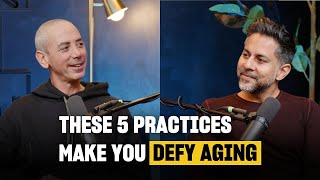
Steven Kotler argues aging decline isn't inevitable. Leg strength is a strong inverse correlate of mortality, and dynamic sports like skiing and surfing build the five functional fitness categories that matter. Kotler recovered from Lyme disease through surfing and flow.
Chapters
The single most important thing you can do, leg strength.
What you're saying is, as we go into our 50s, that's exactly the sports we want to take.
Bones are the mineral factory of the body.
Steven is one of the most brilliant minds I've ever met.
One of the world's leading experts on human performance. The New York Times best selling author.
Executive director of the Flow Research Collective.
He's an award winning journalist and the.
Author of 14 books.
Float isn't just what makes life worth living. It makes a whole lot more life worth living.
His ideas have transformed the way I show up in work. It's allowed me to get into flow states. I've even attended classes by this man where he has taught me how to get into flow states as a writer so I can produce better quality work.
The stronger your thighs are, the longer you live.
Welcome to this episode of the Mindvalley podcast with Steven Kotler. Stephen, thank you for joining us here in LA again. Amazing book. Gna. Growing old, Staying rad country, not gnar.
I'm just saying, man, being that we can cut here.
No, we actually gotta keep that in.
I know you are.
You know, I have a weird Malaysian accent, so it's pronounced nar.
Nar.
Nar as a gnarly.
Yes, exactly. You lived here for a long time.
Thank you, Stephen. Thank you for making me sound like an idiot on my own show. Okay, what is Narcotics I'm here for?
It's a book about peak performance. Aging. It's a book about growing old and staying rad. It's a book that takes most of our traditional ideas around the second half of our life and what is possible and totally upends them. It's based on a personal experience. I took a bunch of these ideas out of the lab and tested them in the real world. But it's about really a revolution over the past 30 years in what we think about aging. So the traditional idea about aging which dominated the 20th century and most of us still believe some element of it, if not all of it, is. I call it the long slow route theory. It's the idea that all of our mental skills, our physical skills, they decline over time. Nothing we can do to stop this slide. And it turns out that's not true at all. While these skills do decline, every single one of them we now know is a use it or lose it skill. So if you keep training these skills, you get to hang on to them, even advance them far later in life than anybody thought.
So you're saying our brain doesn't necessarily age. It's just that if we aren't giving our brain the stimulation that it needs, that's when the aging occurs.
Oh, that's a really kind of good way of putting it. Yeah, in a sense, you're very right.
So I mentioned at the start of this podcast that what this book made me realize is that there are certain practices that I absolutely need to adopt right now. So right now, I go to the gym two to three times a week for high intensity interval training. Everyone's been talking about how high intensity interval training is one of the most important things you can do for aging. Recently, Peter Diamandis started going on and on about this. Right, Building muscle is one of the most important things you can do for longevity. But when I read this book, what that made me realize is that that is not enough.
It isn't enough. So VO2 max, which is sort of high intensity training, gives you really cool facts. So it used to be, we used to think, well, we know this. It starts declining at 25 by 50, it starts to fall off a cliff. And it used to be one of these things where it didn't matter what you thought about was possible in the second half of your life. Somebody was going to hammer you with VO2 max. They were going to be like, oh, yeah, what about? And then this weird thing started happening in ultramarathons. They started to realize that 70 year olds were beating 60 year olds and 80 year olds were beating 70. And so the older people were doing much better and they went, wow, this is really weird. What's going on? Let's look at the VO2 Max of just an sort of average triathlete in their 80s. They have the VO2 Max of healthy 35 year olds. So this thing that we thought fell off a cliff starting at 25, and you could never get it back. We now know if you train it properly, like you are doing with high intensity training, you can really preserve it.
Define VO2 max for membership.
It's your upper aerobic capacity. So when you're breathing really hard, if you're jumping rope, if you're mogul skiing, if you're doing high intensity training, that's what you're training. It's your upper respiratory range. I want to roll back to the point you started with, which is, it's not enough. So what we know is there' categories of functional fitness that you want to train over time. Strength, stamina, agility, balance and flexibility.
Strength, stamina, agility, balance, flexibility.
And then we have, like, very specific guidelines, World health Organization says if you want peak performance aging, not just general healthy aging, peak performance, you want to be at your best. It's 150 to 300 minutes a week of moderate to vigorous, so aerobic activity. Right. For stamina strength, you got to train twice a week, two days a week. And then you need three balance, flexibility and agility days. Or you need to find sports that combine all those things. So when you use the term dynamic, dynamic is a single turn. That means it hits all five of those categories. Basically. Tennis is a really dynamic activity. Skiing, snowboarding, a lot of the action sports are really good for this. A lot of the racket sports seem as well. And it's interesting. These dynamic sports are so much better for health and longevity. This is a work that was done at the Mayo Clinic. You join a health club.
Wait, wait, just before you go on. Okay, so strength and stamina. So you can get that from high intensity interval training. If you guys are on Mindvalley, you know that we have programs like 10X. So 10X, of course, very effective for strength. Studies show that high intensity interval training will cause a 30% increase in endurance, which would be stamina. But there are three that are missing. And what are those three again?
Balance, flexibility and agility.
Balance, flexibility and agility. Balance, flexibility and agility. So that, that was my big aha from this book. I was missing balance, flexibility and agility. So what are the protocols that would give you that?
Yoga is. It would be really good there. I mean, there's a lot of different balance trainings. On the offseason when I'm not skiing, right. I will do things like I'll stand on a Bosu ball and with a kettlebell in one hand and do one legged squats on a Bosu ball. With a kettle ball. Yeah. You start with quarter squats and then you go to half squats and you work your way up and you work your ways up. But that's a really unstable thing. And I do it with four different foot positions, so with my ankle flexion in four different ways. That's one example of that, of that kind of training. The really big deal here, the really big deal, it's not just that these five categories exist individually, it's that if you combine them together same time, if you're training dynamic motion, when you have to do like strength and balance and agility at the same time. So mogul skiing is a really good example of this, where it's an uneven surface, you're being bounced around, it takes a lot of leg strength. And a lot of stamina, but also a lot of coordination. So that promotes the birth of new blood vessels in the brain and the birth of new neurons. So if you want to stave off cognitive decline, Alzheimer's, dementia, all that stuff, you want the birth of new blood vessels that support new neurons and you want the birth of new neurons. So dynamic motion on top of the fact that it trains all these individual categories.
So balance, agility and flexibility. So I think there's this overemphasis on stamina and strength. Right. So a lot of people have protocols for stamina and strength. I think balance, agility and flexibility are the ones that maybe we tend to miss.
One of the ways to think about it is action sports are fantastic for longevity. In fact, the longest lived communities in America, Summit County, Eagle county and Pitkin county, they're all in Colorado. That's Vail, Aspen, Beaver Creek, Copper Mountain, these huge outdoor communities. It's because action sports combine all these things. They do a bunch of other things. But what's interesting about that is most people think about skateboarding or surfing or snowboarding, as these are the activities I'm going to stop doing. Right. And they're the exact activities we want to be turning towards.
Yeah.
So it's really, it's counterintuitive.
So you're saying as we go into our 50s. I stopped skateboarding when I was like 22. But what you're saying is as we go into our 50s, that's exactly the sports we want to take.
I'll give you another one. So the sport that a lot of older adults go towards is swimming. Why? Because there's no pressure on the joints and everything. Right. You hear all that. And swimming's good. If you swim regularly, it can add about like three, three and a half years to your life. Skiing, snowboarding, action sports will give you 10, tennis will give you nine. Badminton, seven, soccer, six. Right. So swimming is the activity most people turn to. But the problem with it is bone density decreases over time. When you're swimming, you're not loading your bones. So the reason strength training matters over time, one you. Because muscles, muscle fibers decrease over time and want to counteract that. But also bone density decreases over time and we need to load our bones. And bones are, it's crucial for balance, agility, all the physical side of it. But people don't realize this. The bones are the mineral factory of the body. So as we lose bone density, the brain, for example, runs on calcium, among other materials. Where do you think it gets that comes from our Bones.
Right. And what you're saying is that we make a mistake. Older folks go for swimming because they think, they think it's going to be easier, and they avoid skiing or skateboarding or surfing because they think it's going to be dangerous. But what you're saying is we have to do the exact opposite.
I am. Now, there's a way you want to approach the act because you still don't want.
Before you go there, I, I really want you to break down the difference between balance, agility and flexibility. I think most people here get flexibility. Right. Balance and agility. That's a little bit confusing me. They seem too similar.
They're. They're roughly the same thing.
But the only reason I, the only reason I'm using two words there is balance is. So if you're standing and you're doing a yoga pose, tree pose, or you're holding one foot, that's balance. Or belay, that's balance. Agility is more dynamic. It's when you're using balance skills at speed. So when you're bouncing down a mogul field on skis or on a snowboard, balance, agility.
Speed is agility.
Balance and speed is agility.
If. So I have this thing that there's.
Also a little difference. So fast twitch muscle response declines over time. So if I'm jumping side to side really quickly, that's an agility training, right? You're training fast twitch muscle fibers. That's different than say, tree pose at speed. Right. Like there's a slight difference between them. And agility matters because fast twitch muscle fibers decline over time. Balance matters because if you're not going to die of cancer or heart disease, you're going to fall down, break a hip and die of a secondary infection like pneumonia, that's the major cause of death among people over 70. If you're not killed by one of the major diseases is slipping, falling, and the secondary infection that you get. So you want, you want to train them both. Agility is giving you the fast twitch muscle response that declines over time. Balance is, is giving you good proprioception, vestibular awareness, those sorts of things. There's slightly different things going on. Big fancy words in those sentences.
Amazing. Okay, so, so let, let's break it down. The, the key idea over here and correct me if I miss anything out, is that we have a wrong perception about sports and aging. As people get older, they actually do less sports to try to be safe, right? So, for example, if people over 50 might do swimming, but in actuality based on the data, based on the science that you're pointing out, they need to be bold enough to look at certain forms of extreme spots, including skiing, because you get the full plethora of the five qualities that are actually going to make you live longer.
Well, you get five of the qualities that will make you live longer. There's, there's a lot more to the equation than just the physical side of it, but yes, it's absolutely correct. Vision.
Is there an impact on the brain, though?
Yeah. So on brain age, crazy fact. The single most important thing you can do, the thing about greatest correlate for preserving brain health and body health, leg strength, thigh muscle mass inversely correlates with mortality. How crazy is that?
Hang on, hang on, hang on. Leg strength correlates with mortality?
No, no, inversely correlates.
Inversely correlates, yeah.
So it's thigh muscle. The stronger your thighs are, the thong, your quads are, the longer you live. And three reasons. So three reasons. One, if you want to. Okay. If you want to live a long time, one of the things that's most important is maintaining robust social connection. Right, right. We all know this. And in fact, there are studies that show that people who have complex social networks maintain robust real friendships, real familial relationships. It's about a seven to eight year boost in healthy longevity. Very, very, very important. So one, when your legs are weak, balance goes away, mobility goes away. You just stop going out and hanging out with your friends more often. Right? So one, there's a social penalty. Two, two, we just talked about bone density, right? And bones are the mineral factory for the brain. Where are the largest bones in the human body? In your femurs.
Right?
So that's two and three is there's probably, by the way, more. This is just what we've, just what science has discovered are the reasons. The third we talked about as well, the third most common killer of older adults is falling. So if you maintain leg strength, you don't tend to fall as much. Leg strength also tends to preserve balance. So that, that's why there's probably way more going on. And by the way, everybody, including the scientists who went looking, were shocked when they were like, legs. This is literally, you gotta remember a bunch of like egghead neuroscientists and geeks who went looking for like correlates for longevity and they come back with leg strength. This is not what they were expecting.
And one of the most important exercises that anybody can do is the leg press. The leg press in the gym and constantly pushing your Threshold in terms of how much you can lift. I did this with my dad, okay? My dad, when he turned 70, doctors told him his body was so weak, doctors told him he was going to have five years to live. I put him on strength training. And now here's the crazy part that people don't get. The rate of improvement for someone over 50 is remarkable. So we put him on high intensity interval training. He went to the gym 30 minutes a week for four weeks. Now when he started out, he was able to lift on a leg press machine, something around 80kg. Four weeks later, he was able to do a leg press 140kg. His one rep max went from 80kg to 140kg. That's almost a 70% increase. And he only did a leg press once a week for four weeks. But he was going like really heavy weights and he was doing that leg press for no more than 90 seconds.
Oh, that's interesting. This is your experience. So the strength work, a lot of it, the early stuff got done at Tufts University in Boston back in the, in the 90s, 80s and 90s, and that people. Exactly your reaction where they were shocked. So the interesting thing about it, about peak performance aging is if you look at the data, two things are very true. The first one is that peak performance aging starts young. So there's stuff in your 20s and your 30s and your 40s and your 50s that really matter. Second is exactly what you were talking about. Interventions even incredibly late in life really matter. It's shocking the improvements you can get in strength as you're talking about. And this is like, there's study after study. And if you look at the original studies, the researchers are blown away. They like can't, like now it's sort of known. But you have these incredibly. The researchers are like, we don't, we don't understand what we're looking at.
Right.
We had sedentary 75 year old women who hadn't moved in 20 years. And in six weeks we saw a 800% boost in strength. What the is going on here? And that's really common, these, these late in life interventions. In fact, there's studies that show that if you're totally sedentary and over 80 and just go from like totally sedentary to I'm now going to climb stairs instead of taking the elevator, I'm going to walk to the store. Instead of driving through those kinds of interventions, you immediately start getting health and longevity effects just from those interventions. After decades of being sedentary in your 8th and 9th so based on all.
The research you've looked at, I want to try a quick exercise with you. I'm going to mention a number of different sporting exercises, and I want you to give it a rating for each on 0 to 10 on how effective these are for strength, balance, agility, flexibility, and stamina.
Let me add one thing to it before we do this, before we're rating them, the thing you also have to remember is from a cognitive perspective, from a mental perspective, dropping into flow is the sing is maybe the single most important thing we can do for peak performance aging. So when you're rating the activities, you want to also be able to rate them for flow. And that's a little bit different because for some people, like repetitive motion over and over. Cycling, swimming. Right. Very flowy activities. So even though swimming is only going to give you 3.6 years from. And you'd be better off playing badminton, literally, if you're picking a sport, you'd be better off with badminton than swimming.
You.
If you're the kind of person who gets into flow from swimming much more easily than badminton, you want to go in that direction.
So since flow. Since different exercises can give different people flow states, let's put flow aside. Let's just look in terms of those five principles. Right? And I think the audience understands you also want to pick something that you're not just going to look at this ranking number. You want to pick something that you really love that's going to put you on flow, that you have access to, that you can afford and that you know that delights you. Okay, so let's start cycling. Scale of 1 to 10.
I'm just, by the way, I'm giving you. I'm in my mind. I know this. Giving you data out of like the Mayo Clinic did this.
Right?
Did this work? I'm just, you know, I'm using their system. Cycling, Road cycling or mountain biking? Road, cycling, road, cycling, four. Mountain biking, nine or a ten.
Wow. Massive difference. Massive difference. What's the reason for that?
Dynamic motion. Road biking is a very.
It's okay.
Mountain biking, you're going also. Yeah. And mountain biking, you're going up and down. You're moving all over the place. Much more novel environments.
There's.
There's more going on. There's more going on for the brain. There's much more fast twitch, muscle response work, more dynamic agility. Right. Blah, blah.
Okay. Swimming, three. So that's really low.
Batman six, seven.
Tennis, eight. Wow. Tennis higher than B.
So I don't know. And I'm not sure they know, but here I think this is it. Tennis tends to come with clubs. More social. There's more social right around the tennis than I think around badminton. Badminton is a little social, but I think tennis, there's like, these huge, big social structures. Skiing, also in snowboarding, when you look at, like, the action sports, that'll give you, like, a Social structures. Right? There's whole social structures around rituals around your kids. Kids. R. I mean, horseback riding is probably really high as well, and there's big sort of social structures around. Around it as well.
So let's continue horseback riding.
By the way, I'm gonna. We're just going one through ten, and I'm just. I'm scaling. It depends on what kind of riding you do and what kind of. No, I mean, but, like, are you aggressive? Are you trotting? Are you walking and trotting, or are you getting too detailed? I don't know. I don't know. But, like, the more vigorous the better is sort of the point I'm making on that one. You could be sort of trail riding versus inside. So I'll give. Sorry, buddy. Nine. Nine.
Really? I make fun of my daughter in a loving way because it doesn't feel like exercise. I mean, the horse is doing the exercise.
You're really not supposed to make fun of your daughter.
We have a beautiful bond. We make fun of each other, but the horse is doing all the work. You're basically sitting on a horse. How can you have a horse?
Have you ever ridden a horse? I did.
I got thrown off. I injured myself as a man, and I never got on a horse again. It was painful, Stephen.
Painful. First concussion I ever had was I got thrown by a horse. So I'm with you. But I got back on the horse.
I wanted to have kids, so I chose not to get on.
That was a different kind of injury. Exactly. There is some physicality involved.
Okay. Okay. Pickleball.
Pickleball.
I think I've been asked this a bunch because it's so popular right now. It seems like it's going to fall in somewhere between, like, badminton and tennis, but with a bonus. So here's one of the cool things. So peak performance, aging in a sentence, right? You want to rock till you drop. You have to regularly engage in challenging creative and social activities that demand dynamic. There's that word again. Deliberate play. And take place in novel outdoor environments. So pickleball isn't exactly novel outdoor environments, but it's a challenging creative and social activity. It's dynamic. Right. It's all five of those categories, not ton of strength. So you probably want to add some strength training in and you want to be stretching before and after. Right. For flexibility kind of thing. But it's very playful. Right. Like the whole thing about the big racks, the whole thing about it and play is incredibly important. So I'll give you something. Here's something shocking. I my challenge and what the that I ran is, could I learn how to park ski in my 50s? People thought it was impossible. One of the reasons is there's that we hear about this motor learning window. Right. Like since they'd say don't become a ballerina after the age of 18, don't become a gymnast after the age of. Right. That kind of stuff. It's because there's a motor learning window that we think slams shut. And it turns out there is a motor learning window. And it does sort of close. But what really changes is not on the inside. It's how we approach learning. Kids learn by playing, adults learn by work. And work comes with a lot more fear, a lot more anxiety, a lot more self consciousness, a lot more shame, a lot more of this crap that gets in the way of learning, whereas play doesn't have any of those things. And from a preserving cognitive function, from preserving physical health, mental health. I'm enjoying my life. You were delicious earlier, right. Pickleball is very playful that way. So some of the activities that are higher up on the list I think are there because some of them are more playful because we know play matters so much. Martial arts, I think martial arts are remarkably good one. There's a lot of anecdot, historical data. Right. I. I recently spent some time around Mark Divine and he likes to mention that, you know, in eastern traditions there are martial artists who live to be 300 or 400. And I don't think that's true, but okay, maybe it is, maybe it is. But one way or another, there's a lot of anecdote about martial arts being really supportive of longevity and certain. Um, I've got tons of friends who are involved in mixed martial arts on different levels and you see, you know, amazing, amazing martial artists in their 70s, in their 80s, like folks you would never, ever, ever want to go anywhere near a ring with. And they're, you know, 30, 40 years older than you, so you see that all the time. And again, it's a very dynamic.
Right. So what score would you give it?
I would give it.
I'd put it. I'd put. I'd probably put it in the 10.
Category in the 10 category. Okay, surfing.
10.
Surfing is a 10, 10.
So skiing may get its own category. And this is. There was a. A Japanese team that was looking at the best sport for longevity. Now this, by the way, it's not in our country. Even though I went on a ski quest. I learned this after, like, afterwards. And it was because a friend of mine did a documentary on longevity and went to Japan and interviewed this, the leading doctor in Japan on longevity and asked him what is the best, single best activity? And he said, skiing. And it's because of how it loads the legs in terms of bone density. So what's interesting is if you want to preserve bone density, you actually, you really have to put a lot of loading and you can't do it all. It has to be like a gradual to heavy loading of the legs. So it's. Skiing actually mimics the way the legs should be loaded for preserving bone density, according to this Japanese team. I haven't seen that duplicated. So from a scientific perspective, I'd want more information, but I'm sharing it. That's incredible. It is biased sort of towards my book, so I like it.
That's incredible. Now, I grew up in Malaysia, right? In Malaysia, Asia, everyone does martial arts. So I went really competitive in martial arts.
Oh, I didn't know that.
Yeah, I competed in the US Open for Korean karate.
I did not know Taekwondo.
That was my first trip to the US was representing Malaysia at the 1993 US Open Taekwondo Championship. Okay, I can still kick your ass.
I believe that.
But I have never skied. I have never, ever, ever, ever skied. And, and this book is convincing me that I need to change that.
Or snowboard. Or snowboard. Right. I mean, skiing from a bone, from the bone density thing, there are other hacks to bone densities. Like, there's other other ways around it, but I found it fascinating.
Okay, so let's continue skateboarding. Yes.
The hesitancy is that, as a general rule, trouble with a lot of these, the combat sports, the action sports, you don't. You still don't want to get injured.
Right.
Our recovery tools, our regenerative medicine, lung, those sorts of things are getting really good. Much better.
So you want to avoid injury.
You do want to avoid injury and you can skate? No, I do. I think skating is a great activity, but it is a hard activity to learn.
So skiing has a lower injury rate than skateboarding.
It's just you're falling on snow instead of concrete. So if you're going to learn to skate those sorts of things. Body armor.
Right.
Those sorts of. Like be, you know, be really careful with it. You know, all these things. Some of this is about flow science and there's a whole bunch of science that backs this up. But older adults, the ma. You want to go slow to go fast.
Right.
So without whatever you're doing, you want to sort of see if you can start building with like an established motor pattern, something you can do all the time with, you know, not a lot of fear, no chance of good going wrong, and just build slowly on top of those things.
Okay, now a couple of popular ones. Yoga.
This is. So I'm going to say something incredibly controversial. And I'm. By the way, I've done yoga for 30 years, so I'm. And I think yoga is foundational for peak performance aging and I will come out and advocate for it. But there are a lot of studies now that are looking at the benefits of yoga and they're not finding them in comparison to a bunch of other sports. And they're finding some dangers around, like the slow stretching of muscles. A healthy body has fascia that rebounds quickly. Right? Right. And if you're doing 30 second to a minute long stretches, you're sort of stretching out the fascia. Good body worker who works with fascia will say, never hold a stretch for longer than 15 seconds.
That's interesting because in the book Body by signs by Doug McGuff, he basically says stretching is useless.
Well, so other people say that as well. There's a whole movement because they figured out that stretching is not about the muscles, it's actually about the nervous system. So when I anesthetize you, I can bend your leg behind your head. Yeah, you're totally flexible when anesthetized. That's where you have. Same thing with baby. Babies have that flexibility. So something about stretching has to do with the nervous system or more than the musculature. So there's this big controversy around stretching in the physical therapy world. That said, in my experience, I think it really matters. And certainly maintaining flexibility is one of those five core aspects of functional fitness. So I don't know how to put a number on yoga because my number would be a lot higher than.
So we're going to avoid where the.
World is right now in case the.
Lululemon crowd comes after us. Just two more. Ballroom dancing.
So I think dancing is a great peak performance aging activity of any kind. It combines a lot of different things. You may have to augment it a little bit with some strength training, some other physical stuff. And I said as part of the formula, if you really, really want to want to maintain physical and mental function, you want to regularly do activities that take place in novel outdoor environments. That is not going to be ballroom dancing. Novel outdoor environments quickly matter for a couple of reasons. One, novelty is a flow trigger. So flow. We talked about how it matters for peak performance aging when we're novelty will help drive us into flow. Two, outdoor environments have two benefits for us. One, we know from positive psychology you're at 20 minute walk in the woods will outperform SSRIs. Right? Improve serotonin levels, lower stress levels. There are nine known causes of aging, biological causes of aging. There are all what they have in common, stress and inflammation. So anything that fights stress and inflammation is an anti aging tool. So nature really does that. So that's great. But as a bonus, you want to preserve cognitive function. You want, as I said earlier, the birth of new neurons and new neural networks. What's called synaptic plasticity. That stuff comes out of the hippocampus. Hippocampus is the part of the brain that does long term memory. Also does map making and location. So the brain is designed basically.
So if you had to give a score score to ballroom dancing.
Seven.
Seven. Okay. That's not too bad. That's not too bad.
I don't know. I'm not really like a great scorer of these things and you know.
No, but you have the science background, right. And your gut is probably a pretty good indicator.
No.
1, we're not saying that these scores are hard science. Right. But Stephen has gone through a ton of research. But what I find interesting about this whole conversation is it's changed my perspective. I don't do sports because I thought going to a gym regularly is going to give me everything my body needs. But you and your book Na country has changed that. So one of the things that I'm committing to doing right now is to learn skiing. I've never skied before and this book has convinced me that I absolutely need to change that.
Cool.
Now, Stephen, before we wrap up, there's a really important story about your background that I want you to share. And I know you've shared the story many times, but I think, you know, in just three or four minutes, my audience is really going to love this. It's how when you were stricken with Lyme disease, because you were at a point in your life when you just couldn't get off a sofa, you taught yourself how to surf and made a full recovery.
Surfing is packed with flow Triggers. So it's really about. There's flow states, right? Which we know they're peak performance states. But there's a really powerful link between the mind and the body when it comes to flow. Surfing's packed with flow triggers to drop me into flow. So when we're in flow, we experience feelings of mastery and control. These are sort of built into the state. Those are really powerful positive emotions. They amplify the production of T cells, which are the cells that fight diseases, natural killer cells, which are the cells that target tumors and other six cells. When we move into flow, there's also all the stress hormones get pushed out of our system. So I had an autoimmune condition, which is essentially a nervous system gone haywire. So if you can reset the nervous system, which is what happens as we move into flow, all, um, it, it really goes a long way towards healing. And finally, all the neurochemicals that underpin this date massively boost the immune system. So flow, you know, it underpins happiness and well being and overall life satisfaction. But from peak performance aging perspective, the way I think about it is flow isn't just what makes life worth living. It makes a whole lot more life worth living.
So you were on a sofa?
I was in a sofa for three years and over about eight months when I was surfing about twice a week, I went from 10% functional, meaning I could use my brain or my body about 10% of the time, to about 80% functional.
And the reason I want you to share this is because there are many people out there who are going to have a hesitancy towards taking up something like skiing, especially if they are over 50. Right. If you were only 10% functional, how did you even start surfing?
Not by choice. If you remember the story. A friend of mine showed up my apartment and demanded we go surfing. And I was laughing, I was like, I couldn't walk across a room. And at the time I was so sick. And she wouldn't leave and wouldn't leave and wouldn't leave. And I finally, I like, I was like, all right, well, let's go surfing. What's the worst that can happen, right? And they literally had to carry me out to the beach. They put me on a giant board, walked me out to the water, and literally it was muscle memory. A wave came. It was a very small day. And you know, I paddled a couple times and popped my feet. I think that was all the energy I had in the world. The rest of it had to do with flow. So when you're in the state, really potent painkillers, the neurochemicals that underpin flow, you get endorphins, right? There's about 20 different endorphins in the brain. I don't know if you know this, but the most common of which it's 100 times more potent than medical morphine. So these are really potent painkillers and things like that. So getting into flow, the state itself is what allowed me to function. I could have never done it without it. It just so happened. When I say surfing is packed with flow triggers, what I mean is like I was out there for 30 seconds. The first wave came, I pedaled a couple times and popped into my feet. I've jumped into a, popped into a flow state almost immediately.
And your 10 functioning all of a sudden went up and up and up considerably and eventually you could surf. You came out of that situation with Lyme disease. You started training for skiing and. Can I share this picture of you? Roll this picture from the book. So those are some pretty impressive abs.
Thank you, sir.
So thank you, Stephen. So what I got out of this book, guys, is that there was this massive piece that was missing in my life and I'm, you know, the mark of a great book is that you read it and it permanently changes you. And I can say that about this book. So go check it out and I'm gonna roll a trailer where A three minute trailer where Stephen's gonna talk about what you're gonna learn from the book. Na country. Roll the trailer.
The traditional idea of aging, which most of you are probably familiar with, it's what could be called the long slow rot.
This is the idea that our physical skills, our mental skills, they decline over time. There's absolutely nothing we can do to stop, stop that slot.
But not so fast.
We've all seen world class athletes, Kelly Slater and Tom Brady performing well past any reasonable expectation. Slater, arguably the greatest surfer of all time, is winning competitions in his 50s. Seven time Super bowl champion Tom Brady, he's still beating players half his age. What about the rest of us? Cutting edge discoveries in fields like embodied cognition, flow science and network neuroscience have revolutionized how we think about peak performance aging. On paper, these discoveries should allow older athletes to progress in supposedly impossible physical activities. To see if theory would work in practice, I conducted my own ass on the line experiment in applied neuroscience and later in life skill acquisition. Tried to see if the old dog.
Could learn some new tricks. Essentially took all these ideas, blended them together and used them to see if.
I could teach myself how to park.
Ski in my 50s.
For those who are unfamiliar, park skiing is the discipline in skiing that involves doing tricks off jumps and on rails and boxes. You saw the Olympics, think Eileen Goo. Only this time with gray hair. Park skiing is incredibly acrobatic pursuit. It involves flipping and spinning and other forms of mid air contortion. It also involves long falls from tall heights. And for all these reasons, plus a half dozen other biological factors, learning to park ski is considered a young person's game. If you're over 30, it's extremely difficult. If you're over 50, well, no one over 50, no one in their right mind, that is, would even consider it. And this brings us to the point. I wrote a new book. It's called in our country, Growing Old Stang Rad. It's a book about peak performance aging. It's a book about what it looks like like when an ordinary person uses the tools of peak performance and peak performance aging to attack a seriously hard challenge in the second half of their life. Gnar is action sports slang for gnarly. Gnarly is defined as any environment, any situation is high in perceived risk and high in actual risk. Country is any territory or landscape, fictitious or real. Thus, in our country, and both a great description of our later years, high in perceived risk, high in actual risk, and the gritty mindset that's needed to thrive during those years. Nar country chronicles my somewhat radical, often hilarious experiment in peak performance aging. It's a book about goals and grit and progression.
You can think of it as an.
Antidote for the weariness. By the time you're finished reading Nar country, you're going to know how to do some stuff. You'll leverage the science of peak performance aging to make the second half of your life maybe the most thrilling and accomplished period overall. You'll also learn how to tap into the superpowers of aging. Creativity, new levels of intelligence and abstract reasoning. Perhaps most importantly, empathy and wisdom.
Let me put it differently.
If you think you've done enough, you're just fine with with Long days of safe, secure, mediocre and average. In our country probably isn't for you, but if you've ever asked what if? Yeah, in our country, it's probably for you. The book was a blast to write.
It was even more fun to research.
Hope you love it.
That's it. Awesome.
Nice.
Thank you, Stephen. It.
More from Vishen






Brown Noise for Deep Focus and Concentration (Best with Headphones) | Gabriel Loynaz



Your Appointment With the Eternal | Guided Meditation with Michael Bernard Beckwith