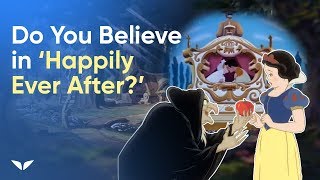
This YouTube video, featuring Katherine Woodward Thomas and other speakers, argues that the "happily ever after" standard promoted by fairy tales, Disney and Hollywood romantic films is a culturally constructed myth that can harm real-life relationships by creating unrealistic expectations. The chunk traces the origin of the myth to early modern Europe (attributed to Venice and the 1500s/roughly 400 years ago), links weddings historically to material and social status, and critiques how media reinforces these narrow narratives.
Questions this video answers
Venice, Italy
About 400 years ago
The 1500s (16th century)
Chapters
They were married and live happily ever after. The end.
I did watch a lot of Disney movies.
I remember my first ever romantic film was about to remember.
I think Rom com sort of set an expectation or a standard when it comes to what your relationship should be.
I remember thinking that, oh, that's how it works.
I'm gonna meet this really handsome dude.
You fall in love with one person and then you stick with them.
Do you want to get married and live happily ever after? If you grew up reading fairy tales, watching Disney cartoons and Hollywood movies, you probably do. But have you ever thought that this gold standard of love is just a myth? Have you ever considered that this whole happily ever after idea may actually be damaging you and hurting your chances to be happy?
You know, the happily ever after myth, that gold standard to which we're all aspiring to, was only created about 400 years ago when the lifespan was less than 40 years of age.
This is Katherine Woodward Thomas, the author of Conscious Uncoupling, the New York Times best selling book and new Mindvalley Quest.
It was created in Venice, Italy, where at the time most of the people were born into utter poverty with no hope of ever escaping. Half the children were dying before they reached their 16th birthday. Life conditions were harsh and dire. Just think of it. When we look at the happily ever after myth, we always see a commoner marrying a noble person and coming into great wealth as a result. So this myth, which was first created as an escapist fantasy to help people survive at a very difficult time, has now somehow become the COVID standard to which we're holding ourselves and each other accountable to everybody wants to get married.
Marriage is good. This is a fine institution.
Ruth B. Bottingheimer, a research professor in the Department of Cultural Analysis and Theory at Stone Stony Brook University, dates the obsession with weddings to the 1500s, when the first fairy tales emerged in Europe. Ms. Bottingheimer says that these stories all culminate in a wedding, usually that of a woman who elevates her status in the world by getting hitched.
Once you became my wife, that made you a princess.
Weddings historically have this long association with material well being. If not, you have a miserable life as a maiden aunt, a lady in waiting, where you serve someone else's life. A wedding is social success. But today the context of our lives is completely different from five centuries ago. Why then do we still believe those myths and expect them to become our reality? And what's even worse, shame and blame ourselves for failing to realize them?
Divorced again.
We should probably thank our media for that. You see, as girls, we grew up thinking that the wedding gown was the most important dress in our lives. Not only because our moms told us that, but also because we saw it in every happy ending of every fairy tale story. We grew up on Disney cartoons about princesses. And what do princesses do? They get married. Just marry the prince, always look pretty, and live happily ever after. And the guys grew up believing that apart from becoming a superhero or succeeding in career, getting a cool car or defeating a dragon, they had to still accomplish one more thing to be fully happy. They had to find the one. She's the one. And so we do what we were told to believe. We meet, we fall in love, we have a wedding, AKA the best day of our lives. As if everything after is doomed to get worse. By the way, we also spend thousands of dollars on that day. And then we expect the credits to roll while our lives stay in a perman state of happily ever after. But it doesn't really work that way in real life, right?
It's important to question our cultural assumptions and myths, because they might not actually be appropriate for us to be aspiring to. And as much as we love the idea of meeting and mating with just one person for life, which some of us will be fortunate enough to do, the truth is, what's actually normal for us is serial monogamy. Studies show that statistically, most of us will have two to three significant relationships in our lifetime. Given that more people are going to divorce this year than buy a new car or eat grapefruit for breakfast, I think it's time that we begin to rethink the goals of love to which we are aspiring and to stop feeling like such a fake failure when our relationships end before someone dies. Because many of us will indeed experience the pain of a breakup. And inside of this happily ever after myth, we've never actually learned how to transition out of our relationships well. And most of us will slip into a sense of shame and despair at the end of a relationship, as though we have completely failed. If you find that you're holding yourself accountable to standards that you're not actually committed to, I invite you to just start to let those go.