How to Become an Inspiring Leader | Srikumar Rao
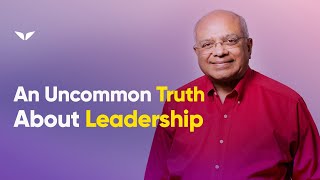
A conversational YouTube interview (host Jason with Professor Srikumar Rao) about how to become an inspiring leader by first being inspired. Rao argues leadership is a byproduct of pursuing a vision larger than oneself rather than attempting to manipulate others. Key themes: anchoring work in a meaningful 'cathedral' vision; focusing on process/actions (hourglass) rather than obsessing about outcomes to reduce stress; building authentic networks by reaching out from genuine inspiration and offering help; feeding the altruistic 'dog' rather than the selfish 'wolf'; decision-making framed by doing maximal good for stakeholders and trusting a 'benevolent universe' that provides what is needed. The talk emphasizes recognizing and updating mental models (we live in a constructed reality) and offers practical metaphors and exercises (diary of inspirational people, mindful hourglass, evaluate whether you feed dog or wolf).
Chapters
We live on a sinusoidal curve, oscillating between elation and despair. And we spend more time at the despair end of the spectrum. It's a lousy way to live.
Welcome to this month's episode for Impact at Work. Now, the guest that I'm bringing you for this month is no stranger to the mindvalley community. He's none other than Professor Srikhu Mah Rao. And for those of you who went through the quest for personal mastery would have known the impacts that he's had on your life. And I'd love to share the fact that for me, I had a chance to go not only through his quest, but through his advanced creativity and personal mastery course, where you start looking at every aspect of your life. And it's taking these concepts of spiritual teachers that have been around thousands of years and bringing them to modern times on how they apply to live our life at the fullest. And what we're going to be building in this episode is a container for those who are looking to become inspiring leaders. This is really close to me because I'm also someone who seeks to be an inspiring leader. And what has happened through my process of working with Professor Rao is that I've become inspired in the everyday life activities that I do in doing whatever it is that I need to be doing in making an impact in the world. What I hope that you're going to be gaining by the end of this episode is a lowered level of stress and you're chasing of the goals of making a bigger impact. I also hope that you're going to realize that you do not need to go out and manipulate people to be able to create a movement around the world. But by simply stepping into the greatest potential of who you are and being inspired in the process, you will be able to move mountains. And so it's with my great pleasure that I bring a former teacher and MBA programs around the world who has had the most sold out courses that has changed the lives of so many people at so many levels. You're going to be able to learn directly from him. And so that's my pleasure to bring Professor Rao to end the episode. Let's get started. Hi everybody. Welcome to the episode. And Professor Rao, thank you for being here.
My pleasure, Jason.
So we're creating a container here. So we're talking about being an inspiring leader. And what I wanted to give an opportunity for people to understand is a lot of the concepts that you bring are actually based on some ancient methods, some newer methods, but you do something Very unique, where it doesn't just touch on the spiritual side, but it expands to encompass so many different areas of your life. Could you tell us more about that?
Sure. What happened, Jason, is I've drawn my material from the world's greatest masters. They lived in different times, lived in different places, but they all intimately understood the human predicament and they came up with solutions that have been tested over millennia and they absolutely worked. But these were people who were interested in your spiritual progress and that's all they spoke about. But the solutions that they came up with can help you a great deal in your material world, in your career, in your quest for wealth. It can do that. They never spoke about it because for them it was irrelevant. What I have done is I've taken their teachings, I've stripped them of religious, cultural and other connotations and adapted them so that they're acceptable to intelligent people in a post industrial society. And they absolutely work.
And so when somebody takes some of these learnings, and in this context here, we're talking about becoming an inspiring leader, what are some of the typical tendencies that people have when they want to become a leader where they go on the wrong path? And I want to give an example. Some people, they say, okay, I want to be a leader because I want to be able to get everybody to do what I want. And here again, you were talking about something that seems very ego driven.
Correct.
Would you be able to elaborate on what are different ways to be certainly inspiring?
Certainly there's something that I used to do when I was a beginning public speaker, and that is I'd ask my audience, how many of you want to be inspiring leaders? And virtually everybody would put their hands up. And then I'd say, if you want to be an inspiring leader, you're already well advanced on the wrong path. And they kind of have their arms up there, not quite down, not quite up, but feeling somewhat embarrassed. I don't do that anymore because it's not a good idea to embarrass your audience. But the point is very valid. If you set out to be an inspire leader, what you're really saying is, I want to have people do what I would like them to do, which perhaps they don't want to do. So I've got to figure out how to get people who don't want to do what I want them to do to do what I want them to do, which is essentially I've got to learn how to manipulate people. Yeah, I'm pushing it a little bit here, but you get the point. So in my book, becoming an inspiring leader is not an aspirational goal. It is something that happens as a byproduct. If you want to be an inspiring leader, give up all thoughts, hopes, dreams of becoming an inspiring leader. But instead, be inspired. Be inspired by a vision that brings a greater good to a greater community. And you have tremendous flexibility in defining both the greater good and the greater community. But unless you can find something that's bigger than you are, to which you can subsume, if not your whole life, at least a big chunk of it, you're not really going to become an inspiring leader. But if you do find that and you learn how to communicate it, then you become an inspiring leader by default. Because anybody who comes in touch with you cannot help but be inspired. You know, it's little bit like Gandhi. He never set out to say, I want to be an inspiring leader. I want millions and millions of people to follow me. No, Gandhi said, the passport laws are unjust and I will not let them stand. And he was a British trained attorney, so he was verbally fluent. And he used that and whatever other skills he had to organize protests against the passport loss. And in the process of doing that, and later, when he came to India and started fighting his colonial rule, he did in fact, becoming an inspiring leader, it was entirely a byproduct. It's not something he set out to do. So if you want to be an inspiring leader, first be inspired. Come up with a vision. Come up with something that brings a greater good to a greater community. And then as you learn to communicate that, you become an inspiring leader.
Now, I know you've worked with a lot of people at various levels in an organization that probably came up with that same aspiration of wanting to be an inspiring leader and then realizing this shift, this new method of going, okay, no, I need to be inspired by a vision. Would you have a good example that would allow someone who might be finding themselves watching this going like, oh, wow, I feel like I've been chasing an outcome without thinking of the process. What would that look like?
Well, I haven't worked personally with Gandhi, obviously, but he is a perfect example of someone who started off, he never wanted to be an inspiring leader. He just wanted to have the passport laws initially revoked and he wanted India to be free of colonial rule. Later on in India, he found that there were many social ills that he thought should not exist, like, for example, the plight of the untouchables, like religious disharmony. And he worked to eradicate that to the extent he could. So he was always motivated by a vision that was bigger than he was, and that works across the board.
And what would you think? Like, what is examples of someone that might not acknowledge this, that still feels that they just need to chase this, this aspect of manipulation. Do they end up having any kind of success, or does it usually.
Oh, they certainly can end up having success in the sense of they achieve high positions. We have any number of people who are in government, in business, in not for profits, who basically have a sheer driven ambition. I want to reach the top. And certainly it is possible for you to reach hierarchically high positions, but in my book, that doesn't really make you a true leader, because the moment you lose your position, nobody wants to spend any time with you and you drop off the radar. That's not true success in my book.
It's almost like there's a disconnect between the authenticity completely. And so if I'm sitting and I'm somebody who understands this, I have a vision that I want to transform. And for the benefit of the audience, I don't think everybody needs to go as far as a vision like Gandhi, but within their organization, there might be something that they're inspired to do. Maybe they're working within the organization. They believe so much into the product, and they're inspired to do so. What are some additional steps now that you know that you're inspired, inspired by the mission? What are some of the things that you can do so that you can live in that inspiration and also be able to benefit more?
Let me tell you a story, Jason. This was medieval England, site of a great cathedral being constructed. And the architect went to the scene of construction, and he came across three people, all of whom were doing exactly the same thing. There was a big block of stone, and they put a smaller block of stone on top of the big block of stone and beat it with a hammer till it broke. And he asked the first guy, what are you doing? I said, can't you see I'm breaking rocks? Why are you doing that? I get paid a hit another day. And the second guy said, I'm helping build the wall behind me. And the third guy said, I'm helping build a great cathedral. And when it's over, people are going to come from all over the world and they will be inspired. And I will have had a small role to play in that. The third one was the only one who recognized the architect. And he said, truth be told, I don't like doing it. It's back breaking Work. And I can get better wages for less effort. I'm only doing it because I want to learn. Will you teach me to build a Cathedral? And 20 years from that day, the guy who was breaking rocks died. He no longer had the strength to swing a hammer, and he starved. The guy who was helping build the wall behind him was living a life of desperate poverty. But the guy who was helping build a cathedral was on his way to building his first cathedral. And I mentioned this story. A, it's an inspiring story, but B, it has a very relevant meaning. Every day when you get up in the morning, you have a choice. You can break rocks or you can build a cathedral. I can't define for you the cathedral that you're going to build. You're the only person who can do that. But I can tell you that unless you find and define the cathedral that you're building, unless you can anchor your being in it so that all your activities flow from this knowledge that you're building a cathedral, you're going to live an essentially mediocre life. Punctuated the flashes of pleasure.
Wow.
You know, take. Take motherhood, for example. Perfect example. You know, you have a mother and she does all kinds of things. You know, she has to clean her baby. You know, she has to remove snot from the nose and all kinds of unpleasant things. But does she think, you know, I'm doing all of these unpleasant things? No. She's caring for a child who is going to grow up and is going to be president, is going to do great things. Then she is the instrument through which this care and nurture is being developed. She is building a cathedral. Extend that into what you're doing at work and what you're doing in life. And when you do that, your life will have a meaning that you will find amazing.
That's so brilliant. And so I want to recap this because it's really important for people to hear a lot of people come up with the idea of being an inspiring leader as the idea that, oh, I need to be able to manipulate the people to do something that they might not necessarily want to do, but if I become inspiring enough, I'll be able to manipulate it to do it. And that is having it completely wrong. That is a major brule. The model of reality is, if you want to be an inspiring leader, don't set that as the objective. Be inspired by whatever it is that you do, and you'll notice that you will naturally just have a different energy upon how you take any action in your workplace, in your Life that will just draw naturally the right opportunities. And you'll, you'll come at it with just a very positive energy.
Completely. Yes. And you'll feel it. You will.
And I have went through a lot of your process, so I know what that means. And so for people listening, if you're chasing those wrong things, you end up chasing where at the end of it, it probably will not give you the, the kind of answers that you're looking for. But by being inspired, you'll see that things will naturally happen even without you putting the direct effort towards it.
And I must also add, by the way, a lot of the persons who want to be an inspiring leader, in their heads, they don't think that they're manipulating people. They just think, I want to be an inspiring leader and this is what I have to do. And it's only when they step back to think, and a lot of them don't, that they understand there is a very fine line between what they're doing and, and an attempt to manipulate. They don't set off to do it consciously, but they cross the line because they're not aware that this is what they're doing.
Amazing. And so I want to touch about another aspect of an inspired leader and this speaks particularly for people in management position or executive position or, you know, a recognized leadership position. Some people have hesitation towards continuing on their path and growing within their career because they feel that once I get to these levels, stress becomes a part of your life. You become extremely stressed and you have so many responsibilities that it might not even give you the quality of life that you wanted. But you have a very different opinion on the stress levels for a leader completely.
I think that the vast majority of persons do not clearly understand why they are feeling stressful. We feel that we are stressed because we have financial problems, we have business and career problems. We are derailed in terms of what we want to accomplish, people not cooperating with us. There are all these grand visions I want to accomplish and somehow it's not working out and all of that is wrong. There's one reason and one reason only why you feel stress in your life. And the reason is that you have a very, very rigid idea. This is the way the universe should be. And the universe is not cooperating with you. So you want to be promoted because of the great work you've done and your boss tells you your progress has been unsatisfactory and you're going to get a pink slip. You feel that you did a bang up job in telling your client about all the great advantages of your product and the client signs up with somebody else. The universe does not play ball with you and you resist it and you resent it. And that's why you feel stress in your life. We tend to live our life the following way. I set all of these great objectives for myself. I succeeded, life's a blast. Or I set these great objectives for myself and I failed, life sucks. We live on a sinusoidal curve or oscillating between elation and despair. And we spend more time at the despair end of the spectrum. It's a lousy way to live. There is an alternative, and the alternative is simple. Set yourself a goal, even a stretch goal. Goals are very important, but they're very important because they establish direction. Once the direction has been established, forget about the goal. Instead, pour all of your emotional energy into what are the actions that I have to undertake in order to achieve the goal. And when you do that, two things happen. One, you enjoy the journey. The destination is a mirage. It's out of your control. You get there and you are somewhere else soon. You know, people talk in terms of I want to climb Mount Everest. How much time do you spend on top of Mount Everest? A few minutes to a half hour. You get up there, your buddy takes a picture of you. Your buddy gets up there, you take a picture of him and then you're on your way down. And you hope you don't kill by an avalanche. If you're going to climb Mount Everest, you better enjoy the weeks and months of acclimatization on Base Camp 1, Base Camp 2 and so on. It's the same with any major goal. Enjoy the journey. The journey is the only thing you have. The destination is a mirage. You get there and then you're off someplace else soon enough. The journey is with you your entire life. When you enjoy the journey, that's when you find the fullness of life. If you reach your destination, fantastic. If you don't reach your destination, fantastic. Because here is the mistake that most people make. We think the benefit of setting a goal and trying to achieve it is reaching the goal. Wrong. The benefit to you is the learning and growth that happen in you and to you as you try your level best to achieve the goal. If you reach the goal, that is a bonus. Be immensely grateful. If you don't reach the goal, you still had the learning and growth. It's a no lose proposition. And when you live life that way, there is no stress because you've already accepted the outcome is beyond your control. You're going to try the level best that you can. So where is the stress? You just enjoy the journey and things that other people would say, how can you cope with that? Hey, it's jam.
And then there's a lot of people that get caught up also in the time element of these goals. And things don't seem to act like they get stressed because either they don't have enough time or they set an objective or a goal where they feel that it should have been done by a certain time. What are ways that people can cope with that?
Well, the method that I just outlined, which is invest in the process, to not invest in the outcome, that's a very big way. And the second part of it is a lot of the time when you get stressed out, it's your mental chatter running amok and it's your mental chatter going, oh my God, this should have been done. It's not done yet. These are all the things that should have come in place. And there's only so much time. It's never going to happen. You're fretting about it. It's not going to make it happen either. So what do you do is just mindfully do whatever it is that you have to do. And, and in my programs I use a visual analogy. Imagine an hourglass. There's grains of sand in the bulb above and there's grains of sand in the bulb below. And one grain of sand at a time goes through that narrow neck. Focus on that. That is the task at hand. No matter how much you agitate the hourglass, you're not going to get more sand going through. So focus on the greener sand that is going through the neck. That is the present moment. That's all you have. And when you do that, you'll be surprised at how much more you can accomplish.
So what is it? And it seems to be mostly in like this kind of western world of like work hard, productive, like hustle harder. Especially for people in these, in these higher up position, they seems to have a lot of external expectations on them and it seems like they are all caught into this outcome focused world. How did it come to being that way? Or has it always been that way and we forgot to enjoy the process?
That's a very good question, Jason. And it's been that way for a long time, ever since the Industrial revolution happened. But yes, we have forgotten how to enjoy the process. What I would like you to do is I'd like you to go back to the time when you were 5, 6, 7 years old and as a child, you could be enthralled by anything. You could watch a dog chase its tail for hours and it was just fun. You could go out and splash in the mud and have a wonderful time. Your mother might not have liked it, but you had a wonderful time playing in the mud. You thought that a nickel was better than a dime because it was bigger. That is our natural state. That's what we can get back to now. We can't go back to being little children, but we can go back to being like little, little children. And that's what my program is all about. Because if you don't enjoy life at a very deep level every day, if you don't come radiantly alive, if not all the time, at least a lot of the time, you're wasting your life. Your life is too short to waste.
And so to bring this all around is the fact that for all the people that are finding themselves in a leadership position or a management position, and you feel like this is going to actually demand more stress out of you, it's not necessarily the case. The fact is, is there's no stress cannot serve you anyway. You have to just trust the process. If you're so focused on the outcome, you don't even have presence in the process. If you don't have presence in the process, you're probably not even being as.
Productive or as you are capable of being. Yes.
And so you're actually holding yourself back by focusing on the outcome and being stressed about it.
That's correct.
And so for someone who embraces the this process, in essence, if they're seeing an opportunity to take on more responsibility as a leader, it's just a part of the process that they can accept and not necessarily label it with the stress.
That's exactly correct.
Amazing. And so the last one I wanted to bring up as a brule, for people that are finding themselves in these authority position, a lot of times it's the pressure about having to network with people. And then when you're networking with people, it's almost like, okay, I need to meet the right kinds of people that are going to serve what I need. And being very focused on only speaking to people that are going to be deliberately giving a benefit to you. And from what I understand is there's a lot of bad intention around that approach.
I wouldn't say bad intention. I would say something that doesn't serve you well. A number of people. And anybody who's successful or anybody who wants to be successful will tell you networks are important. Who, you know, really does matter. So people go around saying, you know, I've got to build up my network. Now, I've been running my program for more than two decades and I would say that probably 70% of the persons who take my program feel uncomfortable at the thought of networking. Networking. Now think about this for a moment. The very notion, you know, I should have a powerful network is a self serving one. Because what you're really saying is I need to find people who are in a position to help me in some manner and ingratiate myself with them. So think of the countless hours that people spend in contact, cocktail parties and receptions and, you know, affairs of that kind, which are deadly boring. They're soul sucking. The very notion that I should have a powerful network is self serving. So here's my take on it. If you want to have a powerful network of long lasting relationships, here's the best way for you to make that happen. Don't, don't try to build a network. Create a network. Don't even think about a network. Instead, allow it to spring up around you. Don't try to create it, Allow it to happen organically. And here's a very powerful way I found by which it happens. Have you, in the course of your life, ever ran across people who inspired you? All the time. Right? You read about them in newspapers or magazines, you see them on television programs. You might actually observe them in your company or trade associations or other places. So there are people who inspire you. Typically, what do you do when someone inspires you? Typically you get inspired for an hour, a day, a week, and then life goes on. Big mistake. Every time you're inspired by a person, that's the universe nudging you on the shoulder and saying, hey, Jason, there's something here for you. So what I advocate in my program is every time you're inspired, write it down. Who's the person who inspired you? What was this person doing? Where did you learn about this person and put it down? Keep a diary for this purpose only. And if you do that, then there'll be a number of entries on that. Go back to those entries after four or five weeks and see which of these persons continues to inspire you. And those are the persons you reach out to. Reach out to that person with a sincere note for here's how I learned about you and I really appreciate what you're doing and come up with a specific offer of help. And the reason you're offering help is if your offer is accepted and you're called upon to deliver Then you're doing something to make the world a better place and that is its reward. And if you reach out regularly in that way, and in my program I have a systematic schedule whereby people do this on a regular basis. Some of your offers of help are going to be accepted. And as you deliver what you promised, you find that you're automatically building a network of very deep, very long lasting relationships. It comes up around you as opposed to you're trying to build one. It's a much more efficient process and you never have to do anything that you're uncomfortable about because you don't reach out to a person unless you are genuinely inspired. So what I'm trying to make is when you reach out from a values perspective, your reaching out is much more powerful than when you reach out from a self influence interest perspective. You feel it, the other person feels it.
And I can think, because I've been in a position where I've had to do a lot of outreach and what you speak about is it seems to confirm all of the times that I've had successful connections with people are usually because I've actually spent the time to find something about them which inspired me. And then when I reach out, I should genuinely can refer to it. And I can even think of all the times that I've made a reach out because I was. Because let's say I had an objective to reach out to a certain person which I didn't have any kind of inspiration that it was felt in the way that I communicated. And so the result was exactly what the expectation would be.
Absolutely, yes.
And so for the people that are in a position where they need to actively network, let's say you're in a, whether it's a sales position, a management position, and you don't want to be just trying to build your network out of a self interest, but you're trying to find more opportunities to find people that you're inspired.
Correct.
What would be a good way for you to have that kind of activity happen continuously in your life?
Well, here's a simple one. Every time you run across someone, we have a habit of in our head making a checklist. Who's this person? What are the layers of authority that this person has or can access? And can this be of benefit to me, throw all that thinking out. Instead simply think of, for whatever reason, destiny, fate, karma, we are together. And in the time that we have together, what is it that I can do to help this person improve his life? Even if it's a simple thing like Bringing a smile to his face, even if it's a simple thing like asking him what he does because you want to know, not because you want to sell him something or get him to do something that would be advantageous to you. One human being to another, reach out, how can I help make your life better? And that's the only intent you have. And continue doing that with any interaction with the cab driver who takes you to the airport, with the newsstand vendor from whom you buy a newspaper, with your colleague who's having a problem at home. Just talk about and say, is there anything that I can do that would make this person's life better, which would raise his or her level of consciousness and make that a policy. You will find that the person you're really enriching is yourself.
And I think in the process of being a leader, you're also someone that's being so inspired, you're always seeking to continuously grow. And so if you're always having that radar and living that habit every single day, it just allows you to grow in the process.
There's a story I tell. It comes from the Native American tradition. There are many versions, but I like the one that I'm about to share with you. So there was this young brave who was going to grow up and take his place among the adults of the tribe. And the final rite of passage was a conversation with the medicine man. And the medicine man said, here is this dog, intelligent, kind, loving, trustworthy. And here is this wolf, malvolent, cruel, vicious, ready to snap at and kill anything. And the dog and the wolf were fighting, and the dog and the wolf are both inside you. And the brave asks, which one's going to win? And the medicine man says, whichever one you feed. Now, think about it, Jason. Inside, each one of us are altruistic, let's help each other and make the world a better place. Impulses. And inside each one of us are, let me get everything I can for myself, and the devil take behind most impulses. And the two are always fighting. It's your job to selectively identify and feed the dog in you. It's also your job to selectively identify and feed the dog in everybody you meet. And when the dog in you becomes healthy and makes friends with the dog and the other person, magic happens in your life as well as the world outside.
And so when we talk about this analogy of the dog and the wolf, would this actually be a kind of personification of your mental chatter?
Absolutely.
And so what would that look like for someone who's Making that conscious choice.
Well, let me give you an example. So you've had a bad day at work, and you go to the coffee machine, and your colleague comes up and says, I had a bad day at work. And you say, you had a bad day at work. Let me tell you about my bad day at work. And you top his bad day with your day, and you walk off feeling smug. You've just fed the wolf in yourself as well as the other person. And you don't even recognize that this is what you've done. But instead, if you were to say, yes, you had a bad day, I had a bad day, you know, why don't we put our heads together and see if there's anything at all that we can do so that none of us and anybody else has a bad day like this again, is there anything we can do? And all of a sudden, you started feeding the dog rather than the wolf. So in your mental chatter, every time you're speaking to someone, just ask yourself, am I feeding the dog or am I feeding the wolf? And if you do that, you will find that how you react to people, what you say to them changes. And guess who benefits the most? You do.
Without even having it as an objective.
Exactly.
Amazing. And so one of the things I wanted to bring up in the context of leadership as well is the whole notion of decision making. And when you're in a leadership position, you're responsible for making decisions. And a lot of people feel like there's hesitation around making these kinds of decisions because they don't want to make a wrong decision. What are some of the ways of having this mental chatter that kind of brings people into a standstill when it comes to decision making as a leader, what are some of the thoughts that you could share to help them be able to have better clarity in the process?
There are several levels on which I can answer that question, Jason. So let me take some of the salient ones. Okay. The first level is, what is your objective in making the decision? And my belief is that when you're a leader, you ought to take a decision which brings good to a greater community. And by greater community, I mean all of the stakeholders combined. Now, admittedly, if you're doing good to one set of stakeholders, you might be taking a little away from another group of stakeholders. Stakeholders. So this is where your judgment as a leader comes in, as what would be an equitable way of arranging the pie or splitting up the pie. That's the decision you have to make. But the intention should be, I would like to do the best I can given the particular set of constraints I have. And having done that, you come up with a plan and then you say, hey, is this the right one or is it not? Are there unintended consequences? And in order to deal with that, I'd like to introduce the concept of the benevolent universe. And this actually comes from one of the world's greatest scientists, Albert Einstein. Now, we revere Albert Einstein because he discovered or formulated the theory of relativity. He discovered the photoelectric effect, but he was also a philosopher. And he said, the most important, important question you will ever ask yourself is, is the universe friendly? Let me repeat that. The most important question you will ever ask yourself is, is the universe friendly? Most of us believe the universe is neither friendly nor unfriendly. It's simply indifferent, uncaring, and doesn't know we exist and couldn't care less. So here I am doing my thing, and there's the universe doing its thing. And sometimes it seems to be working with me, sometimes it seems to be working against me, but it's essentially a random process. What if that wasn't true? What if the universe was aware of your existence and was well disposed towards you? Friends don't shaft friends, do they? They don't. So if the universe was friendly, the universe would never do anything that will harm you. But then you could say, why does the universe give me stuff that is clearly harming me? You know, I wanted to get promoted, but I got a pink slip. Perhaps that's not what you wanted, but perhaps that's exactly what you needed at this stage of your life. It's like you're a small child and you want a tub of ice cream, and your parents give you fruits and vegetables, and you don't want fruits and vegetables, you want a tub of ice cream. And it's only when you have a much greater level of wisdom and maturity that you can say, thank God I got fruits and vegetables and not ice cream. What if the universe was like that? It's giving you what you don't want, but it's exactly what you need.
And so in the process of, like, making a decision here, if you realize.
It'S a friendly universe, and whatever decision you make and whatever the outcome is is exactly what was needed for the benefit of all parties combined.
Amazing. And so that takes a lot of pressure. Now, people are still going to be making a conscious effort to consider the most, most amount of stakeholder. The most amount.
Oh, absolutely, yeah.
And the fact is that there is not necessarily a wrong choice because you're going to have the best decision to be made at that moment.
Exactly correct. And so this is a model, by the way, but it's a fantastically powerful model.
I'd like for you to elaborate on that, because a lot of people operate by models. And even the whole concept of being a leader, an inspiring leader, is a mental model that people chase for. Could you, for the benefit of the people, give a bit more of an idea of what does that whole mental model concept mean?
Correct. Okay. And I'd like to make a small correction. You said a lot of people operate on the basis of models. Wrong. Everyone operates on the basis of models. Most people don't recognize that they're operating on the basis of models. They think this is the way the world works. It's not. It's your model of the way things work. So we all do that. A mental model is a notion we have that this is the way the world works. And we've got dozens of models, maybe hundreds of models. We've got a model for everything. If you're an entrepreneur, you've got a model for how do I increase sales? How do I bring in more and better customers? How do I find an employee worth hiring? What are the screens through which I have to put someone who wants to work for the company? You've got a model for how do I find a person to marry? How do I bring up my children? You've got dozens of models. These models may be in conflict with each other, and you may or may not be aware of the conflict. There's never a problem with having mental models. They're wonderful devices. They help you make sense of unstructured situations. They save you time. The problem is not that you have models. The problem is you don't recognize that you have models. This is not the way the world works. This is my model of the way the world works. And in this short conversation we've had, we've explored a great many models. We've got a model for should I network or how should I network? We've had a model for what is leadership. And I've given you models which are different from those that are commonly held. This is true in every area of your life. Jason, I will go out further. Every time you have a situation in your life that you find unpleasant and it persists, you're using one or more mental models that are not serving you well. And the moment you make changes in those mental models, poof, the unpleasant situation goes off just like that. I'm not talking some of the time I'm talking every time. That's how powerful mental models are and how they completely dictate and rule our lives.
Amazing. So for everybody watching, we build a container here about being an inspiring leader. But what we really wanted to cover is just amazing ways to look at our lives. These mental models that are also models of reality that you might be aware of, you might not be aware of. But whenever you find yourself going towards a position of leadership, it becomes a lot more in your. The challenges will come a lot more towards you and you'll have a lot more awareness to it. Now, in this process, we've actually brought in the light on a lot of these typical pitfalls of chasing this whole leadership kind of middle mentality and being able to give you a different model so that you can see what is going to come up towards you while you are quote, unquote, chasing this. What are better ways you can look at it so you can make a greater impact in the world. We've covered so many models in this. And what I'd love to give as an opportunity before we end the call is just what are some lasting words that we could give for people that are. They're in the workplace, they've just listened to this, which probably have shaken a lot of their existing mental.
I would hope so. I would really hope so.
What is something that we could give to the people before we head out that would give them some grounding here?
Okay. What I'd like people to know is that the life that you're living in is not the reality. It is a reality. You constructed it. You probably constructed it without knowing that you were constructed it. And you constructed it with the mental chatter you entertain and the mental models you hold. It's as if we were all living in the Matrix. But this Matrix was not constructed by an alien civilization out to enslave us. But you did it with your mental chatter and your mental models. So what are you living in is a reality, not the reality. And this is hugely liberating, Jason, because if you're living in the reality and you don't like it, you're screwed. Grin and paring. But if you're living in a reality and you don't like it, you can deconstruct the parts of it that you don't like and build it up again. And you do this over and over again. This is a rest of your life process. And as you do that, you will systematically build a better and better life for yourself. You will reach higher and higher plateaus and you'll be amazed at how much enjoyment there is in life. Something that you completely missed if you were not aware of this process.
Amazing. And so what happened with me is I ended up going very deep in some of the courses with Professor Rao. And I've had a taste of what happens when you start shaking up these models. And I'm somebody who had this need of chasing this opportunity to be an inspiring leader. And what has happened for me is that I found myself being much more inspired in the process, much more inspired in the whole experience of what is it that I'm trying to do to bring education to the world, to raise consciousness levels. And it's been a great benefit towards the interactions I've had through you. So I hope that people that are watching this have had a similar experience, a similar shakeup so that it can actually brings you on a path where you're going to be building whatever it is going to be your impact you do in the world in whatever way that is. You're starting with some different models to consider that start with such a stronger foundation. And so thank you so much for the time that we spent on this.
My pleasure, Jason. It's been an absolute blast. I must tell you that I've enjoyed all, all of my interactions with mindvalley, both the people who took my program and the people who worked with me to make those programs come into being. So I am delighted to be part of the extended mindvalley family.
And for those who haven't went through the quest for personal mastery, I urge you to consider going through that. And if you want to go into more hand holding experiences, I believe you have live workshops that people can attend as well.
That is correct, yes. Details are on my website.
We're going to have the links to your website and everything contained in this episode. And is there a different way for people to reach you or the website is the best tool.
Website is the best. Or they can send me an email. Put my email down on the link too.
Perfect. Thank you so much for watching. Thank you so much for being here.
My pleasure, Jason.
More from Vishen






Brown Noise for Deep Focus and Concentration (Best with Headphones) | Gabriel Loynaz



Your Appointment With the Eternal | Guided Meditation with Michael Bernard Beckwith