How To Save The World In 2 Simple Steps | Emily Fletcher
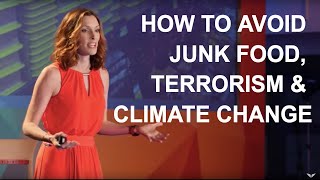
Emily Fletcher gives a 19-minute talk arguing that meditation (twice daily: morning and afternoon) is the fastest way to up-level individual consciousness, which in turn addresses three major global symptoms—poor food quality, terrorism, and climate change—rooted respectively in greed, separateness, and the "I'll be happy when" consumerism syndrome. She cites neuroscience (dorsomedial prefrontal cortex, insula), program implementations (schools, jails, veterans), and several statistics to support urgency and efficacy, concluding with a call to teach meditation widely and vote with consumer choices.
Chapters
Foreign. Hi, friends. Wow. What an extreme delight to get to speak to such stunning human beings in such a stunning location. And thank you, Mia, for that ridiculously kind intro. And thank you to Vishen and the entire A Fest team for creating this. Now, if any of you guys have heard me speak before, you probably thought that I was going to get up here and talk about how meditation can improve your performance. And honestly, it would have been easy for me to get up here and talk about the neuroscience behind why meditation is the ultimate brain hack. How it can help you have better skin and increase your neuroplasticity and decrease inflammation and reverse your body age and get rid of depression and anxiety and insomnia and give you better parking karma and even give you a better boner without the injections. Just unstable. And that's all true, and it does. I've got such a lady boner right now. But, you guys, I gave that talk at Dave's biohacking conference last year, and I've still got the brain octane oil to prove it. Now, don't get me wrong. I love biohacking and I love orgasms. But as we are facing more and more dire circumstances as a species, I increasingly don't care what your resting heart rate is unless you're going to take action with your newly ketoned body. So I bravely titled this talk how to Save the World in Two Simple Steps. You guys want to know what the steps are? Yes. I bet you do. But that would make for a very short talk, and I've got 19 minutes left to go. There we go. And before we can talk about how to save the world, we have to first get clear about what we're saving it from. So, in my humble opinion, we are saving it from climate change, terrorism, and the fact that much of our food isn't food anymore, A trifecta I affectionately refer to as the three big scaries. Now, I know that we can't solve all three of these problems in the next 20 minutes, but what we can do is create a new model so. So that we can reframe how we see these problems so that we can start to take personal accountability for the solutions. So if we look at the fact that much of our food isn't food anymore, if we see that as the symptom, what's the underlying imbalance? Greed. And if we look at terrorism, the underlying imbalance under that is separateness. And if we look at the collective decisions that have led us to climate change, I propose that the underlying imbalance is Actually something called the I'll be happy when syndrome, which is the mistaken belief that you can somehow acquire your way to happiness. So let's start with food. We all have to eat, right? And here's the thing. Most of the food that we're eating these days isn't actually food. It's food, like products. It doesn't resemble anything that came out of the earth. I was teaching a meditation course in San Francisco recently and I went into a grocery store in a lower income part of town and. And I really quickly realized that there was nothing there that I could actually eat. It looked a little something like this, you guys. Our food has been genetically engineered, covered in pesticides, filled with preservatives. And the animals that are bred for consumption are oftentimes given hormones. They live in filth and they're killed in ways that are unthinkably inhumane. Then it's wrapped in plastic, we consume it and we're confused as to why. We have allergies, depression and obesity, right? Yes, yes. So why? Why is this happening? Because most of us are shopping for food that is cheap instead of high quality. And corporations have lobbied our politicians to protect the profit of the corporations making the food and not the health of the consumers consuming it. Right. So what's the underlying imbalance here? Greed. Now corporations are feeding the majority of humanity right now, which is very different than what it was a few short decades ago. We used to grow our own food or get it from local farmers. Think about how different our grandparents food was than ours is. All their vegetables were organic. Imagine them eating a lunchables. Right? Gross. So corporations have one priority that trumps all other priorities and that's to make a profit. And their success is not judged by the quality of the product, but based on how profitable they are. Now look, I like money as much as the next meditation teacher. And we're all guilty of this because we're all running around trying to make money that we don't really take the time to prepare our food. Can you imagine taking the time to grow and prepare three meals a day? Who has the time for that? But here's the thing. If our food is making our children sick, it might be time to re examine our collective values. So the next big scenario we want to take a look at is terrorism. So according to the Global terrorism index, in 2014, the world experienced a 61% increase in terrorism. 61%. Imagine if you increased your body weight by 61%. I bet you'd do something about it. Now this same Study said that the main factors associated with terrorism are hostilities between different ethnic, religious and linguistic groups and also high levels of grievances between groups. So basically, we have a lot of unhappy individuals viewing some people as same and some people as separate. Now, before you can terrorize someone, you must first have an enemy. And before you can have an enemy, you must first see them as separate. It's a lot easier to do things like this to someone if you feel like you're harming an enemy and not harming yourself. Now, terrorism might feel like something that's way far away, and none of us are personally guilty of it. But if we agree that the underlying imbalance is actually looking at life from a place of separateness, and then we're all guilty of it. The last time you cut someone off in traffic, you flipped someone off, you got mad at your mother in law. You chose competition over collaboration. These are all acts of separateness. And if we continue to act under this illusion of separateness, we know how the story plays out. It's never a good one. Just want to check in with you guys. How are you doing? This guy's face is like, I thought this was going to be like a relaxing guided meditation. And I'm looking at pictures of terrorism. So I bet if you were watching this on YouTube, you'd probably hit pause and go watch a cute animal video on YouTube. Well, sir, here you go. Pretty cute, huh? There's actually polka music under this. I mean, it's adorable. But it also illustrates that we're stronger together than we are when we separate ourselves from one another. And now back to our regularly scheduled program of the three big scaries. So this term, climate change, right? We hear it so much, it's easy to get desensitized to it. And I think it's the easiest of the three to ignore because even though the science is in, we think, well, it's not my problem. I recycle. I don't smoke. I use a Brita. I'm good. Right? Also, the only way that it's impacting most of us right now is when we complain about the weird weather over an iced chai latte in a plastic cup and then head back to work. But let's take a deeper look at how climate change is actually already impacting our species. New Orleans is supposed to be underwater in less than 100 years. That means that your grandkids will never go to Mardi Gras. Sea temperatures are rising. By 2050, there is going to be more plastic in our oceans than fish Florida is already experiencing mass extinctions of species. And some of the plastic drinking straws that we're using, they're ending up in the nostrils of these ancient beauties. And this video was so upsetting, I couldn't show you. I just wanted to show you a screenshot. So the next time somebody gives you a plastic drinking straw, maybe you recycle that or just say, no straw, please. Americans use 2.5 million plastic bottles every hour. I'm going to say that again. Americans use 2.5 million plastic bottles every hour. To use something one time that takes 70 million years to go away doesn't make any sense. Now, my dear friend and student and Tony Award winner with a killer Twitter feed tweeted, her name's Laura Benanti, and she goes, sometimes I throw something away. And then I realize there is no away. There is only the Earth and the ocean right now, I'll give you plastic has some redeeming qualities. It's cheap, it's light, and it's convenient. But when countries are going to war over water, we're going to see how truly inconvenient it was. So if climate change is the symptom, what's the underlying imbalance? The I'll be happy when syndrome, which is the mistaken belief that we can somehow consume our way to happiness. And the I'll be happy when syndrome. It shows up in achievement, it shows up in relationships, but most of all, money. We think, oh, if I could just make $10,000, then I won't have to stress about my rent, and then I will be happy. And if you manage to do that, you think, oh, I bet I could do $100,000. That'd be great. And if you do $100,000, then you think, I bet I could do a million. And once you get a million dollars, then you think, I wonder if I could do $100 million. And once you get $100 million, then you want a jet. And once you have $100 million and a jet, then you just miss the days that you could get high and go to the park and not have to worry about managing your money all day, right? So our happiness becomes this little carrot that just gets further and further and further and further away, and then we die. And I'm really sorry if this is bad news, but your happiness does not lie on the other side of any person, any place or anything. It doesn't lie on the other side of an engagement ring or an acquisition of a company or a million people on your mailing list. Your Happiness exists in one place and that is inside of you. And it exists in one time, and that is right now. And any attempt, any attempt to fill an internal void by reaching to an external disposable thing wrapped in plastic is an addiction. And that addiction is fueling our need to consume. We're all so busy running, trying to make money that we don't take time to pack our food. So. So we grab a plastic to go container and we're all so busy achieving that we get our coffee in a plastic to go cup and then we're so caffeinated that we can't sleep. So we oversleep our alarm and we don't pack our food. So we consume and we throw away. We consume and throw away. We consume and throw away. It is a vicious tackle and it is time for it to stop. Yes, yes, yes. But it always seems so fun when Lisa Nichols does it. I just wanted to try it. So if we agree that food terrorism and climate change are actually the symptoms of the underlying imbalances of greed, separateness and the I'll be happy when syndrome, then how do we solve the underlying imbalances? Because I figure if I don't talk about the solution soon, someone's going to jump out a window. So what's the fastest way to uplevel your state of consciousness? Right? Or what's the thing? What's the number one thing that's impacting every single decision that you make? Your state of consciousness. Remember when Dave was talking about you can either let your life be led by a little Labrador puppy or a very well trained service animal. So your state of consciousness is the thing that's going to be impacting that. Now Einstein has already told us that no problem can be solved at the same layer of consciousness with which it was created. So how do we up level our state of consciousness? Meditation. Meditation takes your brain to the gym like nothing else. And I know that might seem like an oversimplified solution, but science has proven that when you meditate, and I'm not talking about any old guided visualization, I'm talking about an everyday, twice a day practice that helps you access a verifiable fourth state of consciousness. When you do that on a repeatable basis, your brain and body not only flood with bliss chemicals, but you also improve your cognitive function. So it stands to reason that if you're happier and your brain is working better, you might be better able to solve these problems that we're facing. So how do we save the world in two simple steps? Step one, meditate in the morning. And step two, meditate in the afternoon. Yeah, thanks. Because as you heal yourself, you help to heal the collective. And if all this is sounding a little bit too much like a Miss America platform speech for you, don't worry, I'm about to get to some neuroscience. And also, full disclosure, I was Florida's Junior Miss in 1997. Don't be intimidated. So, let's start with climate change, right? How on earth could meditation help with climate change? Well, short answer, meditation is the fastest way to cure the I'll be happy when syndrome. Because within 30 to 45 seconds of practicing the style of meditation that I teach, your brain and body flood with dopamine and serotonin, which are bliss chemicals. So it gives you access to your fulfillment internally, so you're not under the illusion that your happiness lies on the other side of the stuff. Basically, it gives you the opportunity to go through life as fulfillment, looking for need, instead of a bag of need, looking for fulfillment. And yes, that's right, I quoted myself. So how does meditation impact terrorism? According to UNESCO, violence begins with the mind. It must therefore be uprooted from the mind. Now, the simple answer to this is when you meditate, you get yourself out of fight or flight syndrome, and terrorism is decidedly fighting. Now, the more complex answer is when you meditate, you light up the dorsomedial prefrontal cortex, which is basically just a fancy way of saying the part of your brain that processes information about people, it perceives as separate. Also, when you meditate, you strengthen the connection between the insula, which is your empathy center, and the dorsomedial prefrontal cortex. So this strengthened connection gives you the ability to have empathy for people that you perceive as separate. It allows you to put yourself in the shoes of someone else. It allows you to go through life realizing that there is only one thing, and we're all it. And that as you hurt someone else, you're actually hurting yourself. And as you help someone else, you're actually helping yourself, it allows you to realize that we cannot murder our way to a peaceful planet. The Dalai Lama said, if we were to teach every eight year old to meditate, we would end war within a generation. And now, despite how the news, and possibly even this talk, is making you feel, we're actually living in the most peaceful time in recorded history. Meditation is already being taught in jails, to veterans, and even in schools, to shocking and heartwarming results. In San Francisco, they've been teaching meditation for a year. At this one particular school and suspension rates have dropped by 45%. Attendance rate has increased by 98%. And on a citywide study, this school had the highest happiness levels of any other school in the city. Yes. So how can sitting quietly in a chair impact our food? Well, if the underlying imbalance is greed, what's the opposite of greed? Generosity. Yep. So that same connection that makes you more empathetic, it also makes you more generous. When that dorsomedial prefrontal cortex lights up and connects to your insula, which is the empathy center, it actually makes you want to help others. In a scientific study, meditators were proven to act with more generosity than non meditators. Here's the thing. The other thing I've noticed from teaching 2,800 people to meditate is that as you start meditating, you become so much more intuitive about what your body's actually asking for, and you become so much less tolerant of food like products. So if we can get a significant portion of the planet meditating, then we might be buying different things. And corporations are very sensitive to what you buy, because if you don't buy their product, they don't make money. So we all have the power to vote with our wallet, you guys, we have to invest in high quality foods. Yes, it's more expensive to buy organic, but you can either pay the farmer now or you can pay the doctor later. So to wrap all this up, if we believe that climate change and terrorism and. And the food crisis are actually symptoms of these underlying imbalances, then how do we solve the underlying imbalance? By up leveling our state of consciousness. And how do we up level our state of consciousness? Through meditation. I know it might seem too good to be true. You're like, wait a minute, you mean I can have better skin, better parking, karma, better sex, and do my part to save the world? Yes, Virginia, there is a Santa Claus. And it's called meditation. This is an exciting time to be alive, you guys. Neuroscience is catching up to what these Indian dudes have been saying for 6,000 years. Right? You're no longer considered a total freaky de hippy dippy if you step outside to meditate at work. And I know that if you're listening to this, then you have a deep desire to leave this world better than you found it. And I know that I'm probably saying a lot of things to you guys that you already know, but I want this to be a call to action. I want you to commit to your practice, and I want you to go to your tribes to go to your communities and let's get meditation taught in every school. Let's get it taught in every jail, right? So I'll leave you with this. If you don't yet have a meditation practice, what the bleep are you waiting for? And if you do have a meditation practice, how are you using your unique gifts to best save the world? Because the best way to hack your happiness that I know, is by being of service, by contributing to making this world a better place when you leave it than it was when you found it. That's it. The end. Goodbye.
More from Vishen






Brown Noise for Deep Focus and Concentration (Best with Headphones) | Gabriel Loynaz



Your Appointment With the Eternal | Guided Meditation with Michael Bernard Beckwith