How to Vote for The Best in US Elections?
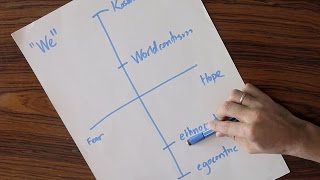
Vishen Lakhiani offers a framework for voting based on a politician's "level of awareness"—how wide their circle of "we" is. He maps leaders on two axes: fear versus hope, and awareness from egocentric to cosmocentric. Vote for candidates who expand inclusion rather than exploit tribal fear, he argues, using examples like Trump, Farage, and Obama.
Chapters
Democracy is a pain because as we're watching this upcoming US Election unfold, it's sometimes so hard to figure out what side should we be on. There's so much negativity on Hillary, so much negativity on Trump. How does one decide where to cast your vote? But as confusing as democracy can sometimes be, it is important to vote. We can see the effects of what happens when people choose the wrong candidate or, or cast the wrong vote. So many countries descend into chaos and anarchy because people believed a leader who made false promises or used, say, populism to sway a population. For example, Hugo Chavez of Venezuela. Now, let's look at what's happening in the US and what most recently happened in Britain with the Brexit vote. With all of the conflicting information coming from two opposing political parties, how do you decide who to believe and who to vote for? I'm going to teach you a simple fail safe algorithm that you can apply in your life when you're watching the next political debate or when you're trying to decide what party to side with. This algorithm transcends what the media is saying. It transcends the words of a politician, and it works. Now, the first thing you want to understand is you're going to take a piece of paper and draw a simple line that looks like this. It's a simple cross. On the horizontal axis of the cross, you're going to add two words, fear and hope. Now, I know what you're thinking, Vishen. You're going to tell me that I should vote for politicians who speak more of hope and less of fear. No, that's not it. Yes, many people have suggested that this fear hope model works. But there's a problem here. When Hillary Clinton is warning us about the dangerous impact of climate change, is that fear or is that hope? When Donald Trump is saying he wants to make America great again, is that fear or is that hope? You see fear or hope? Depends on your viewpoint. Someone who doesn't believe in climate change will say Hillary is being a fear monger. Someone who cares about the planet might say she's bringing us hope, showing us that we can take action to change the planet. Someone who's pro Trump will say Trump is bringing them hope. Someone who's anti Trump will talk about the fear he uses when he warns us of Mexicans or Muslims. So there is a second thing you want to pay attention to, and that is this axis. Now, this axis looks something like this. And what I'm going to show you is a simple scale. And we can Think of this scale as our relationship to the word we. Now, this scale comes from the famed philosopher Ken Wilber, but many other philosophers or experts in human development have used a similar scale. It's your levels of awareness regarding how big your circle of who you include in your we is. Now, right at the bottom is what you would call the egocentric individual. Egocentrism is something that individuals or entire tribes of people exist at when they are only concerned with their own individual survival. If you go back 700,000 years ago, when human beings were primarily hunter gatherers, and you came across a bison, and you were about to hunt that bison, and another hunter came along, you might fight that other hunter for that bison. Because, look, if you couldn't feed your family, you lose your family. You don't give a damn about his family. You care about yourself and your offspring. That's egocentrism. But as human civilization evolved, we move to the next level, and that next level is ethnocentrism. Ethnocentrism is what almost 70% of the world exists in right now. Ethnocentrism is when you decide that your loyalty belongs to people of your skin color or your religion or your nation or your political party. Ethnocentrism is a step beyond egocentrism. It's when you extend your circle of we to a particular tribe of people. But there's a problem with ethnocentrism. You see, ethnocentrism isn't complete. And in a world that's increasingly more connected, more globalized, in a world where people are flowing as immigrants between different countries, when you can have friends on Facebook with people on the other side of the planet, when your religion isn't the dominant religion on planet Earth, ethnocentrism is not enough. And that's when people start ascending to a next level called world centrism. World centrism is when you can be proud to be an American or a Nigerian or a Canadian, but you also recognize that there's beauty in every other country, every other culture. You can be a Muslim or a Jew or a Hindu, but you're open to exploring ideas from other religions. You might marry someone of a different religion or different ethnicity because you simply do not see a difference. You belong to one race, the human race, and you see collective humanity as what your circle of we expands to. So human beings need to move from ethnocentrism to world centrism. It is the path forward. It is progression. But again, there's a fourth level. And this fourth level is sometimes referred to as cosmocentrism. Now, cosmocentrism is a level even beyond that. It's when you feel an affinity to all level life, to all life forms. If an alien species in a spaceship landed on planet Earth, you would feel a kinship with them simply because they are sentient life. Now, don't worry about cosmocentrism. That is way in the future. Maybe less than 1% of today's global population function at that degree of their circle of we. But if you're at world centrism, congratulations. You have made forward progress. You're in that minority of human beings who have risen above ethnocentrism. And rising above ethnocentrism is important. Eric Hoffer, in his book True Believer, which was written shortly after World War II, said the less justified a man is in claiming excellence for his own self, the more ready he is to claim all excellence for his nation, his religion, his race, or his holy cause. When Eric Hoffer wrote this, and Hoffa was a remarkable man, he was the recipient of the 1983 Presidential Medal of Honor. When he talked about this, what he was saying is that the less confident you are in your own abilities, the less growth you have experienced, the more likely you are to move towards ethnocentrism. Because when you don't have enough faith in yourself, you decide that that faith is going to come from religion or your particular ethnic group or your particular political party or people who are like you. You need allies. But as you grow up, as you expand, as you evolve, as you see that you have power, you rise up to ally yourself with all of humanity. In short, this is forward progression. Mindvalley's goal is to push humanity forward. So we always are looking at politicians or political parties that exist at this level. And now this diagram starts getting useful. Remember Brexit? 70% of the UK parliament was against Brexit. Almost every expert on UK economics said Brexit was going to be a disaster. Yet people voted for Brexit. Why? Because a guy called Nigel Farage basically appealed to ethnocentrism. Remember that time when he stood in front of a billboard showing hordes of Muslim immigrants, really Syrian refugees, and said, we shall not have that happen here in Britain, while it was bullshit, because Britain is not part of Schengen, so those immigrants can't come in anyway. But he used that sort of ethnocentric appeal to get votes. As a result, the UK voted for Brexit now, whether Brexit was right or wrong is beyond the point. What I'm saying is politicians appeal to ethnocentrism, which is a lower form of human awareness, to get votes. And when they do that, if you understand this model, you need to call them out on their bullshit. Now, let's come to Mr. Trump. Mr. Trump has said some great things. In many ways, he inspires hope for Americans. But Mr. Trump is appealing to that raw ethnocentrism of a portion of Americans. Now, these people are not bad people. They are people who have been marginalized, they've been sidelined. They're people we need to care about. Remember Eric Hoffer? These are people who are less justified in claiming their own excellence. And so they need to appeal to their larger tribe to back them up. These are not bad people. They're just people who have been forgotten. But pay attention to what Trump is saying. He is appealing to, to a lower state of human awareness. For example, he completely denies global warming. Well, that's one of the dumbest things I've ever heard. Climate change is the single biggest threat to humanity today. But men like Trump will not talk about climate change, because to care about climate change, you gotta be at the world centric level. He pulls people down to ethnocentrism because ethnocentrism is a powerful way to mobilize votes. In fact, when Erich Hoffer wrote his words, he wrote them in a book called True Believer, which was talking about how communism, Nazism was able to mobilize millions of people behind bullshit ideologies. So all you have to do when you're trying to decide who to vote for is to ask yourself, is this politician appealing to world centrism or ethnocentrism? And when you can look at that and see who they define as they are, we, you are able to have a better BS detector. You're able to understand, is this man leading us to the forward progression of the human race, or is this person holding us back to an era that is best reserved for the dustbin of human history? Now, we can look directly at leaders like Barack Obama, like Trudeau in Canada, and see that they inspire hope. Yes, but they inspire hope by appealing to world centrism. Obama is very much looking at cosmocentrism when he speaks about his role as a conservationist, when he gave a 400 million loan to Elon Musk so that Elon could help move the world to alternative fuels. Say what you want about Barack Obama, but one thing about the man is that he appealed to these levels of human awareness. When you look at Hillary, ask yourself, where does she stand? Yes, multiple scandals, there's that whole email server thing and all of that other stuff. But you also got to recognize that when you're running for power, people dig up dirt on everything you do. So dirt aside on Hillary, dirt aside on Trump, the clearest, surest way is to look at level of awareness. Does Hillary ask you to fear other cultures or races? Does Trump ask you to fear other cultures or racists? I think the answer to that is easy. When Trump tells you that we need to fear Muslims, that's appealing direct to an ethnocentrism core that is within individuals that we need to move away from. When Trump tells you that we need a wall to keep out Mexican immigrants, even though the inflow of immigrants has been reversed in recent years and more Mexicans in America are going back to Mexico, well, that's ethnocentrism. So since the facts are cloudy, by understanding this model and looking at levels of consciousness, you can decide who is the person you want to elect in power. And I will tell you this. In modern history, as our world is moving and awakening towards world centrism, you need to pay attention to the language your politicians use. When they tell you, like Hugo Chavez, that the rich are evil, or that gay people are trying to infringe on our right to marriage, or when they rail against blacks or Muslims or Mexicans or anyone that they deem as the other, that's the surest sign that this is a guy you do not want in power. And over and over and over again, nations make the mistake of voting these lower conscious human beings into power, only to see how their infected worldviews bring a country down. So I think I've made myself pretty clear in terms of how I vote, and I hope these ideas apply to you. Because when you watch the next presidential debate, no matter what country you're in, no matter who those potential presidential candidates are, pay attention to their level of awareness, to their level of we, and always pick the candidate. Everything else aside, pick the candidate who has that largest circle of inclusivity. Thank you and good luck voting.
More from Vishen






Brown Noise for Deep Focus and Concentration (Best with Headphones) | Gabriel Loynaz



Your Appointment With the Eternal | Guided Meditation with Michael Bernard Beckwith