Lies in Food Advertising Exposed | Vishen Lakhiani
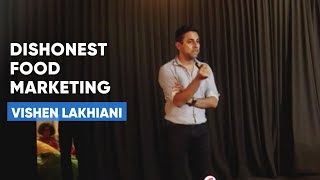
This YouTube talk (Feb 13, 2018) by Vishen Lakhiani critiques mass-marketed foods—using Milo as a focal case—to argue that sugary products and misleading advertising are driving obesity and poor child health in Malaysia. The video cites expert opinions (Mark Hyman calls Milo "definitely toxic" and compares its glycemic index to Coca‑Cola), quotes Milo advertising (claiming "four out of five children suffer from energy gaps"), highlights ingredient-list concerns (sugar listed first; maltodextrin and other sugar aliases), notes product calorie counts (124 kcal per recommended serving), and urges policy action similar to Chile's restrictions. The talk also addresses corporate responsibility and conflicts of interest (Nutrition Society of Malaysia funding disclosures) and closes with a call to share the message.
Questions this video answers
February 13, 2018.
55 (stated as the same as Coca‑Cola).
124 calories (per recommended serving, as quoted).
At least 188,000 USD (reported as funds received from Nestle and serial partners).
"Four out of five children suffer from energy gaps."
Chapters
The country I was born in is now the fattest country in Asia. After this presentation, what I'm hoping is that you see that the vast numbers of us in the modern world today are living in a lie. We believe this lie, but this lie is making us obese. It's making us fatter as a country. It's made us the fattest country in Asia, and it's making our children sick. Now, what I want to unveil in this presentation is what we need to do in Malaysia. Okay? So the first thing is, this has happened before. Some of you who might be like 70 or 80 years old might remember advertisements such as this give your throat a vacation. Smoke a fresh cigarette, and notice something. That guy, he's a doctor. Or how about this one? Now 10 months. Scientific evidence for Chesterfield. Scientific evidence. And this one, I love this one. As your dentist, I would recommend Viceroy's. What you're going to find is that in the next five years, we're going to discover that sugar is as bad as tobacco, potentially worse, but we haven't woken up to it yet. Just like 50 years ago in America, this was considered. Okay, I'm picking on Milo because basically, if we want to spark a conversation, we got to take that one thing that people are really sensitive about and poke it. But this is about all foods that are mass produced and marketed to us. We need to start a conversation on all foods that are pushed, including breakfast cereal, including other types of drinks that we take. I'm Talking about you, PepsiCo, Coca Cola, Kellogg's. In Malaysia, the level of knowledge for nutrition is still way below what's happening in America. In places like California and New York, the consumption of sugar is starting to go down. People are actually getting healthier. They are awakening. In Malaysia, the information being put out is very, very, very obsolete. Yesterday, I listened to an interview on BFM radio with a local nutritionist. She said the amount of sugar in Milo is okay. Right? She said that. I don't know who she is, but I decided I don't want to go for someone who was just a local nutritionist. I want to go for the best in the world. This is Mark Hyman. He is the doctor to Hillary Clinton. He is one of the guys who popularized functional medicine in the U.S. mark Hyman has written a series of amazing books. I think he has something like 10 bestsellers. And his upcoming book coming up on February 28, is called Food, what the Heck Should We Eat? So I asked Dr. Mark Hyman to tell me, what's the deal with Myelo, would you guys like to know what he said? So again, remember, this is not me. This is the verdict from one of the foremost doctors and food experts on the planet.
Milo has the same glycemic index as Coke, and many people use more than the recommended amount on the label. It's definitely toxic.
Milo has the same glycemic index as Coke and many people use more than the recommended scoops. Glycemic index is basically a measure of the sugar spike that you're going to get in a drink. Same glycemic index as Coke, and many people use more than the recommended scoops. Even there from America, he can see what's going on with the Nestle bullshit. But then he said this, and I want these words to burn in your memory. Definitely toxic. He's not just saying Milo is bad, he's saying it's toxic. And also, keep in mind, he said it has the same glycemic index as Coke. Let's look into that. According to Wikipedia, on the actual Milo page, Milo has a glycemic index of 55, the same as Coca Cola. Now, if you mix Milo with milk, of course the glycemic index goes down. But look, if you add milk to Coca Cola, the glycemic index goes down as well. That's Nestle's argument. Look, look, we're not as bad as Coke. People drink Milo with milk. No, they don't. They drink it with sweetened condensed milk. The glycemic index goes up. And of course, you can add milk to anything and it makes it slightly healthier, right? You can add milk to poop. It's healthier. Poop. Now it gets worse. And this is what I'm bringing to attention. And this is what the Malaysian government has to start paying attention to. See, as the public started awakening up to the dangers of sugar, food companies got very, very, very creative. They started having marketing brainstorms to figure out new words for sugar. Last week, a former brand manager for Nutella confessed to me. She said that while working for Nutella, she got very depressed because in marketing meetings they would come up with new names for completely unhealthy stuff such as sugar. And she said it just felt, you know, off to her. Now, many different ingredient lists for Milo suggest that this is what is in Milo. Now, this is not from Malaysia. This is from another country where they have stricter food labeling laws. The number one ingredient in Milo is sugar. Then there's skim milk, then there's malt extract, then there's Something called maltodextrin. Let's go deeper. Right. The four most common ingredients in Milo is this. So number one, sugar. I was talking to one of Malaysia's top health bloggers and she says, look, anything that has sugar as the number one ingredient, just don't put it in your body. Milo is the number one ingredient is sugar. The number two ingredient is skilled milk powder. Number three is something called malt extract. That sounds healthy. Maltodextrin sounds like something really cool that gives you energy and makes you like a superstar sportsman. But I want you to remember these words. Malt extract, maltodextrin, malt extract, maltodextrin. What are the words? Maltodextrin, Maltodextrin. Okay, now this is research on additional names for sugar. This is from an incredible documentary. Watch this with your kid. It's called the sugar film and you will see that. Malt syrup, maltodextrin, Maltese. All of these are other words for sugar. Don't just take it from the movie, take it from the British Heart Society. Okay. Maltose, barley, malt syrup, maltose, all of these are different words for sugar. They come up with these fancy names because we don't know better, including our government. They come up with these fancy names because they let us. It allows them to get away with things like this. When you give your kid Milo, you're giving your kid what is essentially a substance that's toxic, that's making them obese. And also, now we know sugar also reduces the child's cognitive functioning. It can even cause things such as acne and pimples. It is poison to the human body when taken in large doses. And Myelo gets us addicted to it.
And you'll make them hyperactive and irritable and cranky, trouble focusing and learning. And then they're going to be crashing because their insulin go up, their sugar go down, then they need more and they'll go up, they'll go down all day long. They're on a roller coaster of sugar and insulin, which makes them unable to really focus and learn. It's called, by the way, in America we call it an achievement gap. Kids who eat this way have what we call an achievement gap. They have poor school performance, they don't graduate as often. The jobs they get are poor paying and their whole lives are affected by this.
Now let's not just stop with the ingredients. Let's look at how Nestle is advertising. So this is the second thing that we need to force the government to start acting on energy Gaps. You guys saw the video. Let's play it again because I want this song to sink in your head. Energy. Energy. Energy.
Energy.
Low Energy. My thumb. Light.
Low.
Focus. Sky. Baka. Energy gap. Yeah. Four out of five kids have it. Energize. Start your day. The champion. Wave. Happy. Energy. Energy gap. The energy gap.
Milo every day.
Milo every day. I'm not making any judgment on that ad. I simply want you to remember what that ad said. It said, beat energy gap. Drink Milo every day. Drink Milo every day.
You.
It also said that four out of five children suffer from energy gaps. Please ask your doctor about that. Is that a legitimate illness? It's the make believe illness. The idea of the energy gap and then the statement that four out of five children suffer from it. It's right in the ad. They are telling Filipino moms and dads, four out of five children suffer from energy gap. Straight up from the Milo ad. That should Nestle executives. I would love for you to print that on your T shirts and walk around and see if you can look your wives and children in the eye.
I would say, you know, I don't know what the rules are in Malaysia, but in America there's something called the Federal Trade Commission that has to have truth in advertising. You can't just make up stuff and say it. This is one of the most blatant violations of truth in marketing and advertising I've ever seen. It's right. To me, I would say it borders on criminal.
Are energy gaps real? Does Milo really help with performance? So I thought, well, look, let's just ask the number one performance guy in the world. Let's ask Steven Kotler. Steven Kotler is the founder of the Flow Genome Project. Steven Kotler works with sportsmen. Steven Kotler wrote the book Rise of Superman, Stealing Fire. He's the guy who popularized the idea of flow states in sports. What does Steven Kotler think of energy gaps? So, Stephen, what do you think of Nestle's energy gap?
So I got to start by saying I am not an expert in nutrition, but I am something of an expert in high performance. And I've never heard of an energy gap whatsoever. And the only thing I can think about this is the one thing we know is that the body's energy goes up and down. It's a homeostatic system and it's always moving up and down. And their idea that there are these energy gaps during the day and the way to fix that is to drink a lot of sugar. Essentially, you're going to get a tiny little Spike in energy followed by a very deep crash. You're not revitalizing the system, right? And if you want to get that high again, you're going to have to drink more sugar the next time and you're going to pinball yourself up and down. If you're tired and you've got an energy gap, take a nap. Take, take a 20 minute nap. The number one thing most people can do to amplify performance is get enough sleep, right? It's a really simple fix, but take naps, get enough sleep at night. I don't think adding a lot of sugar to the situation fixes it. Again, not a nutritional expert, but you.
Are the author of, you are one of the main partners in the Flow Genome project researching flow states and athletes and high performance. You wrote the book Rise of Superman and you wrote the book Stealing Fire. And you are an expert in performance, one would say.
And certainly, you know, in our experience, nutrition is really hard. Nutrition and flow is very tricky. It's a murky subject. But the one thing that, you know, there's no diet plan that we seem to work and everybody's different, but the one thing we tell people is lots of fruits and vegetables, lots of natural foods, right? More fish than meat. And stay away from processed food and try to stay away from excess sugar. That's pretty much basic common sense nutritional guidelines for high performance for pretty much everybody in the world at this point, right? I don't think you're going to find anybody who disagrees with that.
Thank you. That's what I needed. Awesome. And I have your permission to use this?
Go fucking crazy.
So you heard what he said, right? Now, drink Milo every day. This, this is the lie. See, Milo is essentially not bad. It's not evil. It's like hot chocolate. And there's a brand of hot chocolate that I, you know, I have my kid drink maybe, and it's not like I force it to him. But once in a while, my daughter Eve will ask for hot chocolate maybe once every two or three weeks and she'll have half a cup. And if I compare the back of that box with Milo, it's around the same ingredients, right? It's roughly around the same amount of sugar. But there's something about this hot chocolate. It says something like decadent. A decadent drink. At least that's honest marketing. You have it once in a while. Milo says, drink Milo every day. And that is an ingenious way to take what is essentially a sugary candy hot chocolate. Like crap. Poor man's hot Chocolate and get people in developing versus food. If you ask the average Malaysian, what would you like to take a guess? 80, 20. 80 is what? Exercise or food? 80 is food, right? So you're a little bit more educated, which is why you're here. So 80, 20. Actually according to this study, it's 95, 5, 95% of your body shape is what you eat. 5% is your food. The ideas going out there right now are convenient lie that serve the big food companies. They say Malaysians are hooked on social media. Malaysians lead a sedentary lifestyle. Malaysians drive everywhere. No, that doesn't change anything. This has very, very, very little to do with exercise. Exercise, look, it gives you a healthier heart. It makes you fit, makes you look good. But if it's about obesity, it's about food. Okay, now this is the ending of that article. Exercise is excellent for health. It's just not that important for weight loss. So don't expect to lose a lot of weight by ramping up physical activity alone. As a society, we also need to stop treating a lack of exercise and diet as equally responsible for the obesity problem in this country. Here they're talking about the US public health. Obesity polity should prioritize fighting the over consumption of low quality food and improving the food environment. So Malaysian government, please stop saying it's exercise that's bad science. It is about fighting the over consumption of low quality food and improving the food environment. We need to face science and reality so that we can actually heal this, this weakness in our society. Now on this article there's a wonderful video that explains all the science behind it. I won't play it now, but you can watch it in your free time. I want to give you an example, okay, of the map so you understand exercise versus diet, calories and Milo again, based on the back of their can, 124 calories. Now there are calorie burn calculators out there which will give you an estimate of how much you have to run or walk to burn 124 calories. So those of you who just had that drink of Milo, right, The daily recommended allowance of Milo. Here's what you have to do to burn that off. You would have to run 22 minutes from here to KL Central, right? Hilton Hotel. Now what do you think happens when people do that run? They go to the Hilton Hotel and they have a glass of Milo so they can, you know, so it's an, it's, it's a stupid waste of time. Okay? Exercise does not make you lose weight. Food. Watching what you eat and staying away from fake food helps you lose weight. The New York Times has an incredible newspaper. They're doing an expose right now all around the world of how big food companies are poisoning humanity. Obesity is growing everywhere. Now, in this New York Times expose, they uncovered that the Nutrition Society of Malaysia, which I'm sure is run by great people. And I'm sure this man over here who is the head of Nutrition Society, is a wonderful guy who joined, genuinely cares about Malaysia. But what they said is the data that they're putting out is likely compromised because it's being funded by Nestle, Kellogg, PepsiCo, Tate and Lyle. The Society has reportedly received funds worth at least 188,000 USD from Nestle and Serial Partners. Now, I was shocked when I read this article and that was what sparked my first video, because another thing this article spoke about was the sugar content in Milo. And so in my video, I checked the back of the tin and I simply marked it with a marker, 40%. And that was what got people talking. It's amazing that we never noticed that before. But I think there was something about the shock of that video, something about the marker, something about the way it took off on social media that certainly got the conversation going. Now, this conversation has happened in other countries and other countries have taken faster action than Malaysia. This is the New York Times yesterday. Chile has now created a sweeping wall on obesity. They have banned advertising that targets kids, Tony the Tiger, for example. And this is something that was in the New York times. According to AB Chile, a food industry association, more than 1,500 items, or 20% of all products sold in Chile, have been reformulated because the government got tough. In response to the law, Nestle reduced the sugar in its Milo chocolate powder drink. Chile actually created laws because Chile became a country with dangerous levels of obesity. And these laws cause good change to happen. This article goes on to talk about how now kids in Chile, when they are buying junk food, firstly, they're no longer swayed by cartoon characters. And because it's so clearly labeled the sugar content, these kids are now telling their parents, mom and dad, I'm not going to eat that. I know you ate that as a kid, but I'm not going to eat that. And the public in Chile rallied behind the government. Today, Chile has caused 1500 food products to change. 20% of all products sold in Chile are now forced to become healthier. That is remarkable. That is what we have to do in Malaysia. If you're working for the government, I Would love, love, love to have an open discussion with you on how we can take action. We have to stand up to these big food companies because I believe that the people who work for these companies are ultimately good. I know people who work at Nestle, I know people who work at PepsiCo, I know great, good people who work at Coca Cola. But what happens is when we've created a world where the algorithm is designed to increase shareholder value and not think about the future of our planet multiple generations down, and so everything is about short term immediate stockholder and shareholder value and not about what we're doing with poisoning our body, with destroying our environment. It's the way corporations are designed to run. And corporations will justify that by saying, look, we have CSR initiatives and all of this other stuff, but we as a species need to wake up to this fact. We have to change the nature of how corporations run. I don't think the people at Nestle who come up with the energy gap video are evil or bad in any way. They are in what you would call a state of cognitive dissonance. Now let's talk about that for a moment. This is Tom Chee. Tom Chi is the co founder of Google X. And Tom Chi, after he left Google X, So he's the guy who created the first Google Glass. When Larry Page came up with the idea, he created the first prototype in four hours. He's a brilliant mind, one of the smartest guys in the world, Right? And Tom is a friend and he was sharing with me this story after he left Google X, a big food company came to him to ask him to help them innovate on how get this to get teenagers to drink more of their product. Now, I shared the story in a speech recently in San Diego and I'm going to play it for you. It's four minutes, but I want you to see what's going on in the minds of these multinationals. How can we tell if our work, if what we are doing in life represents cancer or cooperation? So I want to go back to Tom Chee and a really interesting story he shared with me. See, Tomorrow ran an innovation think tank in Silicon Valley. So these massive corporations would come to him and they'd say, tom, help us figure out here's $350,000. Help us figure out how to do X or how to innovate on Y. And one day a particular company came to him and they said, tom, we want to give you all of this money and we want you to help us figure out how to get our Beverage, our carbonated, sugary beverage to teenagers. So Tom said, why do you want to do that? And they go, well, you know, teens are not drinking as much of this beverage. And we think it would be great if you could help us figure out how we can raise our bottom line and improve our shareholder value by getting teenagers to drink our beverage. And Tom said, but you realize your beverage is basically high fructose corn syrup. It's sugar. You realize your beverage contributes to diabetes. And they said, no, no, no, Tom, our beverage doesn't contribute to diabetes. Yes, it has sugar, but everything has sugar. I Our scientists have found that there are at least 100 causes of diabetes, and there's no conclusive link. So Tom said, look, I'm a scientist and I know that I'm not going to work with you. And so he actually turned that down. God bless Tom Chi. He turned down hundreds of thousands of dollars. Tom told me this. He said, when I tried to explain to the employees of this company that their beverage caused diabetes, they refused to buy it. They had many layers of denial saying there are hundreds of causes of diabetes and that soda is just part of a balance set of choices you can make food wise, right? And he said they went further. They would say, look, our company is really good. Our company was the first company to show a multiracial couple in an ad. Our company was the first company to show gay people kissing on a television spot. And that was actually true. And Tom said this. It's a classic example of fooling yourself that goodness in one area gives you a free pass in others. Really what's true is that we need to stay awake and keep learning in all the areas we can. Now, one thing I love about Thomas, he's a really compassionate being, right? He never felt animosity towards the employees of this company. He never felt that they were wrong. He said this I felt for them as well. Because shaking their reality would mean leaving a corporation they enjoy working at with co workers they like and the careers they'd invested in and the financial stability that has helped them support a family in their city. That's what deep down felt at stake to them. That led them to pile on countless layers of denial and misinformation to protect their business, their idea, their job. Which leads to an interesting question. Are you. Are we working for humanity plus or humanity minus companies? How do we know that we have not formed, fallen into that cognitive dissonance? How do we know that we are not actually cancer cells poisoning the human colossus, but deluded and fooled into believing that our products or services are actually good. And this is where I believe our education systems need to introduce a new model into the world. Humanity plus or humanity minus entrepreneurs can be humanity plus or humanity minus businesses can be humanity plus or humanity minus entrepreneurs can be destructive forces or they can be positive forces. If you do not make that distinction, you create entrepreneurs who help perpetuate this society where we never feel enough, where we have to drink high fructose cancer up, which is marketed as happiness in a red can. So the question is, how do you tell if your job, if your, your work is actually pushing the human race forward and is thus humanity plus or if your job and your work is really an algorithm designed to create shareholder value, but it's really going to be creating a world that is worse off for your children? And that is a really important question. Thank you. The question I ask myself in every business decision I make is a question I call the Eve question. My daughter's name is Eve, and I find that thinking about your children is a very good way. If I'm getting a product out, will this product make the world better for Eve or will it simply make me more money in the short term? So the steps are this. And this is how I believe it's going to end. It's going to end with health winning. Because just like what's going on in Chile, what's happening in the us, the fact that even in Britain and in Australia and in many other developed countries, people are fighting back against big Sugar and Big food, that same thing's going to happen in Malaysia. All we want to make sure, and again, I'm speaking here to the Malaysian government, is that we do it sooner rather than later. Because every year we wait means more productive lives lost. No more child diabetes, more mothers who are blindly brainwashed to feed their children dangerous substances. Now, I believe that companies like Nestle can pivot. Every company can. Disruptions occur in industries all the time. Good companies pivot and they move to newer, more innovative products. Surely Nestle can get off its addiction to money from sugar and find better ways to truly live up to its mission. And. And you know what Nestle's mission is? Nestle's mission is to be the world's greatest health and wellness company. I want them to be that. But they are not doing it now. And if you work for Nestle, I want to make sure that. I want you to know we are on your side. Like Tom Chi said, nobody is blaming you. We want you on our side in a fight against obesity because you guys are the $80 billion Bohemian and the only change that can happen is change from within. So yes, we want you to change from within. We want you to be the world's greatest health and wellness company. But if the government has to push a little like they did in Chile, I'm sure that's going to help too. So let's work on this together. And all of us, the public, we got to keep sharing this and keep speaking up and keep demanding accountability. In the recent article on the New Strait Times, Fariza Hanam Rashid said Malaysia has had the largest number of productive years lost because of obesity among females, which was between 7 and 12 years and the second highest among males at between 6 and 11 years. That is not a statistic to go Malaysia Bole. It basically means that Malaysian women are particularly being hit bad by this. Now Chile has made the change. Chile is one of the countries with really high obesity rates now. You're not going to see a drop in obesity levels in Chile immediately. It's going to happen over several years. But they've made the change and children are being educated. That's all we want here in Malaysia. The Malaysian government needs to follow Chile's example. So that's all I wanted to share with you guys today. And if you are watching this on Facebook, feel free to take this video, feel free to slap on your own website, feel free to dissect it, to cut it up, to put your own voiceover in it, feel free to take the script, to take the messaging, put it in your own language. I don't need the views, but I want you to use this in any way you can if you need the views or you want to get people to your YouTube channel, but share it. Share the message in whatever language, whatever channel you have permission to copy, paste, pirate, re, edit, translate, do anything you want with this message, but we cannot be silent about this. Thank you.
More from Vishen






Brown Noise for Deep Focus and Concentration (Best with Headphones) | Gabriel Loynaz



Your Appointment With the Eternal | Guided Meditation with Michael Bernard Beckwith