🛑 LIVE: Online Body Transformation Seminar with Mindvalley's Top Health Pioneers
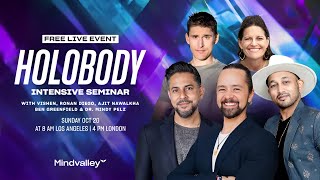
This final chunk focuses on live Q&A and program logistics for Mindvalley’s Hollow Body program plus coaching certification. Ajit Nawalka answers administrative questions: lessons unlock weekly (45–60 minutes of video/week plus live Q&A and coaching pods), program length is four months with access extended ~2–3 months after the live run, a $200 deposit reserves a seat and is credited toward final price, certification costs $2,999 and the Hollow Body (non-cert) option is $1,999 (early seats), and lessons are released week-by-week rather than all-at-once. Time commitment: ~3 hours/week for live training plus ~1–1.5 hours/week outside class to become proficient. Vishen reiterates the program is holistic (integrating fasting, strength training, sleep, gut, hormones, social and spiritual practices) and cites a claimed Net Promoter Score of 80 for the Hollow Body program.
Questions this video answers
Lessons unlock week-by-week (first module unlocked on 4th of November as the program starts).
Program is four months live with approximately 2–3 months of access after the live program to finish content.
Deposit is $200; it reserves a seat and is credited toward the final program price (counts as first payment).
Hollow Body (personal transformation/audit) advertised at $1,999; Hollow Body coaching certification advertised at $2,999 (early-seat pricing mentioned).
Live training ~3 hours/week; outside-class work about 1–1.5 hours/week to become proficient (estimate).
Chapters
From wherever you are in the world right now. We're all talking at a home place right now. I'm inviting each one of you to my own home in Estonia where I live. My feeling is that we are sitting at my house. I'm here, you're there, and we are going to have a conversation about holistic health for the rest of the night, which is a wonderful way to spend a Sunday evening for me. 6, 6:01pm on Sunday evening and I'm seeing, I am seeing the chat on fire. Rosemary Emma Carte, Lovisa from Stockholm. Mary from Seattle, Marina from Spain. Marina from Spain. Michaela from Austria, Rosemary from Spain, Anne from Denmark. Andrea Gina, Georgia from Cape Town, Jackie from Seattle, usa Alejandro from British Columbia, Canada Teresa from Arizona. Greetings, everybody. Welcome to the Hollow body Intensive seminar. It's, it's a pleasure and it's an honor for me to have. Right now we have almost 2,000 people here in, in my kind of living room at home with me. Welcome, you know, make yourself comfortable. I'm very, I not only get happy to be able to talk to you about these things, but I just wanted, I want you to know for all, each one of you of the almost 2,000 people that we have here, it is an honor to be able to have some of your Sunday time.
To.
Have a conversation about the temple of your soul. The next couple of hours, you and me plus Ben Greenfield plus Dr. Mindy Pel plus Vision Lani plus Aid Nawoka, we're going to be talking about things that can contribute to the way that you relate to the temple of your soul, perhaps the most precious thing that we have in life because the thing that makes us alive. And by being here, you're giving me this space, this time and distrust. And I wanted to know that. I don't take this lightly. It's an honor. And in this whole body intensive seminar, what I want, you will see me holding my phone several times because even though there are structures, there are presentations, I slide things that are prepared for you. Like I thought of this through, I prepare something from the heart. I also want to flow with you. And so I'll be looking at who is here and what conversations are happening in this, in the present moment as we are having this conversation. Because the real richness of a conversation about holistic health comes with the interaction that we can have over a certain topic. The beginning, besides the traditional where you are from. I think that's how any online event starts is the easy question where you are from. There are other Things that I want to talk to you about because, because we are starting a seminar about holistic health. If we are starting about a, if you came, if you decided to come to a seminar about holistic health, I want to know what brought you here. In what and where are you situated in this whole journey, in this whole realm of life, which is the health development, the way that you understand the health and the way that you practice the health in your life. And so I want to show you a question that I want to, I want you to let me know in the, in the chat, where, in what stage of healthy living are you? If we are talking about holistic health, we are talking about a way of living. So when we consider healthy living, let me know in the chat, number one, if you are here because you say, hey, I need a fresh start. The fresh start is that thing that, you know, healthy living is something that I think I know I need to get started with. I've tried, but I never took this seriously. And now there is, there's a motivation. Either is because there was a part of my awareness that got awakened to that, or sometimes it's a call to action. I, I felt a pain that I never felt before, or I had, I did a blood test and I realized that things are not so good, or somebody in my family had a situation that made me think about my own health and say, hey, it's time to, to put time here and to put more awareness. If I need a fresh start, I am number one, if I made some good progress, you know, my health journey. Healthy living is not something that is starting right now, something that I started back sometime that I started studying about health, that I started changing my habits. Maybe there was a situation that I solved. Maybe I changed, you know, body weight. Maybe there was a disease that I overcame. And from then on, my lifestyle has changed, my priorities have changed, but I'm looking for the next level. You know, I've done the basics. I'm not in the beginning of this journey anymore. I do a couple of things. I know a couple of things, but I know there is way more to know. I know that there's way more to implement, and I know there is way more to improve, and I want that. So I am number two, if I found that, or maybe health is your forte and like that, that's my field. I am the athlete of my, you know, maybe professionally or the athlete of my group of social group or I am the health person. I'm the health reference. Now. Whenever friends talk about health, they Ask me about or my family. I'm the person who is bringing the message. Studied, read the books, listened to the podcasts, did the programs, changed things. And now I am here because I want to learn how I bring this to other people. Health became that passion. It became a way of myself not only to take care of my own self, but a way of. Of me to express myself in the world. More or less like what happens to me is not only what I do is also hobby. It's also passion is. And I want that to become what I bring to the world. I am number three if that that's the situation I'm having. 112-231-3131. Living healthy my entire life. But I was raised on a farm. Dave saying I just had a physical last week. The doctor called to say that I am healthy. That's fantastic. And that, that's an interesting thing. I was raised on a farm. I'm going to talk to you, to all of you, about how our environment and social situation is changing and how our understanding of health needs to change to follow a advancement of lifestyle. I need a fresh start. Aren't I saying here. And I'm always ill. Catch everything going. You need to change things. You are at the right place. Because we're going to go from the basics to the advanced. Have done it before, did very well, but got back into the standard American diet and need to come back to health. This is another thing that happens. The healthy living is something that starts with an oscillation. There is a raise in awareness, in consciousness, and then you start changing your habits. But you see that you go back and forth. There's a moment of your life that is a call to action. And maybe it's a situation like a health scare or a diagnosis and then you do something and then that problem goes away. And then you realize that you go back to where you used to be in habits the way that they used to be, because the thinking, the body changed, but the thinking remained. And that's normal. That's natural. And part of the holistic health understanding is knowing that your health is not only the diet that you do or the exercise that you perform is a lot of your way of thinking. It's a lot of your identity. It's a set of priorities. That's why I wanted to have this, this checkpoint with you in the beginning. Then that was an intention that brought you here today. You are here on Sunday with me for the next couple of hours. And then Ben Greenfield, Dr. Mindy Vishen, Ajit are coming on. And the fact is that you decided to join. Now we have 2,500 people. What is the intention? Some of you came with a specific question in mind, or some of you are facing a issue or a problem that you are hoping to get a insight or a solution for. Some of you said, you know, I love the topic of health, whatever is available. I go. Some of you is like, I know I love the mindvalley community or the speakers are speaking, so whatever they do, I go, but some of you brought a specific question and if you did, let me know. I changed my mind and it changed my, my life. Paul is saying, and that includes the body, the all transformation in the body, and I think that is the beginning or that is the, the juice of holistic health is that all transformation in the body reflects a transformation in your, in your thought patterns, in your ways of thinking. Back in the day, this sounded esoterical. Ah, your, your body is, is transformed by your thoughts. And you're thinking it must be some kind of, of magic or some kind of, of superpower. And you realize that no, there's a very logical correlation. You change your, your body is in a certain way because of your habits. The way that you eat is a habit. The way that you exercise or don't is a habit. Your daily routine, your sleep time, the, the amount of work or how much work gets into your emotional state, these are all habits. And the execution of these habits generates the physical body in the state that it is right now, passing through the filter of genetics, passing through the filter of life history. And it is the change of these habits that changes the body. If I change permanently the way that I eat or the way that I exercise, or the, the amount of stress that I have, for example, the body chemically changes. But those habits, they come from behaviors that are repetitive. That comes from priorities that I have, that comes from beliefs and thoughts that I have. And so for me to change the physical manifestation of the body, I needed to see what is the thought pattern that is creating a dysfunction in my body and what is the belief that needs to be changed, that will then allow different thoughts, that will then allow different actions that will repeat over time become habits and physically manifest in the different, in the different body that, that is. Understanding that we have now when we talk about holistic health, that changes the, the, the way that our attitude towards it, and that is clarity that we need to have in the beginning of any conversation about holistic health. That's what the, this type of the conversation is how we start a whole body conversation. Hollow from the whole body comes from holistic and so hollow body is not only a set of tools, but is also a way of thinking about health as a philosophy of life is a way of perceiving an attitude towards health that, that is different. Some people are asking coming here for curiosity. Some people are learning more. Intention is to learn, learn all that I can. I need to sincerely start putting myself first. Terry, this is one of the main thresholds of developing a body that is healthy, is the permission that you are able to give to put yourself first. The reason why I bring this question, what's the intention that brought you here today? Is that a lot of, a lot of people come to a seminar like this with a specific question. Now I want to solve this issue or my body is in a state of pain, obesity, chronic disease and things are falling him and I need to solve that problem. And some people will come with an open mind like curiosity or I want to learn like, like some, like most of you said, this brings a more space to a health transformation. The curiosity in the open mind because the, the focus question, you know, my body is in a state of overweight and I need to solve that. And I hope I'll get an answer in this. This is a old way of thinking. The, the understanding that health is something that is performed and not achieved, that is a result of a lifestyle is a current understanding. And for body and health to change, we need that understanding first. We could have a whole seminar here only with tools and practices. Hey, let's talk about strength training. We will talk about, talk about 10 steps later today on very practical things to do. But we can do a whole evening like that. Eating, diet and eating protocol and fasting protocol and sleep hackism, all these kind of things. But at the end of the day, this feels very interesting for the mind. But three months from now, six months from now, there may be no changes because those changes are those ideas are only implemented when there's a different understanding. There's an awakening in the understanding about, about what health means, about what my attitude to health is. And we all have, we all face a inherited understanding about what does it mean to have a physical body and what does it mean to care about our health. Does any of you have a problem, a health problem that you've been trying, that have been facing for a long time and it feels like it's always there. For some people it is about weight loss. You know, there's part of my life that I've always been Trying to lose weight. And if it never ended, it's been like with me for the past, you know, 20 years for somebody else is energy for the last. It seemed that thing that I. I used to have energy when I was young. Now I. I don't have any more. And it feels that just lingering problem. Some people, different types of. Of diseases. There's one problem that comes after the other and it never seems to be solved. Some is just a general dissatisfaction with the body. It's like me and my body. There's always some issue here. There's always some insatisfaction. There is always some type of fight or disagreement. Body is this place, is this thing at this aspect of my life gives me burdens. And it hasn't, it hasn't changed much. It oscillates a little bit, but it is a constant. It is a perpetual problem. And, and I see a difficult sleeping. Yes. Constantly working to lose weight. And I'm tired of thinking about it. Hormonal imbalance, portion control, thyroid disease, Ms. this is when, when we have this mismatch, these lingering problems. The thing that never seem to be solved, this part of that is a inherited understanding of body and health from the past generations that had a different overview because they have different access to information and different health reality. Yeah, we need to understand, when we talk about holistic health before, before we go into the tools, before I go into the practices, we need to understand what is generating our health and our dysfunctions and how and what can create more health to our lives. We come from a understanding about health and body that comes from our past generations. Now, we didn't learn about health at school. We learn from our parents. They learn from theirs. They learn from. From their parents. And if you trace this back now here you see in the video footage, this is real footage from 19 from the beginning of the 1900s. This is in San Francisco in one of the first decades that people could actually record things. The it was black and white in the back in the day, but this footage was artificially colored with artificial intelligence. So it was colored recently, of course, it is 1906 in San Francisco. So it's black and white, but now you see color because of the technology. But I want to take a look of our knowledge in our understanding of health and the way that we experience our bodies today come a lot from what we brought, what we learned from people in that age. But people in that age. 1906 is more or less when our great grandparents were born. Depending of our generation, my great grandmother was born in 1912. Back in those days, what was the reality of health? What was the knowledge available and what were the leading causes of disease and, and death? What was, what was in people's mind? What were they worried about? What issues did they have with in terms of health and, and body situation was very different. Those human beings that you see in this video over here, none of them were very worried about thyroid problems or mood arthritis or cancer or obesity or Alzheimer's, partially because they would die much earlier. Their life expectancy was about 50 years old. And their main causes of death was infection. These people were getting ill and dying from things that we have long overcome. They'll die of cholera, they'll die of tuberculosis, they'll die of any respiratory infection or any gastrointestinal infection. They'll die of different diseases that are, that they would transmit to each other. This is what ended most of people's lives at that time. They also didn't have much knowledge about health. There were no studies and there's no Internet to spread knowledge. So whoever possessed knowledge about body and health were doctors. And so that was a figure of authority. There's something that is hurting in my body and I have no understanding because there's no knowledge available. There is no Internet, there's no studies, there's no just. So we have an idea. This is 1906. At the time there was no knowledge of nutrition. You don't know what is nutritious food and what is not. The idea of vitamins, the word vitamins was only invented in 1912. And then the understanding of vitamin E, R and the nutrients in food, those are things that those people had no idea about. And so if something's off with my body, I go to the doctor. Just like if something's off with my car, I go to the mechanic because I have no idea about. And then there's a dependency situation here. I depend on the doctor to tell me what to do. And the main problem, the main relationship with health is I have a problem, I go fix it. I have a problem. There's a something is hurting or I'm coughing and then I have a medication to stop coughing is a very symptom like relationship. The traditional health is like that. I have an issue, I go to a professional that tells me how to treat deaths. That's that issue. But the issue is not the real thing happening is the symptom. I'm coughing, but there's pain here. And then I go to the health care system that treats my, my, my disease today. We have a different way of, of thinking. We have the, for the first time we have the chance of choosing how our health is going to be. Those people over there, you will see that they, you, you won't see people worried about obesity and diabetes at those times for a couple of reasons. Because one, they would die much earlier. Second, because they had a very active life, there was a lot of manual labor and they also didn't have access to high calorie foods. The access to food period was, was lower. So the problems was underfeeding the body. Now we have the problem of over feeding the body. But those people had no knowledge about body and health. Whenever there was a problem, you depend on a doctor to give you medication. And the problems that ended their lives or the problems that gave them health were infections. It's like it's not something you can really control. You are in a space that somebody else is sick and because of the, you know, labor situation that is very unhealthy. At some point you are infected. There's nothing much that you can do against that and you can treat that and hope that you get better. Today these are not problems for us anymore. What ends our lives or what ends, what shortens our lives or what ends our well being decreases Our health are mostly chronic diseases. When we talk about what, what ends human beings lives today is something that is on the top of this tree over here. These are asthma, diabetes, dementia, cancer, heart diseases, arthritis, autoimmune diseases, obesity, heart diseases as the number one. If you look at all 9 billion human beings and ask what do human beings die of today? Most of them die of heart diseases. All of these situations on the top of the tree, they are what we call chronic diseases. They are not infectious. We don't get them because somebody else, you know, somebody else has diabetes and they were close to me. And then I, I have as well as our great grandparents situations. What they're chronic diseases because they develop over time and they develop as a byproduct of, of our lifestyle different than the generations before that. The diseases or the end of their health develop because of a circumstance. I was in a place and then I'm, I'm sick. Now our sickness or the health or the lack thereof is a bunch of choices. But we are still using the same mindset that those people used that is symptom based. I have a problem, I go to the doctor and I treat the symptoms, treating the root. If those guys here, those chronic diseases here, they have a thing that generates them, they have roots, they have Root causes for them. Back in the day the word was infection. That is what human beings were afraid of. Today, infection is not a huge problem anymore. But it has given space to another word that starts with I call inflammation. All these chronic diseases. Some a person has diabetes, the other person has a heart disease, the other person has obesity, the other person has an autoimmune disease. All of them, if you, if you look at them from the surface, they all look very different and they all have apparently very different solutions. I find my problems is my body has obesity and your problem is diabetes and their problem is a arthritis or autoimmune disease. If you, if you think as our predecessors, as our great grandparents thought, you would think that at the surface they are very different. The treatment is very different because you're thinking of symptoms. The symptoms of these things are very different. But what generate them is something very similar is the accumulation of inflammation in the body. This is a, this schema that you see on the screen. Here is what you study once you start going through the route of functional medicine. It's called the functional medicine tree. And it shows that the accumulation of inflammation in my body and your body will do different things. It will break the weakest link of the chain. But because of my genetics and my culture and my environment that is completely different than yours. Maybe my weakest link of the chain is diabetes and maybe the other person is an autoimmune disease like a thyroid problem, maybe for the other person is arthritis. And so that accumulation of inflammation to me will manifest as diabetes to the other person will manifest as pain in their joints to the other person will manifest as obesity. So if you look from, from our pre ancestors perspective, they all look very different because they're looking at symptoms. Today we have more knowledge and knowledge is spread and say ah, if you look from the other angle, they all have the same origin and this inflammation have causes. Inflammation doesn't happen out of the blue. It comes from certain root causes. And then if you bring all those root causes, the what you eat or the, the amount of the excess of nutrients or the lack of nutrients, the amount of exercise, sleep, toxins, infections, physical trauma. Genetics is also involved relationships even in spirituality. And I'll tell you more tonight how those things are connected. Environments, your beliefs that change, your actions that change how your body manifests physically, attitudes, emotional trauma, drugs, all of these things are the root causes. Now we can organize those root causes. We need, we need a way to work with them now. We need a framework. If these are too many things, I Don't even know where to start to generate healthy. So we need a framework. And so this is when we start understanding how the importance of holistic health. Because for our ancestors the relationship with health is a fix. I have a symptom and now I go fix it, go to the authority, the doctor that gives me the pharmacy and I'll fix those things for us. Now we have a choice, we have a alternative that we can create a lifestyle change the actions that we have on the day that are all addressing the roots of decreasing inflammation. If I have actions that create inflammation that then create they shorten my health. I can have different actions, different ways of living life, different morning routine, different evening routines, different relationship with work, different eating habits, different weekend habits that will generate health that's holistic health. It's not like ah, I have a pain in my joints, what should I do? Instead of going to isolated pieces of the fixing a symptom, I create a lifestyle based on, on seven pillars, holistic pillars. Back in our ancestors they believed in a couple of things. I either take a medication. And then after our great grandparents by our parents generation that was a start. The understanding of the knowledge of health that leads you to think that when I change my eating and when I change my exercise, my body changes. And that's true, that's true. But they are not the only two things. Back in the day we thought that all the answers is change what I eat and change what I how I move my body. Now we know that there are, that these things are only two variables of a more integrated system. Because the way that I think also impacts my, my body the relationship that I have with other human beings. If I, if I sleep, sleep well, if I eat well, if I move well, but I'm in isol, I'm in a state of loneliness. It takes me twice as longer to recover from any injury if I ever go to the hospital. Yeah, if I, if I'm losing weight, I know that nutrition is the, the king and the queen of all strategies. But if I have a good diet, but I sleep poorly, I lose weight, but the weight lost is muscle and not as much fat. So ah, we need to put the pieces together here. We need to know not only the pieces themselves, but how they interact. So this lifestyle is based on seven different priorities. One of them is nutrient richness. And later today I'm going to bring some ideas on how to take actions on each one of them. But here is the priority, here are the where I assess my life in terms of health. I'M looking at those things. Nutrient richness and frequent movement. Exercise is there, but sleep is of utmost importance. Also inner stillness that has to do with stress management. Doesn't matter if I eat very well and if I move my body frequently. But I live in chronic stress. If I live in chronic stress, if I am on stress, my liver is always releasing a little bit of blood sugar. And then that elevated blood sugar creates insulin resistance. And then insulin resistance can create diabetes even when I eat healthy. It was what happens with Tibetan monks. For example, there's A study by Dr. Mario Martinez found out that, you know, Dr. The, the Tibetan monks were from all these spiritual practitioners, the ones that are eating and dying out of diabetes. The in their biggest majority in the, in the whole world. And this is, it was not because of unhealthy eating. They were not eating sugar, they're not eating processed food. But they are trying to process anger, to avoid anger, you know, to practice that one sided compassion. And whenever there is a situation with anger and they've suffered a lot with the geopolitical situation with China. And so every day there's a situation that, that make anger arises and, and then their main goal is to just pretend the anger is not there and offer the thing compassion. But every time that anger comes, the liver releases a little bit of blood sugar and then there's blood sugar. Insulin is, is produced by the body. And if insulin is produced by the body non stop every day, at some point it creates insulin resistance. And insulin resistance given more time becomes comes diabetes. And those people, even with healthy eating, they were facing problems with diabetes. And then eventually the Dalai Lama came to the west to talk about the talk to the Western medicine, say hey, we understand a lot of a couple of things, but you also understand things that we, we need to know. And what they're. Those monks started to learn more is how to process anger, how to process their emotional state. In a way they'll be healthier for the body. So here we start understanding the body mind is connected, but not only that we need deep human connections in the body. The physical body in isolation is very fragile. The physical body, even when the, the eating or the exercise habits are not on point, but it lives in community, has a much more relaxed central nervous system and becomes much more robust. Sync with nature is also another priority of this holistic living. Because the external environment is an extension of the body or the body is an extension of the environment. Today we see a lot of problems related to toxins in the environment, related to the usage of Plastics, for example. Now we're starting to talk even about the wi fi signals and things like, and sense of purpose, the type of work that you do, the beliefs that you have, even spiritual beliefs, they change the action that you have towards your own life and so change the quality of your physical body and your health too. These are things that today we understand that our great grandparents didn't. And so this, if we know how to implement this, if we know how to put this into steps and into a framework, and I'm going to show you later today how a way of doing that, then we have a choice that our great grandparents didn't have, that is to create health. Instead of just fighting diseases. At those points, they were fighting disease. I'm, I'm sick, I go find a medication. Today we have the odd, the, for the first time we have the knowledge and the possibilities. We're not dying by infections and more in biggest majority we, we can create health with habits of our lifestyle. So this is the conversation that we need to have before we go into tools, before we go into habits. Because it's this change in perspective of what holistic health means and what is the role that it can play in my, in my life. This is what guarantees that those tools are implemented that changes the narrative of human health in comparison to our ancestors. My dad is a car mechanic. And I remember when I was a kid, he always bring me to the garage that he opens the, he would open the, the hood of the car and then he'll ask me, ronan, come here and you know, change the water of the radiator. So he will show me that is a piece of the car called radiator. You put water, this is how it works. And then eventually I'll understand how that. What is that for? And then you go and teach me the engine and teach me the other pieces of the car. And he always has, you know, one day you're gonna own a car and you need to know the basics. You need to know how it works. You need to know how, how to understand when it has a problem. If he leaves you in the middle of the highway one day, you need to know at least the basics so you're not in a bad situation. And when you take your car to a workshop, you need to understand what the problem is so that you're not in this place of uncertainty or insecurity that any different mechanic can tell you different things. Have no idea. They just pay your money and they do whatever. Today I don't, I don't own a Car. But I own a human body and that is something that you and I have in common. And that's for sure. But a lot of us work around, not walk around on earth in a human body. And we have no knowledge of how it works. And if you have no knowledge, no domain or how it works, if you, if you still use the same mindset that our ancestors had when they have very little access to, to knowledge and when their lifestyle was different, what, what happens is that you create this perpetual problem. There's this problem that I'm always facing. I'm backing with this thing the entire time. And then I go to one course, I go to one doctor, I go to one person. Every, everybody tells me something different. Eventually I'm confused. And if I'm confused, I'm not very committed to the actions that I take. And this problem just perpetuates itself because to me this is a whole black box. But if I understand how this thing operates and what is my attitude towards health, if I change my, my way of thinking and my priorities change, now I see that whenever the body brings a, it starts to shake somewhere, when there's a pain somewhere, when there's a little noises somewhere, I know what this may mean. If it leaves me, you know, in, in the highway at some point, I know what is the basic that I should do. If I ever go to the workshop, to the doctor, to the nutritionist, the personal trainer. I'm not in this unsafe, unclear place. And I can use the health system as a consultant, as a partnership instead of depending on the, on the authority figure. Because now we have access to, to understanding. But now what we need to do is to change our way of thinking about health and understand that it's is something that is in our hands, that the, our philosophy of health is not to wait to have a disease and try to fix that and to see diseases from that perspective of the symptoms in which they are very different, but see them from the perspective that they are all similar, that they are all a physical manifestation of the accumulation of inflammation. And so work from that perspective and create a lifestyle with these certain habits that create health and then fix whatever problem is on the, on the surface. Now we can talk about tools, now we can talk about habits, practices based on, on this different knowledge and different understanding. For that I want to bring somebody here. When I started learning more about health and fitness some good time ago, this was one of the persons, one people that I learned from the most. I think if all the human beings today needed to write a User's manual to the body. This person would be one of the trusted human beings to give everybody else clear guidelines, because somebody who masters the understanding of the body and continues to advance. Ladies and gentlemen, please help me in welcoming to the Hollow body intensive seminar, Mr. Ben Greenfield.
Hey, what's up?
Good to see you, man.
Good to see you too, man.
Beautiful, beautiful. Ben, what I would love to do with you in the beginning of our conversation is this. Imagine that. Let's play with the idea that we are writing a user manual to the human body. I don't know if you've ever seen Avatar, the movie.
I have seen both Avatars, which is lucky for you because I don't watch that many movies.
Okay, great. Lucky reference, huh? In that when they are introducing the Avatar world, they got the Jake Sullivan, the guy said, hey, here is the world. Here's how it works. You're gonna embody this 2 meter, whatever being, and these are the rules. And they give a briefing to. This is the how that body works. This is the do's and don'ts. Now, let's imagine that there are some souls coming from the. The before life into life. And you are the person giving them the briefing. Hey, you're gonna embody a human body, huh? There are some do's and don'ts here. There are some good practices. There are some things that you want to do, and there are some basics. If we start from the basics and you are briefing human beings to be.
Oh, man, what a. What a great question.
What would be some of the basics away? You need to be aware of this. This is how it works. Do's and don'ts.
Yeah. Okay, so. So the basic basics we can, of course, get out of the way pretty easily, right? You need hydration, you need calories in the form of carbohydrates, proteins and fats. You need oxygen. And probably one of the lesser known things is that you also need photonic packets of light from a wide variety of light spectrums in order to actually allow any of those things to create electrical energy within the body. And similarly, you need electrical contact with the surface of the planet in order to keep the battery charged. So right off the bat, somebody walks onto the planet and they know, okay, I need water, carbs, protein, fat, sunlight, and some kind of a physical skin to skin connection with the surface of this new planet that I'm on on a regular basis, right? So, so those are like the basic fundamentals, right? Water, oxygen, nutrients, earth and sun. Now then you're, you know, let's let's play with this fun analogy a little bit. And you're standing there and you're looking at your, you know, your new hands and your new feet and, and, you know, your belly button and whatever else it is that you're studying. And you know, and, and I would tell you, well, okay, now, there's a few different ways that your body actually operates. There's a few different systems that need to be fine tuned. You know, the way that you would tune a Ferrari or a race car in order for this system to actually function the way that you want it to. Whether we're talking about some kind of a scenario in which you're say, running from a predator or hunting down prey, or a scenario in which you want to be able to lift something, carry something, move somewhere, get from point A to point B, and let's say that you want to do so using your body. You don't have a spaceship, you don't have a motorcycle, you don't have a car. So, you know, my background, Ronan, is in a field called exercise physiology. And exercise physiology, when you study that, you break down the body into specific components of movement. So let me give you the most important examples. Number one is strength. You must somehow subject your body to loads on a regular basis that allow it to adapt and build or maintain new muscle that allows you to not die of frailty or be unable to complete the tasks that you need to complete. So number one, you need to lift heavy things on a regular basis. And for most people that's two to three times per week. Number two, you need to be able to move those same muscles explosively. And for many people that means picking up a sport, tennis paddle, pickleball, golf, volleyball, basketball, you name it. Or it means in addition to strength training, doing things that are more powerful, like occasionally sprinting or swinging a kettlebell, or jumping from a low surface to a high surface, those type of things. So you need both strength and power, right? You need both force and explosiveness. And those are the two parameters that many people these days would train in a gym based environment. And then you've also got to be able to move at a relatively fast pace without the muscles burning out, without getting so overwhelmed by that lung sucking burn that you can't continue to move. That's called lactic acid tolerance. And the way that you train, that is you exercise for a short period of time, you recover for an even shorter period of time, and you do it again. And for example, this is how I often warm up or cool down from my workouts, I'll do 20 seconds hard, 10 seconds easy, maybe eight times through, and just kind of build up some lactic acid in the body. Okay, so the next part is your mitochondria. I would tell this new visitor to this planet that, hey, every single cell in your body has a machine in it that produces via the electrical flow that you're getting from the earth, the sun, the carbs, the protein, the fat and the water, ATP, the body's energy currency. And we must keep those engines within the cells tuned. And the best way to do that is very short, explosive efforts with long recovery periods. The opposite of what I just described you. So instead of, you know, exercising and then recovering barely at all, then exercising again, you would, for example, sprint really hard for 20 or 30 seconds and then just like walk or easily recover or stretch for a few minutes and then do it again, you know, four or five times and everything. I'm telling you, this can all easily be done within less than an hour a day, if you were to put together, like, the perfect program for creating the perfect human body. So after the mitochondria, we get to something that many people might be familiar with called VO2 Max, your ability to be able to get more oxygen into your body. You can raise this a little bit through things like breath work or aerobic training. But the very best, gold standard, scientifically proven way to increase VO2 max is to exercise hard for about four minutes, recover for about four minutes. That's a one to one work to rest ratio. And you do that about four times through. And that only needs to be done, you know, once every one to two weeks or so. And then the last two things I would tell somebody that they need to do is a make sure you can burn fat for long periods of time. This would be like, you know, like later on today, I'll go for a mountain bike ride for about an hour and a half without eating a lot of food, moving at a relatively slow pace, but training my body how to burn fat. Some people might be a hike, some people it might be swimming, some people it might be, you know, playing sports like golf at a relatively lower intensity. And then finally you have mobility. You must be able to do things like, you know, lunge, bend down, touch your toes, arch your back, move from side to side. And so some form of mobility is a piece of this as well. So you've got this person standing there. Now let's summarize. You tell them, okay, so here's what you need. Water, oxygen, carbs, proteins, fats, sunlight and earth, right? That's where you're going to get your energy next. You take this machine and you make sure that on a regular basis, you train it for strength, power, lactic acid, mitochondria, VO2, max fat burning capacity and mobility. And now you're able to actually take all of that energy that you're creating and move it in ways that allow you to be an optimal human being. And so that would be like the first few pages of the user manual. Even though we could of course go a lot deeper than that. But that's kind of where I'd start.
I think I see the project of the user manual. I see you can definitely put this together. Part of that I want to ask you is after the clear guidelines. So then we have earth and light, and we have fat, carbs and protein and the types of movement with power and low intensity and high intensity. Then somebody will say, okay, throughout life my body will age and I will see that there are less obvious things that will affect the quality of, of the aging of, of health that are not only the way that I move or the things that I eat or don't. You know, when I see, for example, you talk about holistic biohacking, I see that you, you talk about human connections as well. You talk about spirituality and how those things affect the experience of the physical body. Could you give us some of the insights that you have gather in this less obvious areas once I'm done with the basics.
Right, right. So you've covered the basics. And by the way, I should probably mention that one other thing regarding the basics that more and more science is backing up. That has become more and more of an issue in an era in which we have rampant access to things like air conditioning and heating and temperature controlled environments, is what's called thermal stress, meaning that the body seems to do very well even from a longevity standpoint, like you were just talking about, from regular exposure to high temperatures, such as a regular sauna practice, and regular exposure to lower temperatures such as cold showers, cold plunges, et cetera. So that's something that should not be neglected and I think is kind of the icing on the cake of a lot of this stuff. But then, yeah, it is interesting because it's likely some kind of an evolutionary or an ancestral mechanism that dictates that if you are in a state of isolation for long periods of time, if you are cut off from the tribe, if you are lonely, if you don't have a robust real analog range of relationships and friendships, well in more ancient times, that would have meant death because of the necessity of tribes working together to hunt, to gather, to support each other, to create shelter, fire, et cetera. Well, now you can be in the comfort of a condo or an Airbnb or a hotel or a home and experience the same type of ancestral increase in blood pressure, stress molecules, inflammation, and a decrease in longevity based on being cut off from other people. So you are right that the relationship component is huge. And you can say the same thing about a spiritual relationship, right? A belief in a higher power, a belief that there is a greater story written for your life. A belief that we are not all just chunks of flesh and blood, you know, on a giant rock floating through space. And our only goal in life is to amass, you know, cars, money, partners, you know, houses, anything else that we can fit into that bucket until we kick the can and then, you know, game over, bro. So the idea here is that in the same way that you might say, schedule time between 8 and 9am in the morning to hit those physical parameters that I just talked about, you know, the way that we do it at our house is 7am in the morning, the whole family meets. If some people are gone, whoever's there meets. If nobody's there but me, you know, it's me by myself on the living room floor. We pray, we read scripture, we talk to each other, we ask each other about our blockers, about what we need help with, about anything else that we can support each other with. And then we do that again at 7pm so we have a whole inter family gathering twice a day during which we are both engaged in spiritual building and also relationship building practices. And then twice a month, we throw big dinner parties at our house where we invite people from all backgrounds and walks of life into our home to, to build community that goes beyond just family. Now, of course, in the in between times, there's all sorts of other things, right? My wife plays tennis in a women's tennis league. I play some pickleball and tennis and frisbee golf with friends. My sons are in jiu jitsu and tennis. We do meal deliveries to local neighbors who need food and meals delivered from the local food kitchen. But if your idea of health is kind of what has almost come to be known as these days, specifically regarding men more than women, is like monk mode, right? I'm just gonna, I'm just gonna lock myself away and work on my body and work on my brain and eat the perfect foods, the same thing, breakfast, lunch and dinner, and just, you know, create an amazing physiology. Well, the problem is that it's very difficult to be fulfilled if you have a perfectly operating body and brain, but a starved spirit. And so you're absolutely correct. The relationship, the community and the spiritual disciplinary practices are just as important as the physical ones.
And then you have the distinction that there are a couple of practices that will work for human bodies because they are human bodies, but then there are some practices that start to be a little different for the female version and the male version of the body. Could you give us some? I think, I think here we make a lot of confusion because I think there are some things that work for human bodies in general. There are some things that need to be a little bit different. And what are the things that need to be different and how much do they matter between the female version of this body and the male version of this body?
Man, that's a great question because it's kind of a travesty that over 80% of the research in human science and performance is done on male populations. Now, of course, much of it is done on rodent male populations, but even the stuff that is done on human populations is largely done on males. There are a variety of factors that contribute to this. Probably most notably just a lack of female researchers relative to male subjects, possibly a little bit more of a male propensity to volunteer in some of these experiments, etc. But and also just the fact that females did not begin to participate robustly in research until at least the past 20 years or so. And prior to that even more of the research was done on males. That being said, there are certainly some things we already know about males versus females. For example, intermittent fasting is something that has become a well known tool for helping control blood sugar, in some cases assist with weight loss. It's not necessarily the fasting that helps with weight loss. It's the fact that if you're only allowing yourself, say, eight hours a day to eat, you're just. It becomes more difficult to overeat calories when you've compressed your feeding window in that way. But basically many males seem to do very well from a hormonal, from a fat loss, from an energetic standpoint, with a daily 12 to 16 hour intermittent fast. And that's what I do. You know, if I finish dinner at 10pm I will not eat until at least 10am, right? If I have a midnight snack, I won't eat again until noon. Well, in premenopausal women the range is closer to 10 to 12 hours. And I'll see a lot of women who are fasting for 12 to 16 hours on a regular basis complaining of things like, you know, sluggish energy levels, high cortisol, some of the bloating and, and weight retention that can be associated with that, poor fertility, poor balance of estrogens and progesterones, etc, and it's because they're exceeding the appropriate fasting window for women. Now postmenopausal women is actually more like a man 12 to 16 hours as far as the intermittent fasting length. But the length of fasting is one thing. Women do better on shorter fasts, men do better on longer fasts. I don't know if that is also kind of an evolutionary, ancestral type of, type of mechanism because traditionally for many thousands of years, men would go out for long periods of time without food to hunt. Women typically would be back caring for children, caring for the village, tending to crops, etc. So they had a little bit less of a propensity to fast. But regardless what the reason is, some of that still seems to be built into us. Another example would be that women, as they age, tend to see a deficiency in testosterone. But the deficiency in testosterone is not as pronounced as the testosterone deficiency that men experience with age. A lot of women tend to see a higher need for hormones or hormonal precursors such as progesterone and dhea. So whereas an anti aging hormonal package for a man might include something like testosterone, for a woman it might be different hormones like progesterone or dhea. And of course, all of this should be couched with the idea that it's best to test anytime we're talking about hormone deficiencies or excesses, so you actually know what it is that you're trying to target. But it's different for males and females. No surprises there. Because we have different endocrine systems and different levels of hormones. Then another example would be that women, and you know, I do a lot of consulting with people from all over the world. I look at a lot of genetic tests, blood tests, etc. A lot of women have a higher genetic predisposition towards low bone density, osteopenia, osteoporosis, et cetera. And I think that for women, even more so than men, and I'll explain why, I'll explain why women have a higher need for axial bone loading, meaning lifting things overhead, squatting, lunging, doing activities that compress the bone from one end of the bone to the other to help to increase bone density. Now the likely reason that Men don't have as much of an issue with that is that men naturally have higher muscle mass than women, and the muscles on each bony end tend to pull on the bones a little bit. And so men will tend to have a slightly higher bone density just because men tend to have slightly higher muscle mass. It's critical, though, for women, especially lean, physically active women, to make sure that they lift weights in such a way that they load the long bones of their body to address bone density issues. So those are just three examples. Right. Women fast differently, women replenish hormones differently, and women have a higher need to pay attention to bone density issues.
Out of.
Out of these conversations that we have about the basics, the beyond the basics, the difference between men and women, what are things that.
You wish.
That we humans understood more about health that we are not talking about? You know, I bet you have loads of conversations, podcasts, and questions, and you see, okay, there are some things that repeat themselves, but I wish that we, as human beings, when it comes to holistic health, were understanding this points, this point here better.
Yeah, Yeah. I mean, if you read a lot of popular literature in the fitness or health space, you see a lot of emphasis on working out, on movement, and you see a lot of emphasis on diet, nutrition and supplementation, all of which have their value. What you see less seldomly spoken of, A, is the part we already talked about, right? Relationships, spiritual health, et cetera. But then B, the concept that we are batteries. Right. And I alluded to this briefly in my response to your first question, but all human beings operate at a specific electrochemical balance across the cellular membrane. A slight negative charge on the inside, a slight positive charge on the outside. And if we can keep that body's battery charged, then it's going to make any movement or nutrition practice far more effective and lend itself much better to health and longevity. So, for example, you know, I mentioned photons of light, especially from the red or the infrared or the far infrared wavelength spectrum. Anytime you get exposed to those spectrums of light, those photons help to excite electrons within the body, allowing you to create more ATP. The same thing with the ground and the earth. I was talking about. Every time lightning strikes the surface of the planet or solar radiation bombards the surface of Earth, it collects negative ions. And when you go outside and touch earth, or walk barefoot or go swimming in the ocean or stroll along the beach, you're absorbing a lot of those negative ions. In addition to absorbing the natural low level electrical frequency of about 0-100 Hz, that the Earth makes. So you're basically recharging your body's battery anytime you're in the sunlight, using red light technologies, walking on the planet of the earth, or using any type of electrical technologies like grounding mats, earthing mats, pulsed electromagnetic field, you know, mats or technologies etc. Now related to this, anybody who can think back to high school chemistry knows that minerals also carry a charge. So keeping the body charged up with ample intake of good, clean, pure, filtered water, preferably with minerals added into it. I mean, heck, when I go out to eat at a restaurant, I've got like a. A bag in my fanny pack full of all sorts of different kinds of salts and electrolytes, because I'm constantly putting those compounds into my body so that I'm able to charge myself up even more in response to the sunlight and getting in touch with the surface of the planet. So when you pair that concept with the idea that we are living in a non native electrical soup, right? Wi fi routers, Bluetooth, smart homes, overhead flickering light, etc. We do face an uphill battle because all of those modern forms of electricity, or many of them, cause a calcium influx into the cells and cause a more positive charge across the cell membrane in addition to throwing off the body's electrical charge. So thinking about things like, hey, is my phone, any of you listening or watching right now? Look at your phone. Is the WI fi enabled? Is the Bluetooth enabled? If so, does it need to be? Or is that just on? Because it's a default setting, you know, like even in my office, I'll show you. Like, you know, I'll work all day in my office, but this is just an ethernet cable. I have an iPhone 15, so this is USBC to ethernet adapter. So my phone's off all day in my office and it's just hardwired in. Same thing with my laptop. My laptop is hardwired with an ethernet cable. I select the lighting in my home very carefully to make sure that it's low emf. When I walk into a hotel room, will unplug things that don't need to be plugged in, like a microwave or the telephones if I'm not using them, et cetera. So just kind of thinking, hey, how can I be as natural as possible when it comes to electricity? And the most important place to do that is the place where you're spending arguably a third of your existence and in high need of nervous system repair and recovery during that time. And that's your bedroom. So if there's one place you're going to reduce electricity as much as possible. It would be the bedroom. But it's this whole concept long answer your question. I know, but it's this whole concept of the body being a battery. And if you want to dig into this more, I mean, there's great books like Robert Becker's the Body Electric or Jerry Tennant's book Healing is Voltage. But I think that really the thing that people should think more about is, hey, I am an electrical being. I'm not impervious to electrical frequencies that are around me. I can harness the natural ones to become healthier and I can block the unnatural ones to become healthier.
Would love to expand just a little bit more in the battery concept. When you talk about WI fi signals, Bluetooth signals, and I see it's a prevalent conversation we're having, the holistic health space. What is the order of the impact size of the things in your opinion? The way that where this question comes from? If I have different priorities to work on in my health, I know that a couple of things are basic like not eating processed food or moving my body a bit more. Is the exposure to electromagnetic fields awareness that as basic of that. Is this something that is even more impactful or is this something that first I need to cover a few basics to then see differences in sorting these things out as well. How do you see this?
Yeah, it's a great question. And the answer is that it depends because it depends on how electro hypersensitive you are. Okay. The things that would make you need to move this closer to the top of the priority list, right. Making sure you're not getting exposed to loss of artificial electricity would be, A, you have low mineral and low magnesium intake. Right. So A diet that's poor in minerals, so you're not able to restore that charge. B, you're not able to get outside frequently and touch with the surface of the planet, et cetera, that's going to make this stuff more damaging. C, you've been tested and you have high metal load. Mercury, lead, aluminum, et cetera. Maybe you've been eating a lot of sushi, maybe you don't detox your body properly, but that's going to kind of turn you into a little bit of a giant antenna and make you much more sensitive to these signals. D, if you're a poor methylator and you can get a genetic test to see how good a job you do at using methylated compounds within the body, if you're a poor methylator, a lot of those people tend to Be more sensitive to the impact that electricity can have on methylation. And then I'd say probably the last piece would be for children. Children have thinner skulls, they had more rapidly dividing neurons. If there's one population that I would be very careful with when it comes to phones near the head, VR headsets, smart glasses, etc. It would definitely be people whose skulls are still developing. And that would of course be children.
Super clear.
Because then he gives an idea of how dependable this is in other variables. Now I have two final questions to you, Ben. One of them is about your, your own non negotiables in terms of habits, things that need to happen on a day, things that need to happen on a week. Whether you are under control, the circumstances like at home or if you're traveling. And the context for this, this question is in this whole space we have different people with different relationships with the body. Some people are obsessed. Now the body becomes a full time job, like you said, monk mode, just in the cave, eating and controlling those things. Some people use the body only to carry the head around. Like the body is this thing that carry my head into meetings. There is no relationship in a, there's a, there's a nice medium there. That would be some non negotiables for everybody. Whether the body is your main thing in your life or it is as, as, as minimal as needed for you. Yeah, negotiables.
Yeah. That's funny because I, you know, everybody I coach, they have a checklist that they, that they check off each day. And it's like, did you do this? Did you do this? Did you do this? Yes or no? So I review that at the end of the week to see how my clients are doing with some of the things that I consider to be really important. And when I say really important, I mean you skip a habit for a day, it's not a big deal. You skip a habit for two days, that becomes a new habit, right? So I don't worry if, if somebody, whatever, doesn't get their step count in one day. But I see, if I see two or three days of that in a row, then I start to worry. So what are these non negotiables? First, at least once a day, get cold. Cold shower, cold plunge. For me, I just jump in the cold water. Usually within 20 minutes of waking. I get in cold water for a couple of minutes, I get out, I feel great. Next is 8,000 steps, minimum a day. You can see, for example, I'm walking on a treadmill right now. While I'm talking to you. When I put a treadmill in my office, it absolutely changed my life because all of a sudden you go from sitting hunched over, back issues, tight hip flexors, et cetera, to literally being able to engage in a much more ancestral movement pattern throughout the day. So in the same way that somebody might be farming, gardening, doing construction work, et cetera, outdoors, I'm at least able to move, maintain blood flow, keep blood flow to the brain, keep the feet strong, et cetera, as I'm moving at various intervals throughout the day. But 8,000 is a good range for step count. Another non negotiable is seven to nine hours of sleep per night. I personally kind of cheat on this. I typically sleep six and a half to seven hours of sleep a night because I like to get up early and get work and other things like my spiritual tending and relationship tending and everything else done. But then I am a siesta guy. So after lunch I usually will take anywhere from a 20 to a 60 minute siesta. So I actually kind of short myself on sleep, so I'm able to get up early, but then I throw in a nap. And based on a lot of Ayurvedic and Chinese traditional medicine concepts, the body becomes a little bit sluggish midday. After that midday meal. I think if you can structure your day to step away after lunch or at some point in the afternoon to relax, meditate, read whatever it is. It actually is really nice because it also allows you to get up earlier in the morning and have a very productive morning, but still have energy by the time the day ends if you want to go with your friends to dinner or whatnot. So we got the sleep component getting uncomfortably hot three times per week, whether that's a sauna, a workout in the afternoon, heat, anything that induces a sweat, that would be another non negotiable lifting. Well, I mean, I went through all the different fitness parameters with you, but I hit at least each of those once a week and some of them multiple times per week. So I'm hitting or checking off the box for each of those different fitness parameters, few others as soon as I wake 32 ounces of good clean pure water. So I start off the day with an ample amount of hydration. Another non negotiable will be twice a day on the schedule. Connection family time, meaning morning family huddle, evening family dinner. That's every single day. Sometimes certain members of the family aren't around, but whoever's around, we do it. And then if you want to get into like some of the nutrition stuff, you know, I shoot for a gram of protein per pound of body mass per day to make sure that I get adequate protein in. I'm very careful with sugar, like processed sugar and vegetable oils. And I get at least 20 minutes of sunlight and 20 minutes of earthing and grounding time in every day. Usually a lot more than that, but my minimum is 20 minutes. So those would be some of the biggies.
Beautiful. And to close our conversation, Ben, I think that this is. This is the type of precious, ladies and gentlemen, and we have now 3, 000 people here. This checklist is out of years of study and dedication on this checklist that he got. Like, this comes from a lifetime dedicated to understanding the human body in. In the science within Ben himself and everybody that he has ever worked with. So very precious thing, but the most precious thing is the application of that. And I know that you work with different people as well. Ben, what is the insight that you've got on knowing what I. What I should do and doing the things that I know I should. What needs to change in my awareness, in my need, in my way of thinking, for me to cross the gap between knowing the things I should do and doing the things that I know I should?
Right. I'm g. I'm going to give you three answers, okay? The first is the elephant in the room that most people are already familiar with that is that you must have a purpose or a why, right? If your purpose or your why for, let's say, working out is so that you can look good at the beach with your short shirt off, I'll. I'll tell you wisdom from a guy who's getting older that becomes less and less of a driving motivation as you age. But if your purpose is rooted in, hey, I want to be around to see my grandkids. I want to be able to play any sport I want for the rest of my life. I want to be able to create a body that's able to absorb a wide variety of calories and nutrients without metabolic distress. Those type of purposes and why is go a lot farther and deeper than the aesthetic ones. So especially with the purpose and the why, think beyond just aesthetics. And that can be an incredible motivating force. The next piece is what gets measured, gets managed, right? I'm wearing a ring. It measures my step count. It measures my sleep. It measures my nervous system readiness. And it's not as though I am not tuned in enough to my body to kind of sort of know if I've slept enough or if I've walked enough. But knowing that I have to look at the number at the end of the day keeps me on track. Same thing with this. This is a continuous blood glucose monitor. It monitors my blood sugar 24 7. It's not as though I don't know that, you know, let's say eating a candy bar in an airplane is bad for me or bad for my blood sugar specifically. But I'm far less likely to eat the candy bar in the airplane if I know that I'm going to be looking over my blood sugar values at the end of the week and it's going to give me a really bad score because of poor nutritional choices that I made. So first is have a purpose and why that's preferably deep and long. Have a way to measure. Because what gets measured gets managed. And then finally everything gets written down for me, for my clients, for my sons and their workouts, whatever. Every Saturday and Sunday, I'm writing down, here's what you do on Monday, here's what you do on Tuesday, here's what you're on Wednesday for your workout, for your cold plunge, for your sauna time, here's your breath, work session, whatever. Because I was actually surprised when I heard this statistic. But a large majority of people who visit the gym and don't stick to a plan or go to the gym and kind of don't do much and walk out, it's not because they don't want to be there, and sometimes not even because they don't have a purpose or a wire. They're not measuring their body or weighing themselves on a scale or whatever. It's because they just don't know what to do or haven't planned out in advance what they're going to do. And when you're looking at things like cognitive resistance, decision making, fatigue, willpower, etc, one of the best hacks to overcome any of that stuff is to make yourself a boss. And my boss is a piece of paper and a pen or a word processor that says, hey, Wednesday, come hell or high water at 7:15am here's what you're doing when you step into the gym and by having something written down, it helps a ton. That's what I do for all my clients. I do the same thing for myself. I eat my own dog food. So have your purpose, have your why. Understand that what gets measured gets managed. And then finally write it down every single week, exactly what you're going to be doing each day of the week to tend to your body, your Brain and your spirit.
Brilliant. Thank you for the, for the generosity, Ben. There's a lot of wisdom and there's a lot of knowledge and there's a lot of baggage behind everything. There's a lot of dedication of, of yours behind everything that you shared so generously with us to get to follow the latest updates of, you know, your insights in health. Where's the best place that we could go?
Oh, man, thanks for asking. I, I got a website. BenGreenfieldLife.com launching a brand new health website@GoLifeNetwork.com and my next book should hit Amazon towards the end of January. It's the Boundless 2.0. So another 700 page blueprint for the human body.
Oh, yeah. I'm gonna have a beautiful space in my, my spot for after reading it. It's a, it's a good one. It's coming January.
Huh?
What'd you say?
It's coming January.
Yeah, yeah, yeah. End of January.
Yep. Okay. Fantastic. Ladies and gentlemen, please, this is the moment to express the, the gratitude for Ben. Ben, I express my gratitude to you. The work that you have been doing is something that influenced my life in a positive way and influenced the life of many people now because of all the programs that we have done, including the life of my parents, my family. And so I have a lot of gratitude for the, for the decisions that led you to do what you do. And I wish you and your family be blessed that you have a fantastic Sunday and we get the time to meet at some point.
I'm grateful and honored to share with you guys. Thank you so much and best of luck with your health journeys. Hopefully I'll, I'll talk to you later.
Beautiful. Beautiful. Ladies and gentlemen, here's the, here's the conversation about holistic health that I want to ask you. You know, most important at this time is identifying one thing they stuck with you because the just did and just offer to all of us is a whole overview of habits from beginner to advanced, from male to female, from optimized to non negotiable. And so it takes years for any person to implement all of that. And the point is not to be able to have taken notes of every single point. And so that you have a lot of notes and now you're overwhelmed because you don't even know where to start. Depending on the point here is to understand what is the one action point or the one insight or the one way of thinking that stuck with you. Because this is what matters at the moment, right? This is the Only thing that matters, the conversation about health. When information was discussed in our predecessors, now ancestors and Great Grandmother 1906, the video that I showed you, their information was scarce. And so there was this drive of I need to keep all the information that I can because maybe it's the only time I'm gonna listen to it. For our, maybe our parents was the same. The amount of education in terms of health, it was also very scarce. The amount of knowledge that we had was also very scars. Now it's not the case. Ben is here sharing with generosity that the same kind of things that you see in his book that he already has and the one that is coming January that you can get that the information is available everywhere. But what is important right now is how we bring those pieces together. And what piece of information? One single idea, one single habit hits me at this point. It's not taking notes of everything because yeah, you know, I don't remember what, you know. He talk about grounding, he talk about cold and hot. But what was the other thing? You know, tomorrow gonna open Instagram, you're gonna, it gonna pop to you. So the amount of information is not the most point is out of all the information that was blasted, there was one point that, that speaks to you. Say ah, you know, Ben shared all these things. But that thing he was speaking to me, what is that put here in the chat? Because this is body intelligence. One of the things is dealing with the mind. The mind will always be in the place of scars that say, I need to learn everything, I need to take notes of everything. And then tomorrow you wake up, nothing changes because there's a laundry list of things to do. But there is out of all insights, there is something that you feel a bit of an openness that is body intelligence. For that you need to take the mind out of the way. The mind that wants to take note of everything like scars. As if that was the only time I could have access to this information. Ah, okay. Just a thought in my mind out of all of this, some of these things will be more important. Maybe is that thing that Ben spoke about the cold shower. I saw a couple of you saying, ah, amazing sight. I, I, I don't do that. And somebody said, ah, I'm from South India, I cannot do this. So maybe that insight is not for you. But there's something else. Is the Bluetooth connection or the grounding or the lifting weights that he spoke in the bank. What is the hate the idea of cold shower. I hate that there's a needle of Cold shower that is just a part of the human experience that I despise. I'll tell you something. The, the cold shower is not the most pleasant thing, but the after effect of the cold shower, whenever you get used to it, it is fantastic. You know, you can see that my energy is a bit elevated today as it is. I came out of the cold shower just before we started. Now my ritual, before we started, I wanted to be in my, my best self to, to each one of you and myself also. I did sauna. And then after the sauna I did coach cold plunge. So I filled the, the bathtub with a cold water. And in Estonia is 9 degrees now, so the water is pretty cold. Celsius. And then after that I did my prayer, my meditation, my breath work and got here in the state the moment that you step into the coding. It's not the nicest on earth, but there's a very interesting study showing the experience of euphoria that people get out of a cold experience. So this is what they did. They got people in a pool, a cold water, about 14 degrees Celsius. 14 degrees Celsius. Let me convert here. This is 57 Fahrenheit, so it is called, but not super 57 Fahrenheit. Cold, but not super cold. And so those people stayed from 5 minutes, 10 minutes and 15 minutes in the water. And they realized that the, the longer you stay under the cold water, the more your brain releases dopamine after the, after that experience. And the dopamine level after a 10 minute in a pool like that, that is cold, but not super cold. It's cold ish is 400. The amount of dopamine that you experience out of low orgasm. And so it is a level of euphoria that brings the energy up like nothing else. If you've ever done any, any kind of winter swimming, you will see the change in mood that is happening. Why is that even relevant? This is a fundamental tool for the management of mental health and addictions. So now you connected the dots here. Now you get the Release in dopamine 400 higher than an orgasm, which is a big amount of dopamine release in the brain. And you bring that, that piece of data with impulsive or compulsive behaviors. Does anybody here experience any type of compulsive eating or, or emotional eating or any type of addiction, whether it was, you know, alcohol addiction or smoke addiction, nicotine addiction or social media addiction, or you know, to a certain degree, or, you know, saying things I shouldn't say, addiction Any type of impulsive behavior, whenever, sometimes food cravings, sugar, carbohydrate, chocolate, emotional eating, shopping, binge eat, ice cream, compulsive eating. So when, whenever you take a look at what is happening in the brain that gives us this compulsive type of behavior. There's a book called dopamination written by Dr. Anna Lembke, if I know how to pronounce it. Well, fantastic science on addictive behaviors and compulsive behaviors like eating emotionally, which makes so hard to improve your health, to improve your metabolism, when you are possessed at night by a willingness to eat that you can only realize the after what is re. What is happening. There is a brain that got used to the amount of dopamine that the eating or eating sugar or eating process or the shopping or whatever behavior it is brings to you. So every time that you eat the. The processed food or the sugar or shops, every time you buy something, there's a little bit of dopamine dies, released into the brain. You press a pleasure button. And by pressing the pleasure button, the response is a pain. When the pleasure ends, whenever you finish the purchase, whenever you finish eating, the brain goes from that amount of pleasure, it goes to the equivalent amount of the lack of, of the pleasure, which is pain. So it goes from a raising dopamine to a absence of that. And the absence makes the brain think, I want more. Because it experiences as pain. And if you engage in that behavior again, eventually it gets habituated. And so it depends on that stimulation of dopamine. One of the ways of overcoming this compulsive behavior that can become a addiction, that can become even a depression, is to do practices that press on the pain button of the brain. Whenever the pain finishes, then the brain compensates itself with pleasure. This is what cold showers do. Cold showers, they raise dopamine not because they are pleasurable, they raise dopamine because they are painful. And then it is the finishing of the cold shower that releases the dopamine. It's not like the eating the sugar or eating the cookies or eating the chocolate. The eating the chocolate is what gives you pleasure. When this chocolate finishes, ah, now the brain experiences the lack of that. And so you want more cold shower or exercise, a good bicycle ride or a good run. If you go for running in the morning, you realize that your mood is completely different. After is because you are pressing a uncomfortable, a pain button. And so whenever that pain is released, whenever you finish the cold shower, then the body experience, the brain experiences the pleasure by really releasing a Lot of dopamine as a consequence. And that amount of dopamine release can break your compulsive behaviors. That cold java, if you see that from a holistic perspective, is not only a way of increasing the fat burn of the body or to do something hard, stoic, or to just raise my energy, it can also be a fantastic tool in mental health, compulsive behaviors. Beautiful people. Let's continue our conversation. From now on. Some of you asked about the agenda. We're going to have a fantastic session with Dr. Mindy Pels. @ this moment, this is another person that if we were to create a holistic health committee about human beings to tell human beings how to thrive in a human body, to me, she would be one of the heads of this committee because not only she has a great deal of understanding between human health in a holistic way for men and for women, but also she brings some of these practices that make such a difference, like fasting, for example. And she explores all the different benefits that one practice can have in different aspects of life. And so to have us the first to have this pleasure and the honor of the presence of Dr. Mindy Pell talking about advanced fasting, please help me in welcoming to the Hollow body in intensive seminar, Dr. Mindy Pels. Dr. Mindy, welcome.
Thank you, Ronan. That's quite a. That's quite a generous intro. So you're so kind, and I love being back here with you all beautiful.
Dr. Mindy, the floor is yours.
Okay, great. So I'm gonna. I'm gonna bring up some slides here in a second, but before I do that, I just love, like, knowing who I'm talking to. So can. Can you guys just give me a little bit of a background in. Let's. Let's put it this way. How many of you are fasting? You can just put. Yes. And what's the longest fast you've ever done? Look at. Yeah, what's. So that I kind of know what. Where we're at. Okay. I know we got 24. Wow. You got. I got to be a speed reaver. 72.
Yes.
Oh, my God. You guys are pros.
You're pros.
This is so cool. Okay. Keep them coming in. So here's what I want to do today. I know that the topic is around inflammation, and one of the things that I love to do is help you understand why the body's doing what it's doing. I. I keep it coming. I love. I've got the chat up, and I just love looking at five days like of all the people who been fasting, I think one of the biggest challenges we have right now to human health is we never got an owner's manual for our body. And we never learned that there's actually some internal mechanisms inside of us that heal itself. You know, the, the. There's some really obvious things that we all agree that the body heals itself, but don't get spoken often enough about how powerful this concept is. For example, if you cut your finger, you don't have to think about it. Your body just naturally creates its own band aid and heals itself. Like, it's not like you have to go around your day and, like, interrupt a work meeting and be like, oh, hold on, I'm repairing a cut I had on my finger. Like, there's an intelligence in the body that's doing this same thing with any of you that have had children. I know that my children are all grown now, but when I was first pregnant with, with both my children, you know, there was moments of just incredible awe of what my body was able to do. Like, I. Here I was like, creating fingers and brains and, and eyes and all of this was, excuse me, going on inside my body. And I didn't have to, like, stop and be like, okay, hold on, I'm going to grow a finger right now. There was just this beautiful intelligence inside my body that made that happen. A fever is another beautiful example of that. When we're exposed to an infection, what the body will do is it'll raise its temperature so it can burn that infection out. So you have this incredible intelligence inside you. And when that intelligence interprets a physical, emotional or chemical stressor that comes into the body and it senses that this stressor is a threat, what it will do is it will start to inflame. So what I want you to start where I feel like we have to start this conversation on fasting and chronic inflammation. At is inflammation is your body's natural reaction to some kind of threat. It is doing it as a mechanism to heal you. So with that in mind, let me, let me pull up my slides right now because I want to show you why fasting has been so miraculous for so many people. Let's see, we got my. Because what I have witnessed in, in watching so many people fast is that you are giving the body an opportunity to start to bring the inflammation down and heal whatever it has has inflamed for. So, for example, a great place to start this, this whole conversation is why, what causes our bodies to inflame? And it's a lot of things. I mean if you just look at the, the ones here, Pathogens. So sometimes people have mold or they have candida or maybe they have a virus of some kind. Injuries. I think we all know the sprained ankle. When you sprain an ankle, there's inflammation, toxic chemicals. This is a really important one and one we're going to talk a bit about today because I think this is what really why fasting works so well as it gives us a break from these toxic chemicals. Environmental factors, believe it or not. Things like chronic pollution, chemicals coming off of our new furniture, off of our new clothes, things like that can create an inflammatory response. And the list goes on. Processed food, food. We live in the most toxic food time that we have ever seen. And we know that can have an impact. And you can see, I won't go through each thing. But what I want you to know is that when the body perceives there is a threat, it will cause an inflammatory response. And this is why we can use something like food and even something or fasting and even something like food to be able to heal it. So why does the body react to these stressors? I want you to think about a sprained ankle. So a little bit of my background. I was a competitive tennis player when I was a child. I grew up in LA and I wanted to play, I actually wanted to play professional tennis. But my first goal was to become a scholarship, competitive scholarship athlete at the collegiate level. So in my quest to play college tennis, there was a lot of hard working out. And if anybody's a tennis player, they know it's very easy to twist an ankle and sprain an ankle. So when we actually look at the mechanisms behind a sprained ankle, we start to see that a ligament has been torn. So the body sent an immune response to the ankle in order to heal it. So inflammation isn't a curse, it is actually a healing mechanism. So when we, when we have a chronic inflammatory response going on in the body, one of the ways that we can disrupt that is by stopping the influx of whatever toxin, pathogen, stressor is causing the inflammation and moving into a different type of a healing response that actually turns off the inflammatory reaction. And this is where fasting really starts to thrive. When we, when I put fast like a girl out into the world, I had already seen on my YouTube channel, I had already seen in my clinic that you can take somebody who has a chronic condition, like an autoimmune condition or somebody who has been eating chronically bad food forever and ever and ever or somebody who has to detox heavy metals or maybe has a really bad mold, influx of mold. And if you put them in a fasted state, what you did is you took a break from all of that, those chronic stressors. And you are asking the body, hey, I'm not going to bring food in, I'm not going to bring any toxins in for a hot moment. And you're going to, I'm not even going to bring nutrients in. So this is going to go into why we. I don't typically love supplements. During a fast, like the goal of a fast is you are literally metabolically switching over into another metabolism where you are telling your body through action. You are telling your body, hey, I'm going to give you a break from the stressors of the modern world and I'm going to ask that you figure out what healing needs to, to go on. So you're literally, this is like the big picture I want you to understand is you're like handing the baton over to your body and you're saying, I don't know exactly what needs to be healed right now, but I know that you know. And so therefore I'm going to give you a break from the influx of food so that you can start to heal me. And then the intelligence takes over. So this leads me often to, well, then how do you decide how long you want to fast? And I know we have a fairly advanced group here, so let me give you just one basic thought as I start to answer this question for you. When you go more. Well, let's go back to the beginning. You have two metabolisms. One that gets turned on when you eat food, we call that the sugar burner metabolism. And one that gets turned on when you have gone a, an extended period of time without food. And what happens is at eight hours you're without food, your body begins the process of metabolically switching over into this fasted state, otherwise known as your ketogenic energy system. It takes about four hours for you to switch over into this energy system. And this energy system, you are usually just warming it up, accessing it around 12 to 13 hours without any food or nutrients coming in. So once you're over there, you get to decide how long do you want to hang out there. I'm going to go through six different level fasts here in a moment. But what I want most, you who are intermittent fasters that do like 13 to 15 hours of fasting a day, what you have done is you have switched yourself into a healing state and inflammation will Start to come down, growth hormone starts to go up. You start to make ketones that can repair the brain and turn off hunger. But that's just the beginning. I always tell people, please join the fasting movement if you want to lose weight, but I hope you stay for all the other benefits that happen once you're in this fasted state. Once you're operating from the ketogenic energy system, the longer you stay there, the more healing happens. So this is why in fast Like a girl, I mapped out six different length fasts. And I like to look at these fasts as these moments where they're like switches where you are like turning on a switch of healing. So let me, let me explain the switches so then you, you'll hopefully be able to see more accurately. Oh, this is how long I'm going to stay in this fasted state state. So intermittent fasting, what most people are doing, like I said, kicks in around 13 to 15 hours. This, since we're talking about inflammation, this is the first place that inflammation starts to come turn off. So when you're going 13 to 15 hours, if you are saying to your body, thank you for inflaming me, you can turn off the inflammation now I'm put, I have, I am not bringing in any food so that you can start to turn off that faucet of inflammation. I don't need that. I'm moving into a new healing state that exists in this ketogenic energy state. So you literally send a signal to your body to turn off the inflammation. You also, your body goes, well, gosh, we've been 13 to 15 hours without food or nutrients. So I'm thinking I'm going to need to start to burn fat to make this other energy called a ketone. The only way you can make a ketone is by burning fat, which is why people lose weight when they're in this. These start fasting on a regular basis because you are training your body to burn fat. This is why, like, fasting is like the easiest way to actually officially lose weight and put it in the chat. Like, how many of you have lost weight fasting and put, I mean, put down the amount of weight because, wow, I have seen some people who have lost like a serious amount of weight and it's, it's really impressive. So, yeah, six, 21 pounds. Yeah. Three stones, 30 pounds. Yeah. I mean, it's literally the best tool for losing weight because you have switched over and the body's like, okay, we don't have food, so we're going into this other state, 100 pounds. This is amazing. In five years. I do not know a better way to lose weight. This is why I am. You know, I've been studying fasting in detail. I've run it, walked the fasting journey with hundreds of thousands of people. I did this in my clinic. Here I am 10 years later in teaching this to the world and I still am so crazy excited about it because there's no better weight naturally to lose weight. Like, no better way to do that. So at 13 to 15 hours, you're telling your body, turn off the inflammation, start burning fat and start to upregulate a hormone called growth hormone. Growth hormone is the hormone of youth. It's the anti aging hormone. You have a lot of growth hormone when you are little, and after 30, you get very little growth hormone at that point, which is why we age very quickly. Growth hormone also is the precursor to all the other hormones in your body. And growth hormone sends a signal that you're in fat burning mode right now. And there's plenty of people, like, there's the human growth hormone diet, there's bodybuilders that use growth hormone. They inject it into their body. You don't need to do that. You get it when you start fasting at 13 to 15 hours, then at 17 hours in this fasted state, now your body's so intelligent, it's like, wait a second, food hasn't come in. So we're going to need to start to get rid of the weak links in the system. And it stimulates something called autophagy. Autophagy is a term that was won the Nobel Prize in medicine and physiology back in 2016 by a Japanese scientist, Dr. Yoshinori Osumi. He figured out that when cells go an extended period of time without nutrients or glucose, that actually there is a trigger inside the cell to push out anything inside the cell that doesn't work and to start to repair the inner cellular parts. Or if this trigger of autophagy has been initiated, sometimes the intelligence inside the cell will actually say, this cell is going to become cancer. This cell is aging too quickly. This cell is damaged so bad. We need to take. It's a weak link. We need to take it out of the system. So it will do that starting at 17 hours. And the term for that is autophagy. So when you're looking at a deep cellular cleaning, this is an amazing place to be in this fasted state. Then you go along a little bit longer, you go to 24 hours and all of a Sudden, the inside of the mucosal lining inside your gut. There are, there are specific stem cells inside the gut that are called intestinal stem cells. And these stem cells repair whatever's going on in the gut. So remember that the immune system is highly regulated by the gut. So when we're back talking about inflammation, when we've got this chronic inflammatory response going on, sometimes the gut is so massively imbalanced that it can't turn off the immune system like in an autoimmune case. All autoimmune conditions have at the root of them a gut challenge. So you go into a 24 hour fast and now you've triggered stem cells in the gut to start to repair whatever is going on inside that gut. So maybe it's a leaky gut, maybe it's like, maybe it's some kind of sibo, like small intestinal bacterial overgrowth, or maybe it's candida. Whatever is there imbalance. At 24 hours, your body is starting to repair that. 36 hours your body goes, well, gosh, we haven't had a lot of food, we haven't had a lot of nutrients. So it's getting pretty deep here. So I think I'm going to go ahead and start burning more fat. And the research on this, I wrote about it in both books I have Fast Like a Girl and then next week Eat Like a Girl comes out, which is a cookbook and a companion book to Fast Like a Girl. So that is now available for you as well. But in both books, what I did is I showed that each one of these fasts have science to it. And at 36 hours, there's like, your body starts burning more fat, especially around the belly, which is a very common place that people want to lose weight. 48 hours, your body resets the whole dopamine system and actually creates more dopamine receptor sites because it wants to motivate you to go find food. And then 72 hours, you reset your whole immune system, because at that point it's three, you're three days in without food and your body's like, we gotta, we have to get stronger because we need to go find food. And when food comes, we need to be able to turn that food into nutrients and energy so we can make this body go. So I like these six different length fasts. I like to cycle them for people. I like to. Some days you do a 17 hour, some days you do a 72 hour. You'll, you'll embark on a 72. You get to decide which one you want to do. Think of them as like healing tools, almost like supplements, almost like medication. You take certain medications to get a chemical response in your body. You go into these different length fasts to get a different healing response from the body. Okay, let's see if I can hold on. So now once you're over there, this is something new I haven't really spoken deeply about publicly and definitely not here to the mindvalley community. But what I noticed with Fast Like a Girl, so give you a little bit of a context. I had already been teaching the principles of Fast like a girl on my YouTube channel and in my clinic. So we had seen that, like millions of it worked for millions of women. Then when the book went out into the world, we have sold over 800,000 copies of that book worldwide of all different audio, ebook, hard copy. Like the world ate it up. No pun intended. It seems like a funny phrase for a fasting book, but the reason I tell you all that is what happened and what I saw over the last two years that Fast Like a Girl has been out in the world is, wow. People struggled to go back into their eating window. They struggled, struggled and put it in the comments because it frees us all when we're like, yeah, I loved fasting, but then it felt so good, I didn't know how to eat again. I didn't know what I was supposed to eat. And so became this very clear. We needed to create another book. Which is why I created Eat Like a Girl. Because I was like, okay, we've got to show women how to have a better relationship to food. And we need to show the world how to break a fast. So I go really deep into ways to break a fast for both men and women in this book. So this is another book that works well for the men out there too. But here's why I bring this all up in this moment is now you're over here healing yourself. You've turned on this intelligence. The intelligence is doing its magic, and now you got to go back into food. Well, one of the challenges we saw when people go back into the food is one, sometimes they boomerang. Put, put it. Let's just call ourselves out. I mean, I was like this when I first started fasting. Like, I would go back into food, and I was like, oh, my God, all I want to do is eat now. So they would boomerang into their bad food. Some. Some people, some, some women weren't getting enough calories when they went back in to the fasted state. Especially when we're dealing with some of the eating disorders and the younger generation has really been, well, everybody has sort of pummeled into their brain calorie counting. And one of the things I found is a lot of women weren't going eating enough calories when they opened up their eating window. And then I had a lot of people say, I lost weight, I lost muscle when I went into the fasted state. How can I gain muscle again? So I came up with a language that I hope will help everybody, that there's three things to think about in that first meal and in Eat Like a Girl. What I'm recommending is that you focus on the length of your fasting window and then the next focus is that first meal. The first meal matters. It matters the most of all the, all the meals. And when you're putting that first meal together, you're looking at these three things. Am I want, do I want to build muscle? If I want to build muscle, then that first meal needs to have protein in it. And I'm a big fan of the 30 grams of protein in that first meal. If you've heard that theory that really opens up amino acid receptor sites so that you can start to build muscle. You need amino acids to build muscle and you can get amino acids in animal protein and you can get amino acids in plant protein. Again, I put lists in Eat Like a Girl for you. All of like the best plant based proteins for that first meal and the best animal based proteins for that first meal. So this is where that book really becomes a beautiful companion to Fast Like a Girl. But what I want you to think of is that first meal needs protein. Somewhere between 30 grams to 100 grams of protein need to be in that first meal if you want to build muscle. The second thing that we found is this boomerang thing where all of a sudden people were like, oh my God, I opened up my eating window and all I wanted to do was eat. I just wanted to eat all the time. And so what ended up happening is they then especially women, women do this a lot. They started shaming themselves, like, oh my God, I, you know, I did so, so well in my fast. And then I went back into food and I couldn't stop eating my favorite bag of chips. And I'm see, I'm undisciplined. I'm really trying to free women from this dysfunctional relationship that has been created with food. So if that's you, that you know when you open up your eating window and you just boomerang in we need to stop the hunger. And the best way to stop the hunger is to make sure that first meal has plenty of good fat. My specific favorite good fat is an avocado. I love really high quality olive oil because olive oil really does a great job at feeding your microbiome, which I'll get into here in a moment. So making sure you have plenty of good fat. Again, I've got lots of lists and recipes and break fast recipes in, in the new book Eat Like a Girl. So and then the third thing you want to think about when you're breaking a fast is how do I reset the gut? So this is a conversation that was, it was really interesting as Fast Like a Girl has gotten more exposure. Of course, like anything else, you're going to get more critics. And two of the biggest criticisms that I've seen to fasting is I lose muscle. We just, I just addressed that. And the second one is it damages your gut. So fasting doesn't damage your gut. What it does is it gets rid of the bad things in your gut. So some of you will notice that as constipation, Some of you will notice that as diarrhea. Some of you will, will feel bloated while you're fasting. That's your body reorganizing the gut and getting all the bad out of there. So in that first meal, we want to make sure that you're including what I call the three Ps, polyphenol, probiotic and prebiotic foods. Again, I have massive lists for you in Eat Like a Girl, but these are like olive oil is polyphenol. Olives in general are high in polyphenol foods. Dark chocolate, blueberries, nuts, seeds, sauerkrauts, kefir. Coconut kefir is one of the coconut kefir, like a coco yo is a brand, is incredible for breaking your fast. Bone broth, if you do bone broth. If you don't do bone broth, do like a mushroom broth and eat like a girl. One of my chefs created the most beautiful mushroom broth for the plant based people. But that first meal should be the one you focus on the most. And some of you will say, well, I want all three of those things. I want to build muscle, I want to stop hunger, and I want to reset my gut. Great. Then you're going to want to put them all together in one meal and just make sure that first meal matters. That's the really important thing. So that you enter back into your sugar burner metabolism and you're Putting your body in a healing state there too. Okay, now once you're back over here and you're eating again, what are some of the things that you need to focus on when it comes to food? Because the last time I came to you all, it was on a different summit. And some of you may have been there, some of you might not have been. I really went into like fasting and the real in depth of like why fasting works. And hopefully you just, if you hearing me for the first time, you're getting sort of a speed course and a Cliff notes version and you're starting to get this. But I also in Eat Like a Girl wanted to create something that was really simple for people to understand because put it in the chat. Like I feel like we have way over complicated nutrition. Like it's, let's just call it what it is. And I think it's part of it is like health influencers. Unfortunately, we've become very dogmatic and you know, to try to grab likes and follows. A lot of people are like, eat this, don't eat that. And I think especially women are very confused. So in Eat Like a Girl, I have something that I really want you to think about and start and I'm not going to go into all the detail, I'll stay very high level. But when you're eating, I want you to think about something called the foundational five. And this really applies for both men and women, but especially for women because our body, bodies are just so sophisticated. Then they have this rhythm to it. And we'll talk about this in a moment. But the foundational five food rules when you're in your sugar burner system is I really want you to start thinking about blood sugar and stop obsessing about calories if that's you. So get a continuous glucose monitor. Start to notice. Like you should be energized after a meal. You should feel more mentally strong, sharp after a meal. Like your meal should give you a performance state. If it doesn't, it probably had the wrong balance of blood sugar. And again, Eat Like a Girl has a lot of details on this. The second foundational 5 rule is that, you know, let's just. Food has gotten so toxic, like processed food is, are is promoting chronic diseases like cancer. And the food industry has hijacked our taste buds. And in Eat Like a Girl I have a whole list of obesogens that have, that are these chemicals that are put in food that take a stem cell and tell a stem cell to start making fat cells. And it Reprograms our own stem cells and makes our stem cells are now making fat cells instead of repairing us. So because the food system is so bad, let's just focus on eating nature's food. Like get away from human made food food. Go to your farmer's markets, get out of your farmer's markets or get into your farmer's markets and out of your grocery store. Get to know, grow your own community garden. Like eat food that comes from the earth because that food has not been manipulated to hijack your taste buds or to cause your body to start holding on to fat. The third foundational five food rule is feed your microbes, not your taste buds. Start really getting to know these polyphenol probiotic prebiotic foods Start. When you look at a meal, ask yourself, what does my microbes need? Not what am I in the mood to eat? I'll give you an example. When I go out to eat, when I look at a menu, I don't look at the menu and ask myself what am I in the mood for. The first question I ask myself is what on this menu do I not eat? Because I want to eat something different. Like recently I was in Istanbul and on, on a trip and I hit a menu that had braised goat on it and I was like, oh, that's interesting. I haven't eaten goat. That's very unique. So when I'm looking at making a choice, it's always based off of my microbes. And then the second question I ask myself is, am I in the mood for it? So again, more on eat like a girl. The fourth one is we need to focus on protein. Every single meal should be protein rich. Protein has amino acids, whether they come from animals or plants. But amino acids help build muscle. You need amino acids to make hormones, you need amino acids to make neurotransmitters. You need amino acids. And so let's look at all the protein sources that can possibly give you the widest spectrum of amino acids in Eat Like a Girl I came, I have a really beautiful two page spread that shows 24 key nutrients that you need to make hormones. This is for both men and women. Nine of those, nine of the 24 are amino acids. So we need to be eating more amino acids so we're getting in those nutrients. And then the last one is fat doesn't make you fat. And I hopefully you know that now that your body needs fat, it's not going to make you fat. It needs it to make hormones. It needs it to nourish the brain. It needs it. There's actually good cholesterol in your body that is a precursor to making hormones like estrogen. You need good fat. So we need to stop looking at fat as being this evil macronutrient. It's an incredible one. We just need to know which ones are the right ones and start integrating it into our diet. Okay, now you've got the basic principles of the eating window. You have this healing state called the fasting window. And so now how do you know when to go in and out of these two different states? So for men and postmenopausal women, you can think about metabolically switching on a weekly basis. And the classic one I give is called a five one, one, where five days a week, you do an easy fast. Maybe it's 15 hours. One day a week, you want to push your fast. You want to extend your fast out to maybe 24 hours, and then one day a week, you don't fast. This would really be like mimicking something like our hunter gatherer friends did. So again, all the week, those weekly variations I have in both of my books, so I won't go into all the details on them, because you can and I explain why you would look at those different weekly variations. But the weekly ones are really appropriate for men and postmenopausal women, for cycling women, we need to flow our fasts and our food with our hormones. So when estrogen is coming in at the front half of our cycle, estrogen doesn't mind if you go into some of the longer fasts. Estrogen is really good with you keeping going. Low carb, progesterone is not. Progesterone really needs you to keep glucose up, and progesterone doesn't like cortisol to be high. So these two sex hormones for women have very different lifestyle requirements. So in your front half of your cycle, when estrogen is really building, let's keep low carb. Let's go into some longer fasts. And in the back half of your cycle, when progesterone starts building, let's like bring good carbs up, let's eat. I call them hormone feasting foods. These are like your squashes and your potatoes and your tropical fruits. Let's bring your nature's carbs up and let's do less fasting. So we do need to vary just very differently. So, and again, both books have a ton on all of that. Okay, now I just want to point out, and I'll open it up for questions here in a moment. So if you have questions Go ahead and put them into, into the, into the Q and A box and I'll go there. But there, I just want to be very clear. There are three places that we do of when it's not appropriate to fast pregnant women. Absolutely not. Absolutely not. You need more nutrients. Nursing moms. I don't want you to go into a fast longer than 17 hours because you really start detoxifying yourself and all those toxins and cells that are malfunctioning and the debris of that will go into your breast milk and then into your baby. So keep your fasts under 17 hours. And if you have an eating disorder, I've seen a fasting lifestyle really help change the relationship to food for many women. But you should be doing it with whoever's helping you with that food behavior. So just want to point that out. Now a couple of things that I just want to point out is that I also noticed when Fast Like a Girl went out into the world, how many people wanted to do longer fast fasts. And, and it was funny because when I pitched Fast Like a Girl to many of the publishers, they were like, oh, I don't think people are going to want to do three day water fasts. But I want to tell you that there's, there's nothing that heals your body quite like a three day water fast. We will be doing one. If you sign up for my newsletter, just go to my, my webpage drmindypelz.com every January and every September we do a group, group three day water fast. So we will be doing one as a community. Last year we had over 100,000 people worldwide fasting together. It was really cool. So if you want to join me, just sign up on that. But those of you who are fasting experts and you're already doing some fasts and you're curious if you should go into the longer fasts. I want you to think about three things. One is if you would go into longer health or a longer fast. If you have a chronic health condition, you know, go into something. To me, something over 24 hours is a longer fast. Go 48 hours, go 72 hours. See, see what heals. You may, you may be shocked. The second thing is if you're really stuck with weight loss. I really like those longer fasts for really unsticking weight. And the 36 hour fast works like a charm. And then there's some great spiritual answers. This is why every single religion has fasting built into it, because there's so many spiritual answers that you can find and I always share the story that I had a really tough moment with my daughter that I was trying to navigate as she went off to college and I just didn't know the right answer. So I went into a three day water fast and on the third day the answer was. Answer came to me and I was like, that's awesome. This is why we do it. So sometimes we go into longer fasts because we want to go within and hear whispers of answers we can't hear when we're eating food. A couple things I wanted to put in here because again, I know you are an advanced group. Make sure when you're fasting, if you're not feeling well, minerals are always really helpful to add in. The element tea is a great product that we, a lot of our fasters will use. It brings in sodium, potassium and magnesium and it makes it really a lot easier for your body to go through the fasted state. So there's that if you're having any kind of detox reaction, a lot of times your body will put all of these toxins into the gut and if you take activated charcoal, it will bind to those toxins and it will help to get to move it out of your, out of your digestive system. And then apple cider vinegar. If a lot of people when they're first learning to metabolically switch into the fasted state, they struggle to bring their blood sugar down. So a little bit of apple cider vinegar can be incredible. In Eat Like a Girl, I had one of my chefs make a bunch of apple cider vinegar drink recipes like mocktails that you can drink in the fasting window. I call them fasted snacks. And we actually have some crackers and some things you can eat in the fasting window in there as well. That can make fasting a lot, a lot easier. Okay, last couple things and then I'll go to the Q and A. You know, we have found this is why I've just keep putting all of my stuff out there. I do four videos a week on my YouTube channel. They all tend to involve fasting. So if you haven't gone to my YouTube channel, we've got thousands of videos over there that might be helpful of your fasting lifestyle. Fast Like a Girl was really came out two years ago. So there's the original book. And then Eat Like a Girl comes out this Tuesday. So if you want recipes and a companion guide, just know that that is available for you. And again, I always say knowledge is your fuel. So okay with that, I'm gonna stop sharing My screen and I, I think I still have five minutes to answer questions, but I see Ronan's here, so let me know. Ronan, where are we going with this?
I would love to address two questions that, that I saw that can be relevant for a lot of people. One of them is from Marian and she's saying that she fasts on a regular basis, mostly 15 hours, sometimes more up to 18. And she says, I never lost one gram, so I don't mind doing it for health. But it is discouraging. So I would love you to address this type of situation. If, if I also want to lose weight and I have been doing now having seen it, what can be some of the, the reasons and what can I do?
Oh my God, I love this question. I'm so happy you picked this one out. I want you to think of when you metabolically switch into this fasted state. You're like, you're like, it's like you're knocking on your, your metabolism door and you're like, hey, I want you to learn how to burn fat for energy. The first couple of times you switch over here, you're doing 15 hours on a regular basis, 24 hours on a regular basis. A lot of times this metabolic switch is rusty. We, you haven't, a lot of people have never gone a long period of time without food. So the liver is like still trying to figure out how to burn fat to make a ketone. So make sure you are varying those six different length fasts that you are going through each one of those fasts and you're pulsing them in at different times. I typically say you should be, you know, doing intermittent fasting. That should be your go to 15 hours. Once a week, you should be trying a 24 hour fast. Once a month, you should try a 36 hour fast. Once a quarter, you should try a 48 hour fast. And twice a year you should do a 72 hour fast. So make sure you're varying that length. Second thing, you want to make sure that you're have closed pathways. And I put, oh my gosh, there's so many lists in both books. But eat like a girl. I have a whole bunch of lists. So dry brushing, making sure you're loofahing under your arm, getting on a rebounder to get your lymph going, getting into infrared saunas if you have those. So you're sweating. Though, all of these detox pathways become really important. Eating the three P's so that there's a good set of bacteria in your gut so they can detox eating bitter foods like the liver bitter foods, making sure that they, you're supporting your liver to break it down. So there's a lot to it. Which is why I don't want you to give up. I will tell you in Eat Like a Girl I put a accelerated weight loss checklist for this exact reason so that you can go through and do a checklist. And I think that there's about 20 different reasons why you would not lose weight when you're fasting. And hopefully I just gave you a.
Chunk of those wonderful. I see that for myself. For example, adding the extended fast here and there really changes the way that the body responds. Right now I'm on a 24 hour fast almost at the, at the end and I do this once a week and once I started doing once a week in the middle of a more regular 16 something, the response that the body gives is completely different.
Right, right.
The other question that I picked that I think can be very relevant for some people say somebody said but I don't want to lose weight. Huh?
Yes, yes, yes.
Should I not do fast at all? Is there any, anything for me of we saw in the beginning that the inflammation. But I would love to, to expand a little bit on that.
Yeah. So we have plenty of people that don't want to lose weight. I, you know, I'm one of them. I, I like the weight I'm at and I love doing all these fasts. So the number one rule is that when you go to eat, you've got to make sure you eat like you've got it. And that's can sometimes be a challenge because switching in and out of this fasted state can make it so that you're hunger goes down. So make sure you're eating high quality food and you need to make sure you're eating enough food. Everybody should, you know, the majority for like thyroid health, I really recommend that people get over 1200 calories a day. You know, if you're in a three day water fast, obviously that's not going to happen. But when you're tacking on an eating window, fasting window, that's what we would like to see. So make sure that you're, you know, that you're eating and then it has to be high quality. Like you gotta make sure you're not a bag of chips is not going to be high quality. But if you eat meat, good steak, if you don't eat meat, you need to make sure you're eating enough beans. And then the longer fasts May become a little more infrequent for you. Maybe you do one three day water fast a year and you're doing your 15 hour intermittent fasting the majority of the time. So you might not need to go into some of the longer fasts. But eating, eat, eat. Make sure you eat.
Yeah, I'm on the same path that my goal is not to lose weight, but the amount of life is different if I spend some time not fasting. You feel this in the mind, just amount of clarity in the lightness that between the body and the mind when you're fasting. Plus sleep is better, less inflammation. You're seeing the, the bag under the fantastic. Even when you're not wishing to lose weight. Ladies and gentlemen, this is the time. I've seen the love being shared, but this is the time Dr. Mindy is looking at the chat right now, huh? This is the time for the gratitude, for the emojis, for the appreciation that you have been sharing. I saw a lot of, you know, thank you. This is bringing this into my life. This was super informative. Thank you you for all the generosity in all you share. And I want to say the same, it's not the first time, not the last one that you come to our community. Thank you for the generosity of your sharing and for everything that you have dedicated yourself to work because he, it makes lives better. And I really appreciate when I see a human being invested so beautifully in a, in a journey like yours, doctor.
Thank you, Ronan.
For me and the entire mindvalley community, thank you so much.
Thank you. I appreciate you all and you know, keep believing in yourself. Nothing will make you fall in love with the intelligence in your body like fasting. So keep at it. You got, your body's got this. So thank you, Ronan, for the opportunity.
Thank you, Dr. Mindy. I, I find amazing that how, how today we have the opportunity of being in our house and then turning up a laptop or a phone and then seeing human beings like Dr. Mindy or Ben Greenfield sharing what they have dedicated a whole lifetime to learn. Like a work of a, of a life of him being that is improving the, the health of so many. And, and we have the option of the opportunity of getting into this now at this point. How is the evening evening for me, for you, day maybe is going to unfold first. I'm gonna bonovox myself here. This is not only for the style, although you always contribute. It's 8:25 in Tallinn, Estonia, right here. So it's evening and I'm full of bright lights. Because of the. The studio here at home and I want to have a nice night of sleep tonight. And so the blue light blockers help when you have the bright lights late at night because the bright light later night, whether it's coming from top the of lights or from your devices, they are one of the things that disrupt your sleep quite a bit. So if you never. Sometimes you see people from the mental health community wearing those red glasses whenever you wear this. This is how you see the world in red shades. And that helps improve sleep if you have. If you are at night with that bright light and so forth. For me that's what I'm doing bonavoxing myself here and the rest of the hollow body intensive seminar. Now we are going to have a a session a conversation you and me on how to bring the all these ideas of holistic health and organize them into steps. In the beginning I told you about the mindset for holistic health that is you having the. The domain knowing how your health works. Knowing how to put the pieces together not depending on a. On a health system. Then came Ben Greenfield and share from beginner to advanced a lot of different action points. And then came Dr. Mindy and focused on one practice but gave all that we need to know now how do we put all these things together? Where do we start from and where do we go next? So for the next 45 minutes or so we're going to have that conversation. Later will come a vision, a walk up on how you coach yourself on and others on how to implement those behavior. How to use the. The wisdom from coaching to turn knowledge into practice and envision on how to use the mind to heal the body. That's what's coming after in the. In the event going forward. Here is what I want to talk to you right now is we have a. We have an issue and I have my phone here because I want to keep an eye on the conversation. Sometimes we can dive into the conversation that is relevant at the. At the moment. Is that a true dark Julia? Yes, True Dark the brand of the the glass produced by our friend Dave Asprey. We have an issue when we talk about health. That is the amount of things that it depend on. Back in the day our parents generation the belief and the in the amount of information is that all you need to do is to eat and exercise, eat healthy and exercise often in the body itself. And today we know that this is not the truth anymore. This. I wanted to look at this chart. You will see different boxes there. My intention is not that you are able to read what is inside of them. I just wanted you to notice that there are many boxes. This is the result of the study from the University of Leeds in the uk. They were trying to map out everything that determines your body weight, not even your entire health, just your body weight, which is one aspect of your health. And they put each one of the variables that determine your body body weight in one of these boxes and then you see how many are there. Now in this bright purple box is all your diet. Ah, you do paleo diet, you do vegan diet, you do carnivore diet, you do standard American diet, do whatever diet. All these efforts is just in that one little box over there. Then the bright orange box is all the exercises that you do. Ah, you do 10x, you don't exercise, you go for a walk, you do pilates, you lift weights, you do crossfit. You are not lead or you're not all these things, they're just that little box. Now see how many others are there that also determine your body weight. And your body weight is one of the things that determine your entire health. And so whenever you group all of the things into categories, you see things like your environment, your physical environment determines the, has an influence on your body weight. If you live in a city, if you live on the farm, like somebody said in the beginning of our event today, or if you live close to fast food places or the pollutants of the environment. The your individual psychology, what you have learned experiences about the body, whether your body was praised when you were young or if it was bullied, or if you're indifferent to that, your individual physiology, the gut microbiome that you have in your inside of your, your of your gut, any type of food that I eat and you eat even the same food will have a different effect in your body because of the individual gut microbiome. So there are a lot of things that connected determine your body weight. And if you were to work on all of them, you will have a lot of different tools and a lot of different categories of action. These are usually the things that I work with is a whole set of things. In psychology you have subconscious beliefs and body image and scientific education. All these things are tools that you make knowledge into action. Then you have things about your physical and mental well being, energy level, sleep, inner steel and self esteem, things on exercise and nutrition, your environment, the way that you can develop habits or let old habits go. These are all things that you work on in order to improve your health. The problem Is that it becomes too complex too easily. And so the work of holistic health is to come up with a framework that makes the implementation of all of this simple and easy. And so that's the, that's the, the work that I propose myself to do. How do we organize the knowledge about the owner's guide about the human body? And how do we make a framework so it's easy to understand and easy to implement? I put all of this together and I organize this into 10 goals. 10 goals of holistic health, which is if you focus on these 10 aspects, one after the other, you will see that health being vibrant, being the most, the strongest aspect of. Of your life. You see the, there's a level of mastery in physical and mental health. And the way that I organize these things is into this 10 different goals. Imagine these different steps as if they were martial art belts. No, when you start practicing karate or something, they get you a white belt or a red belt. And each one of them is not only one single step. You learn different techniques. Inside each one of them are their own level, their own area of mastery. And one of them is more fundamental than the other. And so the way that I see. And I'm gonna go through the. Each one of the stand with you now so that we can have an idea of next steps is to understand colors. Yeah, these are the, the chakra colors. You see that the number one is more root, is more fundamental. Collect the gifts from the three Kings every day. I'm gonna explain to you why this is in a minute. Eat food from nature when you're hungry, stop when you're satiated. These are more fundamental things, which means I'll focus on them first. If I haven't achieved those goals yet or if I'm not working on them, I don't even worry about the following ones, because otherwise I just get overwhelmed with amount of stuff. I need to organize things. I need to start from somewhere. And then the last ones are the purple issue more the crown chakra, more the tune transcendental part of holistic health. So let's go into each one one by one. Over here, number one is collect the gifts from the three kings every day.
The.
The three kings, to me, what I, what I mean by that are three practices that are the basic. Yeah. If I don't do anything else about my house, at least there's three things I would do. And they are the most fundamental. They are also the same, simplest and perhaps the most powerful as all the simple things are. And they are hydration Fasting and walking. Some amount of fasting, some amount of walking. This, you know, if you, whether you don't know where to start. I mean people that I asked you in the beginning who are here for a fresh start, I don't, you know, there's so much stuff that I need to do for my health. I don't even know where to, to start. Here's the answer. The way that I see the framework that I work with, this is the most basic things. I, I start my day drinking water and I drink two and a half liters of water throughout the day. That's, that's my first goal. Yeah, I'll drink a half a liter of water before each meal and throughout the day, two and a half. That's one of the goals. The other is that I will do some type of fasting at least 12 hours on a daily basis. And then we just saw with Dr. Minded out with that are advanced fasting practices. I'll focus on 12 to 16 on a daily basis. And then if I am on a female body that goes through the menstrual cycle, that part of life that goes to the menstrual cycle, you also adapt depending on the week, but sometimes will be 12, sometimes with 13, sometimes it'll be 16 and it will navigate this length of fasting and some way of low intensity movement walking seven to 10,000 steps per day. You know, Ben was talking about 8,000. This is those numbers is what the research shows that we get benefits for the brain, for the heart, and for longevity in general as well. What is the minimum amount of walking or movement throughout the day that gives us the benefits of that exercise can give. And the answer is somewhere about 5,000, 7,500 onwards, 8,000, something like that. So here's the very beginning. And then by this being a goal, the goal is to collect the gifts from each one of these practices every day. These practices, they give you benefits as you perform them. Imagine each one of them as a musical instrument. If you perform them now, they play music. If you don't perform, they don't, it's not like ah, okay, I fast, you know, I fasted for six months and then I, I'm done with fast. It's like shower. Yeah, if you take shower, you are clean after that. If you don't, then you don't get clean after that because you didn't take shower. So it gives you the benefits as long as you do it as, as you perform those things.
Things.
Walking, fasting, water are daily practices. And I collect the gifts as I perform them every day, very beginning. And so here, the way that I start to think is if I, if I'm on the, the stage, that this is the thing that I need to work on. I need to start from a first step. And the first step, can, can I try starting each day by drinking water? I was talking to my wife today on how this habit is solid in my life, but there was a time that it wasn't. Now I will start the day and then maybe drink coffee or maybe eat breakfast or maybe do nothing. You know, eventually, by the middle of the month, oh, I didn't drink water. There are so many of us that are still in this position. Drinking water in the beginning of the first thing ever is one of the most powerful things you, you can do. And so that's one of. Okay, here's my action proposal for me. Can I start my day by drinking water every day? Or for example, can I have my breakfast one hour later? Now I'm practicing a bit of fasting, or can I do a walk on my next call, on my next work call, I put my earphones and I go for a walk like Ben Greenfield was doing for us today. You know, these are some of the things that you propose yourself to do in order to, to put this thing into practice. And then as you are working on high on hydration, on a little bit of fasting, a little bit of walking each day, you are working on the achievement of the first goal. Now you start working on the achievement of the second goal. Because you, you will never be completed on its own. You never go out. Okay, now I finish go one. I can go to two. No, it's one higher than performing. Now as I'm performing this, now I can start thinking of the second one. The second one is a. Imagine this as a goal. Eat food from nature when you're hungry, and you stop when you're satiated. And then you say, ah, man, I come to this all about his heaven. This is what you tell me, huh? It is a very fundamental thing, but how many of us really do that? It is simple. It's not complex. It's just not easy to do. Simple to understand, not easy to do. Because today the eating environment makes it very hard to eat from nature. So here is my proposal to myself. As a owner of a human body, can I reach a level of eating habits in a way that my goal is to eat for nature, eat from nature only, or at least not 90 of the time. And I eat when I'm hungry? No I'm physically hungry and not when I'm bored, not when I'm stressed, not when somebody offers me, not when there is food in front of my eyes. The emotional eating, the environmental eating. I eat when I'm physically hungry and I stop when I'm satiated. Break the breakthrough. Yeah, because a lot of times we eat when we are, when we are done or sometimes we eat until we start eating when we're not hungry. So how do you know when to finish? Because you're already satiated when you started eating? As I just. When I run out of food from both of my eyes or when somebody comes and sees me eating because I'm there eating while hiding. So there's a lot of things to work here in order to be sublime, elegant, very fundamental. I eat from nature when I'm hungry and I stop when associated. Focus your mind this week on this only and you will see how this is a big deal in the transformation of your body. Now here, if you, if you dive deeper into this goal, you will see that we are going to work with five different variables of eating. One of them is when you eat. When you eat. Spark of the first goal. Now you have a time of the day when you're eating, a time of the day that you're not eating when you're fasting. This is already giving healing the body from inflammation, helping the body get to a ideal body weight. Now on the second goal, we are also improving what I eat. When I talk about what I eat, I talk about types of food. Natural food versus processed versus ultra processed. Do I know the difference? I need to know the difference. I need to be able to see a list of ingredients and see what is a chemical additives, see what is a added sugar even though it doesn't say sugar. I need to be able to have that, that skill and we, what we eat. I also need to know macronutrients, protein, carbohydrates, fat, what are the quantities. Fiber, for example, what is the, the. The quantities I need to master those things. Then I need to improve why I eat. I eat when I'm physically hungry or I eat when I'm excited or bored or anxious. How I eat. I eat while I'm on the phone, while I'm listening to something, while I'm here in the hollow body intensive seminar, watching something or doing work. Or I eat with my undivided attention. That helps me regulate how much I eat. Because if I'm eating this trap while in a distracted state, I'm not in touch with the Signals of the body. I pass satiation fast, easy. I finish eating. So, ooh, I think I ate too much today. Or I. You finish eating. I didn't really need to eat that amount. Or you ate or didn't even realize. You're just watching TV and next thing you know, you went to the kitchen, you picked a. A bag of peanuts, you finished that, and then after that, wow, I ate it. And that's the. The how helps you unregulate the how much. Because if you really focus on your body while you're eating, you can gauge your level of hunger before eating, and you can gauge your level of satiation as you're eating and stop when you're satiated. So as you are working on this goal, then you can go to the third one.
The.
And how do you. How do you get started here? 1. You start on a simple step out of everything you say, hey, at least one meal will be 100 natural foods. @ least my breakfast. Can. Can I do breakfast that is only whole foods and natural foods. Do I know a whole foods are. Do I. Am I confident on that skill? Or this is something that I need to watch a few videos to learn. And because we don't have this. This knowledge natural. Okay, I am confident. Okay, now can I have breakfast only natural foods? That's how I start. And then I go for two meals a day, and then I go for three meals a day. And then I start working on the compositions of the meal, the quantity of fiber of protein. These are further steps inside of this goal. But I take one easy step and then it's like one martial arts. First you learn a punch, and after you do the punch, now you learn the kick. And after you learn the kick, then you learn the round. How the roundhouse kick. First learn one action inside of the goal, master that, and then you brainstorm the next one. Once you're starting, also working on that goal, you can go to the third one. And the third one says, move your body often with grace and power and avoid exhaustion. This is also, if you really pay attention to the wording of the thing, you realize that, yeah, it is fundamental, it is simple, but it is hard to apply. It has everything that we need in order when it comes to exercise. First, move often. Then my question, am I moving often or am I having a workout time throughout the day? But the rest of the day I'm sitting on a sedentary state because this is something that affects my metabolic health. That is a study, I think University of Colorado. If I'm not mistaken. That got people who sat for the whole day to do one hard workout a night. And they realized that for as long as you sit for the whole day, that one workout at night gives you no metabolic benefits. They compared people who sat the whole day, worked out at night, and people who only sat the whole day and didn't work out on the next morning. Their metabolisms were impaired. In the same way, regardless of the fact that you did a hard workout, because that's moving not often the amount of inactivity throughout the day is.
Is.
Damaging to the body on its own. So first I need to know, am I moving off? That's why I am standing right now. I'm not doing any exercise, but I could be five hours with you here sitting. But if I'm standing, my body is active. And then if I walk a little bit more, instead of using the car or the bike or Uber for everything I go, I walk. It's instead of going to the closest cafe, I go to the second closest. Instead of going to the closest grocery shop, I go to the second closest. Now I give my body a bit more movement throughout the day. But movement can be done in two intensities. And Ben spoke about that as well. Grace and power. Grace is this light intensity movement. We are walking. Imagine water flowing. If you see water flowing as a river, it's a nice flow of the water, is a graceful movement, is our walking, it's our gentle stretchings, our yoga, maybe, maybe it's our Pilates. For some of us is the graceful movement. We need plenty of that. But every now and then we need that water flowing. Niagara Falls, strong intensity. We need to move in the body with power. We need to lift heavy stuff. We need to move with explosion. Not as often as the graceful, but a couple of times a week. This is other goal of the body. Can I move with grace? A lot of people say, okay, I can move with grace. I can be active, walk, cycle or. But can I also add power lifting? Things explode in, in movement and avoid exhaustion. Some people, I think most people will need the first part of this. We need to focus on the first part of this goal. There's to move often because I need to move more. Some of us, and you know who you are, need the opposite. You move too much already. Just so much that you're like always dragging yourself in enforcing the next workout. Some of us are in the opposite side. It's that we are training too much. And if you, if you are the person you know you are because you are always Pushing that the next training. So we, we. Moving is great, it needs to be plenty, but also not so much. So this is the, the idea here. To me, the most important thing with exercise is to build a relationship with it. The, the question is, okay, how many times should I work out? How many steps should I make? Okay, we can, we can think about that now. You can take 7,500 steps a day minimum. Train with intensity, maybe three times, two to three times in a week with a lifting weight, moving 150 to 3, 300 minutes per week. These are general guidelines, but first.
You.
Need to move with something that feels good. Movement for the first and foremost is to bring more joy to your life and not to be punishment. And this is how we develop the habit. We need to, we need to be wise with the way that our brains develop habit. If you hate exercise, you can be very disciplined for a couple of weeks or months, but it doesn't, it's not going to stick one up. One example is this is my dad. And my dad had already the habit of moving with grace. The walking is part of his life. He goes for a walk maybe two times a day, takes his 10,000 steps easily. But the moving with power was not there. He knew about his strength training. He had pains here and there. He knew it would be good, but there was no motivation. And then last year, no early this year, January, I was in Brazil and we went to the beach. And the beach is where is my dad is like. He becomes a. A boy when he's close to the. To the ocean.
It's beautiful.
Ah, there is a joy. He jumps, he screams, he goes to the water. And he had, we had so much fun at the beach, was just me and him for a couple of days that at some point I said, dad, you love the water so much, huh? I think you would love to take swimming classes. And then his eyes grew bigger like I never thought of that. And it was like a moment of epiphany. This was Sunday. On the next day, Monday, he made his signed up for swimming classes. Because I never thought of that. I love the, the water. I think I would love to take swimming classes classes. Since January, now we are in October, almost November, he takes swimming classes three times a week at 7am and here is my dad learning to swim, moving his body with power. And because here is like in the beginning, maybe February, maybe March, he was learning to swim. And then he realized that if he has more strength in his arm, he can improve his swimming. And so he came to me and Said, you know what? I think I'm going to start training at the gym because it will improve my swimming. And so you see how this thing unfolds. It's not like, ah, I need to go to the gym. That thought never made it for him. But then he started moving his body in a way that gives him joy. And then the mind opens up to, to the other types of exercise. Because if I now do strength training, my swimming that I love so much will improve. And now he is starting to do that in October, in this month. And so even though you can have prescription, you need to, when we need to, we have a human mind, we're not robots. And so we need to work with our ability of creating behavior. And so how do I start practicing that? It's like, hey, can I, can I have movement as leisure once this week instead of having movement as a chore? Can I come up with an idea this week? What is something I would like to try? Maybe it's playing tennis, never tried. Maybe it's rock climbing, maybe it's a sport, maybe it's a group sport or maybe it's a yoga. Follow along from YouTube. Try something different. Can I do this for the pleasure of doing it or the pleasure of exploring it? And then I allow my relationship with exercise go that route. Next thing I know, I'll be doing strength training, I'll be doing athletic training, I'll be doing functional training because I'm creating a relationship with exercise. Does that make sense? Once we are working on that, then we are going to focus on the fourth goal. And the fourth goal is allow, investigate and this identify with thoughts and emotions. Here we're going into the mind because all these first three points, they are still implemented by you. You need to get yourself to agree to do those things. And a lot of the times we have trouble with exercise or with eating. Is the emotional it eating or is the resistance to the exercise? Is the mind saying, I don't like it? It's a thought in your mind that prevents you from taking action. There is a health situation that you want to improve. And then you don't take care of your sleep. Because there is a mind, there's a thought that comes in your mind that says, ah, but we haven't had our, you know, chill time yet. And then you keep on going to bed very late because of a thought that, that came to your mind that, that you're not aware of. So this is, this is when we start seeing the body not only as, as the physical body, but as One layer of a whole integrated system. This is how the Vedic philosophies, the how. This is how yoga sees the body body. Now they talk about pushas or different layers of the body in which the physical body is only one of them. Then you have energetic body, then you have a mental and emotional body, then you have a wisdom body and then you have a, a bliss body. And all of that, all of them talk to each other. If my mind is in a state of, of stress or anxiety, that changes my physical body because I'm not going to be able to make the, the, the healthy choices that I would if I was in a state of love and appreciation. I had a, I work with this lady called Sandra. Sandra is part of, of a group that, that I mentor in Brazil. And when I first met her, Sandra had a fatty liver disease, non alcoholic disease. So liver was full of fat not because of drinking alcohol, but because of accumulation in the body. She had prediabetes and she had hypertension as well. And then, but she didn't know those things. And then she went to the doctor one day and then the doctor diagnosed her with all those things and said, Sandra, if you, you keep this going, you're not going to live into your until your 60s. She was 50, late 50s at that time. Maybe she had three more years of life. She kept that going and that was a big call to action for her. She arrived home and that, that was the day that we met. She opened Instagram and I was there doing an Instagram live and talking about health. And she said, this is my time to start developing health. Where do I start from? She started from the three kings. Hydration, walking, fasting. And then she started taking one step after the other. After nine months, she had lost 60 kilos and she went to the doctor again and she said, you know, the doctor came to her side. What do you do? There is no fat in your liver anymore. There's no risk of death anymore. In fact, I'm taking off seven medications that she was on every month. Now they're gone and they're not. She's not on medications anymore. She's not spending with medications anymore. And she said one great realization I had run it was this.
I.
My body had fat, liver disease, prediabetes and all these things. And that was a challenge, but it only became a problem the day that I was diagnosed. Huh. It's the same day before going to the doctor. This reality exists. The challenge is there after I go to the doctor, same day. Now I have a huge Problem in my life. I'm desperate. I think I'm gonna die. I'm in fear and anxiety and I want to eat emotionally. Just like what is the problem here? The problem is not the disease in the body. The problem is the thoughts in my mind about the disease. The emotional eating. The coping mechanism of trying, you know, to drink, to relax the body is. Doesn't come from the challenge that the body is facing. It comes from the problem that the mind is generating about the situation. And she said that to me was a big revelation. Because every time I wanted to sabotage myself because I didn't have time to go to the gym or because I didn't like to exercise, all these things, I realized they are just a thought in my mind. I don't have. There are situations that are challenges, but who makes problems that the sabotage my actions is the comments that my mind make about those challenges. And once I start practicing mindfulness and I start realizing that they are just thoughts in my mind, the self sabotage starts to disappear. The emotional eating, the drinking late at night, the not exercising because of whatever excuse. Those things I realize that just spots in my mind. And when they're. When, when I develop the mindfulness, I can take the action that is right for me because I just realized the game that my mind's playing. Yeah, that was the main realization that. That she had. And for us to develop mindfulness and awareness of our thoughts so that we can drive the actions that that are aligned with our intentions. We need some space for the mind. We need quiet for the mind. The difficulty is to the most of the time, whenever we have free time, we distract the mind mind. So it's very hard to develop mindfulness in all the freedom that it can give you. Because hey, if you are in the supermarket and then you are on the queue and there are three people in front of you to the cashier, what is the first thing that their brain does? Picks up your phone. We have a lot of difficulty in staying in silence, doing nothing. Every time that there's a moment of waiting an opportunity to develop mindfulness, the brain cannot stand that it pulls a distraction. So we need to be doing things all the time. We're listening to things, learning things, seeing phone. And the more I am distracting myself with the stimulation, the less mindful I can be. So one little step in this direction is can I leave my phone in airplane mode in the first hour of the day so I don't have much stimulation. I can have the time to observe my thoughts, to be mindful and Then decrease all the self sabotage that I do. Does that make sense? Because then we start going for the other aspects and the next one is to be is to sleep. Next goal, fifth goal here is to sleep early and long at the same time every day. Ah, there are different sleep biohacks. You can, you know, take magnesium melatonin and stop drinking caffeine a certain time. Bunch of different things, but all of them is so that can achieve this goal if you focus. If, if the problem, if the challenge for you is this week, all you need to focus on is this. Get one week and say my. The purpose of my life this week will be to sleep early and long at the same time every day. Early. How much is early early? That it feels to me usually if you, if you go to scientific terms between 9 and 11pm doesn't need to be 7pm but also after 11pm because of our circadian rhythm is already late. How much is long between seven and nine hours. There are genetic differences, but we don't see six hours being adequate to anybody. And at the same time every day. This is life changing, ladies and gentlemen. If you focus on that, that if it's hard because you need to structure your routine. But focus on sleeping every time on the same day, every day on the same time and waking up regularly and give yourself a few weeks doing that and you will see all the, you know, the diet that stopped working now works. The energy that was tired now gets better. The rashes on the skin, they stop. The hair that was falling stop. The mood that was crazy now gets good. It is a major change. If you have worked on the on the previous fourth goals. Here is a whole checklist of things that you can do to improve your sleep. But the main ones are the. The first three, you know, long, same time every day and early. But you start from something that is easy. The action, the first action it needs to be implementable because it is a journey. And so to me the first action perhaps a is not having caffeine in the afternoon. Because if I have caffeine in the afternoon it decreases the quality of my sleep. So yeah, I know all the ideal sleep, but my first step is an easy one. I'll switch from caffeine to decaf in the afternoon and if I do that already, then I will look for the next easy step. That is to have a evening routine, evening ritual or a morning ritual. Then start working on the schedule and then I start working on that goal for then after that we start going for more individual goals. Number six. Is to attune to your gut and to your rhythms. Here we are talking one about nutrition. Attuning to your gut talks about your gut microbiome. Now we know how important this is. Knowledge that our parents in our in the previous generations had no idea about because the science was not there. Now we know that even mental health conditions are connected to the gut microbiome. But it only makes sense to work on gut microbiome. When you worked on goal number two first. Goal number two says eat from nature gut. Here on attuning to your gut microbiome, we talk about food sensitivity. If I eat a healthy food, quote, unquote, let's say broccoli and you eat broccoli and everybody who is online right now eat broccoli, the reaction will be different. It's not going to be super healthy for everybody. Some people get super bloated if all of us eat almonds or cashews. Healthy food come coming from nature. It's not a package, not a process, not anything added. Natural food for some of us will be great experience for some of us. There'll be some gas and bloating, a bit of tiredness on the next day. Because now we need to identify what foods from all the healthy foods work better for me and work different for you. But it only makes sense if you're already eating for nature. If you're eating a lot of process refined flours for example, or added sugar. Whether or not you know, changing broccoli for cauliflower is not going to make much a difference. Like changing almonds for Brazil nuts. It's not going to make much difference. But if you work on go to now you can refine it so that it decreases inflammation from your body and then rhythms. Rhythms, talks about circadian rhythms. For the male body, testosterone is high in the morning and drops throughout the day. And there's a cycle that repeats 24 hours. Now you. You're thinking about the exercise that you develop on goal number three. But when you're doing on the day now you're thinking about the fasting. But when is the best fasting according to your circadian rhythm? For the female body you have more cycles. Is a much more complex machine. Complex machine. It has the Circadian rhythm, the 24 hour cycle and then it has the menstrual cycle. That in each week the body is completely different because the hormones are different. And throughout the fertile period and then you have menopause. That is when those cycles stop and estrogen and progesterone go to the Bottom and now they are more similar to the male body in the, in the, in the sense that there are only circadian rhythms. There's not menstrual cycles anymore. And so if you are attuning to our rhythms, you get the fasting or the exercise or the diet that you learned in the first goals. And now you say, okay, first week of the month, how, when, how much exercise? There's one study, for example, they got women in the menstrual cycle to do the same amount of training for per month. They did 3:12 sessions of training, of strength training per month. One group is spread this out evenly, three sessions per week, three here, six, nine, 12, maybe Monday, Wednesday, Friday they go to the gym. The other group did the same 12, but distributed in a different way. They did five training sessions Monday to Friday in the first two weeks of the follicular phase of the menstrual cycle. And then they did one training session only on Wednesdays, on the second two weeks and on the luteal part of the menstrual cycle, two weeks here, five on the five training sessions, two weeks here, one training session each week. By the end of a month, Both groups did 12 training sessions exactly the same. But the ones that distributed it according to the menstrual cycle got even better results. Both of them got positive results. But the ones that tuned to their cycles, their rhythms got even better. So eventually you start mastering those things and then it goes to other parts of health that goes beyond eating, sleeping, moving and things like that. It goes to your social connections. Goal number seven is to is how you connect with other people. Is to it says spend work time with strangers and free time to connect with your loved ones. This is talking about social connection. There's a TED talk by Susan Pinker that studied what makes people live longer and better. And so she came up with a topic. Top 10 the top 10 reasons for staying alive, for longevity. Top 10 is clean air. People who have access to clean air live longer, live better. And then eventually being lean versus overweight people whose body is a lean state live longer, live better. Then eventually quit alcohol. This is top four, quit smoking. This is top three people who quit smoking. This is one of the best things that make you live better and live longer. The top, top two reasons for a better and long life are close human relationships and social integration. Exercise is there eating well? Is there not smoking? Is there. But the top two are about your connection with other humans. The central nervous system is in stress, in, in whenever you have the feeling of Lonely, loneliness and isolation. And even if you have very great nutrition, very great exercise, it is always in the constant catabolic state. On the other hand, if you feel connected, social relate close relationships means your connection with your loved ones. The connection that you have maybe with your best friend, with your partner, or with your son, or with your mom, those few ones that you know, you would die for them. Is that that kind of connection? Maybe 2, 3, 5. In your. In your life. Social integration is belonging of a community. You know those people that they go to the supermarket and they know the name of the cashier and they know. They call it by the name and they know that the. The daughter of the cashier just joined university and then they're walking around in the street and then somebody calls them or honk the car is not. They are not intimate with all these people, but they are integrated. Social integration, this is one of the most important things for longevity, for health. And so the work on goal number seven is to promote those two things. One, you spend a lot of time working in your life. And if this working is to help people first is that work that makes difference, positive difference in the world that already gives you a sense of fulfillment, feeling. But if it's to help people that you don't even know, regardless of their color, ages, sexual inclination, you are connecting yourself with a much larger tribe. Now if the work that I do is only for this, I. I do my work, but it's only for my best friends here. Nice already. But then my sense of connection is very small. My social integration is very much larger. If my work can help people and people that I don't even know. And then my free time outside of work, I spend with the close relationships. Now I am mastering health in a holistic way. And then we go forward to the. To the next three. The first, the next one is to be in nature often and protect yourself from the harms of modern environments. And Ben already went into to details grounding. Put your feet on the. On the grass. Getting out from the industrial unnecessary Bluetooth and or plastics or parabens in the deodorants, you know, became cause of the environment being more in touch with nature. Sunlight and grounding for example. So we already explained a bit of that, but that was next goal number eight. And then goal number nine is to cultivate a spiritual practice to seek higher truth, to maintain curiosity about the metaphysical. And this we have very interesting scientific research to support that saying that the whole idea of spiritual beliefs improving health is by how it shapes your behaviors. While you're, you're here. No, you have different types of beliefs here. You have people who don't believe in anything spiritual. They don't even know what that means. And that belief is called materialism. Means that my consciousness is generated by my brain. If there's no brain, there's no consciousness. And so the moment that I die, everything goes away. Well, I'm, I have this one life here and then I die. Game over. And if I hold that belief, it's much easier for me to have like YOLO type of attitude. So okay, you know, this is the one life. I have this, there's only this body and then everything disappears. And so let's, you know, eat all the things, consume all the things, smoke all the things, do all the things. Things is. It can be very hedonistic and reckless as well. And so the behaviors are less likely to show healthy behaviors are less likely to show people who develop a spiritual practice and they start to develop spiritual beliefs even though nobody's ever sure they start seeing one that are. The body is only one part of my existence. And so there's, I don't need, there is a mission, there is something I came here to learn that is meaning in challenges. The materialism type of mindset whenever it faces a challenge is just misery. I lost a job or there's a heartbreak or I know something went wrong and then it's is misery. You know, I will smoke, I will drink, I'll eat, you know, in order for that thing to pass. When there is a spiritual belief, there's more personal growth, there's more ah, challenges come for me to grow so there's less need for me to cope with those challenges in an unhealthy way. So the spiritual belief always improve your likelihood for healthy habits. And the more you practice your own spiritual practices, the more you, you tend to honor body and health and other people as well. That's the ninth goal. And then the 10th goal is a goal of unlearning all. The first one to nine is a goal of learning. You learn something, you apply something. On the 10th is when you unlearn all the things that you didn't see. What is your own truth is to give up societal expectations to let go attachment to result and continue self education. You now in the first nine goals you tried, you got habits, you improved, you did protocol. Some of them made sense, all of them didn't. On the 10th goal, you are the owner of your own truth and you unlearn everything. You see what makes sense to you and you give up a lot of societal expectations. You realize on the 10th goal that your body is here to provide you a human experience. It's not an object to fulfill somebody else's expectation. Your body is not here to be beautiful for somebody. It's not here to, to fit in whatever societal expectations from your parents or from the societies society around you or from social media. It's not here to perform in a certain way. It's not here to be a, a.
A.
Vehicle for social positioning. It's not here to be part of your self worth is here to be. To give you the life that you are here to have you decide and now you develop mastery over so many things that can. You can decide what is good for you and what is not. What you chose and what other people chose for you that it can leave. And this is when the body changes. Especially when you give up attachment to results is when the body changes in ways that it cannot believe. I will show you a picture here. This picture if so for somebody that I know really well because it's from my family and I work with her. And I want to ask you how long do you think there is between the picture on the left and the picture on the right? Let me see here in the chat. Three months, three weeks, 30 years, four months.
Wow.
Six months, six months, two minutes, nine months, six months, two weeks, one year, 90 days. I'll tell you, there are eight days between picture on the left and picture on the right. This is my system. Picture on the left was taken on a Friday. Picture on the right was taken on the Saturday of the following week. And this.
Oh, it's a lie.
Oh, we get crazy. But there is a whole year and a half of work behind the picture on the left. This is, this is a person that never took care of her, her health until she decided to. And then she started doing all the things. She started doing the. The three kings, the fasting, dehydration, the walking. And then she went into eating only from nature and overcoming emotional eating and then training at the gym, moving with grace and pro power and then you know, mindfulness to these identify with her thoughts and beliefs and all this stuff. For one year and a half the body didn't change a thing. All behaviors changed, but the body didn't. And she was there, she was talking to me. She said, you know, I'm in a very good place because I'm very happy with my behavior. But there's a part of me that makes me very anxious. Anxious because the body didn't change things. She had a very strong attachment to the result. And because of that she would be very anxious. You know, the husband wouldn't support much. She said, ah, now you're not eating this, you're not eating that. We're not, we know we don't go to McDonald's anymore. It kind of just ruin our, our weekends. And you're not even getting any results. Friends were telling her, you know, tell us the truth. You are lying. You know, it's okay, we know you're telling everybody they're not eating. But you know, if you are, just tell us. You can tell these things to us. Implying that she was, she was lying. And there was a lot of attachment to result. And she would feel because the body was not showing the result, there was a lot of anxiety, a lot of stress in the body. Then she works part of, of a group that I have in, in Brazil. One day I proposed them this group a advanced fasting protocol. All is when you do 36 hours fasting four times a week in. In one week, the 36 hours of fasting and then 12 hours of eating. 36 hours fasting, 12 eat and repeat this for an entire week. So you do this fasting four times. And this was the part the group was working on this first goals all the way to the more they reached the level to do the advanced f practice. And she didn't want to do it because she was too attached to the result. She said, no, I'm just going to suffer and what if I do all these 36 hours of fasting in the body doesn't do anything, doesn't change. Again, the attachment to result made just the glimpse of that experience very heavy. And then we have this, this conversation. You know, I was reading the. I've been studying a lot of. The Bhagavad Gita is one of my favorite books of all types of books. And one of the things that the Bhagavad Gita tells you clearly is to detach from the results that your. Your winning is not the results that you achieve. Your winning is to do the doing. The results are out of you is something that the body will do is something that is a bunch of lot of variables coming together for something to be manifested. But that's not your winning. Your winning is to do the doing is to focus on the present. Whenever you are focused attached to result, you're. You're living in the future. And we all know that happiness is in the present and spirituality is in the present. And if I If I'm focusing on the process, you know, the thing is that the process, not the destination, I'm focusing on the doing. I am detached from the result because I am doing something for the sake of doing. And if I did it, I won. And then we had that conversation of letting go of the attachment to the result and doing this for the sake of the doing. And she said, you know, I'm going to do this, I'll do this fasting because I think it will be a beautiful practice, a beautiful experience. She loves the faster the practice fast. And if the body changes, okay. If the body change doesn't change, okay. My winning is to do, do the doing. And then in one week the body changed. It seemed that the body changed everything that he had. You was holding on for the past year and a half, past year and a half, there was a lot of action. The body changed. You just didn't see with your eyes. And then in one week of the detachment of the results, you know what, what people are saying there, I'm gonna do this because I want to enjoy the process. Then it feels like you can't really explain, but it feels like finally the central nervous system went ah. And the body manifested all the, the, the changes that it hadn't before. So I think the, the tenth go here is one of the, the ones that speak the, the louder when you unlearn things and you do things for your own truth. At the end of the day, here's where you start many actions at the end of the day. You start from one water, fasting, walking. And from there you go one step after the other working. This is a whole, this is a holistic health like a whole body framework that we can work on the entire health one step after the other in an organized way. Having this idea of priorities in simple steps. Now you've got this entire idea of holistic health and you made it applicable and it made it easy. One step after the other it becomes a journey and, and this becomes awakening through the body. You change your awareness, you change your conscious, change your priorities. Not a diet to look good for the, for the summer is a way of living life. Some of us just are just waiting for the call to action. There is ah, yeah, I know, yeah, good idea, but I didn't do it anything. Sometimes the call to action comes with a, with a disease, with a diagnosis like Sandra went to the doctor said he's not going to leave much or sometimes with a, with a relative that, that passes or sometimes some disaster. But we don't need to wait for a disaster, especially when we have this space to realize that I don't need to wait for disasters. Take action. You know, at the end of the day, if today was your last day, if today was my last day, what I. The thinking that I have is that I will reflect on the journey of. With my. With my own body. On the day that I die. The body will be the last thing I'll say goodbye to my last out breath. I go, the body stays. And that what is the conversation I'll have with the body? To me, it's like at that moment it gets clear that if you had a six pack and if you didn't, doesn't. It doesn't matter. But what I really want to have the awareness at the moment is to say that we were engaged the entire time. We were connected the entire time. Maybe there were times in my life that I forgot that I abused, that I abandoned the body. But at some point in my life, I had this awakening moment. And then, from then on, I dedicated myself to mirror at least a little bit of the devotion that the body offered me. Since the. The. The day that. That I. That we met. Since the day that I was born. That's what I. That's to me what holistic. The application of holistic health means to me. And to go forward, what I want to invite for us to continue the evening. Ajit Nawaka. Ajit, it's good to see you here, man.
My friend is.
Is.
Is helping us do is how we apply all the wisdom from coaching not only to implement those things in our lives, but also to spread this to people who we care the most. Aji, my friend, floor is yours.
Thank you so much. Ronan. How amazing was Ronan. Come on, fire up the chat. Tell him how grateful you are for. For all that information. I love the 10 ladders. Let's give some love to Ronan. We're gonna see him again in a little bit, but let's give him that love so he can experience it. Thank you very much. Thank you very much. For the ones who have no idea who I am, my name is Ajit. Coach Ajit or Ajit Nawalka, whatever name you might know me as. I am head of Mindvalley Coaching certifications. We bring in coaching to the world. What is coaching in a nutshell? It's a way to bring everything that you. You know to your life personalized to yourself. Right? Most of the information that you heard today may be sometimes generalized, right? You might have identified with certain things that Mindy said Or what Ben said, or what Ronan said. Said as, yeah, I know this, and it's not useful to me right now, right? Or I know this is very useful to me. And there's this thing that you're talking about 10 steps from now which I can't see myself even remembering when I'm there, right? So that journey that needs to be personalized for each individual, how do we do that with all the information that is coming to us at any given time? Be it through amazing presentations like the one that you saw, or through online channels or through a quest, or through just social media, you might be like, ah, I'm overwhelmed with information. I have all this data and all this data, all this information. How do I make it real? How do I know what's applicable to me? Is it even applicable to me? How many of you believe that even before you attended this seminar, you knew a lot about health? Thank you for sharing your wisdom and awesomeness with Ronan. Let's get into the presentation now. Okay? How many of you are like, hey, I knew so much information even before I attended the seminar. A lot of you, right? A lot of you might have gone through the seminar because I've been reading your comments. You're like, this is one of the best things I've attended on health in a long while. How many of you are like that? Yes, yes, yes, yes, yes. Right? So a lot of us have a lot of information, but do you feel, tell me if it's true for you? Because it is true for me or it has been true for me in the past at least. And sometimes it is true for me. Even today where you say, I know all this, but I don't do all this. How many of you like that? How many of you are human like me and not like aliens coming from another planet? All right, so you are human, right? You all are like, hey, I know this. I know I should walk. I know I should drink water, but I don't know. I know I should stop eating when I'm satiated, or not eat just because I'm having an emotional burst right now, but I can't do it, right? So there's a difference between knowing information and living that information, isn't it? So what's the difference? How do we travel? This gap that we have in our lives and seems like most of you or all of you have that gap in your life because of the comments that I'm seeing coming in is that you are like, I have the information. I have the data. I have the matrix. I'VE done the hundred thousand tests that I'm supposed to do. Right. I have all of that, but it doesn't get implemented. I'm not seeing the results I want. I'm not able to get the body that I love, or not just love in the sense even be able to be loving the body that I have. Right. I'm just not able to get to that place. I'm not getting that transformation. Right. And that team seems to be a thing, right? It seems to be a thing. We as a society has traveled into this world where we think data is everything. Data is only everything. If you can turn it into an information that is applicable by the human that is taking that information. Would you say, does that sound agreeable? Right. Not just to know, but what to do with what you know is what's important. Yes. Right. And that may be something that we want to explore. So what I'm going to do is I'm going to take about 20 minutes or so. I might be a little behind my presentation. Jaydeep, please let Vishen now because he's your next speaker. I'm super stoked about what he's going to present you on. And what I want to do is I want to give you a tool to be able to take all this information and turn it into transmission. Would you like that? Say yes in the chat? Okay. Amazing. That is amazing. I'm going to pull up my slides as we quickly comment here. Oh, I'm not allowed to present team. If you could allow, give me that permission. Thank you very much. So what we're going to do is firstly, we're going to learn the dissonance or the gap that we have between information and transformation. See, what happens is information is generated or accepted or received at peak events. Right? This is when you have a big insight. This is when you come to a seminar, like the Hollow Body seminar. This is when you attend a great talk at an event, you have a huge burst of information that comes in. It's a peak event. You go, ah, I finally understand it. Right. So today you understood so much. Right. Today you understood so much. You're like, oh, I understand what's happening in my body. I understand what happens, what fasting does for my body. Yes, that's a peak event that just happened. The challenge is peak events are information events. They've given you the data, they've given you the information. You have the thing you might have taken pictures that you can reference back to. But transformation is not a function of peak events. Transformation starts or can Start at a peak event, which is why you're here. But the way to really transform your life is to take these peak events and turn into daily mindsets and activities. Right? If you take all this information that you have today and tomorrow, you do nothing about it, nothing is going to change. Even if intellectually you will be smarter and you will sit with me in a debate and correct me if I told, instead of one ounce of water, you need to eat one, drink 1.5 ounces of water. Right? So you might be very good at telling data and spitting back the data back at me, but you will not have the transformation. Right? Because every peak, peak event or any information set needs to be turned into a transformation set. And a transformation set is not a peak event. It's a daily act of a new mindset and a new action. Would you agree? Say yes if that has happened already for you. Yes. Cool. So how does anybody take all this information that one might have received today and turn into daily mindset and daily actions? Because if we could do that, we would have the life that we want. Yes. Okay, let's see if I can share this. And if you see my slideshow, I am hoping you do. Yes, you do. Okay, Cool.
Great.
Amazing. So I won't be able to see your comments, but. But stick with me for a second. So the first way to really create information to transformation is ask ourselves the question, why? Why do you want to be healthy?
Why?
See, one of the biggest challenges is that a lot of us go, I want to be healthy, I want to have six pack abs, I want to lower my blood sugar, I want to blank. But most of us can't answer the question, why is this important to us? And if we can't answer the question, why is this important to us? We will never orient our mindset and skillset and activities that need to happen to be able to achieve that. Why? Have you ever reached a destination you didn't know you wanted to go to and it was the right destination? I'm going to pull up the chat so I can see if anybody has been like that. No. Right. Because if you don't know if you should drive to la, you can't get to la. You will just be running around in circles because you're like, where am I going? Why am I going? Right. And you won't go to la. I'm just hypothetically assuming if you don't know why you need to go to la. Are you going for fun? Are you going for activities? Are you going because you're Meeting a Hollywood star. Why are you going anywhere?
Right.
If you don't know why health is important to you, it is unlikely that you will achieve the outcome that you want to achieve in your life. Right. Would we say that's a. That's an agreeable position? Right. And I'm glad some of you are already typing in why? Because what I wanted to do next is to kind of have you close your eyes for like, 10 seconds, take a deep breath in, breathe out for a second, and ask yourself, why do I want to be healthy? Why. Why do I want that body? Or why do I want to feel a particular way? Why do I want to experience this a particular way? Right.
I.
And I love that some of you are so clear that you're already writing, by the way, I'm grateful that you've answered that question for yourself. Right. That means there is a primary motivation that you have to actually do. What we're going to talk about later today as well, is to actually take all this learning and actually turn it into something actionable. We are going to make an opportunity available for you to come join us and use me and Ronan as your guides to be able to actually take this opportunity and make it real for yourself. But before we get into that, my invitation is to really, really question your why. Also, don't just say a why. That seems general. Right. Like, for example, I'm tired of being fat. I'm not saying you are. I'm just saying if somebody says so. And I'm tired of being obese. I'm tired of being 10 pounds overweight. That's not a strong reason why. That's not. You are not driven so much by. I am tired of. You're more driven by a desire. I want to be this. I want that in my life. It is not very spiritual, what I'm talking about, but it's very functional. Right. Let me tell you my. My little health journey really quickly. So a few years ago, I had my second child, my daughter, my beautiful daughter, Ayla. She was three, three years ago. And when I had it, I had a moment where my kid, my son, who's six now, at that time, three made me realize that I was not being healthy. While I was motivated by saying, all right, I want to be healthy for my children. Anybody feel that? I want to be healthy for my family. I want to be healthy for my kids. You know what really got me excited is one day I was looking at myself. I was doing body talk. This is one thing that Ronan teaches beautifully. It's One of my favorite tools schools that he teaches. And I was doing my body talk, and I said, you know what? I love my body. Because when my wife looks at me, she goes, ooh, what a sexy boy toy. Sorry for the flowery language, but I'm sure some of you who have partners would want their partners to look at you and go, damn, you look hot. Right? Anybody like me who loves their wife or their husband and want them to be attracted to them even physically. Anybody? Nobody.
Shit.
Only me. Oh, yeah.
Thank you.
I felt so alone in that second. I was like, am I the only one who's obsessed with his wife? So I was like, hey, I want to be attractive because I actually want my wife to objectify me. Only my wife, nobody else. So you do. You all don't objectify my wife. I want her to objectify me because I love that, right? And that was such a strong motivation because every day I would go, what is it that I need to do that my wife is just so attracted to me? Right? And it was such a strong why. Because I knew exactly what I wanted. I didn't only want her to be like, oh, you look good. I wanted her to see me as an object of her desire, right? And that was such a strong driver that in two years, I was gone from a place where my son literally told me, dada, you're always tired. To me, having so much energy, but also getting that exact comment that my wife gave me, where one day I was just changing her clothes, not trying to impress her at all, and she goes, damn, you look like a boy toy way. And I was like, damn, that's exactly what I wished for, right? So know what you're wishing for. Why do you want this body? Because if you want this body and you have a strong why, I. I promise you the tool I'm going to give you is going to help you change going forward. Starting today in this moment. It's one of the most easiest but most effective tools that one can practice. Okay, so do we have a strong why? Give me a little bit in your. In. In the chat without judging me, in case somebody's judging me in my chat. Don't judge me. I can have whatever why I want. Like you can have whatever why you want. All right, give me a little few of your whys in there. Whoever knows their why, I want you to type it in the chat, right? A strong why is going to drive you. Yes, I love. I desire to be sexy. I feel sexy. That's amazing. I want my experience, my body yes, these are good whys, right? Something that you desire, something that you want in your life. And you're like, I want this for myself. Right? Because we are driven by desires. Yes, pain drives us, but pain mostly. So here's the thing. Here's the reason why I'm saying why pain shouldn't be a desire. Because when you think about the pain, you know what you're doing, you're magnifying your pain. It's a law of attraction stuff I'm throwing at you right now. But whatever you focus on expands. If you're going to focus on the pain, it will expand for you. If you're going to focus on the joy and pleasure and movement of life that you're going to get, you're going to have that right? And I want that for you. And Mindvalley wants that for you. Ronan wants that for you. Vishen wants that for you. We don't want you to just be not in pain. We want you to be moving and dancing. And next time you see us at an event, we want you to come in and high five and say, are we doing that morning walk? Are we doing that morning run? Are we dancing till 2 in the night and still be ready at 8 in the morning? We want vibrance back in your life, right? So choose vibrance. Have a desire that is full of vibrance. All right? Don't worry about your age. It is all possible at all ages. All right? I started thinking about health at 36. I'm 40 now, right? 36 for a lot of people is really old in the context of when people start to get healthy, right? At 36. At 40, I'm like, amazing. Like, I mean, for my wife, I look amazing, and for myself, I look freaking amazing, right? So now let's get into the tool. Are we ready? Say yes. Yes. Amazing. 72 is so young to get really hot, by the way. Amazing. All right, so let's get into the tool. So first thing that what we're going to do is we're going to first understand how our brain works, right? Our brain is always going to choose something that is a familiar pain or an unfamiliar change, right? Because our brain is wired to stay the way it is, right? And how it does that is for every event, it generates a thought. And a thought has no feelings and emotions. It's not a thinking pattern. It's like if something pricks you, you go, it's pain. It hurt. And I'm bleeding, right? That's a thought. It has no emotion. Now thinking Will go, oh, crap, I have blood. Or think you'll go, oh, I have some blood. Right. So you'll make a decision of your thinking pattern and you'll always stick to what's familiar, even if it's painful. Okay? So if by default you always go, oh my God, I am bleeding, you will choose that thinking pattern even if it is actually not helpful to you. Because panicking about a little prick is not helpful to you. Right? And based on your thinking, you will generate an emotion, the emotion of a prick, and oh my God, I have a prick. The emotion is fear, danger. Oh my God, what am I going to do? Where else? Oh, I got a prick, I have some blood. The emotion is, all right, I can just put some band aid on it or maybe just press it a little bit. Doesn't even need a band aid, really. Right. Two completely different emotions. Guess what happens with these two completely different emotions? Two completely different actions. One is panic, one is create. One is just being rational about it, right? And then based on that is outcome. If you're panicked, you're crying and you're in pain and you're creating all the chaos and drama in your life. And when you are regulated and you're just rational about it, you move on and you do the next productive thing you can, like putting on a band or pressing it really hard. Does that make sense? Right. And at any given time, the beauty of our brain is that it actually has all of the options. Because it's a very high processing unit, Our brain can function really, really quickly and have access to all the different thinking patterns that are possible for a person. So they are able to access the idea of, oh my God, I got a prick, and oh my God, I have a prick. Right? Both the thinking patterns are available, and because of that, the whole range of emotions are available. Because of that, the whole range of action is available. And because of that, the whole range of outcomes are available. And based on the thinking pattern that you choose, you would have a life that you want. Does that make sense? Give me a yes in the chat so I know we are. With me. Yes. Okay, amazing. Great. So now let's get into what can we do? So what I'm going to do is I'm going to give you a tool that is called the empowered thinking tool. The empowered thinking tool is a five step questions that you're going to ask yourself starting today. Okay. And you can take photos of these questions so you have access to them later. Okay? So these are very straightforward questions, but it does require you to get present to the moment. Because what you're really doing in the empowered thinking journey is you are stopping yourself at the stage of thought and saying, what's the thinking I will choose today? Or what's the thinking I'm going to choose in the context of what just happened? Right. Life's just events happening again and again on the back of each other, right? And the thought is getting generated on the back of each other. Now it's the thinking that you will choose that will change the rest of your life. So if you're somebody who has had all the information all your life or has that information for a long time, but find yourself not taking action towards it, it's the gap between your thought and your thinking, right? You're choosing the thinking that's familiar, even if it's painful. So you're choosing to say, oh, I feel emotionally dysregulated. I'm going to have another piece of cake. Is you choosing the thinking pattern that is raw is painful. You don't feel good about it after, but it is familiar, so you choose. It is making sense, yes, I'm assuming. Yes.
Cool.
So first, as you start to go, what am I really thinking? The first thing that first question that we ask ourselves in a moment of when an event happens is, what am I actually thinking? Right? So let's take the example of ordering. And I'm not trying to shame anyone for eating cake. Please eat as much cake you feel like your body actually likes having. It's not my business. It's your business, but I'm bringing attention to it, right? So bringing attention to it. Ask yourself, okay, when I feel sad or angry or dysregulated, for lack of a better term, or I have an emotional response to something that's happening around me, why is it that I order cake? What am I actually thinking? What am I really looking for here? Right? What you may notice is most often than not food is association with comfort. Right? So at any point you feel emotionally dysregulated, you choose something that makes you feel safe and comfortable. And it often is some food that you had as a child. Did you? As I'm saying this, is this resonating for you? Like, are you going, that's actually true. Like, I know I crave. I'm from India, in case you didn't realize, with my beautiful skin tone and my wonderful accent is I was born there. So my default craving comfort food is Indian food. And Indian food, when not made at home, tends to be incredibly unhealthy. Have you ever had it? It's full of butter and ghee and just too much Mac and cheese. Cake, chocolate. Why, why, why? Why do you think these foods kind of attract us and get us to get in there? It's because as a child, this gave us comfort, right? And because we default to our 5 year old self because we have never questioned it. We go for chocolate, cake, Mac and cheese, whatever these foods are that help us regulate that dysregulated emotional state. And because we haven't observed our thinking well enough in context of it, it kind of triggers automatically, right? But the moment you pause and you go, why am I, why am I choosing Mac and cheese? Why am I choosing chocolate? Why? What is the thing, right? And the moment you start going, okay, that's what happens, that's the first question is what am I really thinking? I am thinking that when I have an emotionally dysregulated state, I go back to my five year old self who wanted chocolate, or seven year old self, nine year old self, doesn't matter. Whatever, whatever, whatever thing is, right? So that's the first thing that you would go in. I was like, okay, that's what, what am I really thinking? This is what I'm really thinking, right? Once you know what you're really thinking, the second question that you ask yourself is, is this actually true? Right? Is this actually true? Do I really feel more comfortable after eating chocolate? Do I really feel more safe after eating Mac and cheese after. Now, most likely what you would notice is you may have a small. If you take one bite of chocolate, you might feel comfortable. If you eat the whole chocolate, you simply feel more, more dysregulated because of too much sugar in your body, right? Anybody who has a habit of eating later in the evening because they're watching tv. Anybody here? Yes. Only one person. That's not true. We all know that. Yeah, so many of us, right? And have you found that you sleep later and later, the later you eat, right? And that happens because we think it'll make us feel comfortable, make us feel safe, make us feel relaxed, but what happens? We get more dysregulated and now we can't sleep, right? So if you ask yourself, is this really true? Am I really getting the reward that I think that I will have? I would suddenly start to question it. And what I will find is most of the time it is, no, not true, right? Netflix is also tv, by the way, in case people are like, I don't have tv, but I watch Netflix. It's the same thing. Right. So anyways, whatever you are watching, but the point really that I'm making is not to check you on that. The point I'm making is your emotional state causes dysregulation. And we eat stuff thinking it'll regulate it, but it actually dysregulates us further, right? Then what we do is we go, okay, what would be an alternative perspective? What would be an alternate to this thinking? So say for example, your emotional dysregulation was causing you to eat something post 5pm, let's say, or 7pm, whatever is your habit, right? Is getting you to do that stuff you say, what would be an alternative way to think about it? The alternative way to think about it, if I am emotionally dysregulated, maybe what I rather want to do is go out for a walk. Because moving my legs actually regulates my emotions a lot more. Because I'm moving my body and my emotions are connected and sitting in my body. So movement of body may release the emotional charge that I have that will make me make a decision that is different. That is one alternative. Another alternative might be maybe drink water. Maybe drink water, maybe drink a protein shake, maybe I'm really hungry, but protein is going to satiate me a lot more, right? Or whatever that might be. And everybody will have different tools that they can come up with in context of their life, right? Not everybody can go for a walk because maybe you live in a neighborhood that you can't go for a walk, or you have little children and you can't go for a walk, but maybe you can do something else, right? So what are some alternatives to this thinking? What is it that I can do if I'm emotionally dysregulated instead of following my default of eating chocolate after 7 o' clock or whatever time in the day, eating three chocolates a day or whatever that is that you're falling for as a trap right now, right? So what are some alternatives to this thinking? Let's think about these alternatives. Out of these alternatives, what is a more empowered thinking that I can choose in order to create a more desirable outcome for me? And here's why. Knowing your why is so important. If you know your why is to. To. To live the most epic life or become more harder for yourself or for your partner or. Or have a more energetic morning and energetic evening and not feel tired ever, right? More positive affirmative desires that you have. You go, okay, if that's the desire I have, what is the choice that I should make? Should I be eating that bag of chocolates or Should I be going for a walk right now? What you've done is in your brain. You have actually opened a way for it to choose between one or two options. And it cannot go back to default, right? Because now it has to make a choice. Now, here's the trick. Most of us think, oh, every single time, I'll make a walk. Make a choice of going for a walk. You won't. And I want to bring that to your attention. A lot of the times you'll still make the default choice. Because now you're fighting, fighting conditioning that has probably been there with you for 20, 30, maybe even 40 years, right? If you fight the conditioning of 40 years, it takes a few weeks, at least a few months for you to be able to switch completely and be able to always default, make a different choice. You'll make the choice more often of taking a walk, especially with the final step that I'll give you in a second. But what you will do is sometimes you'll fall back to your old pattern. The good thing is you always now have an option, so you can always come to the new pattern, right? So I want you to give grace to yourself when you are choosing, hey, my desired thing is to go for a walk, or my desired outcome will be coming from a walk. This is a more empowered thought for me. But today I fell for the trap and I actually went back to my default. And it's okay, I can give myself grace. I'll get back to it tomorrow. That is okay. Please give yourself grace. You are a human being, not a robot, right? You can't function like a robot or expect yourself to function like a robot. If you will, you will actually not like yourself, right? So your emotions are a good thing. They're good. You have to regulate them. They. That's part of what makes you human, Human. And so choose. But every day you go, okay, what is a better, more desirable outcome for me? What's a more empowered way to think? Here? And once you have that, here is the final thing I want you to try. Try on the more empowered thinking to create progress in the direction of the most desired result and how taking this decision every day changes the way you act and feel and notice it, right? And I want you to try this for the next 14 days, right? So right now, whatever is your default, whatever you fall back to as a trap, find out what's an alternative thinking pattern that you can choose that will get you to the desired outcome that you want. And once you have that desired outcome locked in and that action locked in say for the next 14 days, for the next seven days, I'm going to try on and be this person who goes for a walk versus eats a bag of chocolates, right? And this is just one example, by the way. You can choose anything. It is, it could be drinks a gallon of water because chugs three before he chugs three cups of coffee or she chugs three cups of coffee, right? It could be anything. Whatever it is that you want, health wise, to change in your body and your soul, choose a different empowered thought, right? And as you choose an empowered thought or a different empowered thought, I want you to notice how you are thinking, how you're acting and how you're feeling every single day, okay? Because the way you change that once you start to notice it and you start to log it, you will find more evidence of why you should always choose this empowered thought. And that's one of the biggest mistakes people make when they are doing this activity is they don't notice the change. And because you don't notice the change, you think, oh, this is not big change. It was not. But if you note down exactly what is it that I am feeling and experiencing the day, I noticed that if I don't eat that crazy amount of Indian food for every lunch, I have more energy for my kids, my family and for myself. Most importantly, boom, I could notice it. And I was like, why would I want to feel drained every day? I don't want to do that, right? So my invitation for you, and this is my final invitation for you is see if these, if you could choose a different thinking pattern for the next seven days or 14 days, even better. And as you see it, you will notice to start, you'll notice to see changes in your life. The feelings that you will have, notice some feeling changes in your life, right? And as you experience them, hopefully you'll be able to stick to that transformation that you all want in your life. Because I know you have the education you've gotten. Four plus hours of great education for you on your, in your database, in your pictures, in your notebooks. Hopefully now it's just about saying, hey, how do I turn this into my life? How do I not just keep talking about how to be healthy, but actually be healthy, be the version of me, the best version of me that I want to be, right and to take you further on this journey. I'm guessing Vishen, I just saw him, but he's not here. Team, if Vishen is there, Vishen, just turn on your camera so I'll know you Are here. Just if that can happen. If not, and while we are doing that, I want you to also notice that desire that you just talked about that we just talked about. Right. If it's not available to you, I want you to take a minute, post our conversation today and write down exactly what is that desire that you want? Don't worry about your pain. Your pain will go away the day your desire is clear. And I want to acknowledge. I think it was Buck, Mr. Fuller. I could be wrong, quoting the wrong person, but he said, to solve the way you solve a problem is to not solve a problem. Actually build a vision that's greater than the problem. Right. He said it in context of building companies has really stuck with me. And I've built my entire life around this idea of saying, the problem is we obsess about problems and all we do is make these. Give these problems weight more than they need to have. Your weight is not the problem. Your pain is not the problem. The problem is you don't have a big enough desire to pull you when the problems try to hold you down. So think of your desire. Where is it that you want to go? How is it that you want to experience? What is it that you want to experience? How do you want to feel every day? And what can you do today to make yourself feel the way you've always wanted to feel? Okay, I'm quickly checking my text in case I am doing something wrong here because I did see vision just one second ago and I'm not sure if he is here. Okay.
Okay.
I'm not sure what's happening here. So I can talk for hours, by the way, just because this is one of my most passionate things. Thank you very much for all the acknowledgement. I appreciate that, you guys. Yeah, I love that you all are sharing what your desires are. It is really, really, really good. And I want you to. Okay, so while I'm waiting for vision or maybe he's here and there's some technical issue here, I. I want you to bring attention to what we can do with those desires.
Okay, cool.
Here's what you can do. We have two minutes. Two minutes. Here's what you can do with your desires. If you have a desire, say your desire is. I want to feel more energy. Based on everything that you've learned from Ronan today, and for Dr. Mindy and Ben, I want you to write down one thing that you can change or one thinking pattern that you can change in the next seven to 14 days that will make you feel the experience that you want to have every day in your life just one thing. Just choose one thing. Don't try to eliminate anything. Just try to add something, right? You don't have to go, oh, I'm gonna stop eating this, this, and this, right? The reason why we fail all of the time is because we think we are going to change everything. Like, as if, like, you know, cold turkey, I'm going to just switch, I'm going to change, right? Most of us can't do cold turkey. Most of us need some. A little bit more bring up time, right? So you could add that one thing for you, secondly is find a way to connect with the community. We'll offer you that opportunity as well, by the way, to join a community of people who are going through this transformation together. And I want you to find that ways because here is one thing that I'm missing. The name of the person who shared this data with us. But she found that as she was researching human behavior, human change, she found about 60 or 65% of US only change in context of somebody else or can change in context with somebody else faster and better, right? That effectively meant that if you are changing in partnership with someone, if you're in a community, if you're together, what tends to happen then is you tend to change because the person is changing with you. How many of you find that it's harder for you to change because somebody who's your partner or friend keeps dragging you back to that bar or that, you know, whatever thing that you don't want to do or quits on the workout on the third day? How many of you feel that that's probably the Achilles heel that you have? That is like, I don't have that buddy. I don't have that support. I don't have that external person that kind of holds me and says, all right, let me pull you with me, and we'll pull each other, right? So many of us, we lack that community. We should join anything that is offered at any point. That'll allow us to have community of dedicated souls like you, right? Who go, okay, I can. I. If I have a partner, I can change better. I can change faster. I can be more efficient. And let me be very honest, it's a lot more fun because I got a few more seconds. I don't see Vishen's video, and I'll. I'll. I'll stop talking. The moment Vishen comes on, there's a little adventure I did I've never done in my life. And I was so scared because there is A climb that you do, it's called 29029 Everesting. So basically you climb the height of Everest by climbing the same mountain 13 times. So I had, I said, hey, I really want to do it. And when I signed up, the person who owns it, he said, who are you going to do it with? Oh, Vishen's hair. This story is for later. Vishen is here. I know I'm a little over time. I'm sorry. Vishen, thank you for joining us. Vishen, over to you.
Thank you, Ajit. And thank you everyone for joining us. Going into my part of the presentation for today and I'm going to be speaking about the concept of mind body healing, how to apply your mind to accelerate healing of your body. So firstly, it's great to see all of you guys over here. I'm excited. I see 2, 2, 500 people live with us. I hope you guys have enjoyed the conversation so far. And all of the lecturers, we do this every. We do this event once a year. And one of the reasons we do this event is because this event raises a lot of exposure for mindvalley's Hollow Body certification, which is a certification where we train people to become total wellness coaches. Where you're looking at not just exercise and food, but also all of those many disparate things that Ronan talks about, as well as the mind body impact. Now that's the piece we're going to talk about in the next 30 minutes. What you're going to learn in the next 30 minutes is a methodology pioneered by Jose Silva in the 1960s and the 1970s to accelerate healing in your body. Now, guys, I cannot stress this enough. One of the most remarkable things that any human being can learn is the idea of just how powerfully our mind can influence our body. I'm sure there have been moments in your life when you've probably gone through an illness, maybe you've rebounded from something and you were probably amazed at the rate at which you healed and you noticed the correlation between your thoughts and your healing. Perhaps you also noticed the correlation between your thoughts and your sickness. Today, we often refer to this as the placebo effect, and we know that. But our mind has such powerful control over our body that no new drug can be released and certified as legit unless it's tested against a placebo. What many people don't know is the following two things. Number one, just how powerful this healing is and number two, how to activate it on command because it's not just happy thoughts. So I got interested in this, when I was a child, I remember I grew up in Malaysia and I remember reading an article about a boy who had, was suffering from a tumor in his brain and the doctors were afraid to operate. Now this boy had learned, had read some early books by Jose Silva, by other pioneers in the art of creative visualization. So this was the 80s, this was maybe 1986. And this kid being a child, you see, children don't have limitations on them. This boy started visualizing his tumor like King Kong crawling over his brain. And he'd visualize little aircrafts which was his immune response, flying around this Kong like monster and shooting it. And every day when he visualized this, he would see the King Kong like monster getting smaller and smaller and smaller. In a matter of months, his brain tumor completely disappeared. I remember when I read this story, my mind was completely blown. Then I forgot about it. Now a couple of years later, I developed a severe case of acne. And I didn't understand it then, but my acne was, was an idea planted in me by a well meaning family relative. So what happened was this. I remember turning 13. Most of us remember, you know, becoming a teenager. And I remember, I remember when I, when I turned 13, you know, like many kids, I had all of these like different hormonal issues. And one of the things that I had was dandruff. Dandruff is not a big deal when you're a kid. When you're an adult it can be, but you know, I just had dandruff. And I remember my aunt trying to convince me to wash, to, to, to use dandruff shampoos and take better care of my health. And she said to this 13 year old kid, listen, if you have dandruff, what's going to happen is those dandruff flakes are going to fall off your head, they're going to hit your skin and they're going to turn into pimples. A few days later, I happen to have my first pimple pop up. And my aunt goes, see, I told you. Now obviously my aunt was making crap up. There is no such science. But when you're 13 years old, an authority figure and aunt you look up to and respect, their words have so much power. And because of what my aunt said, for the next five years of my life, I developed chronic acne. It got so bad, it affected my confidence. I was bullied at school. I mean, I remember being in the lunch line in the school cafeteria and having the, the school bully behind me reading out A song he had just composed about me called Pimple Boy. It was awful. And I remember being taken but to dermatologists by my mom. I remember getting injections in my skin. All of these different, like horrific treatments to just stop the pimples, but they didn't stop. I felt ugly. I felt awful. Now as it so happened, I happened during that time to stumble upon the book Silver Mind Control. My father was a self educated man. He, he never went to university. But my dad grew up reading all of these books by, by Jose Silva, by Wayne Dyer, by Napoleon Hill. And the first book that got me into personal growth was literally Silver Mind Control Method. It was published in 1977. And that book had fascinating stories about how when people access altered states of mind, namely the alpha level, which today we access through meditation using concepts such as creative visualization, they were able to heal their body. So I got fascinated by this and I went as deep as I could in the Silver books. Now the problem is this, right? The book Silver Mind Control Method, you don't really learn things. The book is basically a marketing brochure for the Silver seminars. And I couldn't afford to take a Silver seminar. Remember I lived in Malaysia, the seminars were in the United States, in Europe. I never even set foot in the US So I decided that I was going to get my hands on every book I could find in the library and try to understand this philosophy. It took me several years. I bought, I would go to the self help section. While other kids my age were interested in other things like video games, I was reading personal growth books. I was teaching myself, meditation. I was making tons of mistakes because I didn't have the right teachers. So it took me a while. But I remember around three years later, it clicked. And when it clicked, when it clicked, I was able to get a really remarkable result. In five weeks, I healed my acne using a Silver Method procedure that took three minutes three times a day. So nine minutes in total. Nine minutes a day, five weeks. Permanently heal my skin, right? And now, I mean, I often get comments on my skin because I'm almost 49 years old, but I have relatively great skin for a man my age. But it's because of the impact that my mind had. I healed five years of acne in five weeks using a simple process that took three minutes a day. That took three minutes three times a day. So nine minutes total. I'm going to teach you that process today. Are you guys ready? So if you're ready in the chat, just say I'm ready. We're going to go fast because I'm going to attempt to, to. To teach you what in a Silver class, they often do in about two to three hours after really, really, really training people to get into deep levels of meditation. Now, caveat, right? This works if you know how to meditate. If you don't know how to meditate, you have to learn meditation as a precursor. But this is the Mind Valley audience. So I'm guessing all of you know how to meditate. Correct. So if you know how to meditate, this is a mental protocol you are going to use in your mind when you're in meditation. I'm going to teach you the protocol shortly. First, what I want to do is show you just how powerful this is. So let me quickly share my screen. Okay, so you should be seeing my screen right now, confirming you can see that. Okay, so Silver ultramind system. Right now, I want you to know the reason I'm able to share this with you is because mindvalley got the rights to it. So we're doing this with permission from the Silva family. Jose Silva passed away in 1999. I'd become a silver instructor. In 2002, I became one of the more popular Silver instructors. And so the family asked me to teach Jose's work. So in 2017, I became the face of Silva Ultramind System, which is Jose Silva's most advanced work. So everything we're doing here is with the blessing and the, the support of Jose Silva's children and grandchildren. So one of the most powerful stories about the Silver method, why this is so powerful, by the way, the technique that you're learning here doesn't just work for healing. It works for moving you towards your goals. There's a famous story about Richard Back. Richard Back wrote the book Jonathan Livingston Seagull. The book was so popular, it made the COVID of Time magazine. And Richard Back, in an interview with Harper's Bazaar, said his closing chapter for the book came during a Silver class. Right, it came during a silver class because when you learn silver, you're able to go into these altered states and three things happen. You activate intuition, ideas, inspiration flows. You're able to activate healing in your body, and you're able to activate your. Your sense of manifesting. Okay, so Richard Back was one case study. But another case study came from Dr. Or Carl Simonton of the Simonton Cancer Research Institute. Now, or Carl Simonton wanted to see if the Silver Method could be used to help one of the deadliest diseases out there. Cancer. So he used. He did an experiment. This was done in the 19, in the late 1970s with 159 patients with incurable cancer who were given 12 months to survive. Now, the. The methodology was the Silver methodology. Exactly. Silva's methodology. What you're about to learn. But for medical reasons, they used the term imagery therapy. Okay? They didn't mention the brand. Four years later, of these 159 patients, these were the results. 63 were alive, 14 showed no signs of cancer, 12 had cancer regressing, 17 was stable. Average survival time, which is what the scientists were looking for, doubled to 24.4 months. So this is pretty impressive. Now, again, note, we're not saying that you can heal cancer. Look, only 14 people here had their cancer heal, right? But the thing is, this is pretty impressive for. For a study that lasted one year and took just a couple of minutes a day. What Saniton went on to say was about the silver system. I would say this is the single most powerful tool I have to offer patients. Now, again, what you're about to learn doesn't just apply here. It applies also to manifesting. One of the more popular Mindvalley students, this story came out in September 2019. Bianca Andreescu, she was someone just like you, a Mindvalley student, attended a mindvalley event, and she learned these techniques. At the event. She applied them. Her visualization goal was to beat Serena Williamson, win the US Open. She visualized for three years, from 26, from the age of 16 to the age of 19, and she beat Serena Williams. September 2019. Like, this was crazy. My. My phone started. I started getting all these messages on my phone. When, after she beat Serena Williams, when the press went up to her and said, how did you do this? She goes, well, I was using this technique from this book called the Code of the Extraordinary Mind. Well, the technique, again, was this technique that you're about to learn. So why am I sharing this with you? What you can see in your mind, yes. It can heal your body. You can go further. You can use this to manifest yourself towards goals. You can use this to source inspiration. You can use this to improve sporting performance. It is powerful stuff. Okay, so this is what we're going to do. Now. Like I said, the precursor to this is you must be able to access the alpha level of mind. What is the alpha level? Well, if you would hook up your brain to a device called an electroencephalography, which most hospitals have, you would find that your brain waves are beating at a rate of roughly. Roughly 12 to 21 cycles per second, okay, this is the waking state. When we have a cup of coffee, we are basically at the waking state, getting even a little bit more awake, so we can get work done. But here's the sad reality about the modern world. If you look at ancient cultures, ancient cultures did not just survive as a monophasic species, right? Monophasic, meaning you're only at the waking state. They dove into altered states of minds. The ancient Greeks had their rituals at Delphi. The ancient Egyptians again had their prayer ceremonies, the Sufi dancers, the tribes people of the rainforest who communicate through their dreams. In 1973, an anthropologist called Erica Bourguignon did a study and found that 70% of indigenous cultures before Western civilization comes on, they have these altered state practices. But science then goes and says, oh, that's not real. Like, no, right? And. And this powerful abilities that we are born with as human beings, we forget Jose Silva's contribution, as well as the contribution of people like Paramahansa Yogananda and people who teach meditation and people like Wayne Dyer, is that they're helping us understand that we have these abilities within us. It turns out that we tap into these abilities when our brain waves slow down. Now, how do you slow down your brainwaves? You get into a rest, that state, you learn to meditate. And this is essentially why meditation is so powerful. So when you slow down your brain waves to what is called the alpha level, which is seven to 14 cycles per second, even if you do nothing, even if you just focus on your breathing, even if you just, you know, let random thoughts flow through your head and observe these thoughts, you see incredible health benefits. Since 2010, they have now been 15,000 studies in meditation. There's an exponential rise in the number of studies in meditation. And it's found that it alleviates pain, helps you sleep better, removes depression, helps reduce ptsd, improves heart health, it improves the quality of your skin, it slows down aging because it causes, it reduces, it reduces the rate in which your telomere length shortens. And telomeres are an important measure. Your telomere length is correlated with aging. We don't have to go into all of that science, but basically, just being in meditation improves your health. But you can accelerate that using the technique I'm about to teach you. So let's now go on to that technique. I'm bringing on a second set of slides because I want to illustrate this and make this really, really clear to understand. Give me a second to just share this with you. Now, the technique you're going to Learn is called the Three Scenes Technique. Okay? This is one of the Silva's contributions. And he tested this technique and he refined it and refined it and refined it on close to 1 million students. And what you're seeing here is the final iteration of this technique that he published before he died in 1990. This was published in 1995. He passed away in 1999. It's called the three sins technique. Now, let me explain how it works. I'm giving you permission, with blessing from the Silver family to teach this here. Okay? So the basic technique looks like this. You are going to see three scenes in front of your mind. Your eyes are closed, you're in meditation, and you're going to pretend as if there's a giant TV screen in front of you. Okay? So think about the biggest TV screen you can imagine and see it in front of you roughly 6ft out and 15 degrees above the line of horizon. So not straight up in front of you, but a little bit high. Why high? When your eyes are close, when your eyeballs are 15 degrees upwards, it produces alpha waves. So it helps you stay in that relaxed state. This is something that Jose Silva found. Now you're going to see that giant TV screen in front of you. And on that TV screen, you're going to see a movie about your situation. Okay? So let's forget help for a moment. Let's talk about a goal you want to manifest. Okay? So let's say you live in a crummy apartment. You want to be in a nicer apartment. So scene one, directly in front of you, you're going to see and feel the pain. See yourself in that crummy apartment. See yourself not having space for your stuff. See yourself having, like, windows that don't shut properly. See yourself, you know, not being able to have enough space to host friends over. Feel the pain. Then you're going to take that TV screen and you're going to imagine you're moving it 15 degrees to the left. I'm going to show you a diagram in a bit here. You're going to see any symbolic or real action taking place to resolve the situation. So real action might be. You are browsing the real estate ads. Symbolic action might be. Symbolic action might be something that is subjective. You could be, you know, creating a vision board of the ideal apartment that you want to do. But either way, you're seeing yourself take action. Now, the final scene, you see the end result. You see the final apartment. You see how beautiful it is. You see the beautiful sun coming in through the Window, You. You bring in all the emotions of that final scene. Okay? So again, first seed giant TV in front of you. Project as if you're watching a movie, as if you're looking at a YouTube video. Your current predicament, if it's health, you're going to see yourself in pain. Let's say you have a busted knee. You're going to see yourself hobbling around with that pain in your knee, maybe holding your knee, not being able to go upstairs without someone assisting. You feel the pain. You move the scene 15 degrees to the left, and you see the second scene. You see yourself taking some action to heal the pain. Now, that action could be the steps that the doctor gave you, maybe physiotherapy. It could also be symbolic. And this is the most interesting thing when it comes to healing, symbolism actually works. So symbolism could be this. Let's say you have a pain in your knee. You might see the pain as, say, you might imagine you're looking at your knee and they're like these dark black clouds around your knee representing pain. You might see yourself with a symbolic vacuum cleaner coming and sucking up these clouds. Clouds, right. It's symbolism. It's like you're quitting a cartoon about it, but it still works. This is the crazy thing. So that's what you do in the second scene. Now the third scene. Okay, the third scene. Again, you move it 15 degrees to the left. And here you see yourself fully healed. You're climbing up the stairs, you're jumping up and down. No more knee pain. Okay? Again, you can use it for a goal. New apartment. You can use it for healing. So let's just do a quick check. Everyone clear on this so far? If you're clear, go ahead and just type in. Clear. If you have a question, go ahead and type in your question. I can't answer all the questions, but at least I can make sure that we are. That I'm going at the right pace. Okay? I have only 12 minutes left. Amazing. Amazing, amazing. Okay, this is great. This is great. Yes. So you always move to scene. I saw a question coming. You always move the scene 15 degrees left. If you're left, and it doesn't matter. 15 degrees left. So while you move, moving the scene to the left. Okay, it's because this is how Silva found your subconscious mind perceives future. When he would hypnotize people and ask people to go into the past. Hypnotic regression. They would move to the right. When he'd asked people to project to the future, they'd move to the left. So by this, he concludes that the subconscious mind perceives the future as being on your left. So this is my left. Okay. It's going to be different for you. This is my left. That's why we do the left. Okay, so summary. Scene one. Feel the pain. Take into account any changes since starting this process. Exaggerate the pain. Pain creates motivation for change. Okay, Scene two. Shows near future. See yourself taking baby steps. You don't have to know exactly what to do. Just take action and we'll come to this in a moment. Scene three, future outcome. Feel the joy. See the situation fully resolved. See two or more people benefiting. All right, now let's go back to scene one. I want to share with you a case study. This is an actual thing that happened. This. This was shared with, with me as a silver case study when I was going through my training. This was a guy called Jason. I believe he was somewhere in Texas. And Jason was addicted to Coke. Now, I'm not talking about the white powder. I'm talking about the cola. Coca Cola. Jason had to drink two giant liter bottles of Coke every single day. He was addicted to the caffeine, addicted to sugar. If you don't know this about sugar, sugar is highly, highly, highly addictive. Coca Cola is extremely addictive. People get addicted to Coke. Now, Jason was putting on weight. He was. He was getting obese. He was losing his energy. And what happens is when you have a sugar crash, what you got to do, you got to take more sugar to get your energy back up. So it's a vicious cycle. Jason got trained in, in the silver ultramine approach, and he learned this technique. So this is what he did in the first scene. He would feel the pain. He would see himself feeling unattractive to his wife. He would feel himself feeling slow, lethargic. He would, you exaggerate the pain. You want to show that man, I don't want this. He would see himself, like, chugging Coke at lunch, at breakfast, at dinner. Then he moved the scene 15 degrees to the left to show immediate future. This is scene two. This represents action. Now, what he did was this. He showed himself going from 2 liters of coke to 1 liter of coke, right? He would, you know, he would stop at 1 liter, and then the rest of the day, he was drinking water. This is a baby step, right? He doesn't have to know how to reduce his habit. He just saw himself taking action. That means rather than drinking just Coke, he might see a glass of Coke and a glass of water. And he's Alternating. So he's seeing himself cut it down by half path. Then he goes to the third scene. He sees himself completely Coke free. Someone offers him a glass of Coca Cola. He says, no situation is fully resolved. He's only drinking sparkling water or soda water. Now. What do you. What does Jose Silva mean by see two or more people benefiting? He would see his wife benefiting as well. Silva found that if you see other people benefiting from your healing, you seem to accelerate it. So he would see his wife benefiting. Maybe their intimacy is better. Maybe she's more attracted to him. He's lost all of this weight. He's fit, he's energetic, and so on. And he kept doing this. In two weeks, he was completely off Coca Cola. He went from 2 liters to 1 liter to half liter to a quarter liter to zero in two weeks. That's 14 days. So why do I share this with you? If you have an addiction to something that you know is bad, I don't care whether it's French fries or it's Coca Cola or it's too much caffeine and, you know, it's like keeping you up at night, you can use these, the same technique to overcome that addiction. So you're literally reprogramming your brain. It's almost like you can reprogram your vcr. And by saying that we program a vcr, I'm kind of dating myself. I'm showing you that I grew up in the 80s because nobody has a freaking VCR right now. So maybe let's think of a better example. Like, you can re. You can program your iPhone, okay? You can program your subconscious. So. So this is what's happening here. You can program your subconscious to drop habits that you don't like. You can program your subconscious to heal. So what does it look like for healing? I shared with you the Carl Simonton study. This is what it looks like for. For. For the healing method.
Right?
I shared with you my story of healing the skin. In number one. See and feel the pain, feel the emotions and frustration. So in my case, I would see the pimples. I would see the horrible skin. I would see, like, myself getting bullied. In scene two, you see some symbolic action. Now, what is a symbolic action? It turns out your subconscious. If the doctor's giving you a pill, you can see yourself popping the pill. And then imagine, like, when the pill goes through your body, it's, you know, imagine some symbolic action. The pill is radiating white light. The pill is like. Is causing your immune cells, which you can see as little soldiers with, with laser pistols coming out to kill the germs. You could see that, but you could also see something completely symbolic. So what I saw when I was healing my skin is I saw myself in a beautiful forest. Above me was a blue sky. And to my left and right were green greenery. I would first reach up to the sky and scoop out the sky as if it was cream, a blue cream. I would rub it on my face and then I would shine a light from my, from my palms onto my face. The sky cream would harden. I would pull it off like a mask, and off would come all of the dead skin. Then I would reach out to the forest around me and grab like a green cream. I would rub it on my face again. I would take my hands and imagine them like moving across my face like that, shining a white light. And this green cream would blend into my face and become perfect clear skin. That's all I did. Five weeks, three minutes a day. Okay, so this entire visualization process, scene one, scene two, scene three, takes three minutes, three minutes. But you do it three times a day, so it's nine minutes in total. Makes sense. This is assuming you're already in meditation. So I did this three times a day, three minutes each. Nine minutes a day. Five weeks. Completely healed my skin. And that's how you, you, you do it. Okay, so this is the silver technique. Let me stop my sharing and let's go on to questions. I know I was teaching that really, really, really fast, but I wanted to ensure that. But as you can see, it's not that hard. Once you understand these principles of mind, body healing, and just how much your mind has impact on your body, you start understanding that every thought really matters. What is the dialogue you're having with your body? And once you understand this three scenes technique, you understand that you can go into states of meditation and, and not just gain from the benefits of being in that restful state. You gain from actually programming your mind. Okay, so how many of you here really got something out of that? I'd love for you to just share your key takeaway. Post it in the chat. Someone said, how long does it take to get to Alpha? Well, a good person who meditates can do it in about one minute, right? You can, you. There are supplements you can take. It's really about getting rested. You guys could check out supplements like L. Theanine. They help you relax, they help you calm down. Beautiful, peaceful music in the background. I mean, a lot of this is provided by Mindvalley you can go to mindvalleystates.com we have a supplement called Zen. It's a powerful pill that really helps you calm down. You can. If you're a MindValley member, you can browse meditation tracks, the mini tracks over there with incredible sound technologies that help you calm down. A comfortable pillow. Being able to be in. In an environment with good lighting that's maybe a little bit soundproof. Being able to have a meditation practice. No matter what school of meditation you've learned, all of this helps. But if you're really proficient at this, you're able to get to Alfa in about a minute. So someone said, do you see the problem on your screen or do you feel it through your body? No, see it on the screen, don't feel it through your body. Why? Because let's say it's a pain, right? You don't want to while you're meditating. You don't want to force your body to feel pain that would jolt you out of meditation. So don't feel it in your body. See it outside of you. See it like you look watching it on a TV screen. So someone said, will you be guiding us through this? No, unfortunately, we're out of time. I won't be able to do that. But I've given you enough. And the reason also I can't guide you through it is because whatever you use this for, all of you will have different needs. For some, it might be skin healing. For some, it might be a headache. For some, it might be removing a habit. It's too complex to. To do a group guided session. But if you are a mindvalley member and if you really want to get proficient at this, the Silver ultramind program is available as part of mindvalley membership. So, you know, the. The Silver class that I eventually took, it was 18 hours, two full days. That entire class is now digitized, really high quality. And it's available in mindvalley membership, so you can take that. I paid around six or seven hundred bucks for the class, but it's part of mindvalley membership now, so you guys can always do it if you're a Mind Valley member, as I'm guessing more than half of you are. Okay. Yeah. Stephie said here, just finished Silver Ultra Mine Quest. It's fantastic and so effective. Thank you, Stephie. Okay, so lots of great, great, great comments. Thank you guys. I hope you enjoyed this. Oh, Mafa just said thank you. Vision with Ultra Silver Ultramon, I stopped smoking from one day to another. That is fantastic. I'm so glad to hear that. If any of you, by the way, have great stories about silver ultramind, please share them. Go to stories.mindvalley.com share them, because your stories are definitely going to inspire other people, right? And yes, exactly. Someone said these stories, this, this technique is so powerful because you can apply it across multiple things. Yes. You can apply this to manifest, whether it's a. It's a promotion, whether it's. It's doing well on a stage talk. You can apply this to eradicate a bad habit, even something such as sleepless nights. You can apply this to heal, to heal your body. And your body's ability to heal is truly, truly, truly powerful. Before I end, I want to share with you one really amazing story of healing that the New York Times wrote about, right? This was in July 2013. It was a study done by a doctor called J.B. mosley. So J.B. mosley was fascinated by the placebo effect, and he suspected that our mind is so powerful that we can also heal things that typically require surgery. So J.B. mosley worked in, I believe that the Veterans affairs department, I think it was in Virginia. And for those of you who are not American veterans, former soldiers who come back and they often go through a really hard time. You know, every day in America, 22 to 2044, veterans commit suicide. It's a really, really rough life. And American healthcare is not, not as cheap or as effective as in many other countries. And so one of the common things that veterans were suffering from is arthritis of the knees, especially as they get older. You know, because you spend so much time on your running, jumping in, in your training, and it hits you as you get older. And so what happens is there was a surgery that was done to help remove knee pain for veterans. And JB Mostly wanted to see, is the surgery really effective or was it the placebo effect? Was it the. The patient's mind? So this is what he did. They took 10 patients, and eight of them got fake surgery. They were put under anesthesia, and they made tiny incisions on their knee, then bandaged it up. So when these veterans, these eight guys, came out of anesthesia, they could see that they had a bandage, that they had stitches, that they had a cut. They were convinced they got this miraculous surgery. Then there were two other people who actually got the surgery. So two people got the surgery. Eight people got a sham surgery. Can you guess how many of them had their arthritis of the knee disappear in the next one month? All of them. It turned out that it was nothing to do with the surgery. It had everything to do with the belief that their body had been healed. That's how powerful. So this study shook the medical establishment because it showed that the placebo effect doesn't just apply to simple things like headaches. It can be used to heal things that require surgery. That's how powerful this is. 10 out of 10 recovered. So now that particular form of knee surgery is no longer done. It couldn't it, you know, the doctor, on the other hand, talks to patients and tells the patients, listen, you do physiotherapy, do this, do this, it's going to go away. And then it goes away. So here's another one, right? Any of you ever been hospitalized? And you know when you're hospitalized, when you're on a hospital bed, let's say you're going through a hip replacement or something, what happens is that because you're immobile, you lose your muscles, right? You lose your musculature. So a study just came out that showed that loss of musculature due to hospitalization, let's say after a knee surgery or after hip surgery, is reduced by 50%. If the patient, for just a few minutes, visualizes themselves exercising and walking, they don't even have to get off the exercise bed. They just have to few minutes, two to three minutes, visualize themselves walking or exercising, and muscle loss Is decreased by 50%. So imagine, right, the impact this would have on post hip replacement physiotherapy, knee, knee surgery, physiotherapy, people who have broke. I had a friend who broke his ankle. He couldn't walk for two and a half months and his, his legs just shrank. But if he just visualized himself walking, the shrinkage would have been half, which means you rebound faster. That's how powerful the mind is. Okay, so why. So now what I want to do is I want to invite you guys. This is the end of our training today, but if you guys want to stay back, what I would love to do is tell you about mindvalley hollow body. So I'm very passionate about the mind body impact. And one of the things I had my team do is we launched a program on mindvalley to help people master their health. I want to show you what happened to me. So what you're seeing here is me just before I turned 40, this is in 2015, and me in 2022. And in fact me today, I'm 49 years old. And you can see I look very different, right? When I turned 40. My health was absolutely crap. Absolutely crap. I was teaching meditation. I was successful as an entrepreneur, but I didn't really fully understand the impact of total health, of nutrition. I was eating very badly and I was living in Malaysia, which is the fattest country in Asia, just not very healthy food. And so I needed to change. And what happened was that I got so deep into health and a lot of it I realized had to do with my mind. And you can see the transformation. So with my transformation, I decided to introduce health training into Mindvalley. We introduced several amazing programs. WildFit, which is on eating 10x, which is on muscle building, and lots of other programs. And one of the things, one of the approaches that we decided to, to take is a holistic approach. You see, when we think about health, this is a diagram from Ronan and this diagram comes from a major university. I believe Ronan already covered this with you. You will see that people believe that it's all about diet and it's all about exercise. But if you actually zoom in, diet and exercise are tiny pieces of total health. Their social psychology, individual psychology, physical activity, your environment, physiology, individual physiology, food production, food consumption, all of these actually impact your health. And so we put together a program that is a four month health transformation program. Here's what makes it really cool, right? You can go through this program and in four months you are trained by Ajit, by Ronan and by myself. And we hold your hand and over 4 months you experience a complete health transformation. People start losing weight, people build muscle. Your stamina improves. Your longevity markers go up. My last longevity test I used, trying to remember the name of the, the service I use. But in my large last longevity test, which I did at 46, which was two years ago, I was, I had the body of a 20 year old. So I have incredible health markers, but a lot of it is because of this training. So this is a four month program which I want to invite you guys to learn about. So stay back if you want to learn about it. If this is not for you, don't worry. But we'll tell you about this program and here's the best part. At the end of this four months, you can take optional classes where you become a Mindvalley certified health coach. So you can do this program just because you want to improve your health, but if you want to take some extra classes, a couple of extra hours per week, in four months you become a Mindvalley certified hollow body coach where you can actually go out and transform people's health. Now this is what the program looks like it looks at the following five pillars of help. And I'd love to invite Ajit and Ronan to turn on your cameras. Okay. So we can see you as well. And you guys can step in and, and help present some of these ideas with me. And for those of you saying thank you for the, the information, thank you for this, this knowledge, we so appreciate it. We just want to serve, serve our community. Okay? So when it comes to help, these are the five pillars that we look at that identity shifting. This is where the placebo effect kicks in. By the way, what you believe about your body becomes true for your body. So those veterans I mentioned, the identity shifted from I'm an old man with knee pain to I'm an old man with like freedom in my knees because I got this surgery and they think they got the surgery, but really it was, wasn't the surgery, it was the identity. Okay, Then there's body harmony. This is how everything in your body is connected. Automatic behaviors, your daily habits, your daily behaviors. Mental power. This is the words you use, your visualization and then external environment. Who are your friends? Where are you eating? How are you sourcing your food? So when you go to the full program, if you take the coaching option, you get to become a Mindvalley certified hollow body coach. Now, some of you may be wondering, how much is this? Well, we make it really affordable. The four month program is 1999 and if you decide you want to become a coach, it's an extra thousand. So it's two, nine, nine nine. Okay, so who is this for? This program is for those of you who want to transform your own health and fitness. It's for any health or fitness professional who wants to level up. So maybe you are a fitness trainer, but you want to bring in the mind body aspects. You want to bring in the holistic aspects. This is good for you. Maybe you're searching for the best way to help your loved ones return to help. This is amazing. I, I did this program because I wanted my kids to be healthy. And my kids, they are like just incredibly, incredibly, incredibly healthy. Or maybe you're a coach, maybe you're a life coach and you want to expand your offerings to holistic health as well. So Hollow body coach teaches you to integrate five pillars of the hollow body structure into your life. It's results focused, not process focused. And it's adaptable to the modern world. Okay? And if you're ever thought about being a coach, it is a wonderful, wonderful, wonderful career part. I started my career because I Got certified to become a silver coach. That's really what I did. I quit Silicon Valley. I was a VP of technology sales, earning really, really big money. But I just wasn't fulfilled. I quit to go through a training. I paid around, like, in today's money, $12,500 for that training to become a silver facilitator. And through that, I ended up building the company that eventually became Mindvalley. So I'm excited about what we offer here in terms of training coaches, because this is how I got started. But the beautiful part about this program is that you transform your health. Whether you decide to do the coaching credits or not, you transform your health, and in four months, you add years and years and years to your life. Let's look at some case studies. Okay? Andre J. Burns. Fifteen pounds lost and completely transformed her life. Saskia Alusalu. She represented Estonia in the Olympics. This again, even being an Olympian. She said she learned so much from this program. Simone Vidas. She's a famous Estonian kickboxer. And she said this quest gave me great tools to use in myself, my loved ones and my clients. So she used this as a complimentary practice to bring to her her training. She's one of the top fitness coaches in. In Estonia. Jamie Foster. Learning this material has elevated my ability to teach others how to transform their own body and mindset and set goals using habits that are sustainable. Now, of course, the key trainer here is our own Ronan Diego. Ronan is the guy who trained me. He's the guy I go through for my health advice to this day, my gym workout that I do, the gym workout that I'm doing tomorrow that I did day before yesterday, all specifically structured to me for me by Ronan. Okay, so this is how it's different. Traditional health coaching focuses overwhelmingly on nutrition and exercise. Hollow body looks at spirit, mindset, your microbiome, sleep, psychology and personal beliefs, advanced science, metabolism, hormonal balance, and much more. You transform yourself, you transform your loved ones, you transform your coaches. Okay, so here's some of the benefits. And at first, I'd like to. Before going here, I'd just like to invite Ronan or Ajit, if they want to say anything, please feel free to jump in. Hey, Ronan. Nice to see you.
Hey, good to see you. Can you see me? Beautiful.
I love the dreads. You're going full Brazilian on us.
Yeah, the. The style has.
Has evolved.
It's a Bonavox style on the glasses, all the special effects, vision. What I. What I want to say about the hollow body is that we have Done, I think four or about four cohorts of hollow body. And we have a quite a number of programs on health in mind Valley. But the Holo body program is the one that when people finish, they said this is the one that changed the things for me, my perspective on health, the habits that I have, you know, for, for the first time in my life, I see myself as the healthy person. It's not only things that I do to my body is now I become the person that likes to exercise. Now I become the person that eats healthy. I become the person that has the knowledge because we go in detail from beginning, from beginner to advanced. So for everybody who is here, what I want you to understand is that this program is designed for a certification. And so the content of this program is very rich. Is particularly rich because we are not only preparing you to go through a transformation in your health, we are also preparing you to prepare all the US and so we bring all the scientific studies, we bring the, the whole curriculum from the exercise, the sleep to nutrition, all the way to fitness, to fitness programs that you're gonna have made for you to differences between men and women, hormonal health and hormonal balance and menopause and, and then all the biohacks and then the mind over body, everything's completed. All those 10 steps that the, the 10 goals that I showed you before maybe an hour ago, we go through them in detail with action after action, doing this together and bringing the evidence and bringing the explanations before so that you can also prepare others. So it's very rich and it makes a difference because people see that and they often say that, you know, out of all different programs, this is the one that made a permanent change, change in their healthy lifestyle.
So let, let's go on to the benefits. Okay, so why would you guys go on this four month health journey with us? Well, here are a couple of things you create rapid and lasting body transformation. So in those four months, Ronan, what are some of the changes that people see?
You will a couple of things. If people have extra weight, for example, their body is in a state of overweight or obesity, this is one of the first things that they start to see that the body starts to release weight. But they also start to see, because this is always very visible, people always pay attention to that. But then they also start to see that there's much more energy and vitality, that thing of being tired and exhausted, something that, that doesn't happen anymore. But that also comes from consistency. So people start to realize that their Mind has change. They're not sabotaging themselves anymore. You know, that gap between, you know, do knowing things and doing them. Ajit, that that was here just half an hour ago, brings the stools as well on how you transform the knowledge into, into action. So you start realizing, ha, I'm being more consistent. And, and because of that, I'm applying sleep. Exercise is nutrition better. Then the skin gets better and the energy gets better and then there's less self sabotage. And so humor gets better, your mood gets better, and with that comes the bigger health benefits. So there are some people that get off medications after some time. There are medications for heart pressure, for, for blood pressure, for example. There are people who decreased their body weight to an extent, extent that they went from pre diabetes to metabolically healthy. There are people who had, you know, pains, joint pains, or lack of mobility. So there was a woman who had frozen shoulders and then started a fitness part of the program. And she said, you know, in my next birthday, I was younger than the previous one because now I have mobility. Now I can raise my arms above my, my head. So after this consistency, you start seeing the deeper health benefits. More mobility, a better way to more energy, better skin, better digestion, going through the whole elimination diet. So then there's no bloating and, and gas and indigestion. And there is ease in the weight management because the body releases information, it goes deep.
It's a ripple effect, right? So one little things create these ripples that spread and spread and spread and the impact every aspect of your life. And once your health is right, everything else starts to happen. For example, cognition. Okay. There was a study done by Dr. Danny Lehman in 2022. He spoke about this in a podcast interview I did with him. Every extra bit of fat you put on in your body, primarily around the waist for men, primarily around the butt and thighs for women, actually slows down brain cognition. When you drop fat, your brain cognition gets better, which means better ideation, more productivity, less brain fog. And what does this mean? More wages, more salary, more results. If you're an entrepreneur, it's all connected. Okay, so that was number one. Now number two is you learn how to heal your body and reverse aging. You learn. And that's. Sorry, that's number three. Number four is personalized nutrition. You learn how to create a nutrition plan that is right for you. Number five, you learn to optimize your weight and metabolism. So a lot of people think that once you do this, man, I can never enjoy pizza again. I can never enjoy ice Cream? No, you get to have. So I'm actually here where I'm doing this call. I'm in Belgium right now doing a road trip with my son and daughter. We've been eating ice cream, I've been having all the cappuccinos I want. Ate pizza last night, just ate some French fries. My body still stays the same. Why? Because of metabolic efficiency. You train your body. You train your body to, to, to work in the best way. Now, again, I'm not overeating any of these things, but I'm not completely restricted either. Right now, number six, you awaken peak productivity and personal power. Productivity goes up, personal power goes up, confidence goes up because you feel better. Mood swings disappear because again, there's a huge correlation between gut health and mood, the serotonin correlation. And so you find that all of these other aspects of your life change. Now, seven, you, you learn to become an effective coach, teaches this part of it. And eight, you get to uplift and support your loved ones. Nine, you get to build a new career, income stream or personal mission. Now, of course, 7, 8 and 9, for those of you who go further, you're not just doing the health transformation, you're opting for the coaching certification. So you have to do more lessons, but you're learning how to become a coach. Now, what I'd like to do is invite Ajit to give you very quickly just a summary of month 1, 2, 3 and 4 so you know what's covered in each month. Okay, Ajit?
Absolutely. So the first month, we focus on the fundamentals of coaching, the foundations of really understanding how to completely change yourself. This includes really changing your mindset and also learning fundamentals about what are the basic fundamentals of actual transformation in your health and in your body. So those are the two fundamentals, depending on what pathway you take. So we're going to offer you two different pathways. One is to immerse yourself in the hollow body program. Another one is to become a coach of the hollow body program. If you decide to become the coach of the hollow body program, you also get a certificate, which makes you a hollow body coach. And in that program, you'll learn exactly how to coach somebody else while coaching yourself as well. So it's more coaching centered in the first month or the first few weeks. Yeah. Second, next slide. And I think now Ronan should take over because we're going to talk very specifically about health optimization. So month two is Ronan.
Absolutely. That on month two, on month one, on addition to all the coaching abilities, we start the baseline of Health transformation. So what means is that we are working on base the foundations of nutrition, the foundations of exercise, the foundations of sleep. Those seven pillars, inner stillness. Then sink with nature, deep connections and sense of purpose. Those seven seven pillars of holistic health. We are implementing each one of them and we are bringing the science of habit for formation to help you establish new habits and let go of old ones. First month alongside the coaching abilities, you're getting the foundational habits of a holistic health. That goes with the question that somebody asked Mark asked what is the difference between Hollow Body and other programs like Wild Fit or the Viome program. Those programs, they are focused on one area. There's nutrition. Hollow Body is a holistic program program. So you have nutrition, you also have sleep, you also have exercise, you also have hormonal optimization, you also have mindset. I also have is the whole is the most complete health program. The mind values. On month two you get to advanced optimization. So beyond the basics, you go into fitness. And fitness has different components. Whenever we think about fitness, we think only of strength. And that is the main component. And not only is the main component, you get a whole strength training program made for you with all the exercises, with all the guidelines and all the science behind how to do this. Well done. But you also learn balance, you also learn mobility and you also learn cardiovascular efficiency. So that we go into the all aspects and body composition. So there are five aspects of total fitness and we go into each one of them and then we start optimizing the gut. So going to gut microbiome and go into a food sensitivities. What makes a difference for each person under the realm of healthy food. So here we are going more specific into advanced areas. Then we go to month three. If we can change the this light for me, this is when we're going to accelerating transformation. So here we are bringing the whole mind over body set of tools and knowledge. How you use your your mind to accelerate the body transformation, to heal the body, how it transform your mindset. So all the things that you that you have learned become part of your identity. And we also go into difference of hormones. Female body versus male body. What are the differences in training, in exercise, in sleep, in routines, in days of daily rituals, in morning, in evening routines. We go into hormonal balance. A lot of people talk about hormonal imbalance. I don't get any results because my hormones are imbalanced. How do, what does that mean? And how do being balanced through your whole hormonal system? So that's where we go into month three, and then on month four is when we build a lifestyle out of that. So month one, two and three, you.
Learned a lot of things.
You learned the basics, the foundations of the seven holistic pillars. Then you want an advanced into gut microbiome optimization, into fitness optimization that you want into gender differences, into hormonal, hormonal balance, mind over body. Now, how do you make that your lifestyle? How do you build sustainable habits so that after a year I meet you and you are still at it. It became part of your second nature, this habit behavior for affirmation, identity in NLP type of tools, we bring in the last month so that everything that we learned is absorbed into a new lifestyle. It becomes sustainable work.
Amazing. All right, thank you, Ronan. Thank you, Ajit. Now, let's talk about how the training works. Right, so we explained it's 1999 for four months, which is very, very affordable. Because think about what you typically spend on health and what if we can reduce your. Your expenditure on sick care because you are taking care of your body? The world isn't designed for that. The world is designed to. Is designed for sick care. Deepak Chopra once famously said, you know, if. If there is more money in treating cancer than curing cancer, and until then, there will never be a cure for cancer. That's an example of how we're designing a world for sick care. Now, the average American spends about $3,500 a year on sick care. This is what you spend because your health is going off. This program is 1999, and it sets you up with the tools, the philosophies, the methodology, the mindset so that you are taking care of your health the right way. For example, I'm on zero prescription medication, right? Zero. I take, I take a common men's pill to reduce hair loss. That's very common for men approaching 50. But other than that, zero prescription medication. I just don't need to. And I'm as healthy as I am, even more so than I was in my 20s. This is what I mean by being able to really master your health. But it's because of the training I got. And as I said, Ronan was my chief trainer since 2016. So total time is three hours a week. This is what you would be putting in. The money, as we said, is so outlandishly low, given the lifelong benefits. The 1-999 isn't the issue. The three hours a week for four months, that's what we need people to commit to you. Now, this is how those three hours are broken up. There's weekly training, which is 60 minutes. This is recorded live. Q A. This is with Ronan and Ajit and sometimes myself. This is 60 Minutes. This is life. And then coaching points. Coaching points are for those of you who are doing this to become a coach. You practice coaching each other. This is 90 minutes. Okay. So easy to follow weekly trading. All of this is on the Mindvalley app. If you guys have been following the news, the Mindvalley app just got picked up to be featured by Apple. You can actually go and check out a new app in Apple stores around the world. And slowly by slowly, that new app is coming to iPhones and Android devices all around. You get to learn on that app. The live training happens on Zoom. You will share with you the training times if you cannot make the trading time because maybe you're in an awkward time zone like Australia. The recordings are available and then the coaching pods. These are for those of you who do option number two, which is to become a coach, you practice with other people. So let's look at the live call schedule. Okay, so that our welcome call is November 7th. It ends March 13th. So this program is November. January, February. Sorry, November, December, January, February. And then it ends around mid March. The live calls are Thursday, 7:00am, LA, 9:00am, TX, 10:00am, NY. Same call, just different time zones. And whoa, this is so American centric. What is the timing here for London? Maybe one of our Mindvalley support staff could just post this in the chat.
London just confirmed to me London is two hours behind Tallinn.
Yeah, yeah. If you could just. People don't have to do. Right? Yeah. So we want to see. Yeah, I just want to see it for London. Dubai. London, Dubai, Singapore. Thanks. Just so the rest of us can, can, can figure this out. Okay, now that's not all. If you choose the certification option, there are a couple of really interesting bonuses for you guys. So again, maybe some of you want to do it just for your own health. If you do this certification option to become a coach, what happens is that you will also get trained by Ajit on how to start a coaching business. This is a course that you get and how to grow your coaching business. Okay. Our coaches also, one of the things we really love is we love the little touches. All our coaches around the world get a particular pendant. The pendant design for a health coach is based on the falcon and you get this beautiful falcon weather. That is something that all our coaches absolutely love. Now, another really key thing about coaching is we love to unite our coaches in the Community. And if you're a coach, if you join the coaching option, you get invited to our annual coaching conference. It's called Super Coach. It's happening next year in first weekend of August in Amsterdam. And I'm just going to play a quick little video to give you an idea of what this is like. Where's that video? There we go. I'll just play the first 30 seconds, but these are all our coaches coming together. This happened this past summer and it'll be happening again here in Amsterdam. Confirming. You can hear sound, Ronan.
No, I cannot. But I tell you what guys, this is, is one of the, my favorite events of the whole year. When we get the whole, the, the coaches together at Super Coach, I'm about to shut it down. Unbelievable. While we get in this, in this avenue, everybody coming from the whole world who finished the certification several year after year is one of my favorite events of the whole year.
Yeah, it's super fun and we're all about community. The Mindvalley experience is really all about community. And that's why we, we do this event. So you get a free ticket, it's a two thousand dollar ticket. You get that completely free. Because we want you to come and meet us, we want you to come and meet our other coaches. Okay? And then of course there's an online community. Now this is accredited by the EMCC which the European Mentoring and Coaching Council. And so one of the beautiful things about this is that a lot of the students who take this, they're able to make their investment back really, really, really, really fast. Just because you aren't just transforming your health, you are able to now go out and use the tools that our team have put together for you to go and transform the health of others. Okay, so here are the pathways. So you can choose to transform your body with Hollow Body 4 months. Transform your body and become a hollow body coach 4 months. Lessons are the same but if you're going for the coaching option, you'll be getting additional lessons per week. So transform your body with hollow body is around 2 hours per week roughly. If you go with the coaching option, it's three hours per week roughly. Okay, so the audit option, Auditing. If you're, if you've gone to a US universities when you take a class but you are taking it for the learning, you're not, you're not getting a grade for the class. If you audit, that's 2000, that's when you're taking it for your personal transformation. You're not getting a certificate as a Hollow body coach. Okay? So I hope everyone understands that. That's why it's significantly cheaper. This is the option for those of you who don't need to become a coach. You just want to learn your health. You just want to improve your health. Certification is for those of you who want to become a coach. Now you can choose which option you want. 24993499. This is the standard price at this event. We bring it down to 199-929-9999. Okay? So this 500 special discount is available just for the first group of students who come in. So we're going to be accepting and of course you, their payment plans 7999 of 3 months or 11393 months if you're going for the coaching system. So every year we only bring in a certain number of students. This year it's 650. Why do we do it this way? Well, if you're training coaches, you don't want to flood the market, right? You want to make sure that you're bringing in coaches at a certain, at a small pace so that all of them have enough room for business. If everyone is saying, I'm a mind body, mindvalley Hollow body certification certified coach, then how do you grow the business? So we want to make sure that we're bringing in students slowly. So there are seats open for 650 students and the 500 discount is for the first 400. So if you're one of the first 400 that sign up, you get it for 199. Otherwise it is 2499 your spot. Just take a picture of that QR code and it'll take you straight to our website. Let me bring up that. Oh, and then let me put that up there for, for you now.
Okay?
And if our team could just put the website link in the chat. Okay. So on the website, you can see you can take the 1999 option or the 2999 option. Okay? Now one of the things that I want to, I want to say, guys, is that we don't accept everyone. You have to apply. The application fee is 200. If for any reason we cannot accept you, you get your $200 back. Remember, we're building a community here and communities work where they are curated. So we don't let just everyone in. So whether you're going to join it just for your own transformation or to become a coach, there's an application. It's a 200 application, takes maybe 7 to 10 minutes to fill out and then if you are accepted, we will bill you for the balance, which is 1799 for option 11 and 2799 for option 2. Okay. And if you're not accepted, you just get your 200 back, but you want to apply now and lock in these rates. All right, so that is. That's what we had for you today. Thank you so much for staying with us. And what I'll do is, Ajit, Ronan, would you guys be able to stay back to take questions?
Absolutely. Absolutely.
Okay, great. So I'm gonna go back to my kids. I'm gonna leave you guys with Ajit and Ronan to spend the next 15 minutes answering questions. There's still about a thousand 100 people live on the call. Thank you, guys.
Wonderful. Thank you. Let's do Ajit. Let's do the Q and A box. And for everybody who is here, go to the Q A box and either post your questions there because the chat gets hectic, you cannot follow or upvote the questions that are already there, and you want to see the answer. So then what we will do is that we get the most upvoted questions in the next 15 minutes. We're gonna tackle each one of them. Let's see, where do we start? Technical 1. Ajit, how many months in the program and for the payment option, I think.
We have a six pay option that we already showed you on screen. So here's how to really deal with this. Okay, so what I find is you'll have many sub nuanced questions, like, hey, how many hours did you say on that slide? Or, what time zone is this? So, first of all, we make everything really, really easy for you. So if you are saying yes to, hey, I do want to commit the next four months to change my body to live that desired version of myself in the next four months. And it feels like the right time. It feels like the right energy. Ronan seems like the right trainer for you. I say, go ahead and make a deposit. The reason why I say that is because we limit the number of spots that we have for reasons that Vishen already explained to you. And all you're doing is deciding, do I want to hold my spot? Right? So make that decision. Say, hey, I want to say yes to myself. If you're saying yes to yourself, I want to say yes to my body. I'm saying yes to my body. I'm saying yes to this change. You're saying yes to this change. I'll make a deposit for $200. And then what will happen is, as you fill in the application form. You will see all the options like a payment plan. How many payments can you do? Well, it's six payment plan. You don't have to remember that right now. You don't have to decide that right now. You can see if you'd rather take a one pay or a six pay. Right? You don't have to decide. Can I make it on a Thursday if I have to go to work? Don't worry about it. We record everything. This all information is available to you. Just decide if you want to say yes to yourself. If you want to say yes to either. Just saying I want to personally transform or I want to not only personally transform, I want to make a career out of it. Either of those yeses. All you're really deciding is $200 as a refundable deposit. By the way, which means if you say, you know, three days later, go, you know what? I rather give my spot to somebody else. Just ask for a refund. We are happy to do that to you, your mindvalley members, or some of you are at least. And you know that you can totally trust the organization. So that's how you decide. Don't decide for those little details. They will be there in your inbox or you will have access to our support team to decide anytime. The decision you are making is am I willing to deposit to hold a spot for me? That's it? That's all you're deciding? Okay. So make that decision first and we'll worry about the other decisions as you go through the journey.
Cool.
So that's, that's how it works. Right? So, so we'll. We'll kind of not really respond to all those nuanced questions because you will have access to all those answers much easier once your application submitted. Okay, we're going to go into more specific questions. Is that okay, Ron?
Absolutely.
Wonderful.
Something that actually helps them make a decision. Yeah.
Let me see. Zhong is asking this, what about as new research studies come out, does the curriculum get updated and will that be available to us? That's the advantage of us having one live call per week every single week throughout the entire program. Because if there is anything that gets outdated, let's say by, by study, the whole program has a live component that is an hour and a half at least per week that we come live and we address all the questions and address any updates that we need that we need to do. That said, the program works on, on principles, whenever there is new studies on the aspect of health, what these new studies are shedding Light on are on nuances of principles. They are mostly shedding light on methods. We are not. There are things that are established about health, how the, the way that the body works, the benefits of exercise, or the benefits of sleep, or how is sleep works or inflammation leading to chronic diseases. Then you have methods. You have a diet called the Keto diet, the other called the Paleo diet. These are strategies to apply principles. Usually when there are studies that are refuting things that exist, they show. We thought that this method was good, but actually this one is better. But the principles is the same the way that the body gets its own energy, creates metabolism. That is well established. And the whole program is based on. On principles and how to implement principles. And so it's very unlikely. And if it happens that something becomes outdated, of course we'll update the program and have the life cost for that. But it's very unlikely it will be as much as, hey, it turns out the earth is flat, the principle thinks. But if a principle gets outdated, of course it's our responsibility to update the content of the.
The program.
Let's see, which one is the next.
All right, let's see. Okay, they are really specific questions you guys have here. Let's see, what are dates in a year when I can start? I have commitment till March 2025? Well, the only time we promote a program, a certificate, certification, and, and the hollow body program is once a year. So this is the only time you can really sign in for it. But here is my invitation to kind of consider if you think, oh, what if I have this other commitment or that other commitment is ask yourself what's most important to you. One of the things that you may have noticed and you may have noticed for yourself in life is most of the things don't work out if your body's not working out the way it needs to work out. Or at least that's what I've noticed about myself. My body goes out of order. All my plans go out the window. Oh, I want to be really present for my wife. I'm not present if I am feeling bloated and I feel tired and lethargic because I ate the wrong food. Right. I want to really excel in my career. Well, if you got no energy, good luck excelling in your career. Right? So my invitation is see what's important and based on what's important and what's the domino effect of that importance, choose the right decision for you instead of choosing something that is seemingly important but is so transient in life that maybe should be Deprioritized over health, especially one of the things that you can trade in in your life. You can trade in for everything, but you can't trade in your body. The day your body doesn't support your journey, it's unlikely that you will have the journey that you were so set to have. So that's my invitation for you to consider that's what was transformative for me in my life. Is the next certificate until November next year, yes for hollow body. Most likely that is what is going to be the case. So make it again. You're deciding for saying yes for now in the sense of saying, I'm saying yes to make a deposit and I can decide nuances. Here's the thing. Three hours in a week is about the amount of time you use on your phone, watching somebody else's reel, telling you what you shouldn't do in your life or on Netflix, watching a documentary or a series that only makes you feel worse about your current life in some way, or is a segment of gossip that you watch on TV or whatever it might be. But three hours in anybody's life in today's world has no significant impact in the sense of oh, this actually would have stopped my career or stopped my progress. It is not. So why not choose something that's actually going to transform and give you more energy, give you more resources, give you a better career, give you everything better in your life if you invested three hours hours towards that versus this device that you know after you watching, you only want to eat more and don't feel good about yourself or Netflix or whatever that is that is. These three hours are taking from your life. Instead of thinking about food, actually change your life in the three hours that otherwise you would dedicate to meaningless stuff. That's my invitation for you. If you think three hours is a lot for you, there was a go ahead. Yeah.
Here's one that I find relevant. Can you explain the difference between the 1999 and the 2999 options? If you're already a coach, do you need the 29999 option to coach others?
It's completely up to you. It is. If you want to be a hollow body coach, then you want to do the 2999 option. But at the same point in time you're like, no, I am a nutrition coach. And that's what is the kind of coaching I want to do. I can go learn hollow body, transform my life, and then I'll just be a hollow. The nutrition coach that I was sure. If you want to be called a mindvalley hollow body coach. Well, you have to do the hollow body certification. So. Because the coaching is in context of the certification. So that's the, that's the only difference. But you know, if you're like, hey, I'm already a coach, I'm certified. I just want to call myself that. That's perfectly fine. Let's see.
How often the program is offered. Once in a year. Once.
It kind of already answered that question. Yeah, team, if you have pulled up questions, just text us the questions because there's again like 50 questions here. It's hard to pull which exact question we should go for. So.
So just one quick one, Ajit. Somebody said that they paid the deposit. They're unclear about the next step.
So once you've made the deposit, what will happen is that you will get an email giving you the link for an application form. This application form will take you anywhere between three to seven minutes, depending on how quickly you type. Really? Because it's a very simple application form. This application form is to make sure that you have the right intention to join the program. We don't want people who come in thinking they'll make a million dollars tomorrow or any weird expectation like that. We don't want them in the program. We are very tight community, so. And you will find your next best friend in this community, by the way. But anyway, so you get the application form, you fill in the application form, you submit it. In about 24 to 48 hours, you'll get an email saying your application has been accepted or unfortunately, your application has not been accepted. If it's not expected, which is about 10 to 15% of people, your application may not be accepted because of, you know, whatever is the reason that you're joining the program. At that point. You will also get an email or you'll be able to just go Simply refund your $200. If you are somebody like, hey, I, I'm accepted. What will also happen in that email? It'll give you the option of do you want to take a payment plan? Do you want to take a full pay plan? And it will also have other details that you may be curious about. Right. So you'll click on that link, you will decide if you want a payment plan or a full pay plan. You will get to the do the page in the checkout link, you will pay that amount, and then you'll get an email that will say you're enrolled into the Hollow Body certification or Hollow Body program. And here are the details of the live Call the zoom link and all those fun details add to your calendar all those fantastic details that you need to have so you can access the program. The class start date, Unfortunately, I don't remember, but I'm sure we mentioned it, but the class started is. Ronan, do you remember the date?
17Th of November or 7th of November? Let me.
Yeah, it's like in 2, 3 weeks from now, basically. So expect in like 2, 3 weeks. Assume 3 weeks.
7Th of November.
November 7th. Fantastic. So that's when we start the program, November 7th. Irrespective of whichever path you take, it starts on the 7th of November. So that's 7.
Sorry, 7 is the first live call. So 4th of November is a Monday.
4Th is when the program gets unlocked for you. You get to see all of the details of the program. This is the first week module. You get two weeks to try the program, which effectively means the week of 4th of November and the week of probably 11th of November or something. You get to try the program, take it for a spin, see if you still like Ronan's hair or my hat. And if you still like us both enough, then you will stay in the program. If that doesn't feel like your vibe, then you will decide to send an email to my team or our team and just take a refund and you'll be fine there. So you're completely protected. All you're deciding is right now, do I want to make a deposit? Because I am ready to say yes to myself. And once you have done that in the first two weeks, you're deciding, am I continuing this journey or I feel like Ronan's hair need to be cut or just needs to take off his hat. And either of the scenarios, we will, we will be happy I give you my hair. Yeah, maybe I take your hair and you take my hat. All right, let's see what else we got. Can you do hollow body while doing Wildfit? I. I think so. Right. Right, Ronan.
Because what you're learning on hollow body in terms of nutrition is principles and you will learn how to assess any method. So Wildfit is a method. It's getting signs of nutrition. Say, hey, week one into this, week two, this, it has a step by step. In a hollow body, you. You give a step behind and a step beyond. First you understand what our needs in terms of, of nutrition. From all the way from different types of micronutrients, different types of food, from fasting, all those kind of things. You learn the science about these things. You apply the steps and you learn how to look at Wildfit, for example, or a Paleo diet or any other method and understand why they work and whether or not or not they are good for you and how to customize those things because you get, you start getting the mastery of the knowledge. Ah, okay, I'm doing well fit and I can customize this way from. Because now I understand what is behind.
It and I like to just add to that is is think about from the point of view of yes, you can change your nutrition and it is a massive impact on your health. But if you're trying to build a desire, right, it's like saying I have this whole map of 87 items but I'll do one and I'll just take the maximum bang for the buck for that and I'll Forget about the 86. Yes, you will get some results from that one thing that you will do. But the remaining 86 is probably the path to your desired life, probably the path to your desired health, right? You don't only want to fix your nutrition, you also want to build muscle. You don't only want to build muscle, you want to change your behavior around how you see food, how you experience food, what's satiated, what doesn't satiated feel like. You want to be able to change people, not change per se, but be able to influence people around you so all of you can be healthy. It is found that if there is even one person that is unhealthy in your group of five friends, you know you are some of five people. Even if one person is unhealthy, you are more likely to be unhealthy. Even if there was just one person, there's I think about a 60% deficit that is created and everybody is that much more unhealthier with just one person. So you're not the sum of five people or you, you are influenced by the weakest link in your group. It is crazy. That's how much influence it is. And it is across wealth, relationship, health, everything that the weakest link or the person who is the most unsatisfied or not doing very well in that group is the one that brings the whole group down. It's not a sum of five people. They actually don't bring the person up if they're not trained to do so. I've got some questions from the team so I'm going to go over here, Ronan, and we'll dance with the. You can see it as well because it's on the group chat. So the first one that I'm seeing is can you do the normal hollow body course now and in the future pay the coach part? No, they are delivered together. So the only way to do this program is to either decide to go certification or decide to do hollow body. One question, Sorry, I went middle of the program for some reason. One of the person asks when the pro certification program start? It starts the same day which is 7th of 4th of October, 4th of November. Sorry. Is it possible to make an after upgrade from self coach self program to coaching? No, you cannot. You have to decide now. 3 hours per week for the training. How much time outside class roughly per week to do work on transform body, mind etc in the four months? Well, for the coaching part it's. I would say if you want to become proficient within the scope of the program, you need about an hour, hour and a half outside if you want to become really, really proficient. I am somebody who believes in grace and time. So I don't invite people to go crazy in the time frame and feel like after that they're too tired. So I am okay. If you just did three hours, Ronan, how much time will people require out of the frame of the program for them to continue to work on their well being?
It will depend on the type of action that we are doing. Right. Let's imagine, I can't say hey, it's gonna take one hour to implement everything because it. Let's imagine that one week is about food sensitivities and you may have a immense type of impact on your body by swapping one fruit from the other, but swapping one thing different from the other doesn't take time and can have a huge amount of impact on your body. Another week we are talking about sleep and let's say that you were a person that is deep six hours a night. And then on that week we're going to build your sleep routine so that you sleep eight hours. So then that action will take two hours a day in a way, but it gives him more energy. You will make it more efficient in the things that you do. So it's hard to say hey, it's going to take this amount of time per action in the week because it really depends on what we are doing on, on that week. What we. What you will see though is that as your health gets better, your energy gets better and your cognition gets better and so your mood in this position, you know, it takes. How many times haven't you just dragged work because you are there at work but I energy is not there and so you get get distracted because the energy is not there, these things start to go away. And so the mind is sharp, the, the energy is there and you have that willingness to do things because your blood sugar is more stable. So the, the willpower of the, of the body is also more stable. So there is a lot of ways in which you also gain time by having more health, more cognition and more energy. So I can't really answer, hey, it's going to take this much because some, some weeks the action doesn't really take time on nutrition things that I already do some of them in others may take time because the sleep schedule, for example, but that gives you ultimately more, more time and energy for the things that you already do.
Perfect. I'll be out for a couple of weeks. Is this possible get in progress after this? You absolutely can. It will take you more time, of course, because let's say you've missed a couple of weeks of training. You'll have to catch up, you'll have to study maybe over the weekends or however that is that works for you. We have had many students that either have other commitments in the starting or in the middle, sometimes towards the end. And so they catch up over time. And so they do feel like, oh, in the live Q and A calls, I can't really ask the most, you know, most present question and they catch up. And so it takes them a little minute. But we do keep the access for you for the program for I think three months post program. So even if you need a few little more weeks to kind of catch up to the program, you'll have that opportunity. So you absolutely can. And people do it all the time. So it's not you. You're not, you're not alone in there. Does the $200amount includes the coaching certification? The $200amount is a deposit for either of the programs. What does that mean? That means say you decided to take the coaching certification. The hollow body coaching certification. The program is 2999. What you will pay as deposit for $200 gets credited to the 2999 which means the first payment, the $200. The deposit will be considered as your first payment and the checkout link will only be for 2799 as one pay. And if you do payment plan will round out to whatever that comes out to. Same as for if you did the hollow body program only and let's say not the certification. The $200 gets credited towards your final payment. So instead of the second payment being. So the second payment that you will have after the $200 deposit is 1799. So that $200 is credited towards your certification. Keeping the price of the program as 1999 or 2999 for the first 300 or so people. So please make sure you made your deposit. That's why it's so important. Now comes is this different training from individual programs by Ronin and Silva program on mindvalley? I know it is definitely very different from the Silva program on mindvalley. Ronan, how different is this program from the individual programs that you have on the mindvalley membership?
Yeah. Imagine these individual programs as small pieces. Hollow body is the whole puzzle together. It is holistic health. So first you see that, you know the other programs that you think that online value are beyond fasting for example, that are a piece of the thing, a piece of the whole holistic health. That is intermittent fasting which you also get as a bonus in. In hollow body. In. In hollow body fasting is one of the pieces that we bring inside of a whole holistic health system. Then you have the 10x program. That is a strength training program. It's a method just like Wild fit is a method method for nutrition. 10x is a method for strength training. And strength training is one of the pieces of hollow body. And eventually when we get to hollow body there is all 10x is offered as one of one of the methods. But there are also string training methods that we offer you depending on the fitness level that you have. So you see the hollow body is a much more complete thing. And here I'm only talking about these two little pieces. We will talk about emotional eating. We're going to talk about mindset and identity. We're going to talk about sleep. We're going to talk about gut microbiome. We're going to talk about menstruation, menopause and testosterone. We're going to talk about hormonal balance. So we go into all the pieces of. Of hollow body. Imagine hollow body as if we were a combination of many different programs. Many different pieces is the holistic health. Each one of the individual programs on mindvalley is one piece is like okay, I wanna, you know, I have a issue with my car and I take it to the mechanic to fix that one thing that the radiator or the tire or the, the windows whole about it. You become, you become the car mechanic yourself. You know what to do in tire car and you, you renovate the entire thing. Instead of taking your car to a specific program to work on a specific part.
Amazing. Next question I have is Is the fitness program tailored to each participant? When we learn about fitness?
Yes. So we give different options of fitness programs and exercises that are for people who are just starting. If you, if you know fitness is something you've never even thought about in your life, we have the first steps for you. But if you are somebody who is more experienced, then you know just going through the very, very basics like feels like taking step backwards for you. So you also have more advanced fitness programs, all their exercises, all their guidelines for people who go to the gym and even for people who train at home. Although if you really, really want to, you know, push in the fitness aspect, I would suggest you to go to the gym. But we give you the all the options.
Amazing. Will the lessons be unlocked from the beginning or it is week by week? How long are they accessible? And there's different ways of the same question that has been asked. So the lessons unlocked week by week. It is, I mean it is taking you about every week. You have about 45 minutes to an hour of video training, pre recorded video training, plus Q&A plus plus coaching pods. If you are practicing to be a coach. So it is not. It's a pretty informative and transformative program because of the consequences, the information and the actions that you'll be given every single week. So if I give you all four months at the same time, it will be you taking in about 25 hours of content and then trying to catch up to it. So no, we don't want to do that to you. Here's the thing. Mindvalley is one of the best training platforms on in the world when it comes to personal transformation. And I don't say it just because oh related to it. Now we have data to prove it. We have looked at tests, we've looked at what is called a Net Promoter Score and we have found it that there are only few companies that do a good job with it. And we are absolutely the top end when it comes to certification. There is nothing that comes close to what a hollow bodies Net Promoter Score. A Net Promoter Score is during the course of the program. A person says, this program is so amazing, I want to tell all my friends about it. I have had so much transformation that I want to tell my friends about it. How many times in your life do you go to a place or experience a product that you want to tell your friends about it? Once in a while, right? You might be eating at a restaurant like four times a week. There might be one restaurant that you're like, I got to tell all my friends, right? Or you might be using a product once in a while, you see a product, you go, this is so good. I'm going to text my friends. I'm going to send messages to my friends, friend. We have what is called a Net Promoter score is measured by how much do our family, people, our students, actually love the program so much they want to tell their friends about it. The Hollow Body program has a Net promoter score of 80. Now, there is. Right now, there is no other product in the world that has a Net Promoter score that we know of over 80, right? Tesla, when it came out, had a Net promoter score of 90. 1. IPhone, when it came out, I think had a Net promoter score of 70 or something like that. It is that good a program. And this is rated by students that you have interacted with today. Because I could see some of you, like, I know Coach Joa is in one of our programs, and I've seen a couple of names. I'm like, I know you. I know you. I can't see you, but I know you because I've interacted with you because you are our coaches and they are here still in this program enjoying. The next one is because that's how good we are at what we do. And that effectively puts us into situations like, no, I cannot give you 16 hours of content in one day. Go. Yes, I will guide you every single week. And I want you to come on the Q and A calls and take the Q and A calls recording, if you can make it. Yes, I want you to join coaching pods. It's not because we are trying to create the best case studies in the world. Our measure of success is how successful you get. And because of that, we have such nuances that we do. Do you have access to the program forever? No, you don't. And here's the reason why. Because we have also measured that when we give you access forever of a program, you don't go back to that program and you don't finish it. So, no, we have tracked that and we know we have to give you a time frame to finish the program. And so we will give you a set number of months. You get the program. The program is for four months live, but I think you have access to it about two or three months after that for you to finish it up. And the reason is because we want you to finish it about 80% or 85% or something like that. Somewhere in that range of people who will take this program will finish it. Now close your eyes and think about last Time when you finished a program, most of you didn't, right? But 80 to 85% of people that will take this program will finish it. They will start seeing transformation. Some will start seeing on day one, some will start in month four. And that is perfectly okay. We are perfectly okay with it till the time you stay present to the journey and take this experience with us. Cool with that, Ronan, I am done with all the questions I could see here. I'm going to pass the mic to you to bring a close to the seminar webinar.
Wonderful. Ladies and gentlemen, the. The whole conversation here at the end of the day is we're all human beings with a human body. From the outside, we look very different. We play different roles, we have different jobs, different stories, live in different places. From the inside, it's very similar. We live a human experience because we have a human body to provide that to us. And the better the relationship with the body, the better the mastery of what, what it needs and how to work, the better the. The human experience becomes. Whether you are a mom or a dad or an entrepreneur or a traveler or somebody who is figuring out your life or somebody who is in the last decade of your life, the better that the relationship with the body, the better the expression of. Of. Of life becomes. And to me, this, this whole thing, and I think for Hajit as well, these things became work as a consequence. It's not like, ah, you know, what am I going to do of my life? I'm going to launch a holy spirit holistic health program. It started because of the challenges that I face with my own body and then the passion that I had to learn about those things and how this improved mine. And then a couple of friends started to ask and then family and my parents, their health start to get better and then my friends too. And then eventually people that I didn't know. And then eventually I started getting my own certifications and helping other people. And then it has been the root of this is, hey, life is better when, when this thing works better. And can I can we share what we know with you and create a community in the world that understands this so well, that is so passionate about it that that will be a time that, that no, everybody whom you love will be taken care of in terms of their health, regardless of where they live in the world. Because we have this community of people who understand the value of living a life from healthy principles and are there mastering this and sharing this on to others. I think the people who are joining Hollow body right now that is a beautiful experience coming up for you but is also we are also a piece of a much larger vision that will remain after we're gone. I think that's the. That's what we're here for. That's why I'm so grateful to have everybody here with us to have the entire mindvalley team making the seminar happen as I'm so grateful to be able to have like five hours on a Sunday and share with with people things that we know and a lot of you that won't even join Hollow Body already got good things for you. And if that transforms one habit, one attitude towards health, I think our our mission is accomplished. Ajit, my friend, thank you very much.
Thank you very much. Thank you everyone. Have a fantastic rest of the day. Evening morning, whatever that is you're signed up for. And hope to see you all in Hollow body or hollow body certification what is being called to you. Take care. Have a good one.
I see you on Hollow body 4th of of November. I'm there. You're there. Thank you everybody for coming. Thank you for the honor of the open mind and open heart to receive the the inputs, the insights on how you experience the temple of your soul. Much love to everybody. Ciao.
More from Vishen






Brown Noise for Deep Focus and Concentration (Best with Headphones) | Gabriel Loynaz



Your Appointment With the Eternal | Guided Meditation with Michael Bernard Beckwith