🔴 LIVE: Rebuild Your Gut Health for More Energy, Improved Brain, and Living Longer
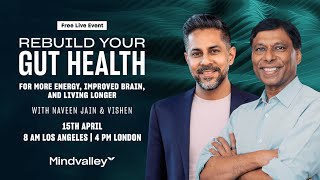
Live webinar (April 2024) hosted by Vishen Lakhiani with guest Naveen Jain (founder of Viome) on gut microbiome’s central role in human health and longevity. The speakers argue the microbiome influences mood, sleep, immunity, obesity, metabolic and neurodegenerative disease, cancer therapy response, skin health and addiction; they promote precision nutrition (food-as-medicine individualized by microbiome/RNA activity) and Viome’s at-home test + personalized recommendations and supplements. Practical claims and examples include harms from antiseptic mouthwash and artificial sweeteners, the idea that DNA is static while RNA/gene expression and microbial activity change, and that personalized microbiome modulation can prevent/reverse chronic disease. The webinar concludes with an invitation to a seven-day Gut Health Quest on Mindvalley and a Viome discount offer.
Questions this video answers
They quoted ~47% human cells and ~53% non-human (microbiome) cells; by mass ~97% human (human cells are larger).
They stated ~90% of the body's serotonin is produced in the gut.
Viome stated it has analyzed over 700,000 samples.
Stool (fecal), saliva, and a finger‑prick blood sample.
Custom Viome supplements are shipped to the United States and Canada (per the discussion).
Chapters
Health to your moods, to your sleep, to your energy levels. And many people don't really understand this connection. So we sent you guys an email and we added a study from Scientific America that said that you are only 47% human. And what Scientific America goes on to explain is that only 47% of the cells in our body are human. 53% is actually your microbiome. Now if you look at it from overall mass, it's around 97% overall mass is human because human cells are bigger. But it shows that there are more non human cells in our body than human cells. But are we taking care of these non human cells? And joining me today is the master of gut health, Naveen Jain, the brilliant award winning entrepreneur who is the founder of viome. So Naveen is known to many of you because Naveen is such a bold visionary. He has a program on mindvalley called Power of Boldness. And he teaches entrepreneurs on mindvalley how to have really bold dreams. And Naveen has started multiple companies. His kids also have started multiple companies. But Naveen's latest company is Viome. And viome seeks to make illness optional by teaching people how to improve their gut health. So we are running this webinar right now to welcome Naveen back onto mindvalley with his second program on mindvalley, the Gut Health Quest, which is a seven day program. It's part of your mindvalley membership. It's included, you don't have to pay any extra for it. It's a seven day program to teach you how to nurture and nourish your gut microbiome. Welcome to the webinar Naveen.
Well Vishen, what a pleasure to be here and talking to our amazing group of people here. And I think people are still are joining in, so let's give them a few minutes as you and I talk about it. You know, mindvalley is really become a lifelong learning school. And this idea that people go to school for four years in a college and somehow learn everything they need to learn and for the rest of their life they can actually use it and stay productive is now obsolete. Especially with exponential technologies. It doesn't matter when you went to whether you went to Stanford or Harvard, this thing you learned about AI is no longer your father's AI. It is changing. And you have to change how you learn. And what I find fascinating, Vishen, is what you're doing is building a lifelong college. A college where you learn everything you need to know today to be successful today and tomorrow. And as the world is changing and the new set of skills are happening. You're keeping them updated and gut health is no different. What if you ask people 10 years ago what gut was and what gut health was Most people will roll their eyes now hundred thousands of thousands of research papers later no longer people are wondering are we actually human? Is genes that we get from mom and dad are actually our destiny? Is it something. Are we destined as a species to be sick as we age? Is there something written into our biology that when we turn 50 we have to be diabetic we have to have chronic diseases whether it's gaining a bit of weight in your abdomen to having a disease just having a low energy just having these diseases that we just say it is just age dad, you're just getting old. You know it's not. You know this is the point where we starting to learn that we in fact control our own destiny. And I refuse to believe that just because you're old you can't have the same energy or more energy than when you were you know, 30, 40 or 50. So I think you know you are a living example of that and I'm following on your footsteps. I am now 65 but you know I wake up at 4am with the same set of energy and until I go to bed because to me the energy comes from inside you and the things you're doing not something you know and obviously that your nutrition and all the other stuff that we're going to talk about and I think we're going to also touch a lot on how does one live healthier longer not just increasing a lifespan and becoming a longevity focused but really health focused Because I seriously doubt any one of us would like to live to be 200 years if you're going to spend 100 years in ICU that's not the life we want And I think Adrishen you had mentioned that Wouldn't that be nice if we could walk to our own grave be so healthy to be able to actually die at work until the last day you die. Or I could argue that what if you could die on the top of the Mount Everest because you could climb the Mount Everest on the last day of your life. Right? And that's the kind of health you and I both want.
So Naveen, I want to share a quote by you. Okay so somebody commented I see Naveen that you are in your office and this room is called the war room. What are you at war against? And I believe this quote, this quote answers that question. The future of health is going to be delivered at home, not at the hospital. And the medicines of the future are going to come from a farm, not a pharmacy. You're at war, Naveen, if you had to describe what is biome at war with, it seems that you're at war with the standard healthcare system, which is sick care.
Yeah, I think, you know, one could argue they don't even care about the sick. Because to me, our medical industrial complex makes money when you and I are sick. And there's no one in the medical industrial complex makes money when we are healthy. Think about it. When we go, if we don't go to a doctor, doctor makes no money. The hospital makes no money. Pharmacy makes no money. The pharma companies makes no money. As soon as you are sick, everyone is happy. Oh my God, we have a customer.
Right?
And the worst thing is this idea of these chronic diseases, or let's call them a lifestyle diseases, they're going to come back and tell you how you actually get to control that. Right. That when someone has diabetes and there must be a button that's catching, there's a lifetime subscriber coming up. This is an annuity that means now for the rest of your life you're going to be selling them something. They won't let you die because your credit card stops working and they will never let you live healthy because you can't pay them. Right. So the idea is if you have an autoimmune disease, they don't care to understand and root cause of what is causing the autoimmune disease to happen. They would rather give you the immune suppression like Humida. So the rest of your life, now you're paying them $100,000 a year for rest of your life rather than actually cure it. And that is what we are against.
And Naveen, I've had you on stage multiple times in Mindvalley. Your stories are always dazzling and I want people to know just a little bit about you. Volume is not your first company. Right. You also started Moon Express, became the first private citizen to get the rights to land a robot on the moon. You're an established entrepreneur, but what happened recently is with the advent of AI, you are applying artificial intelligence with some of the best AI people in the world to analyze the gut microbiome of people. And that's where you're making biome, is making these incredible discoveries and you're starting to see how the gut affects everything. So let's talk about that.
First of all, Vishen, we have this epidemic and this epidemic is not about Infectious diseases. This is an epidemic of chronic diseases. And you wonder what is this chronic diseases I'm talking about? I mean obesity, diabetes, heart disease, you know, talking about depression, the mental health, you know, anxiety, the, you know, picketing, addiction, Alzheimer's, Parkinson's, cancer or even aging, these are the diseases that happen. We have taken it for granted. We absolutely believe that as we get older, somehow or the other we're going to develop these decisions. And I really believe this is a fundamental epidemic, if we can solve it, is going to change the way people live their lives.
So a couple of statistics, right? So with traditional nutrition, we've seen obesity rates saw 13%. 40% of the US population is categorized as obese. And this is now becoming a global thing. I'm from Malaysia. I remember just before the pandemic when I was living in Malaysia, 47% of adults in my country were classified as obese. 47%, that's half. Now it's predicted that by 2050, about half of adults will have at least one chronic disease. By 2035, 36% of adults 50 and older will have at least one chronic disease and that will increase to 48% by 2050. So obviously following this one size nutrition model, we've heard food is medicine, but obviously the same food isn't the same medicine for everyone. And that's where gut health comes in. So Naveen, I would love to have you tell us the story of the gut. Beautiful story that you've shared before. I've heard you share this on stage and it really opens people's eyes. I'm going to have the camera focus on you. I'm going to take away the slides and I'd love for you to tell.
Us that, you know, I think, you know this idea that we humans have that we are somehow this special species and we have this genetic material that makes us so complex, it makes us so unique. And then we have come to believe that our DNA and our but our genes that we get from a mom and dad really make us who we are as humans. I think I was sharing a story with Vishen once that what if you look at it from the microbiome perspective, who are we as humans? Think about it. About three and a half billion years ago, these organisms, we call them bacteria, the viruses, the fungi, the east, these started to go about three and a half billion years ago. If you look at the human species, we have, give or take, a couple of hundred thousand years old. Now if you look at from the microbiome perspective, how the humans Come to be. So I'm going to tell you a story about, from a microbiome perspective, the evolution of humans. From their perspective, it's a tongue in cheek story. But I'm going to tell you that when it comes to science, actually most of this story comes out to be true. So let me start with the story. So three and a half billion years ago all these microbes got together and they all said master, Master, we want to take over the world. We are sick and tired of living in this tiny South African countries and we want to just take over the world. And they all looked at each other and it's always a young one. A young one actually stood up and said Master, I have a solution. What's your solution? Master, what if we can create something bipedal and the trillions of us can live inside these things, right? So we'll have hundreds and trillions who are going to live inside them. They're going to go everywhere in the world, they're going to poop everywhere, they're going to spread us around and we can take over the world. And they created a bipedal thing and they named it humans. And everybody starts saying Humans, Humans, humans. And they were all really happy. Just for few years later all these microbes got together and they started to wonder, oh my God, what have we done? Just like today when we look at AI and artificial intelligence, there are many people who are worried, what if this AI becomes smarter than humans? What is going to happen? Us as a human, Humans? Is AI going to be able to control us and somehow we are going to become slave of this AI?
What?
Human species will completely disappear because AI has taken over us? And microbes are no different. They reassemble and say Master, Master, we have a problem. What's the problem son? Aren't you worried? These humans are now starting to grow their brains. They're going to start to someday become smarter. And if they become smarter, won't they just kill us? Won't they just not take care of us? Master says, don't you worry one bit, we took care of it. Master, what did you do? Well son, we created a direct connection from their gut all the way to the brain. And these humans call that a vagus nerve, thinking that what happens in Vegas is going to stay in Vegas. Well guess what, they are wrong. What happens in the gut is going to go everywhere. Remember, there are hundred trillion of us that reside just in their gut. And what happens in the gut is going to control everything in the brain. And I'm going To come back and tell you the scientific research that shows that how your gut microbiome actually causes you to have depression or anxiety or addiction and many of the neurodegenerative diseases and how the neurotransmitters. You may be surprised to know that 90% of all serotonin is actually producing your gut, not in your brain. Continue with the story. And they say, but Master, Master, what if they don't feed us the right thing? Master says, don't you worry. One of our brother lives right inside the human cell and they call that mitochondria. That mitochondria has its own DNA and it is one of our ancestral brothers. We're going to put right, we put right inside their cell. It is the one that produces all the energy for their self. If they never, if they don't feed us right, we just phone our brother and say shut down the energy. And next thing you know, these humans are all dead. And just to protect themselves, they're going to make sure that we take care of them. Now you can realize that now your gut microbiome is like your puppet masters. And we humans are simply the puppet. And these gut microbiomes are always pulling the string, but they let us believe that we are in control. So if you think from an evolution perspective, I think it's quite likely that humans evolved as a container for these microorganisms. But the truth is there is a symbiotic relationship between the microbiome and humans. And that is symbiotic relationship with. What I'm going to talk about is that how humans in fact outsource most of their out functions to our microbiome. So 99% of all the genes that are expressed in our body actually don't come from the genes that are given to us by our mom and dad. They come from these microbes, the hundred trillion of these microbes that live inside us and on us. Think about it. Our human genes only have 22,000 protein coding genes. Our microbiome has anywhere between 2 million to 20 million genes. That means more than 99 to 99.9% of all the genes that are expressed in our body actually come from our microbes. So vishen now we're going to talk a little bit more about how this symbiotic relationship that works. Because when our body and our microbiome are taking care of each other, we have something called homeostasis. And our body is at ease. Whenever our gut microbiome is imbalanced, whenever there is actually a dysbiosis when the microbiome is not working correctly and it's not actually in the symbiotic relationship, our body is no longer at ease and it's called dis ease, which is disease. So disease is nothing but our microbes and our human body and our immune system that is not working in conjunction helping each other. Most people may not realize that 70% of all of our immune system is along our gut lining. Our human body is like a donut. There is a tube that goes through us. At the top of the tube and our mouth is actually another set of microbiome we call oral microbiome and oral microbiome and our gut microbiome actually communicates together. So when your mother tells you, hey, you should slow down, chew your food and eat slowly. Why is that? It's because when you eat slowly and chew your food, your saliva and your oral microbiome not only starts to pre process the food so that it is ready for digestion, the nutrition can be digested along your gut lining, but also more importantly, it sends the signal to the gut microbiome and to the brain in terms of the kind of food that is coming down. So that body is prepared to digest that food. So for example, when you eat something sweet, that taste buds actually send signal to the brain, which actually sends a signal to pancreas to start releasing insulin. And then now the insulin is there. So when you eat the sweetest stuff, the insulin is able to absorb the sugar and able to turn them right into the cells and get it ready for creating energy, which is ATP. Now imagine what happens when you drink something which has artificial sweetener. Your body, your oral microbiome thinks you have something sweet because it tastes something sweet. It sends a signal to pancreas saying hey, time to release the insulin. Guess what? It artificial sweetener has no sugar, so there is nothing for insulin to do. And over time your body becomes insulin resistant and that's where you become diabetic. So think about when you drinking this artificial sweeteners and artificial sweetened drinks, you are actually harming yourself. In fact, instead of helping and thinking that somehow you're going to be better by taking these artificial sweeteners, you in fact may be hardening yourself more. And then I'm going to come back with Shannon, talk about that, how these certain fat diets are actually are harmful to you. Just two weeks ago, there was a research that was published that clearly shows that people who do intermittent fasting are. There's 91 increased chance of death from cardiovascular diseases. So think about it again. 91% increase in in cardiovascular death for people who go on intermittent fasting. And there is a similar results we saw in the people who are on keto diet, people who are on a paleo diet, people who go on these fad diets are in fact maybe harming them in a long term.
Yeah, the new research coming out is shocking. Another one. Right. Which is worth knowing. Let me ask the group here. How many of you here use Listerine or mouthwash? How many of you here use mouthwash? Just put in a yes in the chat. Okay. So I'd say about half the people. So Listerine came up with an amazing branding, an amazing branding several decades ago saying that their product, if you goggle it in your mouth, you have fresh minty breath. What we know today is that if you use mouthwash, your odds of getting becoming pre diabetes go up significantly. I'm pasting in a chat the link to the scientific article from the National Library of Medicine. What happens is because the Listerine actually kills useful bacteria in your mouth that is helping with the digestion of certain food products. And with this bacteria in your mouth being killed, it increases your odds of diabetes significantly. If you check out this article, it is a massive, massive, massive increase. 50% increased risk of developing prediabetes diabetes combined. Right.
And that's just from beginning. In fact, your oral microbiome, remember it's proudly kills 99% of bacteria and viruses.
Right.
And people thought that somehow killing those bacteria was good for you because somehow you stopped the bad breath. Yeah, killing bacteria, bad breath is a symptom. And these bacteria actually are directly linked not only just to diabetes vision, as you pointed out, it's also linked to your heart disease, it is linked to neurodegenerative diseases and it's linked to many types of cancer. So when you are actually doing the Listrin or any of these antiseptic mouthwash, you are in fact harming yourself more than you are helping yourself.
Yeah. So I just pasted the link to the study. Let me do it again. I'll paste it. This is on PubMed, NCBI, the National Institute of Health. So you can check it out and you can see the number there. Straight up, 50%. Naveen, are there any other practices that we do today that people just think are common sense but are actually hurting us?
Well, I think, I think I find it really fascinating that, you know, people who are in relationship, they find their mate and they kiss their mate and they don't realize that sometime you could actually Know who is going to be the real heartbreaker. And I think imagine if you can analyze their saliva and oral microbiome and find out that their oral microbiome in fact is going to cause you heart disease. So you could find a real heartbreaker before they even you kiss them.
So you're saying someone, the person we kiss can influence our oral microbiome in a negative way that it can heart disease. What?
Or in a healthy way.
Right.
I mean, that's the point, is that find a mate that's going to be complementary to your oral microbiome, not someone who is going to actually give you a hygienist. Right.
You just made dating so much more difficult for everyone. Okay, so a couple of questions, couple of questions. People are saying, okay, if not Listerine, what mouthwash should we be using?
Yeah, and I think it's very interesting. Is that mouthwash for what? To actually hide the symptoms of a bad breath? Bad breath is simply a signal that your oral microbiome are producing stuff that is causing inflammation and it's not helpful. So what is a bad breath? Bad breath comes from two things. When your oral microbiome produce something called sulfide or polyamines. Right. So polyamines really tastes like rotten iron sulfide.
Right.
So the point is you can now know what is it that is going on that causing your oral microbiome to produce something called heliotosis, the bad breath. But if you can adjust your oral microbiome and you can do that many ways, you can take the probiotic to probiotic mouthwash. We actually, in fact have a personalized oral lozenges that we do based on the analysis. I'm going to come back to in a second here how we do that. We also have a personalized toothpaste that when you use a personalized toothpaste, it has all of the probiotic, postbiotic and prebiotic to adjust your oral microbiome just like we do for the gut. So as we go along, I'm going to talk about how you can in fact understand what is happening in your body and what can you do about it. So not to just say, oh, it is, this is what's happening. Tough luck. This is a bad luck that is happening. Just remember, you get to be in control of your health. And what if actually the illness could be optional? And what I, what do I mean by illness can be optional is vishen that you have an option, you have the choice that you actually can make yourself healthy. And people say, why does anybody want to be sick? Well, you know, a lot of times we know, for example, smoking is bad for you. It sees right on the cigarette pack. Smoking causes cancer, Smoking is bad to your health. People still open up the thing and smoke. Why is that? People sometimes know what's good for them, but they don't see the immediate, immediate effect of it. So they think it's BS, right? They say, hey, I've been smoking for 10 years, I don't have a cancer. How can they possibly tell me that smoking causes cancer, Right? Because what they do, the action and the results are not immediate. People actually don't believe that this actually could possibly be true. Or if it is, it's not true for them. And that's all people say. It may be true for others, but not for them.
Thank you, Naveen. Thank you, Naveen. So let's do a quick recap, okay, of what we've covered right now. We've gone really deep, but I want to now just bring in some slides for those of you who are like logic analytical thinkers so that you guys can understand a quick summary of what we've covered. We spoke about how precision nutrition is the future of the health industry. It's not a one size fits all approach. It's knowing exactly what you should eat that is relevant to for you. Naveen, you want to add anything here?
I do want to add because I don't think we quite covered it. And I think this idea that we have had is that somehow there is going to be one magical bullet that is going to keep all of us healthy. And then we came up with this idea of food parameter and we came up with the idea of the foods that are good for you and the foods that are bad for you. And what we learned, Vishen, is not. First of all, I just want to step back for a second, just talk about when we say we, who is this we and what have we done so far and what have we learned? Because to me before we do that, I think, you know, this stuff is slightly out of context. So Vishen, as you know, I started VIOME seven years ago and our simple belief when I started Vyome was that what if. What if we can understand what are the biological changes that happen in the human body at the onset of these diseases? Whether we call them obesity, diabetes, heart disease, depression, anxiety, and many other names that we have for these diseases. What is it that changes in the human body? And if we can understand these changes, biological changes, we should be able to prevent these diseases from happening, to be able to diagnose them. Early if the disease does happen, and to be able to outright reverse them if we can find the right solution for that. And that was a fundamental belief around why today. We have now analyzed over 700,000 samples. And what is interesting thing we learned is there is no such thing as universal healthy food. And let me tell you why I say that. So today when somebody tells you that everyone should eat avocado, guess what? Avocado may be good for you today, and it may be harmful to you a year from now. It may be good for someone else and maybe harmful to you. And the reason is avocado contains compounds that actually convert, that make lot of uric acid. So if you have high uric acid to begin with, and you take avocado, you're going to end up developing gout. Same thing happens with things like broccoli. People think broccoli is healthy for you. Broccoli can be healthy for some people, but broccoli can be harmful if you have high sulfide production, because sulfide is highly inflammatory. Same thing. Lot of people eat so much protein to build their muscles, and they don't realize that when the protein is not being digested that actually it goes into the gut and your microbes actually ferment that protein. During the protein fermentation, it creates lot of ammonia, and that is highly inflammatory. And you have heard that people say, well, Popeye told us spinach is healthy for everyone. Well, we know that Popeye was not a scientist. The spinach contains very high amount of oxalates. And if your microbiome cannot digest these oxalates or oxalic acid, then it actually ends up creating a kidney stone. And same thing. By the way, what I think that a lot of people think red meat is bad. Red meat actually has a lot of nutrition. However, it contains the compounds called choline and carnitine. And your microbes can take choline and carnitine. And in some people, that can make something called tma, trimethylamine. And the trimethylamine or TMA gets absorbed in the blood, and your liver converts the TMA into something called tmao, trimethylamine oxide. Right. And TMAO is what causes the cardiovascular diseases. So now, if your microbes are not converting the red meat into tma, then you can eat all the red meat you want and you will be fine. But if they are producing a lot of tma, then the red meat can be bad for you. And that's the reason vishen some people can eat red meat and live to be 100 and some people end up getting a heart disease. And that is because.
Because like historically, like several years ago, there was, There were these claims that eating a lot of red meat is bad for you. Now you hear biohackers, eating a lot of red meat is the most important thing you can do. And what you're saying is that. Well, both are actually correct. It just depends on what sample of users you are testing this on and what is going on with their gut microbiome.
Exactly.
And I think very interestingly, understanding the gut microbiome.
Exactly, Vishen. And I think the same thing is true, by the way, for obesity and diabetes. You know, in fact, we have now built the underlying AI model where we can predict for every single food that you eat, we can predict the glucose response your body is going to have to that food. And in fact, what we learned, and we published this research that shows that some people can eat bread and have very low glucose response, but when they eat banana, it may be very high and there'll be other people who have completely reversed. And we know intuitively, we know several people who can eat bread all day and never gain weight. And some people like me, can smell bread and gain weight. Now we know exactly why, because how your gut microbiome is converting these foods and do they create the high glycemic response or low glycemic response? And this is all individualized to each person. Now, coming back to just one, one more thing here. So now when you do this analysis, so at Biome Vision, what we do is we analyze your saliva to understand your oral microbial activity, we analyze your gut, and then we look at all of your gut microbial activity, and then we look at your fingerprint blood, and then we look at all of your mitochondria and all of your immune system. And then we analyze everything using AI.
Let me repeat that again for everyone so they understand. So if you guys, if you guys are using Biome, and we'll give you $100 discount on, on the, on Biome at the end of it. But if you're doing Biome, I've done this. You submit a stool sample, a little pinprick of blood, and a saliva sample. And those three things is what the Biome artificial intelligence analyzes. And it's done so for 7,000 people. And that's where the patterns emerge. And then you get an app, and the app tells you exactly what you want to avoid, what you want to, to. To. To go deeper, what you want to eat more of, and so on. And the Results have been this, right? 39% improvement in severe IBS. Sorry, slide went backwards. 31% boost in mood and mental well being. Because if it didn't occur to you, your gut microbiome also influences your happiness levels, your moods, your well being, your focus. I'm going to ask Naveen to talk about that more in a moment. And then a 30% reduction in type 2 diabetes. Okay, so we spoke about the microbiome. We spoke about how 95% of all chronic disease is linked to the microbiome. And now I want you to touch on this, Naveen. 90% of our body serotonin is produced in the gut by the gut microbiome. If you're not making enough serotonin, you're going to feel depressed. Depressed. Let's talk about the gut microbiome and moods.
Yes. So I think, as I was talking about that our human body is produces lot of neurotransmitters from GABA to serotonin and in fact a lot of the precursor to serotonin, which is tryptophan, right? So the food we digest, the food we eat, what microbiome does with that is really what we get. So, you know, if I could say it in a little gross way that most people would find it really, really troubling is that we end up absorbing the poop of the microbiome. When I say poop of the microbiome is really the metabolic product that microbiome produce. So we feed them and they feed us. So the vitamins, the vitamin Bs and the vitamin Ks and many of these vitamins and nutrients such as short chain fatty acids, our body cannot produce short chain fatty acids which are absolutely critical to our health, such as. But all of these are signaling molecules that tell our body, tell our gut, tell our immune system what is going on. Remember, when you have a gut, it has all of the sensing the immune system and all the sensors are along our epithelial cells which are our gut lining. These gut linings are constantly communicating with our immune system between friend and foe. Now if I may go back and think about when the child is born, the first exposure to the microbiome they get when the baby is going through the birth canal. So when baby is born, it going through the birth canal gets the first exposure to this microbiome. Unfortunately, when some babies are born out of necessity through C section, they miss out on all of that. In fact, the research shows many of these children who are born through C section end up developing a lot of food sensitivities allergies and other chronic diseases. But coming back to it now, those microbiomes start to settle in the gut. Now the first few days of mother's milk, in fact contains polysaccharides. That is all it does. So most of this stuff is basically the, you know, antibodies, immune system and polysaccharide. Interestingly, this polysaccharide is a complex carbohydrate. Our body cannot digest one bit of it. In fact, it is there purely to feed the microbiome. So think about what nature is saying to you. Nature is saying we just created this offspring to make this offspring healthy. The best thing we can do is to feed them, not to feed our own species. So they feed the microbes. So that microbes are now actually start to communicate with the immune system and start to build the immune system. The reason that children get sick so often is because their immune system is not yet matured.
Right?
This is the part that how our immune system becomes mature is through constant communication between our microbes and our immune system. Anyway, what I was saying was that the gut and a brain connection is that as our microbes are digesting these food, it produces these neurotransmitters. And these neurotransmitters are constantly in communication through our CNS system, through this vagus nerve. And this is really the key to understanding addiction, is key to understanding depression, is key to understanding, you know, anxiety and many of these mental health diseases. If you were to just Google, pick a disease, you want addiction and microbiome, schizophrenia and microbiome, depression and microbiome, you'll start to see that how gut microbiome is a key to understanding these diseases. In fact, some of the research, you know, this is something really interesting is that people do is in especially in easy to do in, you know, non human species. But I'll tell you about the human species as well is when they were able to take a microbiome of a person who is fat and they gave it to a thin person. In case of thin mice, the mice became fat. When they took the poop from a thin mice, that microbiome and gave it to the fat mice, the mouse became thin. In fact, they were able to do the same thing for depression, diabetes and addiction.
So the microbiome is probably one of the key determinants of obesity and depression. What about sleep, does it affect sleep as well?
Absolutely, 100%. So remember, your microbiome also has its own circadian rhythm and it is constantly communicating with your brain circadian rhythm. So in fact, the time of your eating is also determines actually how you sleep. And we're going to come back and actually talk about, you know, if you want to live healthier longer, what are the things you could do to stay healthier. But coming back to the thing, your gut microbiome actually impacts your sleep. Not only just the total amount of sleep, but how much of the REM sleep you're going to get, how much of a deep sleep you're going to get and the kind of sleep you get actually impacts your health.
Right.
So I think it is whether you. Skin diseases. So, Vishen, one of the things we learned was your mother when you used to say your beauty comes from inside. What if she was a real scientist saying, hey, if you take care of your gut, you have a perfect skin that is going to have no acne, no dry skin. A beautiful glowing skin comes because your gut is in good health.
So that, that's, so that, that's crazy. So it's skin, it is moods, it is obesity, it affects really every part of our life. And it all has to do with, with really understanding the unique patterns of a gut microbiome and what we need to feed it.
You know, very interestingly is that people talk about this. You know, a lot of people who are obese are taking this drug called Ozempic, which is essentially a GLP1 drug, right? It's a glucogen like peptide drug. Interestingly, your body, your gut microbiome can actually promote the natural GLP1. And this is how it works is that when you eat a certain prebiotics and fiber, if you have the right gut microbiome or you can adjust your own gut microbiome to produce something called butyrate. The butyrate signals your body to produce GLP1. So if you eat the right food, you will be able to in fact produce your own GLP1. And that will cause you to lose weight and actually feel full.
Okay, so I want to ask you a question, Naveen. I, I noticed this in, in myself and I noticed this among friends as well. I live in Europe, but I come to the US a lot currently in the US When I'm in the US and I'm eating American food, even if I'm trying to order healthy, I put on about one pound a week. It's crazy. As soon as I go back to Europe, in Estonia and I'm back on European food, I shed one pound a week. And I've never understood this. What is going on there?
Several things, Vishen. First thing is, obviously the way we grow food in us is really grown from mass scale industrial production and the nutrients in our food are lacking. So just about if you go back just 10, 15 years ago, the one avocado had more nutrition 10, 15 years ago. Now to get the same nutrition, we need eight avocados. The same nutrition that used to be.
Just want to express that you're saying that an avocado Today has 1/8 the nutrition of an avocado. How long ago?
Just 10, 15 years ago.
What, in 15 years?
Yeah. And what's happening here is that, you know, our soil is completely depleted of nutrition. Our soil doesn't have any of the microbiome that is actually feeding the plant to create the new nutrient food. Now we're simply using the artificial fertilizer, we're using the pesticides and insecticides. In fact, the worst thing is how the amount of antibiotics, we are putting it in our animal feed. And imagine the reason we do that is when you give antibiotics to a cow, what it does is it kills all of the microbiome. It's like throwing a nuclear bomb inside the body. It kills all of your gut microbiome. Guess what happens? The cow becomes fat and now there is more meat to sell. And when we eat that meat, we are getting the same antibiotics. And what happens to us, we are getting fat because it's killing our gut microbiome.
I see. So it has to do with how animals are raised as well. And Europe has much tighter regulations than the U.S. that is fascinating. That is fascinating to think that actually killing the microbiome of the cow, so the cow gets bigger and then that is falling out into our own bodies when we eat that steak.
And I think that's one part. The second part, also really vishen, really surprising, is that, you know, our microbiome is constantly changing with the food we are eating and the environment we live in. Right. So here, if you're living in us, you're probably living in this concrete jungle. You don't have any trees, you don't have any of the agriculture. You're no longer near the, you know, cow dung or, you know, horse dung or all of this stuff around the nature and you no longer inhaling all the microbiome. And that's the reason we saw that people who live in a farm, near the chickens and the cows and the things, animals, and near all this stuff, their microbiome is so rich that they don't get allergies, they don't get sick as often as the people who are living in urban areas where there's mere concrete and they have really no way of collecting that microbiome.
And I've also read articles that said that if we are raising kids, let your kids eat stuff off the floor, let your kids like kiss the dog, you know, let your kids get exposed to dirty things, play in dirt. Overprotecting your child actually hurts their gut microbiome.
It does. It's a hygiene theory which basically says that if we become too hygienic in some sense we are not getting the diversity of microbiome that our body needs. And in fact, if you, you go back and look at the, some of the Amazonian tribes, our diversity of our microbiome is so much lacking. And this is one of the things that I want to just take off the belief system. People say we should eat like our ancestors. Right? We should eat just like our ancestors did. And what we forget is first of all, ancestors had these wild animals where they were not being fed antibiotics. Let's just start with so we don't get that same number two, they were eating lot of root vegetables, lot of fiber, they would take the plant out of the thing, they will shake it up and eat a lot of soil. And the microbiome that they were getting, number three, they actually were doing tremendous amount of walking and exercising. And the number four, don't forget our ancestors also died by the time they turned 30 or 35. So if you want to eat like your ancestors, you're going to live like your ancestors and you may die at 30, 35. So thinking that hey, my ancestors only ate meat and if I just ate meat will be healthy, just forget, don't forget that they also died when they were 35.
Yeah, that's, that's very true. Very, very, very true. Okay, so again, quick summary time. So understand that your gut microbiome affects so many different aspects of your life. From your sleep to your moods to your health to obesity. With precision nutrition, you get better gut health which leads to disease prevention. Now this diagram here, Naveen, this is a little complex, but it seems to show how the gut microbiome influences rheumatoid arthritis, eczema, asthma, IBD, IBS, cardiovascular disease, type 2 diabetes, NAFLD. I don't know what that is. CKD and mental health disorder.
It's a non alcoholic fatty liver disease. It's a non alcoholic fatty liver disease. But you know, Vishen, interesting thing is everyone who is listening to it, please go ahead and google any other diseases and microbiome and you will see there are at least 10 to 100 research papers on every single disease that shows how your gut microbiome, oral microbiome, is connected to every one of the disease, including cancer. And here is more important part, Vishen, even the cancer therapy, whether immunotherapy works or does not work depends on your gut microbiome. So it not only causes. Yes.
Wow.
Interestingly, not only the cancer is involved. Vishen, there was a research that was published that shows they took the people who had cancer and they gave them immunotherapy and it worked for about 30% of the people, other 70% of people. The immunotherapy did not work. And they took the microbiome of the people who, where the immunotherapy worked. Change the microbiome through the fecal transplant and the same drug started working. Think about it for a second.
This is interesting. So this cancer therapy worked for 30% of the population. It didn't work for 70%. And so what they did is they analyzed the gut microbiome of the 30%. Okay. And then they did a fecal transplant, which is literally where you're taking the microbiome through poop and transplanting it into another person. That sounds bizarre. And then that other person was able to benefit from cancer therapy.
And by the way, same thing happened is that they saw that people who had addiction and they changed their microbiome and their addiction to alcohol went away.
Right. So could it be, could it be that that person, People who are addicted to alcohol have a gut microbiome that has craves alcohol and is influencing their behavior to put in more alcohol? Like with sugar.
Yeah, exactly that. And you know, you and I probably both know that once you stop eating sugar for, you know, two weeks, suddenly you craving for sugar goes away. Why is that? It's because you've got microbiome that relied on that sugar and fructose is no longer alive and it's no longer craves anymore.
You've killed off the bad, the bad microbiomes. That's, that's great. Okay, so let's talk about this one. DNA is static. Let's ask the right questions. RNA or ribonucleate? Let's talk about this.
Yeah, so one of the interesting thing is, you know, even the identical twins, the two people who have identical DNA, the paternal, paternal twins, even they depending the same, if you give them the same food, they will completely digest it differently. One of the twins may get sick, other may not. One the same food may be harmful to One twin and not other. In fact, there's a Netflix documentary that talks about that. But let's come back to it. What happens is that your genes are static, which is DNA. So if you were to do your DNA test today and then you gain £200, your DNA is still the same. Then you become diabetic and your DNA is still the same. Then you get heart disease, your DNA is still the same and then you die. And if you were to look at the DNA 100 years after you die, it's still the same DNA. So DNA can't even tell you you're dead or alive, let alone you're healthier or sicker. What is constantly changing is something called rna. So remember your high school biology. DNA makes rna, RNA makes protein. So when you analyze your rna, it's called gene expression. So think of, you know, another way of explaining I think vishen that I find really useful is that every part of our body is same DNA, identical DNA. So my hair, my skin, my nose, my eyes, my heart, my kidney, my nails, everything is the same DNA. Then why is it I don't have the eyes growing on my fingers and the nails growing on my head? Same DNA is because the same DNA, when it's expressed differently, it becomes hair. When it's different expressed differently, it becomes eyes and kidneys and blood vessels and neurons. Now so DNA is like an Alphabet and RNA is a story you write and Wyome analyzes your rna. So we know the story that is being written, we know the gene expression that you're doing. Similarly, by looking at the gene expression of microbiome, it actually tells you what microbiome is producing. Whereas every other company other than Wyoming can only tell you what organism side your gut, but they can tell you what those organisms are doing. And what is most interesting is just like your DNA, the same organism can produce good in one environment and the same organisms can be harmful in other environment. So for example, Akkermansia can actually be good for some people. And lot of people who take probiotic like Akkermansia can actually be harmful. And it's the number one cause for Ms. Multiple sclerosis. So any one of you, when you're taking a probiotic or prebiotic that is not designed for you, that is not based on your unique biology, then you could be harming yourself. Same thing happens when you take nad. NAD can be good for you or NAD can actually be causes the progression of cancer. If you don't believe just that, NAD and progression of cancer, you can see the Research I'm talking about.
Yeah, I just bought a bottle of and what you said just made me realize I shouldn't just be. Just be buying the hype on Amazon and thinking that this is going to fix my gut.
And in fact Vishen, one of the very interesting research that came out that actually you may be interested in is the postbiotic which is the heat killed Ekermansia is actually better for you than the probiotic. That's live Akkermansia because live Akkermansia causes more harm than good. Whereas postbiotic which is a heat kill the shells and the, and the, the material that it produces like butyrate is actually what is helpful.
Got it, Got it. Thank you, Naveen. Okay, as we come, as we come to the tail end of this, what I want to let you guys know is that we've produced a seven day Gut Health quest with Naveen Jain and his team. It's available in your Mindvalley membership. Most of you here who are attending already members. And I want you to know you don't have to pay extra. All you got to do is go to your Mindvalley membership. This is it. Search for gut. You will find the program and that's what the program looks like. You can see it's beautifully put together. Okay. And it's just a few short lessons for you to take on every day behavioral shifts. A few short lessons and what you will learn is how to improve your gut health health in seven days. So in seven days you will already have massive improvement in your gut health. And then we've added a couple of bonus content which speaks about nad probiotics, the secret of healthy foods, mapping your personalized health journey and so on. So this is going to be available to you as part of the gut Health quest. So go check it out. If you're not a Mindvalley member, you can become a member. It's. It's very easy. Okay, so the quest looks like this. Part one is, speaks about disease and the relationship between the gut and disease. Part two goes on to how the gut influences your brain, influences your moods and much, much more. Part three is really shocking for people. Your genes are not your destiny. Just because your parents were obese doesn't mean that you have to be obese. And this is a huge, huge, huge, a huge awakening for many people. Okay. And then part four is rewriting the prescription. Let food be thy medicine. Part five is, is the truth about supplements. Not all supplements are going to work for everyone at the same time. Part six is how to Stay young and healthy, increasing your health span and your lifespan. And part seven, which is the seventh day, is microbiome here, microbiome there, microbiome everywhere, all at once. And it talks about the microbiome relationship in ourselves, our partners and so on. Okay, if you're not a mindvalley member, you can just grab that QR code. I believe that's a small discount. And you can get a mindvalley membership. You won't just get access to Gut Quest, you get access to 100 programs. Those of you who are members, this is now available for you. Go check it out. Each lesson is only about 20 to 30 minutes. That's all. 20 to 30 minutes. But in seven days you will learn so much about your body that you don't really know. Right. And these are a couple of like amazing feedback from people who have taken the quest just these seven days, these seven short lessons, how it is changing their lives. All right, so you can start today. Now, the total time is 20 minutes a day for 21. Sorry, it's not 21 days. I believe that's a mistake. It's seven days. Yeah. Okay, now let's talk about volume. Okay, for those of you who want to do the VIOME test. So Naveen, tell us a little bit about viome.
Yeah, so I think Vishen, I think we have a short time left here. So Viome is an at home test. You can in fact get a test ordered. And I think you have a discount. For Mindvalley members and people who are listening to this webinar, you're going to give them a discount and you can go to the vyon.com and actually use the code and buy the kit. And when you do that, it comes to your home and there are three things you do. You spit and you spit your saliva in a tube. You do a finger prick and drop four drops of your blood in a tube. And then you give us a touch of your stool and 10 days later on your app it comes back and tells you what is your biological age. So for example, I'm 65 years old. My biological age has not come down to 52. Now imagine when I'm 70 years old, my biological age could be down to 40. So as I am aging chronologically, my biological age is coming down. That means I have same energy, same thing as if I am 40. Now in addition to that, you get all of your health data. We tell you what foods to eat and why, what foods not to eat and why, and any of the supplements your body needs a Probiotic. We custom make it for you and ship it to you every month.
Okay? And I just want people to know that there are two aspects to Vayo. So you send in your stool sample, saliva sample, blood sample, and you get an app. Okay? And the app guides you what to eat, what you should avoid eating. It guides you. So the app guides you. Now, some people go for the second level of Biome, where they also request customized supplements. So Biome produces customized supplements unique to your gut. Now, those customized supplements, Naveen, I understand, are only shipped to a few countries. What countries?
That is. So currently, the custom supplements are only shipped to US And Canada.
Got it. Okay. So. So that's why. So I have to use the biomap because I live in Europe. So I can't get the supplements in Europe again. I believe that's going to change shortly, but right now it's not possible. So I use the Biome app to see what I should be eating, what I should be avoiding. And it's helped me in many ways. For example, it told me that I have to reduce. In my case, I had to reduce red meat. I had to reduce avocados, which incidentally, steak and avocados are my two favorite dishes. And I didn't realize that it actually had a negative impact on my gut. So I didn't eliminate it completely, but I reduced it and I started adding more balanced things that the Bio app told me were necessary for me. Okay? Now, and if you want to get on Bio, this is. This is what it does. It'll help you with your biological age, gut health, oral health, cellular and energy efficiency, inflammation response, brain and cognitive health, immune system health, heart and metabolic health. And your scores. The scores, which are the analysis of your gut and your microbiome, are turned into recommendations. What foods to eat, what foods to avoid. Okay? And this is what we mean by precision nutrition. We are all unique, and not everything works for the same person. So the Biome kit looks like that Biome Full body intelligence. And you guys can use this code to get a hundred dollars off biome. Okay? Gut quest 100. Repeat the quote, the quote. So you can go to biome b I o m e.com and the promo code you want to use is gut quest 100. Again, remember the app version of volume. Let me actually just go to the volume website and show you guys. And Naveen, feel free to guide.
Yeah, What I was saying is in the countries where the custom supplements are not made, you can actually get a forwarding address in US and they ship it to your country. So you can probably just get a forwarding address for us and they can ship it to whatever country you are.
And then I see that you guys also now have Oral Health Solutions and Gut Health Solutions. Okay, so you can get the app, but if you're not in the US you do have to figure out a way to get it shipped to you. So it's a little bit more complex, but that's. That's what the Volume website looks like. And Naveen, where do people add the promo code? Is that in the checkout when you buy?
Yeah. Click on the full Body Intelligence and you can get the code.
Yes, Intelligence test and then. Yes.
And you can.
Yeah. Great. Awesome. That's great. Perfect. Okay, so I will stop here. Okay, so thank you everyone for joining us. We're at the end of the hour. This went great. We had 2, 500 people live with us, which is really, really, really nice. It's always nice to have you share your wisdom with us, Naveen. And this was very awakening. Like, I'd say sometimes some parts of this were like, mind. Mind blowing because it was so counterintuitive to what we have learned about our health. So thank you so much for sharing your wisdom with us this past hour and thank you, all of us, for joining. Those of you who are mindvalley members, I will see you in the Gut Health Quest. I hope you guys like it. We're really excited about the production quality and the level of content in this program. Those of you who are not members, consider becoming a member. Just a few hundred dollars a year for over 100 of the world's best programs in every aspect of personal growth. And maybe some of you will become Biome customers as well. So thank you all and thank you, Michelle.
I appreciate it. And thank you everyone.
Bye, guys. Bye.
Bye.
Record.
More from Vishen






Brown Noise for Deep Focus and Concentration (Best with Headphones) | Gabriel Loynaz



Your Appointment With the Eternal | Guided Meditation with Michael Bernard Beckwith