Master the Art of Connection through Presence | The Mindvalley Podcast | EP #50
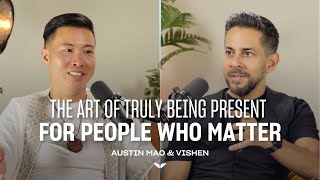
This Mindvalley Podcast episode (host Vishen Lakhiani with guest Austin Mao) explores "ultra presence": an expanded form of presence that holds multiple contexts (external environment, bodily sensation, relational field) simultaneously. Austin recounts his transformation from a distracted tech entrepreneur to a retreat facilitator (Ceremonia), references retreats like Prisma, and frames presence through psychotherapeutic (IFS parts language) and spiritual (Buddhist, Dalai Lama) lenses. Practical elements include a guided "stretching" exercise to layer attention (body, heart, relational gaze, periphery) and a relationship drill (saying "you" vs. "me" then alternating with compassion) to discharge charged interactions and restore empathy. Applications discussed: deeper intimacy in relationships, creative flow and alignment at work, and everyday practices (asking "What's it like to be you right now?") to cultivate presence.
Chapters
I didn't even know I wasn't present because I was dissociated.
Today we're going to be talking about a concept called ultra presence. How to be completely present with your friends and your partner. And it's a fascinating topic because we live in such a distracting world.
You just look around the room, how many of us are on our phones, right? We're so non present. And that was me before. I was constantly addicted to my phone.
And we're trained in society where even the barista will say, hey, how's your day going?
Totally.
He doesn't care. He has no idea who I am.
Every major spiritual tradition leads you into presence. I think that thousands of years of spiritual texts cannot be wrong. This is the core of what it means to be human.
Austin's a former tech entrepreneur who flipped his life around. Austin and his team, architects of human transformation.
Here's the thing about transformation. Attention is power. Like, look at the politicians, look at actors, right? There is so much extraordinary power there. When we're able to hold attention on ourselves, we have inner power. I believe that that is what many would describe as a temporary state of enlightenment. And the question is, how can we learn to activate this in our lives more and more and more? And I would say the easiest way way is to really.
Welcome to another episode of the mindvalley show. I'm Vishal Kiani, your host, and today we're going to be talking about a concept called ultra presence. And our guest is shortly going to define that for you. Our guest today is Austin Mao, a brilliant, brilliant, brilliant man that I was introduced to by Keith Farazi on the playa at Burning Man. Austin's a former tech entrepreneur, a former real estate investor who flip this life around to instead start an institution called Ceremonia in Colorado. And Ceremonia is this incredible place. Tons of my friends have been going there. And it's a place where you go to go through these deep, transformative experiences and emerge as a completely changed individual. So Austin and his team, architects of human transformation. While Mindvalley does this through an app and through events all around the world, they do it through their retreats at Ceremonia. Our topic today again is Ultra Presence. How to be completely present even when there's a storm, there's chaos going on around you. How to be completely present when you need to focus at work. How to be completely present with your friends and your partner. And it's a fascinating topic because we live in such a distracting world. Austin, welcome to mindvalley.
Thank you for having me. Vishen, such a pleasure to be here.
Tell us a quick little bit about your background and how you got to where you are today.
Great. I was a multi time entrepreneur first, grew up a single child to a single mom and so was constantly seeking to develop myself materially before and Keith, our mutual friend in which we met actually introduced me to a retreat. I had never even known what a retreat was. I thought it was something you would wave a white flag at in battle. And as I went through my first experience, this was a retreat in Mexico. I had a first transformative experience. Right. One of our, our mutual friends Eric and Meads. I was just in speaking with him and he was sharing about telling stories of your life. And as I was recounting stories that were meaningful for me to share on stage, I recognized that I couldn't even use stories from my past life. Not only had a transformation helped me rewrite who I was, it was a completely new sequel, not a new chapter.
Because you stepped into a retreat in Mexico.
Yes. Yeah. Here's the thing about transformation that happens. It's that I remember after that transformative retreat I started, I started going to more. Right. But I would go on a high and then I would come back to earth and not know how to instill into my relationships, into my business, into my, my purpose in life what I had gained from altered states of consciousness or from, from powerful experiences. And so I didn't know how to integrate who I was. And that's when I had a really powerful experience at a retreat called Prisma. This one was in Austin, Texas a few years ago. And I remember pounding my fists on the floor. My partner, who we both know was there and a week before we had agreed to separate fully and yet we had paid for this multi thousand dollar retreat training. When we go to it, we didn't tell anybody the decision we made. We didn't tell anybody that we were partners either. They didn't know until the final day when we were encountering each other in the process that Prisma has. And I was pounding my fist on the floor saying I don't know, I don't know. And it was the first time in my life that I had admitted I don't know to myself to be able to say that because as the single son that's always taking care of my mom, always taking care of the women in my life, I always had to know, I always had to know the answer of how to get us out of a financial rut, how to create stability in my company. How to launch a new product, et cetera, et cetera. I always had to know, and I didn't allow myself the space to not know. And so when I came out of that experience, that's when I decided to start something. To start Ceremonia to help facilitate people into their own transformations. Through that process, I discovered what really matters and what's so curious about all the. The new hot stuff in transformation, whether that be breath work or, or tantra or whatever it is out there, they all kind of align on something that the ancient spiritual traditions like Buddhism have been teaching all along, which is be present, be here now. Right. Like what Ram Dass says. And so I've just gotten more curious about how do we bring greater presence into our relationships, into our triggered states, into our zoom meetings and working with.
AI because that's something I've noticed about you, Austin. You know, we have this, this archetype of the wise man, and you and I have this massive circle of friends, and we just had 50 friends together here in Estonia at a Mindvalley event, and we were organizing all of these incredible group dinners and tea parties. And there's one thing about you that everyone notices. You are so present whenever anyone's talking to you. They feel like you're giving them your full attention. You bring a peacefulness to any group you're in when you're around. It's as if people feel safe and peaceful around you. I've noticed that about you, but I've not had the ability to pinpoint it, to say, oh, that's what he's doing. I just considered you. Wow. Austin's like a wise elder now.
How old are you? 40. Okay, you're 40, but I'm Chinese, so I look 20.
But. But you feel like you're this 75 year old wise elder in, in any group you're in. And it's actually pretty damn cool. It makes you magnetic. It makes people want to know you. Right. There's this power that, that we see in movie characters like the Jedi Knights of Star wars. And that I think is perhaps what your presence is bringing to the table for the people around you.
Well, first of all, just thank you. And I wasn't at all like this before. I was completely non present. I was just with Esther Perel and who's a relationship like the relationship expert. And she asked this question, what's the last thing you stroke at night and the first thing you caress in the morning? And it's your phone, right. And she was relating to how we go to bed. And as a couple, we're just on our phones. If you go to, to a fine dining restaurant and you just look around the room, how many of us are on our phones, right? We're so non present. And that was me before. I was constantly addicted to my phone. I was constantly addicted to distraction and I was not present. I didn't even know I wasn't present because I was dissociated. But there's something that really impacted me. It was a story of the Dalai Lama. The Dalai Lama had this five day event and at the very end of it he was the headliner and he's older now, right? But at the very end he asked the hotel manager to gather the hundred staff in the room because he wants to say goodbye. And they line up, this is an hours long line. And each person, he's just with them in total presence and ask them about their lives, about their day, about their dreams and their passions, from the CEO down to the wait staff. Just being completely with the human inside of each of them in that moment. What I imagine is that is that person in front of them is the most important person in the world to the Dalai Lama. And so I seek to emulate that in my life when I'm with people. But the interesting thing about being present with other people is that often people think it's all about me being with you and your experience. But actually it's about me feeling myself at the same time. The impact that you have on me when you blink or when you move your legs or the way that you're sitting with me right now, like the impact that you're having on me and me being able to relate that back to you and recognition of how I'm impacting you and getting curious about you, etc. That's real presence in connection.
So is presence simply a form of stillness and focus on the person that you're being present with or is there more to it?
I think there's so much more to it. So something I'm very passionate about is how, how do we learn and how do we teach, right? And there are two kinds of learning. There's didactic, AKA from a book, from a lesson, from Mindvalley. And there's transmission, which is you and me sitting here and me intuitively feeling you, you intuitively feeling me. Right. And so I believe both are extraordinarily valuable, especially the didactic, to teach other people. And one of the things that I learn is from a field called Internal Family Systems ifs, which is the fastest growing Psychotherapeutic and psycho spiritual model. And it's all about parts. Parts work. Like a part of me, if you've ever said, a part of me feels anger, a part of me feels sad, a part of me is confused. Well, you're kind of speaking that language. And what ifs says is that there are all these protective parts and what they're protecting you from is feeling yourself, feeling the tender, wounded, inner child parts of yourself. For me, those buried deep down parts that ifs calls exiles. The one that has been most prominent in my life is the one that carries a burden, a voice that says, I'm alone, right? And actually goes a little deeper. It's an existential quality of I'm spiritually alone. Like, I can't be met in my spiritual experience of myself. And when I was unaware of that part, what I would do in my life is I would seek to enroll people into my quote, unquote level of spirituality. And how that would express sometimes is, let's say I'm facilitating other people through their transformation. If it didn't go perfectly, I would get anxious, I would get angry, I would get stressed out, right? Because I was. That part inside of me was like, oh, no, that person's not going to be my friend. The person's not going to connect with me. Now the way that relates to every connection is at every moment, if I'm unaware of my parts that are needing love, I'm not able to be fully with you. My parts are preventing that connection because I'm seeking from you to fulfill something in me.
You're right. You're right that I see that in people so often. I was at a party, a celebration party after an event recently, and a lady comes up to me and she says, can you give me five minutes of your time? Now, I'm only at this party for like one hour. So five minutes is a big ask because there's a lot of people I want to greet, I want to. I want to meet. So I ask, well, let me ask you what. What is your intent? And she says, I need to share with you something really important. So I'm like, okay, what is that before you share? Because five minutes is a long ass. Let me give you a few minutes. What is your intent in the sharing? And she goes, I need you to discover how amazing my work is because I think you should publish me. So I immediately told her, your intent, respectfully, is a little bit selfish. You are asking me to give you five minutes of my time because you want to sell me on your work in the hopes that I might publish you. Well, there's a. I can't do that, but I can give you my email address, and you can shoot an email to this address, and my team will review it. And so I think this was a good example of where someone approaches you, but they don't have the intent to really be with you. They want to extract something from you.
Right.
And I'm guessing what you're saying is that we have to shut that off. We have to come from a place of, I want to listen, I want to serve, I want to be with this person, rather than I have an intention for what I want to get out of this person.
Totally. And I've been that person before in my life very recently. And what's happened is it ruined relationships because I didn't show up with an authenticity and a level of surrender, effectively. You know, my. My story of what was happening underneath, in the parts of that. That particular individual is underneath. There was a part that was saying, I need Vishen to endorse, to believe in me because I can't do it myself. And there was. Maybe I don't know who that person is, but maybe there was a scared little girl under underneath. It's like that carries a burden of, I'm not enough. I'm not good enough. I need someone to validate me. And what's interesting is this pervades every aspect of our lives. So my viewpoint on anger, for example, if I'm angry at my partner and I'm saying, you did this, you did that, what I'm effectively doing is saying my version of reality is real. They're. They're saying their version of reality is real. But I need her to validate my version of reality. I need you to acknowledge that what I'm experiencing is real and what's actually deeper underneath this. It's because I don't believe that my experience is real. I need someone out there to validate something in here. And. And have you ever met a person who's like, you just. You just are in their presence, and they're so magnetic that you're just like, I just want to be around you. I just want to be around. And actually, I think you not only have you met that, you've curated a lot of those people in your life. Intuitively, I believe it's because those people have a quality of a solidity, a steadfastness in a root, a rooting of who they are that they don't need the outside money, accolades, fame, to validate that they matter. Do you see what I'm saying?
I get what you mean. Right.
And when we have that level of conscious awareness which we can develop, then we're able to be more connected because we're more connected with ourselves.
So, so presence then, you're saying, comes from this level of self mastery where we are connected. We understand our emotions, we understand the root causes of how we are feeling, what we are feeling in. And thus we don't need to extract from anyone. We don't need that validation. We don't need someone to buy into our worldview. We're simply there.
Totally. And it's not just relational. It's when you're, when you're coding something on a. On a platform, when you're, when you're writing your book, there is a level of self mastery where you're tuning inwards and able to be with the tender parts of yourself to relax back, the protectors. And, and that's actually where creativity comes from. The creative inspirational spirit comes from the innermost corners of our heart that are locked away. It's why when people go on vacation, they go to the beach, right? And they're relaxed. That's where the inspiration clicks because suddenly the. The noise of the world is quieted and they're able to listen to themselves more. That's why writers, maybe you do go to mountaintops and, and hole away to be able to just connect with oneself. Now imagine if you could do that with your closest loves, with your best friends, with strangers. Imagine if you could do that with your workplace, that you're able to focus and rest while you run. You know, imagine if you could do that with your impact in the world. Like, what could be possible is, is magnified, amplified.
I love that. I love that. Now, what are some of the practices that you bring for people to experience this?
I'm excited to share this practice with you, and recently I shared it on stage at Mindvalley University. Thank you for that opportunity. Okay. It's a practice that I learned from the retreat Prisma, and it's called stretching. And what it's going to be about is holding multiple points of attention at the same time. Okay, so for those that are list just audio only, please go to the side of the road because this requires you to put your attention very clearly in one place. All right, so let's start by closing our eyes. If that feels comfortable and safe. Taking a deep breath. Just start to scan your body from head to toe. Feeling the top of your forehead, your nose, your lips, Your throat, your heart, your belly, your hips, your knees and wiggle your toes. Feeling the ground beneath your feet. Just take a deep breath into your heart space. Now open your eyes and find something in the room or wherever you are that is you didn't notice before. Could be a mark on a wall or a lampshade. And now, Vishen, look in my eyes and just notice the connection that we're sharing in this moment. And now, while holding this relational context, looking each other's eyes. Now feel your heart continuing looking in my eyes. Holding the relationship, feeling now feeling your own body. And now layer on the periphery. Like look behind me while looking in my eyes, while feeling your heart. And now see if you can feel the temperature on your skin while holding the relationship, while feeling inside of you. We'll take a deep breath there. What did you notice just happened for you?
I felt extremely calm and I. And I. I started noticing different things. I can feel the temperature, can barely feel my heartbeat, but I can feel my heart. I can see you. I can see the beautiful lamp behind you. All at the same time.
Yeah. Did you feel more present?
Absolutely.
Yeah. So. So this took a minute. And this is a demonstration of what we're calling ultra presence. Right. And it's a deeply meditative state because you're called to hold multiple contexts that normally we focus on one at a time or don't even focus on at all. Right. Outside of us, inside of us, and relationally. And as you layer on, if you try to notice the taste in your mouth, the feeling on your skin, the sounds that you're hearing, our vision. Notice your heart while noticing your knee, while noticing your forehead, while holding the relational context. Men. I believe that that is what many would describe as a temporary state of enlightenment because you're. In addition to being a spiritual badass. We kind of just talked about this. You're also a technologist, right? Right. And one of the things that I. One of the ways I like to think about enlightenment is that it's information. How much information can the mind hold? The mind is very precise, but it can hold only a limited amount of information. How much information can you feel in your body? The body is the seat of our emotions and the word love that we might feel. Man, how many volumes of books and reels of film have been written to try to describe the feeling of love that we feel in our heart? Millions. And the spirit is able, is. Has infinite information. Right. As we are holding these different contexts in hyper presence, in ultra presence, we are tapping into so much more Information than we're normally used to holding, and we become superhuman.
So the act of doing this exercise, you're saying, is allowing us to absorb information. But isn't that the opposite of presence? Isn't the point to just be with you rather than to feel the temperature and feel my heart and look at the lamp behind you? Isn't the point simply to be with you? Isn't this distraction?
So this is. This is a great question. Sung, a Buddhist teacher, he wrote a book called the Science of Enlightenment. And his claim is that the great invention of Buddha is this. So before Buddha, they had. There was meditation for thousands of years. And it would just be a cycle of calm and concentration.
Calm.
Concentrate on the calm, get more calm, right? But what Buddha said is if you focus on your inner sensations with equanimity, with time, with sensory clarity, you're able to experience purification and insight, right? We're able to understand why we feel the way that we feel. And what he's effectively saying is it's the combination of awareness and attention, combination of awareness and attention that you're getting information, right? And the information leads you to that insight and that purification. Attention is power. When we hold attention over others, like look at the politicians, look at actors, right? There is so much extraordinary power there. When we're able to hold attention on ourselves, we have inner power, right? Imagine in a fight, flight or freeze state, if you could. Every time you're frozen, every time you're. You're in a flight wanting to run away, you're able to take a breath and feel the feeling. The amount of power that you bring in your life to actuate a change in your life, to convert challenges into opportunities is tremendous. You are tuning in to the information of your body.
So when you're in a room of people and you have this ability where people who are with you, talking to you, feel that you are so present. I mean, I've read of people like you mentioned, Dalai Lama. I've read how Bill Clinton has the same effect on people. He is only with you, even though there may be a hundred interesting people in the room. Is this what you're doing? You're noticing. You're noticing your heartbeat, you're noticing the temperature of your skin, you're noticing what's behind them. Is this what you're doing or have you simply gotten to a level where you're so present because you've done this enough and you've trained your brain to absorb multiple levels of information at once?
Well, it's really both. I've trained myself. I've been in the practice. But here's the other thing I talked about learning earlier. The best way to learn is through play. Right. And if you just think about your own childhood, right. The boring classroom, how much did you actually retain? But do you remember that really interesting teacher for most people. Fun fact, by the way. For most people, it's their history teacher. Was that for you?
It was for me, Yep.
The history teacher. Because there's a lot of interesting tidbits in history. Right. It's fun for me to be with some. I mean, in the last few weeks I was with people that I had no idea who they were, but when I was just very curious about what it's like to be them, you know, imagining myself under their skin. Right. It was fun and entertaining. And so I've. The training that I've trained myself and I invite people into, through facilitation is learning how fun it could be to just be fully with somebody.
Right? Right. That's beautiful. Now how does this translate to work, to moments when we need to be focused and fully present in the work we're doing?
I think the word comes that comes to mind is alignment. Right. As a transformational guide, something like 20% of the people that, that I've worked with quit their jobs or exit their companies in the first year. And. And the reason is they discover that what they feel is their truth is no longer aligned to the doing that they're putting in the life. Right. There's a framework called be, do have. And as we become more conscious, we're more in the being, AKA no matter what I'm doing, no matter the material wealth that I have, I am in the joyfulness or the gratitude or the love in life. Right. No matter where I'm at. And then that cascades into the doing where I put my energy as it pertains to work, as we are able to be aware of and tune in to what it's like to be me. Right now I can think like this email that I'm writing. I can feel, is this in intuitive alignment, Right. You are a master of intuition and, and the way that you intuition is felt, a felt sense of it, right. But what if we could hold onto the different levels and qualities of intuition and it'd be really finely attuned to that at any given moment, down to the. The letter that I'm writing all the way up to the visionary strategy that I'm creating.
Right, Right. That's beautifully said. Very, very, very beautiful. Now what about presence in Relationships. How do we. What would be your advice for moments when we want to be so in intimate and present with a partner that the moment just feels timeless?
I think there are two scenarios, right? There's one scenario where things are going well and we have an opportunity. We have a date night and it's 10pm, we're lying in bed, there's a candle lit. That's one scenario. The other scenario is when we are in the suck, right? It's we have a fight, we have a disagreement. So something is off, right. In. In the former. Sorry. In the latter, when we're really in a challenging situation, I think what's of utmost importance is making the unconscious conscious, AKA revealing our experience. And when I guide people through relationship dynamics, what I work to do is abstract, away from the story. Because if you and I are in a relationship and we're having a challenge, if I start telling you my side of the story or how I feel, it's super easy to trigger you. Okay, but let's go a layer under that. What if we started talking gibberish? What if I started going? Well, it would disengage the mental side of your mind and you would just be dropped into your emotional body. Right. But I have another exercise and we can do it and where the two people, all they can say is you and me. Because actually what's happening if I go, you, you, you, me, me, me in a conflict, that's actually what's happening. It's saying I matter. Do you want to try it on?
Let's try it. Let's try it on. Give the audience a bizarre demo.
Okay. Okay. So I just want to name a coach of mine. Peter Benjamin taught me this. So first what we're going to do is we're going to point at each other and with intensity. The same level of intensity, we're going to say you at the same time.
Right?
Okay, let's try it on. Ready? You, you, you, you, you, you, you. No, just say you, you, you, you, you, you, you, you, you, you, you, you, you, you, you, you. And what you notice, as.
As that went by, it almost got comical.
It almost got comical, right? It's like, this is ridiculous. We're just pointing at you, saying you.
Yeah.
Okay, now let's point at ourselves and say me.
Ready?
Me, me, me, me, me, me, me, me, me, me. Now how did that feel?
That felt pathetic.
Pathetic.
Felt so needy. We're.
What, what was the energy curve like?
You felt aggressive. Me felt needy. Yeah, but either were like icky energy.
Okay, now you Say me pointing. And I'm going to say you with the same intensity, but with compassion.
Okay.
Okay. Ready? Me, you, you, you, you, Me, You, Me, you, Me, you, me, you.
That felt empathetic. That felt loving.
How did that feel in your body?
Comfortable.
Comfortable.
Peaceful.
Peaceful, Yeah. I imagine that you felt met.
I did, I did.
Felt, heard, seen, like. And really what I'm saying is energy transfer like that.
This demonstrates what's. How emotions and how we use words and tonality can make such a shift in energy.
Exactly. My body is tingling right now. And what, what I'm feeling is really connected to you.
Right.
And what I'm effectively doing is putting the energy of I care about you.
Right?
What, how you feel matters to me. But how often does that get lost in translation when we're in the story of like, you did this. I, I need this. You violated these boundaries.
Right.
It gets. The compassion is lost because we're in the mind. Right. We're not present. And so to answer your question, first of all, everybody, this is a great exercise to do when you're in a charged place, because the you and the me discharges the energy. We're making the unconscious conscious that what we're really saying underneath all the words is I. I matter. I matter what I feel, matters, care about me. That's really what we're wanting. And then when you meet intensity with compassion, here's what, here's the difference. Particularly the masculine, we're taught that when the. The feminine is in their emotion to just be stoic, like, and to try to. And we often, we try to fix the problem.
Right, right.
Which the feminine doesn't like. But that's our default way. That's how we grew up. But if I'm stoic and you're emotional, what happens? I'm effectively saying, like, calm down. No, I'm saying no to your emotion. But what if I'm able to acknowledge the intensity of your emotion with my compassion? Right. So if you're in a state of a conflict or a challenge doing this, and then we have the conversation, the energy is discharged and now we can approach each other with loving kindness.
So you're saying, do the you, you, you, the me, me, me, and then you, me with empathy. With empathy, and then go into the.
Conflict discussion, then go into conflict.
Gosh, to do something that crazy, you must have a great degree of trust.
With your partner, man, if you guys want to get out of it with, with ease instead of it getting sticky for days, weeks, whatever.
The guy behind this process, a friend.
Of mine named Peter Benjamin.
And is this something that Peter Benjamin gets couples to do?
Yeah.
So this becomes a toolkit that couples use when they need to have a hot discussion.
Exactly. And like you learning transformational things, then bring it on. Mindvalley. I do the same thing with our programs. You know, learn transformational things that work. And I'm like, oh, I'm going to integrate this. We have a bunch of couples coming, you know, in our retreats next week.
How do you. How do you quiet your mind so. So my mind is always thinking about things, ideas, projects, new companies. So even if I'm in any type of gathering, yes, I'm there, I'm there. I'm loving connecting to people, but there's always sometimes this chatter going on at the back of my mind. How do I become even more present with the room of people I'm in?
So first, I think there's a really useful tool to titrate attention. So when people begin meditating, they often close their eyes first and tune into their breath. But that can be really hard for most people. It was really hard for me. Right. Like, it's kind of like going to sleep when you. Before you go to sleep and you're like, man, I gotta wake up for this 8am call and I gotta be on it. What happens? The more that you say to yourself in your head, I gotta sleep, I gotta sleep, the less able you are to sleep. Am I right? Right. With meditation, same thing. The more you're like, oh, I need to be present, I need to tune in my breath, the harder it can get. And so one practice that I advocate for is opening your eyes just a sliver. Just a sliver to let some visual data, visual information to come in. And it's way easier to meditate. So in the context of a room full of people, how do we titrate a single attention? Well, I like to do that through connection. I find somebody and I give them my full attention. Right. Very curious in their experience. And that helps me shut off my monkey mind. So recently we've been in many rooms full of people, really interesting people, and I'll just. It doesn't matter who it is. To an extent, I'll be next to somebody at a buffet line and I'll just be like, what's it like to be you right now? And just give them my full attention. And what I notice is by doing that I am more present with me as I'm present with them. And it shuts off my mind because I'm curious about their Experience. And I'm feeling myself.
I love that. Thank you. What will be some. Some closing words of advice for the people watching this right now?
Every major spiritual tradition leads you into presence. And presence can lead you based on the spiritual traditions, lead you to higher states of consciousness, to connection with spirituality, with divinity. I think that thousands of years of spiritual texts cannot be wrong. This is the core of what it means to be human. This is the core of connection. This is the core of manifesting. Right? And the question is, how can we learn to activate this in our lives more and more and more? And I would say the easiest way is to really care. To really care about someone else. Every spiritual tradition says service is the pathway to God. So what would it be like to go to someone? It could be your local barista, it could be your best friend, it could be your partner who you haven't shared a meal without a phone with in a month, and just sit down, be like, what's it like to be you right now? How do you feel right now? How can I be present with your experience and getting very curious of what it's like to be in connection together?
I love that question. What's it like to be you right now? You've asked me those questions on several occasions.
If you ask someone, how are you? What's the typical answer? Okay, good, fine.
Exactly. We are conditioned to report that. Yeah, that's fine.
Yeah. It's become virtual greeting. Right. But if I. If someone says, good, my typical response now is, what's that like? What's good feel like? And it's invitation to go deeper. Because if you say good, my interpretation is a complete projection. You might be having the shittiest day of your life.
And even when I am, I say good. Because it's just a default response.
Yeah. It's actually a response that says, I don't want to tell you.
Exactly.
Right. And part of the reason why you.
Don'T want to tell me question itself feels insincere. We're trained in society where even the barista will say, hey, how's your day going?
Totally.
He doesn't care. He has no idea who I am.
Yeah. And when they do that, I actually close my eyes, take a breath, and I tell them very authentically. To a person. Often the Bristol is like, what just happened? But it's. It's a nourishing practice.
Right.
You know, I not only do this for me, I do it for them. Yeah, Right. Because how. How many times does a barista ask in a day, how are you and gets. Fine. Good. Great. A thousand in a day.
Yeah.
I mean, if it's a.
That's beautiful, Austin. Thank you. Where can people find out more about you?
I'm on instagram at. @austinmau. Our one word. Yeah. A U S T I N M A O. And then I'm our retreat center. Is that www.cremoniacircle.org?
Ceremoniacircle. C E R E M O N I a circle.com.org.org?
Yeah, we're nonprofit.
Got it. Thank you so much, Austin Mao. Hope you guys enjoyed that podcast. I'll see you in the next episode of the mindvalley Show.
Thank you, bro.
More from Vishen






Brown Noise for Deep Focus and Concentration (Best with Headphones) | Gabriel Loynaz



Your Appointment With the Eternal | Guided Meditation with Michael Bernard Beckwith