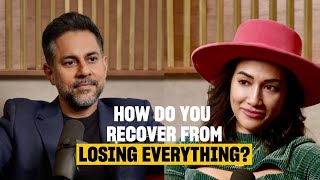
This is a conversational YouTube interview (April 7, 2023) in which Vishen Lakhiani interviews Dr. Neeta Bhushan about her traumatic early-life losses and how those experiences led her to develop a resilience method called 'The Bounce' (presented in her book Suck. Now what?). Dr. Bhushan recounts growing up as the eldest child of immigrant parents in Chicago, caring for a mother with breast cancer from age 10, losing her mother at 16, her brother at 15 shortly after, and her father by age 19. She also describes a later abusive marriage and a turning-point exit (December 31) that prompted deep personal integration and the creation of her four-step resilience framework.
Questions this video answers
10 years old
16 years old
15 years old
By age 19
December 31 (left hastily; marriage lasted ~15 months)
You lost your mom, your brother, and your father all in the span of two years. And you were not even 20 years old when this happened. You were 19.
Yeah.
What brought you here? What brought you to this seat right now with this book and in the life you are living right now?
Oh, wow. So I have to say, I think it starts out with where I come from. Like, born and raised Chicago to immigrant parents. My mom was Filipino, she was from the Philippines, and my dad was from India. So, like, typical tiger parenting. And of course, they wanted the American dream, and so they settled in Chicago. And I was the oldest of two younger brothers. And as you would, I grew up very needing to do all of the accolades and the achievements because my parents wanted us to be in dance and piano and all of these things.
I.
At 10 years old, I became a caretaker to my mom, and she fell sick and she had breast cancer. And so for those six years, she would be in and out of hospitals. And so our life would completely change when my mom would transition. So she passed when I was 16. And then a year later, a year later, my brother, DJ, who was 15 months younger than me, he was like. He was my best friend. We were super close. He had an asthma attack at school, and he never made it. They tried to revive him three times.
How old was he?
He was 15. And so that definitely shocked us. I mean, this was not even a year after my mom died. So lots of trauma, lots of big emotions. And there is my Punjabi dad again. My Punjabi father, who didn't have the wherewithal he was. He just completely. It took him out. I mean, he lost his son and he lost his. His wife within a year. And so two years after my brother dies, my dad gets this diagnosis, stage four lung cancer, and he died 10 months to the date. So at 19, within this span, I lost my mom, my brother. And your father. And my father.
And you were not even 20, correct?
Yeah. So a decade later, when I would go to dental school, I would get the good grades. I felt in love. I finally felt love in my life. And I'm rebuilding my life in this way, and I get the biggest unconventional love story. But in fact, it was me losing myself because I got into a very abusive, tumultuous relationship where then I had to leave haphazardly December 31, which would change my life forever. And shortly after that, before you had to leave your abusive husband, we were married for about 15 months.
I see.
We were married for 15 months. But it was that day, December 31, that would fully shift my life. Because that's when I had to realize that I was living my life for other people, that I had not really integrated. I had not worked through a lot of the grief. I had not accepted my reality for so many years, for a whole decade. But from the outside, I had a million dollar practice for the outside. I was changing smiles to have the contrast going, and starting from some of those deeper, darker days of not knowing what's going to happen. So all this to say, this is what led me to create what I call the Bounce. Four Steps to Build Unshakable Resilience. In my book that Suck. Now what?
I know so few people who have gone through what you've gone through. So knowing what I know about you right now, you have definitely bounced back in a dramatic way.