Supercharge Your Brain & Body | The Mindvalley Podcast | Ep #67
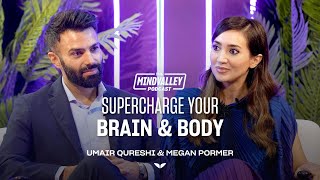
Dr. Omer Qureshi explains how to measure and improve performance across brain, body, and nutrition through baseline testing. He covers hyperbaric oxygen therapy, which uses high-pressure oxygen chambers to boost oxygen delivery and neuroplasticity, and identifies the main culprits behind fatigue: nutrition, training, sleep, and psychological stress.
Chapters
I'm fatigued mentally. I always think overthinking.
Overthinking obviously can cause mental fatigue. I personally deal with that. Can you help us understand why we.
Suffer from overthinking the fast paced world that we're living in? Is there a specific reason that you're overthinking? What are you worried about? It's such a difficult question to address because for every single individual out there, there'll be a different reason why they are feeling the way they're feeling. The best way to address this is to look at.
Hello everybody. Today we are going to spend some Insightful time with Dr. Omer Qureshi from the Brain and Performance Center. Dr. Qureshi has over 15 years of experience in family and sports medicine and he is known for his refined SK skills in hyperbaric and performance medicine. So we're going to learn how the Brain and Performance center can help us all improve our performance. So, Dr. Omer, thank you so much for being with us today.
Thank you so much for having me.
I was really looking forward to learning from you on. Firstly, I'd like to know that at the Brain and Performance center, what is your definition of performance?
This is an interesting question because everybody, if we break down what performance is, for me, at the very basic level, performance is the ability to perform a task in very simple terms. Now when I apply that term in the context of brain, in the context of your physical performance, cognitive performance, I see it as health performance. Now, health for me as a definition, no longer just an absence of disease, it's an absence of disease with maximal cognitive functionality, mental acuity, physical performance, and ultimately nutritional optimization. When you take that picture together, that holistic kind of approach to health, put it with performance, that gives you the ability to carry out any task to the best of its ability. That's how I kind of encapsulated and.
How do you help your patients or people who visit you improve their performance?
So I think in order to improve performance, we need to have an insight as to what our baseline performance is. So the first step along any journey should always be where are you performing at? Are you where you should be? Are you above? Are you below? And that involves obviously an in depth assessment and in depth analysis of all of those elements that we spoke about. I see objective and subjectively looking at your brain, looking at its performance, looking at cognition, looking at the physical, looking at the nutritional elements, putting it together, presenting it to somebody who asks you where they're at, and then addressing each individual element.
So basically understanding where People are struggling and where they can be, what's their peak performance and how you can help them, how you can take them from where they're at to where they can be. That's very interesting. So a lot of people don't really understand the connection between their brain health and physical performance. Can you explain to the audience of how brain clarity and focus can help our physical performance, whether it's at sports or success at work?
The brain, the brain essentially is the cpu. The brain controls everything that we do. And the way in which I bring it back to a lot of people is through medicine. When you have a stroke, ultimately damage to the brain impacts the physical performance. In a very simple term, you cannot move an arm. And a lot of the guys that come in after they've had a stroke, oh, I've got a problem with my arm, I can't seem to do this, I can't seem to do that. But ultimately it's because the center that is controlling that movement is impaired. So that's at the very kind of primitive, basic level. Now, if you can improve the center that is controlling that movement or that function, you're going to improve its output, improve its performance. Now, at a normal level, for somebody who's not performing at the elite athlete level, simple improvements in your brain can result in improved outcomes physically at the higher level, as you get to that point where people are trying to gain minute improvements, where a difference of a millisecond here or there is going to be the difference between winning and losing, any small change that we can influence to a degree will result in better outcome.
I see, I see. And how does hyperbaric medicine help boost brain power?
Okay, so first and foremost, what is hyperbaric medicine? So if we break it down, hyperbaric is hyper and increased barrier pressure. So we're applying high pressure, but actually it's hyperbaric oxygen therapy. We're applying this in the context of high oxygen, high pressure. When we synergistically apply the two together, we're able to actually increase the amount of oxygen that is absorbed within the blood. The rate limiting factor in most processes within our body is oxygenation. If we can increase the amount of oxygen that we're getting to any end organ, whether it's the brain, whether it's the heart, whether it's the muscle, we can improve its performance. So we apply the two together, put people into this chamber where you're giving them 100% oxygen, and we're getting more oxygen to the end organ, improving its function, which is great. In theory. But we all know you can't live in a chamber for the rest of your life and perform there. So what we then do is apply a protocol where we fluctuate oxygen to high levels and low levels. When we apply this protocol, what the body ultimately does is adapts to change better than it adapts to a steady state. If you can continually fluctuate from high levels to normal levels, we actually mimic training in an environment that is hypoxic. So altitude training, where there's low levels of oxygen, so you make your body make a change that triggers a number of changes further down, it responds, it creates changes that are going to improve functionality. So we get an increase in the amount of vessels that are produced, we get an increase in stem cell proliferation production, we improve neuroplasticity, so nerve regeneration and we improve mitochondria function. And that is our target. Ultimately, it's those cells that are going to be producing energy for every function of your body. If you can mimic those changes without giving any of the problems associated with a low level of oxygen hypoxia, we gain massive benefit, minimal harm, and ultimately enhance and improve functionality. Wow.
Very interesting. We're all fatigued. We are, we're all exhausted, mentally, physically. How can you help people boost their mental sharpness and physical energy, whether they're an athlete or regular people like us?
Ah, it's a tricky question because everyone is fatigued, in my opinion, for different reasons. And if I go back to that initial point that I made about the body not just being one entity, it's these different pieces of the jigsaw that fit together to give you this perfect picture. If one is missing, what you'll notice is you're missing. You can't see the overall vision. So is fatigability down to what you're eating? Have you addressed the nutritional element? Are you eating the right things? Some people, interestingly, think, I can go through this. I'm on a great diet, I'm fasting, I'm managing my calories, my macronutrients. But are you deficient in supplements? Are you definition in certain minerals? So address the nutrition, address the physical element. Are you training enough? Are you training in the right zones? Are you training in the right way? What might work for me might not work for you. Then we talk about cognition. Now, when people turn around and talk about cognition, everyone associates it with just memory. For me, cognition is different facets of your brain's performance. Whether it's memory, immediate delayed verbal, non verbal, whether it's attention, both sustained and normal focus, whether it's motor function, whether it's executive function, multitasking ability. So the other facet that you need to address is where are you weak and how do you address that? Is that the reason why you are fatigued? And then have we even spoken about psychological elements that can also be a factor? A lot of the main psychological conditions are associated with fatigability. So we need to break down the areas where we can improve. We need to dissect it with a fine tooth comb, look at which areas can be addressed, which areas can be improved. And once we've identified what they are, how we do it is going to be very individual, depending upon what works for you and where you're lacking.
It's very customized and you've worked with a lot of individuals and businesses. How can you help companies help their employees and team members stay more sharp, active and healthy?
So this for me is executive health in essence, which is recently gaining a lot of popularity and rightfully so. If I put my mindset into a business owner, into a C suite executive, ultimately it's about improving productivity, having a happy team, which ultimately will improve results and therefore improve profits at the very kind of simple, basic level. Now the we've actually had Quite a few CEOs and we've actually had companies that have actually put their whole CC suites through. They've had to commit to the program three months and that's two hours a day just within our chamber. The logic would have been I've lost 1, 2, 3, 4, 5 of my top executives for two hours a day, 10 hours of time. It's going to be non productive and non beneficial. What they've actually found is that the outcome of going through a process where your team is functioning at its optimal level has resulted in better innovation, better ideas, better thoughts, bringing these ideas to the forefront, executing them in a better way, and ultimately improving performance outcome. Employee happiness has resulted in an improvement in, as we've mentioned, profits and performance. And that's what their end game is for a lot of them, in my opinion. Correct? Absolutely.
So to our audience, how many of you guys are feeling fatigued at the moment, whether physically or mentally? I would like to pick two people and I want you to ask your questions about in which areas you feel fatigued and then Dr. Omer can maybe help you pinpoint what is it that you need to address?
Yeah, I'm fatigued mentally. I always think overthinking.
Overthinking?
Yeah.
So overthinking obviously can cause mental fatigue. I personally Deal with that. Can you help us understand why we suffer from overthinking?
So I'm going to ask you first. When you turn around and say that you suffer with overthinking and it's something that you deal with, how do you deal with it?
Recently, I've learned from my spiritual teacher to do a practice called thoughtless silence, which means when I'm sitting in silence, I'm not allowed to have any thoughts. It's hard, it's hard to do it. And the second thing I've learned to do is I speak out loud with myself. I talk out loud. Whatever thoughts that are coming through my mind, I talk it out loud. And then I feel like I'm emptying the mental load.
Okay, so again, you've just described two techniques that work for you. Yes. So when you say that you are tired, you're overthinking. I think the most important thing is to identify why you are overthinking. Is this just the fast paced world that we're living in? Is there a specific reason that you're overthinking? What are you worried about? It's such a difficult question to address because for every single individual out here, there'll be a different reason why they are feeling the way they're feeling. For me, if I'm fatigued. What I find personally, the thing that probably fatigues me the most is sometimes when I'm on my phone and I'm scrolling, scrolling, scrolling, trying to absorb a lot of information. Whereas the best thing that I can do at that point is probably turn it off, get some time away and that's how I deal with it. So you have to identify why you are overthinking, what's the trigger for your problems, and then address that on an individual basis. Then you can identify, okay, this is the root cause. Now that I've identified that, how can I, do I need help in order to address it? Do I need somebody to talk to? Do I need to have my own personal time? Do I need to direct my overthinking to something else? Whether it's extra physical activity, whether it's social, taking yourself away from a social setting.
But is there a physical reason for overthinking?
There's many physical reasons. I would probably say if it's underlying it, is it a mental issue? Is it anxiety related? Is it depression? But if you were to ask me, is there one reason physically why you overthink? I don't, I don't think I could pinpoint one specific reason.
So we have to understand the root of overthinking. Like in my case, I know why I overthink. I want to make sure I'm loved by everyone. So I constantly have to overthink to make sure everybody loves me. But it's about finding the root. And then I assume that at the Brain and Performance center you get to the root of the problem and find techniques and basically treatments to solve the issue. I'd like one other person. Yes. Yes.
Yeah.
Hello, everyone. My name is Saba Amir. I'm from Pakistan. My question to you, Dr. Amir, is that my fatigue sometimes that I deal with is that I wake up feeling tired. And I know that could be because I haven't gotten my deep sleep or the REM sleep that we keep learning about. And sometimes that fatigues me during the day. Like the tasks that I'm supposed to do, I don't really get through them as well as I would. I feel that it's only because of my determination and will that I'm able to do a lot of things. Not really, you know, getting up, feeling very fresh, although I know on a cognitive level what I need to do. But why is it still not working? Or if there's any other tip that could help us.
So this one. See, in this case, you probably have already identified the reason why you're feeling so fatigued. It's clear that your sleep or your sleep pattern is the issue over here. And the best way to address this is to look at what is affecting your sleep. So we're living in a world currently where technology has come into it massively. So we actually advocate a lot of our clients, we actually provide them with, with a wearable device to look at their sleep pattern, to look at how much REM sleep they're getting, what's their sleep wake cycle like, what's the time to get to bed at the point at which you are hitting the bed, how much time you're spending with regards to additional devices. Then we talk about medication because some medications obviously have impacts on excessive drowsiness or vice versa. And then the basics of sleep hygiene that we try to reinforce. Simple things like breaking down your diet, breaking down the amount of caffeine, the point at which you're drinking, what point you're training. All of these factors play a part in affecting your sleep and that subsequently will have a knock on effect. But this is even without looking at biochemical markers, laboratory testing as to other reasons, supplements. I don't think we've got enough time to talk about supplements. But there is A. There's a massive data of research coming in about which which supplements can aid sleep, which supplements can impact sleep. The issue that we generally have with supplements, unfortunately, is the amount of data out there that supports this is very variable. And trying to access the regulation of supplements at the moment is a big issue. So if we can get that nailed down a little bit better, and I think that's an area that definitely can be looked into further.
Thank you so much, Dr. Qureshi. That was very insightful. Guys, please check out the Brain and Performance center to understand how you can improve your performance and to understand how you can maximize your potential or to better say, to align with your highest level of potential. Thank you so much. Thank you.
Thank you.
Thank you so much.
More from Vishen






Brown Noise for Deep Focus and Concentration (Best with Headphones) | Gabriel Loynaz



Your Appointment With the Eternal | Guided Meditation with Michael Bernard Beckwith