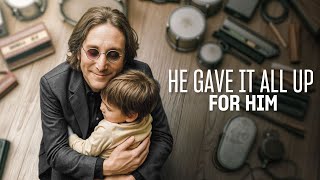
Vishen Lakhiani reflects on fatherhood, prompted by an anecdote he heard from Warren Farrell about John Lennon choosing to step away from music to raise his son. Vishen situates the story against his own family milestones (his son Hayden turning 18; daughter Eve finishing primary school) and emphasizes presence over achievement, noting a statistic that roughly 85–90% of the time parents spend with children occurs before age 18. The video recounts that John Lennon took a five-year break from music (1975–1980) to be a "house husband" for his son Sean, wrote the song "Beautiful Boy" in 1980, and regarded those years as the most meaningful of his life. Vishen closes with an explicit call-to-action to prioritize presence with loved ones.
Questions this video answers
June 15, 2025.
Almost 85–90% of all the time you will ever spend with your children happens before they turn 18.
1975–1980.
"Beautiful Boy".
Sean.
Chapters
The fatherhood lesson that changed John Lennon's life and mine. This may be the boldest video title I've ever written, but stay with me, because this is the story of a man you definitely know. Trust me, you know this person. But maybe, just maybe, you never truly understood this man. Because this man made a quiet, radical decision before his death, and it changed the entire trajectory of his life and the life of his child. And today, the story is hitting me harder than ever because my son Hayden is turning 18. My daughter Eve just graduated from primary school. She still slips her hand into mine when we cross the street, but I can feel the clock ticking on that, too. And even after two decades building Mindvalley, even after meditating with monks, interviewing billionaires, creating platforms to help people transform, nothing has brought me face to face with the raw, soul shaking truth of life like this. My biggest moments with my kids are happening right now, and they are slipping through my fingers. Studies show that almost 85 to 90% of all the time you will ever spend with your children happens before they turn 18. Let that sink in. And as my son is turning 18, it's making me reevaluate what really matters in life. So back to the story of John Lennon and why this matters so much to me now, and why, when you hear the full story in this video, it will shift something in you, and you will likely never be able to go back with your understanding of life, work, and love in the same way again. I heard the story a few weeks ago, and it stopped me in my tracks. It comes from Warren Farrell, the author, speaker, and and pioneer in men's emotional health. In an interview on YouTube, Warren shared a moment from the 1970s when he was attending a party in New York City with the feminist icon Gloria Steinem.
So here I'm at the party and Gloria and I make eye contact, but she has a number of people that are surrounding her. I have nobody surrounding me.
And so.
But I'm sort of winding my way.
Up toward her when a man came up to Warren, stopped him and said, are you Warren Farrell? And Warren said, yes. The man smiled and said, I joined one of your men's groups, but you always disappear like the Lone Ranger. Warren chuckled politely. See, Warren back then was launching these men's groups in different cities. He would initiate the group, then he would move to a different city, right? And then the group would run on its own. So he would start these groups, but he wouldn't really know the members in this group. Thus he didn't know who this man was. So he chuckled politely and tried to get away to Gloria. But the man, the man went on.
To explain, and I gave up my job and focused full time on raising my son because I had previously, you know, neglected a previous son that I had. And I really felt I made a mistake doing that.
And now when his second son was born, this man decided he was going to quit his job. He was going to put everything to the side and he was going to just dedicate the next five years of his life to being with this baby boy. So Warren stopped, fully turned towards him and said, was your wife okay with that? The man nodded. Two things made it work, he said. Her support, the support of his wife and the men's group he had joined. Now, at this point, Warren was hooked. The man had told Warren how his men's group, the group that Warren had started, had changed his life. Warren wanted to know more. So they sat down and talked for an hour. Just two men, deeply connected, sharing truth. The man told Warren, my soul opened up. My heart healed in ways I never thought possible. He spoke of his own father wounds and how this being present for his second son was changing him. Then something strange happened. Young man approaches the table and said, can I get your autograph? Warren smiled and started fumbling for a pen. Sure, said Warren. And then the man said, actually, I mean him, and pointed to the person Warren was talking to, the businessman who had quit his job. Warren looked at the man, perplexed and said, sorry, what's your name? The man said, my name's John. And Warren said, well, my name's Warren, Warren Farrell, you know that. John who? The man replied, john Lennon.
And I go, I'm Warren, you know that. I guess I say, well, John who? And he goes, john Lennon. And I go, oh, wait a minute, you're a singer, aren't you?
John frickin Lennon, one of the most famous human beings on the planet. Warren Farrell didn't know that. Warren later confessed that he hadn't owned a television set in 20 years. He had no idea what John Lennon looked like. So he's sitting there with John Lennon, and the only thing John Lennon wanted to talk about at that party wasn't fake fame or money or peace activism. It was fatherhood. And that the greatest decision of his life was stepping away from his work, stepping away from it all. Stepping away from the Beatles to raise his son, Sean. John Lennon took a five year break from music at the height of his fame. And what he did was diapers, bedtime stories, walks, baking bread. He called Himself a house husband. And he meant it. And Yoko Ono supported him completely. From 1975 to 1980, John gave his son the one thing money couldn't buy. Presents. Now, here's the gut punch. John Lennon was assassinated in 1980. John didn't see that coming. His family didn't see that coming. The world didn't see that coming. But those five years, John said they were the most meaningful of his life. Not the song Imagine, Not Abbey Road, not even the Beatles. It was the ordinary magic of fatherhood, something that most of us have access to. But because it's so common, we neglect it. We neglect how absolutely magical and fantastic and beautiful the experience is. And instead, we park those moments aside and focus on the fame or the money or the business. And that's what hit me the hardest. Because now I look at Hayden standing taller, becoming a young man preparing for adulthood. I see Eve still holding my hand as she crosses the street. But soon she won't. And I ask myself this. And I want you to ask the same question to yourself if you have children. But even ask the same question, as it matters to your partner or your parents or anyone in your life that you deeply care about. The first question is, am I showing up for their souls and not just their schedules? Am I giving them my presence and not just my protection? Am I willing to pause the world to be with them? The truth is, this legacy isn't always what we leave behind. It's what we leave within the hearts of the people who love us. Remember this line. Your greatest legacy is not going to be the book or the business or the company or the social media following. It's going to be what you leave in the hearts of the people you most love. It's the bedtime hug, the inside joke. The moment you stopped to listen, really listen. And John Lennon understood this. Warren Farrell witnessed it. And now I'm trying to walk that path, too. And I just wanted to share the story with you for whatever it means, for whatever way it lands on you, so that if you're a parent, you don't waste the most precious years of existence and you understand what truly matters. Pause this video now and go hug your child. Even if they roll their eyes, as mine would, or if they're not with you. Send them a loving message, even if they pretend not to care or don't answer, because that's what children do. They ignore us to teach us lessons, but we love them anyway. And one day, that hug, as awkward as it may be, may be the moment that holds them together. And if your children are grown, call them, write them, love them fully. Because the quiet choice to be present may be the loudest message you ever send to to the world. Now, if this story moved you, if it cracks something open in you the way it did in me, there's one more thing you need to hear. Because even after stepping away to raise his son, Sean John left behind one last thing that almost no one talks about. It was a song he wrote in 1980, just before he died called Beautiful Boy. And I want you to pay attention to the lyrics. Before you cross the street take my hand Life is what happens to you While you're busy making other plans Beautiful boy Before you go to sleep say a little prayer Every day, in every way it's getting better and better. I cried when I read the lyrics of that song. Every day, in every way it's getting better and better. That exact quote hangs on my wall in my apartment because that quote comes from Emile QA, early 19th century personal growth teacher. And every day, in every way, it's getting better and better is the most powerful quote that I think anyone could repeat to themselves. So I leave you with that message. And I hope all of us are truly reminded of what truly matters in our lives. And it's not the chase, it's the presence. If you enjoyed this video, click subscribe or follow me on Instagram. Vision for more deep wisdom from incredible individuals around the world.