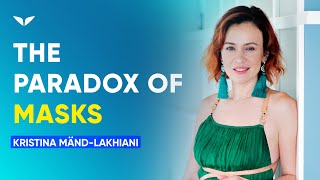
Short YouTube talk by Kristina Mänd-Lakhiani describing how people adopt social "masks" (roles/behaviors) to gain connection and acceptance, but that long-term wearing of masks causes loss of self. She contrasts this with children who feel inherently lovable, summarizes research identifying three traits of deeply connected people (believing one is lovable as-is, showing up authentically, and having the courage to be vulnerable), and ends with a call-to-action to attend a masterclass about removing masks.
Chapters
Have you ever noticed that throughout the day you put on different masks, you take on different roles, and it seems absolutely natural to us. Obviously, we perform in different ways, so we put on those masks. And sometimes we even forget what is behind those masks. But have you ever thought, why do we do that? Why do we put on masks? The thing is that this is our human nature. It's our evolutionary trait. We want to feel connected. We feel that connection is something which keeps us safe. So we put on those masks and so that people accept us, so that people like us. Because somewhere deep inside, we are afraid that if they see what we truly are, that they might not like us. But think about the kids. They don't wear masks when they're born. They know that they're lovable just the way they are. They don't think that they have to do something to deserve love. It's later on in life, we teach them to put on a mask, to put on a certain behavior, a certain role, so that they feel accepted, so that they feel part of society. Yet scientists have discovered that this is a really wrong tactics. There was a research into people who have really strong sense of connection with their loved ones. Scientists were trying to understand what makes them special. Why do they feel so strongly connected with the people in their life? And what they've discovered is super interesting. These people have three common traits. First of all, they believe that they're lovable as they are, just like kids. The second condition is that they are not afraid to show up to the world the way they are, just like kids. And the third condition is that they have the courage to show up in the world despite the uncertainty of how the world is going to receive them. That's what we call vulnerability. Don't you find it paradoxical? We put on the mask so that we are accepted and loved. Yet scientists have discovered that to be accepted and loved, you have to take off the mask. And there is nothing really super wrong about wearing masks from time to time. Obviously, we have to behave differently in different environments. When it becomes a problem is when we forget the masks on, when we forget to take them off. Moreover, we forget what is hiding behind those masks and why are we hiding behind those masks. So having a mask on and off is fine, but forgetting who you truly are behind that mask, that is where the problem lies. I really hope to see the world when the kids don't learn to put on the masks and hold onto them, when they don't forget what they truly are, when they don't hide behind the mask so long that they forget their true essence. And I believe that when humanity learns to drop them masks to remember their true essence, we are going to live in a much more happy and fulfilled world. So how do you take off that mask? It might be quite scary. We're going to talk about that at our masterclass. To attend the masterclass, sign up right under this video. And I hope I'm going to see you at the masterclass. Bye.