The Truth about Living Your Potential and Passion | Cheah Kar Fei
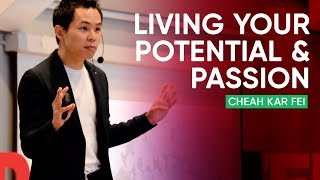
Cheah Kar Fei (life and performance coach) argues that passion, purpose, and potential are not discovered but designed. Drawing on ~10 years of coaching experience and work with about 50,000 people, he introduces Ikigai (doing what you love; doing what you are good at; being paid for it; what the world needs) and drills into three pillars that create fulfillment: values (often formed from painful experiences), future identity (behaving as the person you want to be now), and motivation (growth and contribution). He advocates a "multi-passionate" life—holding multiple passions/roles simultaneously—and illustrates this with a client who is both a web developer and a photographer. The talk includes personal anecdotes (e.g., initial stage fear, speaking internationally) and practical prompts to reflect on values and motivations.
Questions this video answers
About 50,000 people.
About 10 years.
1) Do what you love; 2) Do something you're good at; 3) Be paid for it; 4) Do something the world needs.
Growth and contribution.
About 2,500 people.
Chapters
What is the difference or what is the similarity between a web programmer, a web developer versus a photographer? Before I tell you the answer, I want to ask you a few questions. Find your passion, find your purpose, fulfill your potential. How many of you resonates with one out of these three statements here? Majority of you. And these are actually the three statements that I've listened to the most from my almost a decade of coaching experience. I am a life coach and performance coach. What I do is I help people who to get clarity and build their confidence to achieve all their goals in their life. And these are the three statements that I receive the most from all my clients from all backgrounds and all walks of life. And I've been doing this for the past 10 years. And this is the three things that has been always people coming to me and telling me what they're looking for. They want to look for their passion because they believe that once they achieve the passion, they'll be happy, they'll be fulfilled. They wanted to really live their purpose because they feel that there's something more in them that they want to do. There's a bigger purpose in their life of what they want to do. And most importantly, they want to live up to their potential. They want to live up to what they can really do. They want to live up to be the person that they aim to be. And this is the problem. See, you never achieve or find happiness or fulfillment if all that you do, it's finding it. There's no finding, there's only experiencing. You don't find the passion or purpose. You design them. And what do I mean by design them? Let me tell the people about this. 50,000 people. These are people that I've coached, trained, mentored or spoken to all around the world, in different continents, to different young professionals all around the world. And these are the three things that I will share with you after this that I have personally learned. And I think this is an idea of a multidisciplinary life that every one of us should live. This by all means are not research based, but this is by my own sample science and, and my population of clients or people that I've spoken to over the past 10 years. And there are 50,000 of them. Some of you might be familiar with this concept. This concept is called the Ikigai. So this concept came about because there's this province in Japan called Okinawa where people actually live really long. So there are a lot of researchers who became curious about why did these Japanese live so long. And obviously when you talk about Japanese. The first thing that we think about is, is it because of the raw food that they eat, you know, sashimis and stuff, or is there any other things why they actually live so long? And based on this research that's been done over the years, there's one thing that they found that actually contribute to their longevity, and it's called ikigan. Ikigan means the reason for being. Basically everyone in Okinawa actually state that the reason why they wake up every morning is the reason why they continue to live, is the reason why they actually live longer. And in order for you to actually achieve this reason for being, this purpose that you have, there's four things. Number one, you should be doing what you love. Number two, you should be doing something that you're really good at. Number three, you should be paid to do all these things. And last but not least, you are doing something that the world needs. That sounds like a perfect purpose for your life, isn't it? When you're really good at it, when you love doing it, waking up every single day and you actually get paid for it, and the world actually begs you for your services or your skills or your competencies. But is that really how we live our passion and purpose? These are the three things that I have done my own research, that I've spoken to multi millionaires, successful people that I coached, that I trained, that I work with. What are the three things that really, really make them have a fulfilling and happy life? And these are the three things. Number one, their values. Number two, their core identity. And number three, their motivation. Now, let me break it down to you. Number one, your values. See, most of the time, our values are derived from some of our most painful experiences in our life. Whoever you are right now, your habits or whatever that you do right now, they are all products of your past experiences. And most importantly, the values that you have right now are products of traumatic or painful experiences in your life. Think about it. Two siblings can be born to the same alcoholic parent. One turned out to be exactly the same as their parents, and the other one turned out to be a successful billionaire entrepreneur. How can this be? It's because both of them look at the same painful experience and they decide on the different values that they want to have. For the person who became an alcoholic, his value is that I'll be the same. If born in the family, I'll be an alcoholic. But for the other person who became a successful multimillionaire, his value is that I will take risk. I will not stay where I was. I want to Go to where I want to be. And this is your values. So for you, if you really want to figure out your values, you want to look at your painful experiences, ask yourself, what have you learned from your past painful experiences that has shaped you, who you are today? Think about that. Really go into deep thinking about things that you're doing right now, goals that you want to have, things that you want to achieve in life. Why are you now achieving them? Are these the values of the past experiences in your life that is stopping you from getting there? Number two, your identity. Now this is very interesting because I've done this a lot and this is the same thing. I talk to almost every single one of my clients. Most of us believe in order for us to have a happy, fulfilling life, we need to achieve certain things first. You need to have the job title, you need to have the financial freedom. You need to have that big company that you want to have. You want to have to climb that carpet ladder. You want to work in specific companies that everyone in the world wants to work for. But that's not how it works. The mind doesn't work in a way that moves towards something that's really, really far away. But the way the mind works is that it will get you where you want to be. If you start behaving as if you've already achieved what you want to achieve. And this, I'm talking about your future identity. Some of you might ask, hey Darfe, that sounds great, but I don't even know what I want. I don't even know what identity I want to have in my life. That's wrong. Every single one of you in this group has a role model. Every single one of you. Now then the question is, what is the role model that you actually want to behave like today? And that brings me this question. How can you be the future self you want to be right now? See, I have fears of public speaking. 10 years ago, 10 years ago, I was on stage in front of 500 people and I was given the mic and I actually cried. I was 18, I cried in front of 500 people. Think about what they do to your self esteem and self confidence. And right now I spoke in stages all around the world. This year I spoke in Russia, Singapore, India. And my biggest prop today is actually 2,500 people to a group of CEOs HRC C suite level in Singapore where they are way, way, way older and more experienced than me. So what gives me the confidence? Is it because I'm really better than them? No, it's because I start to behave as if I'm confident. I behave every single day knowing that every time I get on stage, I will nail the stage. I will be the best speaker on stage. Is that a fact? I don't know. But does it really matter? It doesn't because it serves me. It helps me when I get on stage to present in front of thousands and thousands of people. So that is my future identity. That's the identity I want to have when I start behaving and acting like I am today. And last but not least, your motivation. And motivation is extremely important for you to create the life that you want. A lot of research has been done and my personal experience as well. There are two core human motivations that really, really make people think. Number one is growth and number two is contribution. Humans are wired for growth and contribution. Every single day we are seeking to grow. And the time when you stop growing is the time when you feel that you are most unfulfilled, unhappy, lost. You have no idea what you're doing in life. And trust me, this is applicable to not only university students, young professionals, it also happens to some of my multi millionaire clients when they have achieved multimillionaires, multi millions in their life. When they stop growing, they wanted to sell off the businesses, they wanted to throw away everything and start something again. Because when they start something again, they start growing. And the second one is contribution. When you contribute to others, you have that feeling of fulfillment and happiness. A lot of us are living this life trying to seek and find happiness and fulfillment when in an instance you can get it immediately. Our brain is wired by contributing to others, we are genuinely easily happy and fulfilled. So these are the three pillars that has very big difference. In order for you to really find out what motivates you, you can ask yourself this question. What motivates you to keep going when times are tough? All of us, no matter how young, how old we are, we have gone through down times and there are things that actually pull us through. It could be our family, it could be our partner, it could be our business, it could be our peers. It could be just an intuition that keeps you going and stick to that. That is your motivation. So now, going back to Ikigai, does that mean that every single one of us actually has one purpose, one passion in our life? Maybe the answer is not so. And that's the idea that I want to share today on multi passion, a term where I coined because I believe that human people have different passions and at a single time you can have different passion in different areas of your life. You can have different passion at different stages of your life. I know for me right now, my career that I've been building for the past 10 years is one of my most important things. But I know, I know for sure, two, three, four, five years down the road when I have my own kids, things will change because I've become a parent. But does that mean I only have one purpose, one passion? No. I can have multiple passions at the same time. And going back to the question of what's the difference between the web programmer versus the photographer? These two persons are actually the same person. He's actually one of my coaching clients. What happened was he was actually on the verge of quitting his bad programming job. He does photography on the part time, earning some side income, doing it for fun. He was on the verge of actually quitting his job as a web developer. That means him really well. He was like, you know what, I really don't like this job. I want to pursue my passion. Very, very massive message, right? Everyone in this room was told, pursue your passion and your money will come. But throughout my coaching with him, he realized that he's actually passionate with both. And the reason why is because he valued the art of problem solving by becoming a web programmer or web developer. He became a web developer to help clients to solve technological problems that they have. And he has an identity. The identity for him is that he wants to be a creative person through photography. He wants to go out to be able to shoot anything he likes, he likes without being dictated. Think about it, right? If you quit a full time job and pursue photography full time, what does that mean? You have to earn some income. And what does that mean? People pay you, your clients pay you to shoot what they want you to shoot instead of what you really want to shoot. For him, that is the identity that he wants to keep. He wants to be the creative person to shoot and have the freedom to be creative, play with photography. And last but not least is his motivation. He knows he can grow by solving problems by becoming a web developer. And at the same time, he knows he can grow by growing his creativity through photography. I actually coached thousands and thousands of clients and participants all around the world in this picture. This picture was taken in Estonia where I actually coached group of multimillionaires. From a multi millionaire to a girl right here who is actually 17 years old would drop up from school because she believed that she wanted to find a clarity about what she wants to achieve in her life. And these three pillars, the values, the identity and motivation is something that I personally have found that helps to create a multi passionate life and a multidisciplinary life to all of you. So if you are still seeking to find that one purpose, one passion, that one potential that you want to live by, maybe it's time to drop it. Because you have a choice. You have a choice to live life by design, not by default. You have a choice to decide and design the life you want to experience every single day in every single area of life, and not that one passion or potential or purpose that people have been telling you. And with that, I hope you have a great evening. Thank you.
More from Vishen






Brown Noise for Deep Focus and Concentration (Best with Headphones) | Gabriel Loynaz



Your Appointment With the Eternal | Guided Meditation with Michael Bernard Beckwith