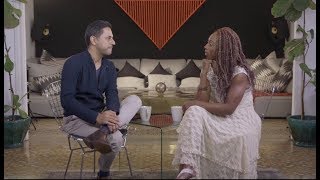
This is a short transcript excerpt from a conversation between Vishen Lakhiani and Lisa Nichols about public speaking. Vishen frames personal stories and "darkness" as "breadcrumbs" to one’s mission; Lisa emphasizes that conviction—being willing to stand for something—is essential to make an audience fall in love with a speaker. She offers practical and rhetorical guidance (stand for something, own your voice, let conviction be felt) and uses familial aphorisms and references to figures like Dr. Martin Luther King to illustrate her points.
Chapters
Your stories, your darkness are the breadcrumbs to your mission. They help you see your why. They help you understand what is the next piece of art you're going to create, or the next company you're going to found, or the non profit you're going to support. They can be the greatest gift you've ever had in your life. It all depends on how you look at them.
Now you just did the best segue ever to the next piece, the next piece of information that really talks about what do you need to do to have an audience fall madly in love with you while a huge part of that is story, huge part. But what you just said, what you just said just made so clear is that stories and your entire message has to be fueled by your conviction. If you want to know what makes you a game changing presenter, what makes you a game changing speaker, whether you're speaking to one or a boardroom of five, or in front of 50, or in front of 5,000 is have a conviction. Be willing to stand for something. Be willing to stand on a conviction. My grandmother says that, baby, your conviction and your convenience won't ever live on the same block. And most people won't hold on to a conviction because they don't want to be inconvenienced. They don't want the chance of someone having an opinion that differs from them at the chance that the person in the third row might not like their conviction. See, when you're not willing to stand for something, Dr. Martin Luther King says this. If you won't stand for something, you'll fall for anything. What do you stand for? What's your conviction? How do you want to use your voice? You've been given the gift of voice. How will you use it? What are you going to change? This is a bold question, but what are you going to impact, infect or change because you were born? What are you going to influence because you're here? Every time you open your mouth, though you may not be on your charge, you may just be hanging out still inside every space. Who you are. My grandmother says who you be. And I know that's not grammatically correct, but when my grandmother says who you be, that means what you do when you're not talking, what you say when you're not speaking. What's the cause that pours from your skin? And when you sweat, your conviction comes out of your skin. What is that thing? What do you stand for? What I stand for is melting walls and building bridges. What I stand for is people owning their voice. Even if it's just a whisper right now, own your whisper until it gets stronger. And then stand that thing that matters for you, and you don't have to stand for it like Nelson Mandela or Mahatma Gandhi or Martin Luther King or Cesar Chavez. You don't have to stand for it like that, but stand for it the way you would stand for it. You don't have to do it the way Vishen would do it or the way I'm doing it. There's no measure to it. There's no measure to the value you bring to the world. One of the most important people on the planet that you may not ever meet is my grandmother. Because in her quiet time, she pours into me. She doesn't have to do anything else. And so don't measure. Benjamin Franklin says that comparison is and will always be the thief of all joy. Don't measure your conviction to someone else's conviction. But if you want to be memorable, you want to be unforgettable, you want people to fall madly in love with you, make a stand, because at the very most, at the very least, they'll admire you. They may not agree with your stand. I appreciate people, even if I don't agree with them, I appreciate that they know their stand. They know their conviction. So when you want to make an impression as a speaker, as an orator, as a businesswoman, as a mother, as a father, as a friend, live inside your conviction and then gift your conviction to us. Allow us to see it. No, no, no, no, no. More importantly, allow us to feel it. I don't want to just hear about your conviction. I want to feel it. I want to be palatable. I want the tingles in my finger to occur because you just start speaking. I want the tingles in my finger to occur because I saw the way you love the perceivingly unlovable, the way you were willing to forgive the perceivingly unforgivable.