Who's That Girl? | Fireside Chat with Eve on Creativity, Identity, and the Future | Ep #74
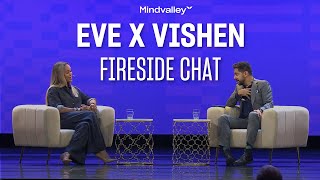
Recording of a live fireside chat (YouTube Ep #74) between Vishen Lakhiani and musician/author Eve. Conversation covers Eve’s personal transformation (addiction recovery, anxiety, fertility struggles), identity (name meaning, upbringing in Philadelphia), daily practices for wellbeing (daily walk, breathwork, acupuncture, therapy), performance philosophy (service-oriented performances; uplifting audiences), work–life balance (being a mother and artist; setting boundaries to prevent burnout), and perspectives on AI in creative fields (sees AI as a tool, cautious about voice/data usage and compensation). The talk also highlights gratitude, excitement as creative drivers, and the spiritual framework Eve calls “GAAU” (God, Angels, Ancestors, Universe).
Chapters
Just being okay with saying, I just can't right now. I just can't right now. I'll get back to you. And again. And I think for a lot of people that come. It used to come with guilt from me. I did used to have a lot of guilt. I don't anymore. I don't anymore. Because for me to be the best version of myself, I can't allow myself to get to Burnout Eve from me.
It is such an honor to have you here. Please.
It's an honor on stage. Honor to be here.
Please give a big round of applause to Eve.
Thank you.
So Yves Memoir is called who's that Girl? And we're really, really honored to have you over here.
Thank you.
Eve. One of the reasons we love having incredibly creative, brilliant personalities like you who have done such incredible things is because I believe that one of the best ways we can grow as human beings is through modeling. To try to understand someone like you in terms of how you see the world. Because you do not see the world in a conventional way. To understand how you create, how you produce. And this event, and today, a lot of it is about creating. It's about work. It's about getting our gifts out to the world. So my first question to you is on personal transformation and self identity. But before we even go there, I just wonder if you have any message for our audience here in dubai and the 5,000 people watching live?
Oh, my goodness. Well, first of all, I'm just so honored to honestly be here. And, yeah, the message is, I mean, first of all, thank you for being here. Thank you for sharing your energy and giving your time. So, yeah, that's it.
What is your favorite thing to do in Dubai?
My goodness. Probably eat and shop. There's so many amazing places to eat here. And I live in England full time. So the other favorite thing is just soaking up the sun. So, yeah, it's always nice to come here.
Are you here often?
Not as often as I'd like to be. I'm trying to convince the hubby to make the move. But we'll see. We'll see. I do come probably every at least once or twice a year. Yeah.
This is an amazing place to live in as an alternative to London. I'm living between Dubai and London.
Okay. Okay. Yeah.
Now, one of the things which I love about you is your name. My daughter is actually called Eve.
Yes, I know.
And Mindvalley's AI, which is named after my daughter, is also called Eve. We're launching an AI called Eve this year. And it stands for Everyone elevates.
Love it. Love it. You know, it's funny, when I was younger, I hated my name. I thought I was cursed. I did think I was cursed up until I was about probably early 20s, because I grew up kind of in a religious environment. My grandmother was Jehovah's Witness. So we would go and people would be like, you know, it's your fault there's evil in the world. And I really did take that on. But my middle name is Jahan, which means universe. And when I got older, I realized that Eve really means first woman, first woman of the world. So now I embody that. Now I love my name. Now I love my mother for naming me Eve Jahan. Yeah.
Jahan. That's such a really cool name. What language is that?
So it crosses many languages. Actually, she named me after Shah Jahan that built the Taj Mahal because she's loves, love, but one letter is different. I am J I H A N. Where I think is J A H A N. But yeah, I now love my name. Yeah.
Eve Jahan.
Yes, Love it.
Okay, so your book delves into the evolution of identity. How has personal growth practices impacted you?
Oh, my goodness. In so many ways, you know, I am this. I still think of myself as this little girl from Philly who has been able to see the world, travel the world, be on stages like this, but only because I was able to push through a lot of the adversities. You know, I could have been a statistic and been home and kind of never made it in the industry. I mean, you know, I came through a male dominated industry. And it's not just in my personal life that I've pushed through. I think in my. Sorry, not my professional life that I've pushed through. In my personal life as well. I went through a lot of, I won't say addiction, but I had a hard time with drinking and alcohol. And that was something that I had to figure out. If I wanted to elevate in my life, then I needed to get a hold on one. Why is I want to be drinking? And that came from a space of just not feeling enough. And. Yeah, so I started working on my personal development, my personal growth, and figuring out what other spaces in life I wanted to be.
So firstly, thank you for sharing that really vulnerable moment.
Yeah.
What is it? So when you came out of that, what were some of the practices or maybe even some of the books that inspired you, the ideas that inspired you, that helped you rise up in your career?
Oh, my goodness. I. I Think it almost came back to. I went back to that little girl, to that faith based place that I grew up in. So I always, I have this motto called breathe and believe. Right. And the belief is not so much just the religious aspect, but just that belief in something, that life. There are things that are bigger than you, that there is something there that is guiding you. And that is the thing that I think kept me kind of sane with that though. I do a lot of different modalities. I see healers, I go to acupuncture very religiously. I do breath work when I can. I try to meditate. So I use a lot of different things. And therapy, talk therapy, is there a.
Modality that you've seen incredible results and you wish more people knew about?
I completely wish more people knew about, especially from where I come from. I come from a community that really is not into therapy. It is, you know, in the younger generation, people are more open to it. But the older generation say for like my mother and people like that, they are not into therapy, talk therapy, or even, you know, alternative modalities. They don't think that that's something that really does help. Whereas I know, and I am a witness to it does. It does help. Yeah.
So this, this whole era that we're going in is really impacting the music industry.
Yeah.
Right. Even if you guys use Spotify, you'll see how AI is now using is there are AI generated songs on Spotify. AI is recommending your playlist.
Yeah.
How is the rise of AI impacting you as a musician?
You know, it's, it's still very new. It's still very new. I haven't personally used it within my music and writing, but I think that AI is here to stay. Right. It's another tool for us to be able to be creative. So I don't think it's something that we should be afraid of. I think it's something that we need to learn and learn to embrace. I do use it. I think it's fine to use it for ideology. I think it's totally fine to do that. But it's again, it's a very new thing. I don't think it's something that should be pushed away. I actually came in to music at a time where Napster started, and as an artist we were like, you know, what is streaming gonna do to my revenue? Right. I think it's the same thing as an artist, you're kind of like, what is AI gonna do to do do? Do people need to see me if AI can write a song in my voice, and I don't think we're just not there. And I just don't think we should be afraid of it in that way just yet.
Do you think music is. I'm wondering out aloud here. Is learning music a form of personal growth practice? Does learning music change you in some way?
Absolutely. I think my music, and I will say personally, not so much learning music for me, it's the performance. Performing has been big for my personal growth, how I want to show up on stage. And when I was younger, performing for me was about, let me give a good show. How do I feel now that I'm older? When I get on stage, it's, how can I make the audience. How can I make them leave this place and be happier than when they came in? How can I share my energy in a way that uplifts the room?
I love those. You know, Tony Robbins says that the questions we ask ourselves will determine how our life unfolds. I love that you get on stage and ask yourself, how can I make the audience happier when they leave the room? I think that's such a great question for anyone here who's a speaker, right?
Yeah, I think because ultimately, again, when I said in the beginning, I'm so appreciative that people are here, that you can do anything you want, and you chose to be here, to be listening, to be in this room, to be sharing your energy in your space. It's really selfish. It would be selfish of us to sit up here and just be talking to each other and close. You're supposed to be open and you're supposed to. I don't know. I guess it's almost like. I won't say mission. That's like a big word, but it's part of what I'm supposed to do as a performer is to give a bit of myself in a way that is positive and uplifts people. Yeah.
So someone like you, you're really playing two roles. There's the act of creation and then there's the delivery of that when you get on stage. And these are two. Both of these are challenging in itself. How do you balance that? Like, where do you feel you spend most of your time? And I'm also curious, how do you train yourself for both?
That's a good question. I've never been asked that. Where do I spend my time? I think at the moment, it's kind of a perfect split in the way that also now that when I perform, I feel like I'm putting on A superhero suit. So I'm able to kind of put that on and go out. But then there's that conscious part of me or subconscious part of me that's kind of like you're here to do something a bit bigger than just perform. I don't know. It's weird. I've never been asked that. I've never thought about that before.
And the reason I asked it is because there's so many musicians. Like my kids. I come from a very musical family. My daughter Eve, she plays the piano and the violin. My son plays the electric guitar and the saxophone. And I have so many musician friends. And they're producing great music. Yeah, but they never got that big break to get on stage to perform.
Yes.
How do you think a musician gets to that next level?
Yeah, that's hard. Because there are so many amazing musicians on this planet who, like you said, have never had that moment or might not ever have that moment. You know, I do believe that there's that extra bit of. I don't want to say drive, because I don't want to say that people aren't driven, because that's not what it is. But I think that's this other knowingness of, I need to be able to share this. This is not just for me. I need to share this with the world. This is not just for me. And that's the only way that I could think of it. There's this extra knowingness of, yeah, I need to be. I want to be in front of people. I want to be on the world stage. I don't know.
Well, I think one of the things you said is really interesting. I want to share this. This is not just for me. And earlier you said, every time you get on the stage, the question you ask yourself is, how can I make my audience happy? Do you think that's it? Do you think that the difference between the musicians who are not getting that big break and those that are. And by the way, when I say musician here, it applies to those of you who are public speakers, those of you who are artists. Right. We're all producing something, then distributing it. Do you think it is that drive? Could it be that drive to serve? It's not. You're not chasing the fame, rather, you want to serve.
Yes, yes. Saying it in that way, I believe that has to be it. Because fame is one thing I never wanted. I could care less about the fame. Even when I was younger, I could care less. I just wanted to perform. I just wanted to be in front of people. So Possibly. Yeah.
Care less about the fame, but seek to create a reality where your audience is happier when they walk out the room because of your gifts.
Yes. But I believe that's. That's what we're all supposed to do.
Yeah.
No matter what you do in life, that is what we are on this planet to do. Is why you do this, I'm sure. I mean, I've been following you for a long time, and, you know, that's what you do. You know, this is what we're here for.
Yeah. Is there. Is there a bit of advice there that you would. You would give to the thousands of people watching who are maybe artists in their own way?
Yeah. I mean, just listen. Your gift is your gift, but your gift is for everyone as well. It's just be okay. Be open to sharing, be open to exploring, whatever that means, you know, Be open to. Yeah. Be excited about it. That's another thing. I think there's the excitement, the energy. Be excited about it. Yeah.
You know, it's funny because I read so many books on manifesting.
Yeah.
And what you're literally talking about is in what you're saying, you're actually touching on so many of the core pillars of manifesting.
Yeah. It's true. I say, like, people who know me personally, they know I'm like a golden retriever. Like, I have golden retriever energy because I am so excited about. Like, this is amazing. I'm usually just happy to be there, but I think that's what you have to be to create, to elevate. You have to be excited about the mundane. You have. Like, I walk through this park in England. Literally, I've walked through this park a million times. But I every day am so thankful that I get to look at those trees, that I know where that flower is, that I know that Peacock's gonna be on that side. But I'm like, hi, Mr. Peacock. Like, you know, And I think that's how you have to approach life. Even the things that you maybe done a thousand times, look for something. It might be a spark because you were open and excited. There might be something new that inspires you.
Do you believe that there is a higher power or. Because you touched on this earlier, a higher power or a source that is nurturing you, protecting you, following you, lifting you.
I call them my team. Like, you know, we all have our team. You have your team on the ground, your physical team. But my team is called the gaau. God, Angels, Ancestors and Universe.
I love that.
That's aau.
God, Angels, Ancestors and The universe. Beautiful.
Yeah.
Eve, that is actually such a beautiful idea. You need to write a personal growth book. So as I'm. As I'm listening to you, three things. I got three lessons. May I share the lessons I got. I'm just sharing my mental notes from what I'm hearing from Eve. Firstly, the idea of Gaau, everyone, you got to write that down. That is really, really powerful.
Thank you.
Okay. Gaau, believing that you're protected, number two, gratitude. I love the way you spoke about gratitude. I want to go back into that in a bit. And then excitement.
Yeah.
Esther Hicks, who wrote, you know, some of the most popular philosopher works on manifesting, talks about how emotions are what lead to manifesting. It's not the vision in your head, it's the emotion. And you spoke about emotions to such a degree.
Yeah, it's true. That's great. Yeah, I. That is how I live my life. This, those three things actually, I guess the pillars that. As to how I live my life.
Yeah, but what do you do on days when you wake up and you're just not feeling good? Like something is off, you don't even know what it is?
Yeah, I mean, we all get like that. I allow myself a one day personal pity party. I think we all need a pity party sometimes. I give myself one day. Seriously, we all need a pity party. And you can't feel bad about. Don't feel guilty about it. Cause that's the other thing I think we do as humans. We feel guilty all the time when we pause for like a second. And yeah, I allow myself that because sometimes you just need it. And if I'm, you know, I've had the flu, maybe two days, maybe two days, but then you just kind of get up and go forth. That's all you. That's what you. You can't do anything because ultimately that rest time, that stopping that pity party, you know, you get it out, you get it out and then you're like, you know what, what's next? What's next?
How do friends and family play a role in supporting you?
Oh my goodness. I am so grateful. I have an amazing mother who has always been my rock. My mother had me at 17 years old and she has just been. We've grown up together, I feel like. And she has always been the person that has had my back. My husband's amazing. My family, my friends, my step kids. Like, I'm very, very, very lucky. And it's funny because when I wrote this book, I was very scared. I was like, oh, Lord, do I really want to be putting this out in the world for people who have known me for so many years to read, you know, a lot of things that they have never heard before. But within doing that, I got closer to my mother. You know, I got closer to some friends because some people were like, you know, I never even knew you went through that. So. So, yeah, I'm very lucky. I have a really amazing support team. Even my management, they're in the building somewhere. My glam, everyone. My glam. They're my friends. Everyone. Yeah.
You know, just the way you're thanking people and the way you're looking for your management team in the audience, it shows that you really are practicing gratitude. Even on this seat, on this chair, you're thinking about the people who are supporting you and expressing gratitude. I just think that's really cool.
Oh, my goodness. No, but I think that's important. We can't be. Listen, the more you give it out, the more you feel it, actually. So the more I give it out, the more it fills me up and that energy just, you know, it expands and it's nice.
So question for those of you who are watching, I want you to ask yourself these three questions. Number one, who has your back? Is it your family? Is it your team? Is it the gaau? Was that it?
The gaau? So that is God, angels, ancestors, universe, and the universe.
God, angels, ancestors, and the universe. Second question to ask yourself is, how often are you expressing gratitude? I think it's really cool that you are continuously living in gratitude on this chair. When you're walking through those parks in London, when you wake up in the morning, how often are you practicing gratitude? And the third question is, are you truly excited about what you're doing? Like, are you seeking the fame or are you seeking to give a gift to your audience? How excited about are you about your work? Just take a moment, guys, and as you're listening, reflect on that. Anything you'd like to add on those three things?
No. I mean, I think that's beautiful. That's perfect. You know, they seem so simple and they are, but I guess it's remembering to do all that.
Yeah.
When you're busy. When you're busy. Because sometimes it's hard. Yeah.
So I now want to talk to you about complexity, because you're doing a lot of things. You wrote a book, you write music, you're an actress, you have businesses, you're traveling around the world. You have so much responsibility on your shoulders. The biggest question I seem to get from people like you who are top performers is about burnout, overwhelm, burnout. Having so much that you suddenly. It can be tough.
Yes.
How do you deal with those moments when it feels like it's too much?
Yes.
I.
When I was younger, you know, it took me years to figure out the wall. You know, hitting the wall, my goal. I'm still working it out, but I'm a lot better at. I'm a lot better at being able to voice to my physical team or others, listen, I just don't have it in me right now. Or it's a no for now, you know, and taking a step back, that is the only thing I think that can help you with. Burnout and a lot of the other modalities, breathwork and things that kind of bring you back to yourself. But I think it's having, you know, just being okay with saying, I just can't right now. I just can't right now. I'll get back to you. And again. And I think for a lot of people that come. It used to come with guilt from me. I did used to have a lot of guilt in that. And I don't anymore. I don't anymore. Because for me to be the best version of myself, I can't allow myself to get to burnout, you know, so.
So before you're achieving, you're about to hit the wall.
Yeah.
You already know that you need to start slowing down and saying no to opportunities. How do you. How do you decide that? How do you. Two questions. How do you first know that you're about to hit that wall? Is there, like, a feeling in your body?
Is it still figuring that out? I'm not perfect on that point yet, but for me, I have and still do not as much, but I have anxiety. I talk about this in the book. It's something that I've suffered with for a while. So for me, it's when I get that extra bit of flutter. I call it a flutter in my chest or if I'm feeling as though I'm not breathing as deeply as I should when my brain is in a complete loop, that's when I know I need to take a step back. And I'm still figuring that out because, one, I love to work. I love to travel. I love my family. I love. So I want to be showing up. But, yeah, you have to take a step back. Yeah.
So one of the things that, you know, helps. Helps people who are. Who have so much responsibility in their shoulders is having a structured schedule for the week of the day. Right. So Many people here probably have their select gym routine, the usual yoga class, their meditation practice, a particular type of food that they eat just so they can keep their body and their mind fit. What is that for you? What is your schedule like?
Oh, well, it can be better, but structure, for me, structure and discipline. It's funny, we was having this conversation backstage before we came out. Structure and discipline are still things that I'm figuring out. I will say, you know, I have a little toddler, I have an almost three year old boy. So having that in the morning, when we wake up in the morning, knowing I have to drop him off to nursery, and then I do a big walk through the park, that is the thing that I do. I do a big walk for my brain. And then, yeah, I'm not a very structured person. This is why I'm staying for the weekend as well, to learn some for myself. But yeah, I do believe structure does help you. Yeah, but I'm learning. I'm learning.
But you know what's really great, Eve, you just said something that's really interesting. A big walk.
Yes.
Right. That is an amazing way to start your day.
That is one thing I do not skip. I do not skip that. That is mostly. That is the most important thing for my brain. Yeah.
What do you think about when you're walking?
It varies. It varies. Sometimes I try to use that walk to not think about anything. I try to use that walk to just not even have anything in my ears. But there are days where I feel like I need a walking meditation. So it just depends. It depends on where I'm feeling physically, emotionally. I change it, as in when.
For artists looking to integrate emerging tools and technologies while maintaining their voices, what advice would you give? What are some really incredible new technologies or tools? Because today's theme is all on technology that you're using to boost your creativity.
I mean, again, it is AI. I wrote this book with an amazing writer. Her name's Kathy Iandoli. She's incredible. She's a professor at nyu. And we talked about this and I asked her about this, knowing I was coming here and how she felt about it. And she said the same thing I said earlier as to don't be afraid of it. It is there. It's a tool. It's an extra tool for us to use as artists. I mean, you still need your authentic voice. But I feel like, embrace it, embrace it, move forward with it. And it is something that I'm still figuring out. I think it's exciting. I think if you look at it from an excitement standpoint instead of a scared, you know, coming from a scared standpoint, then. Then it can be a tool that really helps you in your life. Yeah.
So this is what. I wonder how you feel about. AI Generative AI is being fed by the cumulative work of people who are creating great things. Right. So music, AI that's generating music and lyrics has actually trained itself on all of your songs, all of Michael Jackson songs, all of your beats.
Yeah.
AI that writes has trained itself on all writers, all of my books.
Yeah.
You're not being compensated for that. I'm not being compensated for that. How do you feel about that.
Again? You know, it's. We're. We're all. We're figuring it out. It doesn't scare me as such. I think we. We have to move forward and figure out how to. How do we work with it? It's not going anywhere. So how do we figure out how we get compensated for things? You know, I don't know. Is that setting up certain things? I don't know. You know, it's funny because I had the choice when, for the audiobook, I had a choice to give a sample of my voice and let it do the rest, and it freaked me out.
Was, you know, able to emulate the.
Oh, yes. No, completely. I could have just given a sample, done a reading sample, and it could have generated the whole book.
Wow.
And I was like, you know what? I'm just not there yet. But I have to say, after reading a whole audiobook, maybe for the next one.
Possibly.
Maybe for the next one. You know, it's a bit scary, but it's also really exciting. But we do have to figure out how to monetize. Otherwise we're just in the wild, wild West. And that's not fair to anyone, you know, doing any type of body of work, you need to be compensated for what you do.
Yeah. That's going to be an interesting challenge that the entire world is going to have to reckon with as we go forward on that voice thing. I still think as much as AI generated voices can sound real, there's something. You kind of feel it intuitively.
Absolutely.
It's off. Something is off.
Because we're not perfect. Because we're not perfect. You know, there's a chapter in the book where I'm reading about my son, and I talked about my fertility issues. I have fertility issues, you know, trying to conceive my son. And it took me so long to get the words out. And the director said to me, you know what? That's okay. Because people are going to want to hear the crack in your voice. They're going to want to hear the emotion. And that's the thing that AI cannot give us. It's soulless. Right. We still need us. We still need that human touch. There's nothing better than that. Yeah, yeah.
When I tried using AI to generate my book, I have awful pronunciation of certain English words because I went to school in Malaysia. And I actually want to keep those mispronunciations because it's real. Right. Our flaws are what make us human.
And it's who you are. It's who you are. And people that know, you know, you speak that way and it's.
Yeah.
And it makes it beautiful. It makes it you. Absolutely.
So in your case, being a mom and also building an empire, how do you juggle that? I think I face that as a father of two kids, but I know certainly, especially for women, it can be a lot tougher. How are you juggling that? And what would your advice be for women who are trying to do that same thing?
Oh, boy, that question. You know, as. For years, I actually thought I couldn't do both for years. When I was younger, I kind of was like, especially coming from hip hop, it was like, you did not have babies, you do not get pregnant, your career is everything. So obviously I am a later mom, which I thoroughly enjoy. But there is that guilt. There is that guilt. There's that mom guilt. And yes, as a father, of course, you have it as well. But for women, you know, I feel like in the world, people look at us as the ones that are supposed to stay home and supposed to be there for everything. So if you're not with them, where's her child? What's going on? There's still a bit of judgment. Ultimately though, you have to be a whole you who to, you know, raise a whole person. And I think the things that drive you and the things that you love go forth, go do it. Because it just makes you a better human. It makes you a better mother for your child. I truly, truly believe that. Like, I miss my baby. He's not with me this weekend, but you know what? I'm not gonna miss his foot in my face at 2am I get the bed to myself. You know, it's been a long time, but me being here also makes me rush back to squeeze him and love him. And as a woman, I think we have to get rid of that guilt that we can't do both. We can do both. Yeah.
Love that. Thank you. And apparently the audience loves that advice, too. If you had to think about your life, what would you say was a pivotal lesson that you learned that shaped you?
Say that again. What's the first one?
A big lesson that you learned? Maybe it was, you know, something went wrong and you learned a lesson from it. Someone gave you some powerful advice, and in some way it shaped you.
You know, I've been very, very, very lucky throughout my career. I've had many moments where I've been able to. I guess I've been pulled to the side, so to speak, where people have given me little jewels. You know, coming up in hip hop as a female, it wasn't easy, but I. My first movie that I ever did was with Ice Cube. And I remember I was so scared of him. I was scared. I was like, he just looks really serious, but he was amazing. And I remember he pulled me to the side and just talked to me about my management. You know, Queen Latifah is someone who also became like a big sister to me and pulled me to the side and asked me how I'm doing and things like that. I've had many, many challenges where there would be rooms that I would walk into and people would ignore me in the sense of they didn't want to really listen to my ideas about music, about different things. And I just felt like, you know what? I have to keep pushing through. I believe in what I'm doing. I have to keep pushing through. I don't know. I think in those moments, you just have to remember that what you feel deeply is what you need to fight for, whatever it is you're going, you know, whatever it is you want to do. So I don't know. I've had many. I don't think there's one moment, you know, I've had many, many big, amazing things. I think the biggest challenge, though, if I had to choose one, it's not even in my. It's not in my professional life. It's in my personal life of getting through these dark periods of feeling like you're not enough. And that was probably my biggest challenge. The personal. Yeah, yeah.
Is there a quality about you, maybe something that you learned from your parents as a child that you think gave you the edge to do all of those things that you did?
Well, I always thank Philly because Philly made me feisty. I'm a Philadelphia girl through and through, so I think, you know, as Philly, we are underdogs. We're used to being the underdog, and we're used to having to show up. And I think I definitely saw that in my mother as well. I saw that in my family of, you know, doing the most with the least and being able to go through hard times, but also realizing that, you know what? It's only hard right now. We're gonna figure this out. It's only hard right now. It'll be sunny. It's raining now, but it'll be sunny later. And I definitely think that comes from my upbringing, for sure. Yeah.
I love that.
Yeah.
And the final question.
Eve. Yeah.
What is a moment in your life that just makes you really happy when you reflect upon it? What's your happiest memory?
Oh, my God. I'm again, very, very, very lucky. You know, there are so many. I get emotional. One. My son, for sure. Having my child. But also. Thank you. But also being clear, because, again, you know, in the book, I do talk about this very dark period of me numbing myself, numbing my emotions. And there are days I do wake up in the mornings, and I'm like, you know what? I feel so clear. I feel so grateful. I feel so happy. And I lost my happiness at one time. And thinking about happy, it's not just. It's not the thought of it. It's the feeling. Feeling of it. And that's where I live. Yeah.
Beautiful, Eve. Thank you. Please give a round of applause to Eve.
Thank you. Thank you.
And the book is called who's that Girl? Thank you. Thank you, Eve.
Thank you. Bye.
Thank you.
Thank you.
More from Vishen






Brown Noise for Deep Focus and Concentration (Best with Headphones) | Gabriel Loynaz



Your Appointment With the Eternal | Guided Meditation with Michael Bernard Beckwith