Why You Should Forgive People Who Hurt You | Vishen Lakhiani
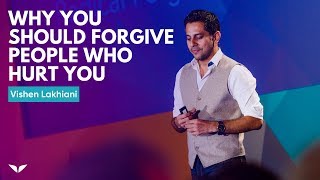
Vishen Lakhiani was betrayed by a manager who stole $100,000 from his company. At a biohacking retreat, he did a forgiveness exercise that produced his highest alpha-amplitude brainwave score and led to major improvements in his life and business the following year. He walks through the practical steps of the exercise.
Questions this video answers
$100,000
About 140 staff
About 15,000 square feet
August 31, 2018
Chapters
Sometime last year, I experienced one of the most awful experiences in my life. I found out that a guy I'd hired in my office in Malaysia, where we have about 140 staff, had been stealing money. Worse, he was a trusted person who was in charge of our operations. He was there to make sure that our employees had proper housing, you know, that air conditioning was running, that the massive office in there, 15,000 square feet was running well. But we caught him and actually pilfering money, he had created a series of fake companies under his own names or relatives name, and he was paying his own air conditioner repair and paying his own cleaners. And he had, in the end, he had pocketed $100,000 for himself, right? So it was an awful thing. And when we finally caught him, there were threats, threats that he was going to have gangsters follow up, follow me in my car. On the way home. He started disrupting our, our work, sending the fire engine over, saying that our office was a, was a fire trap. All of this shit started happening and it was a really, really, really stressful time. But sometimes the world, or the universe or God or whatever you want to call it, gives you these moments of stress so you can rise above them. You know, Michael Beckwith calls these kensho moments. Kensho moments are moments where you grow from pain. Something happens, maybe your health breaks down and you end up in hospital, but you grow from that and you learn to appreciate your body. I was about to have a kensho moment and that kensho moment happened. Coincidentally, this dude, Dave Asprey, and his friend JJ Virgin, invited me to experience a new type of biohacking model that Dave was promoting called 40 Years of Zen. So I went to this thing and what they promised was this. What they promised is that you're going to meditate for five days in the chamber. You're going to have your brain hooked up to all of these machines. You're going to. And the scientists who developed this had found how to reverse engineer, get this, the brainwave states of monks who had been meditating for 40 years. So they looked at monks, psychics, billionaires, and they're like, these are what are in their brains. And they reverse engineer that so that you can hook up your brain and in five days you can develop the brainwave activity of a monk who has been meditating for 20 to 40 years. So it's a bit incredulous, but I thought, wow, well, with a promise like that, let's try it anyway. Now I went there and as I went into the chamber, with my brain hooked up, Dave was there, too. JJ was there. Joe Polish, some of you guys might know him, was there as well as, like, billionaires, a Hollywood actor. It was a very elite group. They finally shared with us the secret. What were we supposed to do when our brains were hooked up? Now, turned out it wasn't going into an astral projection or lucid dreaming or going into deep states of meditation. Turned out one of the biggest things these scientists found to get your brain to function like the brains of monks who have been meditating for 20 years. And by the way, that's what the hookup looks like. Was this one thing radical forgiveness. And so I had to forgive everything. I had to forgive, like, I mean, I love my kids. I had to forgive my kids for little moments in the past where they irritated me while I was trying to work. Had to forgive my mom and dad for, like, the slightest thing. I had to forgive every friend I knew. I had to forgive people who had genuinely hurt me. I had to forgive everyone. I had to forgive myself, younger versions of myself. I had to Forgive myself from 10 years ago when I made a bad business decision that cost me $3 million. I had to forgive and forgive and forgive. And this was four days of forgiveness. And finally I came to that one guy, let's call him Mr. X. That one guy. This had just happened, and I was so angry with him. It was so painful. And I had to forgive him. And I saved him for last because I'm like, no, it's going to be so tough. This guy threatened my family. He stole from my company. He was someone who used my trust of him to take advantage of me. And I had to forgive him into love. Now, here's the thing. It's not just forgiveness. It was forgiveness into love. That means at the end of that forgiveness session, you must be able to picture this person who hurt you so bad coming to you. And you must be able to hug them and feel empathy and understanding for what they went through. And so I had to forgive Mr. X. I had to see, why did he do what he did. Maybe his parents were poor and maybe theft was the only way his family could survive. Maybe his wife was sick, maybe he was ill. Maybe he had an ill child, maybe and that's why he needed that. Maybe he was abused as a kid, and I had to imagine all the ways, just why he would justify what he did. And I had to be empathetic to him. But here's the crazy thing. When your brain is hooked up like that, it's measuring your brain waves. It's measuring two things. Basically alpha amplitude. So the higher your alpha spikes, the more monk like your brain is. And brainwave resonance. So the more balance your brain, that means you're not alpha on just one end. Your alpha in both hemispheres again, the more ideal your brain. And all of a sudden, as I forgave Mr. X, I heard the loudest beep so far. They use sounds to tell you how well you're doing. I opened my eyes and there was my score. And it was the highest alpha amplitude score I'd ever generated. It was amazing to see with my own eyes what forgiveness could do in my brain. And that was liberating for me. Now, the next year, as I got rid of all of my doubts, all of my forgiveness, the next year ended up being the single most successful year of my life. And my life had always been successful, always growing like that. But the next year it spiked. I had the book come out. This is the most successful a fest we've ever done. Mindvalley just exploded. My health, my happiness levels, everything just spiked because I was able to shed 40 years of pain, of things I had to forgive myself and other people around me for. And that's why forgiveness is so important. Now, the exercise itself that is done in 40 years of Zen is super simple. I now do it every morning. Every morning I forgive something, and you wouldn't believe it, but even a waiter who rubs you the wrong way, that negativity stays with you. So every morning I clear myself of all negativity. Now, those of you who do the six phase meditation, which is that meditation program I popularized, Phase three is what it's forgiveness, right? And this is basically what you do. Now, we won't be doing it live in this group because some people will break down, some people will be really, really, really uncomfortable. But interesting things happen when you practice this. For example, when I was at 40 years of Zen, we had one fellow participant with us. And this person was having a really tough time forgiving. He had to forgive a family member who had sexually abused him while he was like 10 years old. And that had really, really, really messed him up. Imagine, right, if a family member does that to you at 10. Now he was having a tough time forgiving this family member. Forgiving and forgiving and forgiving. And now he was like in his 50s, but he still had to forgive for something that happened 40 years ago. And an interesting thing happened the very next morning. So we were in day two. The very next morning we were heading to the lab. And he showed me a video on his iPhone. And he's like, vishen, I cannot believe this just happened. Remember I was telling you about that family member who abused me when I was 10? Out of the blue, the family member just sent me a video of himself apologizing. It just happened. It's as if reality shifted when this person forgave his family member. It was really bizarre. It happened within 48 hours of that forgiveness ritual. So you may not. You may think you know it's all happening in your head, but perhaps at a deeper level, something more profound is happening. That's why phase three of the six phase meditation is dedicated to forgiveness. Now, the exercise itself looks like this. Okay? You spend a minute or two minutes, no more than that, thinking and feeling the anger. And the anger can be for yourself, for something you did in the past, for something someone did to you in the past. You spend two minutes feeling that, Then you stop. Then you see a younger version of yourself or the person who abused you or wronged you in front of you. And you try to develop empathy for them. Ask them, you know, try to think for yourself, what made them do it? Did they face abuse as a kid? That they experience something really bad? Were they simply mistrained? Two ideas have really helped me. One is a quote from Neale Donald Walsh in his book Conversations with God. He says, I have sent you nothing but angels. Every person who enters your life, little, small or big, good or bad, is a fellow angel there to teach you something. So I find that thinking about that philosophy helps. Another philosophy I think of is the phrase hurt people, hurt people, which simply means that everybody who hurts you is doing it because at some level, they will hurt themselves. They're just passing it on. But you have the ability to cut that cord and stop the hurt so you don't continue passing it on. Think about human history, right? And how nations fight nations fight nations, fight nations for generations because of this crazy idea. Hurt people, hurt people. But when we can forgive, we can move on. So in that second part of that exercise, you feel empathy. Bill Bullet said, knowledge is the lowest form of learning. Empathy is the highest form of learning. Empathy means you can see things from another person's point of view and really seek to understand them. Empathy is one of the greatest forms of intelligence we can develop. That's all it takes. Now, it doesn't mean you'll forgive someone immediately for certain acts. It could take years. But this is the first step. And you never know how powerful this can be until you try.
More from Vishen






Brown Noise for Deep Focus and Concentration (Best with Headphones) | Gabriel Loynaz



Your Appointment With the Eternal | Guided Meditation with Michael Bernard Beckwith