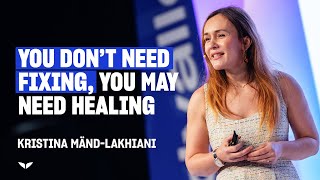
Vishen Lakhiani argues you're not broken, you need healing. He contrasts punishment-based training with encouragement, uses a Soviet Olympic story to show how forcing conformity harms kids, and suggests using a green marker to focus on strengths instead of a red one for flaws.
Questions this video answers
Four years old ("When I was four years old, it was 81, they came and they picked me in kindergarten for the Olympic reserves").
Chapters
If you're using all your concentration to look something that the society wants you to be like, you're taking this energy away from something that might matter. If you've seen Soviet Olympic sports, there were people who broke and they were discarded. We idealize punishment, hard criticism, being hard on yourself as the only way to success because we only look at people who have succeeded. You guys are not broken and you don't need fixing. You might need healing. If you are using half of your concentration to look normal, you're only paying half attention to what matters. If you're using all your concentration to look something that the society wants you to be like, that your peers want you to be like that, maybe you want yourself to be like. You're taking this energy away from something that might matter, that might save your life. I've been teaching self love for quite a few years now. And one of the most common objections that I hear is. But isn't moderate level of self criticism healthy? We think that we criticize ourselves out of best intentions because we want to be better, right? So you have to criticize yourself. You have to be objective, realistic. So there are two ways to raise children. And I love comparing self love to loving children. Because I believe that the most natural and the easiest way for us to experience unconditional love is when you have your children and if you are more or less sane parent, because I've seen parents who don't love their children. But imagine, and if you don't have children, maybe you have pets, plants, whatever you love unconditionally. There are two ways to raise children. I was born in Soviet Union, I was actually full on in Soviet Union. And Soviet Union was known for enforcement methods. If you know sports, you know that Soviet sports were quite high standard. Soviet Union had a lot of Olympic champions. And how it worked, it was very simple. There was an institution called Olympic Reserves. They plucked really young kids. They took them into the Olympic reserves and they built Olympians. When I was four years old, it was 81, they came and they picked me in kindergarten for the Olympic reserves for gymnastics because I had a great potential. And I swear to you, this is probably one of the earliest memories I have in my life. This training, they forced me into split right away. It was a mincing machine because they were creating Olympians. So I cried and I begged my mom never to take me to that training again. So the next year when they came and they picked me up for figure skating because obviously I had potential, my mom said, no, we've tried already. So you might say I was a failure because I was. I didn't last the mincing machine. So I didn't become an Olympian. I became a speaker instead. Thank you. I was a failure in sports to the point that when I studied in school, I had straight A's in everything except physical education. I still struggle with sports. It's a trauma I'm carrying for the rest of my life. So when we talk about punishment, hard work, discipline, sacrifices as the only way to success, it is because we judge by the very few who have survived and we disregard the waste material, which I am in sports, I'm the waste material. And there's a lot of waste material. If you've seen Soviet Olympic sports, there were people who broke and they were discarded. And we idealize punishment. Hard criticisms being hard on yourself as the only way to success because we only look at people who have succeeded. But most of us won't be at that level. Most of us in one level or another will be a waste material. There's another way to raise through encouragement. Oh my God, you're doing so well. It's so cool. Do you want to try higher? You fail. Never mind. I still love you. You failed. I still love you. Because failure is not the reason to not love you. Actually, encouragement also produces champions. I do not know. I haven't checked the statistics more or less, but one thing I know for sure, it doesn't produce waste material in its wake. What I want to tell you guys, I want to beg you to stop fixing yourself because fixing implies that you're broken, which you are not. I suggest that if you approach to becoming better, you approach from the point of view of healing, not fixing. You're not wrong, you're not broken. Nothing is wrong with you. Nothing is wrong with any one of us. But you guys are not broken and you don't need fixing. You might need healing on your own terms when you're ready for that. Healing assumes that you are human and you have had human experience. And that's why I'm such a proponent of encouragement rather than punishment, in personal growth and transformation, of kindness and compassion rather than harsh criticism. Imagine if you could put all your effort in your life into things that matter. You know, when I was in school, I was a perfect straight A student, so I might not have bring this example to the point, but you probably will relate. When my mom went to school, she was told, oh, Cristina is doing well in all those subjects, but here she is not doing so well. Maybe she should put more effort into things that she doesn't like. Imagine if they said Christina is doing so well and she really loves physics. What if she puts more effort into something she really loves? It's called the green marker and the red marker technique. Red marker is when you're pointed to your flaws, to things you have to fix to become better, to become perfect. Green marker is when you are pointed to the things you are good at right now. Imagine if in your life, rather than pretending to be a perfect version of something, pleasing the world, pleasing your peers, pleasing yourself, you could actually let it all be and focus on the things that matter.