Anjou Martinez - Why to Invest in Apartments -vs- Other Assets
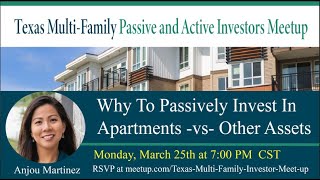
This is a March live webinar where host Wayne Courreges III, CPM® interviews Anjou (Angie) Martinez about passive multifamily (apartment) investing versus other asset classes. Angie, an NYU-educated accountant and MBA who began residential investing in 2008 and commercial in 2022, explains why she focuses on multifamily (tangible asset, housing shortage, tax/depreciation benefits, cash flow, forced and natural appreciation, leverage), why she invests in Texas (job and population growth, affordability gap), how she underwrites and vets operators (prefers Class A/B, reviews financials, emphasizes operator integrity), lessons from early deals, the importance of broker relationships, and current market sentiment from industry conferences. She cites concrete experience: ~11 apartment-community investments, 2,400 passive units total, ~1,600 units as a general partner, and a closed Majestic Apartments deal (44 units in the Galleria). The session includes audience Q&A and closing contact information (beaminvestmentgroup.com; LinkedIn/FB: Anjou Martinez).
Questions this video answers
March 25 (host announcement).
11 apartment communities (investments across Dallas–Fort Worth, Houston, San Antonio).
Approximately 2,400 units invested passively; almost 1,600 units as a general partner.
Majestic Apartments — 44 units in the Galleria (closed last year).
MBA and accounting education from NYU; former CFO/financial controller roles in transportation/logistics, events/media, and healthcare companies.
Chapters
Foreign.
Hey welcome. It is March 25th. We are excited to have Angie Martinez here to talk to us about why to passively invest in apartments versus other assets. So if you haven't been to our meetup before, the first 15 minutes is so we do a lot of networking, a lot of breakout groups and build the relationships through through that time. And then when we come back we'll do a lot of the the guest presentation typically from 7:15 central to 7:50 and then we'll have like Q and A networking for additional experience. But this meetup was really built around educating passive investors learn about multif family investments. Just really trying to make the journey a lot easier for themselves. A little bit about myself as the host. My family Jennifer and I have been married for 15 years. As of this year my son Hunter is 12, daughter turns 11, the middle child turns 11 this year in June and then Emma, My youngest turns 9 next week. So we have about 37 million assets under management with Texas, Louisiana and Alabama. I worked for 16 years with CBRE before going full time into our real estate investments. But I started our real estate investment company in 2019, grew it to a point where I was able to leave the W2 and focus 100 on our investments for our investors. And and really the only other thing I wanted to add here is we focus heavily on multifamily hence the, you know, this meetup. But we also do a lot in RV boat and business storage as well. So you can check out my podcast, Untold Stories of Real Estate Investing. Also, we have a lot of blogs and a lot of great information@creipartners.com enough about me I want to introduce Angie Martinez. She is at a conference right now, so I'm so grateful for her time to join us. Angie's been investing in residential real estate since 2008 and in commercial real estate since 2022. She's a general partner in 190 multi family units and a limited partner in 2,400 units in Houston, Dallas and San Antonio. She was a former CFO and financial controller for transportation and logistics, events and media and healthcare companies. She's an accountant and MBA graduate from nyu. Angie grew up in the Philippines, moved to New Jersey when she was 16, and moved to Houston in 2021 with her husband and three kids. So Angie, thanks so much for being with us today. I'm going to stop sharing on my side and over to you.
All right, thank you. Well I'm so grateful Wayne for inviting me into your webinar and again I think we can make this very informal. If you guys have any questions, I'd be happy to answer that at the end, but I really just wanted to share my story on how I became a multifamily investor. And so here you go. So when I was starting out, I always looked for people that are already in the space, right. And I put a few people that I've met personally live. Donald Trump, Barbara Corcoran, and Shaquille o'. Neal. And one thing that we all have in common now is that we all invest in multifamily apartments. I was an event in Florida two years ago when I didn't own any multifamily, and Donald Trump was there as a speaker, which is very rare. So it was a room of maybe 1500, 2000 people. And he was asked what was his first acquisition on his own, not with his dad.
Right.
Because before they would buy condos in Brooklyn. But his first ever acquisition was a multif family apartment in Ohio. He moved there, lived there for two years before he ventured out into other cities. So that was his first apartment complex. Marlboro Corcoran, on the other hand, most of us know her from Shark Tank, but she's really a real estate. A real estate broker. And so most people think that she would be in New York, right. Or that she's investing there, but she's not. I was at a conference also two years ago in South Carolina, and when she was the guest speaker, she. She said that up to that point, they currently owned 17 multif family apartment communities. I don't think it's syndicated. She didn't really elaborate, but most of her capital are tied into those. Her son is managing it. And it's not in New York, it's in Pittsburgh, Pennsylvania. And then Shaquille o', Neal, we probably know him from living in Newark, New Jersey. That's where he's investing his money as well. Of course, he's diversified, but he's investing in affordable housing, large multifamily apartment communities in North New Jersey. So a little bit more about me. It's actually a 2,400 units at this point is what I've invested in passively. I'm almost at 1600 units as a general partner, and they're all over Texas. I live in Houston. And so most of the deals that I do are local right there in Houston. And what's good is I invest in all my deals. Wayne and I had partnered in this deal right here, Majestic Apartments, 44 units in Galleria. We closed that last year. But before we dive further into multifamily, I just wanted to share, why even pick multifamily? As I mentioned, Wayne mentioned, I'm here in Dallas, Texas for a multifamily conference and I've attended maybe 15 or 16 of this when I was out two years ago. And whenever I talk to the brokers, lenders, family offices, people that are infusing hundreds of millions of dollars in commercial real estate, I would always ask them, what are your favorite assets? Right, asset class. So usually they'll say industrial multifamily. Even today there was a family office from New York that's here and they invest nationwide. And I also asked him the same question, what are your favorite assets? And he's like, industrial multifamily. So that's just to give you a sense of the risk and reward portfolio. Life sciences, biotechs, these could be labs, right? So when it's green on the left or my left, it shows that. Whenever it's green, it just shows that it's a better risk and reward ratio versus let's say the ones that's red. So you can see warehouse distribution, which is industrial. What's next after that? Suburban multifamily. So this is good. And you, you have some people that are in self storage, right? There are some that are really niches and which is good. There's riches in the niches. And I think the more that you really do the homework, the more that you can find out what are the better assets to, to participate in. And so for me, when I saw this when I was starting out, I said, all right, well let me just focus on multifamily because I want to be an expert in one thing and then once I'm an expert at that, I can always diversify. So I started with just multifamily only in Texas. And I started in my own backyard. The other reason why I like multifamily is that for one, right, you have tangible assets. I was a former accountant, so I like the fact that it's tangible versus intangible assets. So I moved all of my money from 401k to a self directed IRA. And that's what I've used to invest passively in those 2400 units. So I haven't personally invested in cryptocurrency just because I like the fact that, you know, real estate is tangible. So I'm trying to stay away from intangible assets. The other thing is we still have a housing shortage and you can go at any city at this point. I Don't think there's any city right now that's totally oversupplied. So I think wherever people are at this point, there's an issue in terms of just the housing prices are going up. You know, we're not building enough housing. And so people are staying within their families longer versus buying either their own home or renting. The other thing I like is the. So capital preservation, right. And then tax benefits through depreciation expense. So as an accountant, that's one of the reasons why I moved from New Jersey to Texas is because there's no state income tax. There's also no corporate income tax. But just going back on the state income tax, I've always looked for ways to cut down one of our largest expenses, which is taxes. And so just by investing in commercial real estate, specifically those that are already up and running. Right. And that you're doing some value add to allows us to capture some depreciation and then be able to offset that with either some of our gains as a landlord. And then if you're a real estate professional, there's other benefits. So. And the good thing about that is whether you're. You use that year one or not, you don't lose it. Right. It just rolls forward. You could carry it forward until you use it maybe year five when it sells, there is passive income with monthly or quarterly cash flow. So for people that are looking for maybe a preferred return, you know, a lot of the deals we do have preferred return and we like that these buildings are already existing, so we're able to pay out that quarterly cash flow. We also do a lot of the national forced appreciation. So that just means that these properties, because we're renovating them, but we're renovating them maybe in a span of two years, we are forcing the appreciation. But then at the same time, because we're holding it for three to five years, there should also be natural appreciation because we invest in better areas where there's job growth, rent growth, population growth. So multifamily overall is a very stable and resilient asset class. You talk to any banker lender, even if it's regional or institutional capital, whenever you talk to them, they. They favor this for that reason. Right. Most people would need a home. And whether that's multifamily or, or other forms of housing or multifamily, let's say luxury or multif family, more affordable, they're going to need a home. You have a good hedge against inflation. So there's a lot of other things that we can we can look into for multifamily, such as you get leverage, right? Leverage here in the bottom. Leverage. Real estate is that you can be. So let's say if it was stocks, I would have purchased $100,000 worth of stocks, and that's all I can get, $100,000. But when it comes to real estate, we're able to leverage that up for $100,000 back then when it was 8020. Right. I could borrow the other $400,000. Right. To buy a $500,000 asset versus just buying $100,000. So that's what's good about real estate, but also multifamily, because then lenders are still favorable to, to this asset class. Another thing I wanted to touch on is why invest in Texas? Right. I mentioned job growth, and Marcus and Millichap is one of the largest brokers in the country. And this was from their slides the year prior. Well, they, they usually issue this, I would say February, March of every year. So I, I think the latest ones just came out. But it's not too different from what, what's in here, which shows that Dallas and Houston are still leading, right, in terms of job growth. So what does that tell us? It tells us that. So the ones on the left is the top 10 metros. And then here on the right, you're seeing the bottom 10 metros. We're starting. We're trying to stay away from anything that's bottom 10 metros because it just shows that jobs are leaving these places. And the jobs that are. The, the places that jobs are, are growing are right here on the left side. You'll see some notes on the bottom for Austin, right? 61,900 jobs are 4.3%. San Antonio, 47,000. But just the absolute change, you look at it, 235,000 jobs for Dallas Fort Worth is so much bigger than what New York is already providing. And New York is, you know, a good cosmopolitan center as well, financial capital of the world. But apparently a lot of these Fortune 500 companies are moving already to Dallas, Fort Worth and Houston area. So we like this, these locations. Plus we're local, right? All of us are local there. The next one is population growth. So a lot of the younger population are still the, what we call the target renters. So it's good that if there are a lot of adult or young adult population in these metros, that means that they are forecasted to keep growing. And you see the same four cities, right? Austin, Dallas, Fort Worth, Houston, San Antonio versus the bottom 10 metros. The other reason why we invest in Texas is the affordability gap. It just shows that this is the, the difference between what someone would have paid for a monthly mortgage payment. So that would be either. So that would be principal, interest, taxes and insurance minus what the effective rent is for an apartment community. And you could see that in Austin it's a lot bigger, right. 2022 or even 2023, these numbers haven't changed much. It's still around $3,000 is a Delta in Houston. In San Antonio, you'll see here about 1700. I think now it's a little bit less, but it's still definitely a wider range. I was in a panel, I was listening to a panel today and they said that the national average is around, I think sixteen hundred dollars. So you know, Houston, San Antonio, roughly in the same ballpark, whereas Dallas and Austin are still a little bit bigger in terms of the, the gap. So what does that tell us if we're a multif family investor? It tells us that most people are priced out. They cannot afford to buy a house. What are they going to do? They're going to continue to rent. I also started reviewing the newer markets in Milab and they had a graph there that at least as of last year 2023, their data indicated. And their data is from all over bls, Right. Bureau of labor and Statistics, they have costar real page. They have their own markets and statistics as well. But they were looking at it and that as of last year 2023, only 25% of households can even afford an average priced home in the whole country. Right. So and they had a chart of different months, months, different years. And this is a significant drop from where it was prior, even within the last 20 years. Right. Like it's never fallen to 25%. So it just really shows that aside from the affordability gap, home prices currently are super high. That if people are not getting 20, 30%, maybe increase under, in their, in their paychecks, it's probably harder for them to really even afford a home. So with that I wanted to turn it over to you, Wayne, for any questions or you know, you want to just maybe discuss a few things we can.
Hey Angie, that was awesome. A lot of great insight there. So thank you. I'm gonna turn on my screen here.
Thank you.
Thank you so much for doing so. One of the questions is how many multi family projects did it take you to consider yourself an expert and what were some of the main challenges or lessons learned you faced early on?
Right. I Think what's important is where are those units being purchased? So keep in mind there are a lot of sub markets depending on where you're buying. So I think what's really more important is the number of transactions you've done, right? Not just the unit count. So what do I mean by that? So at this point, for me personally, I've invested in 11 apartment communities, right. Dallas, Fort Worth, Houston, San Antonio, and then in Houston I've been a co GP in six deals. And now in certain sub markets I have three deals, right, that we bought. Yes. We haven't gone full cycle yet. That's why I partner with people that have either gone full cycle yet already. So now you're starting to see trends and then the more that you're in the industry, people talk, right? Because you could be a buyer right now, but few years from now you're going to be a seller. And so people that were already ahead of us, right, they've already either done business with other people. So you, you got, you get to start. It's like you're plotting trends of what's happening in a market. And I think the more you do that, the more you become an expert. I don't think that there's really a bar that says, all right, now you have a thousand units, you're considered an expert. However, I'll share with you what I just learned today here at I am in Dallas. A lot of the larger institutional one I call the institutional partners. These are people that are raising hundreds of million dollars in 90 days. They just told us that they raised $100 million in 90 days to fund Multi family. Right. And they're in Houston. So I'll tell you one thing, what are the groups or for them, the people that fund. Right. They're usually a thousand units. They should have already gone full cycle. It's not really the unit count. Oh, we've done 1,000 plus units or I think it's also the deal, the transaction volume. Right. Because then 1000 units could just be one right. Deal or it could be maybe five deals. So now you get some track record. And what was your, you had a like a follow up question, right?
Yeah, there was one. What were the main challenges or lessons you faced early on?
Yes, so when I underwrite and before I even, because I invest in all these deals myself, I always look for the operator first. Right. I really vet the operators, make sure that the operators are who they say they are. Right. That integrity, trust, that's super important because honestly there's a lot of deals out there. And you can be doing business with anyone, but you got to align with people that you know like and trust that you see a future with. Right. Because I'm not in this game for, let's say, just a few years. No, I'm here for the next 20, 30 years. Like, this is what my kids would inherit. Right. So even those partnerships, I want to make sure that they're. They're good. So that's one is really vetting the operators. And the challenge with that is you don't really know until you start talking to people either through lunches, dinners, coffees, closed doors. Why? Because even though you saw them on an ad, you see that they're putting out conferences or maybe they have a podcast. They could be popular. Just because they do a lot of marketing, that doesn't make them good operators or good capital stewards. And they, that also doesn't mean they're good partners for you. Right. They're just. It just means they're very good in marketing. But you still have to vet out, see if they're location. And when I say location, I don't even look at the underwriting financials until I like the location. Currently, I'm only investing class A and B. I've stayed away from class C. Right. One of the challenges I've seen earlier on, on a deal that I was a passive investor in, so this was my first passive investment. It was that it was in a not so good area compared to my other deals. Right. So that's the only deal I have that's not paying right now. Right. There's no distributions, deposit. So I said, you know what, it's a, it's an older property, 1979, in an okay neighborhood, maybe B minus, you know, you could say C plus. So now I'm stricter with what I look for. I try to stay within the class A or class B properties and newer vintage with less crime, higher occupancy. And the third thing that I look for is really the financials. So some of the challenges for that is if you're not as savvy yet with underwriting, then it'll be hard for you to really know what you're looking at. Right? Because everything can look like it's 2x in 3 to 5 years until you really know what assumptions or levers to pull. Everyone can make it look so rosy. Right? So I think having a good checklist, either as a general co, general partner, or even as a lead investor, is key to making sure that you really do your own due diligence and ask the right questions. Because those challenges, I think there's always that hurdle. Right. And the more of those hurdles you can clarify upfront, you mitigate the risk versus jumping in. And then now you're either closing already, you've closed, and then now you start uncovering these things because I kid you not, there were deals I was offered from last year. No, sorry, two years ago when I was newer as a passive investor. And I didn't invest in those deals, and I'm glad I didn't. I felt like it was too big for this group to handle. And now not only are they doing capital calls. Well, no, not only have they post distributions, but now they're doing capital calls, so. And some of these people are my friends, you know what I'm saying? Like, this is. They're good people, but it's not just the opposite. Location. And then you look at the assumption. It's easy to just sign up for a deal and then perhaps it may not perform the way it should have.
Yeah, I think it's a good reminder that real estate, you know, there's a lot of. There is risk. Right. It's. It's not just the. On the presentation for so many years, last five years, you know, had been pretty hot with cap rates compressing, and it artificially made everybody look really good. So it's separating a lot of the strong operators and, and those that are not. And you know, those that are going through some of these capital calls too, you know, the. Is the communication, the transparency, you know, what are they doing? That experience, too, is helping, you know, everybody get through this. So this sort of leads to my next question, Andrew, is are you actively looking for deals to buy today? Are you waiting for, like, the spire sale to happen that people are anticipating?
Right. No. So I've been actively looking for deals since I got started, which was in 2022. And the reason for that is that there are deals to be made in any market, any cycle. It's just a matter of looking for the right partners. Right, right. Sub markets, because real estate is very local. So you're absolutely right. I've had friends from two years ago that got into the market, but also for them, they must have gotten started before 2022. So 2020, 2021. They still have that mindset of, oh, deals were this good. Right. And this is how it looked like. And I guess some of them didn't quite adapt their strategy coming into 2223. So a lot of them were sitting on the sidelines right. But then those that sat on the sidelines, you know, that just there's. If you're not doing transactions, it's harder to continue to build your portfolio because then once you sell off, Right. Basically, some people sat on the sidelines for three years. So my business model has not been that right. Mine was more partner with the right operators, just like Wayne, and tackle deals that make sense. So, for example, that Majestic deal that we did, right. Like, it was a very good cost basis. It was end of 2023, and I already had a deal in Texas Medical center at that time before we even partnered on that deal. But when I saw it, I said, I don't know how I'm going to make it happen to do both deals at the same time. But it was the right deal and it worked out right. So I think it's good to know that if you have a good underwriting, you know, you've educated yourself enough on how to tackle these deals or what value you bring into the table, it's easier to be confident in any market. Right. And yes, you have to educate yourself, attend conferences, talk to the right people that are hustling, doing deals in these markets and figure out what they're doing. I think that, yeah, that'll be key to, to be able to get deals. So now in this conference, right, People are saying that, you know, like, people are actively buying equity is sitting on the sidelines, they're ready to buy deals. So I think transaction volume is gonna increase.
Yeah, I think it will too. And I think it's gonna cause the markets to go back up. Like, for me, I'm thinking if you're. I. I love sort of the calm before the storm. I feel like that's sort of where we're at right now, where there's just not a lot of frenzy to go out and buy. So if we can buy assets when things are calm, because once everybody starts coming in the conference, everyone's like, then, you know, that's. That spurs, investment spurs, hopefully, you know, financial markets to open back up. But that also benefits us when we were buying at a lower, you know, cost basis than, than it was, you know, a few years ago.
So I have one more story just to illustrate that point of why people are being rewarded for taking action. So, for example, for you, Wayne, right, a lot of your deals are off market, which is good because you're, you're. You're not just sitting on the sidelines like you're trying to make deals work, but at least you're talking to sellers, brokers, and just trying to make it happen versus just waiting. So that's good. And then on the other hand, I have a deal that's closing next month. And this deal, we're getting it at a 6.5% cap rate, right? Very good locations in Houston. But most importantly, there were other people that offered on this deal. In fact, one group so big that if I tell the name, you, most people would know who they are. And for whatever reason, the broker gave it to us versus this other group. And when we asked. When my partner said, ask the brokers why. Why us? Right? Why do we get this deal? And they said, that's also because you bought a deal from us last year. Right? So they, My partner said, bought a deal in Dallas the year prior with the same broker. So you see, relationship is. Is crucial. These brokers, they're. They're probably hurting 2023, especially 2022, when the rates started climbing, the interest rates were started. Started to climb. That's when all of a sudden, right now, the brokers had to look for. For deals. So those that were actively in the market were rewarded. And I think I'll continue. Right. There's a positive effect to that.
That relationship to brokers is huge because the deal that, you know, came to me from Majestic through a broker, you know, now we're looking at, you know, a future upcoming opportunity as well from that same broker. And so it's like, you know, when you start getting into the space and building the relationships. In the beginning, it was deals coming that, like, were passed over by all these other sponsors. And there's like, oh, here's a deal. But it really wasn't a deal, quote, unquote. But now there's more opportunities because they see that you can close because they have a reputation too, in front of, you know, their. Their clients, the seller. So I'm gonna pause there. Any other questions? Thank y' all for. For being on and. But I wanted to see if there's any other questions. Feel free to unmute and ask or if you want to. That box. All right. Yeah, I just wanted to just make sure I'm good. I. I appreciate the insight, though, Andrew, and it was great to meet you.
Likewise.
All right, well, I do have one more question. I. I didn't make the. I am in, obviously. I'm. I'm at my house. What is sort of the feel right now going on? Like, you know, are people excited about the rest of 2024? Is there a sense of anxiety about, like, oh, crap, you know, I got properties that are struggling or doing well. Like what, what's your overall sense right now?
So I've attended the same conference three years in a row. This is my third year here. Same conference, roughly the same people back in 2022. And this was March, right? The conference always in March. Back in 2022, people were still reeling in from 2021. Right. And they didn't, people didn't know though that it's the peak yet or like the peak was coming by 2022. So it was a lot of activity. It hasn't really slowed down yet. March of 2022, so everyone's excited. But then last year, March 2023, that's when everyone's saying, oh, no. Right. With the rates where, where they were at last year, around that time frame, it was it a good time to really buy. In fact, even for me, last year, I think the first deal we closed on was in July of last year. And the sentiment was frozen from last year. Most of the speakers were talking about survive till 2025 because now they know what happened with the deals they bought in 2020 and 2021. The three to five year mark will, you know, would be around 24 to 26. And then now the sentiment, I think, has changed, especially because the feds just announced, right, that they're looking to do three more cuts this year. So that's a positive trend for, well, for us as investors because now we can maybe relax a little bit. But some of the people that were on the panel today don't think that that's all going to happen in 2024. But even if it did, right, people depending on where they're at in the cycle, because some people really bought a lot last two years and they probably weren't supposed to buy all of those deals at a very high asking price. So, yes, there's a lot more debt funds that are being created. So the debt funds are being used to rescue other people's deals so that they can infuse it with some more cash because they probably didn't account for it. So someone was talking today, right. Florida insurance, when they bought it a few years ago was 450 per door. Now it's 2300 per door. Yeah. And I know some markets, like for us in, in Houston, that's already increased. Everything has increased. So I think overall the market sentiment of people that spoke is that people are more optimistic now than they were last year. There is a lot, there's a lot of money sitting on the sidelines still on the institutional side. But retail investors, I think are ready to pounce. Multifamily is still great and people always say, right, real estate is very local. Where are you investing? I was talking to a guy today in Kansas City and he's doing four development projects and so far they're doing very well. And this is not syndicated. This is just their own. So I think it's. It def. It's based on market locate. Like where is the submarket? Then also, what happened to that group within the last three years? Right. Were they growing well and growing responsive responsibly or were they just both buy. Because there are a lot of groups too that just bought a lot of deals, couldn't handle it, didn't have the right infrastructure, scaled so fast. They put the team in place or processes in place and that, you know, that's, that's why they didn't really succeed. 24 and then a lot more opportunity, more optimism. Good.
Hey, so we're going to turn this into a podcast and YouTube video. So for those listening in, how can people reach out to you? I know it's on your back screen, but be good auto, you know, from an audible standpoint.
Yes. You can visit my website@beam b e a m investment group.com or you can follow me on LinkedIn or Facebook. You can find me at Andrew Martinez and my first name is A N J O U and then last name Martinez with a Z.
Perfect. Thanks Andrew. I appreciate you being on. I'm going to stop the recording and I hope to obviously talk to you very shortly.
More from Wayne

September 2026 Meetup: Investing Ahead of Growth: The Bryan–College Station Opportunity





May 2026 Meetup - Apartment Complexes & Passive Investors: Opportunities & Risks


March 2026 Meetup - Reading the Market: Economic Indicators Every Investor Should Know


February 2026 Meetup - Syndication 101: How CREI Partners Structures Deals for Investors

Build-to-Rent (BTR) Communities Explained: Why Investors Are Paying Attention