BPI Episode #12: What You Need to Know Before Investing in Real Estate Syndications
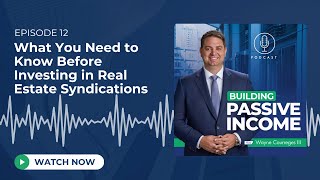
Short-form episode (under 15 minutes) from the Building Passive Income podcast hosted by Wayne Courreges III, CPM®. The episode explains the key questions passive investors should ask before joining a commercial real estate syndication: (1) understand the property-level business plan (income drivers, expenses, capital plan, underwriting/performa), (2) confirm minimum investment tiers and their differing terms, (3) know the preferred return mechanics and equity split waterfall, (4) clarify exit strategies and hold period, (5) review project risks and mitigation, (6) verify key team members and property-management approach, and (7) confirm communication and reporting cadence. The episode also gives explicit CREI Partners example investor classes (Class A, B, C) and promotes a passive-investor coaching program.
Questions this video answers
Minimum $250,000; 10% preferred return; no upside (no equity participation on sale).
Minimum $100,000; 8% preferred return; 80/20 split (80% to investors, 20% to general partner after the 8% hurdle).
Minimum $50,000; 7% preferred return; 75/25 split (75% to investors, 25% to general partner).
Chapters
Welcome to Building Passive Income, the podcast for professionals, entrepreneurs and investors who want to build wealth, diversify beyond Wall street, and create financial freedom through passive commercial real estate investing. Your host is Wayne Courageous iii, a seasoned investor and founder of CREI Partners, a leading commercial real estate investment company. He spent nearly two decades navigating and educating others on the commercial real estate, from multifamily to storage to retail. Each episode is under 15 minutes, intentionally short, easy to understand, and packed with insights that help you grow your income and protect your capital without becoming a landlord or sacrificing your time. If you're ready to learn fast and invest smarter, you're in the right place. Let's get started.
Welcome back to Building Passive Income podcast. I'm your host, Wayne Courageous. Today we're going to be talking about questions to ask before you invest. So the hardest thing for a passive investor during the life cycle of the deal is to evaluate not only the sponsor, which we talked about on a previous podcast, but also evaluating the deal, right? And so because once you've evaluated the sponsor and the deal and you go through the paperwork, you sign the paperwork, the private placement memorandum, which includes the company agreement, includes a subscription agreement, at that point, you're wiring funds and you're hands off at that point, right? You're passively invested. You're trusting that the team is going to be executing the deal. So what are some questions to ask before you invest? So, first of all, what is the business plan? If you look at every deal, whether it's a multifamily, office, retail storage, each property is its own business plan. That business plan has income, has expenses, income minus expenses is net operating income. And then you have your debt service, maybe there's an asset management fee. And then you have your, your net operating income after, you know, debt service, et cetera. And that money is what's distributed back as far as cash flow to, to the investors. So understanding what the business plan is, where are the income sources? What's the driver to grow income or to look at other miscellaneous. Miscellaneous income. And then you're looking at where the expenses are. You, are the expenses based on proposals? Are they based on priority historical data from the, from the seller? What expenses may grow, like taxes and insurance, for example, may grow? Is that looked at in the Performa, where maybe some expenses, maybe there's some control methods through the property management fee or payroll, et cetera, that they can be looking at. What's the capital plan? Ultimately, treating this like a business that many of you are already, you know, Business minded people, even those that are doctors or attorneys or in supply chain, whatever you all understand, you know, from the most part, business income minus expenses is profit. So understanding what that business plan is, understanding that there's a clear direction or ability to get to point A, to point B, and looking at what properties in the area are able to achieve that business plan. So typically that business plan is part of the private placement memorandum. It's also part of the webinar or the investment video or presentation that was provided, whether it was in person or online. But that's something that really the sponsor should easily be able to articulate and show backup on how they were able to drive to their conclusions to support them on their business plan. Because that business plan should be in line with the performa or the underwriting. And so if you just step back and just look at it from a helicopter viewpoint of does this make sense? Does the business plan seem like it's achievable? Are there crazy projections in here that just probably doesn't make sense? Like, you know, 10, 15% year over year rent growth. Now hopefully that's not like in the projections, but just understanding like what is the annual rent growth, what other miscellaneous income can be accounted for, what expenses can be adjusted and how they came up with it. Really what you're trying to do is just make sure it just makes sense. Like not over complicating it. Just does it make sense and does it fit your assessment of like, hey, did you know, is this ultra conservative, Is this ultra risky or is this somewhere in the middle? So think about the business plan from that standpoint. Just don't over complicate it. And just thinking of it as a typical business that has income and expenses and you just want to understand what that business plan is. The other thing you want to look at is like what is the minimum investment? So you understand the business plan. Now you need to look at minimum investments. A lot of times sponsors put out their $50,000 for certain class of investment. Maybe it's a, you know, some type of preferred return with a equity split. And then maybe for a, you know, 100, $100,000 investment, maybe it's a different asset investment class with a, maybe a higher preferred return or maybe a higher equity split. There may be even an investment class where it's even a higher amount, maybe a $250,000 minimum, there's no upside on it. Potentially maybe it's just a 10% preferred return. So for a 250,000 investment, you're getting 25,000 in annual distributions. And you don't benefit from the upside at sale, but you're getting that consistent cash flow. And even more powerful, you're getting the tax depreciation on that as well. You know, you're not, you know, talk to your cpa, of course, but you're not having to, you know, pay on taxes on that income because you have paper losses. And we'll go through that on a separate podcast. But understanding the minimum investment and seeing that the minimum investment has different terms based on, on the amount of investment. So understanding that is pretty, you know, key to one of the questions to ask before you invest because you want to make sure it's in your budget and you're able to, you know, get the returns that you're, you're wanting to get. And this really goes to the next one is like what is the preferred return and equity split? Typically you would see a 7 or 8% preferred return. And what that preferred return means is that you, as a limited partner gets 100% of the preferred return before there's some type of waterfall to the general partner. So say it's a 7% preferred return. You would have to get 100% of that 7% before the general partner receives any of any type of future splits. Say year one is not a 7%. Like you didn't get 7% on year one. Cash on cash, maybe you got 4%. Well, that 3% goes into the following year and maybe even to the following year after that until you're caught up. And so that's what the preferred return model is. Some sponsors don't do a preferred return. It's just a straight up split. And whatever the profit or the performance for that quarter, they'll split it maybe 60, 40, 70. Whatever the splits are, every deal is going to be different. So understanding what the preferred return or what type of return metric they're using and how are you going to get your distributions and are you going to get distributions before the general partner or is it going to be split equally or at some type of different split that you're comfortable with? So typically for CRIA partners, we do three investment classes. The first investment class is 250,000. That 250,000 is has a 10% preferred return. So for year one, they're getting $25,000, but there's no upside. So that's typically what we see with class A investors. Class B investors are $100,000 investment higher, but they have an 8% pref and an 8020 split. So after that 8% hurdles met. 80% goes to the investor, 20% goes to the general partner team. And this is done on a para split, right? So based on the ownership and equity in the deal, but again 8% 8020 for 100,000 investment. And then for Class C investors that's a $50,000 investment and that's typically a 7% pref 75, 25 split. So typically you definitely see that type 75, 25 or 70, 37%. But we do different investment classes based on what people are looking for. They, for example, the class A investor, they're more looking for cash preservation, they're more looking for that cash flow coming in. They're not as much worried about the equity upside where for class B and C investors we're looking at it from not only cash flowing but also that equity upside which is really a driver into a growing wealth as it multiplies the investment over, over the hold period. So the other things to looking for and asking before you invest are like, what are the exit strategies? Is it a three year hold, a five year hold, a seven year hold? What happens to the debt? Like is it a five year loan and what happens if it expires five years? Are they going to actually be looking to sell in year four so they can, you know, sell before the, the loan becomes due? Is there a potential refinance? So looking at the different exit strategies and understanding, is the time horizon good for you? Right. Because that investment that you put in, that investment is, is held there and likely being spent whether it on capital renovations or closing costs, et cetera. So it's not a liquid monies that's going to come back when you want it to come back. You know, you have to, you're investing in a hard asset that is using those monies for a certain purpose. And so just making sure you're comfortable that the deal is typically say a five year hold or a seven year hold. Are you okay with that timeline? And again with those investment distributions and the tax depreciation, what's very normal to have a five, seven year hold period. What we had experienced over the last few years is you know, two, three year hold period because property valuations were just getting so frothy and so crazy that investors decided to sell just to maximize returns during the up cycle. So looking at the different exit strategies, whether it's a refinance, whether it's an actual sell, that's something to consider and make sure that you're comfortable with. Other things are what are the risk? This is really heavily put into the private placement memorandum. Typically the presentation talks about all the good stuff, the returns and the business plan, but really dive in deep like what are the risks that are involved in this investment? And there could be many risks, obviously the economy be one, inflation or there's which impacts expenses, helps rents, but impacts expenses. And there could be, you know, tariffs. If it's a major renovation plan and they're getting, they're having to order a bunch of lumber or a bunch of steel or whatever it may be. You know, you just need to understand like what are the risk of the project and how is the sponsor team owning up to the risk and how are they going to plan ahead and and sort of try to offset those risks if they're all just talking about all the great possible things that are gonna happen in the deal and they're not really looking at the other side that hey, there's always risk in investments. And so how do we reduce risk by one, naming those risk and then two, trying to figure out like what can be done to offset those risk. Other things here are like who are the key members? And this is one of the things I talked about in a previous podcast about sponsors, but understanding who are the key team members. It may be the case that who you're partnering with or who's reached out to you to raise capital may not have all that experience, but they're surrounded by people who do. Right. It's a team sport. And so you want to understand who the team members are not only on the ownership side, but who's the day to day property manager of the team. Is it done by the sponsor's own property management? Meaning are they vertically integrated or do they have third party management that handles more than arm length distance but is able to do the property management based on experience in the market and they have resources. And that's what we prefer at CRI Partners is third party management. All of our multifamily is done by third party management and for many reasons, but biggest reason is they have the scale and the people to help take care of our residents and our investors through their professionalism and what they do best and that's managing these type of assets. So understanding not only who are the boots on the ground people are the company, but also who's running those asset management, who the key team players of the general partner team. Those are all things that you want to ask for. Other things you want to ask for is really how are communications handled? Is it done on a monthly basis or basis? Are you getting access to the financials, do you have the ability to call the sponsor and get updates or just check in with him or her on a regular basis? You know, those are the type of things when you invest in a deal, know that you're an owner in the deal, right? This is not just you're passively investing into the stock market like you are actually part of the management entity that has title on the deed. So feel free to ask questions and look at the financials that are being sent to make sure the communication timeline is good. So a lot here to consider, but ultimately just don't overthink the deal. When it comes to like the business plan or the team, all this is like do you feel confident that you have the right team and there's a right business plan? Because real estate has done extremely well, right, over generations and generations. One of the probably the original investment of all time was real estate back in the caveman days. Like this stuff is not just new, but it's just making sure that you're educated and you're asking the right questions and you're looking at deals objectively to make sure it's a good fit for you and your capital. So anyway, I just wanted to share this podcast because I just feel like it's such an important topic for newer investors, even older, more experienced investors. But it's good just to be a reminder of what to look for, what to ask in investing in commercial real estate. So hey, if you want to learn more, definitely check out our passive Investor coaching program, passiveinvestorcoaching.com but more importantly, please help this podcast grow so it helps other people just like you. Wanting to learn about passive investing. Would love for a five star review. Would love for you to like and share this with your your work and so that way we can continue providing great value and education to those looking to diversify their wealth and grow in real estate. So hope everybody's doing well and we'll catch up on the next podcast.
Thanks for tuning in to Building Passive Income. If today's episode helped shift your mindset or gave you a new tool to grow your wealth, do us a favor and like subscribe and share this podcast with someone you care about. Want to go deeper? Or join our free Passive Investor coaching program@ passiveinvestorcoaching.com it's the perfect next step to start building wealth through commercial real estate the right way. Remember, financial freedom isn't a dream, it's a decision. And it starts with building passive income. We'll see you in the next episode.
More from Wayne

September 2026 Meetup: Investing Ahead of Growth: The Bryan–College Station Opportunity





May 2026 Meetup - Apartment Complexes & Passive Investors: Opportunities & Risks


March 2026 Meetup - Reading the Market: Economic Indicators Every Investor Should Know


February 2026 Meetup - Syndication 101: How CREI Partners Structures Deals for Investors

Build-to-Rent (BTR) Communities Explained: Why Investors Are Paying Attention