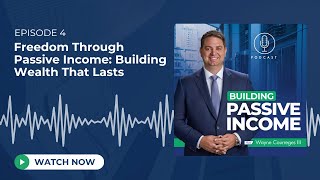
A ~15-minute Building Passive Income podcast episode (BPI Episode #4) hosted by Wayne Courreges III, CPM®. The host explains why passive commercial real estate investing delivers financial freedom by producing predictable cash flow, equity upside at sale, tax-depreciation benefits, scalability/diversification across properties, and reduced dependence on a single paycheck—enabling choice of how to spend time, accelerated retirement, and generational-wealth building. The episode includes anecdotes (rural residents with passive income; professionals like doctors and dentists), examples of reinvesting returns to compound wealth, and a call-to-action directing listeners to passiveinvestorcoaching.com and CREI Partners.
Chapters
Welcome to Building Passive Income, the podcast for professionals, entrepreneurs, and investors who want to build wealth, diversify beyond Wall street, and create financial freedom through passive commercial real estate investing. Your host is Wayne Courageous iii, a seasoned investor and founder of CREI Partners, a leading commercial real estate investment company. He spent nearly two decades navigating and educating others on the commercial real estate, from multifamily to storage to retail. Each episode is under 15 minutes, intentionally short, easy to understand, and packed with insights that help you grow your income and protect your capital without becoming a landlord or sacrificing your time. If you're ready to learn fast and invest smarter, you're in the right place. Let's get started.
Welcome back to Building Passive Income. I'm your host, Wayne Courage iii. Excited for another episode. This episode we're going to be talking about why passive income is key to financial freedom. And we're going to really dive into this because one of the things that I learned early in life with Passive Income is, and you might have relate, is like going to a place, a beautiful place where there's not a lot of industry, say, you know, Montana. And I sort of gave that pause because, like, before COVID not a lot of people lived in Montana. During COVID a lot of people moved there. But let's just pretend like a lot of Montana still is pretty rural. So, you know, now yes, people are working remotely, et cetera, but for a while there, like, I would go up and visit family and I was like, what do these people do? And when I was talking to them, you know, some of them for sure are remote workers, but a lot of them have passive income. They have freedom of time. Their time is their own. And so over the years, they've invested, you know, and maybe it started out with the $50,000 investment or whatever that investment was, but they started an investment process that gave cash flow and that cash flow allowed them over a period of time. I doubt any of them was like, unless they came up with a bunch of money from an inheritance or, you know, an ipo, selling, et cetera. But a lot of them did the steps to invest over time and build a portfolio that provided, you know, solid income where they could choose where they wanted to live and how they wanted to live. The key word in that is choose. A lot of our investors are doctors, attorneys, engineers, you know, high net worth individuals that are investing in real estate, but they enjoy what they do. We have dentists as an example. Now, dentists, you know, they're, you've gotta be showing up to the office to be a good dentist. There's a lot of churn with patients to make that high income. So it takes a lot of stress on the body for any doctor. As an example, when you have a choice to say, hey, I love what I'm doing, but I don't need to do this anymore, or maybe I'm like, okay, well I'm not loving what I do anymore. And so now it's time at least having that choice of that income is where passive investing early really compounds future in life to allow you to make that choice to determine what you want to do for your time. Passive income trades all that hard work we talked about in prior episodes. If you haven't listened to it, go to the prior episodes about active investing and all the work and such. Whereas passive investing, you're trading dollars for your time and that those dollars are like little soldiers working and getting you income consistently so that you are able to choose what's best for you and your family whenever that place or time comes into place. The other thing we get is we get a lot of entrepreneurs, a lot of business owners who want to get away from paycheck dependency or the cy of cash flow. Because as an entrepreneur myself, I know that cash comes in depending on certain times of the year based on for us acquisitions. But other business owners are going to be at a different pay cycle based on what is going on with their product or service. And so when you have this passive income provides consistent income when you need it, right? And then, oh, by the way, you're getting this passive income. And then as equities grow and it's pushing the business plan, then there's the upside of equity at sale. So it's, it's a really great, from an income standpoint and then equity upside. But with passive income, you're not reliant on one employer or one paycheck or that one deal coming through. You have income that will allow security, it's going to reduce stress and it will make you, it will allow you to make life decisions without fear of losing income, which goes back really to that first point of like time becomes your own, right? The other thing is that scalable wealth creation. One of the things I love about passive investing, you don't have to put $200,000 down as an example, to buy that one single family home down payment and get the income, you can Instead of do 200,000, you could do 50,000 or $100,000 increments in multiple properties. So it's scaling your wealth with the Ability to diversify, similar to maybe your other investments or your other portfolios and other asset classes, whether stocks or bonds, wherever. It's a similar thing on passive investing, where you can invest in multiple properties, you have multiple streams of income and think of each property as its own business. It has its own revenue, has its own expenses, and net operating income after debt service is what's paid out. Right. Seeing that you have those choices and the ability to scale wealth by diversified is massive. And something that passive investors absolutely love doing. Especially like if you're an entrepreneur or high net worth individual where you don't want to put all your money in one real estate deal because it's a huge risk. If you put all your money right, real estate, there is risk. We, we reduce risk in a lot of ways. But being able to diversify is key. Another thing about passive investing, and it goes back to choice of time, et cetera, but it can accelerate retirement. It can allow you to make those decisions if you've got the passive income where you can determine, okay, is it the time to retire or not. Again, most of our investors, you know, they're not looking to get out of their day job, they enjoy what they do, they worked hard in school, et cetera. But it gives them again that choice. I think that's the biggest aha moment I keep repeating as I'm going through this is that investors need choice. And to have choice, they need to have security, they need to have consistency, they need to have obviously that income and then the equity growth to grow their wealth even further. Which really goes into the generational wealth as you're investing in real estate and say that investment yields a 1.8 or a 2x multiple. So I'm just going to be almost a 2x multiple just because easy math that you invested 100,000 and now becomes 200,000 over, I would say in today's climate, say five to seven years for a moment, a couple of years period that was, you know, two to three. I mean it was getting pretty crazy, getting frothy. That's when you know things are getting, you know, maybe a little too aggressive. But in a normal cycle, five to seven years, that's, that's pretty good. You know, that's a 20% average annual return. Well, say you reinvested that now 200,000 because initially is 100, now it's 200,000. Now you've invested that 200,000. Well, that goes into an investments, maybe multiple investments get you another 2x and another 2x. And while we're getting that cash flow. We're also getting tax depreciation and we're going to go through that in a later episode. But all this is part of that wealth generation. You know, when you're looking at passive income and the benefits, think about your time, think about your choice, where you want to be and how even the predictable income, maybe as an entrepreneur, you know, if this is speaking to you, because I understand it as an entrepreneur myself, where like, you want that consistent income, you want to be able to rely on it, or you're like, hey, I want to be able to, you know, not have my work decide my future. Like I want income where I can make the choice. Going back to the scalable of diversifying and then creating generational wealth and getting the tax benefits as well is why people like yourself and myself invest in real estate in the first place and why many, many investors invest passively as a way to grow and diversify their wealth for their family and themselves. So hopefully there were some aha moments in the sense that you understand why people passive invest. Cash flow, equity, upside, tax, depreciation, not worrying what's going on in the world outside of like that 1 mile radius of, you know, whatever particular submarket you're investing in. That's all very, very, very, very powerful, you know, especially in multifamily, because people have to pay rent on the 1st and if they don't, you know, then they get late charges and, you know, there's that process again. As an active investor, you don't have to worry about collections, you don't have to worry about screening and finding the right tenants. What you're worried on and what you enjoy is whatever gets you up every day and gets you excited to give back to the community or work hard for your family, et cetera. While in the background you've got this passive machine growing and working hard to give you the cash flow, the predictability and the upside returns that you're expecting as an investor. If you want to learn more at a faster pace, check out passiveinvestorcoaching.com at passiveinvestorcoaching.com it's free. It's something I put together. It does talk about CREA Partners as an investment company, but it also talks heavily about evaluating deals, evaluating deal sponsors, how to look for a good market, et cetera. So I definitely encourage that. I'm excited to continue the momentum and get more of these daily episodes out and hopefully continue adding value to you and your day. Hope everybody is doing well.
Thanks for tuning in to Building Passive Income. If today's episode helped shift your mindset or gave you a new tool to grow your wealth, do us a favor and like, subscribe and share this podcast with someone you care about. Want to go deeper? Join our free Passive Investor coaching program@ passiveinvestorcoaching.com it's the perfect next step to start building wealth through commercial real estate the right way. Remember, financial freedom isn't a dream, it's a decision. And it starts with building passive income. We'll see you in the next episode.