CREI Partners Webinar: Concepts and Benefits of 1031 Exchanges
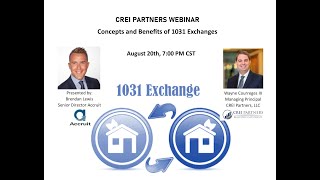
Webinar (CREI Partners) presenting an educational overview of IRC §1031 'like-kind' exchanges. Speakers Wayne Courreges III (host) and Brendan Lewis (Accrue) cover history (1921 origins; §1031 codified 1924; modern approvals 1935; time limits after Starzec v. United States/1979), definitions (like-kind, boot), three core requirements (qualified use, like-kind, exchange via qualified intermediary), timelines (45-day identification, 180-day completion), exchange types (delayed/simultaneous, reverse—more costly, improvement), identification rules (3-property, 200% rule, 95% exception), taxes affected (capital gains, 25% depreciation recapture, 3.8% NIIT), example numeric calculations, estate-planning benefits (step-up in basis), and common hazards (vesting/entity issues, related-party sales, carryback financing). Presentation includes practical advice and Q&A.
Chapters
Well, thanks for joining us today for this webinar on concepts and benefits of 1031 exchanges. Would like to first give you a little background on what we do. At CREI Partners, we provide opportunities for investors to grow and diversify their wealth in purchasing large multifamily apartments. We do this several ways, but primarily we raise money to buy assets by by pulling funds by larger assets that typically would not be able to be purchased by the individual directly. We'll acquire the value, add real estate and then immediately start our property business plan and then as the property gets stabilized as we're able to return those distributions to our investors, we'll do that and then either look to refinance or sell at the end to distribute the profits for the investment. A Little bit About Me I'm Wayne, I'm based out of Austin, Texas and I lead the investment life cycle and Investor Relations for CREI Partners. Last 13 years I've worked with a Fortune 150 company leading property management services of about 4 and a half million square feet for both institutional and non institutional clients. During this time I've had the ability or been very fortunate to have projects that have worked with other professionals in the real estate business and were able to do over $60 million worth of strategic plans to reposition the property for their investment parameters. And you know, ultimately my passion, real estate and leading teams and desire to increase others and our wealth push me to start CREI Partners. If you haven't already listened, check out the Untold Stories of Real Estate Investing. You can find that at itunes or Stitcher or go to creipartners.com podcast and then also check out my ebook that's focused on the top five Must Knows for Passively Investing. Definitely a must read, is a good foundational spot where you can gain more information and you know, definitely have an opportunity to, you know, ask questions. Reach out to me directly and has great recommendations on books and other podcasts for you to learn more about passively investing in real estate. So without further ado, I want to introduce Brendan Lewis. Brendan is the Senior Director of Business Development at Accrue. Accrued is a financial technology company offering a full suite of escrow like kind exchanges and special member services. He's participated in hundreds of tax deferred exchanges and is an invaluable resource to property owners, accountants and attorneys as they navigate through the 1031 tax deferred exchanges. He also has experience in Delaware Statutory Trusts, tics, opportunity Zones and cost segregation. He has a varied background that includes brokerage residential, commercial development, escrow settlement and financial services. And he's been recognized for his excellence and featured in several publications. Really glad and very appreciative of Brendan for his time and sharing his knowledge about 1031 exchanges to our audience. So with that, Brendan, thanks for your time and look forward to it.
Thank you very much. Wayne, Share my screen here. What a good introduction. I've got not gotten one like that. Can you still hear me on there?
We hear you.
Good.
And then for those that are on this webinar, feel free to put your questions in the Q and A and we will answer those at the end. Definitely want to give time to ask questions to Brendan as we finish up.
Perfect. All right. Well thanks Wayne, for the introduction. We'll just go. We're going to go over concepts and benefits of 1031 tax deferred exchange. A lot of people, varying degrees of familiarity with this topic. You have people that have done exchanges that haven't done one in 10 years. You have people that have never done them but have heard about them. Well, this is just kind of a high level overview and we'll, we'll get into some of the, some of the different types of exchanges as well and as well as the benefits. You already went through my about me so we don't need to go into that. We'll skip over it. But about our company. Accruit is one of the leading independent trusted managed Service providers of 1031 exchanges and the only company that leverages technology. So what does that mean for you know, for the, for the, for the, for the taxpayer? It results in, you know, we're able to facilitate more exchanges in a way that is efficient and we can spend more time working with the individual exchangers and consulting with them. We specialize in conflicts financial instruments so you don't have to allow me to focus on your business. And we're independent, non competitive, not title affiliated. We're totally independent and we've been in business about 20 years. We've got a team of subject matter experts which I sort of fall into as well and about 100 years of experience collectively in the 1031 exchange space. There's very few things that we come across that we can't handle. So a little bit a brief history of exchange. The first like kind exchanges occurred in 1921. So this was going on almost 100 years of tax deferred exchange. Section 1031 as we know it today became an amendment to the federal tax code in 1924. In 1935 the Board of Tax Appeals approved the first modern tax deferred like kind exchange. And in 84 time limits were imposed as a result of the Star Curve v. United states decision in 1979. So what is a 1031 exchange? It is effectively, it is right. It References Section 1031 of the Internal Revenue Code. And so it allows owners of investment real estate to defer capital gains and other applicable taxes that would normally be due upon the sale of investment real estate so long as that, those, those, those that those funds are reinvested in another property of like kind. And we'll go over what like kind means, and this is the section right under the tax code. No gain or loss shall be recognized on the exchange of property held for investment, held for trade or business or for investment if such property is exchanged solely for property of like kind, which is to say it's held for productive use in a trade business or for investment. And so it's important to mention also, this is not a, this is not a tax free transaction. This is a tax deferral. But it's one of the most powerful wealth building tools that we have at our disposal in the world of real estate investing. There's sort of three general requirements when it comes to a 1031 exchange. The first one is both the property surrendered and the property received must be held for those, must be qualified use. So again, productive use in a trade for business or for investment. And what does that mean? That means, you know, owner, user type, deals, investment property, all of those are applicable. The property, secondly, the property surrendered and the property received must be of like kind. And we'll go over what that means. That's a big misconception. And then third, there must be an exchange as distinguished from a sale and a purchase. So we step in as what's called a qualified intermediary exchange. Companies are actually called qualified intermediaries. And we step in and act on behalf of the taxpayer to facilitate that exchange. So we talk about like kind. 1031 exchanges are also called like kind exchanges. Essentially what like kind means is it's any property that is held for investment or for use in a trade or business. So a lot of people think I have to sell my apartment building and I have to buy another apartment building. And that's not the case. There's a lot of different options. Any kind of real estate, essentially that is not your primary residence you can reinvest in. And so some of the examples, raw land for a shopping center, apartment building for a shopping center, hotel for an apartment building. So you kind of get the idea there. Another important term is what's called boot. And in the, in the. We're jumping a little bit ahead but in terms of a 1031 exchange, boot is considered anything that is not replaced. So that is not replaced with like kind real estate. So in the, in the, in the course of the exchange if some of the funds are not spent those that portion of the, of the, of the, of the funds are taxable and it's, and they're, it's called boot. I get asked quite frequently how long a property has to be held for and there really is no time period that's explicitly stated by the, by the irs. And there's letter rulings and case law which are relied upon. But the most important thing is the intent when the property is acquired originally. So this is where people that do like fix and flip and things like that and it doesn't apply. Those folks are considered dealers by the irs. So if you happen to invest, if you invest in commercial real estate, but you also have a business where you buy homes and renovate them or even any kind of property you buy and flip it, so to speak and sell it for a quick profit, that is considered, you're considered a dealer in the eyes of the IRS and you can't take advantage of 1031. But if it's held for long term gain that meets the, that meets the restriction there. So what is a capital gain? A lot of. Well, I'm sure we all know capital gain is a rise in the value of an asset investment or real estate that gives it a higher value than its purchase price. And a gain is not realized until the asset is sold. And capital gain must be declared on income tax returns. As we know, some of the benefits of 1031 exchanges, I mean there's a tremendous amount of benefits, but just a few to mention here. Obviously deferral of capital gains, that is the primary intent. Secondly, leverage for wealth building. This is an area that is used quite frequently. Somebody will sell a property and sell one property and buy two, leverage themselves and buy two or more reallocation of assets. We see this a lot. This could be this sort of, it's very broad but this could be. If this could apply to selling land and purchasing something that's income producing. It could be just reallocating your, you know, moving to a deal that might be, might work better for you and then consolidation, diversification, another big, another huge benefit. Pretty self explanatory. Somebody that owns, you know, five or six multi family properties. Let's say all over the country, they want to consolidate those and purchase maybe one. And then the inverse would be they maybe own one that's of high value and they want to sell that and they want to buy multiple. And then lastly, retirement and estate planning. And this is something that not a lot of people know about, but the tax benefits of a 1031 exchange not only are there for the individual who participates, if they continue to roll over those gains over the years into different properties, but it's also a very important estate planning component there because upon death, as an individual, when somebody dies, their heirs get a step up in basis. And so if it's their spouse, then that individual would receive a partial step up in basis. And if it's the children, then it would be a full step up in basis at that point. What that means is any of the taxes that that individual would have owed are at that point effectively forgiven through a stepped up basis. So it is stepped up the day that that person dies, essentially, and so that you don't have that huge gain any longer. So we talked about capital gains taxes. There's other applicable taxes here that are important to mention. Obviously, the first one is capital gains. So, you know, you're looking at anywhere between 15 and 20% for federal. And then another could be zero. There are states that don't have state capital gains taxes, but many do. If you're fortunate to live in the state of Texas, like myself there, you don't have. And Wayne, you don't have a. There's no state capital gains tax, but if you're in a state like California or New York or various others, you could be 13.3% is the tax in California, for instance, so it can be pretty substantial. The second tax is, which technically third would be what we call depreciation recapture. And that essentially is a 25% tax on any of the, any of the depreciation that's been taken on that property over the course of its ownership. And the irs, I have clients all the time who come to me and they say, you know, I didn't depreciate the property, so I don't have to pay that tax. Well, unfortunately, the IRS assumes that you did pay, that you did depreciate the property, and they're going to tax you anyway on the maximum depreciation that you could have taken for that. You know, typically per a depreciation schedule, if it's a residential or commercial property, they're going to tax you anyway. So if you're not depreciating a property, you probably should, but don't take my word for it. Talk to your, talk to your cpa. The third or fourth rather tax here is what's called a, the NIIT net investment income tax. And this applies to the 3.8% federal tax. It applies to, it used to be called Obamacare or Medicaid or Medicare tax. It applies to individuals who are single filers and high earners. So if you're single and you make over $200,000 a year, you fit into that category. If you're married and you make over and you file jointly and you make 250,000 combined, you also file to fall into that category. And in most situations, this is an applicable tax because that you're looking at for, upon the sale of a property because those, the year that that property is sold, it might push you up into another tax bracket. So even if you're not at that level, it could put you there. So this is not a, this is, some of my colleagues don't like this map, but I happen to like it. It's just short. It sort of gives you an overview of the country and how looking at combined top marginal tax rates, capital gains. So this is as of 2016, not much has changed. But you know, you're looking at, in a state, like I said, you know, California is 33% for federal and state combined. And then, you know, you have states like Texas where they're quoting it at 25%. But it just gives you a nice, you know, visual in terms of where these, where everything, where they fall. So we'll go through a little, a quick calculation in terms of how to determine your taxable gains. It's just really simple numbers here. Let's say an individual purchased a property for $300,000. They had made 20,000 in capital improvement and they depreciated it $100,000. The basis would be the 300,000. But in order to calculate net adjusted basis, you add capital improvements and you subtract deprecia. So now we're at 220,000. So second calculation is what is the taxable, what is the capital gain that we're looking at here? And that would look now we're fast forward to this individual is selling the property for 900,000 and you subtract the net adjusted basis, subtract sales expenses out of there, which could be anywhere, you know, 8 to 10% closing costs and you know, real estate commissions, things like that, you're looking at a $600,000 capital gain. So the third calculation is what, what do I owe? What does that person owe on 600,000? So in this situation, we're saying we've got the depreciation recapture, which, which doesn't, it doesn't vary. It's always 25%. So that's 25 grand. Then we've got a federal and state capital gain. So the national average is 27%. So that was what I put it's 162,000 in federal and state capital gains tax. And then finally the net investment income tax. Let's assume this person is now pushed up into the category they already were in the category of a single filer high earner. So that's another 3.8% taxes, 22,800. So we're looking at just a little over 200,000 in taxes. So it's pretty significant. So in kind of comparing and contrasting a sale versus an exchange, you have, you know, your net proceeds, your net after tax proceeds is, you know, $610,000 if you were to sell the property. But if somebody knows they're going to take those funds and they're going to reinvest them into another piece of real estate, at least the considering a 1031 exchange and talking to us about it is always advisable in the situation of an exchange with these same numbers, the proceeds with the tax deferral or 820,000. So all we're subtracting is the sales expenses. And so you can see it's a pretty significant differential there. So there's a couple different things to talk about in terms of a complete deferral. It is possible there's such a thing as a partial deferral. I'm not sure if I go over that in here or not, but a complete deferral is essentially, in order to get one, you have to purchase, purchase a replacement property of equal or greater value to what you've relinquished. So if the property sold for a million dollars, you technically have to buy another property for a million. It's not based on the proceeds, it's not based on the profit, it's not based on that. The idea here is continuity of investment. And so therefore you have to purchase something of equal or greater to what you sold. There are certain what we call allowable expenses, like sales commission, like real estate commissions that can be subtracted and not have to be replaced. So in the example in that previous slide, there somebody tech doing an exchange with this example, somebody would really only have to replace that, you know, the $900,000 property. They sold, they technically only have to replace, you know, because the expenses were 80,000. You only have to buy a property for 820,000 in order to get a complete deferral. So you've got to reinvest all the net proceeds from the relinquished sale into the replacement property. And you have to obtain equal or greater financing as was paid off on that relinquished property. So whatever debt was extinguished on the property that was sold has to be replaced on the property that was, that is purchased. And then finally you have to. The individual has to receive nothing but like kind property in the course of the exchange. So anything outside of that could be taxable. We talked about boot. So if there was cash left over, that portion would be taxable. And that's when we talk about a partial deferral versus a complete deferral. Many people are aware that there is a timeline for this. We talked about in the very beginning in terms of the government imposing a time constraint there. I like this graphic. I think it really explains how to get your kind of ducks in a row in terms of looking at an exchange. You know, considering doing an exchange. There's sort of this pre identification period, what I like to call it. And it's. It's that time when you're identifying a. You're choosing a qualified intermediary to work with, for instance, accruit and you're marketing the property for sale. The timeline does not begin on the exchange until the close of the relinquished property. So if the day it closes, the day after that is day one of 180 and the first 45 days of the exchange are what we call the identification period. And that is where an individual identifies the properties they are going to replace. And we'll talk about how you identify and what that means and then the remainder of that time or it could, you know, the transaction could all occur within the first 45 days, but you have up to six months, 180 days to complete that closing on one or more of the properties that have been identified. There's a couple different types of exchanges. And this is another thing that a lot of people don't know about. There's technically four. The first one is considered, is called a delayed exchange. They're also called forward exchanges, deferred exchange. You know, they're all sort of the same thing. But that's essentially what that means is it's a sale and then a purchase. Simultaneous exchange is when a closing still can be a sale and a purchase, but the time period in between those closings are very. It's a short period or perhaps they're even happening on the same day. A reverse exchange and improvement exchange is where some people aren't aware of these opportunities. So a reverse exchange, put simply is the ability to put purchase the property before somebody disposes of another asset. And so there's a lot of value in that. They're quite a bit more expensive in this industry. It's pretty much an industry standard that they could be as much as 6 to 12 times more expensive than a regular exchange. But you're looking at, there's a tremendous benefit there and a lot of it is just being able to have more control over the situation. And then third is an improvement exchange. The last type of exchange is an improvement exchange. What that means is, and I don't want to get too far into the weeds, but you could also have a reverse improvement. But that gets kind of, we don't want to go there today. But the last one is an improvement exchange. So that allows somebody, for instance, they sell a million dollar property and they want to buy something that maybe has some deferred maintenance issues or needs a new roof, needs new H Vac, whatever it might be. It allows you to take a portion of the proceeds or as much of the proceeds you'd like that need to be replaced and use those toward improvement. So if somebody sold a property for a million dollars, they would purchase something for 700,000 and they'd have 300,000 approximately to do improvements on the property. And it still has to be done within the 180 day period. But these, the idea here is that these are, you know, I've had people, you know, try to build new construction and they'll get as far as they can with it and that's, that's an option. But the, you know, I think for, from my perspective, the value in that type of an exchange and improvement exchange is taking that, you know, excess 300,000 in my example and maybe replace, you know, big ticket items, you know, new roof, H Vac, things that are going to be costly, things that are going to be quick relatively and being able to get those done. And so again, reverse improvement exchanges, alternative, different, you know, different things maybe you haven't heard about before, but gives you some increased flexibility there. So we talked about that first 45 day period which is intended, which is called the identification period. There are three different ways that you can identify and you have to pick one of them. I like to say that all of these rules and sort of all the timelines and the rules for identification are outlined by the irs. So unfortunately we were just presenting them, but we don't set the rules, we just follow them. So I always like to say this is in order of most used, the least used, and it's sort of a tiered situation here. So the first one is the three property rule. By far it's the most used, the most. And it basically is you've sold a property, now you're in the identification period, you have the ability to identify three properties of any value. Obviously, the idea being you're going to purchase something of equal or greater value than what you're selling, but you can identify three properties of any value. The second one is what we call. Now this is, this is where I say sort of tiered. Because if you wanted to identify more than three properties, you would move to the next rule, which would be the 200% rule. And what that states is that you can identify any number of properties so long as the fair market value does not exceed 200% of what you're relinquishing. So if you're selling a property for a million dollars, you can identify. But you wanted to identify six properties. You could, but it just. The value of those six properties can't exceed 2 million in value. And then the last one, which is, I've only seen maybe once or twice in my career, but it's called the 95% rule or 95% exception. It refers to the ability to. So this is again idea of a tiered situation. So if you wanted to, if an individual wanted to identify more than 200% of value, they could. However, they essentially have to close on all of it, everything they identify. And so, you know, you see this with, it's definitely not the higher dollar figure, you know, properties, but you're seeing it within perhaps land deals and things like that. But again, it's that 95%, you have to acquire 95% of the value, which basically means you have to acquire all of it. There are rules for identification, which is why, why qualified intermediaries exist. Part of the reason is those, you know, those identifications have to be made, have to be submitted to us, so they have to be made in writing. We are a totally paperless company. So in writing is kind of not totally accurate, but it is in writing. We just do things through DocuSign and it's all email and all that, but which is unique for this industry. But it has to be. They have to be made in writing. They have to be received on the 45th day or post March on the 45th day, again, post March is just sort of industry thing that we say, but you know, again, we're paperless. So it just has to be received by the 45th day, has to be signed and it has to be dated by the taxpayer who is involved in the exchange. Taxpayer or taxpayers who are involved in that exchange. And then lastly it has to unambiguously describe the property. So you can do that through a legal description, a physical description. You know, there's other ways to do it, but those are by far the most common. And then last thing, which I'm not sure is in this presentation within that 45 day period. I get asked this a lot, what happens if I, if I want to change my identification? You're absolutely able to do that. You can only do it within the first 45 days. You can rescind and you can resubmit identification, edit them, whatever, but not beyond the 45 days. So you have to act on some of the properties or all of them that you've identified if you're past 45th day. Couple of things that are excluded from 1031 exchange. There used to be a personal property component to 1031 Exchange. It disappeared out of the tax code in 2018 as a result of the Tax Cuts and Jobs Act. That related to things like rental car fleets and airplane fleets and different large company leasing companies, BMW Financial, things like that. They used to do a lot of personal property exchanges, but those are just allowed now. So things that also are not allowed, stock in a trade or other property held for sale, stocks, bonds, notes, securities or evidences of indebtedness or interest, interest in a partnership or an LLC are not like kind and therefore cannot be exchanged. However, there is a way. There are plenty of ways to exchange properties that are in a part that are owned by a partnership or owned by an llc. And we really excel in that space. Gets a little bit tricky, but we have a tremendous amount of experience in that arena. And then lastly excluded are certificates of trust or beneficial interest. Couple of exchange hazards. These are not things. It's not to say that you can't do them or that there's, you know, inherent issues there. It just makes it a little bit hairier and we just have to. That's when you involve us and kind of help you sort through that with your advisors as well. CPAs, et cetera. Vesting the same taxpayer requirement that we talked about the idea that the person who's selling the property has to be the same person who's purchasing, same entity or individual purchasing the replacement property. So that's, there's a couple caveats there including things like single member llc, disregarded entities, things like that. Partnership interest, again not, not, not an issue. But, but definitely something to consult us about well in advance of the sale or as quickly as possible if you're anticipating a sale on a property where there's a partnership situation. Carry back financing, seller financing, things like that, that can be another area that gets challenging. But we're more than happy to step in and help in any way we can and get that resolved. Related parties, buying and selling from related parties that typically you're not able to, you're not able to sell to a related party. That becomes an issue with the IRS because of things like basis shifting. You know, you could have two brothers and they could just constantly buy and sell each other's property. And so therefore they don't allow people to do that. Non exchange related costs. There are some expenses that are not allowable expenses. And then finally the holding period or holding requirement, the idea that this is being held for investment purposes, long term gain, et cetera. All things to just think about. Again, not issues here per se, not roadblocks, but things to be aware of. Any property held for. I'm going to skip over that one. So kind of bottom line is in terms of why exchange. In summary, capital gains tax is substantial. It is. In fact, you'll hear CPAs, you'll hear people in that world say well pay the taxes. It's, it's capital gains taxes are not getting any lower. They're already pretty low. Well, as you saw with these calculations and I mean depending on what state you're in, they could actually be pretty substantial. I think 33% or 38% is substantial. So although they've been higher in the past and they may be higher again, I always see that there's always a benefit to doing an exchange in most cases if you are purchasing another property. Another reason why to exchange leverage dollars otherwise spent on taxes. So you know that I always like to tell people, even if you have an inkling, you know, you might think that you aren't going to be able to facilitate this or you know, complete an exchange within the 180 day period. The costs associated with starting an exchange and not completing it, first of all, the costs associated are very minimal. The there is no penalty for not completing the exchange or failing to come to close on a replacement property. The worst case scenario is you're out, you have to pay the taxes. So you're no really better off than you were in the beginning but you're no worse off. I should say another benefit in terms of why exchange transfer to income producing property. Again this is a big topic where you know, people own land where they might be holding it for long term gain but they've gotten to the point where it's, it's, it's, it's there like they've, you know, it's where that's, that's they're fine with the value on valuation on it, they want to sell it and they want to move into something that is going to produce, that's going to generate a rev revenue and again going back to diversify and minimizing risk. Things like, you know, management concerns, all of those play a part in that is another reason to exchange. Just a short disclaimer. Obviously you know, we are more than happy to help with Advise folks on 1031 exchanges and how to effectively facilitate this for a client. But at the end of the day tax and legal advice is something that we don't really give and we really want, want to rely on. You know, we'll certainly work with your CPAs, your attorneys, whoever, whoever you'd like to make sure that we're all on the same page on the transaction. And I appreciate your time today this evening. This is my contact information. Feel free to reach out with any questions regarding 1031 Exchange, tenant and common deals, any of this kind of stuff. And I can certainly advise you on those in terms of how they, how they relate to DSPs as well in terms of how those play a part in the exchange process. So I appreciate your time today. And back to you, Wayne.
Hey, thanks Brendan. A lot of great information. Are you seeing with it getting political season? Have you seen more investors try to rush to get into these 1031 exchanges with the, the potential targeting of future 1031 and how that may play out next year. Have you seen anything on that?
Yeah, I mean I think that, I think that there's definitely, I think there's obviously growing sort of consternation around this idea of our 1031 is going to go away. Biden has referenced that obviously in his, in his tax plan. It's not something that a president can do and it's not the first time that this is the 1031 exchange has been attacked as you know, as I said, it was been around for 100 years effectively. It's been on the chopping block many times and it's, and it's people have those in the, in the political world, legislative folks have realized that, that seen the value in this in terms of reinvestment into other properties and creating jobs and all sorts of tremendous benefits economically. I have, I have heard from other people, I wouldn't necessarily say, you know, run out and do your exchange tomorrow unless you were already planning on doing it. I don't think that, you know, if it just doesn't make sense and, you know, not. But, but I have heard folks saying that, you know, they're taking, they want to take advantage of what we know now and that they're feasible and that they're allowed and go ahead and do an exchange prior to the end of the year and. Or, you know, before next year. Right.
I don't have any questions in the Q and A. Someone has risen their hand, though, so I'm going to allow them to talk, push that. So. Are there any questions for the group for Brendan? All right. Well, Brendan, thank you so much for being our guest today and talking through the 1031 exchanges. Appreciate your time. And if anything, get in touch with Brendan. His information's here. And for those that are listening, his direct number is 469331. 1031. Again, 469331. 1031. Thanks, Brendan. Appreciate it.
Absolutely. Take care.
More from Wayne

September 2026 Meetup: Investing Ahead of Growth: The Bryan–College Station Opportunity





May 2026 Meetup - Apartment Complexes & Passive Investors: Opportunities & Risks


March 2026 Meetup - Reading the Market: Economic Indicators Every Investor Should Know


February 2026 Meetup - Syndication 101: How CREI Partners Structures Deals for Investors

Build-to-Rent (BTR) Communities Explained: Why Investors Are Paying Attention