CREI Partners Webinar: Legal Must Knows for Passively Investing in Real Estate
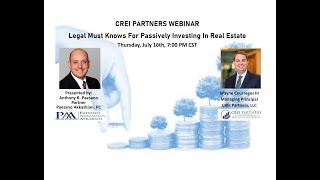
This content was created by Wayne Courreges III, CPM®. This content was uploaded by Wayne Courreges III, CPM®. This is a YouTube webinar titled "CREI Partners Webinar: Legal Must Knows for Passively Investing in Real Estate" (recorded 2020-07-17) hosted by Wayne Courreges III, CPM® of CREI Partners with guest speaker Anthony Paisano (real estate/securities attorney). The session is an educational presentation and Q&A for passive multifamily real estate investors and operational/back‑office personnel covering securities and regulatory topics: Regulation D (506B/506C), Form D and NASAA/blue‑sky filings, accredited investor verification and questionnaires, subscription and joinder agreements, transfer restrictions and Rule 144, offering document structure (PPO/OPM), capital waterfalls and preferred returns, opportunity zone structures, escrow/raise mechanics, broker‑dealer exemptions and related disclosures. The recording includes back‑and‑forth dialogue between the host, the attorney presenter, and attendees during Q&A.
Chapters
Well, thank you for joining us for this webinar. My name is Wayne Courageous. I'm with CREI Partners. Our company provides opportunities for investors to grow and diversify their wealth and purchasing large multifamily apartments. What we do is we raise money to buy assets, pulling investment capital from multiple investors and we'll use that to acquire the real estate. We'll asset manage and work with third party property management companies to execute the property business plan along with our partners in the area. Once the property is stabilized, we'll return returns to our investors and implement the exit strategy or refinance when it's time. A little bit about Myself I'm based out of Austin, Texas. For the last 13 years I've worked and continue to work with a Fortune 150 commercial real estate company. I've managed about four and a half million square feet of institutional and non institutional properties in Washington, D.C. houston and now back in my hometown in Austin, I've worked with dozens of real estate professionals executing building strategic plans, over $60 million worth of projects, assisting owners through their investment life cycle from acquisition to implementing the strategy and disposing the property for investor returns. My background in commercial real estate, leading teams and all, and growing our investors wealth really pushed me to start CRI Partners. My educational background I have an MBA from UNC while I was in the Marine Corps, I was going to school and earning my undergrad and a portion of my Master's in Economics and I'm a Certified Property Management Manager designation. So a little bit to keep an eye out for. We post or we've been doing a podcast since June. It's called the Untold Stories of Real Estate Investing. So hope that everybody will listen and share and enjoy that we really hit the the raw truth, all the good, bad and ugly and more during these. We'll post our next podcast show next week but please go and listen to those if you haven't already@creipartners.com podcast and then you can also if you're looking at passive investing and you just like to really get a foundation of what to know or you know what questions you should be asking. Where do you find deal sponsors? What do you ask when renewing or reviewing a property? Check out this ebook. This is just one resource. There's many books that's also mentioned in here that definitely recommend but it's@creipartners.com ebook excuse me, ebook. So I want to introduce our guest speaker today. I met Anthony a few months ago and just been really impressed with him and his background, he's a very experienced real estate attorney based out of Michigan. He has a JD or law degree from the University of Detroit Mercy School of Law and his undergraduate Purdue University. Some of his career highlights was one representing a Florida company in general corporate matters and 19.3 million regulation the offering of investor class of securities and real estate development and management company along with a $4 million acquisition of property for development. And another one of his highlights here was representing Michigan company and general corporate matters and $25 million in Regulation D offering an investor class of securities and real estate development company. Anybody that's going to be investing in real estate from a passive side and these larger projects are, are going to see a lot of these documents that Anthony's going to be talking to us about today. And so hopefully it adds value. Get a little bit more comfortable with the terminology and the different documents and sort of, you know, if we walk away with a few questions to ask or a little more knowledge of the documents, then I think, you know, this hour or so is definitely worth the time. We will have a Q and A session once we go over the documents. And so, you know, feel free to write your questions or in the chat box and we'll go ahead and get those questions answered. So with that I'm going to turn it over to Anthony. Anthony, thank you for being here.
Thank you for inviting me. Wayne. I think this is a great opportunity to educate the group and your contacts in what is a fairly complex regulatory scheme that is sometimes, if not all the time overlooked by any passive investor. My job today is to hopefully provide the participants with some documents, some things to look for in any kind of an offering document, whether that offering is presented to them through a broker dealer relationship or through a family office or directly by the issuer, the party that is selling the securities through what we call a broker dealer exemption where officers and directors and control persons of an entity retain the ability to sell their securities without going through a broker dealer. It's a way for the SEC to streamline the ability of issuers to be able to sell directly to the public. And I've been doing this for 20 plus years and I would be probably doing the whole world of securities offerings a service if I could say everything can be Learned in a 30 minute to an hour presentation. There's a lot that goes into this and I am more than happy to answer any questions. I'm very accommodating. If you ever have any questions, my information can be found at www.taalawfirm.com and always feel free to shoot me an email or a call. So with that being said, I'm going to jump right into my presentation. When we first went about this, Wayne had asked me about a presentation that I could give in the form of a PowerPoint. And I thought that a better course would be to actually share with the group actual offering documents. And it is important to understand that what I'm going to show you are examples of issuers relying on what we call safe harbors. And I guess the beauty of our technology nowadays is that I'm going to use some terms, write down the terms and just use Google. And hopefully that will open up further access to secondary sources to learn more about some of the terms that I'm going to be using every state. And so I start off here with just a simple disclaimer. And I do this because I have ethical requirements under Michigan by the State Bar of Michigan about disclosing any kind of securities documents. This is just for educational purposes. And I'm not trying to sell you anything, I guess is essentially the message that's being sent here with this, with this document. I'm going to be talking to you about Regulation D. Regulation D is a byproduct of the 1933 securities Act. And Regulation D is one of many exemptions from registration. What the 1933 act says. And there's also a 1934 Exchange Act. But the 1934 Exchange act deals with what we call the anti fraud provisions, security offerings. So it's not addressed in the context of what I'm going to be providing some background on today. But the 1933 act has a Regulation D. And I'm sorry, taking a step back, what the 33 act says is that all securities and securities is a very broad term, whether it's ownership, equity in an entity, notes or bonds in an entity, or any kind of negotiable instrument that gives certain rights to investors or members of an LLC or shareholders of a corporation or partners in a limited partnership. And there are certain exemptions to that registration requirement. The document that I'm showing you here, and I understand that Wayne is going to be circulating these documents, I have a disclaimer on this one. I get this from. The source is called Morrison Forster. Morrison Forster is a wonderful law firm. They're all throughout the country and they provide perhaps some of the most educational secondary sources in the field of securities. So if you ever are looking for a specific topic, you can always call me or like I tell everyone, you could just look up Morrison Forster, that's a great, great firm with great resources. The document here, I'm just simply showing you all the exemptions that the securities act allows investors. I'm sorry, it allows issuers to rely on for purposes of selling their securities. And I'm just scrolling through it briefly so you can see just the general nature of some of these. The ones that I'm going to be focusing on are 506B and 506C because frankly, in the context of multifamily passive investment, those are the exemptions that you're going to see the most on your offering documents if you're not an accredited investor. And once again, I suggest you go to Google. Accredited investor is defined under Rule 501 of Regulation D and it provides certain classification of people that are deemed to be accredited. And if you're not an accredited investor, you can still participate in certain exemptions from registration and buying securities. And under Rule 506B, as stated under issuer and investor requirements, it talks about the 35 non accredited investors that can participate in a 506 offering provided that they are sophisticated. You will see a trend. I'm seeing a trend lately because of increased enforcement actions with the SEC that and with FINRA with broker dealers. And FINRA is the Financial Industry Regulatory Authority which oversees the conduct of broker dealers in the context of, amongst other things, selling these direct placements. Most broker dealers are dealing exclusively with accredited investors on their offerings. However, those issuers that are relying on a broker deal exemption and selling the securities directly, they still accept subscriptions for non accredited investors. You have probably heard of the term crowdfunding. It is a way in which issuers are able to engage in general solicitation to parties or two potential investors who are not accredited investors and issuers that are not relying on. I'm going to bump up here 506 which says that general solicitation is permitted, but all purchasers are accredited investors. And so what happened was, is that after many letters going back and forth and guidance from the SEC and rule suggestions, the determination was made that we need to come up with a better way to be able to sell securities through a platform that non accredited investors can participate without being concerned over the general solicitation requirements of 506. And you are going to see that primarily in your Reg A offerings and then in your crowdfunding. However, for purposes of multifamily, we're seeing, we're still seeing it. Maintaining issuers, maintaining the 506 exemption on the right, you'll See reference to blue sky laws. And a lot of times people don't understand what is a blue sky law. A blue sky law is certain exemptions that apply or certain rules that apply in states in which there are sales of securities. Under Rule 506B and 506C. Provided you are following those rules, the issuer does not need to comply with the state blue sky laws. However, there is a portal for filing. You still need to report your filings with the state and it's done through a system called the nasaa. And so that's more or less for operational folks that are going to be that are either listening in or be reviewing this presentation. I would work with your back office folks to make sure that they're familiar with the NASAA filing rules. And this is then a good transition over to what we call a Form D. So an issuer not only has to file the NASAA filings, but also what we call a Form D. And I'm going to be showing you the offering that's at issue here. It's for a project in Detroit called Exchange Detroit. I am the attorney on that project for the offering, and I'm going to show you the organizational chart for that project so you can get a taste of what it really means to be a passive investor in a large multifamily development, but without getting into too much detail. For those that are in back office support, a Form D, very simple form to complete. It's all done online and then it's filed with the sec. So you may ask, why do I have to get involved with the SEC if the offering that I'm engaged in is what we call a private offering? And the reason is because you want to. By following the rules of. In this case, we're staying within the Rule 506 discussion. You want to make sure that you are protected by what we call a safe harbor. What the SEC says is that as long as you follow the safe harbor procedures and you're not engaged in any type of 1934 Exchange act fraud, then you're quote, unquote, safe from having any type of liability. And I'm using that term very broadly, but liability under the securities act related to selling unregistered securities. So you can rely on your state blue sky laws, but the Regulation D requirements preempt what those state laws require. So all issuers that I work with, regardless of how small the offering is, if I'm relying on Regulation D, I am filing a Form D with the SEC and I'm filing my NASA Filings for my sales. Okay, so let's jump into it. So what I'd like to do is show you what I would consider to be a very standard passive investment opportunity. Don't be turned away or shy about the numbers. They are large. This is a specific type of offering meant for a certain class of investor. But you can have a regulation D offering or any other offering in reliance on exemptions under the securities act for any amounts. There are some limitations, but once again, I can't cover every limitation in a short presentation. But this is a good example of a passive investment. And what are the benefits of being in a passive investment? You typically, as a passive investor, are entitled to, depending on the structure, but most of the time, a preferred return on your investment. And that preferred return is defined usually in the operating agreement. And I'll show you that related to this project as an unsatisfied preferred return. So as Wayne can attest, the life of a multifamily development is you raise your capital and we fill the stack, as we call it. So you get your construction financing. Let's assume it's a new build and that construction financing takes precedent over any type of equity returns. But as an investor, your investment continues to accrue interest. At some point, equity construction financing is drawing to a close. You are going to have what you call your permanent financing. So the permanent financing comes in, the project is now worth more, and the funds are loaned into the company. And we have what's called a capital transaction event where there's going to be proceeds from that financing after payoff of the construction debt, that's going to trickle down through what we call a waterfall to the investors. And that waterfall, typically, if not all the time, first pays off the unsatisfied preferred return. So I'm going to show you how that works here in the operating agreement. And this is. This is my version of an offering document. There are many ways to present an offering, but my objective here is to show you the documents you should be looking for and to give you a little bit of an idea of how that waterfall works for a passive investor. So what we do is we go through a general business summary. Typically we address the project itself. And what I'd like to do is start off just showing you this corporate structure. I think this gives you a real good idea of how these entities are typically set up. And bear with me, I'm just going to reduce my font here a little so I can get all on the page. Okay, so this is called. This is an opportunity Zone fund. So you're going to pull up your Google again at some point tonight and look up Opportunity Zone, an Opportunity Zone business and Opportunity Zone fund. There are certain capital gain benefits associated with investment into an Opportunity Zone. And I'm in Detroit, as Wayne had pointed out, and Detroit is one of those regions that has benefited significantly from Opportunity Zone legislation. And a lot of big developers are teaming up with sponsors and I'll go through that terminology in a minute to really hit the Opportunity Zone hard. And so this is what this project consists of. So the actual investment is within this entity called Gratiot Opportunity Fund. So that's what the investors are investing into down here. There are two different classes. And once again, this can be any structure that is put together by an issuer. But this is very, this is a very basic one. This Class A member is what we call, you've seen it used. The terms are always a little bit different. Either KP key personnel or a sponsor, or in the context of a limited liability partnership, it's called a general partner. As the class A member, in this case the sponsor. The sponsor is ultimately responsible for numerous events in the life cycle of a development. The primary one perhaps is providing the guarantee or key personnel within the sponsor of the construction financing, construction financing, and Wayne can attest to this is a very, very broad spectrum recourse and non recourse obligations owed by the sponsor. And so when we talk about exposure and liability and we talk about limited liability, the benefit, one benefit of many is that you're not within this class A group. Okay. Rather you are in this class, which is an investor class. No guarantee obligations. Typically there are no additional capital call requirements. Typically there are what we call preemptive rights. I could show you a project that we had done in St. Petersburg, Florida, beautiful multifamily, where we started off with the entity that raised the capital and then we started off with just the two classes due to a whole host of issues that just come up in the natural lifecycle of a development. We had other investor classes that had to be created to bring in some additional capital. And so we had what's called preemptive rights. And so the manager in this case is Gratiot Fund manager, which just oversees the operation, made a capital, excuse me, it decided to raise additional capital. And so it did an offering, I believe of around $10 million. And all of the investors that were in the investor class had the first right to participate pro rata in the new offering. So when you're looking through your investment, a potential Investment and your operating agreement with that potential investment. Take a look for preemptive rights, P R E E M T P T I V E rights. And once again pull up Google and you'll learn a little bit more about it. And so in this instance, we had to do two layers because we were investing in an Opportunity Zone fund which then pushed the money upstream to the entity that was acquiring the property. And then we had to create what's called a single purpose entity to purchase the property in what we call a bankruptcy remote entity. That is outside the context of this presentation. So I'm not going to get into any great detail, but I wanted to at least show you an org chart of an entity. Okay. And then I in my offerings, if there are any type of entitlement or benefits associated with the investment, I like to include it in my presentation. I think that's really important for an investor and I try to keep it in simple English, but unfortunately sometimes these things are not as simple as explaining them. But I still do my best. I think that's really important for anyone that's involved in putting together offering documents. Use pictures, use words in simple English and lay out. And now we get to the next step. These are those benefits I was telling you about on Opportunity Zone. So you may want to take a look at those when this gets circulated. This is the most important part of an offering document in my opinion. Besides, the structure is I put my money in, what am I getting in return and how does the distribution work when there's excess cash made available for distribution. And so I like to include first what happens in the event of a capital transaction event, because you're going to get your return on that capital transaction event and that capital transaction event in a new construct. Multifamily is going to be the permanent financing. Or if you're buying into a portfolio of properties and perhaps you're not securing or your sponsor or your entity is not securing any kind of debt financing for improvements, your capital transaction event is going to be at the time of the sale of the property. But this is a typical waterfall. And as was indicating in this case we had the 10% preferred return which I discuss up here. Okay, non compounding. And then down here, the capital transaction water, we call it a waterfall because it's water flowing downstream and who gets what and when it went first to the class B members. Those class B members are the passive investors. So if you're listening to this and you're interested in passive investment in multifamily or any type of real estate portfolio funds. The waterfall is important for you to understand. So in this case, it first goes to the passive investors in the amount of their unsatisfied preferred returns. Okay. And then it goes to the members in an amount equal to their capital contributions. Now this is a good time to explain. Okay, well, if that's the case, Tony, what about those class A members above? So you're telling me they're getting their capital returned, what we call parapassu, or on an even level, as you. And that's typically not the case because that class A member is not contributing capital into the company. That class A member is the sponsor. What is he contributing or what is it contributing? It's contributing the guarantees, it's contributing the entitlements, it's contributing perhaps the relationships to secure tax abatements. They're bringing everything to the table to be able to facilitate the development. And so when we go down to the second piece in an amount equal to each member's capital contribution, that is typically, if not all the time, a return of your respective capital. Okay, and then where does it. So then you say, okay, well what, okay, financially though, this guy, this class A member, how do they ever make any money on this? Well, they're going to get their money on the net cash distribution after those capital accounts are returned. And so as a passive investor, in this case, they get their unsatisfied preferred return first, then they get their return of their capital. Okay. Then they're going to get 60% of the balance on a pro rata basis in accordance with their ownership of each respective class of units and through the life, through the life cycle of the development. In this case, the intent is to hold the Property for the 10 year period under the opportunity zone legislation in order to maximize tax mitigation. There are going to be times, hopefully, fingers crossed, there's a capital transaction event. We have permanent financing and after a period of time, and you're going to want to make sure you're looking at this in your pro forma materials that are provided by the issuer. The hope is that within a certain period of time it becomes mailbox money and you end up receiving these distributions down here as the company establishes and obtains net cash distributions. You always include in here, though, for discretionary distributions, the unsatisfied preferred return language, because you may go through your permanent financing, which we discuss in this capital transaction, and you may get your unsatisfied preferred return, but you may not get all your capital returned. It just may not be enough. Money. So your capital account continues to stay at that amount and it continues to earn an unsatisfied preferred return. And so if there's a discretionary distribution that's declared, it is made to the class B members. In this case, we had it subject to approval of the Class A member. And the reason being is because if the Class A member is guaranteeing any debt, it wants to make sure that it's paying off that debt first. In this case we worked with a very, very good broker dealer out of the Detroit area. And so I made some disclosures in here regarding the use of the broker dealer. And in this case it's sort of unique in that my office serves as special manager to the manager of the Gratiot Opportunity Fund entity. That is very not typical, but it was something that we had to do under these circumstances in order to keep things moving quickly and not bog down the system. So there's some disclosure in there and I'm not going to get into great detail, but I wanted at least point that out. Okay. You're going to always have some general securities discussion and disclosures. This has probably been used by me 100 times in offerings and so I'm not going to spend time on that statement on projections for those that are looking at potential offerings. There's been a lot of communication within FINRA and the Department of Enforcement about broker dealers, not issuers disclosing or sharing financial projections in pro formas. It's a very hot topic because the concern is with FINRA is that broker dealers are providing projections and pro formas that may not come to fruition. Even though you're providing the disclosure that these are just projections, they can't be relied on. And so a lot of broker dealers shying away from providing financial disclosures to investors. Now if you're an issuer, the rule, it's an anti. It's more in the guise of like using the projections and performance as a means of soliciting investment in an issuer situation relying on the broker dealer exemption. There is no guidance on whether the use of projections and pro formas constitutes misleading statements. But I do caution issuers to discuss with your legal counsel whether it is something that should be disclosed. So I do a statement here on financial disclosures. Forward looking statement and introduction to risk factors. These, these are all your CYA provisions for your issuer. I'm not going to go in any great detail into these and then I always like to include a simple terms of the offering and then these are those risk factors that I was referring to. And you know, it may be a good idea for those that are looking at perhaps getting involved in multifamily and opportunity zones. I would take a look at this because it does provide you with some good analysis of things to look for in opportunity zones and where some pitfalls may be. Then I have some general disclaimers. Now we get to the meat of the exhibits and the documents that will be binding on you by purchasing the securities. This is an llc, and so with an LLC you have operating agreements. If this was a partnership, this would be considered a limited liability partnership agreement or a partnership agreement, depending on your state or the state of the issuer. I am not going to go into any great detail here, but for those that are interested in learning a little bit about how these are structured or how I at least structured this development, this would be a good one to read. Okay. And then we go down to bear with me here. Okay. This is just, just because I'm proud of the city of Detroit and everything that we've. We've battled through. This gives you an idea of what the development is and where it's located. It's a. The multifamily Gratiot there and brush. And you see this little thing here? That's the People Mover. The People Mover works through the, what we call Greek Town in Detroit where the casinos are. So it's a real hotspot right now. A lot of young families, Quicken Loans, who just announced its IPO or its S1 filing. It's going to be making its IPO. One of the largest mortgage brokers in the country is right down the street. And so it's a great place right now to be. And I'm not going to get into any great detail here. This is just the development. And this was a snapshot at the time of the offering. But I'd like to include my business presentation. And you'll see in this instance, I talked about financial disclosures. We did make some disclosures here. Given the size of the offering, the issuer determined and the broker dealer determined that provided we made reasonable assumptions and we were extremely conservative in our projections. They. They determined that it would be necessary to do so. So there are some disclosures that are made in here. Financial projections. They did a very nice job. This is, this is one of the better groups I work with. Okay, so now we get to the questionnaires. Okay. There are three documents. You'll always. We call it the investor Packet. There are going to be three documents that you're going to have to sign off on. Typically in most offerings. One is your accredited investor questionnaire. The issuer needs to know whether you're indeed an accredited investor in a 506 offering. And that's what this questionnaire intended to do. It provides here the things that constitute the categories constituting accredited investor status. The SEC has bounced around over years about, well, if someone fills this out and they're not accredited, how will I ever know, right? I mean, they can just check the box. The SEC has said that an issuer needs to make reasonable attempts to confirm the validity of an accredited investor. As you can imagine, what constitutes reasonable in the world of law is very broad and unclear, and it's designed that way. So I would recommend under these circumstances. I've dealt with a broker dealer here, so as the attorney for the issuer, I didn't need to worry myself about whether the investors are accredited. But if this was a broker dealer exemption, I would recommend that you at the very least obtain in a confidential basis at least two years of tax returns or alternatively some sort of financial statement. Sometimes investors are more willing to give a financial statement as opposed to a tax return. And I think that would satisfy the reasonableness factor. Okay, then the next thing is your subscription agreement. You're buying something, you're buying an asset. It's like if you go and you buy a car, you're going to sign the agreement because you're taking title to that asset. This is a very standard subscription agreement. It talks about what your obligations are. There's a lot of language in here about you realize that you can't sell these securities in a secondary market. And I'm going to address that briefly, even though it's a little outside the context of a 506B. Investors, they like exit strategies. How do you get out of this thing? You put your money into this thing and yeah, that's great. I'm earning my return. And yeah, that's great. It looks like after a period of time, that preferred return is going to be paid off at the time of permanent financing. But how can I get out of this? Well, typically you're not going to be able to get out of it absent a provision in the operating agreement allowing certain transfers. So when you go to your operating agreement, take a look for not only the preemptive rights language, but also whether there are any restrictions on transfers of your securities. The securities that are sold under a 506 are called restricted securities. What that means is that you can't get your securities and trade them In a marketplace or on an exchange. A marketplace is the over the counter market which is operated by. And then you have your exchanges and those are the ones we always track. They're the nyse, the NASDAQ and other exchanges that are deemed to be secondary markets. The only way that you can lift the restriction and sell those shares in a secondary market is by getting an opinion letter from the attorney, which we call a 144 letter lifting that restriction. So I just wanted to address that. That's another thing for you to Google is Rule 144 under the securities Act. And I'll tell you a little bit about actually go to Morrison Forster, Great, great site for discussion about what constitutes restricted securities. Okay, then what we do is we always have at the end you're signing off, you're subscribing, and this is the case I told you, where I'm the special manager of this end, this fund. Then you have your joinder agreement. You're saying, okay, I bought the securities, now I want to join the company. And so you sign a joinder agreement and you step in and now you're in this case, you're a new class B member and you now hold your security. No certificates are issued, typically for an llc. If you're investing in a partnership or a corporation, you may obtain a certificate. But remember, those certificates can't be traded anyhow. So that's typically why these closely held companies in these investments don't issue certificates. I wanted to show you another deal. Now that's 124 pages. That one's only 81. But I call this a more scaled back approach. I worked on this. This is a current development in Winter Haven, Florida and the sponsor of development, Excellent group who has brought in some investors directly. And so we didn't have a broker dealer. We were relying on the broker dealer exemption which I bring up down here. And we ended up raising capital through a closely knit group of people. And so we didn't have all the bells and whistles, but we still included. I wanted to point this out because although we didn't get involved in doing a heavy duty sales through a broker dealer or taking it to market, we still include everything. I don't like to cut corners because I'm relying once again on the safe harbor. I filed a Form D for this offering. I filed an NASAA filing to meet my blue sky requirements. Even though it's a limited amount of people that invested. And as you can see, even in these smaller deals, it's still the same Idea. I also wanted to point out we have an escrow agreement with this. And so you investors, one thing you should always, and I apologize it reduced it on me here. One thing you should always do when it comes to investment is check to see whether this is what we call a best efforts raise, whereby the funds are made available immediately. Or is this what we call a contingency raise or an escrow raise with what we call an impound requirement or an escrow requirement whereby the funds come in and your funds will sit in escrow. For my escrow raises, I always use a third party that's not associated with the broker dealer. So typically a bank that's not affiliated with the company in any way in an interest bearing account. And you always want to make sure that those funds are held by an independent escrow agent. You receive statements showing your money sitting in escrow, you understand what the interest rate is while that money sits in escrow, and then understand what triggers a release of the escrow with those funds being released to the company and in turn your security is being issued to you. So in this deal there was a short escrowing period. And so I wanted to show that with that being said, like I said in the beginning, it's hard to cram in securities regulatory matters that have been in existence since 1933 and have taken on so many different interpretations and forms and twists and a lot of complex state regulatory requirements. But my hope is that at least I gave you some insight into things to look for and, and some benefits of being a passive investor. Wayne?
Yeah, thanks, Tony. And I, you know, this is all, it's a lot of information, a lot of great information. I mean, this One document was 124 pages. This was 81 pages. But the end of the day, anybody that's investing in a security and as a passive investor in these larger, you're not buying, you know, the single family, you're not going to have all this, but the bigger multimillion dollar projects, you're going to have this private placement offering memorandum. And at least from a high level, you've seen it now. And typically you would ask the sponsor or your attorney any questions that you may have about that document. So with that, I'm going to allow everybody on to talk, really open it up to Q and A. If you prefer not to talk, you want to do in the chat box. If there, there are no questions, then we'll close the meeting and the recording. But definitely want to give an opportunity to ask questions. I will say asking questions to an attorney can sometimes be expensive. So this is free right now. So if you have any questions, you know, take, take the opportunity to ask. There's, there's no silly questions or anything. So with that, are there any questions? And I need to, I'm going to try to unmute. All right, so everybody talking should be permitted. So if you're muted on your side, just go ahead and unmute.
All right.
One more chance anybody would have any questions. We got a question here to the chat box, Tony. How should a sponsor handle family member contributing smaller amounts of money who are not accredited? I'm going to unmute you, Tony.
I'm sorry, Wayne. Okay. In that situation, what you typically see is the sponsor entity, in that example that I showed you where we had the class A member that was an entity. And so within that entity, there were certain members who participated by making certain capital contributions within that entity. And then that entity served as the sponsor, serves as the sponsor. Not every investment into a company requires you to go through this form D process. If you think about it, every time you start a company and, and you're going to issue stock and it's a closely held company, you're not going through all of this process to sell those securities or to issue those securities. There are certain state exemptions that you can rely on. And so what I would do in that situation, if it's mom, dad, sister, brother, cousin, and you, and you want to have an entity set up to be a sponsor to go raise capital to help to pursue raising the. Getting the stack lined up, I would do it through a separate entity, issue stock within that entity or membership interest, if it's an llc.
All right, thank you for that question and answering that, Tony, are there any other questions? One thing I wanted to mention, we went over that accredited investor form and with the 506B, you know, we can take up to 35 non accredited investors. So I don't want that the number that you also, with the net worth and all, and say, well, I don't have the net worth. There are provisions, Tony, correct me if I'm wrong, please, but that we can take up to 35 non accredited investors. Anything over the 35 investors would all need, you know, to be accredited at that point.
That's correct, Wayne. And there are also other exemptions that are out there that allow other sophisticated investors to participate. And that's where the. I brought up the regulation A as also one of those alternatives.
Well, sounds great. If there's no other questions, I'm go ahead and close this meeting. I will send the recording out to those that are registered and post on our website@creipartners.com if you all have anything else, just feel free to reach out to me. My email is@waynereipartners.com and Tony, can you give us your contact information if anybody wants to reach out to you?
Yeah, of course. The best way to get ahold of me is or the best way to get my information is go to PAA, that's Paisano, occasion appcarry and paalawfirm.com just go to my profile and my email is there. My email address is A Paisano A P A E S a N O a law firm Dot com.
Sounds great. Well, thank you Tony. Thank you for all that joined and for those that listened to the recording. You all have a great rest of the day.
Thank you.
More from Wayne

September 2026 Meetup: Investing Ahead of Growth: The Bryan–College Station Opportunity





May 2026 Meetup - Apartment Complexes & Passive Investors: Opportunities & Risks


March 2026 Meetup - Reading the Market: Economic Indicators Every Investor Should Know


February 2026 Meetup - Syndication 101: How CREI Partners Structures Deals for Investors

Build-to-Rent (BTR) Communities Explained: Why Investors Are Paying Attention