Jack Krupey - The Power of Real Estate Investing: Unlocking Opportunity and Building Wealth
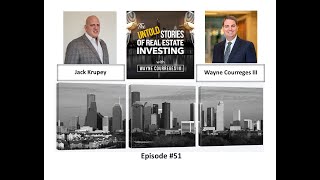
Interview episode (Untold Stories of Real Estate Investing) featuring Jack Krupey, a 20+ year real estate executive and founder/CEO of JCAM Investments. Jack recounts his path from single-family investing to Wall Street loan-portfolio work (buying/selling non-performing and performing loans), then building a syndication-focused advisory business. He contrasts 2008-style residential distress with today’s housing shortage and strong mortgage locks, explains commercial pain points (bridge loans, expiring rate caps, refinancing stress, cap-rate expansion), and argues Class B/workforce multifamily is a resilient value-add niche. Jack and host discuss market opportunities (Houston, dollar-cost-averaging), tax advantages of syndications (depreciation, Puerto Rico relocation, 1031 rollovers), and guidance for passive investors on sponsor selection and diversification.
Chapters
Welcome to the Untold Stories of Real Estate Investing hosted by Wayne Courageous iii, a place where active and passive investors come to hear the good, bad and ugly of real estate investing. Our guests consist of experienced operators and investors who want others to succeed by sharing their stories. If you're looking to syndicate deals or grow your wealth passively in real estate, you've come to the right show. It's now time to sit back, take mental notes and enjoy next episode of the Untold Stories of Real Estate Investing.
All right, welcome back to the Untold Stories of Real Estate Investing. I'm your host, Wayne Courageous. Today I'm excited to have Jack Rupe. Jack is an experienced real estate executive for more than 20 years. He's the founder CEO of Jcam Investments, a company providing access to private advisory services for real estate and alternative investments. Jack focuses on investment and management of different asset classes. Previously a real estate broker, wholesaler, landlord and Wall street employee, he transitioned to offering passive investing opportunities to accredited investors. Throughout his career, Jack expanded his connections. Today, his vast network is composed of long term relationships with skilled real estate developers, sponsors and syndicators. Some appear on this podcast to share the valuable lessons from their own investments. Welcome to our show, Jack.
Wayne, great. Great to be here. Thanks for having me.
Yeah. So we've gotten to know each other through Raise Masters, which a lot, you know, several of our guests. For those that have been listening to our show, it's a great mastermind and we have great, great people and great professionals that have been in raised Masters. But tell us of your journey. How, I mean, you. We mentioned Wall street, wholesaler, broker, you know, sort of give us, give us your story up to this point. Sure.
So I graduated in 2001. I had an information technology degree. I thought I was going to be traveling the world as a computer consultant. I was really into the Internet and just the early stages of the Internet and 2001 was the dot com crash and there wasn't a lot of jobs. I was fortunate to have one. I didn't turn for a company, but instead of traveling the world, I was setting up small networks for small companies in Rochester, New York. And there wasn't a lot of other opportunities to grow at the time because there was hiring freezes everywhere. Um, so I went to Vegas. I think it was, it was like a month after September 11th and the flights were like $50. So I went to Vegas with one of my friends and I saw the glitz and the glamour and the money and it was just like, wow, what I'm Doing with myself right now doesn't seem like it's going to get me to where I thought it would a couple years ago. So on the flight home I bought one of those paperback books at Hudson News, how to how to Make Money in Real Estate, no money down and got back was I read it cover to cover and called my college landlord and he was a real estate broker and he owned a bunch of houses. And you know, a month later I had a house, no money down and then two months later I had another one and really kind of lived that infomercial dream. Started a, you know, got my license, was sending postcards out, all the traditional stuff. But I realized it was really difficult to scale and you know, built up a portfolio of almost 50 units and we were managing other people's units. The property management's a very thankful, a thankless business. And you know, after the credit cris of 2008 everything just kind of froze. And you know, this was Rochester, this wasn't Phoenix or Vegas or it wasn't really a boom bus market. But you know I wanted to, I'd always wanted to kind of do something bigger. So I moved to New York City and there were hedge funds that needed real estate people, people that had bought foreclosures, short sales and done all that because they were buying thousands of loans and they were Wall street people, they didn't know what to do with them. Yeah. So learn the banking side of the business and the bleeding edge of the financial crisis. I literally worked on Wall Street, I lived on Wall street also and my commute to the office was further vertically than it was horizontally.
I'm sure that wasn't cheap.
Yeah. Though 8 was probably the cheapest time ever to live down there. So learned the business there and then went on my own and ended up partnering with a small family office, bought a few million dollars worth of loans and we were buying and selling non performing and performing loans just on our own, running a small fund and then took a meeting with a, with a group of guys that hit me up on LinkedIn and I thought it was maybe a couple guys from Long island that wanted to buy five loans. It turned out it was a bunch of ex Bear Stearns guys that were restarting a fund after Bear Stearns collapse and we ended up over the course of five years, bought $3 billion of loans with them.
Wow.
So it was an incredible ride. I kind of backed into, you know, relatively high level Wall Street. You know, we were selling, we were buying directly from Fannie Mae, we, you know, had banking relationships with Goldman Sachs and Nomura. We did securitizations. I met one of the characters from the Big short who had launched his own bond fund and was actually buying the bonds of the mortgages we securitized. So it was a crazy ride. But I was, I ended up, I was miserable. I was making more money than I ever had in my life. But it turned into that Wall street grind. And you know, I got into real estate in my, you know, when I was 21. I got in because I wanted passive income. I wanted that, that, that lifestyle and that flexibility and you know, I'd sort of, you know, got, got onto this different path and on top of that I was in New York City paying 50 tax rate and it was all active income at that point. So eventually I left the firm and I really dove into taxes, I really dove into just tax efficiency. So I ended up leaving the firm as an employee, but I still owned a piece of it. I moved to Puerto Rico and I'd been investing in syndications passively and I just realized the tax benefits of it. And once I'd moved and eventually got bought out, I had a pile of my own money that I was investing into syndications anyway and I really formed this business around my personal investing activities.
Nice. So lot to unpack there but I really want to talk about these non performing loans and that experience that you had back in 0809 into how it translates today. You know, we, we are seeing a little bit more distressed properties. There's a lot more news, you know, that people are reading, especially passive investors that may put people more on the, the sidelines than they had been previously. What's your take of what's going on, going on now compared to, you know, back 0809 time?
Sure. There's two parts of it. There's the residential side and the commercial side. I'm going to start with the residential side and that does somewhat impact the multifamily side as well. So residential is a completely different ball game than it was in 2008. Before, before 2008 there was a lot of residential loans that were in these option arms that were, you know, at, at a 6% teaser rate. But then we're going to go up to 8 or 9. The fact is now 30%, 30 to 40% of the US doesn't have a mortgage and the other 20 to 30 to 40% are locked below 4%. So roughly 70% of the population, give or take, has either no mortgage or less than 4%. And so there is a chronic housing shortage. Add to that, interest rates are high, construction costs are high because of inflation and in many markets just housing starts are down. And you read something about certain markets where maybe there's still some supply coming, but that's usually at the higher end of the market. If you're building, you're usually building kind of a class A, nicer building. And then eventually the ones that were built in 2005 sort of trickle down and become Class Bs. But there is a shortage and there's still a shortage of that kind of workforce, Class B housing. So it's really hard to buy a single family house right now. And a lot of people are just trapped. They have equity trapped. There's, it doesn't make sense for them to sell and they're just not going to sell unless there's a major life event. So I think for that reason a lot of residential I think is going to be stable. There were certain markets that maybe needed a few percent dip because of just the, you know, just going crazy in 2021. But you know, residential, you know, should remain stable. You know, with that said, there's always a certain amount of distress. There's always certain life events that happen and if there's a major recession and you know, there could be some people that are in trouble. But the other thing that's happened in residential that really wasn't there in 200910 is, you know, the banks are really incentivized to modify. There's programs in place and there's liquidity. If you, if you have a loan that re performs, you could sell it back to the bank six or 12 months later. So there's a real incentive to make a lot to modify loans and make them reperform both from, you know, the government regulation angle and also just the economy of just making it profitable. We actually made more money when we modified loans and resold them in most cases than if we had to take them back.
They're doing that. You're seeing that on the residential side, like single family.
Yeah, yeah. On the residential side. So yeah, if you would buy a portfolio of non performing and then you would do a modification and get the loan performing, you could, you could essentially flip the loan. If they paid for six to 12 months, you could sell the loan back to a bank or insurance company. So there was major financial incentives and that just, that industry wasn't really as, you know, 2008, nine. There had, hadn't really been a mortgage foreclosure crisis. There was a little bit in savings and loan, but that was on the commercial side. So pivoting to commercial, you know, I did mention that in some cases at least multifamily, it's going to prop up the, the, the, the single family lack of inventory in some ways props up multifamily because of the, the values. But multifamily has the problem with bridge loans. Now there's a lot of noise on that, but you also have to remember that there's still a ton of long term fixed rate debt. There were still a lot of family offices, a lot of private equity that just would do 5, 7, 10 year debt. So the percentage of bridge loan debt while it's making all the noise right now is, is not necessarily a contagion to the market. But with that said, I mean I'm in a few deals, we're in a lot of fixed rate, but we're in some deals with adjustable rate. And the pain is real on, on those loans rates went, you know, from practically zero to you know, five, five and a half percent. And when you add the spread on that, I mean it brought the real interest rate in some cases with if there was no cap to eight, eight and a half percent. Most people bought three year or two year interest rate caps. So we're getting to that point where the two year caps are expiring in mass. Those that had three years, you know, are often are going to happen sometime the next year and it's causing real pain. I'm hearing of capital calls and we've had one or two small ones and that's going to be a challenge. And it's also affecting cap rates. Not as much as the interest rates have moved however, but the cap rates have expanded and they needed to, if you have, if it's, if your cost of debt is 6, you can't have a 4% cap rate. So that, that affects the values and really it puts the operators in a bind because now is maybe not the opportune time to refinance and, or to refinance into long term debt. You may not have the proper debt service coverage ratio. So a lot of people, what they have to do is just raise more money, prepay a lot of interest to just extend these deals another year or two and continue with their business plan. So it's certainly a challenge. There's going to be, you know, we've seen a few high, high profile foreclosures in Houston and that was, there was more going on. There was the one high profile Houston deal where there was more Nefarious actions. It wasn't just, it wasn't, it was more to it. But what we're seeing is the good operators and we're in a number of deals with groups that have, you know, 50 plus buildings they own. The good operators have some leverage with the banks. There's an old saying, if you owe the bank a million dollars, you're screwed. If you owe the bank a billion dollars, they're screwed. And what gives me a lot of optimism is we are seeing that at least with our large operators, the banks are playing ball. They're giving a discount on the interest rate and adding a little bit of the spread onto the back of the loan and you know, allowing, allowing them to continue because rather than foreclose on 50 properties, if you will, which that could cause more of a contagion, I think, you know, the banks have come to the conclusion that a really strong operator that, you know, that's operating the building well and is just really caught up because of the capital markets is better to continue than the bank trying to take it over and do it themselves.
Yeah, the bank doesn't want to be the landlord. But you know, we, we mentioned bridge loan for the listeners that may not know what the bridge loan is. It is a variable rate loan that bridges from the time you purchase the property until you can refinance into more long term fixed rate debt. And so ideally a bridge loan would be a, an opportunity to, if you buy a, a asset that isn't performing to its highest ability, so you're buying maybe a deep value add type property and you're going in, you're renovating, you're changing management, you're doing the right things to get it back to, you know, stabilized occupancy, good revenue. What was happening during those value add period, bridge loans is you then refinance it into more stable Fannie Freddie type loans. The issue that was happening, two issues is because it's a variable rate, not all end rates are so low, not all operators got a rate cap. So there were, there were some, now they're, they're hurting quite a bit because you know, their, their rate cap is. There was no recap or the recap to Jack's point was expiring. The other thing, and we've talked about this a little on our show previously, was that bridge debt was heavily used during times when assets were priced extremely high. There was a lot of competition so people were buying overpriced assets that didn't have a whole lot of value add. With bridge debt and those operators are really, really struggling. So I wanted to, you know, I just want to explain what bridge debt is and sort of what, what we're seeing now. Now we talked about this before the show, Jack. This is the time for me. I'm bullish and man, Houston had that foreclosure and it's getting such bad rap. But Houston is booming and it is a great city. And when oil prices are going up, Houston does even better, right? It's a lot of, there's a lot more going on in Houston, just oil by the way. But I will say I'm bullish on buying. We've got a contract in Houston that we're closing in a couple of weeks. I love Houston. I love multifamily, I love what's going on. For me, this is the time to, to buy. You know, we're getting fixed rate debt off seller financing. We're able to, you know, buy assets 33% less than what is on the, you know, appraisal district. So talk to us about that. Jack, what are you seeing in today's market? Are you as bullish as me on, on real estate in this market? Are you more standoffish?
Yeah, right now I'm absolutely bullish. And then, you know, you need, you need to be, you know, aggressive when, when other people have, have challenges. A couple quick things. So Houston, there's a economist I fell in name, Peter Zeihan. He's got a great five minute YouTube video about why he likes Houston, why he's so bullish. It's the oil. It's also the petrochemicals and the plastics and all the off the byproducts. One of the largest hospital systems in the, in the country. It's, it's an all around great market that I'm very bullish on as far as deal flow. You know, dollar cost averaging is one of the most powerful things in investment. So especially to, you know, for, for both the active investors looking for really great opportunities, but also the passive. Maybe they went into one or two deals in 2021 and now they're, they're concerned or they're, you know, worried about, you know, maybe not getting the distributions. They thought if a deal works now, you need to continue dollar cost averaging in, because the deals we're buying now are in some cases at a 20% discount or more to where they would have traded at their peak in 2021. And so if a deal cash flows today with interest rates in the sixes or sevens, if the rates drop at all, there's significant upside. A one point rate drop could be a 20% increase in value if the cap rates drop somewhere similar. So it's really important to dollar cost averaging and then the new deals will cash flow day one. And overall if you're consistently building that pyramid and investing into, you know, whether it's multifamily, self storage, just all of the syndicated alternatives, you know, if you're consistently investing over a three to five year period, you know you're going to be building tax deferred income because you're generally showing a loss because of the depreciation. And then when you do take your, your capital gain or any recapture five years later if you reinvest in something else, you, you know, you could offset some of that. So this is the time to continue building that, that long term wealth and that long term portfolio outside of the stock market. Because look, the stock market at a 10 year period in this, in the 70s to 80s where it didn't do anything and that was the last higher interest rate period. So there's no guarantee that you get that 10% a year in your Vanguard funds. And if you, if you take the time to, to research and, and get more involved in this side of the market, I think it's, it's a very powerful tool for retirement.
I agree Jack. And one of my biggest regrets now I had just gotten out of the Marine Corps in 2007, started in commercial real estate with the CBRE there in Washington D.C. but I didn't have any money like it was, I was living in, I was Alexandria, Virginia living in my one bedroom and it was expensive. But those people that took advantage of that time who were set up for that time and bought assets when everybody else was running. So I have the mentality, you know, I'm not, you know, super, you know, knowledge comes with age and I've seen several cycles of ups and downs and recessions and definitely being in these different markets. But I just remember 089. I wish I had been more prepared but you know, just, it just is what it is in today's market I'm much better prepared now. Real estate's a risk. There is no crystal ball of what's going on, but so is stocks. And for me, you know, we, I try to stay diversified but I also put a heavy percentage of our net worth into real estate. Just the fact of social media the way it is today, like you know, one tweet, one thing going on outside of the country or in the country can really hurt, you know, stocks performance Whereas real estate, it's not, it's a physical, tangible asset that is serving a need that, oh, by the way, you have to pay your rent if you're going to want to have that basic need of shelter. So, you know, I just, I think overall around, I just am more bullish and, and I'm grateful, Jack, that people are not as bullish because it's better time for us as sponsors and operators to find good deals. So when I go to these conferences and people are like, they're not buying. I'm like, great, I don't have to compete with you like I did a year or two ago, which was crazy. It was a bubble feeling. People were putting in a million dollars more than what we were offering. And I'm like, how, how do you make those numbers work? You know, hopefully they're, they're doing okay still, you know, right now. But I just, the numbers didn't work, you know, a year or two ago. So. Anything more you want to mention on that before we shift gears?
Yeah, I mean, you know, there, there's, there's two different types I mentioned earlier, like the, the larger operators that have more wherewithal and that's, that's something I'm seeing right now as well. And you know, there, there's the, there's the people that clubbed up together, all went through a course together, raised a bunch of money. Those are the ones that I think got into a little bit more trouble. They don't necessarily have the balance sheet to make a capital call because it's like 20 different people with like 100k each. Whereas we, we had operators that have written seven figure checks themselves to keep deals moving. When their, their lender was not releasing the construction draws, they're writing a check themselves to get the project done so that it wasn't stalled while waiting on the bank. So there's a lot of the good operators. The ones that have the capital that are actually executing right now are the ones we want to be invested with. And the deals that are distressed are for a couple different reasons. We were recently involved in a transaction where it was actually Blackstone selling. They had to sell because it was part of their private fund and there were redemption requests. It was an open ended fund. So people are requesting their money back and it forced Blackstone to sell a good asset that they were not through with their plan yet. So it's still a value, still a bit of a value add. They sold it for 8 million less than they paid for in 2021 because they had to because of their fund docs. There's another deal which is closer to that example I mentioned to stay, you know, that, that, you know, we were fortunate to generally to stay away from where it was a, you know, just a syndication group of a bunch of people who went to one of the seminars and it was an asset. In Dallas, their interest rate cap expired and they cannot afford to cover the debt service now. So their choices were basically they had to sell because they couldn't raise enough new money to handle the interest rate payments for another few years. So similarly, we're buying at about 8 million lower than what they paid for it in 2021.
Wow.
So they're, you know, they're not going to lose everything, but investors will lose principal on that deal. And, you know, their, their loss is, is our gain. And, you know, with that said, if you have the staying power and you can last another few years, that, that same asset may have still made a profit. If, you know, if, if the investors had the wherewithal to just weather the storm and continue to raise, you know, renovate units, raise rents, you know, grow the net operating income, because that's still the most powerful thing. And, you know, the number one metric I look at is, you know, does the value add plan make sense? Will they renovate a unit and raise rents from 1000 to 1300 or, you know, a thousand to 1500? Because raising, raising the rent by $400 a month is almost 5,000 bucks a year. A $5,000 increase in net operating income can raise the value of the building by $100,000. To me, that's still the most powerful metric. And if interest rates move up or down another half a point a point, if, if we're in a recession or not, if, if that rent number is moving to that level, that's the one thing we can control. And that's what I really focus on, and that's what I preach to, you know, to almost everyone I talk to, is that, you know, if you hit that metric, it doesn't really matter what happens in the economy. If you're hitting that metric, you should be okay.
Hey, listeners, it's Wayne Courageous. I just want to pause real quick to say thank you for listening to our show. I hope that you're getting a lot of value out of it. If I could ask you to go ahead and, like, subscribe and share this podcast, that would mean a lot. It will get a lot of other investors like yourself learning about the process and the steps to successfully invest in real estate, either As a passive or an active investor, I also want to do a quick introduction of CR partners. I'm the managing principal for CRI partners and we started it back in 2019 with one goal to grow your wealth passively in real estate. We do so by buying assets in multifamily, build to rent communities and RV boat storage facilities and we do so in areas that have strong market fundamentals and also have strong partnerships with with other real estate investors such as ourselves. We personally discovered that passively investing in real estate was a really great blend for people that are busy like yourself and that you can invest passively in real estate and still reap the rewards of the returns, the tax benefits, et cetera. If you're interested in learning more about passively investing, check out our website. We do a lot of content through our passive investor coaching program, through our podcast, our blogs and just other information that we do on a daily basis. Check out creipartners.com again creip partners.com if you're interested in building the relationship and joining our investor club, there's a link there to to join. We'll set up a call and continue building the relationship with you. We're super excited to have that opportunity and I want us to get back to the show and hopefully again you're enjoying the conversation and look forward to connecting soon. Thank you. Well and, and I think I always like to look at like lessons learned and I never kick people when they're down because at the end of the day that part of this is timing of market, right? It's the risk. And you know there's, there's good operators that are suffering right now too. They're, you know, it's not so anyway I don't, I, I try personally not to like I said kick anybody down but I try to learn as much as I can to make better decisions not only as an investor for myself but as an investor who's or fiduciary to my investors. So a couple things I've picked up recently. One I am grateful we we bought a property last year Jack that did have a bridge debt and the bridge debt was based on value add but it was a three year bridge with two one year extensions and had a rate cap. So for three years. So part of that is I'm sleeping at night knowing that we've got time. But we also have two year, two one year extensions. Right. That's one. But two and I posted on social media about this about a week ago is that we're still seeing 10 to 15% rent increases. And the story behind that though is like we bought a property and we have a couple other properties like this as well where we bought way below. Well, we bought where the rents were so below market that the 10% isn't 10% above market. It's just getting closer to what market is. And so that's the story behind the bridge. And what you're talking about with value add is, you know, when you buy a stabilized asset and consider it a value add, it's harder because there's not, you're already leading the market in a more stabilized market priced asset. Right. Or you know, so from a passive investor side it's important to ask those questions about, you know, look at the comps like where, where are rents today at, you know, what property you're going to invest in? Where are the comps around? Because you can still see that 10, 15, that's where you're getting that 3, 400 plus rent on renovated. And it's doable in today's market because it's still within market comps. I know there's a lot of words, it's not like 400 more than what the market is because in today's environment that's hard because everybody's competing for occupancy.
So yeah, you're 100, right? We're, we're absolutely on the same page there. I, I will just add, I've seen some, I've had some articles sent to me and you know, we, we're, we're in a deal in Phoenix as an example. We're in deals in Dallas where you know, it's like top 10 markets where rents are declining and Phoenix will be listed up there. But it's actually the average or it includes the class A where class a went from 2000 to 1800 but that's the thousand to twelve hundred dollar rents are still going up 5%. So it really, you really need to do a deep dive. The statistics can really be molded to kind of whatever the clickbait is on the, on the article, but it really is, is, is market dependent and asset class and whether it's class, you know, class B or C. Yeah. And look, it doesn't mean that there's not certain markets where you know, you're dropping rent $20 because the occupancy across the street dropped and then they're dropping. So it's not completely immune. But you know, your main point is, you know, when you're, when you're buying something where rents are below market and that still happens across the board. It happens. There's still a lot of mom and pop owned. There's, there's also, there's buildings that had, you know, seven years ago got seven year debt and during this whole upcycle in 2021 where everyone else is buying to renovate some of those buildings just didn't have the budget. If you were in a syndication seven years ago and it was just a simple steady buy and hold and collect your coupons every month, you know, you're not going to necessarily raise money to do a capital call to renovate units to try to get into the game when that wasn't the business plan for the building at the time. So there's still opportunities that people just miss the boat and that whole, you know, run up in rents in 2020-2022. They're deals that families have owned since the 80s and they just haven't bothered. They just paint and carpet and you know, don't really push rents because they owned the building since the 80s. It's you know, either free and clear or they bought it for nothing back then. So those opportunities still exist. And that's, that's real estate. One on one at that point is just finding, finding a way to unlock value.
Agreed. No matter where. I don't time markets, you know, you just buy based on what knowledge is given at hand. You know, where interest rates are today, where are the insurances today, where taxes, what are those projections? Conservative. So the numbers work and this is a point you made earlier. The numbers work today. Imagine when rates and things to go down in the future, which they will. I mean there's cycles and history shows that there's cycles. Who knows how far it'll go down. I don't think it's going to go get back to where it was. But you know, if we look at forward curves, you know, we should, we should see some decline. One thing and then I want to shift gears here for the last 10 minutes or so is you mentioned class A's are going down. That's my issue with Class A. I mean I would love to show on my website and be a proud owner of 200 plus units that are 2015 or newer. I mean there's some pride owning a quality asset, don't get me wrong. But the concern I have for my risk profile for is that when we do go into recessions and new constructions coming online, we're seeing a lot of supply that's competing those rates and the occupancies tend to go Down. Now, if you talk to a class A operator sponsor, they're going to dispute what I say and I respect that, but that's just sort of what I'm seeing. I don't see that as much on B and C. If anything, the class A in a really bad environment are going to be moving into your class B and, and going down. So I, it's just a point you had made about, you know, class A's, you're not seeing the, the rent hikes.
Yeah, yeah, I agree. I think there's a couple things. Number one is you are competing with institutional and REITs and publicly traded companies in some cases. So by nature you're buying at a lower cap rate because there's, there's more competition, more liquidity there. You're, you're buying it closer to replacement cost or at replacement cost in some cases. And that new supply is generally class A. I think a lot of those tenants could be the tenants if rates drop, that are the ones that are buying a house as well. Not that class B tenants can't buy a house, but I think you're more likely to have, have those headwinds. And you know, I think the most important thing about the Class B, the workforce housing is you're buying below replacement cost. A 1980s, 1990s asset. You know, the location, it's usually replaceable because most of these cities have expanded out a little bit. So, you know, you have a great central location. You just cannot, there's, there's not going to be the new supply at that price point. So overall there's a number, you know, a lot of great tailwinds and a lot of great reasons to, to, to invest in, you know, in the class B assets. I think it's really the sweet spot.
Yeah, that's pretty powerful. We haven't even mentioned replacement costs. You just did. That's huge as well. So let's shift gears. As a passive investor yourself, but also, you know, a person who helps other people grow wealth in real estate through your funds. Talk to us about taxes. I mean, I, on conferences that I listened to you at previously. I mean, not everyone's gonna, you know, be able to just get up and move to Puerto Rico, right, for taxes, but would love to spend, you know, the next five, ten minutes or so sharing your experiences and what you see as benefits of investing in real estate from a tax standpoint.
And yeah, absolutely, it's super powerful. And you know, again, I took a pretty extreme step. I had the flexibility to do it, but, you know, it's something that I was surprised as I've talked to, you know, thousands of investors, you know, people making, you know, ranging from making seven figures a year to, you know, having built up, you know, a couple million bucks or more in, in, in funds and still working in W2, that it's more. More people than I thought, just don't really understand it. And even me, if you, if was, you know, I'd been in real estate, and all of a sudden I got thrust into Wall street and I kind of didn't know. I didn't even think about it because, you know, when I started in real estate, I really wasn't paying taxes. So the most powerful thing about real estate is you can show a loss through depreciation, which is a paper loss, while getting positive cash flow. Now, passive losses through real estate cannot offset, in most cases, can't offset your. Your W2 salary, although there's a few loopholes for that. But it is passive. So you can build. I mentioned building that pyramid. So simplest example is if you make a million bucks a year, if you're a doctor, make it a million bucks a year, and you have nothing else, and you just invest in real estate and you're making, say, 8 to 10% a year in cash flow, that's likely to be completely tax Deferred. You'll get $10,000 in your pocket, and your loss on paper may show a hundred thousand dollars. And then so for the next five years to 10 years, you're burning off that loss. Where it gets more powerful is most people that are making a million bucks a year have some other passive income. Maybe you bought one or two rental properties and you're earning 100 grand a year on your rental properties. But it's a pain. You're. You're already, you're busy with your work. You're working 60, 70 hours a week. It's not worth buying another rental property. It's not worth your time. Now, if you invest into a real estate syndication and you get that loss on paper, and often it's 70, it could be 50 to 80% of what you invest. So you take a $100,000 investment and you get an $80,000 tax loss. Instead of making, instead of having to pay tax on your rental property income, it's now wiping out that other income. And again, I'm not a CPA to give official tax advice, but the tax deferred income is very powerful. And one of the simplest things is if you own REITs, if you're in the highest tax bracket and you own REITs, you need to yell at your financial advisor because they're not doing a good job. Because REITs are taxed at 29.6%. Because REITs are not what's called a qualified dividend. If you own Apple stock, you're paying the 15% dividend rate. But REITs are going to be taxed at 29.6%, whereas a real estate syndication, you're going to show a loss. You'll have tax deferred income for pretty much the entirety of when you own it. And when it sells, there is a recapture and then there is a capital gain. However, that's typically, you know, capital gains is 20%. I think recapture is 25. This can get a little more complicated, but at the simplest level, if you reinvest your profits into another deal, you take another loss, and you could in many cases defer taxes until you're in retirement. And that's one of the more powerful things as well, because most accredited investors are, you know, say the average accredited investors in their 50s. Maybe you're, you're starting to think about retiring in five to 10 years. If you're in New York or California and you're at that 50 tax bracket and you're building up these losses. Now when you retire and you move to, you know, you move to Florida, you move to a state with no, no state income tax and these buildings sell in five years, your tax rate, you might pay 10% tax when it sells. The first, I think 80 if you make, you know, if you're showing a loss and you make less than 80,000, the capital gains is tax free. So there's a lot of efficiencies. It's the type of thing you really, if you're sitting down and figuring out your retirement plan, it's an amazing piece of your overall retirement plan.
Absolutely. And one thing too is if you have those other properties that are taking a lot of your time and you're looking to shift that into more of a passive, you know, you can 1031 that as well, so.
Oh, absolutely. That's a great point. Thanks for. I forgot to add that. And, and yeah, you can 1031 into a, into some syndications as well into larger syndications with, you know, very experienced management team. Generally, at least for the ones I'm involved in, it needs to be about a half million dollars in proceeds. But, you know, in many markets that could be one single family house.
Agreed. Well, as we close up here, a lot of great content. Thanks, Jack, for sharing so much what, what is one of your proudest moments in real estate investing and how can people reach out to you?
So I, I think the thing I'm, it's not just one moment but it's like what I, I, I've, I've got a lot of people into this business full time. I've always been an evangelist. So you know, in my 20s I got people into house hacking, buying, buying some rental properties, living in half. I got a lot of people into the non performing loan business early on because there was a lot of people pivoting from real estate. So when I look around now and can count the people that are supporting their family or reaching their retirement goals are, you know, I've learned the business that that's really, you know, what I'm most proud about. I'm trying to, you know, just as I've aged and I've kind of my interest have changed. Now it's about, you know, just helping people find that efficiency, the tax efficiency, the passive income, just the options that are outside the traditional financial system. I think far too many people are stuck in that stocks and bonds and index funds and just don't have enough exposure. The average family office or somebody worth 50 to 100 million has half of their money or more in private equity and real estate. Whereas the typical accredited investor that's maybe worth 1 to 10 million, you know, usually has 90 of their money in the stock market. So I want to change that. I want to help people, I want to provide more information and yeah, and our funds are built around, around that. I mean we've, our first fund, we made 30 investments in the syndications all within one fund. So the, you know, shameless plug here. But yeah, the value proposition is someone who's gonna, yeah, gonna put up, you know, if you have a hundred thousand and you want to put it into your first syndication, do you want to pick one deal? Do you want to say, okay, I'm going to put this just in a Dallas apartment or just in a, in a Jacksonville apartment? Or do you want that diversification across multiple groups that you know, I've personally vetted that I have my own personal money with. So that's our value proposition. And, and I'm really trying to build my own community as well. We have our podcast and Wayne, I'd love to have you on, it's called Alternative Investor Mastermind and we're on all, I'm on social media, Facebook, LinkedIn, just personally as well as our JCAM Investments page and we have a Facebook group for alternative investor mastermind encourage people to reach out. We do have a number of ebooks and guides as well. So a lot of free content that we, we're happy to send. So you know, reach out. We love to network.
Yeah, sounds great. We'll put those links in the show notes as well. Man, we could have gone another hour on non perform. I wish we talked a little more about non performing loans too.
And we could, we could do it.
We could have kept it going. We do another one.
We, we could do it. We could do it again. We could do a multi parter or like part two. Happy to do it. All right.
Hey, thanks Jack. I appreciate you being on listeners. His contact information will be in the show notes and excited to see you at an upcoming conference. Jack, thanks again for your time.
My pleasure. Thanks. Thanks for having me.
That's all for this episode. We hope you subscribe, share and leave a review of the show. For more information about passively investing in multifamily apartments, check out Wayne's free ebook by going to C R eipartners.com forward/ebook. Also, follow us on Facebook by searching CREI partners. This was the untold stories of real estate investing.
More from Wayne

September 2026 Meetup: Investing Ahead of Growth: The Bryan–College Station Opportunity





May 2026 Meetup - Apartment Complexes & Passive Investors: Opportunities & Risks


March 2026 Meetup - Reading the Market: Economic Indicators Every Investor Should Know


February 2026 Meetup - Syndication 101: How CREI Partners Structures Deals for Investors

Build-to-Rent (BTR) Communities Explained: Why Investors Are Paying Attention