James Bohan - Passive Real Estate Investing as a Tax Strategy
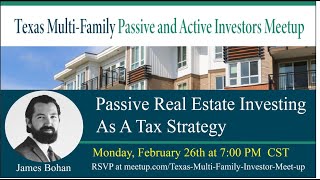
Recorded Feb 26 at the Texas Multifamily Passive and Active Investors Meetup, CPA James Bohan (founder of Stonehand) presents a practitioner-focused overview of real estate tax strategies for passive and active investors. Key topics: income classifications (ordinary, capital gains, investment), passive vs. active participation and material participation tests (500-hour safe harbor; real estate professional = 750+ hours and >50% of time), depreciation and bonus depreciation (cost segregation to accelerate deductions), depreciation recapture (Section 1250 and Section 1245 distinctions), entity-choice implications (LLC/LP, S‑Corp, REIT), opportunity zones (gain deferral to 2026 and potential 0% tax after 10+ years with substantial improvement), and practical Q&A clarifying recapture treatment and K‑1 reporting. Session also notes several numeric facts useful to investors (see topics/answers).
Chapters
Foreign.
Welcome to our monthly meetup, the Texas Multifamily Passive and Active Investors Meetup. I am recording this because we do make this into a podcast, our YouTube channel, and then use it as a recording for those that want to listen back to it. So we are here February 26th and let's get started. So if you haven't been on our meetup, it really is a place where we bring other service partners. Like today we got James Bowen and we've got, you know, last month we had Madison Specs talk about Cost Seg. We've got other syndicator sponsors that come as well. But really we just talk the good, bad and ugly of multifamily investing. One of the things I'm going to do differently this year we branched into like RV boat and business storage. And so we're going to be talking a little bit more about storage in this meetup as well because the diversification I'm seeing is been really important. But anyway, all this to say active and passive investors, welcome to join and ultimately we try to make this journey a bit easier. Now we do meet on the fourth Monday of each month other than December and that's 7pm Central Time. We just finished our networking breakout groups and then we'll do our guest presentation shortly and then our Q and A networking event. So a little bit about myself. I'm based here in Central Texas. I lead the lifecycle investor relations for CREI Partners. We are focused heavily on value add, multifamily and RV boat and business storage in Texas and the Southeast United States. We are buyers. We are not sitting on the sideline Right now there's a huge opportunity to buy properties now. It's a bad time to sell or for those properties that are struggling know not a good time to sell. But for us and buyers and our investors work super bullish right now. You telling my voice like I'm super excited about things ahead. There's some really great opportunities that we will be purchasing over the next year, hopefully having y' all as investors or co partners with us as well. We've got 37 million assets under management, Texas, Louisiana and Alabama currently. I worked for a CBRE, a Fortune 150 company previously and now full time on our real estate investments at CI Partners. A lot of experience managing capital, renovations, development and repositioning. Check out our podcast the Untold Stories of Real Estate Investing. And we actually are shifting from that. I'm going to start doing weekly updates personally on that podcast, but we're going to be shifting to an entrepreneurial podcast very soon. We also have a book that's about to be launched in the next month or two, so more interesting content. Good stuff. Coming soon. All this leads to creipartners.com so if you want to read podcasts education, look at our past investor coaching program. Whatever it is, check out Creipartners.com all right, enough about me and our meetup. Let's bring in James Bowen. So he is a multifaceted CPA entrepreneur and real estate professional. As the founder of Stonehand, he provides accounting, tax and fractional CFO solutions to real estate businesses, funds and syndicators. With more than 15 years of experience, he brings a wealth of knowledge in analyzing real estate transactions, tax structuring, creative financing techniques and working capital management. Then the real estate investment management industry. James is well regarded for his deep understanding of the complexities involved with a multitude of investment assets and complicated organizational structures. Between 2010 and 2015, James earned his California CPA license and was admitted to the Dolinger Master of Real Estate development program at USC's Sol Price School of Public Policy. He earned his Master's in Real estate development in 2015, graduating the top 5% of his class and achieving an honorable mention for outstanding performance on the KPMG performance on the final comprehensive examination. Excuse me all. While continuing to work part time for kpmg, he focused his undergraduate studies in real estate, finance and international business, earning bachelor degrees in both accounting and Business Administration from usc. All in all, just a incredible resource that we have at our fingertips here. I'm going to stop my share, turn it over to James and go from there.
Thanks Wayne. Can everyone see the screen now?
Yes, we see it.
Okay, great. So yeah, thanks for hosting me Wayne. I'm going to give a little presentation over real estate taxes, a little overview over taxes in general. Here's a little disclosure. This is not tax advice. Tax advice costs $1,000 an hour. This is just general information. A little bit about me. Wayne Touched on a lot of it at Stonehand is a CPA firm and a small family office. I've been a CPA for 12 years. I'm a fourth generation real estate developer, born in Orange County, California. Grew up in Las Vegas. Spent my time working for a firm called Rosten Cast with Abhishek who's on this call here and that firm got bought by kpmg. I went and became the CFO of a debt fund at 30 years old, did over a billion dollars of transactions, onboarded over 1400 investors and then I have 3 degrees from USC and now I live on a farm in Idaho. So there's quite a few tax advantages for real estate. The real estate association and lobby is one of the biggest lobbyists in the world. In the United States that is. And so they lobby really hard to keep the tax rules favorable for the real estate industry. A lot of Congress members and politicians own real estate as well, so they don't want to ding their own pocket. But from a high level, outside of that political framework, we won't operate in. You know, real estate benefits from having favorable capital gains tax rates. When there is the sales, when you hold it, there's depreciation, sheltered tax, cash flows. What that means is you might get $1,000 in your pocket, but the K1 might show a $500 loss if you refinance the property instead of selling it most of the time.
Okay, no, this is, this is not for coloring.
This is not for coloring. And the other advantage is those debt finance distributions is when you can take money out of a property, monetize it without a sale, but take money off the refinance, that's tax free. And then I'll touch on opportunity zones which came in the TJCA and the last tax bill that was passed, well, six years ago. So starting from the beginning, there are so many different types of taxes out there. And even within income tax there are so many classifications of income. So on your income tax side, you can have ordinary income and that could be passive active material participation, we'll get into later. You can have capital gain income and you can have investment income that's really your, your stocks, your bonds, your interest, your dividends. There's then payroll and self employment taxes. When you're a business owner, you pay self employment taxes on the money that your business makes. If you're a W2 employee, you pay, you know, half of the half the total payroll taxes out of your W2. There's sales tax, there's property tax. I know there's a lot of people here in Texas that don't have state income tax, but they have large property tax bills. There's foreign tax, there's international tax. Foreign being if you invest in say Mexico, Mexico are the task. International means inbound to the United States. There's foreign investors, real property trades act, there's effectively connected income. And then beyond that there's state taxes. Not in Texas, although apartment syndications do pay a gross receipts tax. And there can be city taxes, New York City, Los Angeles city, half the cities in Michigan have their own taxes. So there are a lot of taxes out there and most of the time taxes are going to be your number one expense in life. Divorce, maybe number one, maybe two, but it's up there. So here's just kind of your, your current maximum tax rates. Corporations pay 21%. It's graduated. These are all graduated for individuals as well. At 37% max. The self employment payroll taxes I mentioned is 15.3%. That's up to the $168,000 Social Security limit. If you're self employed, you can take a deduction for the employer side. It gets it to a lower net effective tax. There's investment income tax that applies on interest and dividends. Also if you're passively invested in real estate, this is a tax that kicks in at certain income threshold levels. There's the additional Medicare tax. If you make too much money in this country, you need to pay for everyone's mental health. That's California's way they call it. This slide is coming a California background. So it's one of the highest tax states that can be at 12.3% up to 13.3%. New York's I think a little higher. Once again, you're all in Texas, you don't have to worry about that. So now types of income again, you know there's ordinary, that's called trader business. This is also your W2 wages. There's the interest, dividends, rents from real property, capital gains. And then they're all, even capital gains have different tax brackets for them. Collectibles, which is like gold coins is 28% and then within the capital aims is this thing called 1231 which is sales of business assets, which, which is technically what most real estate sales are. And these are all going to be broken out on the K1 you get when investing into a real estate syndication. When you're investing in real estate, you know, you want to understand what kind of income you're going to get. So there's this idea of are you a dealer or an investor? And you know you can be a passive investor in a syndication and this, this test is going to be applied at the syndication level. So for example, a dealer is a guy who buys a plot of land, builds condos on it and sells all the condos off. He's in the trader business of like making widgets, but the widgets are homes. So this is considered ordinary income and it's not eligible for capital gain. When you do what Wayne does, when you buy something for a long term hold and long term appreciation or you build something and you hold it for over a year, then you can get long term capital gains treatment from selling that. And that's where the, this idea of dealer versus investor comes in. So now we kind of get to this idea of passive versus active. And once again, interest and dividends are not considered passive income to the irs. Even though you as an investor will think that's kind of the most obvious investment income thing there is, those are considered investment income for these purposes of, of classifying the statuses your investments can be. Now, passive losses can only be offset by passive income. One of the great things about real estate investment is that you get a lot of that depreciation coming through to you on your K1. And unless, and we'll get this in a second, you're a real estate professional, you can't use those real estate losses to offset your other income to unless you have passive income. So if you're in multiple syndications and some are selling and triggering that passive capital gain, but you're investing new money into new deals, you can get into this cycle where you'll have realizations of, you know, large capital events coming out to you. It will be taxed, but if you reinvest a lot of the money to the extent we still keep bonus depreciation, you'll have this cycle where your passive losses will be offset by passive gains as the properties start to sell. There are other passive investments you can make also. If you are a seasoned business person and you're at the point where you can kind of step back and quote unquote, retire from your business, there are ways to take your, your ordinary business, whether you're a doctor or a CPA like me, say hey, I'm retiring, but I still own the profits of the business and try to get that classified as passive income. Then you can use all your passive real estate losses to offset it all and then once again pass rentals. Also get hit with the 3.8% investment income tax when you're in the really high tax brackets. So to break it out a little bit more, there really comes down to four distinctions of how you participate in an investment or a business activity as these are really described as. So it comes down to four passive active material participation, and then real estate professional is another sub designation of material participation. So passive. That's very easy. This is what's called like LPs in this because the traditional structure has been in limited partnership where there's a general partner who takes on a liability and a limited partner who has no liability. This does that. Language doesn't technically apply in the parlance of using LLC from a legal perspective, but people still use the parlance in the same. So if you're a past investor in Wayne's deal, you invest the money, you get a K1 that's all passive lost to you. Now let's say, let's talk about this active scenario. This active one usually comes up as like, hey, I own a single family home with a property manager. I work a day job, but I work with the property manager to oversee management. I approve the tenants. I do a little bit more than just nothing. So under this threshold, you can have your losses up to $25,000 a year. Under this active kind of participation status, you go one step further and this is where you get into the material participation. Now you go from passive to non passive. Non passive losses can offset non passive and passive income. So non passive losses are, are, are amazing. And the gold thing to get if you're, if you're trying to offset active or other non passive income, this really comes into play. If you're running the business, there's a seven factor tap test of which the safe harvest says if you work over 500 hours in a, in an activity, you're deemed to materially material participate. And then you get all those deductions, income expense as non passive. And then there's one more step above that and that's where you're a real estate professional. And the, in the stringent tests get a little bit more severe there. Once 500 hours, you have to spend over 750 hours materially participating in real estate trades or businesses. And you have to spend over half of your time doing real estate. So me as an accountant, if I'm spending 60% of my time doing CPA work, but 40% of my time doing, you know, real estate development, I'm not going to qualify as a real estate professional. So that's kind of really the distinction of all these different words that you hear. Passive, you're active. It's very nuanced. And this is kind of very a high level overview here. Yeah. Kayoko, do you want to ask a question? Question right now?
Yeah. So I've been wanting to ask this question for a while. So material participation is 500 hours. So to become real estate professional, is it 500 hours plus the 750 or 750? The 500 is already included in that 750.
The 500 is included in the 750.
Okay, great. All right, thank you.
Good question. By the way. So now we keep talking about this and why. Well, the reason is because depreciation. So depreciation is a phantom expense. You always hear this idea of phantom income which can trigger if, like you get a loan forgiven or there's more taxable income than there is cash because you're making larger principal payments on a property, which can happen, but it's a phantom expense in that it's not a cash expense. You pay for the building, you pay for all the components of the building and then you're able to depreciate it over their given IRS lives. So one of the great benefits that we'll get into next slide is bonus depreciation. But when you buy a property, you're going to want to break out what assets are part of the residential building. There's multifamily as well, commercial, self storage, retail, office. Those are all recap. Those expenses are recaptured, depreciated over that time frame. When you get to fnaf, which is furniture and fixtures, it's appliances. If you're putting in new dishwashers or you put it in laundry units to properties, those are all, you know, five to seven year life land improvements, which is like your asphalt, your paving, that's 15 year life. Now these assets that are able to be identified outside of the building, they're able to be eligible for bonus depreciation. And in the past, that's been the case where you can take 100% of the deduction in the first year and then we're in the middle of changing it potentially with Congress right now it's set to phase out from 20% a year starting last year. But the House passed a law that says retroactive to 2023 and 2026, we're going to bring back 100% bonus. They passed that about a month ago. Now it went to the Senate. The Senate had it, you know, to look at, to review. They didn't really touch it. They voted on sending more money to Ukraine and Israel before they took a vacation. They're back in. They're back to work this week. They might vote on it this week. But this is something that will affect your 2023 taxes potentially by getting more deductions out of this. So that's kind of the current legislation. Overview further on bonus depreciation, you might have heard of this thing called a cost seg before. That's short for a cost segregation report. And like I said before, that report will segregate out all the asset types in the building. So let's say hey, you know, 5% of the building was for the FF and PPP and E, there was a lot of paving. So 20% land improvements and then the rest of buildings. So when you do those reports, your the main goal is to find out what can be bonus depreciation. And then even if bonus depreciation goes away, it helps identify how fast you can get some of those expenses back. Like with the appliance and stuff, the five to seven year stuff, you can start taking those deductions over five to seven years instead of the longer 39 or 27 year building life. So what is taxable income? You know it's not if you get cash in your pocket, the taxable income? Well, it depends. So let's say a property has positive income after expenses and depreciation reducted for rental revenue. Then after depreciation there's still positive income. Then yes, that's taxable income. What about partnership makes quarterly distributions to you? Maybe if in the scenario above they have more income than expenses as positive income. But if there's so much depreciation from the bonus assets or otherwise, if you receive cash in your pocket and a basis in the asset, which is a little more technical thing, then no, getting that cash is not going to be taxable income. And your taxable income reported will be reported on a K1 when you get the K1, like I said, it'll show up. What's ordinary income? What's rental income? What's the capital gain from a potential sell? It'll also show on the schedule what your distributions were. So you can see on your schedule you might get a $3,000 distribution but a $10,000 write off. So some more ideas of what's taxable income. Let's say you foreclose on a note and take title to secured property. Is that taxable income? That, that's another maybe. It depends on the basis if you get anything or if you just basis transfers over if your loan gets forgiven most of the time, unless you meet certain exceptions, which there are a lot that's considered cancellation of debt income. And so that's kind of like a phantom income where you're getting relieved of a liability to pay something back, but you owe taxes on it, but you didn't get the cash, you just don't have to pay the cash back, but you owe taxes back on the cash you don't have to pay back. So another example of phantom income, say the property owning an LLC refinances the property and sends a distribution, like I said before. That's not taxable income. A question I've got before. Is a deduction allowed for capital reserves? No, that's just basically putting money in a different pocket. Once you pay for those capital replacement and expenses, make the repairs, that's when those amounts become deductible. So kind of outside of that, going to go through a little more a couple basic tax things. And this is to explain why you're going to see everything really held in a partnership. So corporations used to be subject to the highest tax rates. They also have double taxation where once the company makes a profit, it pays taxes on that. And then once the owner of the corporation receives the money, they get taxed on that dividend. That's why you hear people saying there's double taxation in corporations with partnerships. This is partnerships for tax purposes. They're usually. So LLCs are usually partnerships, but LLCs can be anything. They're a great structure that way. LPs, limited partnerships, I mentioned before, limited liability partnerships and limited limited liability partnerships. And, and the latter two are usually used for professionals, architects, lawyers, accounting firms. And so the way to think about a partnership is that it's two more than one individual coming together. So the way the tax code is really written is that it's like if Wayne and I are individuals and we go out and we do business, everything's been reported on our own returns. The IRS's view of that, okay, these two people are in a partnership together, but their share of the assets and expenses should be reported on their personal tax return. It's the. If you can understand that and read the tax code, it starts to make a lot of sense. The way they set up the rules for partnerships. S corporations are kind of like a hybrid with corporations and partnerships. They borrow a lot from corporate tax law with regards to things like building gains on transferring assets out. They have limits on who can own them. They do have some benefits, particularly for operating or management companies with the LLC's LP world, like I said, it's a pure flow through. So all any activity that's from self employment will come through an LLC or an LP as a self employment income tax and be hit by that 15% I mentioned before. With an S corporation you're able to split that up a little bit further. There's REITs. These are corporations that are also another hybrid sort of thing where it's a corporation, but so long as they pass out all of their income as dividends, then they don't pay taxes. They don't pay that corporate tax. It's a nuance with REITs. So if you invest, invest in a REIT, you're going to get dividend income and capital gain income rather than a pass through of rental income. This has ramifications of for a lot of things such as 199A deductions, the income won't be considered passive anymore. So you have a passive income you want to write off. You don't want to use a REIT because that'll give you dividends, not passive income. You still do get depreciation sheltered cash flows because the REIT will take the deduction and you only get the dividend on the taxable income. There are a lot of reasons why people use them. They help block state tax filings for the end user. There's a lot of new rules with what's called pte pass through entity tax on the state level. I'll touch on that towards the end here too. So anyways, that's REITs. Other structures, there's a million. There's a bunch of different types of trusts. There's land trust you can use to buy real estate anonymously. You can have an attorney set up a trust and only the the trust name is on the paperwork. There's Dynasties Trust where if you want to start getting some assets out of your estate, if you've invested in a bunch of syndications or own a bunch of real estate, you can set up a dynasty trust. Get the appreciation out of your state that way. There's grantor trust, there's revocable living trusts. A lot, a lot of them are the basic trust that almost everyone should have to avoid. Probate, the general guidance that says everything owned by a trust at the end of the day. And then that way you can have your trust document say where things should go when you, when you pass away. And then lastly there's tax exempt entities. So pension funds, IRAs, 401ks, all that kind of stuff. If you have your own self directed IRA or 401k you're able to invest in private placements like real estate, which is great. So a little bit more on REITs. This is if you are investing kind of through the stock market. A lot of private equity funds use REITs in their, in their structures as well. For some of the reasons I mentioned. It is a tax efficient entity as long as dividends are made to cover the taxable income. REITs have more rules to comply with being a REIT. They must have a significant amount of assets in their income come from real estate. No more than 5% impermissible tenant services can be allowed. In the world of self storage, that could be. I've done a lot of analysis of this for pension funds. But if you have a self storage thing and you have a store on site selling locks and boxes and stuff, that's not real estate income. So there are ways to structure around that. But that's just kind of the idea there. And then REITs don't allow dealer properties. So that idea of building condos and selling condos or building homes and selling homes won't work. For a reit, everything has to be held for at least two years, otherwise it's considered a prohibited transaction and subject to 100% tax. So this is kind of a chart of how most syndications or real or any real estate investment really gets done. So you'll have your propco here or the deal entity, LLC as I'm calling it. Most people use LLCs these days. Some people use limited partnerships. If you have investors from Canada, they have a weird thing about LLCs. So you still see them out there. So the investors will come in. This is the idea of the lp, the limited partner. Technically they're called a member of the llc and usually they'll have a manager or a managing member. There's legal nuances and I'm not an attorney, so don't ask me about that. But the. I keep clicking it, but the promoter entity is the S Corp, LLC or lp. And then the promoter, Wayne, in this area, the syndicator is here. So he'll be the manager of this entity, be authorized to manage it, buy the property, open bank accounts, and generally just conduct the business and oversee it. Send distributions to the investors and take the fee income that they agreed to for running the deal. One thing that came out of the last tax bill was opportunity zones. This was a really exciting thing six years ago when it happened. But they're still around and people are still doing them. The benefits used to be a little greater because they actually reduce the capital gains tax you would pay. But that, that game is out the window right now. So what you can do now is if you have any capital gain from anything that can be Bitcoin, stocks, real estate, you sold some gold, you can invest the gain money into an opportunity zone and get certain benefits. This is different from a 1031 where if you sell a property, you have to invest all the proceeds, principal and gain. Here it's just the gain that can be invested. If you invest in opportunity zone, you can defer tax on that capital gain you triggered until 2026. So you get the time benefit of money there. If the new opportunity zone is held for over 10 years, the new investment pays zero tax on the sale. This is insane. It's very rare in the tax code that you'll ever say they completely eliminate the tax on something. This was, was very exciting and something that's still going on. And you have until the end of 2026 to invest in one of these opportunity zones and then it goes away. And then one of the other things is you must substantially improve the asset. They don't want people investing in these impoverished areas and just letting everyone do the work and riding the lift. You must invest at least 100% of the building value that you buy in order to qualify for all the opportunities and benefits. There's a lot of nuances on when, when you can get all of these, but this is a high level benefit. Like I said, the tax code is set up to invest in real estate. And this is another great example. So that kind of concludes my high level overview of real estate taxes for passive investors. We can open the floor up to Q A here.
Great job, James. A lot of information. We have plenty of time for Q A. If y' all want me to read out your questions, definitely put in the chat box or I believe you can raise your hand and I can. Or James can call on y'.
All.
There is one question here. What were those acronyms? It was like FnF.
Okay, I see the chat here. Yeah. FF, PPE, furniture and fixtures, Property, plant and Equipment. It's just anything that if you put a new biking stove in, if you like I said, you put a washer dryer or you put appliances into a building. That's usually where the FNF will be seen. It's your personal property. That's a distinguishing thing between real property and. That's when you're able to use the bonus. Depreciation, depreciation recapture and how this is taxed. So thank you for mentioning that. It was a bullet earlier. It kind of skipped over it. Depreciation recapture is also called section 1250 recapture. The idea is that if you've depreciated a building over time, $100,000 when you go to sell it, the IRS looks at that loss that you took before and requires a recapture. Not exactly at ordinary tax rates, they apply a 25% tax to that. So it's a little more than the capital gain, a little less than the highest ordinary income threshold, but it's still over or overly advantageous. It's Just something the IRS catches up with at the end to kind of even out the fact that you took deductions along the way. Outside of a 1031, can you reinvest or do something to avoid recapture? The only other way I've heard about that is with the opportunity zones. So the new investment you hold, if you sell it, like I said, that's a 0% tax on it. And the way the IRS technically explains that is that if you've held your new opportunity zone investment for over 10 years at the time of sale, the basis of the asset, and so the basis is what you pay for minus depreciation, high level, the basis of the asset becomes your sales price, which is insane. So 0% recapture, 0% capital gains tax on an opportunity zone investment. That's the only one of the other ways I've seen to avoid recapture.
We have a hand raised in the, in the audience if you want to go.
Sorry. So about depreciation recapture. So I read that if it's not a straight line depreciation, you can't do depreciation recapture at 25 or 28 or something like that. So if you do cost segregation, can you still do depreciation recapture 25% or does it become ordinary income?
My understanding, and let me double check this with you to make sure that it changes that depreciation real capture is still capped at 25%. Okay, I, I haven't seen on a K like because how it works is on a K1 you're going to get things as 1231 gain, long term capital gain, short term capital gain and then section 1250 recapture. I haven't seen that section 1250 recapture be broken out between long term capital gain in short term or not other recapture. But it could come back as a line too. We have another tax partner in your Abhishek. Do you, can you help me out here?
Yeah, so, so like you mentioned, if you do a cost study, then you have assets which are not real assets. So a recapture related to those assets is a 1245 recapture and that will be taxable at ordinary rates. But when you sell building and land, that's a 1250 recapture and that's taxable at 25% rate. So to answer your question, there will be ordinary recapture as well, depending upon if there is sale of ordinary assets, which is not real assets.
Right. Those ordinary assets are the FF and E. And then Abstract, how is that report on the K1, does that come through line two rental or. I haven't seen a section 1245 recapture on a K1 before.
Yeah, it just goes to line two.
Yeah.
Okay, thanks.
And then James, you have your screen the Investopedia. I don't know if you mean to or not.
No, was just trying to get the answer to the question.
Any other questions? Again if you don't want to read out loud or anything because the recording I can read it that way. James, while we're still recording for those that listen via audio, can you let us know how they can reach out to you because they may not have the slide in front of them.
Oh, good call. Yeah, James Bohan, I'm available@stonehand.com you can reach out to me via the website. There's.
All right, I'm going to stop recording and then we'll hang out in the group here for a few more minutes. But appreciate James, thank you for being on and all that you do for us.
More from Wayne

September 2026 Meetup: Investing Ahead of Growth: The Bryan–College Station Opportunity





May 2026 Meetup - Apartment Complexes & Passive Investors: Opportunities & Risks


March 2026 Meetup - Reading the Market: Economic Indicators Every Investor Should Know


February 2026 Meetup - Syndication 101: How CREI Partners Structures Deals for Investors

Build-to-Rent (BTR) Communities Explained: Why Investors Are Paying Attention