Jeff Greenberg - The Untold Stories Of Real Estate Investing - Investing in Student Housing
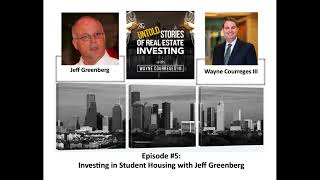
This is a transcript of a YouTube episode of "Untold Stories of Real Estate Investing" (host Wayne Courreges III) featuring Jeff Greenberg, CEO/managing member of Synergetic Investment Group (SIG). Jeff describes his path from single-family attempts to multifamily investing (since 2007) and an accidental entry into student housing (first student property ~2015). SIG focuses on value-add, market-rate multifamily, student housing and senior living; portfolio highlights cited include projects valued over $30 million, 800+ units historically and currently controlling over 300 student housing beds across Georgia, Arizona and Ohio. Key topics: comparisons between student housing and traditional multifamily (university-centric market analysis, proximity to campus/bar districts, higher turnover and turnover-related costs, bedroom-to-bath parity, marketing differences); COVID impacts (virtual tours, sanitation, leasing cadence tied to university plans, ~95% collections on semester payments); financing nuances (some lenders/agency loans exclude smaller schools); value-add playbook (renovations, furnished units, campus partnerships, Wi‑Fi, security upgrades); fundraising/JV strategy and advice for passive investors (focus on sponsor quality, reserves, recommended books: James Kandasami’s Passive Investing in Commercial Real Estate and Brian Burke’s The Hands-Off Investor); and a humanizing anecdote about rehabilitating a troubled Georgia property and improving residents’ lives.
Questions this video answers
Since 2007.
Projects valued at over $30 million.
Consisting of over 800 units.
Currently controls over 300 student housing beds in Georgia, Arizona and Ohio.
About 95% collections (semester payments and monthly payers).
Chapters
Welcome to the Untold Stories of Real Estate Investing hosted by Wayne Courageous iii, a place where active and passive investors come to hear the good, bad and ugly of real estate investing. Our guests consist of experienced operators and investors who want others to succeed by sharing their stories. If you're looking to syndicate deals or grow your wealth passively in real estate, you've come to the right show. It's now time to sit back, take mental notes and enjoy next episode of the Untold Stories of Real Estate Investing.
Welcome to the Untold Stories of Real Estate Investing. This is your host, Wayne Courageous. Today we're going to hear from Jeff Greenberg, CEO and managing member of Synergetic Investment Group LLC, also known as SIG. Since 2007, Jeff has been investing in multifamily and student housing assets in various markets throughout the United States. Jeff has been in multi family projects valued at over $30 million. Consisting of over 800 units, SID currently controls over 300 student housing beds and properties in Georgia, Arizona and Ohio. SID currently focuses on value add, student housing market rate multifamily and senior living multifamily properties. Without further ado, welcome to our show, Jeff.
Well, thank you very much. Glad to be here.
Yeah, so very impressive background. I'm sure there are items I missed. Is there anything you wanted to add to introduce yourself?
Well, I don't know, you did a pretty good job. The only thing is I kind of jumped from never doing anything in real estate into multifamily, even though we did try our hand a little bit in single family. I never owned a single family home other than my own personal residences and jumped straight into commercial real estate into multifamily properties.
So how did you make that jump or what triggered you to do it and then more so in student housing?
Well, the. We were looking in 2005, 2006 at single families and that wasn't a great time to be looking at single families. We were looking at REOs, you know, bank owned properties and the banks didn't know what the heck to do with all the properties that they had. So it just wasn't working out. It took too long for them to decide to accept our offer or not accept our offer and prices were dropping like crazy. So it just wasn't working in the single family realm. And so I jumped into multifamily, just happened to hear a guru talking about how you can get into multifamily with limited funds and jumped into it from there. Now, it wasn't for another, let's see, it was about 20002015 that I actually got into student housing. My first student housing properties coming up on five years. And how I got into it was total accident. I didn't have any plans on getting in student housing. I didn't know anything about student housing. But I had an intern that was looking for properties for me that we could close on. And he brought me this one property in Oxford, Ohio, at Miami University. And when he kept saying Miami University, I kept thinking, oh, Florida. And he said, no, no, Miami of Ohio had no idea. And so I had to do my research and learn about the student housing, about the property itself, about all those different nuances. And that was my first venture into student housing and decided that I liked it, that it had its special. It was a special niche, and I did enjoy that niche. So we were looking for more than just student housing afterwards. But it just so happens that we did bump into some more student housing properties that, that we decided to go ahead with.
So when you're now looking at value add opportunities, are you looking at more stabilized or I should say when you're looking more for student housing projects, are you looking more for value add or stabilize projects? And then what, what markets are you interested most in right now?
Well, right now the big question is, you know, is are we looking for stabilized or, you know, more of the value add? And that's a big question right now with, with COVID out there. You know, a lot of people are kind of laying low, gathering up their funds and deciding which direction to go in the area of student housing. I'm still very bullish on it and I still feel there is going to be plenty of room to move on value add. The properties we're looking at that are market rate multifamily. You know, there's that big question of are we going to be looking stabilized, are we going to be looking more value or, excuse me, more stabilized property or value properties? Because with this Covid, it's a whole different. It's a whole different ball game right now. So we're looking very cautiously now as far as what areas we're looking in. A lot of what I've doing has changed. I've been syndicating deals for the last 15 years and most of the time, I mean, on all of those deals, I was the lead deal sponsor, but I was also the main, if not exclusive, fundraiser. And so I am not looking as much for right now for deals to acquire. I'm looking more at deals to become partners in. And I'm doing more in the way of Fundraising, we're looking at creating a fund that we would invest in as a JV partner into other deals. So what areas I'm looking at, I'm pretty much open to different areas around the, around the country. But I mainly I'm looking for some high quality deal sponsors to join up with and evaluate the area and the property once I choose a few deal sponsors to work with. So I'm pretty much open to different markets around the community, around the country.
And so right now you have the 300 student housing beds. Where are all those located now? And how has things changed since COVID hit, since you brought that up and more specifically, how has your operations and your efforts to lease up your student housing projects?
Okay, so I have properties in Ohio, Georgia and Arizona each within either a half a mile, within a block or the one in Arizona is actually two miles from a university, major university. And things have been a little strange. If I can just back up. One of the things I really like about student housing is it's very recession resilient, it may not be pandemic resilient. And that's something that all of us in this industry are kind of seeing that, wow, there is something out there that could harm us. So for most of the properties that we have, the summer schools are going to be online, which means typically we get a limited number of leases for the summer anyway. So that might be limited, but most of the schools now that we're involved with are going to have on site classes for next semester. They're going to do some modification as far as the schedule. And so basically we're back to normal as far as the lease up a little bit different. Some of the tours are going to be virtual. Some of the events that we used to go on campus and have lease up events, you know, sitting on the malls with people walking by our table and doing lease ups, that's changed to a lot more virtual. So we are seeing changes on that. As far as the amount of lease up, the leasing activity. Once the schools have announced how they're going to be behaving in the next semester, lease up activity has picked back up and is going as normal. The one thing that we are doing on some of our properties, making sure that common areas are cleaned more often, that we sanitize as much as possible the properties that do have management offices, we limit access and protect our staff. And do you know, typically the same thing that you would in a typical multifamily property is try to do more cleaning activities and try to do more Things online and virtual.
Yeah. And with the lease up coming up, how has your collections been since pre Covid and then during the time where things were shutting down on the multifamily side, we're seeing 90% or more receiving the collections, which has been good. Has student housing had similar success and collections?
Yeah, most of our, most of our properties are on semester payments and so most of that we've received at the beginning of the semester. Those people that we do have on monthly payments are still making their payments. So we're probably 95% on our collections on all of those. But as I mentioned, we expect summer to be. Even though they're going to have. Well, they're going to have online classes during the summer, so that may reduce our summer income. That typically has been a pretty small amount anyway, so that will cut into it a little bit.
So what are some of the similarities and differences between traditional multifamily versus student housing? I think with traditional and student housing, obviously the bed, comfortable, safe location, obviously to the university. But are there any major operational differences or the way you would underwrite student housing versus multifamily?
Well, let's talk first about the market. Typically on a regular multifamily, you're looking at the market, what's going on with jobs, diversity in the market, the age, median age, influx of population. Our focus on student housing is much more into the university population of the university, their growth, what their plans are. So it's a big focus on the university as opposed to the city. You're also looking at the distance from the university. The closer the better. Typically within a mile is best. You start getting outside of a mile range and you're going to start going downhill. Also, there's advantages to be within the or close by the bar district, where everything is in walking distance, where people can go and party and go to the bars and be able to walk back home and not have to worry about getting on a vehicle. So location is very, very much a key. As far as underwriting. The biggest issue on the underwriting is turnover. You may have turnover every year, and in my Ohio property, I think first year was probably 80% turnover, which is one of your biggest expenses. And so obviously that is something you need to look at and make sure you have higher maintenance budget for the turnover. A lot of people think that you have the higher maintenance expenses because of damage to the property and we have not found that to be true. Most of the time. Any of the extra damage that we see has to do with turnover. I mean, or the extra expenses, turnover and not so much damage. Damage is typically covered in the deposits, the security deposits. So we pull that out of there. So it's not that much. I mean, some examples of some of the damage that we see. You know, I've seen iron marks in a carpeting, wine stains on a carpeting. We get maybe plumbing calls coming in because there's a shot glass or there's a beer cap down the garbage disposal. Somebody leans a little bit too hard on a cabinet. Those things we get people forgetting their keys and deciding to kick the door in instead of, you know, getting someone to help them get in. We do get punched walls when there's some domestic thing going on, somebody gets mad. And busted doors, inappropriate items going down the toilet. I don't know that's that much different than a lot of our multifamily properties. But typically all that stuff is compensated as far as with, with the deposits we calculate all that and at the end we just take that off the deposit. But turnover, obviously that, that can be an issue. Now in my Georgia property where they don't have a lot of options as far as going other places that one, the turnover is much less because there's just not a lot, a lot of options. My Ohio property, there's plenty of options. There's a lot different properties. They could get closer to the school or closer to the bar district and so we'll see more turnover. So it just depends on the property. But that's your main difference. The only other one, the other big one is marketing. And that's going to depend on each property as well. My Arizona property, we spend a lot of money on marketing. We spend a lot of stuff with Facebook and Twitter and all of these things. Where. My Ohio property, that's all absorbed by my property management company, they do the advertising and that's all on their bill. We do pay a higher property management fee than we normally would on a multifamily property that's a little bit higher. But it all works out with the reduced marketing expenses that we don't have to pay. So it does depend from property to property, but those are important. The other thing is that we see a lot of, is the units themselves. You do see a lot of people that like a one to one parity on bedroom to bathroom. We do not share bedrooms, we share units. So everybody rents their own, has their own bedroom and they would prefer not to share a bathroom. So the better you can get as far as the parity of the two, the more advantageous that is. So that's one of the big things as far as what we look for close to the campus and as many bathrooms as possible.
Yeah, I like how you brought it from a macro standpoint on talking about location. I mean, if I was underwriting a property with student housing, the location would be very important, but I would also think about the surrounding, you know, city and all, and then just walking distance to those restaurants and bars. And of course, of course campus is important. So if I'm underwriting a student housing opportunity, you're looking at comp set for rental rates, I would assume maybe on a price per square foot basis. Would that be similar in student housing? When you're pricing your units?
We usually don't do it on the square foot. It's by bedroom usually. You know, I mean, like I said, we only have one person per bedroom, but we don't really look at what the square footage of the bedroom is. Also, you're looking at amenities. Most of our properties don't have much in the way of amenities. If you get to some of the other purpose built properties where they've got the pool and the media room and the game room and the exercise room and all that, for the most part we haven't gotten into that area yet, so we don't compete with them. So typically our prices are going to be lower than theirs. Also, the farther away from campus that you get, you know, the lower your prices are going to be. So most of our properties were not the high end property, but that's fine. We're going to get those people that can't afford the high end. An example, our Arizona property, there's some new units that have opened up near the University of Arizona and they're going for maybe $1,200 a bed per month and they're right near the campus and they have all kinds of amenities. Ours, which were just about at two miles away, we're very happy with $500 a bed. We knew that we're not going to be the high end provider, but we're there for those people that can't afford that. And we've got nice properties. It's just we don't have all those amenities and we're not close to campus.
So what are some of the value add strategies that you would go after? Is there reimbursement on utility billings? You talked about the amenity base. Have there been amenities that you've brought into your properties that have helped increase rents to grow your value? So what have been your strategies?
Well, the main, the main Thing that we've brought in is WI fi throughout, especially on my Georgia property where we. That particular property, we renovated the entire insides of the units. That one also we do. Those are all furnished. So we brought in all the furniture, we fixed up the units, we put WI fi throughout. We've made some little alcoves into little meeting areas. We put digital cameras up there to increase the security. We put security doors with a key fob entrance, upgraded the laundry room and gave people a safe place to live. When we got that particular property, it wasn't a safe place to live. People were. There was drugs going on. There was a lot of non students living there. So our value add was to provide the students with a safe place where they were comfortable. And that was, you know, pretty much our big, big value add there. And then teamed up with the athletic department to try to encourage them to bring their athletes over to the camp, to our property, which was a big advantage for them because it was close enough to the campus that the athletes didn't have to have an excuse that their car wasn't running or something, that they were within walking distance of the property. And so we got a lot of support from the athletic department, so making it safe and clean and showing them that we were on the same page as they were as far as providing for that clientele.
Do the universities give any type of incentives or any help or local tax? I mean, is there anything that's given to the student housing to provide that safe environment for students?
Not really. They're willing to advertise for us, you know, I mean, typically with their magazines, if we support them, if we pay for it, but for the most part, not the Georgia one. Yeah, we. We did get a lot of support from them. In fact, they sent their security guys over to our property because we were asking them to let people know that we were there and that they. That they approved of what we were doing. At first they said they wouldn't do it because they weren't able to fill up their dorms. And they said, well, until our dorms are filled, you know, we're not going to send anybody over to you. And then all of a sudden we found out that they weren't able to get their dorms ready in time. And all of a sudden they said, okay, well, let's take a look at it. And they looked at our property and we say, okay. The only thing they asked us to do was to put those security doors on where as a key fob entry. And they were happy with that. And the campus police actually patrol our parking lot. They come by as part of our patrol because we are that close to campus. And so we've gotten that joint cooperation with them. And then we do advertise with their athletic department, which gives us a little bit of an acceptance with the student population on that campus as well. So that joint cooperation. And then the mayor of the city came out to our open house and that helped things out. We've had a lot of the VIPs from the school come to our different open houses and events on our property. So that helped in that way. But as far as any kind of tax rebate or anything, no, we have, we haven't received anything like that.
So is there a certain distance from the university or a certain number of percentage of the of your residence beans students to be counted as a student housing?
I mean, typically we like properties that are 100% student housing. And as far as the distance from the property, that wouldn't really matter. I mean, except obviously you're going to be able to get more for your property if you are closer to the school or as I said, you know, to some of the other things like the bars and the city activities and stuff. But there's no official title that it's student housing. We do try to keep it exclusive, mainly because it doesn't always mix students and families sharing the same building. I know some properties that have tried that and you've got maybe students that are staying up late at night making lots of noise and then families with kids getting up in the morning and dogs barking and the kids outside playing doesn't always work too well. So we try the best we can. The only one that we have mixed right now is our Arizona property, which is basically 2020 standalone townhouses. And so some of the townhouses we do have families in, but for the most part we try to keep it as student. And we actually have one of them is an Airbnb at this point. But that's not really optimal. We'd rather have it one way or the other.
Have you found that financing student housing is different or more challenging than say, multifamily when it comes to long term agency debt or other sources of debt?
Well, there's different requirements and some properties are easier to finance through agency or, or through other means. There are some lenders that are more hesitant to get into student housing. We had one lender was saying all they wouldn't do anything unless it was a major percentage of grad students they didn't want to deal with undergrads we had others that didn't want to do student housing. They wouldn't do student housing. But there's plenty of lenders out there that will do student housing. Some have a limit as far as the size of the school. So I don't remember what it was, but I don't remember it was Fanny or Freddie that needed a school population of maybe 18,000. I was working on a school that had 15,000 so they wouldn't do it. So you need to find who will do the student housing. But it does, it does eliminate some people, some of the lenders. But there's plenty that will do student housing.
So it doesn't have to be student housing, just real estate in general. But what would you say is the good, bad and ugly of real estate investing for anybody that's looking at getting in there, whether that's an active side or passively investing with you?
Well, I think that real estate is a great way to diversify whatever you are investing in. It doesn't follow a lot of the other investment opportunities. It's an alternative investment opportunity. I think it's a great way to come in as either a passive investor or if it's something that you want to come in and learn as an active investor. It's an investment that as an active investor you put the effort out there and you continually reach out and work at it and, and you will become successful as a passive investor. I think it's a lot more predictable. I think it's a lot safer than I think the stock market. That doesn't mean that you shouldn't diversify and put some money in the stock market, maybe put some money in precious metals. But there's some great opportunities to expand your wealth through real estate and that's through all different types of real estate, multifamily, senior living, self storage. I'm a little bit hesitant on some of the other commercial aspects as far as retail and those. They seem to be going up and down as far as with the recession. But I know plenty of people that have made a lot of money in those. I just am more hesitant on some of those other aspects. I know a lot of people getting into medical offices or triple net properties if you want to protect yourself and just get a steady income. So there's many, many different aspects of commercial real estate. I just happen to like multifamily and student housing is just one aspect of the multifamily portion of commercial real estate.
And what do you think from the bad and ugly aspects? There's definitely A lot of good. But is there anything that you would say is, you know, isn't talked about very often?
Well, I think we're talking about it a lot right now with COVID This is something that hit a lot of people that they were not expecting, especially in the. In the student housing, you know, who expected schools to close down and send everybody home. That certainly wasn't expected. But I think the main thing is with any kind of real estate is to have sufficient funds to cover you in the event that something like this hopefully will never happen again in our lifetime. But it could happen in more of a local type of thing, whereas we've got a lot of acts of mother nature that surprise us. So I think be sufficiently funded as a passive investor. Invest with someone that's been through it before, someone that's conservative enough that they are prepared for the worst and conservative in their underwriting and estimations on what kind of returns are going to be given to investors. That's the big thing with real estate. I think it's a lot more predictable. I think you can bet a lot more on the jockey knowing that someone's been through a lot of experiences and that they're prepared for these different experiences. Unless you spend a lot of time analyzing different stocks and different companies. I mean, there's certainly people that are doing that that have spent a lot of time with the analysis. But most people in the stock market just kind of trust either mutual fund managers or some financial planner to pick your stocks. I think that real estate is a much more predictable way to build your wealth. If wealth building is what you're looking for, or getting into deals that are cash flow. I think the cash flow on real estate is phenomenal and its main thing is getting involved with an experienced deal provider or fund manager.
Yeah, I feel I was talking to someone earlier today and it was a little bit about that predictability where it's sort of predictable the stock market will go up, but then it's going to go down and it's sort of like what's your stomach? Are you okay with every 3, 4 years it dropping down with the expectation? Well, it's going to go back up in another two years. It is more predictable. Obviously, the pandemic, it's hard to predict. But I'm really curious on, you know, now that we've had this pandemic, hopefully in our lifetime it won't happen again. But that's always going to be in the back of our minds from now on. So is there anything we will do or you will do differently on an underwriting or do you think the lender reserves are going to be higher over the next couple of years? Or do you think once we get through this, you know, whenever that may be, it goes back to the way it was?
I would say lender reserves are not. Any conservative deal sponsor should have significant reserves anyway. If they don't have those reserves in the particular deal, then they need to have those reserves personally or for their business. One of the things that a lot of times people would ask, how much money are you putting in personally? And typically what I've done is my answer is I have reserves that I keep for all of my deals and if I had to jump in to help one of my deals off with some of my funds, I would prefer to do that and to have those funds kept on the sideline to protect all of the deals that the, you know, whatever one needed help. If I put a lot of money into each deal, which I may put some money into each deal, but if I put a lot of money into each one of my deals, I may not have that, those funds available to help out a deal that was getting into trouble. And, you know, that's the biggest thing is wherever you put it, if it's in each deal or if it's, you know, in reserve with your company, there needs to be money in reserve because with real estate, additional funds are going to solve most problems. You know, as long as you didn't get into a property that's just a total, you know, mess, you know, in a horrible neighborhood with, with no potential market going down the tubes, most of the time you can solve most of the things with a little bit of money. The main thing is getting into the deal, into a good deal, making sure that you're in the right market, you're in the right property and you're in there, most importantly is you're in there with a deal sponsor that has everybody's interest at heart and is going to do the best for the investors and essentially everybody involved.
Yeah, it's great advice and it's a good segue to. What do you think are some of the most overlooked aspects of real estate investing that can cause mistakes?
Well, first of all, the most overlooked is the deal sponsor. And that's why I said before that the fund that I'm going to be developing, I'm going to be mainly looking at deal sponsors and a lot of the deal sponsors, some great deal sponsors I've rubbed shoulders with at a mastermind where I've met James And a lot of other great people. Because a good quality deal sponsor is going to do good quality conservative underwriting. Now that doesn't mean that that's not something you want to look at anyway. But the most important aspect I feel is knowing who you're dealing with and who that deal sponsor is. That is number one, the most important thing. And I could trust their numbers a lot more than I could trust somebody else's numbers as a deal sponsor myself. I know there's so much you could do with the numbers that the unsophisticated investor, passive investor, is going to look at that and say, wow, that looks great. Those numbers look great. But if they're based on unrealistic assumptions, it doesn't matter. You can manipulate numbers all over the place. And I've seen numbers that are totally ridiculous that show a great return. Well, that's never going to happen. And if anything comes up to upset the boat, all of a sudden they're going to be in trouble. And that's why the experience and integrity of the deal sponsor is really so much more important than any underwriting criteria that you can come up with. The integrity and the experience of the person running the show.
Yeah, that's, it's really important. You mentioned James and you know, for those people that are getting into the industry or becoming a syndicator, it's important to write to partner with experienced deal sponsors to help get that comfort level from people like yourselves and others who want to see an experience sponsor who has that integrity, who's been through it before. So other things that passive investors need to know. You mentioned there's a lot of ways that a sponsor syndicator can change the deal to make it go their favor. How would you say passive investors should learn about those different levers and what places can they go to just to continue learning?
Well, first of all, we've mentioned James Kandasami and he has written a great book focused towards passive investors which has got some good information. And the other book that I would say which is a must read is Brian Burke, his book on the Hands off Investor. And you can get that one on Amazon or BiggerPockets. Those two books give you a great idea as far as what you need to look at as a passive investor. Now the biggest problem is you've got high net worth individuals. We may have a lot of those out there listening to this conversation that are busy that busy with their lives, busy with their businesses that they may be running, bringing in that income and they don't, they don't have the time to do all of those things that is required or you should be doing in order to protect yourself. So that's why there are people out there that provide that kind of service. That's one. You know, not to toot our horn, but that's something that we do is we're going to be checking out the, the syndicator, we're going to be looking at the underwriting, we're going to be looking at the market, we're going to be going through all of those details to make sure that we're interested in bringing our investors into it. And there's people like that that will do, do it for you or you get to know the syndicator and that's real important. But most. Most don't. Most don't. I could say that in the hundreds of investors that have invested in my deals, there have been very few that have really asked me the questions that they should have asked. They've gone through the PPM and read the details and read the details of the operating agreement and ask the proper questions. Most of them have done it out of trust with me and I appreciate that. And most syndicators will say the same, that they appreciate that they trust them, but that's their responsibility to find out all the details beforehand. Because once the boat has sailed, once you've invested your money, you know, you're there to ask questions. But for the most part, you know, you're not at the helm anymore and you're kind of stuck with the ride. So in the beginning, that's when the passive investor should be asking all the questions. They have that right and that obligation to ask all the questions, to inquire about what's going on and why is this number here and why is that number. And if it's somebody that doesn't have the interest, doesn't have the knowledge, doesn't have the ability to do all that, then they need to find somebody that can help them with that and not just go ahead and jump on in and invest their money without doing that due diligence. Their responsibility is to do that due diligence up front or get somebody that will do it for them to protect them. And that's the best way to protect yourself.
Yeah. And you mentioned a couple books. One was James Konasami's Passive Investing in Commercial Real Estate, Insider Secrets to Achieving Financial Independence. It's a great book. What was the other one? I'd like to read that one as well.
That's by Brian Burke and it's the hands off investor.
Hands off investor. Perfect. Well, very valuable information through this podcast on, obviously, student housing, but then a lot on the passive investor side. And I do agree, it's nice to have investors trust and they look at your success or your business track record. But they should be asking questions and, you know, whether it's through meetups or reading blogs or attending webinars, you know, the more information, the education they have, the more comfortable they're. They're making the right decision. So. Well, you know, as we typically close, you know, what are some of your proudest moments investing in real estate?
Well, I have to say that the proudest moment I had was with that property in Georgia. We bought it at 30% occupied. Well, 30% economic occupancy. There was probably about 48% physical occupancy. And we kicked out all the riffraff and the ones that were just not even school students. They were just hanging around and smoking dope. And once we renovated that property, we did a video. We were making a video to present to the athletic department because they were going to put our video on their Jumbotron during their athletic events as a advertisement for us as part of our sponsorship. And I went down there to do the videotape and my property management company did a video, and it was horrendous. But I have a little bit of a video background. So I went down there. I didn't let anybody know who I was as far as the owner. And I was interviewing these students and talking to them and asking them how they felt about what the new ownership had done to the property. And my last question was always, if you could talk directly to the owners of the property, what would you say to them? And there was a couple of them that said, thank you, thank you for. For creating a safe environment for us. And some of these kids were. They were living there prior to our ownership, but they were saying, thank you for making the environment safe. But this one girl went and said, thank you for creating an environment that I can bring my mom and show her where I'm living because she was too embarrassed to show her where she was living before that. And she said thank you, and she had me in tears. And I actually asked her if I could give her a hug. And we hugged. And it was a beautiful moment. And I think about that, that here I could go and run a business. I could make money doing the business, but I could also change people's lives. And that was probably one of the most moving moments that I've had with real estate.
It's a great story and love the idea of videotaping to hear what your residents think of what the changes that you're doing. Yeah. Thank you for sharing that. So what are ways that people can reach out to you? You had mentioned that you're interested in JV ing with other syndicators. How can people get to know you or reach out to you and anything else you want the listeners to know about you?
Well, you could get a hold of me by email, which is jeffsynergeticig.com that's S Y N e R G e T I c I g.com also my website, synergetic. Either synergeticig.com or synergetic investmentgroup.com either one of those will get you to my website and you could reach out and set up an appointment. We could talk or just send me an email.
Sounds great. Well, Jeff, thank you so much for your insights and your time to be on the show and you stay well and wish you the success in the future.
And thank you very much. Thank you all.
That's all for this episode. We hope you subscribe, share and leave a review of the show. For more information about passively investing in multiple multifamily apartments, check out Wayne's free ebook by going to creipartners.com forward/ebook. Also, follow us on Facebook by searching creipartners.
More from Wayne

September 2026 Meetup: Investing Ahead of Growth: The Bryan–College Station Opportunity





May 2026 Meetup - Apartment Complexes & Passive Investors: Opportunities & Risks


March 2026 Meetup - Reading the Market: Economic Indicators Every Investor Should Know


February 2026 Meetup - Syndication 101: How CREI Partners Structures Deals for Investors

Build-to-Rent (BTR) Communities Explained: Why Investors Are Paying Attention