John Azar - The Untold Stories Of Real Estate Investing - Scaling Real Estate Through Private Equity
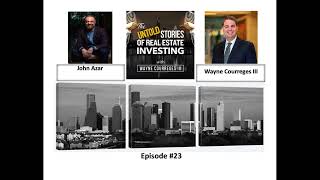
Interview with John Azar (founder/managing partner of Peak 15 Capital; managing member of Mac Venture Partners) about scaling real estate through institutional equity. Azar recounts his start in structured finance (Boston Venture Partners, 2004–2009), lessons from 2008–09, Peak 15’s specialization in institutional equity placement (rather than debt brokerage), sponsor/co-GP roles, geographic and asset-class appetite (multifamily, build-to-rent/SFR, self-storage, industrial, student housing, etc.), and practical expectations for syndicators seeking institutional capital — notably track record, credible underwriting, and typical institutional minimum checks (~$4–5M). He also describes a limited-capacity, tailored coaching/mentorship program and shares contact info (peak15cap.com, LinkedIn).
Chapters
Welcome to the Untold Stories of Real Estate Investing hosted by Wayne Courageous iii, a place where active and passive investors come to hear the good, bad and ugly of real estate investing. Our guests consist of experienced operators and investors who want others to succeed by sharing their stories. If you're looking to syndicate deals or grow your wealth passively in real estate, you've come to the right show. It's now time to sit back, take mental notes and enjoy next episode of the Untold Stories of Real Estate Investing.
Welcome to the Untold Stories of Real Estate Investing. I'm your host, Wayne Courageous. For our next episode, I'm excited to connect with John Azer. John is the founder and managing partner of Peak 15 Capital, a capital advisory and syndication firm servicing commercial real estate operators and sponsors in identifying, sourcing and securing their capital stack. John is also a managing member of Mac Venture Partners, a Southeast focus owner operator of multifamily assets. In his leadership of Peak 15, he directs strategic development, investor and client growth and new acquisitions and syndications. He also leads the investment committee, capital management and growth. John is also the head of the Peak 15 coaching program for new syndicators and sponsors. Welcome to our show, John.
Thank you. Thank you very much, Wayne. Appreciate it.
Hey, so very excited to have you on our show and and look forward to getting to know you more and having our listeners learn as well through our conversation. But is there anything I missed or anything you want to add before we dive in?
No, not. I think you may have forgot to sprinkle in superhero and I'm just kidding. Yeah.
At the end of this do a plug in for your coaching program and these other things because this is just the 10 minutes before this show that we were connecting already added more value and I was like oh, we should probably record some of this stuff because this is actually, you know, part of the. It's all good.
It's all value add is my middle name. Yeah.
So I really want to dive in deep on capital placement the stacks and but before we do, what led you to real estate investing? What got you into this career path?
Good question. I the thing that got me excited the most by real estate investing is is is probably my first venture into real estate which was back in 0405. I I started my first company, my first major company in in with two of the other of my that I worked with at Morgan Stanley when I was on the investment desk. We started the company called Boston Venture Partners and that company specialized in structured finance for large scale commercial real estate deals. And the reason we picked that is because we, that's a couple of deals we were doing when we were at Morgan Stanley involved some large players that we tried to structure a deal for a major, major deal, like, you know, 100, $200 million plus that we had to do bond sales and that kind of stuff. So it's, you know, actually one of them was almost a billion. So. So a lot of the players that were involved in those deals reached out to us and said, hey, would you, if you ever open your own shop, we'd love to work with you. So we opened up our shop. Didn't take long for us to realize that, hey, we can satisfy that entrepreneurial itch and open a structured finance shop. And we did and we didn't. When we opened this, I did not really know that much about commercial real estate other than the financials and sort of the investment part of now doing a bond offering or you know, something like that. And we kind of learned on the fly we had to kind of build the plane as we're, as we're trying to take it, get it off the ground and flying it. And, and the more I did that business, we did that, we ran that company from 04.05 until about 2009. And during that, those times I learned so much about real estate. I learned I had a ton of respect for a lot of the, the developers that we working with, the finance companies that we were working with, the, you know, we worked with engineering companies, finance company, architectural firms because we were in touch, we had our hands in the entirety of the deal of a big deal. We worked on hotel, large scale hotel conversion projects, skyscraper projects, water redevelopment projects, waterfront redevelopment project. I mean, and it really taught us, taught me a whole lot. It made me fall in love so much with commercial real estate and the whole process of it. And also the biggest thing that made me realize is the kind of money that could be made on the other side, be it on the, on the, on the, on the general partner side and being on the owner side and being on the major investor side because we were just really kind of supplying, either supplying the money or structuring the deal. We were almost like investment bankers for commercial real estate at the time. And although I'm not going to say we didn't make good money, we made good money, but we weren't on the owner side, we were not on the GP side. And it kind of made me realize, wow, there's a whole world out there that is, that I could, that I could tap into instead of just Being the sort of the middleman or the kind of the mover of money. Instead of being the mover of money, why don't I be the owner of the money? That was how pretty much I started my entree into commercial real estate, unfortunately in 08, you know, what happened in the economy, and by 09 hit, we were pretty much out of money, out of clients, out of, you know, out of luck, out of time, and we had to shut that company down. So it was. Even though it was my first entree and love of commercial real estate, it was also my first failure as a company.
So.
But, but that's okay. We learned a lot. I was very thankful for it and move on and you know, open up, you know, a second firm later on, a few years later.
Well, you know, I know a lot of people really struggled during that time. You know, I was watching a live Facebook stream the other day of this real estate investor who was on the ownership side during that 0809 period, and he was saying that he was feeling like in today's environment, it's a lot frothy like it was then.
Are you.
Do you feel similarly that, you know, what you're seeing now and the money that's being put at some of these properties? And we were talking earlier, before this podcast on the aggressive underwriting that's going on. Are you seeing any similarities between now and 0809?
You know, the only similarities is that, yeah, there's. There's some euphoria out there that's unwarranted, that that's probably the only, the only. Similarly, there's a, there's a lot of euphoria about, you know, about properties, about assets. You know, let's. And, and really about rent growth expectation. I think rent, the rent growth expectation is, is out of control. You know, I, and I think it's unsustainable. I'm not, you know, I, I'm not going to sit here with a crystal ball and tell you what's going to happen, Wayne, in the next, you know, two to five years and, and tell you, yeah, it's, you know, this is going to crash or that's going to crash. That's going to stop. I don't know. You know, and I'm, and I'm definitely not going to talk about this real estate as a cycle or where we are in the inning. If I hear anybody say anything about it, about a baseball reference to any innings, I'm going to, you know, I'm going to take my hat and burn it Nobody knows.
And it just, every year it's the same. It's like, you know, they always say, when's the best time to buy real estate? It's now. You know, there's never. Yeah, if you're buying based on cycles or timing, it just. The best time is now and then. Plus the benefits of the taxes and all the.
Well, that's right, the best time. Yeah, the best time is now. As long as you know what you're doing and as long as you are paying attention to the number and as long as you're buying. Right. The problem is, you know, a lot of people don't have the stomach not to buy. Not, you know, and I'm going to repeat, the stomach not to buy, not the stomach to buy. Because the stomach not to buy, meaning you have to hold back. You have to say, like, you know what? Like, if I don't find it one deal this year, and maybe I don't buy anything this year, but obviously not everybody can afford to do that. Some people that live and die by deals, they have to buy deals, they have to place money, they have to move money around, they have to work with investors. Otherwise they'd be, you know, they would, you know, either lose credibility or lose investors or really not make money. And I can understand that. But it's, it's, it's the thing that scares me the most is that the underwritings out there that are underwriting 10, 15, 18% rent growth expectation, that just scares the crap out of me. I mean, you know, I just don't see, I just don't see how that could be sustainable nationwide. I don't see how that could be sustained in all parts of the country. I could understand that being sustained in some parts of the country. But, you know, for nationwide rent growth to be 10 to 15%, I just, I just don't see it.
So shifting gears on the debt and equity side, you know, I know that Shells bread and butter at peak 15 capital. Can you explain the difference between the debt and equity side of capital and how your company fits in with partnering with these active deal sponsors?
Yeah, we specialize in equity for the most part. And I think that makes us kind of unique in our, in our cohorts because not a whole lot of companies say they specialize in equity. A lot of companies say, well, we do equity and we do debt. We will do debt. If we, you know, if, if, if needs be, especially on new development and construction, that is usually more, it's more, that's more applicable for us. Because a lot of times that someone who is doing a new construction, new development will likely need a major amount of debt or some creative debt. So we'll work with that on the debt size. But for the most part, we really specialize in equity placements, and those come in the form of one check from usually one of our institutional sources, one of them institutional large family or private equity hedge funds that we know that's in our investment realm. I am a sponsor, so this business is also. The only uniqueness about this business is really, this is a business established by sponsor for sponsors, as opposed to some Wall street firm that's trying to cash in on growth of commercial real estate. So I will view every deal from the spectrum of a sponsor myself. If it's a deal I believe in, if it's the right underwriting that I believe in. I always ask for underwriting. I always ask for the numbers. I always ask for the Stor story. Like, how do they get there? What, you know, what got in there? I mean, it's got to be believable. It's got to be something I would want to do myself. If I want to take it to some of my investment guys. You know, if it's something I look at and say, hey, this is a good deal, I would do it myself. Then it's, you know, it has legs. And I could take it to my. My institutional investors. If it's a deal that I say, you know what? This doesn't make any sense to me. I. I wouldn't take it to any of my guys. And I'd be very frank and upfront about it to a lot of the sponsors. I'd say, look, man, you might, you know, you might want to do some work here and there. You might want to tweak this and this. And I think you're almost there, but you're not quite there. Or, you know, your numbers are kind of short on this end. Or not, not, not, you know, not long enough on that end. So. So they're gonna, you know, they're gonna get a unfeathered opinion from me. Whether they want it or not. It's. It's for. Everybody's good because I want everybody to be on the same. On the same page.
Yeah, it's nice that you have that background as a sponsor. Do you. Are you actively looking for deals as a GP sponsor yourself? Are you focusing strictly on this equity placement right now?
No, we do, we still do that. Yeah. Yeah, no, absolutely. I actually just did my last syndication. We wrapped that up a Couple months ago, I did a syndication in Greensboro, North Carolina for 150 units. We did actually two deals this year. We were hoping to do a third deal, but unfortunately we kept coming up as bridemaids on deals and we're still bidding, so we actively bid and look at deals. As a sponsor myself, you know, we. So I'd say that, I don't know the breakdown of the. Of the business. I would say maybe 30% of it is sponsors, sponsoring and syndicating deals, and 70% of it is placing institutional capital. Yeah.
And when you're placing institutional capital, are y' all investing as an entity? Are you going in as a gp or how. How are y' all going into those type of deals?
Yeah. Yeah, good question. It's. If it's just a. If it's just a placement, then we would know. We would just place. It would be just a check that we'd bring from institutional partner and we would just get paid a fee for it. We would not be part of the deal. We would just make the introductions to the entities and let them kind of establish a relationship. We're just really about consulting to establish a relationship for them. If it's a deal that I really like, if it falls into my kind of purview of geographic appetite, deal appetite, if happens in the right timing for me and if the GP is open to it and wants for me to be part of the deal, sometimes every now and then I will entertain being. Being a co GP myself. So I will go in on the deal as a GP and still bring, you know, outside institutional equity to the deal as well. Yeah.
So you talk about the geographic. Like, is there certain markets that you're excited about, markets that you're moving into? Because it's starting to meet that criteria.
You know, I'm looking at more, a lot more markets than I used to. So historically, through my other from Mac Venture Partners, we did a lot of Southeastern, mostly Southeastern only focused investments, mostly in the Carolinas, Georgia and Tennessee. I am now looking into not only those, but I will look in. I'm gonna look in Texas, I will look in Oklahoma. I will look in Niagara River Valley region. I will even look at as far as Utah and Idaho. And so I will look at everywhere where there's, you know, the nuggets of value to be found. You know, I even bid on a deal, you know, recently in rats out of Chicago, in Illinois. So I mean, we'll. I'll look nationwide as long as. As long as the numbers make sense. And there's it's enticing enough and we think we can make a play and we think we can have decent control of the numbers and the business plan, then I, I have no problem going after a deal no matter where it is. Yeah.
So from a syndicator standpoint, what, what should they be asking or looking for when they're trying to partner with a group like yours on side. You had mentioned you want to look into the numbers. And a lot of syndicators will like, well, they sometimes don't want to open up the book. You know, they take offense. But if you're investing a million dollars or more into their deal, I definitely think it's reasonable. But what are, what are things you, as a sponsor you would look for and what you recommend being on the other side? What type of questions and things should they be asking when they're, what do you.
Well, when you say, when you say they're hesitant to open the book, what do you mean, open the book? Like, you mean the underwriting or you mean the underwriting?
Absolutely right, the underwriting. So they'll do the webinar and go through and say, hey, these are the projections. But there's this side of looking for passive, passive investors and not so much more so on the investor side.
Yeah, no, I get it. I get it. If it's individual investors, if you're going after individual investors, then yeah, absolutely, you don't need to show underwriting. You wouldn't show underwriting, but that's not the same thing. If you're talking to institutional investors and you're talking to me in particularly. So if you don't show me the underwriting, we have no deal. I can't, I can't move forward with you. So that's that. You know, if, if you're, if you have a problem sharing your underwriting, then, then that's, we should just, we should just stop right there because it's, that's the, that's the first thing that any institutional investor is going to ask for. So.
Well, this is great. Like what, what other things are they looking for too far? Is there a certain amount of raise that's required? You know, because all these requirements done with an institutional. And, and I would think on the, the reverse, like someone getting started is not likely going after the institutional money. You're looking for someone who's got the repeat.
Yeah, most of our clients will end up being, usually end up being clients that are sponsors that are really graduating that country club money. And they've already done a couple of syndications they've already syndicated maybe anyway anywhere from 50 to 200 doors to maybe even thousand doors or 2,000 doors. You know, they've syndicated enough doors where they know the difference. They know the syndication game. They've raised money from individual investors. They may have even done one or two full cycles. So these are not, I'm not talking about green, fresh out of the gate sponsors. Those are not typically who we work with because they're not fundable by institutional investors. People who are funded by institutional investors are folks who have had some track record, has had some success, have closed on. I'm hesitant to put a number on it because you know what, like 100 doors in New York City is a whole different game than 100 doors in, I don't know, Idaho or North Carolina. So 100 doors in New York City could be $50 million valuation. 100 doors in North Carolina could be $1 million valuation. It just depends. I'm hesitant to say numbers, but more so than numbers is the amount of deals that they've done and that they've already been the route of raising money for individual investors and they're now ready to kind of go up the ladder. And mainly really in terms of equity check size is concerned. So our minimums, typically what we see is about 4 or 5 million on the lower end. Really 4 million is the lowest most of our investors would go. And there's no limit on the up. I mean we've looked at deals to place that are. We're working on deal now that's going to be probably 150 million just equity.
Is there a lot of international money coming in to invest in Yalls deals? Is that something that there's not?
Most of our investors are domestic by nature. Yeah, all of our investors are domestic by nature. If there is anybody institutionally, they will still invest through some kind of a US entity of some sort. So international investors cannot by law invest in US based entities or US based syndications unless they have a US based company to invest through. You cannot just accept foreign money without it coming through some kind of an entity, an offshore entity or something like that.
Yeah, so we've talked about the location, geographic areas, sort of that threshold of equity investment. What about asset classes? Are y' all focused on, I mean multifamily for sure, but are y' all looking at storage or industrial? And one thing that's sort of coming a lot, at least in my path, are more build to rent opportunities. Are y' all looking at anything outside of multi family right now from a Equity standpoint or y'. All, Y' all stick within that wheelhouse?
No, yeah, we'll. For, for. For equity. We'll, we'll do deals. I mean, we've. We will work on multiple, you know, multiple kind of deals. I mean, we'll work on self storage, student housing, industrial office, retail, mixed use. Yeah. Built to rent is another new one that's, that's definitely hot. SFR is becoming very, very hot entity out there. You know, the thing with SFR is it's got a lot of competition from major institutional players because they're converging on that market like, you know, bees on honey. So it's just for our listeners, myself.
Just for single family rentals.
Yes. I'm sorry. Yes. Single. Single family rentals. Yes.
That to me is fascinating. That and scary in a way that institutional money is going after single family. You know what. And we're all going for yield. And I know that there's opportunities in single family, but just competing with the mom and pops and the person who's trying to get their first home and all, it's, you know, it just adds another layer of difficulty of getting in without cash.
Yeah. That's what's making probably the housing market even more crazy because you have all these institutional guys going into cities like Charlotte and Raleigh and Dallas and Jacksonville and a lot of those major hubs that are hot for multifamily, and they're going in and scooping up single family homes by. By the dozens more by tracks, complete developments. In fact, a lot of times they're developing from the ground up. Built to rent, you know, whole communities just to rent, which is, I mean, it's, it's, believe me, it's baffling to me. Like, you know, I. I see a couple of communities I drive by here in Charlotte that are now that are getting built, that are going to be just built to rent. They're going to be just. Just rentals of single family homes.
Yeah. And for those that are not familiar with the build to rent concept, so it's like think of multifamily stacked on each other. It's these stacking them in more of a horizontal multifamily. So you would have these single family homes that are managed and have similar amenities as you would in multifamily. So you have this economies of scale and they're all rental opportunities. And I think it's fascinating because with COVID especially, you know, I'm thinking, you know, if we were ever needing to. To rent or if I was in my early 20s again, you know, needing to rent. What a great opportunity to be in a house and be around, you know, that lifestyle.
So. Yeah, well, that's why it's, that's why it's a hot market to, for a lot of these institutional, major investors to invest in. It takes a, it takes a lot of money to invest in that side of the coin.
It's a development play. Right. And it's not a cash flowing, it's a development play.
But even if you're just buying stabilized SFR single family rentals, even if you're just buying stabilized single family rentals, you still buy them by portfolios. So what they're going in is buying a portfolio of 10, 15, 20, 100 homes at a time. And it takes, it takes a lot of money to buy that, that kind of firepower.
Yeah. So before we go on, are there any other items you want to talk about with capital stack or equity placement that we haven't covered so far that you think would be helpful for him?
Yeah, you know, you, I'm going to go back to one of your questions that you asked earlier. What's, what's the, you know, what is it? What does it kind of take? And you know, what do they look for, institutional investors look for with thing, you know, I told you kind of, you know, experience, obviously, previous experiences. One, the check size is the other one, like I said, normally minimum of 4 or 5 million. The business plan, which is really, they need to understand where you're thinking, how you're thinking about doing this. Why do you think you deserve to do this? Why do you think you have the capacity to increase rents here or there? They want to understand that you understand the market. If you're just going into a market that you don't know anything about, that's probably not a good play to get institutional funding for it. If you're just kind of taking a flyer and starting to learn about a market, that's probably not going to be a good play for institutional players because they don't want to learn with you. They want you to already have known the market. They don't want to be your guinea pig to learn a market. So they want to invest with people who know the market well and they operate well and they, you know, and then they're very confident about the market. So, yeah, so the sponsor experience is very important to them. What they've done, you know, how they're going to do it and what they're going to do in the future, their stability, their scalability in the future, their capacity to do multiple deals. You know, they, a lot of my institutional guys, you know, like to come in as a programmatic investor with people. So they want to have, they want to come in on one deal, but they also want to do the next, you know, five deals with you or four deals with you. So they, they, you know, they don't want to just come in and establish a relationship just to do one deal. They'd like to do multiple deals with the same player. So they, you know, they're very relationship driven. So, you know, you have to have the firepower to make them believe that, hey, I, you know, I can probably do multiple deals in this market.
No. Well, they grow with you, you grow with them. It's be great. Now they investing. When they're bringing in, you said 4 million, 5 million, I would assume, are they wanting part of that general partnership and are they taking a big part of that by funding a large percentage of that equity? Are they investing more as a limited partner?
Both. Both. Sometimes they will invest as an LP in deals, sometimes they'll invest as a, as a JV and co GP in deals. General partners, second general partner. Sometimes they will invest as lp. Even if they invest in lp, they're going to want some aspects of control into the deal. If they're bringing, obviously justifiably so if they're bringing 80, 90% of the equity stack, then they're going to want some control for that to safeguard their investment. So they either sell right decision buy right refinance, recapitalization, that kind of stuff. So. And sometimes they'll do a combination of pref equity as well as, as well as equity. So the combination of preferred equity as opposed to just straight up, you know, LP equity or passive equity.
Yeah, well, I want to shift gears a little bit and just with your vast experience in real estate, I mean in your career, and we talked a little bit about the financial crisis there, a little bit. But you know, what have you found is the good, bad and ugly of real estate investing? For those that are getting into it and, and those that are grading like I am, to find good opportunities, what are some things that you're seeing in the spectrum of real estate investing in today's market?
And that's a wide question. I don't think we have enough time tonight to answer that question. But that's a wide spectrum question. The good is that you gotta love what you do. If you love the real estate industry, if you love going after deals, if you're a deal junkie, Like I am. And if you kind of love this industry and love the dynamic of the relationships, you know, and love building relationships and, and being, you know, being relationship driven with people, then you will have fun and you'll, you'll definitely succeed this in this industry. If you're not relationship driven, if you, you know, if you dread doing deals, this is probably not the industry for you. If you are also not patient, this is probably not the industry for you. You got to be patient. You got to have a long, you know, you got to look at, got to, got to look everything from a long goal perspective. This is not a, this is not a race. This is not an industry. That's, that's a race. This is a marathon. So you gotta, you have to, you kind of, you have to pace yourself. I understand. I, I see a lot of people coming in this industry and they want to do, you know, like, you know, we want to own, we want to own a thousand unit this year. You know, we own, we want to own 2,000 units. Well, that's great, that's great that you want to. But it's the difference between what you want to do and what you can actually do and what you can actually do with a reasonable, still justifiable and with, you know, somewhat guarded and, you know, you know, tampered expectation on what you can, what you can do with, with a certain amount of safety and fiduciary responsibility for your investors as well. Just because you want to invest, you want to own a thousand units, it's not own 1000 units at all cost. If, you know, people who are doing what we want to own, you know, 2000 units this year at all cost, they're probably going to lose their shirt off at some point because I guarantee you they're overpaying for something along the way to get those units. You just, you know. Yeah, I mean, we, we see it all the time. I, you know, I, I, you have to, you have to underwrite. Well, I can't, I can't stress how important, you know, good underwriting is in this business. Good underwriting in this business is everything. It will make you or break you. And it, it will, you know, the way that you look at deals and the way that you are, you know, you're, you're, you're doing the math on deals and breaking them down and having what kind of assumptions you're going to have in a deal. Your assumptions in this industry are key. So you have to make sure you have the right assumptions in your underwriting and that that creates a wide variance among. Among people. So if you're not sure about your assumptions, ask, reach out, you know, involve somebody else. There's no shame in looping in other people to make sure that, hey, I still do it all the time, you know, I loop in somebody else. I look at my brother, I loop in other partners, and, you know, and I say, look, man, I mean, I'm looking at this deal. Am I, Am I wrong? I. Is this really, Is it really this good? Is it really this bad? You know, are my numbers, you know, am I looking at this too, too conservatively? Am I looking at this too, too optimistically? Like, you know, how. How is that have it. Have some kind of a checkpoint instead of just going in blind and saying, well, I, you know, I think I did it right, then this, this looks amazing. Let's, let's go after it. You know, if you miss one number, especially in today's market with the numbers being so tight and so high, if you miss your projections or you miss some assumptions by, you know, such a little margin and we take some kind of a dip in the economy and, you know, your, Your, your rates or something, take, take a complete dip. You're, you're, you're, you're screwed. You know, to put it mildly. So, you know, just, just be very careful out there. And this is a fun game. This is a great game. This is a, it's a, it's a fantastic industry, but at the end of the day, it's, it's, you know, it is still dealing with real money and real consequences.
So. And this wasn't a segue to this question, but part of underwriting and finding good deals and such is really having somebody like you said that you can ask and questions. And also, can you talk to us about your mentorship and coaching program that you have through pick 15? Is, is that part of the syndication? And, and we didn't talk about this previously, but obviously you're, you, you're very eager to share your experiences and be, you know, in that coach realm, so. Love to hear more about that program.
Yeah, you know, to be honest with you, it's, it's not something that I talk about as much. I don't, we don't advertise it. It's not, you know, we, we only, we talk about it on our website a little bit. You know, but we're not really, we don't actively market anything. It's just I, I do it because I, I love coaching. I really love the sort of working with coaches with folks to kind of get them up and up and running in this industry. I, and I love, I love kind of the mentorship round. I've, you know, I've had, I've been fortunate enough to have some fantastic mentors in my, you know, in my life as I was going through my different business, you know, growth periods and my different inflection points in my life. So I kind of want to, you know, do the same thing for, for other folks. My coaching program is kind of tailored. It's not, you know, it's not a cookie cutter approach. I don't, you know, there's no, you know, I don't send off people to, to watch a bunch of videos online and come back to me with questions. It's, you know, they usually, it's. We have to, you know, they have to, we have to line up our time together and they usually get me or they usually get, get me and one of my staff or one of my, one of my guys that, that, that you know, that I trust really well to, to, you know, do any, any of the, any of the sessions. So as a result, I end up having very, very limited capacity. Our bandwidth on the coaching program is not that large just because I have to have the time to dedicate to it myself personally. So I only have limited amount of time per week to do coaching.
All right, well, as we close up and end shortly, one question I always ask is what are your proudest moments in real estate investing and just real estate in general? And then how can the listeners find you and reach out if, you know, for further discussions?
Proudest moments, boy and proudest moment. It's a good question. I have not been stumped with a question in a while. Proudest moment. I don't, you know, I mean, I think probably you know, even more recently, I think the. This year have been last year and really being fully through running peak 15 through Covid was an incredible year for us because it was a tough year. We did not make a lot of deals. Money was definitely not there. Some of the guys that were with me, one of my major guy that's been with me for a long time, we started doing deals this year and thank God this year have been fruitful for us and we've done syndications, we've done a couple of deals deals and you know, my, I guess my proudest moment is to, is to make sure that, that everybody that's involved with me gets gets, you know, gets taken care of and gets taken care of well. So my, my proudest moment is to make sure that they're, you know, those guys have, have, you know, are starting to build their own kind of wealth and their own, their own, you know, passive income and, and, and they're providing well and they're, they're hanging their head high and, and you know, they're saying, hey, it's worth it to, to, you know, to, to, to be in this and to, to kind of hang my hat with, with John Azar. That would be, that's my proudest moment. Yeah.
Love it. And how can listeners reach out to you?
They can find me online. LinkedIn is obviously one place. I'm under Jalal John Azar there. They can hit me up on our website, peak15cap.com they can email me at azar peak15cap.com azar15cap.com well, John, I appreciate.
Your time and getting to know you and providing some great insights on obviously the capital, the equity stack, but just your real estate knowledge in general. So thank you again and look forward to connecting soon.
Thank you very much. I appreciate you having me.
That's all for this episode. We hope you subscribe, share and leave a review of the show. For more information about passively investing in multifamily apart apartments, check out Wayne's free ebook by going to C R eipartners.com ebook also follow us on Facebook by searching CREI partners. This was the untold stories of.
More from Wayne

September 2026 Meetup: Investing Ahead of Growth: The Bryan–College Station Opportunity





May 2026 Meetup - Apartment Complexes & Passive Investors: Opportunities & Risks


March 2026 Meetup - Reading the Market: Economic Indicators Every Investor Should Know


February 2026 Meetup - Syndication 101: How CREI Partners Structures Deals for Investors

Build-to-Rent (BTR) Communities Explained: Why Investors Are Paying Attention