Rob Beardsley ‐ The Untold Stories Of Real Estate Investing- Considerations when Underwriting
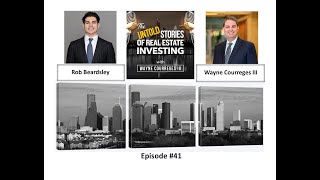
This content was created by Wayne Courreges III, CPM®. This content was uploaded by Wayne Courreges III, CPM®. This is a YouTube podcast episode titled "Rob Beardsley ‐ The Untold Stories Of Real Estate Investing- Considerations when Underwriting" (created April 26, 2023). It is an interview-style conversation hosted by Wayne Courreges III, CPM® with guest Rob Beardsley of Lone Star Capital. The discussion covers multifamily underwriting and acquisitions, market strategy (Houston and Dallas), insurance and tax pressures, capital raising (retail vs. institutional), financing choices (fixed-rate permanent debt vs. bridge), underwriting assumptions and risk management, lessons learned, and Rob's book "The Definitive Guide to Underwriting Multifamily Acquisitions."
Chapters
Welcome to the Untold Stories of Real Estate Investing hosted by Wayne Courageous iii, a place where active and passive investors come to hear the good, bad and ugly of real estate investing. Our guests consist of experienced operators and investors who want others to succeed by sharing their stories. If you're looking to syndicate deals or grow your wealth passively in real estate, you've come to the right show. It's now time to sit back, take mental notes and enjoy next episode of the Untold Stories of Real Estate Investing.
Welcome to the Untold Stories of Real Estate Investing. This is your host, Wayne Courageous. I'm super excited today to have Rob Beardsley on the podcast with us today. Rob oversees acquisitions and capital markets for Lone Star Capital and has acquired over $350 million of multifamily properties. He's evaluated thousands of opportunities using proprietary underwriting models and sold over 10,000 copies of his ebook, the Definitive Guide to Underwriting Multifamily Acquisitions. Rob, welcome to our show and thanks for being on.
Thanks for having me.
Yeah. So if you could give our audience a little background about yourself and how you got into the industry and where you are today.
Absolutely. I grew up in Northern California in the Bay Area in a real estate family. My parents focused on the residential side of the business. They were involved, they had a brokerage firm, then they did fix and flips and some construction on the single family side. And that, that business didn't really resonate with me. I saw my parents work really hard and just chasing commissions and they weren't really accumulating assets. And so I really fell in love with the Warren Buffett model, get rich, slow long term wealth accumulation. And so that was where I found multifamily to be the best fit. And so it really was a great fit for me in particular because I had the single family background from my parents, understood that world. And then as you know, going from 1 to 100, it's not rocket science. So jumped into multifamily with originally with my family about now, I think seven years ago. And unfortunately, you know, my dream was to start a company with my dad. Unfortunately, he was just still busy with his brokerage. So I went out and met my business partner, Kent. We started Lone Star Capital five years ago and you know, as you mentioned in the intro, since then We've acquired almost 400 million in deals all in Texas and have, you know, just had a great run so far, growing the company, building the team. It's been a lot of fun, a.
Lot to dig in on that. It's Just. I mean, it's just incredible thing in five years, that huge upswing. It's incredible. But. Well, that's interesting. I didn't realize that you're. You had a background and, you know, just growing up in real estate, I think that's huge and to learn, and that's one thing that I'm trying to do. My. My middle child, Lily, she. She goes to properties with me. She actually shows interest and she said some pretty cool. Like, you know, she's. She's gonna turn 10 in June, but yeah, it'd be pretty cool. The other kids, my son's like football, you know, doesn't care about anything else but memorizing football cards and playing football. And Emma, she's more in the tumbling stuff. So. Anyway, I. I may have one real estate person, I guess, is what my point is in the family. So were you, you know, what were you doing with your family growing up to get you that exposure and. And any of that transfer over to what you're doing today? Even though that was single family, you're doing larger multifamily.
Yeah, there was a lot that I learned just through osmosis. My parents, they ran the business from home, so there'd be employees coming in and out, and I would just be at home listening to them on the phone talk to eels all day. So it rubbed off more than I realized. And I think I've never really said this on a podcast or thought about this too much, but one thing that I really like that my dad did with us as my sister and I, who's right there, she works for me as well at the company, he always spoke to us very maturely, and he spoke to us as adults when we were kids growing up. And I think that was a tremendous value and benefit because we got exposure to more mature conversation and in turn, learning to present ourselves and speak more maturely and intelligently. So I think that's been a huge win, especially being young in the industry. I started Lone Star when I was 20, so. And, you know, raising money is hard enough, and then trying to raise it when you don't have any experience and you're 20 and you're a dropout, that is really tough. So I think armed with, you know, that ability to speak and be intelligent, communicate, lead and inspire, those are, I would say, the most important keys to our success.
Yeah. And one thing that I've noticed about you, I mean, we recently met earlier this year, but your name and.
Your.
Brand, I should say, has been really strong in the community of Multifamily investing, you know, last, you know, several years. But one thing I think that separates you from others and maybe it's because you're having to overcompensate a little bit because of that education background and. But you're always dressed for success. You're always in a suit and tie. And so when people see a 24, 22 year old starting or 20 into you, you know, where you are now, it's like that has to, I mean, the image and the professionalism that you portray at a young age is inspiring. And for people that are, you know, thinking there's one path forward to success with college or whatever, you know, you, you've overcome those challenges. So I'd like, you know, if you could speak to a few moments just about that for people who, you know, or were in your shoes of having to make a, I mean, it had been a huge hard decision early on that. And then how did you overcompensate to be through those, you know, challenges?
Yeah, for sure. And it's actually great timing because this month marks the five year anniversary of dropping out of college. So that's exciting. So I was attending Carnegie Mellon in Pittsburgh, which it was at the time the number one information system school in the country. So, and I was studying information systems, which is a blend of business and computer science. And coming from Silicon Valley, I thought that was perfect and do something technical and get into tech or a startup. So the decision to drop out was honestly not as difficult. And that's because I had the, you could call it privilege to do so. Because while I was living a very cushy college experience, oh, you know, my meals are paid for, I'm just dorm, no stress, just have to get your work done, easy living. And so when I, when I told my parents, I, you know, I want to actually go all in on this. I had already started Lone Star, we were already working on stuff, but I wanted to go all in. You know, they were supportive. They, they recognize I laid it out and I said, hey, it's, it's basically zero risk. If I fail, I can go back to school and pick up right where I left off. So that's, why not take the opportunity. And the upside for me is I get to just live at home and you know, live be able to build the business from, from scratch. But you know, the funny thing my dad said is, okay, well if you're not going to be a student anymore, that's it, you know, we're not supporting you, you can live at home. Which I did for a year before moving to New York. But, you know, no, no cushy, easy life anymore. Right. You need to, you need to grind. And so those, those formative years were, were extremely valuable to. And we went through plenty of hardship, so. And I don't regret it at all.
Yeah, it's. I like to call it baggage. When you don't have baggage, it's easier to do riskier things, you know. Yeah. You know, shifting a little bit, you know, in the Marine Corps. And people don't think in the Marine, you know, I started The Marine Corps 2000, I guess 2003 to 2007. And people don't think about the Marine Corps is that the average age of a Marine, Rob is 19 years old, average age of army. And I've got plenty of army family and, you know, friends. 27. A lot happens between 19 and 27. And you think about it at 19, when I was in, I didn't have. And I have a beautiful family. They're not baggage. I don't try to use it in a bad term, but in a way of. I didn't have kids that I was responsible for. Right. I didn't have a wife that I was, you know, trying to be a man and support etc. Like I am today. So circling back to you and why I'm even saying this is because taking that risk at an early age, when you do, fortunately for you, you, you, your parents aren't going to let you drown. You know, you got a place to live. I know you, you went from Northern California to, to New York. Well, if New York didn't work out, I'm sure your parents, like I would with my kids. And then that the learning, you know, of business, you know, I went to business school, textbook, you know, you learn, learn business, but you don't really know what you're doing or really understand business until you're in business. Right. And then even when you go back, if you were to go back, you know, say, like when I went for my MBA, I was glad that I waited like 10 years before I went back for my MBA, because if you're just going from one school to another, you just learn a textbook. So you had that huge advantage in my mind of taking that risk. And I'm not trying to understate your risk. Right. You, you did take a risk.
And.
But it's, it's just a great time to do it. So for those listeners, you know, we're not saying drop out of college, et cetera, you know, thing but you know, when you don't have the family responsible for and you, you're just taking care of yourself, you're happy with ramen. You know, even people rob that are looking at like doing broke commercial real estate brokerage, I mean that's an eat what you kill type business. Right. And it's, it's not for the ones who have a lot of responsibilities, debts, maybe family, etc. It's, it's for those younger people that are a lot more risk tolerant at that point.
Yeah, that's, that's a very good point and I, I recognize that as well. The time to take risk is when you're younger, when you have less responsibility. And no matter what you do, if you're going to try to get something off the ground, it's going to take at least two years before you make any money. So that is really tough to do if you need to support a family and whatnot. Which it's really incredible when you compare my experience with my business partner because my business partner, he's 17 years older than me. He had a family, three kids and, and he, and he left a high paying corporate job. Right. And so his taking that risk is completely different than mine. So I have to commend him so much. And he handled it very well. And I certainly played therapist during that period as well, you know, as much as I could. Right. But we, we leaned on each other.
100. All right, so you started Lone Star Capital, sounds like in Northern California. You decided a year later to move to New York City. Talk to us about that. And then also did you have a coach? I mean, yeah, your, your parents were focused on single family brokerage, but it's a completely different beast than managing operating multifamily, you know, large multifamily.
That's right. That's right. Yeah. So I mean before we were recording, I told you that I had taken my first job in New York. I fell in love with the city and wanted to move out here. Fortunately, my business partner was born and raised here, so it was just made a ton of sense to just move out here and start the business together here. And the, yeah, the, that was really all that was behind it as far as a coach. We both were in Joe Fairless mentorship program and that's what was our initial attraction to Texas. And then as we were looking out at the market, Dallas, Austin, Houston, San Antonio, we gravitated a bit more towards Houston. Houston is a bit more of an interesting market. Higher cap rates, a little bit more risk, a Little bit more nuances. So we got our first deal done in, in Houston and then from there just went to the next one and the next one and we just got the momentum and just decided to continue our focus rather than spreading ourselves out.
Yeah, I mean it's, it's similar what we've been doing as well with Houston. I, I chose Houston because that's the closest city I live to. It's a city that I've lived in. I've got a lot of the relationships. But it's also, when you go there, it's a very diversified city and not only on the people, but the industry, it gets a bad rap, I think Rob of, of. Oh, it's just an oil city. Yeah, it is, but it is the largest medical center in the world. You know, my daughter, you know, had a surgery, heart surgery. It was a non invasive one day surgery just a few weeks ago. And people in the waiting room are coming from Dallas. They. So we had to be at that, you know, the hospital at 6:00am people left, this particular couple left at 2:00am to get, you know, get settled here by 6:00am. And I was thinking Dallas, I mean, surely Dallas has a pretty damn good medical center. But you know, we have people from all over, you know, coming to Houston. You got the Port of Houston, you got the education, you know, so, you know, I love that people don't recognize Houston in the way they would view a Houston Austin, because it's easy. Barriers of entry are less hard, in my opinion in Houston. Are you seeing the same thing? And are, you know, are you still bullish on Houston in general having in today's market?
Yeah, long term? Very much so. We obviously have to recognize the challenges with insurance. I think that's very topical right now and that's affecting people in a big way. And so that's affecting our underwriting in a big way. So what we've seen is interest rates have obviously impacted all deals across the spectrum, no matter what market you're in. So that we're battling that challenge and then on top of it also, insurance is a challenge in Houston. So we're being very mindful of that and that that is affecting, like I said, our underwriting and that's creating a very big, big bid to ask Gap. But going back to Houston's reputation, it is a good and a bad thing for sure. It's kind of overlooked, which is funny to say that the fourth third largest city in the country is overlooked, but it is, but it. So that helps with maybe slightly better pricing, better Opportunity, but it's harder for raising money. Right. It's overcomeable for sure. But it's interesting to have those conversations with investors where they go, oh, it's catching easy to build in Houston. No thanks. Or oh, the hurricanes or oh, energy dependence. So we have had those hurdles and that's one of the reasons why we have expanded into Dallas recently.
Yeah, let's dive in a little bit more on insurance because that is a big thing going on not only in Houston, but really any coastal city. Now we have a very reputable good insurance broker. We just renewed our insurance across our portfolio few months ago. But my understanding is, is the reason, not only is Houston having the spike in insurance, property insurance deals with, you know, a lot of the massive hurricanes and you know, losses that have happened year, it seems like year after year consistently, but also just the number of carriers that actually will ensure the Houston market is less. So the capacity. So I guess what I'm hearing out in the market is the capacity to insure these properties is less. And in doing so think of like a supply and demand. It's more, you know, it pushes price. And so when we're underwriting deals, it's depressing. It's like going out to the insurance broker and then you're trying to make the numbers and then you're like, dang, could it really be 12, 1300 a door? You know, and, and so, and could potentially, you know, rising. So it is hard from an underwriting standpoint to, to do that and predict the future. But you know, for those listening and may not understand, you know, what's all going on in the insurance market, that's one thing. And then real estate taxes, you know, we just, I'm sure you looked at your real estate appraisals that just probably, you know, that came in last month. I was looking at that, I was like, man, they are being super aggressive. Product taxes, of course we'll protest, but you know, in Houston you got taxes, insurance and of course rates. But if you look at it like what you also said to Rob was the more of a long term, you know, if you look at it from a long term standpoint and if you don't have to sell today, like you've put yourself in a situation where you know your debt is, has some flexibility, then you know, people will ride the, ride the storm out.
Yeah. The longer your outlook, the better off you'll be. Doesn't necessarily mean you have to hold it through that long term outlook, but that is the safer bet. And something interesting on the insurance side, like you explained, there's people, players exiting the market, so there's less, less competition. So rates are higher and there's been losses, repetitive losses, and that is affecting pricing as well. I think the insurance business is cyclical and I just have to imagine that there's going to be new entrants, there's going to have to be some sort of reshuffling of the deck. And I think we'll figure it out because some of these prices for Coastal is just getting out of hand and it's just not economic. And I think the, you know, the capitalist market will bring solution to bear. And that may be a little pollyanish sounding, but I do think that that is how the game's going to go. But with that being said, like we have to underwrite these higher insurance costs today. We don't want to be on the wrong side of an insurance estimate. Right. That just, that's not where you want.
To miss on a deal right now. Well said. And you know, I'm sure on a lot of your other podcasts, other, you know, conferences and all, you've talked about your underwriting based on the success that you've had over the last five years. Right. You're in your comfort zone. You've hit it out of the park on these deals and consistently performing, but in today's environment, it's a completely different beast. Right. So what I'd like to do is not really focus on the success of your past underwriting, but what are you doing today to prepare Lone Star Capital and your investors of protecting preservation of cash, but also making the right deals on top of and then try to still close a deal because of price differential between seller and buyer expectations. So I'd like to be more forward thinking and obviously some of the backward successes and what you've done, but what are you all doing now that may be different if not changed previously?
Yeah, right now we're being very mindful of risk. I think risk is mispriced in the market right now. You could go to the market right now and buy a deep value add deal and it would just be the same yield on cost or cap rate or whatever valuation metric you want as, as a clean stabilized deal. So there's just. You're not getting paid for the risk out there, so it's better to not take it. So. And also given the fact that there's likely going to be operational headwinds in the near term, such as a recession, which would impact collections, rents, occupancies, Right. It's harder to be as optimistic as before in our business plan. So we're just being that much tighter with pro forma rents and tighter with growth assumptions. We've of course widened out our exit cap rates just to be in line with the market. We're not trying to predict the future or anything, but just have to have good underwriting fundamentals. And for us good underwriting fundamentals are we, we take what we see as the market cap rate in today's environment and then we just widen it by about 50 basis points. So yeah, we've got about 50 to 75 basis point wider exit caps today than a year ago, which is material change as far as debt. I'd say this is the biggest strategical difference is we are only doing fixed rate permanent financing. So no bridge loans anymore and the fixed rate, so typically we're doing seven year loans which I think is a perfect sweet spot because it's long term enough to be able to ride out the storm and have that long term view, but it also is short term enough to where we can still be an opportunistic seller or refinance into a better capital market. Yeah.
And if the deal works at the fixed rate in today's market than refinance or you know, having some different exit options will widen.
Right.
To have that, that fixed debt. So and you know, Fannie and Freddie, it was hard to get agency debt in the last, you know, few years. You know, it's been tough. The bridge market has been, been going strong. A big part of that was valuations of properties were skyrocketing. Right. So the DSCR minimum couldn't get you your Fannie and Freddy. So, so that, that is shifting. It's good to see that coming back into play more. And, and I definitely would agree that the fixed debt would be important on the cap rate. You had mentioned a larger spread. So 50, 70 basis point is, is are you saying that the going in price that you're buying it say the cap rate today you're adding the 50 basis points up front or is that at the end example if you buy at a five and a half cap today, are you saying that year five you're doing more of a six cap, so 50 basis point, you know, 10, pretty much 10 basis points per year type growth? Or are you being even more aggressive than that?
No, that's typically what we do. We identify where the cap rate is today. So but the, the reality is most of the time we're buying a deal with some value add component so let's say, let's say today, if we're lucky, we're able to buy a deal for, at a 5 cap, but we're buying a compressed cap rate because of the embedded upside. The deal might have some rent growth opportunity, there might be other income opportunities, et cetera. So naturally the deal will trade at a compressed cap rate. So maybe the real market in this scenario is five and a half. So from there we'll take that five and a half, widen it to six. So we'll buy the 5 cap and then we'll project to exit at a 6% exit cap rate.
So it pretty much doubled your, your annual basis points. So instead of doing like 10 basis points higher each year, you're doubling that to be more of a 20 basis points. What I'm hearing.
Yeah, it just depends on the value out of the deal and, and where the market cap rates are. And the thing that's so tough right now is where is the market? There is basically no market. Very few deals are getting done. So it's hard to confidently and definitively say, oh, this, this deal should trade at an X cap rate or the market's at an X cap rate right now. It's really tough. Right.
Well, I mean, even, you know, it just the longer that you and I are in this business, the more cycles we see. Right. And you know, and we don't. Just a few years ago, you know, we were in that, a couple years ago in that Covid mindset and people were pausing, not knowing whether they're going to buy or not. And it's sort of like this eye of the storm right now where it's like there's nothing going on. But they, you know, we know we're going to have turbulent, more turbulent times, which from a buying side is extremely exciting. Right. Because we're able to, you know, buy when there's an opportunity, you know, better opportunities to buy. You know, I would say on the, maybe I'm not on the lower end, but buy. Right. So that way we can, we can in our investors benefit at the end, at the upside.
Yeah. And it's not going to be easy because it's going to be in a moment of not panic, but duress. There's, there's going to be some, it's not going to be an easy environment where you're going to say, oh, well, the deals are on sale now and I get to go to my investors and tell them what a great deal it is and everybody invests and we close. It's going to have to be. You're only going to see those opportunities when there's daily headlines of recession and stock market lows and real estate collapse and stuff like that. That's when you're going to have to hold steady and pull the trigger on a deal that, you know, the numbers make sense but the world seems uncertain. Investors are going to say no to you because they're going to clam up. So yeah, I think the other problem is a lot of us, you and I included, are awaiting this opportunity and that stymies the opportunity. Right. It kind of defeats itself because if you and I and a bunch of other people with pockets full of cash are ready to jump in and buy the moment somebody kind of drops their price and sells then that, that price, there's going to be a floor. So I think what's really interesting. Well, and I could, you know, we're obviously talking about the future here. We could be wrong but I think there's so much liquidity out there that we're not going to see a deep and prolonged buying opportunity. I think it's going to be quick and it's. And it was Covid was like that as well. And unfortunately we sat on our hands. We didn't buy anything after Covid hit through, through, through 2020. So there was a window of opportunity where interest rates dropped because of COVID and cap rates hadn't adjusted yet. So you could have bought deals and locked in a fantastic spread. But then the market obviously got privy to that and cap rates dropped in line with debt and the opportunity was gone. So it is harder to catch a, it's harder emotionally to catch a falling knife but it's harder to execute. Catching it on the ups, catching the market on the upswing. Right. By the time you, you know, see the bottom and then things are on the rise, people are going to be going crazy and it's going to be competitive again. Buying when it's still going down is going to be the better, the better opportunity.
100 I'm always a glass half full type person. And you buying, not buying in 2020 could have been a blessing because you might not have done an interest rate cap or those people are having to refi or looking at restructuring their debt right now. And it, it, you know, I feel very fortunate that in some cases I didn't buy. But someone once told me or asked me was like, you know, what is your biggest regret? And time and time again it's not buying that property or it's not, you know, but you know the numbers. That's why we underwrite.
Right.
And so it's tough.
There's a lot of deals out there that we passed on that would have made a ton of money and that's just how the game goes. But another way to say what you said, or a different look at it is what, what's the best deal you've ever done? It's the one that you don't do. Right. The best deal is walking away from the wrong one. Because the wrong deal, a bad deal, can just crush you. So that's a really important lesson, especially when you're early in your career like myself.
Yeah, well said. So switching gears to, of the capital raising, I mean, you've had success with private capital.
Yeah.
You've said it's a little bit more challenging in Houston. There's an education piece to it and to get investors on board, I'm sure. But when you talk with institutional buyers, what is going on today that may be different a year ago and how have you capitalized or are they backing off? I mean, there's still money that needs to be placed. Everybody's still looking for yield, I'm sure, in these institutions and, and private investors. So, you know, what are you seeing on the institutional side?
Well, really quick, on the retail side, you know, private high net worth capital, our director of business development, Craig, puts it this way. We've got 75% decline in transaction activity. There's just very little deals going on right now. So while there's been a decline in retail demand from investors, it has been not as big of a decline as transactions. So in the end, while some people might be saying, oh, it's harder to raise money, it's actually not. There's actually, there's just less places for people to put it and there's still, there's less demand, but there's still more, there's still more of an imbalance today. So we're seeing still quite a significant amount of capital coming in from retail and high net high net worth individuals. On the institutional side, however, it's completely dry. It is very cold out there. And that is because institutional investors struggle with headline risk and kind of herd mentality. They don't want to be the first people to stick their neck out and invest when everyone else is sitting on their hands and then look foolish. Right. So they're all kind of waiting and seeing, watching each other and they'll all jump in at once probably. And because they have managed funds, they have for the most part the luxury to wait it out. A couple quarters. Right. They're not like a high net worth individual who maybe just sold a business and has a ton of money and they'd like to invest and get some depreciation and things like that. So they're less event driven or circumstantial. They just, you know, they've got their $500 million fund, they've got to put it out in 18 months, 24 months. And they, they are mostly paused right now.
Yeah, well, it makes sense if they've got the fund and they can hold off to your point earlier, all buying at one time should be, you know, interesting in the market, but now it is. You know, I always say we try not to be herd mentality, but when you're. These bigger institutional groups were maybe the risk differential from a retail investor and institutional maybe a little different. And I say that because institutional many times are more risk adverse in ways and in doing that the returns are less for their investors and they're. And that's fine. Right. Whereas retail investors, at least I can speak for myself, you know, I, I can have a little risk just knowing that the return is higher, you know, so it's that relationship. So nobody wants to be the first in the institution. It makes sense. On the retail side, there's still activity. There's, there's less, as you mentioned, and you make a great point. When there's less activity, there's still people out there who's looking to place capital. So, you know, the, the supply of, of money out there is still, still available for those looking to raise that capital.
Yeah, absolutely.
In Dallas, now that you've entered the Dallas market, how's, what's your experience in the market so far and winning deals there compared to your comfort zone of Houston?
Yeah, I think there is an element of experience and comfort zone which gives us an advantage in Houston. But nevertheless, I think Dallas just really is that more, much more competitive. There is a real difference there. So I'm sure it'll improve over time as we build our expertise and our reputation and we'll get better deal flow in Dallas, better looks, but still it's, you've got to come ready to go and ready to stretch your numbers because that's just the way it is. Right. You're not going to walk into Dallas with really easy, conservative underwriting and expect to win a deal. There's a lot of other buyers who want that deal as well. So that's what we've seen in Dallas. On the flip side though, when we closed our first Dallas deal A few months ago, we had a ton of new investors come in, and that was really cool to see. I mean, obviously repeat investors is what you really want, but we had a bunch of new investors come in because naturally is our first deal in Dallas. So for all the people that are interested in working with us, but just for one reason or another, Houston wasn't a fit. We saw that, that thesis of ours play out. So I'm excited to continue to grow.
That that makes sense. I have investors who are like, yeah, we'll invest in deals. Austin, San Antonio. But you know, that that market was. Been crazy over the last couple years. So, you know, I put in an offer and somebody came in like a million dollars more. I'm like, how the heck are you? You know, yeah, you're winning the deal, but are you really winning today? Like, is it really, you know, can it be cash flowing at that point? But that's just how that the markets were there. So talk to us a little bit about your. Your underwriting, this definitive guide to underwriting multifamily acquisitions. What. What drew you into writing that book? And is it. Is there anything that you would have updated on today's version if you wrote it?
Yeah, great question. So, yeah, I originally wrote that book and I published it in May of 2020. So it's been about three years now. And it's been a fantastic experience. I felt that there was a big gap in the market, that there was no book out there that detailed the underwriting process to my liking. There wasn't really an option out there. You could maybe go to a textbook, but the textbook wasn't real life. And then as far as actual process and some from someone who's actually doing it, there just wasn't that in existence. So I wanted to give back to the community and, and fill that niche gap. And that's exactly what we did with that book. And it's been a huge success. We've sold almost 15,000 copies, and it's been, yeah, it's been a great ride. It's provided a ton of credibility. It's grown our network a lot. It's opened doors. So I think I knew in the back of my mind that writing a book was going to be a good idea and a success, but I definitely did not foresee this level of success and benefit that it would bring 100%.
And would you change anything in the book today?
Yeah, as far as changing it. It's funny, actually, a few months ago, I did a reading of the book to record the audio Audio book. And so I, that was the first time I had reread the book in a long time. So that was an interesting experience. So I'm trying to remember what I would change.
It's impressed that you even did that. Most time people outsource the audio part.
No, I thought, I thought it was a fantastic opportunity to write. One of the purposes of the book is to show myself and my personality and build a relationship with the reader or the listener. So why would I give up that opportunity and let someone else talk to them? Right. So I think, I think that's a no brainer for an author to do, but I'm trying. Yeah. As far as changes, it sounds like.
The fundamentals haven't changed.
The fundamentals definitely haven't changed. I would say, I would maybe say that I would be a little bit more aggressive or explain things a bit more realistically. I was still a little, but still a little bit stubborn back then and just, you know, my way or the highway and the numbers need to all work out this way or the deal doesn't work. Because as you know, the reality is you're going to have to bend your numbers in one way or another to, to make the deal make sense. Right. We're just in a competitive environment where you have to take the, you know, you have to be optimistic in one way or another or else you're just not going to win. So I think that potentially was missing from the, the book a bit. Just to have that, having that commentary of, hey, if you need to stretch the numbers a little bit in this direction, this direction, here's how to do it wisely without going, going off the rails. Right. How do you keep risk under control while still winning deals?
Yeah, really well said. I was underwriting a deal earlier this year and what I was finding myself as, I, I really like the location of the property, age of the property, the story of the value add. And so I was making things a little bit more aggressive on all accounts and that's not like me. But my emotions are starting to get into it. And so one of my partners was looking at it, he's like, Wayne, there's no room for failure the way you underwrote. And I took that feedback and I look back, I was like, you know, huge lesson learned. Right. And, and you have those wake up calls and that's why you have your, your partners, you know, sort of your advisors looking at it. But if you're aggressive on a couple parts and you're conservative on a few other parts, they can Balance out each other. The worrisome part, Rob, and what was happening with a lot of deal sponsors when cap rates were, you know, compressing is being aggressive on all fronts. And in the past it wasn't an issue. Right. Because cap rates were compressing. People were making money just based off the sale of the property. But as we move forward into 2023, 2024, you know, I think, you know.
You'Ve got to be.
Sounds like you've got to be a little aggressive on to be competitive, but not to a point where everything is, is aggressive. Would you agree or change?
Well, absolutely, yeah. And you need to. Yeah. Like you can't push every button, obviously. Right. You can't have it stretch too tight and. But to your point of looking at a really nice deal in a nice area, strong growing market, I mean, if you are buying a deal in Dallas, why are you buying a deal in Dallas? Because of the job growth, the rent growth, everything. Right. You might as well embed some of that upside into your model and show that. Right. There's two ways to look at stretching your numbers. There's one way is to get more aggressive on your assumptions, which is going to increase your return projections, of course. Or the other way is to be willing to accept a lower return. Right. You can say, hey, the returns are only penciling out to 13, 14% return. But I really like this deal. I really like the location. So I think it's worth it to accept that lower return. Right. That's one way to look at it. It's two sides of the same coin, right. The unfortunate thing is investors have a hard time with that. It's hard. At the end of the day, it's hard to go to investors and say, hey, I love this deal, it's fantastic. Here's why we should do a 13% return deal. They don't want that. Right. They want the exciting numbers. So it unfortunately, I don't know who to put the blame on, but unfortunately investors want that, so sponsors do it. And then we kind of end up in this world where sponsors project more aggressive numbers to attract investors and the cycle continues. So at the end of the day, and this will never change under promising and over delivering is the name of the game, that's how you really win at this. So you can't, you just can't go out to your investors and project too high of returns because it's going to catch up with you one way or another. And to keep ourselves honest with that, I'm really proud of the fact that every Single quarter. When we release our quarterly reports, we benchmark the property's performance to our original underwriting that we used to create the return projections.
Excellent. Yeah. That transparency and that communication is key. One last question before I close with our final question, which is, you know, which. What is your proudest moment in real estate? But on the headlines, we see a lot of success with Lone Star Capital. We see, you know, a lot of great things, and a lot of great things are happening. What is one thing that you wish you would have done differently? That in a way you got burned or, you know, you. And I'm not asking to be too vulnerable out here, Rod, but really the. We can all pat ourselves on the back, say, hey, we. We knock it out of the park. But there's usually those lesson learned that you just wish you knew back then. And one I'd love to learn from you, but also, I know our audience would. Is there anything in the last five years that, you know, you just won't make that mistake again?
Yeah, definitely. A lot of learning lessons. One thing, real estate specific was more so about partnerships. And, you know, the first management company that we partnered with was a disaster, unmitigated disaster. And we worked day and night tirelessly to rectify that situation. So partnerships are everything. People are everything. And that is super important. So looking back on it, the mistake we made was being ill prepared to put a property under contract. We put the property under contract and then went to go find the management partner and then went to go find a loan guarantor, et cetera. And that's a total mistake. There's so many things that you can do before you even have the deal under contract. And you're doing yourself a disservice if you don't sort those things out, because there's already plenty to do once the deal's under contract, you might as well knock out the things that you can.
100%. And a big part of that is building your investor base. It's not the time to find your capital when you're. When you got a deal and then when you get earnest money on. On hand at all.
So right when it comes to investors, dig the well before you're thirsty. 100% love that.
So what is your proudest moment in real estate? And it could be two or, you know, and then how can investors or, you know, audience members reach out to you and Lone Star Capital?
Yeah, I think the proudest moment was when we closed our first deal in Houston. It was an odyssey, ton of work, a lot of failure to get to that finish line. And it, it felt really good. It just, it validated everything that I had been working towards and why I dropped out, why I started this business, why I've been working 14 hour days. You know, that was it. So that was really, it was more, I was more proud to, on that day, closing that deal than I was selling it. Right. And selling other deals. And actually that's, I mean, that's the real success, right? Selling is the true success when you sell and earn a great return. But for me, that, that moment was the most proud, perfect.
And how can listeners reach out to you?
You can learn more about us at Lone Star Capital on our website, l s t r e.com that just stands for Lone Star Capital Real estate. So l s c r e.com and feel free to reach out to me directly on LinkedIn as well.
Hey Rob, it was a pleasure having this conversation and getting to know you and sharing a lot of insights to our listeners. So thank you for your time and look forward to just keep building the relationship with you in Lone Star Capital.
Likewise.
That's all for this episode. We hope you subscribe, share and leave a review of the show. For more information about passively investing in multifamily apartments, check out Wayne's free ebook by going to creipartners.com ebook also follow us on Facebook by searching Crei partners this was the untold stories of real estate investing.
More from Wayne

September 2026 Meetup: Investing Ahead of Growth: The Bryan–College Station Opportunity





May 2026 Meetup - Apartment Complexes & Passive Investors: Opportunities & Risks


March 2026 Meetup - Reading the Market: Economic Indicators Every Investor Should Know


February 2026 Meetup - Syndication 101: How CREI Partners Structures Deals for Investors

Build-to-Rent (BTR) Communities Explained: Why Investors Are Paying Attention