Stratton Park Investment Opportunity
This webinar (YouTube) is a sponsor-led investor presentation for Stratton Park Apartments (San Antonio) by Wayne Courreges III, describing a 127-unit value-add multifamily acquisition. It covers disclaimers (506c offering), sponsor/team background, San Antonio macro and Arboretum submarket data, property details and condition, rent comps, pro forma vs T12, sources & uses (purchase $10,750,000; investor equity raise $5.2M), loan terms (quote ~5.34% fixed), planned unit renovations (102 of 127 over 3 years), investor tiers (Class A/B/C with minimums and preferred returns), timeline (under contract Mar 21, 2025; raise Apr–May; close target June 2025), accreditation/process, and live Q&A clarifying insurance growth (budgeted 4%), prepayment schedule (1% buy-down), and lender call forcing sale.
Chapters
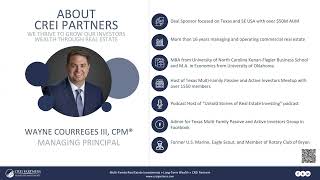
Foreign. Good evening everybody. Thank you all for joining the Stratton Park Apartments webinar. Super excited to really go through the investment from a macro level. Why we love the deal a little bit about San Antonio, the market that we're buying in and then of course the property, Stratton Park Apartments. So just to start off, this is a disclaimer. This is not an offer or solicitation to purchase securities. We always recommend to talk to your tax, legal and other advisors. Nothing in here really has forward looking statements. These are our assumptions along with our management company. So just know that this has not been reviewed or approved by the securities Exchange Commission. Other disclaimers this is a 506C offering for accredited investors. If you're not sure what an accredited investor. If you are accredited investor, we'll explain that later on in the presentation. But just want to be respectful of everybody's time. If you're not able to make the entire webinar recording will be sent out tomorrow to all those that are on this call. I also have QR codes if you want to do a soft commitment. A soft commitment is not anything more than saying that you're interested and this is the placement. And then we have first come, first serve. We've got a lot of people on tonight's call. So if you are even considering about investing, definitely do the soft commitment. It just puts your place in line for the investment. So there are several reasons why I love this deal. Mind you, our last multifamily investment we purchased was August of 2024. It's taken us many months to find opportunities. And one of the things we've been looking for are distressed deals. Now this property is not a distressed property. It's over 90% occupied. But the seller is a distressed portfolio situation. And so it's a unique opportunity. And that last year they bought this property in March. And here we are about a year later, we're buying it for $3 million less than what they bought it for in 2024. So day one basis right there, there's 3 million. But we are super excited because this deal came to us through a broker relationship. There's no offering memorandum. It didn't go out to the world. It's just through a broker relationship that we have there in San Antonio that was like, hey, this is a great opportunity. You want to look at it? And of course we said yes. We've been trying to buy into San antonio really since 2021. I've been underwriting property after property in San Antonio and numbers don't work because like I would submit a bid on a property and then I would get outbid by a million dollars. So think about Austin, San Antonio, a lot of growth, a lot of demand. And so I just didn't buy there. And so Houston was where I was able to find value and continue finding value. But this really has opened it up for us having this opportunity just for, you know, exceptional reason. Number one, buying it 3 million less than what we, what the seller bought it for last year and 800,000 less than the Bexar county appraisal. And that's huge for taxes. And we'll talk about that shortly. The second reason I love this deal, it's a 1985 asset, clean bones as far as wiring and plumbing and roofs were replaced in 2019. Like, this is a solid deal where we were buying like early 70s product at a much higher price per door. Now we're buying, you know, mid-80s, early-90s product for prices that were just unreachable, you know, just a couple of years ago because of the demand that was happening. This property will go into the submarket, but it's in the Upper Arboretum submarket of North San Antonio. So a growing area. And so we just love that the property is of good age and a good location. At the end of day, real estate just matters. Location, location, location. And this property doesn't disappoint in that. And then really, number three is what we're all looking for is cash flow and tax depreciation. Every deal we've done over the last three years has cash flowed day one. We have not hit our missed distributions on any of our assets that were not developed. Now the ones in development are still being developed as part of the process of the lease up, etc. But all the properties like this, they are cash flowing and they produce an amazing amount of tax depreciation. And with tax season now, I love we're sending out K1s and there's just a really good amount of tax appreciation happening for our portfolio. And so you can do that when you're buying an asset 3 million less than what the prior seller does. And you're doing it with fixed rate debt. So all of our properties that we buy are fixed rate debt. We do not use bridge loans. I don't have any bridge loans on our portfolio. And we'll talk about that with inflation on a couple slides from here. But you know, right now our fixed rate debt is 5.34%. What's great about the market right now, if you can Say that and I'm very bullish. I think things are really great for real estate guys is the Treasuries are going down. And so as treasuries go down, the rates for multifamily in particular go down. So 5.34 was the rate we were quoted a couple of weeks ago. And so as we go through the loan process with Fannie Mae, this loan actually may decrease for interest rate. So it's not your multi family ordinary deal. We only do maybe 2, 3 at the most a year. We don't have a lot of deals that we send out consistently. And the reason is because we're just underwriting and trying to find opportunities. And trust me, we have investors who are like, hey, when's your next deal? When your next deal? And I'm like, nothing really works. And so here we are, finally finding something that works since our last investment. So let's talk about why multifamily investing. At the end of the day, everybody needs a place to live. It's a risk, resilient, basic human need. We all need shelter. And so especially in the Texas Triangle, there's a lot of growth, a lot of people moving to the Texas Triangle for jobs and cost of living, being a lot cheaper, et cetera. And so when you have housing and you have population, the demand that's coming, it just is something that I really feel like when you compare that to office or retail, things that could easily like if the economy just goes spiraling out of control, people can close their doors at night, move their stuff from an office standpoint, but people need a place to live. When I worked for CBRE, I saw that during 0809 and commercial real estate where a lot of the offices, a lot of the retailers, those, they were, they would, you know, move out in the middle of the night and then we would come in and check on them and the next day they were gone. Well, multifamily housing, I don't see that risk. It hasn't happened during COVID hasn't happened in other cycles because at the end of the day people want a roof over the head. The other thing is I like about multifamily is the best risk adjusted return among other asset classes. So whether it's office, retail, industrial, I mean those are all great in their own way. But multifamily has always led the pack from the investment cycle of returns over a period of time. Have it has multifamily had dips? Absolutely. But over a period of time it's always, it has prevailed it's done extremely well and is out beaten the hotel or part or retail and office. And so that's another reason why I like the multif family. Obviously cash flow and equity appreciation is, is massive from a cash flow standpoint we're not buying deals and we haven't bought deals that don't cash flow over the last few years. So if they, if they don't cash flow day one, we're not buying it. All of our deals recently and I said in the last few years have like Q1 after buying the property we're distributing cash flow equity appreciation as we, as the market, you know, increases and the demand increases, supply lessons and we're paying off our debt, you know, there's a lot more equity appreciation that's being paid for by our residents. And going back to tax benefits, we, you know there is talk about going back to 100% depreciation. I think, you know, that's a very good possibility. But even still we've got really good tax benefits through a cost segregation and providing those paper losses for investors. So this slide is not normally one I have but I put it in for this one because I feel like the timing of it's, you know, pretty particularly good over the last couple of weeks stability during market volatility. So I don't really care on our portfolio what's going on. That's me personally because most of our investments are in real estate. Everybody's going to be a little different, everyone's going to be diversified different. But I don't have to worry about an Elon Musk tweet. I don't have to worry about what's going on in China. I don't have to worry about anything other than the submarket that we have properties in. At the end of the day, the first of the month rents are due and we are really dependent and driven on that local economy. So no matter what's going on on the outside world, as long as the submarket and that market is doing and even in not even the market as a whole, just more so the sub market, no matter what's going on in the outside world, the volatility which is going to happen, you know, there's going to be ups and downs. We've seen it. Many of us that are on the call have seen multiple cycles of this and we don't get scared actually we get in the mindset of buying those people that didn't run away from real estate in 08 and 09 made an incredible amount of money. I was Getting out of the Marine Corps at that time. So I didn't have a whole lot of money. But I was in commercial real estate and I saw a lot of people like oh, the media saying this, doing that. And so people, you know, didn't invest. And I just thought to myself, like, man, if I would have bought those stocks, that real estate, if I had that opportunity during that time, it would have been a great lift to our portfolio over the long run. Not even the long run, you know, five years later, it was just incredible. We saw that during COVID people got freaked out. Stop buying, stop buying, stop investing. Those people that went in when things didn't look good, they did extremely well over the next, you know, few years. So stability during market volatility is huge. Especially with multi family inflation. There's no better asset to invest in than multifamily when we're thinking about inflation, especially when we have fixed rate debt. So fixed rate debt's happening, say in this case 5.34% rents follow inflation. So if inflation is going up, inflation's going up. But what's staying consistent is our taxes or excuse me, our, our mortgage, our fixed rate debt. So it's a built in inflation hedge. As I was mentioning on the stability during market volatility, local performance, not global panic. I just think that's really timely right now. And lastly, the demand grows during both market instability and stability. We've seen this across our portfolio in Texas in particular, where there's just a lot of growth. We can't deny that there's been a lot of supply in certain markets, but there's not any new permits going out. And so when you think about like, okay, over the next two years that supply, say in San Antonio, there's 100,000 units that gets absorbed per year in San Antonio, well that's the case. Like in two years there's no inventory. All that, all the supply is gone because it's all been leased up. And so that's going to drive rents, that's going to drive demand and then that's when the developers start taking off their developments again. So these are these cycles of real estate with oversupply under supply, etc. So anyway, I added this slide. I just feel like this is an appropriate time to really remind people, investors like you and myself that you know, going into real estate, buying a hard asset, you know, you are owners of this property with me and it's tangible and it doesn't matter what's going on, the outside world we're living in or we're investing in a physical asset. So a little bit about myself. I'm Wayne Courageous. I have been in commercial real estate my entire career out of the Marine Corps. So I went to high school, obviously went in the Marine Corps and then got out in 2007 of the Marine Corps and was with CBRE for about 16 years. I started Crei Partners while working for CBRE in 2019 and grew it to a point where I couldn't do both the W2 job and CRI partners. So in June of 2023 left my full time W2 and went all in on CREI partners and our investments. I have an MBA from University of North Carolina. I host a monthly meetup which I see a lot of people have joined from that meetup which is amazing. But we meet on the fourth Monday of every month virtually. I've got a podcast, Untold Stories of Real Estate Investing. We're actually about to launch another podcast soon for passive investors. And then I'm a former US Marine, as mentioned, Eagle Scout and member of Rotary Club of Bryan. So we've added on two team members, two full time team members. One is Shelby Whitaker. Many of you, if you've invested with us before, you know Shelby. She handles all of our investor relations and really the hospitality experience of once you invest with us. Between K1s and the investor portal, any questions, the monthly updates, et cetera. Shelby really handles a lot of that and then of course I support along the way too. Um, for any of y' all on the call who have invested with us, you know that I'm very responsive. We share our monthly financials, we're very open book and transparent and so hiring someone like Shelby to join my team was really, really important to continue elevating the experience as we grow our properties. On top of that, we hired Will Swenson earlier this year. Will has a several years of asset management experience and so he's taken on the full time role of leading our asset management. And that was really important in a strategic hire because I wasn't as I was growing and buying more properties, I was doing a lot of the asset management. And so when I hired him as a strategic move to take care of our properties, we're not going to be one of those companies that grows too fast and can't take care of our investors and our properties. So hiring Will to work and partner with our property management companies that are third party was essential to our growth and business. We've got over 50 million assets under management. We are lead sponsors on these properties. Ivy at the Galleria Candle Ridge Park Apartments, Majestic apartments. We have two 20 by 50 storage facilities. One in Bryan, College Station and one in Huntsville, Alabama. We have a build to rent community that is a 98 single family home development. That's think of it like a horizontal multifamily versus like a vertical multifamily. We are developing a multifamily development in Bryan. Sam Rayburn Apartments, 150 units. We'll be launching that soon. And then we have a medical retail in Alabama, 8331 Madison partners on this deal are essential. These, these guys I partnered with previously and just have a lot of respect for a lot of trust when things nothing from a passive investor. You're, you're interviewing the team or you're going through the due diligence of us as part me as a, as the general partner or the, the jockey on the horse. But for me I'm looking for partners who when things get tough and I'm saying sort of the general partners when things get tough, you know, are we working together? We, you know, getting through any of the challenges because no property is ever going to be easy. But if you have the right team, we're working together and collectively so. Dr. Rashmore Venkatramani, I've known him several years. We recently partnered on the Strat or excuse me, Kendall Ridge Park Apartments. He's the owner of Redoc Agency, a manager of Redock Capital. Owns a manager several rental properties in Houston invested in as a general partner unlimited General Partner over 2000 apartments over the last seven years. Dr. Adebayo Fasanya. He's the founder and CEO of Dr. Breathe Easy Capital. He's invested in multifamily since 2015. He's got over 184 million in assets and over 1800 units under management. We've got Donald Lindsay. 17 plus years of managing expansion of private equity backed companies through acquisitions of companies in real estate. He leads the investment in acquisitions of companies with a total valuation of over $1 billion across diverse assets and industries. And then we've got David Priest. 20 years as a full time real estate professional. General partner on over 600 units of apartments. Limited partner on over a thousand units of apartments. These guys are on weekly calls on our properties with our property management company and we're guiding the budget process, the monthly performance. We're getting daily KPIs from our software. So this, this is the team including myself who are going to be running day to day asset management. All right, so let's talk about San Antonio. I absolutely love San Antonio. I grew up in Austin. We all know that Alamo's in San Antonio. If you watch the final four, you and the championship last night at NBA that was obviously in San Antonio. Just a beautiful city and great people. If you like Tex Mex, definitely head to San Antonio. Great culture, great food, just great people all around. We're going to go through all the accolades here shortly, but it's among the 24th largest US metros in 2023 it had the fastest or the largest growth in population it rated on the US Census as number one. Think about there's over 2.7 million residents in the metro which is the second largest city by population other than Houston. San Antonio in the metro is larger than Dallas. It's also the seventh largest population in the city limits which is just massive. It's crazy. The US Census fastest growing metro number one rank 2023 population growth was 22,000 and the expected population by 2034 is three and a half million. The employment growth 2014 to 2024 is 25.2% and the national average is 14.2%. So a lot going on for San Antonio from a growth which really drives with jobs, cost of living and just a lot of great things to do around San Antonio. It's been a strong performance over the past 10 years outpacing numerous growth markets and percentage of population and employment growth. Houston is a market that we're really bullish in and we've bought a lot in. But San Antonio has been a market that like I said earlier has been a property or a, a city that I've been trying to buy in for a while. There's been 18% growth in the last 10 years, 25% unemployment in the last 10 years. So this is up there with Nashville, Dallas, Charlotte, Jacksonville. I mean a lot of the cities that you know, are heavy growth and not a lot of people are talking about San Antonio. That's one of the reasons I'm, you know, very bullish and been trying to buy because there's just been a huge amount of growth here over the last 10 years. Other accolades fastest growing city. We've mentioned that the second biggest city in Texas with a metro size the size of Chicago. It's a larger population than the entire state of New Mexico. There's diverse economy, tech, health care, military energy. Is home to five time NBA champions, the San Antonio spurs and two major amusement parks. They've added 36,000 plus jobs in 2023. The a top US tourism hub with 40 million plus vis million visitors annually. And it's home to Joint Base San Antonio. With 80,000 military personnel. San Antonio has a global presence, $580 million in exports in 2024. Obviously that relates to strong trade ties. There's 11 million passengers handled by San Antonio International Airport for 12 months ending in December 2024. And Toyota's 531 million dollar expansion added 400 plus jobs. There's consulants from Mexico, Japan, UK and more. Home to six Fortune 500 companies. There's 47 non stop flights to U.S. mexico and Canada. And it's home to 400 plus companies with global operations. San Antonio is a city that's just going to continue, continuing to grow obviously with strategic location near Austin, that whole area When I was growing up think about Austin, San Antonio being one mega city. And that's true if you've driven i35 between Austin and San Antonio is one massive city. And that's just going to continue to grow. So it makes no, it makes perfect sense why San Antonio's had a huge global presence. We're going to see growth over the next five years. So this is according to JLL, 5% employment growth, 13% GDP growth. It's putting. We hear a lot about Dallas, we've been hearing a lot about Vegas and Orlando. I mean San Antonio is in that pack of properties. So excited to see that continue for San Antonio. So if you're not too familiar with San Antonio, so San Antonio is southwest of Austin, so this sort of macro level. But obviously here's Austin come down San Antonio. Now in San Antonio, just like any market, there's places that you want to buy and you don't want to buy. Where the, and where you want to buy obviously is location and the growth. So if you think of North Santon, if you're looking at San Antonio the way it is now and you say okay, imagine it being a clock at 10:00pm and 2:00pm sort of in that quadrant between 10:00pm And 2:00pm those are, that's the area of growth and where you want to be looking at where you want to be buying. On top of that, a lot of cities, the inner loop tends to get the most rents and the most growth. So in this case 4 10s the inner loop that's not the case in San Antonio. The growth and the rental and such is outside the loop. So with Stratton Park Apartments being outside the loop and within that 10pm to 2pm quadrant it's continue, it's in the line of, of growth, especially close proximity to 35 and Austin. So from that standpoint, you know, I just wanted to show that map of like just getting a visual of where Stratton park is located. Then we get in a little more dialed in. So North Central San Antonio is where Stratton park is located. Look how close it is to the San Antonio airport. It's about seven minutes. Most cities, the San Antonio or any airport, you really don't want to live nearby. Like it's not a place to live. That's not the case in San Antonio. It's really a nice area outside were near the airport. This is a very, very, you know, we'll talk about the Arboretum submarket in particular, but a very, very nice area where like I personally wouldn't mind living and you know, raising my family. It's close to Castle Hills and a lot of great other submarkets. So with all the restaurants, it's walking distance to Target, walking distance to H E B. Excellent schools, parks, entertainment. 13 miles away from downtown, easy access to major highways. 19 minutes if you want to go Six Flags, Fiesta Texas. It's just, it's a great location and a great submarket. So we started at the Macro of San Antonio. We're dialing it in on what region? North Central. And now we're going to be really talking about the Arboretum submarket. So within the Arboretum submarket we've got 29,000 employees, over 2,835 companies, 47% of the population has a college degree or higher. And this is a stat I really, I always look at is what's the occupants or excuse me, what's the rental versus homeowners. And 49% of the rentals are occupied households. So there's a strong rental market. The other thing that you know, I always look at, especially the last couple of years is, you know, what is the supply that's coming online over the next few years. They've got 350 units of multifamily expected through 2025 and they've got absolutely no new starts. So if you look at the submarket occupancy that's a little down. The property is 90%. So it's, it's trending higher than the submarket. But as those 350 units become occupied and there's no new supply and more people are continuing to move to the area, this submarket occupancy is just going to increase and increase. And so this is a stat that I'm always looking at. And then the other thing I'm looking At is crime. You know, at the end of the day, I can make a property beautiful, I can do different things, but you can't really change an area. This is the lowest crime area that we've ever bought. And I have a map of it. It's green, it's like nothing's going on. And that's just a really good testament of this area. Looking at submarket occupancy rate 86 and a half percent population 1 mile is 7545 people. With over 83,000 people within 3 miles. The population growth from 24 to 2029 is expected at 5.58%. The median income is outstanding at $64,000. When we look at like what our rental rate compared to what the median income, it absolutely supports the rental rates that we'll be looking to do. Daily asking rent per square foot is $1.49. So between proximity to the airport, low crime, numerous office and residential buildings bundle retail and option and restaurants north central and more particular Arboretum really is a great place to live. And when I say like my family and we would live there, like it's the truth. When we did due diligence, walked around like this, it's a really nice neighborhood. So let's talk about the property. We talked about city, we got into the submarket. We're now going to talk about the property itself. So it's 127units. It's a mix of 72 one bed, 22 two bed. And then there's a separate property maybe like 500ft across the road that have townhomes. So it's pretty unique where it has like your traditional multifamily. And then there's 21 bed, two townhomes and 13 two bed townhomes. There's pools on either side of the road. There are 13 residential buildings, one leasing office. Apartment rental rates range from 789 to 1399. So going back to, you know, the median income absolutely supports increased rents from this 40 occupied units are well below market and we'll talk about that through our business plan. But the apartment community also offers many reserve parking, laundry facilities, access to bus transportation, community grilling, seating area. And you'll see some of these pictures as we move along. But a lot of the units are in this type of shape. You'll see black appliances, you'll see, you know, carpet. Typically you see carpet in the upstairs and wood or vinyl flooring on the first floor. That definitely helps with like the sound. But you know, fireplace all in all really Nice units that will continue doing minor renovations. We don't plan on spending crazy amount of money on interior renovations. When I say crazy, I don't expect to spend 8 to 10,000 a unit because you're not going to see the huge increase on rental rates to offset that type of investment. But we'll do moderate increases and if we're able to get, you know, 70, 500 rent bump, we'll do extremely well. And it'd be well within the business plan. So that's part of being conservative is like the days of like pushing 150, $200 rent bumps, like I don't live in that world anymore. $7,500. If we can do that and it makes our business plan work, then fantastic. So the market will change and the $150 and $200 rent increases will happen over time. But that's not how we want to underwrite it. So a little bit more into this I have budgeted and we'll go through our perform a 3% rental increases and on our portfolio wide we have typically a 5 to 7% rental bump. And the reason we have that, despite what's out there in the world of like negative rent growth and a lot of concessions, is because if people like those 40 units that are already below market, a 3% rent bump is like 27, 30, 27 or $30. Even if they paid that $30, it would be more expensive for them to move out than pay the $30 rent bump. And where are they going to move? Because if they move down the road, they're going to be paying market, which is higher than where they are paying now. And so, you know, we, we feel very confident that we can get 3 to 5% rental increases from the existing population. Take care of them from a resident, I mean they, in return, you know, we take care of the property, obviously have great taxes, tenant relations or resident relations, creating a culture where people want to stay, et cetera. It reduces the, the tenant turnover, reduces the expense. And we can grow the property without having, you know, people be leaving because it's, you know, crazy amount of money to live there. And so these are all things that we look at to reduce risk. When you look at a value add standpoint, you know, there's deep value ads. That's not this property. It's, it is a value add property and there's going to be opportunities and to grow rents, but we're not having to do it by getting 20, 30 of the residents out. So that way we can renovate and Push. It's really all organic rent growth. Once they were to leave, give us notice because there's going to be natural churn. We do modest renovations and we get them back. But the property has beautiful live oaks. The roofs were replaced in 2019. The pools look great, the sidewalks, there's two pet parks. Again I mentioned there's fireplaces, outdoor grill. I mean this is a solid class B asset in a class B neighborhood. So I want to do a quick video here. All right, so we're going to continue talking about the property. I want to pause there real quick reminder the QR codes. I'm seeing a lot of soft commitments starting to come in. Thank you for doing that. Soft commitments does not say you're absolutely going to invest in the deal. It just puts you in line. So that way we hold your spot. So definitely use that QR code. If you have any interest in investing, go ahead and go through that process. All right. So going back to the property, other things we're looking for, copper wiring, H vac, roof plumbing, electrical inspections were all complete. We met there a couple of weeks ago, ran cameras through all the the plumbing between the buildings, all pvc. There were some areas that will need some maintenance, need some repairs but, but overall no major concerns. Electrical, there's no stab lock breakers, Federal Pacific, nothing that's going to impact our insurance or need replacements. Exterior railings and soffits were recently painted in August 2024. You probably saw a lot of that in the, in that video. Roofs again mentioned were 2019. So what are the things that we have to do? Well some things over time, H vac unit replacements, that's normal R and M. We're going to be looking at adding washer and dryers to units and doing a property wide leasing program and actually owning the washer and dryer. So all, all that rental income comes directly to the property. We've done that on a couple properties and it's done extremely well. Pressure wash all the exterior as you saw in that video there needs to be some pressure washing, need to be restriping of the parking lot. Like all that's easy low hanging fruit things to just bring up the property appeal. The pool near the townhomes needs to be repaired. The pool by the other main properties are, is looking good but we'll have to do some repairs on the other one. Looks like a pool pump and then we'll perform exterior paint repairs on that side. But a lot of our, our value add is the renovation of 102 of the 127 units during the first three years and again it's really important, minor upgrades like I'm a really good landlord owner in the sense that we want to really take care of our residents, provide events, etc, but if we're not going to be that owner that goes through a capex budget year one and then we don't have money for a rainy day so there'll be some renovations that happen. But it's going to be very thoughtful, mindful and especially if we're able to get a return on investment. Those are things that I'm going to be looking for and that just goes with experience. We've um, you know, we've. I've had a property many years ago where you go in and you add and do all these things, you make it to where it's like a place you would want to live and then you realize like they don't really care about that. They want a place that's affordable and you know, safe and convenient to their work. So other things that we look at as investors is the FEMA flood map. Real estate is already risky so why add the risk of having a property in a flood zone? So this map here shows that this property is not in a flood zone. The other thing as I mentioned, this is the greenest, best crime report I've ever had on any of my properties. But it is in the green and so I just wanted to show and highlight this is that you know, even though we're close to the airport, the crime in the area is very solid. MLDC Management is a company that we have worked with on three, three of our other assets. They will be managing this property for us. This property is a very much of a boutique type company and that's a very good thing because I've had management companies that were very large 20,000 plus units and I felt like just a number to them wasn't getting that personalized experience. I know the owner extremely well at mldc, know the regionals and they will do a fantastic job. They turned down so many people to get that one lease and that's the type of work and type of management company you want. So that way we're not dealing with evictions on our properties. We don't have high bad debt, we don't see a high eviction process and a lot of that's just because of their screening factors. There are people out there that are concerned with what's going on geopolitically that a lot of people are going to, you know, that are not documented Workers are going to have to leave. Well, that's not the case in MLDC because all of the people that rent have to show proper paperwork. And I. It's not a political discussion other than it's really important that you have a management company who is being strict and following that to the T. And another thing for me that's important is to have third party management. There are things that one days I'm like, hey man, it would be nice to be if we're vertically integrated, but it's also nice to know that there is and I'm speaking to you as a limited partnership. It's nice to know that your general partner isn't vertically integrated on the, on the deal. You know, we're. I'm an eagle Scout, Marine, like I like to sleep at night. I don't have ethical issues or concerns. But there are people out there, when they're vertically integrated, they start moving money from a bank account to bank account and it starts, you know, fudging numbers. When you have a third party that just absolutely will not happen because they're not going to risk their reputation on that. So this is one of those things for me is just having a third party. It keeps that arm distance. It makes sure that that is professionally being managed for our investors. So MLDC's outstanding company. They were also a big part of the due diligence of the property, doing the physical, also the lease audit and then the, the budget as well. We'll go through that operational budget shortly. So rent comparables, 1 bed, 2 bedroom, $43 average a square foot for Stratton park apartments. And so as we go through the next slide, just think $43 and then I'll summarize on a couple slides here. But Altamonte is just right down the road. It's 0.3 miles, $60 a square foot. So this is a competing comp for us. Their per square foot is a lot higher than ours. Harper at the park, it's $1.42. It's an older property. It looks older, 0.7 miles, but still within the range of, you know, where our rents are. I would say Altomonte is a better comp. It's a near our age property. It's a much larger 432 units versus our 127 as well. So other properties, Arbor Hill is about $36 a square foot. Then you got 550, which is $1.52 a square foot. So when you start averaging them out, they're about A$49 on the average comps. So the subject being Stratton park, we're at A$43 a square foot and the comps average is A$49. Put these pictures up there just to show some other looks of the interior units. But I love this roof. It was bought, it was replaced in 2019. Those, those are expensive. So it's a great thing we don't have to worry about during our ownership. All right, let's nerd out on some numbers. This is something that I love doing. I don't outsource this. I really dig in on the numbers and one of the things I like to do from a macro standpoint. Now this seller I mentioned had some, is having a portfolio distress situation. The property itself is not distressed but still when they vertically manage the asset naturally there's, there's going to be, if you're, if your portfolio is distressed there's going to be stress on the employees to perform. So on this income for the T12 they're at a million 503. On our year one my number is less than the million 503. I'm anticipating that we will have some move outs, that we will have some bad debt that people were put in that they shouldn't be. And so those are things that we look at. If you see on the rent concessions, you know, and the, the bad debt like I'm, I'm anticipating that we will still have those things. Vacancy loss. I expect we will have some evictions. Like that's very normal and that's okay because it allows us to get the property stabilized with residents that are going to pay their rent etc within the MLDC guidelines. I mentioned the annual rent growth up here, the 3% again that's, you know, some people are like, well there should, there's negative rent growth. And that's true if it's a class A property there's not a lot of rent growth because there's not a lot of value add. They're already at the top of the market. But when you're already below market and you're less than even a lot of the units that are in the, in the apartment, you should be able to get 3 to 5% rent growth. Again that's only like when you think about it like on a 700 that's only like 2530 rent bumps and we're able to do that. So on our performing expenses, our expenses for property management fee are 3 1/2% general and administrative, $325 a unit. So it comes out about 41,000. So this is the, this is how we would operate any of our properties. So we feel very confident in these numbers. They're also higher in most cases than the existing seller. And obviously we're going to try to reduce expenses where possible, but we're not fudging and making numbers look better just to try to, you know, get the deal to work. Like if contract services could easily like hey, 24,000. But it's like no, we've done all the work. We know that trash past security, pull services, we're going to be closer to 35,000. Marketing, we're going to be probably having some move out. So we need to be, you know, spending more on marketing payroll. I don't know what they were doing for 125,000. Barely get a person for that 170,000. I feel very confident we can get a maintenance person and a manager. Repairs and maintenance now thinking about replacement reserves, our repairs and maintenance and our capital, we'll spend about 25,400 in R M for the year. And then this is sort of a catch all. So this is sort of a, you know, things that we may not see right now, but we just need some contingency. So that's part of our R and M expenses. Our insurance is 108,000. We've already received a quote for this and so we feel very confident about insurance. One nice thing about San Antonio is you don't have the swings of coastal cities because it's more inland. But 108,000 is what we have. Their T12 showed 219,000 and I found they put one of the, when they closed on the property, they had to prepay insurance and so they categorized that in their T12. So yes, this looks high and it absolutely is high. This is based on a quote. And the group that gave us the quote has done all of our multifamily so feel very confident in this number. Real estate taxes. I had mentioned earlier that we're buying the property $800,000 less than the tax appraised value. So day one and I've done this on two other properties that we bought over the last couple years is we're already buying at a much lower value than the tax appraised value. And so every year in Texas we fight our taxes, we protest our taxes. There's consulting firms that get contingency fees based on how much taxes they can save you based on the protest. Well, this is the easiest protest. It's literally showing them the purchase sale agreement of the Purchase price. And that's the purchase price that they will put in their system and bill out on the real estate taxes. So this 245,000 is crazier low than the real estate taxes that they have been paying. And that's just because of the value of what we're buying. We're in essence buying the property for a little bit more than what the debt is on the property, which is just crazy. Utilities kept that flat. And then we've got replacement reserves. This 25,400, this is a lender's requirement. So as we have unit renovations or H Vac replacements, we can tap into this 25,400. It's obviously like gravy on the potatoes. Like it's, it's extra monies and funds that we can tap into. What you'll see here though is the expense ratio is 56.3%. So it's higher in year one. And then it gets over. As we push revenue, it gets more into our sweet, sweet spot of 53 to 51%. These are the numbers that we typically would see on our portfolio. But year one, just being conservative on the revenue, uh, we're expecting the expense ratio to be about 56%. The other things that we're looking at here, the debt service coverage ratio is 1.75. Crazy. I mean, a few years ago we were doing, doing deals like 0.81. They weren't even able to get their debt service paid and they did a lot of reserves. This is 1.75 debt service. What this means is for every dollar one that goes to debt, there's 75 cents that left over to pay the bills. And so for Fannie Mae and these groups, they typically want to see 1.25 for them to do the deal, we're way above that at 1.75. If I look at yield maintenance, 9.4 debt constant 6.7, break even 66.1%. This is a big reason why I got a single family early in my 20s, because like when someone moves out of your single family home, you get no rent. I, I mean there's going to have to be a lot of units, like 40 units that would have to move out for me not to hit my break even. These are the, the risk things that we're going through to feel comfortable about any deal that we buy. And cash on cash, 4.8%. Year one, it grows at 6.6 up to 8, 8.2%. The cap rate at purchase is 6.1% on our expenses. The Cap rate on their expenses is five and a half percent which seems aggressive. And the reason is that if you take out and I thought about taking this number out but it, it wouldn't reflect the T12 and I wanted to be transparent on the T12. But if you take the 219, 000 and normalize it on what their actual year insurance is, this cap rate is 6 and a half percent and I mentioned that the interest rate is 5.34. So we're buying a cap rate, we're buying a property 1% higher than the interest rate of the property. And that could, that yield difference could even be further as rates continue going down and we actually lock in our rate. So this is my Performa. These are the numbers that I feel very good about. I sleep at night, but it doesn't matter what my Performa is. It's what the property management company feels like they can do. And I typically, sometimes I'll adjust numbers here or there, especially on expenses if they see something that I don't. But on my revenue numbers I never adjust. So I do my pro forma. I live with it, I'm happy with it. It gives me comfort. At night I can sleep. But then my management company comes in. They have not seen my pro forma and they are underwriting based on what they've seen in due diligence and how they can operate the deal, what their comfort level is. And so if you look at the net revenue here, they do it 1,000,552 988 and this number and these slides will go so you can dive in for those that really want to look at the numbers. But their net revenue is 1,000,552 988. My number for year one is 1,000,496. So I'm a stay conservative. I think they're staying conservative as well, which I think we all benefit. Even if we meet in the middle it's going to outperform our Performa. But that, you know, from a revenue standpoint, 1 million 552 their net operating income. So a lot of these expenses line up with what I have just because I've used MLDC for the last three other properties I've used MLDC so I know where their R M, where General GNA are marketing. So a lot of those numbers are similar but their net operating income is 742,000. My net operating income is 653,000. So it's over a hundred thousand. My net operating income year one is about 100,000 lessons than where our management company, who is the boots on the ground obviously going to be doing the work, sees that they can push. So a little less than 100,000 difference. So I wanted, I like to show the slide because this is coming from our property management, our boots on the ground. Again, I typically don't adjust our performa to match theirs, but when we do budget meetings and we're working on doing our weekly calls, etcetera, we're focused on this performer because they, they don't know about this one unless they watch this video, which I don't haven't seen them do on our recordings. But unless they do that, then they're not going to see the the two performance. All right, so let's talk about the class A. There are three class A's for those that. There are a lot of people here that were on our Candle Ridge Park Apartments and as you know about that one that's been doing really well. Quarterly distributions sent out K1s, et cetera. But how we did that one and how we're going to do this one are very similar. So there's three investment classes. There's class A, which for those investors that want just cash flow and they don't really care about the upside, but they want the cash flow, there's a $250,000 minimum to be in class A and to do that for that you get 10% return. And so Q1, you'll have $12,500. If I do my math in my head every quarter, 12,500 for that 10%. If you were to do 500,000, which is the max, it would be 50,000. And so how that works is the class A investors gets paid first and that and our underwriting already, our, our Excel spreadsheets, it already counts for this. So when we talk about cash on cash on these other investment classes, that's taken into account class A10 preferred return. So it's $250,000 minimum not to exceed 500,000. I'll tell you now it's very likely already taken because we've had repeat investors and they just want the cash flow. But if you're interested in that, like seriously, there's that QR code, do it quick because people, they just want that, they want that cash flow, they want that guaranteed 50,000 a year because a lot of them live off it. And I've got one investor who gets several hundred thousand dollars from us every single year. And then his K1s offset his passive income and he's, he Just living the dream. Anyway, so this is a good one, 250,000 minimum 10% but there's no upside. So the Class A investor IR is 10%. The Class A investor Equity Multiples 1.5. This is assuming a five year hold and a class A average annual return of 10%. So this is more for again cash flow. Now then we get into class B and C. Class B is $100,000 minimum and how this is structured and it's extremely favorable in the and multifamily investments. It's an 8% preferred return meaning I don't get any monies or our GP members don't get any monies until the investors get whole on their 8% return and say year one I'm at 4% well that other 4% is accrued to year two and then year three, year four until we sell the property. So those returns accrue and I like that a lot of people are going into these Equity splits like 60, 40, 70, 30 with no preferred return. I rather you make more money than me because you're going to tell your friends and your family and you're going to likely reinvest and we can all grow together that way. So I've stayed with the preferred return. Another thing I've stayed with is like on this deal, 8020 LPGP split, it's very aggressive. So 80% of the profits go to those investors based on their para share. 20% goes to the GP, the class B investor IR on this. And again this is based on my numbers that I feel like being, you know, super conservative like to sleep at night. These numbers are much lower than our management company numbers. But the IR on this that I feel like we can sleep at night is 16.56. Maybe it's 16 and I'll show you a sensitivity analysis in a future slide. But let's be accountable. 16.56 Investor Equity Multiples 2.05. So for 100,000 investment you should see low over 200,000 return which includes your principal class B average annual return of 20.93% this 20.93% you're still getting the 4% but when you take in the exit and your cash flows along the way, that's where this average annual returns and this is why, why people get really wealthy in real estate and become real estate millionaires is because they see a 2x on their return and then they also have, you know, these great average annual returns. A lot of people invest with self directed IRAS solo 401ks. Obviously do cash, but you can't get these returns. And we've talked about that early on on, you know, the equity markets, et cetera. On it's, this is a physical asset. And so anyway, so 100,000 will be the minimum on this. The class C anticipated returns are still exciting, still good. $50,000 investment for this. It's a class C investor IR 15.47. We got a class C investor equity multiple of 1.96. So, you know, a little shyer than 2, 2x multiple. Class C average annual return 19.12%. How this is split though, it's a 7% preferred return. So we're giving a little bit more to the investors bringing at least a hundred thousand. It's a 7% preferred return with a 75, 25 split. After 18% IRR, it goes 50, 50. And that's the same with the class B. And so there's incentive for us to outperform over an 18% IRR. I mean there's incentive for us regardless because we want to do well by our investors. But this is where we really are targeting too. So that way we can get further growth to you as our investor and then us as a general partner. You'll see cash flow again. This is, you know, day one cash flow, first quarter. There are deals where I said, well, we won't do cash flow for the first six months and all. And I don't feel that about this property. This is what the price that we're buying and getting it at. This is a day one cash flowing deal. All right, so let's look at the sensitivity analysis. And I did this one. I believe this one is. Yeah, so this one is on class B. So if you did a hundred thousand investment, this is the sensitivity analysis for that. And this is where the, the exit cap rates come into play. So I use costar. No one has a crystal ball where cap rates are going to be five years from now, three years from now, even tomorrow. But the, where our cap rate typically lines up is what CoStar, which is a leading multifamily research investment company. So their cap rate in five years shows San Antonio's trends of 5.8% cap rate, which is in line with interest rates and such going down. So we're at 5.8. But say it doesn't go down, maybe it's a 6%. I mean it's still a 2x multiple, 15 and a half percent IR. I mean even if it's at six and a half, 12.9% IR and 1.8 equity multiple is still, you know, very attractive. That's in a worst case. I can't imagine we're not even at six and a half percent now. So I mean actually we're buying this property at six and a half but it's also distressed. But as deals go down it's. My point is, is like these are all extremely good returns even if it starts getting a little more aggressive. 5 and a half, 5.25 depending on where Treasuries and things go. I mean this could be be a home run. I don't live in the home runs. I like my single basis. And so that's where, you know, that number I feel comfortable with. Now this deal here, this is for your class C. This is the 15.7% range. Again, if we're looking at, you know, the cap rates of where it could be could be 23% or 2.7x multiple or it could be as low as 1.7, 11.9. It's still beating the returns and removing the volatility of the market getting great. And this doesn't include tax depreciation, those paper losses that come by us doing cost seg. So but I like to show this because it just gives a bigger picture of like, hey, what if Wayne's cap rate isn't right? Well, let's look at, you know, different looks of how the investment will go. All right, so some, a few more slides here and then we'll do a Q and A. But deal breakdown, sources of funds. So the Total loan is 6.9 million or 6.987 million. Investor equity is 5.2. How this is broken down is the site acquisition is 10,750,000. That's I think their debt on the deal is like 10.2 million. So you know, slightly over their debt on the deal. Capital expenditures and reserves is 764,000. Acquisition fees 268,000, loan fees 243,000 and then closing costs 161. So this is the use of the funds for the 12,187,500 combined. And again that's broken out in this 5,000,200 investor equity is what we're raising capital. So the loan breakdown, we've got a purchase price of 10 million 750 price per door is 84,000 6 49. The loan, it's going to be a seven year fixed rate. I always do seven years even though I'm looking at buying in year or selling in year five and is because I don't Want to be a distressed seller. I want to be able to time the market obviously. And if that's year four, great. If, if, you know, year three, fantastic. But say year five is like really when we're target on selling. What if the market isn't good in five, year five to sell? Well, that gives us another two years where we're not, you know, stressing about our loan. Loan to value 65%. This is really important because we're not over leveraging. There's enough equity, we're bringing in enough equity to buy down the loan even further, which reduces, you know, increases that debt service coverage ratio, you know, increase or decreases the break even. You know, remember I mentioned that 66% break even. A big part of that is because this debt is being bought down at a very conservative rate. Deals that are doing 70, 75% those days are long gone unless you do a bridge debt. But people out there are still doing 80% plus on loan to value, which is just crazy. Anyway, 65% loan to value is definitely conservative and where we want to be buying the asset day one. This interest only right now I have it underwritten at two years. There's a really good chance this could be a four or five year IO. So we're working through that with jll, our debt broker provider. But for a conservative basis. I did two years, but this could be a four year interest only alone. So we'll look more into that as we get to that over the next week. So let's talk about timeline. So we were under contract March 21, 2025. We did due diligence on March 26. We're launching April 8 here. Equity raise launch ppm availability is going to be on Monday. So what we're doing over the next couple days is soft commits. I mentioned those partners early on in the slides. They are also, they also have tranches that they're raising for. So I fully expect ours to be our tranche of equity to be raised this week. Especially because we haven't raised capital since August of 2024. So again, if you're interested, do the soft commit. It holds your spot. CR Partners is not raising the full 5.2. We're raising a certain amount and once that amount is raised, the rest is the other investors. So the other partners. So that's something to be really mindful of. This is not one that like on my way around and all it's like here's a great opportunity. If it works for your timing, fantastic. If not, it's totally okay. But we're raising our equity April 8th. Starting ppm availability is going to be on April 14th, which I believe is Monday. So we'll have that legal documents and then we'll be doing Investor funding between April 14 and May 30. The funding has to happen before you're fully committed. So you'll what you'll happen, you'll sign the paperwork, you'll wire your funds and all this is through our portal. It's very, when you use your QR code to do your soft commitment, the process is very smooth. It is a portal that will, you know, give you all the updates, show you all your investments, all the K1s, PBMs, everything's in one place. It's similar to like having a Fidelity account or, you know, you know, another investment banking type thing. It's, it's a very sophisticated portal. So you'll do your, your funding through that, doing the wire or ACH. And then we're looking to close in 60 days. So June 6th at the latest, June 30th. And then we're looking to sell in 2030 and 2032 again. If we close June, the first distribution such will be the first quarter after, so 6, 90 days after June. And then you'll be all through the portal and ACH to, to your banks. All right, I've got a couple more slides here. So this is a 506C offering which is for accredited investors. So to do that, you'll have to verify that you are an accredited investor and we'll walk through that whole process with you. But in short, if you have, if you're an individual filing as an individual on taxes and make 200,000 or more a year, you're considered a credit investor. If you are married, 300,000 or more is required or a net worth of 1 million or more. That excludes your primary residence. And there's a couple other nuances like certain licenses would pass, that's fine. But ultimately what you'd want to do, and we'll guide you through it is is use verify investor.com. that website will be used to verify your, your investment or excuse me, your accreditation. And so we as sponsors don't see your financials and all you use a third party to verify the accreditation. Once we get the accreditation letter, once the paperwork is signed and once you wire or ACH the money, then you're in the deal. It's your spot saves or you know, are actually in the deal. And then we, when we close, you are owners of Stratton Park Apartments. And so if you're interested in investing, please commit your investment by CRI Partners LLC, cashflowportal.com or if you can just use your phone and just do the scan me here. We'll also send out the webinar and the link tomorrow to send out to everybody. But with that I want to see if there are, there's any Q and A. So I want to turn it over to live Q and A. So any questions? You should be able to type your questions and then I will be able, able to answer. All right, so one of the questions here is how come the seller is selling at such a, a low price if they're not in distress? So the property is not distress like I mentioned. I don't know all the details but what I'm being told is the lender, there's a certain lender that this person has used and they're, this lender is calling all debts so they're calling all property. So they have to go to, to the lender. So they're, it's, they're the lenders in essence forcing the sale regardless of how good the deal is. All right, another question here is on the insurance. What is the forecasted insurance growth? So we budgeted at a 4%. San Antonio doesn't see a big increase like what we do in other markets, but it's, it does pretty well. So one of the questions here is can I verify the store the lender is calling all debt? Yeah, it's verified. It's what, it's what they sent their investors in a, in an email. But great question. What is the rating of the school district it's in? I believe it's a three. Three out of five. What is the lender prepayment cost at one at five years. So that's typically how we do it. It's 1%. So it's a buy down. So it's like 5, 5, 4, 3, 2, 1. And so you'll typically 1% prepayment. That's also part of the, the underwriting as well. Great questions. All right. I know it's a little late, just wanted to give it another 30 seconds or so if there's any other questions. A lot of soft commitments have been coming in. So Shelby and I will be reaching out to everybody that has done soft commitments and those that are on this call who may be still thinking about it and we will go from there if there's any other questions. If not grateful for yalls time. Oh, it says can you repeat what you said about how much you will be raising. So we typically raise a million and our deals, but the whole raise is 5.2 million. And so those other partners will raise their portion as well. Some raise a million, some raise a million and a half, etc. So but we'll be targeting a million for hours. Should be able to do that in a pretty quick time frame. So we're always our GP Tim is always putting 5%. We at least have 500,000 in the deal. All right, well I will reach out to everybody. All right, one last question here and then any other questions, definitely email me@waynearipartners.com so we raise together. So we'll have the webinar. Those, those everybody will have their own individual webinar. But we are raising together. We have one portal that they're all tying into and so we raise, we race together. But everybody has their own set of investors that they go to. Like those that are on this call know C partners. They know me that a lot of y' all have already invested in our deals before or have been in our circle of influence based on maybe a meetup or reading one of our ebooks, listening to a podcast, etc. And so but it's very normal for the GPS to raise like this individually. So any other questions, definitely reach out to wayne@creipartners.com or reach out to everybody. I texted many of you already on the call and we'll do other text message tomorrow. So we're available and available to ask any questions. Appreciate Yalls time and have a great evening.
More from Wayne

September 2026 Meetup: Investing Ahead of Growth: The Bryan–College Station Opportunity





May 2026 Meetup - Apartment Complexes & Passive Investors: Opportunities & Risks


March 2026 Meetup - Reading the Market: Economic Indicators Every Investor Should Know


February 2026 Meetup - Syndication 101: How CREI Partners Structures Deals for Investors

Build-to-Rent (BTR) Communities Explained: Why Investors Are Paying Attention