The Crest Build-to-Rent Investment Webinar
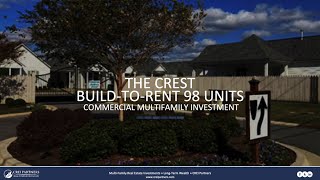
Recorded webinar (Dec 2, 2021) by Wayne Courreges III presenting 'The Crest' — a 98-unit build-to-rent development in Lafayette, LA. He introduces the sponsor team (Wayne/CREI Partners; Derek Alexandrinko — local developer; Andy McMullen — senior sponsor; Abel Pacheco mentioned), explains the build-to-rent asset class, Lafayette market strengths (population growth, university, medical, retail), unit specs (3BR/2BA, ~1,200 sq ft, concrete floors, granite counters), conservative underwriting (pro forma rent $1,515; actual early rents ~$1,650; 3% rent/expense growth modeled), capital stack (loan ~$11.6M; investor equity $2.5M; GPs invested ~$700k), contingency reserves (~$1.2M), target construction completion Q1 2023 and hold/exit window through 2026. Investor terms: 506(c) accredited offering; preferred return tiers; projected conservative LP IRR ~18% (2.15x multiple) and aggressive scenario up to ~24% (2.66x multiple).
Questions this video answers
98 single-family homes
~12 acres
3 bedroom, 2 bath; approx. 1,200 sq ft; uniform designs
Pro forma $1,515/month; early achieved rents ~$1,650/month
Total loan ~$11.6M; investor equity $2.5M; ~80% of investor equity raised at time of presentation
Chapters
All right, so thank you for your time this evening and for those that are going to be listening to the recording afterwards. I'm excited to introduce you to the Crest build to rent 98 unit development in Lafayette, Louisiana. I'm going to be your host. Wayne. Courageous and excited to get started. So our attorneys always tell us we have to say this disclaimer and there's a section in here. I won't read every line, but I always like to read this. Nothing in this document contains legal, tax, financial or any other type of advice. All investors should consult their own financial, tax, legal and other professional advisors to determine if an investment is suitable for their unique situation. So please read this at the recording and let's get started. So I always like to start off with the exceptional reasons why I personally like this deal for my personal investment and why I am bringing this to our investors. So the first exceptional reason, number one, is the proven strategy. In any business out there, if you've got proven business plans and customers already knocking on your door, the risk to start and implement and develop that business has just improved dramatically. In this case, we already have six units, the development's already there. We're going to go through that a lot further into detail later on. But the units already being built, the renters are already in, they're already paying higher than pro forma. We'll go through that later and there's already a waiting list for more. So there's already a proven strategy here. So nothing in this presentation, unless things just go completely south in the economy, if is overstating what we believe can be done because of what's already happening at the property. So I love that from a risk standpoint, for those that know me, know that I'm pretty middle of the road, boring but conservative person. And so anything that reduces risk, and we're going to be talking about that a lot in this presentation just because that's all what I'm about is, is reducing risk where possible on these type of investments. Ultimately all investments have risk, but when we can mitigate those risks, it's even better. So with building those current homes, land had already been purchased, entitlements already complete, a big risk in development is you're still in most cases trying to get the land, you're trying to still get the entitlements that's already been done and that equates to faster return. So on these build to rent development opportunities where you could still be a year out from buying the land, getting the entitlements, getting the Contractors getting the materials, et cetera. That's already been done. Six homes are already been built. Two homes are on their way. We're putting infrastructure in over the next five months. We're going to be building these out quickly so that way we can get those returns in. And unlike traditional multifamily new builds, we're able to get income at each property being complete instead of waiting for all the units and then getting the certificate of occupancy, etc. So all that equates to faster returns. We'll talk more about that. And then there's a slide that I've got dedicated on this is multiple exit options with any type of development. Real estate things are booming. Things are incredible in the real estate, but there's also risk as we talked about earlier. Anything we can do reduce that risk is great. And one of those things is having multiple exit options, which we will talk about shortly. So let me introduce myself first and then the team and then the team's experience as I mentioned earlier. This is Wayne Courageous. I'm the managing principal of CREI Partners. You know, we exist to grow our investors wealth through real estate. The more money I make you, the more money you you will reinvest and continue growing our business. So I am all about protecting our investor capital and putting your money first. I'm a deal sponsor, an asset manager, more so I'm an operator. I'm not a capital raiser, I'm not a sales guy. I'm not asking anybody to do anything that I'm not doing and that's investing in real estate. But ultimately what I enjoy and what I'm most good at is operating properties through asset management. I've got 14 years of managing and operating commercial real estate with a 150 Fortune 150 company. I've got a certified property management designation through the Institute of Real Estate Management and an MBA from the University of North Carolina Kenan Flagler Business School. I'm the host of the Texas Multifamily Passive and Active Investors meetup with over 700 members. If you aren't already joining us, please do. We meet on the fourth Thursday of every month and we bring in other syndicators, real estate professionals and we really dig in on all the different aspects of multifamily investing. For the Passive Investor podcast, host of the Untold Stories of Real Estate Investment Investing admin for a Facebook group, Texas Multifamily Passive and Active Investors Group. On the personal side, a former US Marine Eagle Scout and a member of the Rotary Club of Austin. I've got three kids, nine, eight and six. And an amazing wife who's very supportive of my real estate passion. Been married with her 12 years and yeah, so that's a little bit about myself. I'm really excited to introduce to you our team. The team has a lot of experience not only in build to Rent, but multifamily and real estate investing in general. Abel Pacheco, based out of San Antonio, president of 5T CRE. He's been a real estate investor since 2008. Over a thousand doors across, 13 syndications, $100 million of commercial real estate. Great guy and excited for him to be on our team. One of our senior sponsor syndicators, Andy McMullen with Legacy Acquisitions has orchestrated over 750 million in commercial real estate transactions over a 20 year career. We're going to talk on the next slide more about their team's experience and how that is going to be a huge benefit for all of us investors that are investing in this deal. The boots on the ground. The guy who knows Lafayette through and through is Derek Alexandrinko. He's there. I met him a couple weeks ago in person when I was doing my due diligence. Extremely impressed with Derek and his team. Again, not his first rodeo on these type of developments. And he knows the players. He's got relationships there. He was clearing the land. I mean he is. One of the reasons why I was willing to get on board with this team is due to Derek and his ability to really know and understand the market. Having Boots on the Ground is extremely important, especially us being based out of Austin, Texas. But he oversees all the capital equity debt departments with Hammerhead Capital along with his partner Christopher Ventri. And so yeah, this is the team and real excited to partner with them. They've got a lot of build to rent development experience. That's one thing we like to do is we want to partner with people who know and understand what they're doing. We don't want people to do this to be their first development type project. There have been several that this team has completed and put together all surrounding Lafayette, Louisiana areas. West Broussard Villas, Cottages on Solanges, Catalon Gardens, St. Fernand Townhouses. And so the Crest on Colorado is in a better position due to those experiences at those other properties. So before I go into deal, I really want to talk about what is Build to Rent. In our last meetup we spoke more about that. So those that are listening that went to the meetup will have a Pretty good idea of what build to rent is, but it's sort of this fairly new asset class within multifamily. I want to be clear, it is a multifamily asset. It is treated like an apartment building, right? It's known as horizontal multifamily, single family rental communities, build for rent, townhome communities. This picture on the top right is one of the first build to rent communities in Phoenix about five years ago. Notice the homes are smaller, the lots are smaller. You see that community pool. That is a massive build to rent community. And it's treated like a multifamily. You've got a property manager, the community common areas are taken care of by the maintenance team, the H Vac, et cetera. It's treated. If you think of a traditional multifamily apartment building and you break it up into smaller thousand to thirteen hundred square foot units and make them single family properties. That is a build to rent community. And it's massively growing and changing the landscaping and I would say disrupting the, the multifamily industry in general. I'm still passionate about multifamily, traditional multifamily. But this is definitely, in some cases, you probably have heard the gold rush and I don't want to be cliche, but it is a massive investment class that's growing very quickly and being very attractive. And we'll talk more about that. So with any attractive investment, it's all about your customers and business, et cetera. It's about who's going to be able to come and move in and live in these, in the product that you provide. And so on this slide, I really tried to cover, you know, say like multifamily renters. Why do multifamily renters want build to rent more living space, private outdoor space, there's privacy, the attached garage. One thing I love about multifamily, it's easy to relate with others because we've all lived in an apartment, right? And we all remember the people above you and the people below you and you go out on the patio and there's smoke or whatever and it's like, ah, I really want to be in a, in a house, you know, and excited for the next move. So that's why multifamily renters want to be and build the rent. Single family renters. They like the community amenities, the things that we all enjoyed as an apartment renter. Pool, clubhouse, playground, if you had kids, fitness center, those are all in these type of developments. And build to ramp in the homeowners and prospective home buyers, it's maintenance free, it's indoor, outdoor maintenance handled by management. They're not having to worry about anything that can hurt their budget that month. And then home buyers not having that mortgage, you know, being able to have that flexibility to leave anytime, they don't have to be stuck with the house that if the economy turned that they would have a hard time selling right now. Obviously that's not the case due to supply and demand. But one thing I also love about this is we're seeing a lot of institutional buyers and this has even drastically increased and as I said earlier, disrupting the multifamily space due to Covid. And there's certain things in life that happens in business that disrupts and changes. And it's people like even myself personally that wanted to get out of the neighborhood I was in and buy some acreage and not have all these people looking at my backyard. It's the same thing in here where people want to get out of that apartment. They've been stuck and cooped up into an apartment building and they're ready to get out, but maybe not able or want to buy a house, but still have the benefit of having a house. Back In March of 2020, JP Morgan put 120 million into this asset class. Brookfield put in 300 million. Tricon Real Estate, 300 million. Lennar as of March 2021 put $1.2 billion into this asset class. So not only are the traditional, you know, the multifamily syndicator sponsors like myself buyers buying these type of assets, but you have this huge massive group of institutional buyers with incredible amounts of capital looking for yield. And those builder rent apart builder rent communities are providing that yield and the money's following. So if we look at the metrics of multifamily, we talked about, you know, some of the benefits and why people want to move there. 82.7% of build to rent rentals occupants stay in those built to rent units. The retention rate is extremely high compared to the multifamily, which is still pretty good. Again, I'm not talking, I don't want to talk negative on multifamily because in a few months I'm going to probably come to you with the traditional multifamily because I like cash flow and those are good as well. But at the end of the day, what I want to point across is that in build to rent, people go into these homes and they have the backyard, they have the upgrades and the enjoyment of feeling like they have their House. So they're not looking for that next thing unless they're looking to maybe go buy, etc. Year over year. We all know in most asset classes rents have skyrocketed, right? Build to rents in this case from year over year. September 2021 14.3% compared to multifamily rents, 11.4. Those are pretty dang them. Good numbers Regardless. On our pro forma, we are conservative and we'll talk more about this in a later slide of 3% rent growth. But as you're seeing, if we're going to get the returns that I'll show you later at a 3% rent growth, imagine the returns at a 14% year over year or 11% year over year. So one of the exceptional reasons I mentioned earlier with the multiple exit strategies, I want to be clear that the goal of this is to sell as a, an apartment type community, right? A multifamily community. We're looking for people like myself and Andy and Derek who go out and are looking to buy these larger multifamily properties that those. That's definitely a buyer base, right? But we're also looking at the institutional. And what I'm seeing across the board is in many cases institutions are buying these properties because before they're even completely built, you know, they're looking for that yield. They're being so competitive and trying to find these off market opportunities. It's incredible. But say everything just went to heck and things just the economy went down. Nobody's projecting that, but say it just completely went to shambles. What we wouldn't want to do, but what we can do and still make a good profit is turn these into a typical neighborhood, you know, single family homes where we're doing an HOA and then we sell them off one at a time. We're going to talk about what homes in the nearby area are going for compared to what. We're being conservative on our projections. But I like this traditional multifamily buyers, institutional buyers, and worst case if needed, the single family homes. It's a big draw for me on these, on the builder rents. So I'm focusing on the Southeast for our developments and purchases. In this graph here, 5.3 million homeowners will be in the south, east, Texas, Florida, you know, these regions in the next four years to 2025, 7.2 million more renters will be in these areas. Of that 1.2 million more homeowners in the Southeast, 1.8 more million more in renters in the, in the Southeast. All that to say is we all know this. There's massive growth coming from the west and northeast, coming down to the southeast of the United States. So all that to be said, there's a lot of growth population that's going to drive the demand. And if you put yourself in your shoes, if you had a choice between an apartment, multifamily traditional space, or down the road having a single family still having the same amenities, communities, which one would you prefer? I would choose a builder. Rent. So those people are potential customers of ours. So many people on this call, including myself, I will admit didn't know much about Lafayette, Louisiana. We drive through Louisiana quite a bit when we're heading to Destin every year. But I had to go to Lafayette to one have this type of conversation with our investors. Do my due diligence, drive around with Derek, really understand like what's really driving Lafayette. And I will tell you, the more I've researched in Lafayette, the more impressed and the more excited I am about this investment and in future investments in this area as well. I'm going to read a lot of these and I know many of you see these, but for those that are going to listen to the recording, there's just a lot of accolades with Lafayette that I think is impressive. 1. I love food. Southern living Tastiest town of the South. Wall Street Journal calls us the happiest city in America. Where to retire magazine calls it the top retirement destination. USA Today 10Best warm weather getaways. Convention south calls it the top music mecca in the South. According to College Park, Lafayette is a top 50 college town in America. And realtor.com, 10 smaller cities poised to skyrocket. Now here are some of the demographics and other things that I really needed to know and understand before I could come to you as our investors. The market is growing, the population is expanding. Over the last year since 2020, population growth has increased 6.5%. The general area, the MSA population is about 489,000, of which 126,000 are in the city limits. The family median income is 67,000. So what I want to see, if I look at our rents and see, you know what, how far can we max out those rents and still be within, you know, the three times monthly income compared to the rent, we're still well below that and we have some wiggle room to even potentially grow our rents even more because of the high median income. When I thought of Louisiana, and trust me, every time I do a deal, I have to convince myself when I Think of Louisiana, I think of a lot of energy and oil. And what is that going to mean for the economy if we're investing there? And so going there and really understanding that the education, yes, Louisiana is heavy energy and I don't see oil going away anytime soon. So we're good there education. University of Louisiana is based out of Lafayette. We got to drive that area. A lot of growth, development near the university. And you know, obviously it's a very, very large and good university and supports a strong workforce for, you know, people getting out of college. But the other item I was really impressed with was the medical. You know, Lafayette serves as a regional medical support for the other parishes around. You know, it's, you know, the massive development wing going in at the hospital. And so when you look at the energy, education, medical, you look at the growth of the population, the median income going back to that slide earlier about the millions of people moving to the Southeast, you know, I can then start convincing myself like, hey, this is a great investment for myself and our investors. Okay? The cuisine, the history, the culture. Those are all things that I would say Derek, at the end of this could probably tell you, you know, Lafayette is a great place to raise a family. I know he, you know, has family, his wife's a teacher actually at the school that this particular community is zoned to. So I was super excited about learning about Lafayette and convincing myself. So let's talk more about this asset overview and location and more about it. So this is a class A build to rent, brand new development. And as we've covered before, it's built on 12 acres, 98 single family homes. They're all three bed, two bath consists of stainless steel appliances, granite countertops, open floor plan, you know, premier trim package, polished concrete floors. We have pictures and we'll show some, some different floor plans shortly. But this investment, and one thing I really liked hearing from Derek is the efficiencies and the economies of scale of keeping these properties or the interior pretty much the same. The exact same. Right? So from the lumber and the granite countertops, et cetera, able to buy bulk and the right size without loss of product and material was huge. That helps on the bottom line. So I wanted to give you an idea of Lafayette. You'll see i10 here. That's how I drove in from where I live. Drove in south, southeast of I10 is really where the massive growth is occurring. I've got a slide that shows a little more of a zoom in on, on the property, but with the airport and all the Development, we are in the pathway of the growth, which is what I want to see. You know, I don't want to be in an area in any market where we're not in an area of growth. If I zoom in on, on it, these are incredible restaurants and I want to say vendors, but you know, retailers that are near the crest on Colorado. One in particular is Whole Foods. Think about the amount of market research and the demand that these companies go through. Starbucks, Sam's Club. They're not putting in a Whole Foods or Sam's Club if people are moving into this area and can't afford those type of products. So that was a good sign to me. And then having been so close to this growth of new retail, I mean, everything is, I won't say everything is new, but the developments and the retail tailors near us are quite new. The Chateau and Mirage apartments, one thing I was impressed with, I mean, rents go up to $3,600 for a one to two bedroom or one to three bedroom home, right? We're projecting our poor form as 1515 and we're actually getting $1,675 or $1,650. Excuse me. And so, you know, pretty much double the rent. You can be in an apartment building, which more of a reason why I love this concept. At the Creston, Colorado, homes are selling for 207, 335,000. At the DSLD Homes area, this cottage at East Broussard sold recently. This is a build to rent community. It sold for 208 or 2004000 a door recently. Similar concept, build to rent. I'll tell you on our deal, it's 183,000 a door. So if a similar project you talk about, a case study is selling for 204,000 adore and ours is projected 184 or 83,000. You know, there's. We're being conservative and it reduces the risk that we've talked about you know, continually throughout this presentation. So right now, the crescent build rent site in this picture is an old picture. Derek and team have done a lot more since then. But it is, it's land and it's great because it's cheap land. You know, those are all good investments, especially if you find cheap land in growing developing areas that are in good school districts and you have a lot of communities and developments, new homes and apartments growing in that area. And so as I mentioned earlier, it's a 12 acre lot. The city approvals, permits have already been obtained. Construction is already going first Six units are built now, performing the conservative underwriting. I mentioned it in the last slide, but I want to reiterate on our pro forma, we're budgeting $1,515 in rents. We're already having $1,650 rents. Already a waiting list. The six units are already leased. The risk of it continues to drop, especially when you look at the neighboring opportunities that a, a renter would, would choose and decide, you know, where do they want to, you know, put their hat. So let's look some pictures. Beautiful. These are homes that I would, would love to live in. You know, the concrete floors, the granite countertops, the electric fireplace. There's doggy doors, which on the side is. It's great because those, those doggy doors encourage dogs, which equates pet rental. So cash flow. You know, the wooden ceiling, the shiplap accent walls. I mean, this is beautiful. And they're doing this on every single property. Right. They're all looking similar. We're going to talk a little bit more later on about hurricane. But these are built like a tank and we'll talk about the hurricane risk and what, you know, protections and such are in place, etc. Because it's important from a risk standpoint. But these, these properties are, as I said, are built like tanks and constructed extremely well. And so going back to that retention slide, you know, if you're here and you're feeling like you have a community and you've got space and you can have your barbecue pit and not feel like somebody's on top of you, you know, you're going to stay and be willing to pay rents for the future and higher than you would currently. So these units are the same. 1200 square feet, uniform designs, reduced building costs, decreased construction timelines. We talked three bed, two bath. They're low maintenance. They've got concrete floors, the modern interior colors, granite countertops, the vaulted ceilings. And again, you're going to get these, the slide deck and the recording. But, you know, as you look at the design, it's smartly laid out. You know, one thing I was impressed with Derek and his experience with single family developments and things that he's done on his other developments is he understands and knows what renters are looking for, for the size of the laundry and the closet space, et cetera. Everything was really thoughtful on what they were trying to accomplish and what the customer or the, you know, in this case, the resident is wanting to have in their home. So these are four elevations that are going. The thing I Liked about the community is that they're not all going to look the exact same from a standpoint of color. And the front facade, even though the inside, as I mentioned before, it's all the same. The outsides do look different, which I love. You know, it'll make it and feel more like a home community, one that doesn't look just like every single home throughout. So from a new development, comparables. I'm going to go to the crest at the very bottom. 176,400. If we were to sell those homes on an individual. 176,400. If you look at these other homes, 208,000, 109,000. Dogwoods at 229,000. I mentioned the cottage on East Broussard, 204,000. We're again putting in enough risk to mitigate risk at not saying I could come to the investor say, hey, we can get 208,000 a door, et cetera. But coming to you at a pretty conservative number and still be able to make the returns is incredible. I think, you know, as you can see here on the right, some of these developments, you know, have. They have a pond, they've got, you know, garage and clubhouse, et cetera. Every community is going to be a little different at the crest. You know, we'll have the pond, we won't have a clubhouse, but we'll have a dog park, playground, common area, barbecue, and large backyards. That was one thing I loved about this property compared to the cottages on East Broussard is the backyards. That is something that's important for me, especially as a family, to go in and have that yard space. And so, again, just really excited about what was planned and thought out for the crest here. So let's talk about the sources of funds the property's already purchased. When we talk about skin in the.
Game.
The general partners have already put in 700,000 on the deal. We'll be putting in from a general partnership side, about 370,000 from an investor's equity. So we've got skin in the game. We believe in the product, but we want to be as transparent as we can with the sources of funds. So the Total loan is 11.6 million. Investors equity is 2.5 million. Of that 2.5 million, 80% has been raised. So we should be full in the next week, really, after this presentation. I see these spots going very quickly, and so we're excited about that. This is not something that we're having to say, hey, this is three, four weeks of finding Investors, this is all happening very quickly. And again, 80% has already been raised. So we're, we're excited to get CR Partners investors on this deal and finish it up. So that way Derek and his team can have the funds needed to accelerate the development. The uses of the funds, site acquisition, developments 3.1 million cost to build 9.2 million development fee 342,000 loan fees and cost 171,000. And what is important, and we talked about this time and time again on those risks, is having the reserves. If lumber and material skyrockets or there's a massive economic collapse, et cetera, we've got another 1.2 million in reserves. And as I mentioned earlier, the thing I loved about this development and learning more and getting really excited about it was each property, we don't have to finish all of them. So if things get really, really bad in the economy, we can finish on that last project and pause, right. We're not having to spend our capital, our investors equity, your money, my money, the team's money on it. When things are bad. Now, I don't see that happening. Nobody does, but nobody has that crystal ball. And again, it's all about mitigating risk. But having that 1.2 million contingency reserve is incredible. And those that are actively looking for multifamily type deals, I would say that that is a massive contingency to have. So I thought that was really good. The build to rent projections from a financial standpoint, you know, year one. So we're in this year zero timeline, right. We're a few weeks from securing the loan and then by. And we have a timeline later on in the slide deck, but probably around May timeframe between now and May, we'll have all the infrastructure, the plumbing, the electrical, the streets, all the infrastructure needed to then produce massively develop these, these properties quickly. So what we did is on year one, you're going to show a net operating income loss of 55,000. And that's typical, right? It's new development. You know, think of this as a true value add. This is the biggest value add that you could have land and adding value and the development. But if you go into year two, we're, we're. Our net operating income year two is at 505,000. Now on our expenses, we've looked at comparables from an operator standpoint, I have reviewed and felt comfortable with the numbers. The vacancy credit loss as we get into later years is at 10%. It stays constant. We're not trying to be too Aggressive on the the vacancy. Even though I said earlier, there's there already leased and there's already a waiting list. The operating expenses are growing 3% a year. Once stabilized, rental income as I mentioned earlier is growing 3%. And you know all this projections and as we go into future slides about the returns are all based on the prior conservative pre construction numbers, not the aggressive what we're seeing and that's actually happening on the site. So as we go into the investor projections. So there's two options. There's a class A and a class B. And ultimately what that is separated by is how much the investor is putting in. So for those that are putting in over 150,000, you'll be in the Class B 9% preferred return. If you're doing between 50,000 and 150,000, it's an 8% preferred return. So what I like about it from our investor standpoint is year one, there's not expected cash flow per se, right. And so year two, the 8% that you accumulated in year one will go into year two. So the spreadsheet talks about how or shows you know, cash flow. Year one, zero. Year two, 2300. If you're putting in 100,000, year three, 16,000 in returns. Year four, 17,000. Year five 17,000. So from a sample return of say from 100,000 investment, we're looking at a 2.15 equity multiple and a projected LP IR of 18.31%. So when you look at all the cash flows in the sale at Today's rate, about 18% return year over year and then having of 100,000 you're putting in the investment comes back 215,000. Now this is the conservative side. That's that 3% rent bumps, those are the 3% expenses, those are the $1,515 rents. If we get more aggressive. Right. And I don't at the end of the day I want you to be happy and sold on this pro forma this investment return projections. But if we go off of what we are getting today, we're looking at a 2.66 equity multiple and a 24.27 IRR. Again, I don't want to over promise under deliver type things. I really want to focus on the conservative underwriting. But again if we're looking at what's happening today, it should, it could potentially be a lot more. Looking at the 2.66 equity multiple, we will also plan to sell in three years however the market changes. So we're telling all our investors this could be a five to six year investment. So when you look at this investor projections, you've got to be good with this five years, right? But at the end of the day, as we talked about in our exit multiple exit options, there are a lot of people looking for yield and they will come from individual buyers, institutional buyers. And when they can get us the returns and the investment, our team, our general partnership will review and make that decision on what's best for the investors on the deal. So super excited about this investor return projections. One thing I also like to show in our presentation is the sensitivity analysis. Now the levered IRRs here are combined of limited partners and general partners. But I want to just show this as a visualization of how good it can get and then if it gets bad, still how good it can get. Which is why I love this deal. So the base case on vacancy is 10%. On this deal it's 23.04 combined again with the limited partners and general partners. If you're doing an 8% vacancy, that bumps up to 25.81% IRR, 9% vacancy. If we're going up a little higher, 24.45% if we go higher, if you skip down to scenario four, if we have 11% or 12%, you're still in the high teens on the IRR. The equity multiple is still incredible on this sensitivity which I like to see on the exit cap. Our going in exit cap is at 5.25. Our base case exit is 100 basis points higher at 6.25. Right. And so if we even jump up if things got. So if we're at 5.25 and say we went up to say 6.75 on an exit cap, we are still in the high teens, the teens that you would be looking for on a traditional multifamily, which you know, I like from a sensitivity analysis. Number three, when we were looking at income growth, we had mentioned the massive income growth before. But say we get 5%, we're at almost a 30% IRR. A 4% is at 26% IR. You know, obviously the base case mentions 23% when combined LP and GP, but it's still massive. Now what if we just get 1%? I mean we're still at a 14%. So all these things when I'm trying to convince myself to then try to discuss with our investors, I just get, I'm just excited about, you know, the expense growth here. We did a conservative 3% and it's all still looking good. So as those that have been on a lot of these investor webinars and such, the numbers are tight to get these deals. There's only so many levers that you can do. But as being as transparent as I can be to you and show you that the levers here, even if it goes worst case in best case, which it's already best case today, not to say it will happen continuously, but we're still set up as all of us as investors together making really good returns. So let's talk about the construction timeline. We've got a few more slides and then we'll open up to Q and A. But the entitlements have been completed as of June. They've started construction. As I said, I've touched the dirt, I've seen it. The guys are going at it, clearing the land and starting their infrastructure, finishing out. They finished out the six units, they've got another two units. And then talking with Andy, or excuse me, Derek, yesterday, those should be done in the next couple months. And you know, they'll keep moving forward with the newer properties. So between now and end of May, the groundwork in essence should be completed for us to then really jump start our construction. And we can have Derek talk to us shortly about the construction timeline and such. But ultimately what we want to do is be on target to have construction end, have all the 98 units complete by March 31, 2023. All right. And so that's why I was saying earlier, you know, if we can sell in 2023, fantastic. Now if we're still, if we're getting great returns and things are good, you know, the GP may hold it at the end of the day, we're projecting on a five year hold, but with construction ending in 20, you know, first quarter 2023, you know, we are really excited for the potential opportunity to return our investor capital at the returns we were talking at before or more stabilization. August 2023. And then as here it shows, December 1, 2023 to June 1, 2026, anticipated sell date. So for all of our investors, I really want you all to feel comfortable with 2026 of the return. But that is not my goal to get you money back in 2026. Right. But let's all be worst case thinkers and make sure we're all understanding, you know, this is an investment. Communications is key. So everybody on this call and those that are listening, that are investors with CRI Partners, you know, we communicate monthly, we do a quarterly call, you know, so we, you are owners of this property, you know, and as owners, you want to be communicating, whether you want to be on those calls or see those emails, at least you have that option. You know, communication is extremely important because me as an investor, I expect and want that, you know, from our, our GP investors as well. So this is a 506C offering. So this is for accredited investors only. Credit investors would need to show proof of substantial income, which is 200,000 a year, 300,000 if married or have a net worth over a million dollars, not including your residence. So if you're not accredited, that's okay, you know, let's build a relationship and on future deals that I can do a 506B on, you know, I'd love to have you be part of our investor base. But if you are accredited, this is open to you and you will need to self certify and have either a certified public accountant or an advisor, investment advisor registered with the securities and Exchange Commission or going to the website verifyinvestor.com I don't want to make it sound too complicated because it's really not. And thousands and thousands of other accredited investors have gone through this. But if it is your first time, we'll walk you through it. So don't be too concerned on that. But I want to make sure we know that this is a 506C offering. Now this is first come, first serve. As I mentioned, 80% of the funds are in and we're looking to have the rest in by December 17th. So this is quick but still time for you to review the ppm, ask questions. We can set up a call if needed and dig in further. But December 17 is when Crai Partners is closing on our side on the capital. Obviously, if we don't have all the money from either our partners or our investors or the other investors, it's going to stay open. But I'm feeling very optimistic and excited that this is going to go very quickly because it should. Derek and Andy and the team have really found a good one. So I'm excited to be part of it. Now with that, I would like to have Andy and Derek introduce themselves. Let's start with, with Derek Boots on the ground and really just talk to us about from a risk standpoint of the hurricanes, you know, things that we've talked about because I think that is a, that's a concern in most mines. It was in mine. So if you could ease us on, on that and any other updates or exciting things that you have about Lafayette and the development and then we'll turn it over to Andy. Sure. Yeah.
I appreciate everybody. Yeah, glad to be here. I appreciate everybody tuning in to hear a little bit about a project. I've lived here for almost 40 years and personally own about 50 properties. When I speak to folks out of state, it always is their main concern. It's like, well, how do you deal with hurricanes? And we see it on the news and every year it seems like we're trying to dodge one or two storms. But I've never had to file an insurance claim for hurricane damage on any of my properties. In general, the main concerns, the bigger concerns are flooding. If you live in a flood zone, then it is a real concern. This project is not in a flood zone. We are designing a retention pond system to handle a large flood event, like a 50 year type storm. So it's still designed to handle that, but we're not required to have flood insurance. So that's, that's really a large actually value driver. If you're buying a property that's in a flood zone, it's going to be, you know, sold or you'll have a lot less interest in it than the properties that are outside of the flood zone. And as far as hurricanes, it's just, you know, we have to cover it under insurance. So you have that and you're required to carry it. I've never had to file it. Worst case, you know, we've had to go and prop some fences back up. You know, sometimes the fences lay down when the winds are strong, but in general it always, it's worse for the coastal communities. The first 10 or 15 miles from the coastline, we're more insulated from that. So by the time the storms get to us, it's really just a bad brainstorm. And that's just from my personal experience. Obviously there are, you know, you know, really bad storms, like Charles got hit with one last year, but they're a little bit closer inland than we are. So. Yeah, I mean, that's really just kind of my experience with storm and flooding and kind of how we're positioned with this. I see one question that just popped up. As a crow flies, we're probably about 30, 40 miles from the Gulf. It would take you a lot longer to drive to the coastal community, but we're about, probably about 35, 40 miles inland.
Yeah. Thanks, Derek. One thing I really want to hit, we would not be investing in this deal if we were in a flood zone. And so one thing I love about this deal is it's not in a flood zone. That was one thing that we want to make sure of. And then as mentioned earlier, the roof shingles are rated 130 mile an hour. And as mentioned, with the. The smaller size of the property and the beam going down the center of the homes, you know, I. It really changed my concern on that, on the risk, because I'm like, y' all on this call and listening in. Was that a risk? And that. That was mitigated for me. One of the questions, Derek, was a lot of construction delays recently. What is the plan or the contingency for that?
Yeah, I mean, we've been discussing. I mean, I get updated information monthly from all my vendors and suppliers. Luckily, like you mentioned, the way we have these designed, it's all the same products. So we know down to the number of pieces of siding on each house, you know what we need. And so they're keeping us abreast on that, really. The ones that are taking longer, the main ones is windows that they're taking three times as long as they used to. So luckily, again, ours, the way they're designed, they're all the same window sizes. So we just need to order one truckload of windows. And I could store them at my warehouse is three minutes from this property. That's just the benefit of me living here. And that's. So that's probably the one thing, the supply chain issue that we're going to try to get those ahead of time. Everything else is fine for us. And on the labor side, I've been working with these same subs for years. I keep them busy, so they're pretty loyal. We don't have the same labor problems that I'm hearing that they're having in some of these other spots. Plus, we're not doing 400 units at one time. They know that they have a year's worth of work on this project, so they're all, you know, excited and looking forward to that steady stream of work.
Thank you, Derek. I'd like to turn it over to Andy now. I've got a question for Andy. What kind of tax brackets or breaks on this type of deal for passive investors? And then I'd love to hear your thoughts on why you got excited about this investment opportunity as well.
Well, I think, Wayne, just knowing you and how you approach things, I think it kind of speaks for itself. Right? I mean, it's rare that we get on a call and we see a deal like this with these same risk mitigants. Right. I know you don't bring anything to your group unless you feel like it's. It's checked all those boxes. What for me stuck out, I think was the kind of head start that we had. Right. Derek came with already the land. We already had the loan lined up. We already had proven the model. And then it just keeps getting a little bit better by way of rent growth. Right. As you mentioned earlier, you know, when we were doing the underwriting, we wanted to have, you know, enough in the reserves to withstand kind of a high supply chain issues with supply chain or high lumber cost. I think they were at 1500 per thousand foot board at the time. And then rents, they were at 1515. And the last one we did was 1650, as you mentioned, plus $50 in pet rent. So my point to people is just review the, the material and you know, tell me where you could poke holes at it. You know, obviously we could be running into some things with the economy and I think that we've prepared for that as well. But I don't, I don't see inflation slowing down too much. And as you guys know, it's good to own things when you're in an inflationary market. As far as the tax. So we will be able to deliver a partial negative K1. We did. We are working on a cost segregation study for this particular year. We're not sure exactly what that negative K1 would look like. However, in 2022, we'll be doing the bulk of the building and so we should be able to deliver somewhere in that 65 to 70% range. So if you invested $100,000, you would receive a negative K1 in that 65 to 75 to $70,000.
Did I answer your question there, Wayne? Yeah, absolutely. That was a question from one of our investors. So I know a lot of people invest in multifamily, are looking for that tax benefit and wanted to make sure we're answering that person's question with the answer is yes. It's just 2022 would be where we would get that negative K1.
That's correct. That's correct.
We've got a question here and we've got about two more minutes. Just respect everybody's time and then again I'll do the recording. But I do think it's a great idea. But with Derek, any plans for electric vehicle parking?
Each house has two cars directly in front of the home where they can park. We hadn't discussed it. That is new. I mean, I guess Teslas are starting to pop up here and maybe that is an option we put on a few of the homes. It's just not Something we have discussed, but I don't see why. It would be a very high cost to us and it might be a cool thing just to offer on a handful of the houses. Definitely something to look that we can look into pretty easily.
Yeah.
One of the comments here was is this a return on cap or return of capital? So since we're not, we're paying cash or our returns based on the, the cash flow of the, of the property. So return on capital. Right. So we're in essence the preferred return going into year two. You've got that 8% from year one, year two, paying back before the general partners are getting out of that income. So that's another aspect I like about this deal. It's return on capital. It's a return of capital and we can talk separately on that. So, hey, I'm going to ask everybody to get your phones and if you haven't already, take a picture of this QR or run your Q. It'll take you to a website where you can go ahead and do a commit. And ultimately a commit is not a commit until you got funds in the, you know, with us. And we're moving forward. Right. So don't be worried if for whatever reason you change your mind. This is not a pressure, this is not a. At the end of the day, we want you to feel comfortable. We want investors who are excited and can see the benefit of this type of investment. But if you are interested in wanting to learn more, I want to give everybody an opportunity for that. So go ahead and use your phone, go ahead and put your information in there. I am going to provide the recording, the slide deck and also the link to our investor portal where we'll have the ppm, operating documents, et cetera, where y' all can review. And As I mentioned, December 17th is our target date for funds in hand and ready to go. So with that, Andy and Derek, thank you so much for being on with us and thank you, investors for being on and allowing us to look for investments to grow all of our wealth. It means a lot and it's not something that we take lightly. So thank you for your time. For those that are listening to this on the road, when I post, etc. Anybody has questions, you can email me at Wayne W A Y N E at C r e I partners.com or call me at 512-710-2500. Well, everybody, thank you again for your time this evening. I appreciate everything that Derek and Andy has added to this presentation and look forward to partnering with you soon. Whether or not on this one, another one, we'll just keep them going. But I'm very, very excited about this one, so thank you again for your time. Thanks, Wayne.
Really grateful that you're. You're on this with us. We appreciate you, man. Take care, Derek.
Thanks.
More from Wayne

September 2026 Meetup: Investing Ahead of Growth: The Bryan–College Station Opportunity





May 2026 Meetup - Apartment Complexes & Passive Investors: Opportunities & Risks


March 2026 Meetup - Reading the Market: Economic Indicators Every Investor Should Know


February 2026 Meetup - Syndication 101: How CREI Partners Structures Deals for Investors

Build-to-Rent (BTR) Communities Explained: Why Investors Are Paying Attention