The Hidden Power of Solo 401Ks and Self-Directed IRAs
Recorded April 2025 monthly virtual meetup hosted by Wayne Courreges III (CREI Partners) with Shelby Whitaker and guest Paul from Equity Institutional Services. The session explains how retirement accounts (Solo 401(k)s and self-directed IRAs) can be used to invest in real estate and other alternatives, contrasts the two vehicles (eligibility, 2025 Solo 401(k) contribution limits, loan options, and UBIT exposure for leveraged IRA investments), describes the "checkbook" (LLC-owned) IRA structure and prohibited/disqualified-party rules, outlines the account-opening → rollover/transfer → funding → deployment process, and provides custodian contact details. Host background and meetup logistics (monthly, networking-first, passive investor coaching resource) were also presented.
Questions this video answers
Fourth Monday of every month at 7:00 pm.
About $50 million assets under management.
$69,000 (2025).
About $23,000 (W-2 employer 401(k) reference).
$7,000 per year.
Chapters
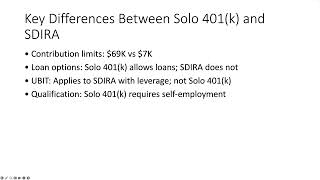
All right, welcome everybody. We are going to be Talking about solo 401ks and self directed IRAs. This is our monthly meetup. We meet on the fourth Monday of every month. And so, and it's through a virtual meeting. We've had already a networking at the beginning of this meeting. So we're going to dive right in. For those that are not familiar with our meetup, we again meet on the fourth Monday of every month at 7pm we always like to do networking breakouts in the beginning because all this information can be recorded and sent out afterwards. But the networking and the relationship building, it's really essential in real estate investing. So we just did our networking and now we're jumping into the content portion. We'll go through this probably 15, 20 minutes and go through a Q and A and networking and ultimately we're all here learning and growing together in real estate investment syndications. So I'm your host, Wayne Courageous. I own and operate Crei Partners. We have about 50 million assets under management in Texas, Alabama and Louisiana. Our portfolio is a mix of apartments, build to rent communities, RV boat and business storage and retail. Prior to me launching CREI partners and doing this full time, I was with CBRE for 16 years managing office, commercial retail. So my whole background and career has been in commercial real estate. I really started CRI partners in 2019, ultimately to grow our family and friends and colleagues as well through real estate. For me, working with CBRE was a great opportunity and I loved working with them. But it sort of really hit home that I need to be owning real estate with investors like yourself. My background in education, I have an MBA from the University of North Carolina, my Master of Arts in Economics from University of Oklahoma, and a Bachelor's in Business from National University. I also want to introduce one of our team members, Shelby Whitaker. Shelby is also based here with me out of Central Texas. She runs our investor relations and ultimately the, you know, creating the experience for our investors, not only, you know, now when we're doing these type presentations, etc, but we're also during the time where we send out investments and just keep everybody updated and educated on what's going on and doing our distributions, et cetera. So she handles all that. Obviously what I mentioned before, we've got a portfolio of 50 million assets under management, but that is shaping up to double this year. So super excited about that. But as mentioned, she's handling all of our investor relationships, communications that are going out, our blogs, et cetera, are the work of Shelby. Ultimately, she is passionate about diversifying your portfolio and income. And so part of getting to know us at CRL Partners is to connect with Shelby. Last thing, Shelby graduated from Texas A and M with a degree in communications and a minor in psychology. So one of the things I wanted to put out there is our passive investor coaching program. It is absolutely free. It's, I don't know, over five hours of content that I put together. What I notice is our meetup. It's great, you know, just one hour every month and a lot of times, like over 12 months you'll have enough knowledge and experience like, okay, I'm ready to go launch and be a passive investor. But I spent a lot of time on doing short videos. I mean Overall it's over 5 hours of content but they're broken out into different videos. So if you are interested, just go to passiveinvestorcoaching.com again passiveinvestorcoaching.com just subscribe and it's, it's free content for y' all to continue learning. All right, so I am going to go through some slides on solo 401ks and self directed IRAs for those that are in the group. I will check to see if there's any, any questions and as I mentioned before we went recording, if there's any questions, we don't know, we'll definitely reach out to our main contact over at Equity Trust and see if they can help provide more information. But from an introduction standpoint, most investors don't realize they can use retirement funds to invest in real estate. A lot of times investors think they have to use cash or sell out of their 401k to then invest in commercial real estate. But the powerful thing About Self Directed IRAs, Solar 401ks is that you can leverage your retirement funds and passively invest so you can direct those investments wherever you choose. It could be an oil and gas, can be real estate, it can be all different things. It could be debt notes. We got investors who help us buy land through their self directed IRAs. Like they'll lend, they'll use that as a debt or we've got a lot of investors, some on this call that are that they will invest using their self directed ira. The biggest reason is the tax advantages. You're in the cash flow, obviously the appreciation. So a lot of investors, you know, they need cash to live off, especially the ups and downs of the economy right now. But whether they use a self directed IRA or solo 401k, they're not going to use that cash flow anyway. Because those are reserved more for retirements. So if they're investing with their self directed IRA or Solo 401k, they can invest in a deal confidently while still having the cash they need to live off of. Depending on how the IRA is set up, depending on will help on the tax advantages. So the distributions that come from, you know, say CREI Partners or another group that y' all invest with, those distributions will be tied into the 401k or the self director IRA and taxed just like it would in any other investment that you would have in that retirement account. So we're going to talk more through the solo 401ks and the self directed IRAs with the more of a focus on passive real estate. And we're going to start off with the Solo 401k. So many people don't have a Solo on 401k because they're not self employed. So this is reserved for people who are self employed, who are small business owners with no full time employees. Now the contribution limits for 2025 are, you know, are high. I mean they're. And when we compare that to a self directed ira, you know, depending on your, your tax situation and your income, it, you know, will determine what you'll decide to do. But for contribution limits in 2025, it's $69,000 and then anything over 56, 76,500. If you compare that with a normal 401k which is about 23,000 through your W2 corporate employer, you know, it is quite a bit more. And the reason is, is that you're, you're able to match as an employer what you are, what you're investing as an employee. So there's the employee and then there's the employer match. So Advantages to solo 401k, higher contribution limits. There's loan options just like in your traditional 401k through your employer you're able to do loans off of that and then you've got your tax deferred or Roth options. So as I mentioned earlier, when you have those distributions that come in, they're, you know, between the tax deferred and Roth options at retirement, you know, everybody's going to be a little different on their tax situation. So always encourage people to talk to their cpa. Last month we had James Bowen who was our CPA on our syndications and for me personally, so definitely happy to make a recommendation to that group or if there's any questions for that, happy to find the resources for you. So the self directed IRA and This is what I see most people using. Many cases maybe they had a 401k with their other, you know, original W2 employer. It grew to a sizable account and maybe for whatever reason they left that employer. So they rolled over that money from a, a SOL or a traditional 401k into a self directed IRA. So that's one way that they may have funded their self directed IRA. Or every year they can put $7,000 or you as a person could put $7,000 into your self directed IRA. And then over many years, you know, that will obviously continue growing. Say you get 25,000 or 50,000 and you use that to, instead of investing in, you know, Wall street, you invest in Main Street. You're looking at with syndications, like with CI partners or other groups and you're investing, you're having more control over how you're investing your, yeah, self directed IRA funds. Similar advantages to the Solar 401K. It's tax deferred or tax free growth, just depending if you're doing a Roth or tax deferred type investment. Again, flexibility to invest in real estate, private equity, really, you know, there's no one telling you really what you can and cannot invest in. There's, it's a pretty open whether you want to do debt funds or you want to invest in, maybe one of your friends starts a business and you wanted to invest in that business or you do real estate, you know, you can even do like single family housing. So there's all different types of ways you can maximize and control where your, your funds are going. So the key differences between the solo 401k and self directed IRA, we talked a little bit about it. Obviously with the contributor contribution limits, 69,000 versus the 7,000 loan options, you can pull out monies and the 401k will charge you an interest on that so you can repay it. The self directed ira, you don't have those loan options with ubit. And this is something really important for those that are investing in real estate with their self directed ira. Just know that there's a UBIT tax and the UBIT tax. The reason why that is triggered is because you're buying real estate typically leveraged, so there's typically a loan in place. And so because of that you would trigger that ubit. And so it's something to be mindful of. If you are a business owner and have the ability to do a solo 401k, that may be more advantage to you because you wouldn't have that ubit. Again, you would talk to your tax consultant, you know, with when you have the depreciation loss, especially if you haven't used all those, the depreciation for your investments, you know, you could talk to your tax person and see how you can, you know, offset that with your self directed ira. I say that but I am correcting myself because if you're invested with cash, you have the opportunity to benefit from tax depreciation or excuse me from depreciation. And that depreciation is a huge benefit in real estate investing. And so but you don't have that advantage with when you use your self directed IRA or solo for 1k. So that's something also to consider when you're investing with cash or your retirement funds is if you have a lot of passive income and you're looking for paper losses that to offset that passive income because passive losses offset passive income, then you know, maybe cash may be the better option. Something again to talk to your tax person about and obviously happy to answer you know, questions on based on what I know as well. Solo on 401k does require self employment as well. And as I mentioned earlier, no other employees. So where I've seen investors do this is like maybe they're, they have a W2 job but their wife, you know, starts her own business maybe whatever it is. Like for example, my wife's a marriage and family counselor. She doesn't have any employees but she has her own business. And so you know, if she wanted to she could create that solo 401k. So sort of wrapping up here. We've got a few more slides but why use retirement accounts for real estate? Again, tax advantages is the, is the key one leverage. So you can, in a solo 141k you can use leverage without the UBIT diversification seven having all your monies tied to the stock market, you know, diversifying. And I, I've never been one to say like go all in on real estate. I mean for my portfolio, 90% of it is in real estate. But that's because I, you know, I know real estate, it's been something I've done literally my entire career. But you know, for majority of people like having it diversified further between stocks and bonds and you know, maybe some oil and gas, maybe you know, real estate, etc. Whatever is your comfort level, you're able to do that through this type of retirement account and then you got cash flow. You know, it's what we're all trying to do is get cash flow whether it's for retirement or now Depending on your situation. So having the ability to grow the portfolio just like you would if you're investing in a traditional investment. But in my mind like a faster pace because if you think of like a five to seven year hold and if you're making a 15 to 20% return, average annual return over that five years, you know there's potentially a lot more upside when you're investing in a physical asset. And like I said, you know, I don't have to worry about what's going on overseas or what's happening geopolitically here in the United States or someone's tweet. At the end of the day people need to pay their rent. They're, you know, it's local, everybody needs a place to live type thing. So that's makes me really bullish on, on multifamily and investing with these retirement funds. So let's do a couple examples. Actually I'm a pause real quick to see if there are some questions. Oh, Paul, you are here. Hey Paul.
Hi Wayne. My apologies. I had a family emergency come up. I wanted to make sure to join you guys here on the meet up on the, on the back half Man.
I'm so glad you're here. I'm glad you're okay. So we have. I can pause my presentation and if you want to put your presentation up.
If you would absolutely love to Wayne, but you are doing a phenomenal job. That, that is for certain, terrific. I would love the opportunity.
Yeah, absolutely. I'm going to stop share and have you go. I'm glad I checked the chat box. Thanks Shelby for putting that out there. And then there was another question too. I believe if I saw that was from Priya too. She had a direct question. So Paula, if that's okay, I'll ask this question to you and then if you want to take over the slides, that'd be awesome. So if the employment change happens midway through the tax year and and you are now self employed, are you still considered eligible for solo 401k?
Oh yeah. If you have that active. Yeah that active business, certainly. Perfect.
Okay, well I'm going to turn over to you and then there'll be lots of times for Q and A too and chat. So thanks for being on Paul. Sorry.
Yeah, of course Wayne. My apologies for being tardy.
So you should be able to share at the bottom. If not, let me make you perfect.
I see it, I see it here. So you guys should be able to see my screen now. Can you guys see when I transition slide into the next One.
Yep, it's perfect.
Wonderful. So a little bit about us guys. Formerly Equity Institution, formerly Midland Trust, now Equity Institutional Services. We are a custodian, so very similar to Fidelity A. Schwab, a JP Morgan. What really differentiate us though is going to be the whole alternative asset component. So the ability to invest into real estate and as Wayne was saying, diversify one's portfolio. So whether it be oil and gas, real estate, any of those alternative assets that aren't stocks, bonds, mutual funds, we were acquired in 2023 and transitioned to Equity Institutional Services in 2024. A little bit about us we're located in many different places. I'm located here in the Midwest in Sioux Falls, South Dakota. That's where we're chartered with the South Dakota Division of Banking. Also we have offices in Chicago, just north of Sears Tower, headquartered in Cleveland, Ohio and then have an office in Fort Myers, Florida as well where we do a lot of 1031 exchanges. A little bit about us before we were actually acquired, we were named the best custodian for private equity by Forbes Advisors. Definitely something we know very well. Like real estate as as Wayne was touching on earlier, self directed referring to the fact you can get into these other alternative assets, even areas like notes, futures, foreign exchange and quite more the assets you're not able to invest into, that being life insurance and S Corporation stock, you need a custodian to go ahead and invest. Alternatively it is required as Wayne was speaking to those tax advantages are a phenomenal reason to go ahead and invest many different investment options for diversification. We do have flat fixed fees when it comes to our administrative portion and this is truly a great way where you can go ahead and get vested into multiple different areas not having all of your eggs in one basket. A lot of people will look to do this with a job change. So as that question prior, that's a big reason why people will look into self directing funds and a big reason because outside of that a 401k typically becomes able to be rolled over and used to invest when those employers are illiquidity is another big reason people will invest with retirement funds if they want to stay liquid during periods of uncertainty, retirement funds can still be deployed and you can still invest in awesome opportunities with great returns and then tax mitigation, you're able to go ahead and not pay capital gains taxes on those returns. Now writing off it is a two way street there. What type of accounts can be used? Many different types of accounts can be used to be rolled over. Even a qualified annuity plan can be used to be rolled over into something like a traditional IRA. A lot of people know what 401s are with typical businesses. 457B, 403 Other items like thrift savings plans. Many different retirement plans can be boiled into that self directed IRA. And there's many different types of IRAs. Traditional, SEP and simple all being pre tax accounts. SEP and simple accounts are going to differ due to those employer size, due to how many people you're going to be going ahead and having there as an employee in a Roth. Obviously being that post tax account where you're really able to have a great return in a tax sheltered environment where you can take advantage of that compounding interest. Some different considerations when using your IRA to keep in mind. A big one I call out is the IRA is the one making the investment, not the individual. So it's going to be for the benefit of that individual. All cash flows need to involve that custodian and then typically active 401 money is off limits. I did have the ability to speak with someone last week who was able to do what's known as an in service rollover where you could go ahead and access those funds even while employed at an employer. Pretty easy three step process to invest, open the account, fund the account via rollover transfer and then go ahead and deploy the capital. There's also another type of IRA out there. It's known as a real estate checkbook IRA and it's also another way you could go ahead and invest. It's not a specific type of an ira, but really it's an IRA that owns an LLC outright and it gives that IRA owner full control of that LLC while having that IRA as the sole member of it. A big benefit of this is going to be due to limited liability protection. It's typically going to be used for those with tenants or real estate property. A huge benefit of this is also transaction speed. You're able to write directly from that checkbook as that name implies. And then bank account connectivity. Being able to go ahead and have transactions with speed. Definitely something we can help. Assistant is going ahead and creating that llc. So the articles of organization, the operating agreement, registering for the in the initial state filing and then going ahead and getting you set up with one of our partners at Titan Bank. That is something though an individual can choose to do as well is actually create that llc. So you do have the ability to to do so as well if you're comfortable and have experience forming llc. A big difference in this one though is that it's going to be a single member manager managed llc, allowing you to be the signator and have full control over it while keeping that IRA as the sole owner. So here, this, this graph is going to be the structure that's going to give you a great understanding of what that entity would look like to go ahead and fund it. You would want to move funds from your current custodian over into that IRA or 401k account here and then use it to go ahead and move funds into that single member llc, that checkbook ira, to where you could effectively make those real estate investments as you saw fit. Real estate investments could flow back to you as that single member llc. But we're going to cover in a little bit here that ultimately those distributions and those monies taken out of those retirement accounts to you personally will still need to flow through the custodian. So the first thing to certainly keep in mind when using your checkbook IRA and when investing with a self directed IRA in general is going to be disqualified. Parties really important to call out an individual to one owns ira. A spouse, any ancestors, so parents, grandparents and then any direct descendants, children, their marriages, so son and daughter in laws and then any of their descendants and thenceforth as well. So grandkids, etc. Those are the parties that you're not able to actively transact with when it comes to your ira. There needs to be some arm's length there. Prohibited transactions are also something to keep in mind. Just ensuring that at the end of the day there's no self dealing. For instance, if I owned acreage raw land, let's say personally, I would not be able to go ahead use my IRA and purchase that raw land for myself directly. That would be seen as unscrupulous in regards to the handling of funds. There can't be any commingling. So an instance of this would, while using that checkbook ira, you certainly wouldn't want to use it to buy a cheeseburger just for dinner that night. You're going to want to ensure that those retirement funds are strictly for that retirement investing and that personal funds are just that. Any distributions need to be ultimately taken through the custodian. So what that would look like age 59 and a half is the age where you're able to start taking distributions penalty free. And that is the age people will start drawing upon their retirement accounts once. When they start drawing upon those retirement accounts, they would actually need to go ahead and move funds from their LLC back here to us as the custodian to Go ahead and take those distributions. And the same is true of, of contributions money going into the account that you're contributing to on an annual basis. Those need to be made with the custodian and then have those transferred over to that, that checkbook that, that make account that is owned by that llc. There is an individual responsibility of course, while having that manager managed llc. You're going to be responsible for all, all investing decisions. And then ultimately you're going to need to have personal oversight, keeping a ledger, ensuring you're keeping track of those bank statements as well. The process for investing using a real estate checkbook ira, fairly simple. Go ahead, you would open the account, you would then form a new llc. You could either form that in house with us or you could set up your own as previously mentioned. And you could certainly go ahead and open that business account. We partner with Titan bank to go ahead and do that. They work with many different custodians and have a great experience of going ahead and funding those checkbook IRAs with those checking accounts. Most financial institutions don't have the experience that they do when it comes to the retirement sector. Transferring funds to your, to your checking account is something you would want to do from there and then go ahead and invest in and manage your real estate investments accordingly. And then I wanted to be sure tonight as well just to open it up to questions. Want to make sure I'm a reliable resource to you guys tonight and yeah, help answer questions that you guys might have about using a self directed IRA for investing.
Thanks so much. Paul, Any questions in the chat box that anybody wants to, to ask? If not, what I'm going to do is I'll turn it off the recording because sometimes people want to ask questions but not be recorded. All right, just for before we close the recording portion, Paul, can you, for those that may be listening in down the road, can you tell the audience how they can reach out to you?
Yeah, so a great way to reach out to me is, is going to be my phone number. You can reach me direct. So the, the phone number I just went ahead and and entered in the chat is certainly the one that you could go ahead and reach out to me. I'll also put my email in there if you guys would prefer to contact me via email, rather.
Yeah. And Paul, do it by audio too in case.
Oh perfect. Yeah. 605-799-8620 and then my email is p.herb e s trustetc.com perfect.
Well, Paul, thank you. I'm, I'm gonna stop the recording. And then for those that are still on the call, you know, we'll have additional discussion. But thank you for your time tonight.
More from Wayne

September 2026 Meetup: Investing Ahead of Growth: The Bryan–College Station Opportunity





May 2026 Meetup - Apartment Complexes & Passive Investors: Opportunities & Risks


March 2026 Meetup - Reading the Market: Economic Indicators Every Investor Should Know


February 2026 Meetup - Syndication 101: How CREI Partners Structures Deals for Investors

Build-to-Rent (BTR) Communities Explained: Why Investors Are Paying Attention