What Passive Investors Should Know About Property Insurance
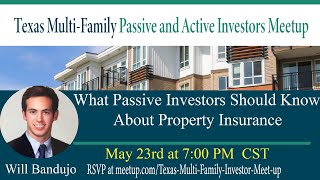
Hosted meetup (YouTube) led by Wayne Courreges III with Will (multifamily insurance broker, Fitzpatrick) presenting to passive investors on property insurance for apartment/multifamily assets. Main points: the insurance market is hard (rate and deductible increases driven by catastrophe losses and inflation); active owners should prioritize loss control (tenant screening, property maintenance, electrical panel updates) to manage premiums; passive investors should ask about adequate replacement-cost valuation, coinsurance clauses (commonly 80%), ordinance & law coverage, large retentions/deductibles (examples: small five-figure deductibles years ago vs. six-figure or percentage-of-value deductibles today), and whether policies cover assault/battery, firearms, or abuse & molestation. Flood insurance is separate and NFIP does not cover business interruption. Practical advice: obtain 5-year loss runs, check FEMA flood maps, budget higher insurance increases (Wayne cites 10–15% min in Texas), and develop relationships with specialty multifamily brokers for quicker, realistic underwriting guidance.
Chapters
Go ahead and record. All right, welcome everybody. I hope as I said earlier, you had a good breakout group. Just wanted to go through our meetup and those that have joined us month after month. You know, this is very repetitive but for the new people that have joined, you know, really thank you for, for joining. We, I like to do networking breakouts early. So between like 7:05 to 7:15pm 1, it breaks the ice, makes you feel comfortable and then two, not everybody can stay till the end. So it's nice to have some networking because you can always get the recording, you know, after the presentation, such and then we go into guest presentations. They range between timeframes but we go from there. And then usually afterwards there's always time for Q and A and getting to know each other a little bit more, a little bit about myself. My name is Wayne. I have been in commercial real estate last 15 years. It'll be 15 in June. Time flies by. But I have really enjoyed doing a lot of repositioning, renovations, doing a lot of strategic plans over different life cycles. So real estate is definitely in my DNA from an early age and really heavily investing into multifamily for many reasons. But I think for me, especially in this environment that we're in, it's definitely much more risk resilient. We are diversified, we've got money in stocks and such, but at the end of the day I don't have to worry about a tweet or market conditions at the end of the day. Real estate, if you're buying in the right locations, it's a great long term wealth building. It's not a get quick rich thing, but it's definitely a long term wealth building. And we do these meetups really to try to educate a lot of the passive investors that invest with us and invest with others. So part of the education platform that we do is I have a podcast so you can check out craipartners.com podcast and then I've got an ebook that if you don't have my ebook yet, you know, reach out. I'll also send those to the new people in this meetup and then if you haven't joined our Facebook group, search Texas Multifamily Investors Group. We are growing that as well. So let's go to the presenter, Will and Will is my go to insurance person. You know, we have deals that we're underwriting, looking at. Will's assisting us on those. He's helping us with the gallery deal that we have under contract in Houston. One of the things that he says in here is he's very highly responsible, available, and that's for sure Will's ammo. He's always available. But he started his career in the insurance industry with Fitzpatrick back in 2014. His risk management expertise and client expertise experience is focused solely on the multifamily industry, which is huge because you go to, you think insurance, I can just go to State Farm or whatever and they can give me a quote. And it just makes it extremely difficult to find very competitive rates with people who know what they're talking about. So going with a group like Fitzpatrick and Will, who all they do is day and day is multifamily, is huge. He earned his BA in economics from the University of Texas at Austin. He currently resides in Dallas where he enjoys playing golf and spending time with family and friends. Extremely grateful for Will being on today. I met with him at lunch about a month ago and this is like his first Zoom presentation. So super excited to have him and appreciate his partnership. I'm going to stop sharing, turn it.
Over to you, Will. Yeah, Wayne, I appreciate you having me. Yeah, this is my first one. So I really kind of want to keep it as, you know, an open discussion and not more so. If anyone has any questions at any time, feel free to jump in and cut me off and tell me that I'm not making any sense. So let me share my screen here. Alrighty. Can everyone see that?
Yeah.
Okay. Wayne obviously gave you the background. I've been in insurance and specifically multifamily focused since 2014. June is also my, my anniversary date. So I'm coming up on eight years. Primarily do Texas and the Gulf states, but we are nationwide and I focus on tough to place, cat exposed or convective wind exposed complexes. Let's get into it. So one thing, when I kind of made this and was talking to Wayne, he wanted to keep it brief and you know, the way he described it was what I would want to explain to my mom if she was going to be a passive investor. And I don't think I made it quite basic enough. Wayne just had a good point when he was speaking. Why you go to someone like me or my peers versus just going down the street to your state farm or farmer's agent. And the reason is that those companies typically stay away from the tougher risks. So apartment complexes are just a difficult risk. You know, you've got tons of tenants living there. The claims tend to be higher than they would in residential or your car exposure or something like that. So a lot of those carriers Just don't write that class of business. A lot of that falls into what is called the excess and surplus lines industry which are with you know, carriers, Lloyds of London and more kind of no name carriers if you will, that you don't see advertised on TV every day. So that's a reason that companies like ours and insurance brokers and wholesale brokers come into play in the apartment sector. So for anyone who this investor more passive or maybe you're just getting your feet wet. I wanted to give kind of a background of where the insurance market is currently. And we're probably in the late second year, third year of a hard market. We're seeing big rate increases, deductible increases across all lines of business. And that is from A class brand new apartments to, to all the way down to C and D class. You're seeing in Houston and Dallas take a lot more rate increases than San Antonio and Austin. So to go with the first bullet point, we've just seen an increased frequency and severity and natural catastrophes over the years. I think wildfire season in California, five days longer than it was in years past. And so you've just seen these larger and larger weather events continue to eat up at carriers for years over years. And now they're really focusing on profits more so than they were in the past. In the past, insurance carriers actually only made money on investments. Only in eight of the last 35 years have insurance carriers made money on underwriting versus investments. So as carriers reposition and really focus on profits, you're seeing rate increases and you know, 20, 30, 40, 50, if not in some cases depending on losses. And to go with that is a lot of people may sit there and say okay, well my apartment didn't have any losses, why am I increases. And it really is an interconnected global economy. In the insurance world a lot of the carriers writing the hurricane exposed apartments in Texas are also taking lines on the apartments in the earthquake zones in California or you know, tsunamis in Haiti or wherever. And so all areas are feeling that effect of those storms. And so that's why everyone across the board is seeing rate increases, not just the complexes that have had losses. And obviously to go with that is inflation. We're in the highest inflationary period in 40 years. That's something that's probably more come on in the last year or so. But it's causing the cost of goods and materials to, you know, be increased and delayed, which is causing claims to be open longer and more costly. So that's kind of where the Insurance market is now just a brief overview. Does anyone have any questions regarding that? Clear as mud, huh? Okay, we'll keep going. How can you help to manage rising premiums? The biggest thing that an owner can do, an active owner, and good to have the passive investors, you know, ask their actives, is loss control. You know, what kind of condition do you keep the property in? Do you carefully screen the tenants? You know, do you have good tenants in there? Obviously just the class of business like Section 8 housing or USDA housing is going to have those kind of lower income tenants which just in turn leads to higher claims requiring renters insurance. Make sure if the tenants are liable for anything that happens on the property, you can use their insurance to help pay and cover any damages. Big things to keep. And this kind of primarily is in regards to general liability, but always just keeping the property in good shape for the fences, the walkways, the parking lots, you know, is there good outdoor lighting? Just keeping the property in good working condition help result in a better loss control and more favorable claims experience. Stovetop fire suppressors, they're a little canister, they fit right above the stovetop in the kitchen and they're very good at putting out grease fires, which is a common, common claim industry where the market is unfortunately it's just tough to get a decrease in premium right now. But the best thing you can do as an owner is help your loss control so you are not contributing to the higher premiums with big losses. And then lastly, I just kind of want to briefly cover a few things to look for in a policy. If I was a passive investor, these may be some things that I would ask the activists. You know, is my policy covering me for this inadequate valuation? This is actually something carriers are really focusing on right now. In years past we had a lot of property undervalued. There was a big claim recently at a Walmart warehouse in the Midwest and I think it was valued at only like, you know, the coverage was for 70 million or something. I'm just pulling that number out of thin air. But it was very low and the claim is going to pay out half a billion dollars. And so carriers are really focusing on the valuation of the properties. And so I would want to know, is my property property adequately insured? You know, is the replacement cost that we have on the policy going to be enough to cover the rebuild if we have a claim? And then what almost goes hand in hand with that is a coinsurance clause. And a coinsurance clause stipulates that you, that you insure your property for a certain amount of the replacement cost. So, for example, most co insurance clauses require 80%, and that means you've got to insure your property for 80% of the replacement cost. And the issue with that, don't know what the replacement cost truly is until you have a claim. And so coinsurance is never a good thing because it can penalize you and stipulate how much you get paid out for your claim. Another big thing in policies to look for is ordinance and law, Especially on the older vintage value add deals, the 70s 80s frame, ordinance and law is going to cover you for increase to construction code. So if you have a building completely burned down to the slab, you know, you probably rebuild it with say, you know, a full sprinkler system that's probably, you know, current fire code. So ordinance and law is going to cover you for that full increase in construction. And the last thing I would ask about are the retentions, you know, what are the deductibles? As the market hardens, we've seen carriers really tightening on their deductibles. And so people are taking, you know, three years ago a $10,000 fire deductible, and now they're taking $100,000 fire deductible. Or they were taking, you know, a $25,000 wind hail deductible in Dallas, and now they're taking 2% of their total insured value, which could end up being hundreds of thousands of dollars. So those are kind of the four main property things that I would look for in a policy and then shifting to liability. Those three, you see, they're all pretty straightforward. But a lot of policies exclude these and that's assault and battery. You know, if anyone's assaulted on your property, firearms, if there's a shooting, and then abuse and molestation. Those are probably the three claims that are going to pay out the most, but also the three that are excluded the most. So I would definitely want to take a look for those in the policy. Again, just kind of wanted to give a brief overview. Nothing too in depth. So that's kind of all I got for a brief overview of insurance. I don't know if anyone's got any questions or. Wayne, want to take back over?
Yeah.
I have a question. How can somebody, and I know this, this may be Pollyanna. You can get sued for somebody being abused and molested on the property and you have nothing to do with it.
Yeah, it is something that we see quite often.
Wow, that is outrageous.
Yeah. And that's why it's Definitely something to be on your policy.
Okay, good to know.
I've got a question. So Will, is that a service you provide, like say after? Because, you know, if you're looking at a property that you want to possibly, you know, you're running the numbers on and you're trying to figure out, you know, what is it going to cost for, you know, insurance as part of the, you know, the deal and what do you say? You, you talked about loss control. So you know, like on a value add deal, you know, you're looking to improve the property. So how do you do you as an agent or you know, an underwriter, would you come in after the fact and provide guidance on some of the things that you could do to, you know, get a better rate on that on the policy or how does that work? I mean, I'm going to take pictures of all the improvements that I'm doing as I'm improving this property to send it to my insurance guy and he's going to go to bat for me with these carriers to get a better.
Yeah. So on a new, new deal, certainly it's going to be all after post. There's probably not a lot you can do, you know, pre ownership. So a lot of that would be post closing. I will say the loss control measures I listed are more so to help, not contribute to the losses, to help the property. What we see, the only things we're really going to get decreases from carrier are those huge, huge capex items. Are you going to completely redo the plumbing, gut the walls and put in new wiring, new H vac systems or putting on a brand new roof? A lot of times people go in and put in a couple million bucks and painting the trimming and putting in new cabinets and new refrigerators and stuff. And unfortunately those items don't much to reduction in premiums. So the loss control items I listed are more so just to help you out as an owner to avoid claims they're not more so going to reduce the premiums. Does that kind of answer your question?
Yeah, it does.
Yep. Yeah. So for those that are, you know, active investors on this call, you know, stablock breakers is one of the first things I'm always looking at when I'm looking at a deal. And then, you know, the wiring, you know, those are two things that usually whoever I'm talking with on the insurance will for sure ask those questions of, you know, what's the, you know, what's the wiring situation and then the, you know, other stablock breakers just due to the claims the fire risks and it's not the end of the world if they have it. It's just, you've just got to put it in your minor capital budget like hey, we're going to be. This would be one of the first things we will do is replace those breakers.
Yeah. To follow up on Wayne's point and that's. I don't. If many of you are not active or passive investors, stablock breakers, they're an old type of breaker box commonly used in the early 60s, 70s and they're just very heat prone and they're prone to exploding if you. And so they're very big fire risk. Carriers are taking a huge issue with those lately and just cannot recommend enough. If you deal with them, if you still want to buy the deal, then definitely put in some money in the budget to replace those breakers.
So I had a question from an investor this past week that we or I guess it was last week where I looked in our real estate attorney on and one of the question was is with these condominiums in Florida that there was just that huge lawsuit that came out last week and the claim and it was a question of if say you invest passively in a deal and you get sued, what is from a limited partner, what is your liability? Are they, you know, they sue the entity that you're part of? You know, can they come after you individually? And you know the. The answer was is no. I mean you've got the LLC or the limited partnership but the risks that you put in, and we all know this when we invest in real estate is the amount that we put in. So from a passive investor standpoint, if you're putting in 50,000, you don't have more exposure to risk. From a liability standpoint, people that invest in trust especially they're worried of is there increased exposure to our trust by us passively investing in deals. And so I felt like that was a really good. I had the assumption of your covered limited partner, your money that you invest is, is always at risk. Right. But your trust or your llc, your individual livelihood is not exposed.
So yeah, that's a very, very good point.
The other thing too, from a passive standpoint and from an active side, I mean this is something we do every day. Right. Our number one job is to protect investor capital and we do that in many, many, many ways. Insurance is not one of those ways that we go cheap and you know, we want to make sure that he will talked about replacement costs and all. But the other aspect is business loss income. So say A building burns down, do you have insurance that's going to cover that loss of income? Right. And so that's, that's an important aspect that, you know, you should add to your, to your list of questions. And if your partner, general partner, a lot of times they just want to deal with very passive, passive investors. And what I hope you're getting out of this meetup is like, I don't really care about, like, you should be asking questions. And these are questions that you, as a sophisticated investor, when you sign off and say you're sophisticated or accredited, that you're asking. So ask about that business loss. Now, one thing Will didn't touch base on is flood insurance. And that is an extra policy. And we don't touch areas or properties that have been flooded or in a flood zone. That's the first thing, especially in Houston. That's the first thing I look at in Houston is, has it been flooded? And are you in a flood zone? Go to the FEMA website, check that. So there's nothing wrong with investing in flood zones. You, as an investor just have to determine the risk. But the FEMA website, that public information, you can go do a Google search on any property you're about to invest in or considering investing in, and then you make that choice. Do you want to invest in that particular deal? And so those are all their insurance considerations.
And Wayne, I'm going to follow up with what you just said about business income and flood. You know, nfip, the national program, doesn't cover business income. So it's always something to be wary of. If you're investing in a property that's in a flood zone and they're using nfip, it does not cover business. The property does flood, you would be, you know, out of those units if there was a flood event. Yeah.
Wayne, how do you determine if a property is already flooded? Like, how do you find out if something in Houston flooded during Harvey that isn't in the flood zone?
No, it's a great question. And part of Houston, those are in Houston when I live there. You know, we had Memorial Day flood, Tax Day flood, and then Harvey, and they all flood different areas.
Um, so they're not necessarily in flood zones.
They're not necessarily in flood zones. Right. So I mean, when you walk, you do due diligence, you'll notice the. Just the staining of the facade, you know, just I just walking around with the amount of rain that occurs, especially in Houston. And I mean, Austin, we get flash flooding in Austin. Right. And so it's like, you know, the water with the limestone, the soil is very, it's not very deep. So the water, you know, doesn't really have anywhere to really go but surface and causing the flooding. So I think just those signs. But Will or whoever, your insurance, they're going to ask for a five year loss. And so, you know, that's going to be one of your key moments to see what's been recorded, you know, what's been shown as a loss, and then relationships. You got to know just the areas. Like I know, you know, I'm getting deals in Memorial City, like part of Houston, and it doesn't get flooded very often, but it got flooded. And when they opened up those floodgates during Harvey, you know, so unless you know that area really well or like know like, hey, something did happen. Let me do a little bit more research. I will say FEMA did update its, its flood maps since Harvey too. So I know they're updating that consistently, but I would say that five year is pretty important. And then just observing the property, asking questions to the property, usually the property manager, a lot of times they don't even know that the property's on market. So just asking general questions. A lot of times I'll go to these properties and just pretend I'm looking for an apartment or I'm an apartment locator and I'll ask questions. And usually the property team's very open to talking. They like to talk, I like to listen.
Okay, how fast do you typically try to do this kind of research, especially in today's market when you've got people having money go hard on day one and then you know, what if a week later you get all this information about past insurance and you're like, holy hell, I really don't want this deal anymore. Like, how fast or before, you know, can you get that kind of information to determine if you really want to move forward and do more research?
Yeah, it's a good question. And if others have, you know, I'm learning here too, along you all. So I would say, like, I don't like deals. That money goes hard. We had a deal that money was hard, 400,000 day one. But we had early access. And so part of the sale, usually the sale agreement's about two weeks to negotiate. So during the two weeks of negotiation, we're, I mean, we're spending that money having inspection. If they allow you like one property we looked at earlier this year, you know, we paid for plumbers to camera the line and everything, look at the Irrigation or the, you know, all the piping. And also while we were doing the contract, FEMA is free. I mean, when multifamily group, you know, Dallas, when Bryce sends me a deal, the first thing I look at when he sends it to me is because he always sends me deals in flood zone. And I always tell them no. I don't know why Bryce on a recording. But if you're listening, Bryce, don't send me flood deals. Like, you know, flood zones. Like that's the first thing. Even on Austin, I'll send me a deal.
And I'm like, no.
And sometimes like the deals that come from brokers, I mean, you think about like they're the deals that have been passed on and passed on and passed on to so many people. So it's like, why are they sending this to me? Like, why aren't they sending it to someone else? So it's like I always, I'm always a pessimist, like day one of them giving me, you know, this off market deal. So it's, you know, just being careful and then doing your due diligence. Your letter of intent should give you Morgan access to do your due diligence during the sale agreement. If it doesn't, then you just as an investor have to make a decision. Do you have that much money to lose? I don't. So I usually just pass. Okay, you know, I don't know what, you know, Kathy and others, but usually I stay away from hard money unless I've got early access.
Will I have a question for you, Will?
Yes, ma'. Am.
So when a property trades and you know, the last time it, they have, you know, X insurance, they pay X annual insurance on the property and now the property is going to trade for $20 million more. I don't know. So does the insurance correlate the cost of the insurance correlate with that, with that new purchase price?
No, no, not at all. It has nothing to do with the purchase price. The only, the only way that would come into play is if the lender is requiring the cost to be, you know, X amount of the loan value or equal to the loan value. But even at that, you can provide, you know, a replacement cost estimate of saying, hey, you know, it's only worth $100 a square foot, you know, and you pay just say $200. You know, the example I give is, you know, if you bought a five million dollar piece of land and put a porta potty on it, you wouldn't insure it for 5 million bucks. So to answer your question, no, the increased cost of the sale is not going to directly impact your insurance cost.
Okay, that's good to know. I was a little worried about that.
Will, is there. Is there a good or decent starting point when you underwrite a property? Like, what's a rule of thumb, would you say would be like a cost of insurance to start off with? Is it 1%, half percent?
So, unfortunately, there's not a really good rule of thumb because every deal is different. Deals five miles apart in Houston could be different. I typically ballpark costs off per unit cost, but again, there's no unfortunate just rule of thumb that I could say of, you know, 1% of the sale price or whatever. Unfortunately, it's just, you know, can give a pretty quick estimate when looking at a deal, but there's no just blanket estimate for. To go off the cuff. What.
What would you ballpark off of per unit then?
Well, again, that's. I. That's just how I ballpark it is per unit. But I have to look at the deal to get an idea. I can't just say, you know, I can give Mark, you know, right now in Houston and Harris county for an old vintage deal you were probably underwriting. You know, what do you think? $100 a unit?
Yeah. Between 750 to 850 a unit.
Yeah. You know, it just depends. Every deal is different.
But, John, this is why it's good. You're asking questions like an active investor, so I'm assuming you're doing that. This is why you do these things. Because Will, you can call him, or you build these relationships, you know, it's like you build your team. And Will, and that goes back to Morgan's question is like, how quickly? Because insurance kills deals, time kills deals, taxes kills deals, but insurance really kills deals. And you mentioned it earlier, it's like the price, especially in Texas, where it's going up so much. I mean, sometimes it makes me upset because I'm like, man, this deal works. And then I give it to Will or someone else, and they're like, hey, your insurance is low. And I'm like, why? You know, and so you start getting emotional because it's like, man, I feel like you got something. But then insurance in the day, though, Will's job and why I trust him and why he's my partner is because he's given me the truth. Right. I'm not going to be surprised at closing and then day one, not be able to pay or, you know, protect the asset. Right. The way we expect it to. So we want partners to tell us the truth, but sometimes the truth hurts. So, John, really have the relationship with, you know, someone who's in the trenches on multifamily insurance to help you.
So would you say the price. Should you underwrite, like. Like you do for anything else, a certain percentage increase per year for insurance as well? It's the same with, you know, plus 3% every year or what?
Yeah, I'm doing 10 to 15 minimum in Texas. So that's why a lot of investors are going, you know, active investors, like. So there's a reason why, you know, I don't have, like, there's not a whole lot of deal flow because numbers just don't work if you take into taxes and insurance. But a lot of investors, Kathy or June, and, you know, many of them, like, they start looking at Arizona, you know, they look outside taxes that are maybe not, you know, have been as impacted in taxes and insurance. So for me, I offset that risk because there's a lot of people moving to Texas. It's a landlord. I mean, there's things to offset that risk.
But, you know, Arizona, writing a 10% increase every year. Is that what you said?
I mean, on the insurance piece, at least. I mean, and that could be, you know, I have a buffer on other expenses, too, so. But Will was saying earlier, I mean, he's seeing even larger increases. So, I mean, it's now one nice thing on insurance. And it's not ideal to go out to bid every year, but, I mean, that's something. It's a controllable expense in a sense that you can see what the market has at that point. But there's only so many of these. And correct me if I'm wrong, Will, but it sounds like there's only so many of these insurance groups out there, and these mortgage are. These insurance brokers are going to the, you know, the same pool of.
Right. Yeah, Most. Most of the wholesale brokers are. They're all going to the same pool of insurance carriers.
Yeah.
So, Will, you're saying if, you know, if I have a deal, I can send you an email and say, hey, what. What do you think? What's. What are the numbers for this deal here? And you'll give me a quote?
Yeah, I can let you know what I think. Absolutely.
And you could also, I mean, look at other markets, like Alabama, for instance.
Yeah. Like I said, we're nationwide. You know, my big focus is in Texas and the Gulf states, but do quite a bit of business in Colorado as well, and Tennessee, Kansas, so. Yeah, happy to help you ballpark any deals you're looking at. Great.
Thanks.
Well, Will, if my mom was on here, she probably would have learned a lot and asked the right questions like replacement cost and you know.
Yeah, well, I hope. Hope you learn a little bit.
Yeah, no, it was really great. Any other questions for the group or any. Or we can. All right, well I will send this recording out to everybody as well and hopefully follow up and do some one off phone calls and keep building the relationship. But if there's nothing else, I hope everyone has a great evening.
Okay, this is.
Great.
We can get the contract info of Will and.
Yeah, yeah, I will. I'll send that out. We'll do a follow up email with the recording probably the next couple days and I'll make sure you have Will's info in the meantime. Will, do you want to put in the chat box?
Yeah, if you need.
If you need them sooner, open the chat box here.
Okay, thank you.
More from Wayne

September 2026 Meetup: Investing Ahead of Growth: The Bryan–College Station Opportunity





May 2026 Meetup - Apartment Complexes & Passive Investors: Opportunities & Risks


March 2026 Meetup - Reading the Market: Economic Indicators Every Investor Should Know


February 2026 Meetup - Syndication 101: How CREI Partners Structures Deals for Investors

Build-to-Rent (BTR) Communities Explained: Why Investors Are Paying Attention