William Quinton Hollins - Scaling From Single-Family Wholesaling to STR and Multi-Family Properties
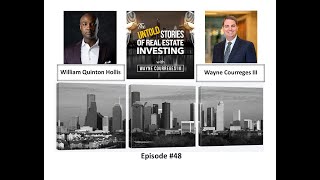
Transcript of a podcast episode (Untold Stories of Real Estate Investing) in which host Wayne Courreges III interviews William Quinton Hollins (principal of 24 Capital Group). Hollins describes his origin story in real estate, his transition from single‑family wholesaling into private equity and short‑term rentals (STRs), practical wholesaling tactics (lists, assignment fees, buyer sourcing), STR strategy and operations (market selection, design/amenities, specialized/local management), the TechVestor partnership and Fund 1 details, and advice on niching to scale and reduce investor risk.
Questions this video answers
2022.
About six years ago (wholesaling for two to three years before switching).
$25,000.
A 2× equity multiple over a three‑ to five‑year period.
Chapters
Welcome to the Untold Stories of Real Estate Investing hosted by Wayne Courageous iii, a place where active and passive investors come to hear the good, bad and ugly of real estate investing. Our guests consist of experienced operators and investors who want others to succeed by sharing their stories. If you're looking to syndicate deals or grow your wealth passively in real estate, you've come to the right show. It's now time to sit back, take mental notes and enjoy next episode of the Untold Stories of Real Estate Investing.
Welcome to the Untold Stories of Real Estate Investing. This is your host, Wayne Courageous. Today I'm excited to have William Hollis. Hollis is the principal of 24 Capital Group, a real estate private equity firm based in Connecticut that specializes in helping real estate professionals take back their time and own their futures by investing passively in cash flow and real estate deals. Hollis's passion for real estate began when he was a kid watching his family's landlord collect rents. As he got older, he became an expert in creating opportunities in finding deals and is committed to staying at the forefront of the latest technologies. Hollis is also dedicated to sharing his knowledge and expertise with others, regularly speaking at real estate conferences across the country. After growing 24 Capital Group's asset portfolio to over 80 properties in 2022, Hollis is excited to tackle new opportunities and to continue making a positive impact on the real estate community. Welcome, Hollis, to our show.
Thank you for having me. I really, really appreciate it.
So obviously I read you know the template you sent, but there's a lot more to you and I'm super excited to get to know you and, and share your knowledge, obviously with our, our listeners. But tell us more about yourself. How'd you get in real estate investing and anything else you want to share before we get going?
Yeah, for sure. You know, I, I love telling this story because just like you, I put a little tidbit in the bio about my landlord collecting rents when I was a kid. But what gave me the bug to begin with was I grew up in Hollis, Queens. Just like my name and my landlord's name was Mr. Carter. Mr. Carter came around every first of the month in the 90s, stuffing hundreds of dollars into his wallet. By the end of the day, collecting all the rent in the neighborhood, the wallet wouldn't even fold, it was so thick with hundred dollar bills. And I remember sitting one day like six or seven, eight years old looking at Mr. Carter thinking, I need to figure out how to do what Mr. Carter is doing. I don't know how he's doing it, but he seems to have it figured out. So that's kind of what gave me the real estate bug. But to be totally honest, growing up in that community and not necessarily having the financial education and mentors necessary, for a long time, I thought that investing in real estate was something that'd just be totally out of reach for me. You know, growing up in New York, real estate was expensive way before the COVID pop. Right. So it really just seemed. Seemed like something unattainable until a buddy of mine took me to a real estate conference that was near where I live now in Connecticut. And we learned all about how to wholesale real estate, which is basically being a deal finder, kind of getting scrappy. And so that's how I got started going out, finding deals for other investors. And after a while, I just realized, man, I just created another job for myself. It's not quite what Mr. Carter was doing. Right. So I started to try to figure out how to purchase some of the real estate myself and came back to the same problem. Real estate was still expensive in the northeast, but I realized when I started looking at larger deals that the numbers started to make a little more sense when you bring partners on. And so I kind of became educated in that. And that led to me, you know, starting my firm, 24 Capital Group.
So how many years have you been doing this investing in real estate?
So the beginning of that wholesaling journey was maybe about. About six years ago, and I did that for two or three years. And then last year I switched over fully to, you know, the private equity side, helping other people invest in the real estate deals.
Nice. So let's talk about wholesaling. We haven't really talked about that much on our show, so I'm actually really interested in. In that. And what, what were, what was your experience with that? What was sort of like your daily grind? Because it was very, I'm sure, very transactional because you're finding deals and trying to, you know, finding those investors. So different types of. Of work in real estate. One is very transactional, which I would assume wholesaling was for you.
Yeah, really, really transactional. If you don't like talking to strangers, it's probably not the, not the business for you. So really it was a lot of cold calling, you know, going out, seeing properties, negotiating contracts. I think it's a great entry point into the world of real estate, because it doesn't. You don't necessarily need to put a lot of capital into it to get started. I mean, you could, but you don't have to. And I, I didn't. And you can do most of the things yourself. You know, you kind of make your calls, get your lists, make your calls, go see the properties. You start to learn really how to analyze deals. And that's really helped me a lot in giving me the background of really how to underwrite deals. I mean, underwriting and multifamily. And you know, at the portfolio level, it's a little bit different, but at the, it's most of it are the same. Like, you know, you have your expenses you got to look for, you got to check the value of the comp. Comparable properties in the area, what sold, what's the going rate for this? What's that going to cost? So wholesaling is what taught me that. But it is, it's a grind. It's a grind because as soon as you stop making those phone calls, the deal stopped coming and the money stops coming. So it's a different world for sure.
So in wholesale, was this mostly in single family?
Yep, single family and small multi.
And how did you find those list?
Great question. So there's a few different methods you can use. One, you can go on like your county tax assessor website and basically pull a list of everyone who's delinquent on their taxes. So when you're looking, when you're wholesaling deals, your biggest point of leverage is the distress of the seller. Right. So somebody who has to sell their property for whatever reason, they have a very tight time frame. They don't have time to go to a realtor, put it on MLS, wait for somebody with an FHA loan to close in 45, 60 days. They want to close fast. Right. So basically you have to go find those people, people who are going to be foreclosed on, people who have tax liens, people who need to move for work is a great one. And another little secret nugget that I started doing toward the end was just going to the realtors, because usually when people, even if they're in a time crunch and they need to sell their property quickly, they still call a realtor first. Right? That's the way you think to sell your home. But at the end of the day, not everyone is really in a good position to sell their house with a realtor on the open market. I mean, the realtor is going to want you to fix up the house. They're going to want to bring people through your house. Not everybody's comfortable with that. So when you go to a realtor and you say, hey, I, I have the ability to execute on these deals. I can bring buyers to these deals or I can buy the deals myself. The Realtors can be an excellent little secret resource for wholesale deals.
Yeah, no, I, I think that's a great strategy for sure because I know a lot of people, like you said, they don't want to have the whole marketing process of people coming in their house. I mean especially with, in our household having three kids. It was awful. We went to Arkansas on a camping trip and we cleaned our house really good before we put our last house on the market. That. And so we, we stayed away for that week. Luckily it went under contract that week. But yeah, if you're living in it and you've got pets and other things, you know that Realtor strategy is huge. The relationships, anything in real estate across all assets, you know, the, the relationships is key now. Seems like finding your list, you know, that's all hard work. Are there programs or softwares that are outside of the appraisal and tax filing? I mean, I'm sure now everything's monetized and I'm sure six years ago when you were doing it to today a lot has changed those that may be getting into it today. Is there a software you're aware of that just makes that even easier?
100%. So there's a great software. It was actually, it actually came out around the time that I got started called Propstre and I could put a link to that in the show notes. But it's a great software. It actually pulls all sorts of different lists from bank foreclosures to tax foreclosures to high equity landlords. So it'll pull a list of people who have owned a property for, you know, 20 years. They're in the bottom third of their mortgage and they have a ton of equity. But maybe they're older. And you can also filter for non owner occupied. Right. So since this is a landlord who's had this property for a long time, has a ton of equity and he's probably a little bit older, maybe he's looking to retire. You know, that's somebody you can give a call and maybe he's not thinking about selling the property, but make him an offer and you never know.
Yeah, not. That's huge. You know, we, we did that on the multifamily side. You know, we, we always try to find, you know, in real estate investing there's, we call it like red waters and blue waters. Red waters where all the sharks are going after the same meat. A lot of times the Brokers are, you know, when a deal is on the market, everybody's, you know, maybe a year ago, even more likely to go after it. Now, things gotten a little slower. But, but you're, you're finding through that sweat equity, Hollis, you're finding that blue water where there's more opportunities by going direct, like the guy who may not think about selling, but hey, you called them. And now at least starts that conversation. And then it builds the timing too, because maybe in a year or so they start thinking about it and then they can save potentially on the commission fee, which makes it a little more enticing for people like yourself. So it's, it's relationships and then hard work, grit, and very transactional. So two more questions on that before we switch gears. What type of money is made and how is it made when you do your wholesaling?
Great question. So on the, in wholesaling, you make what's called an assignment fee, right? So because you. I didn't have my real estate license, real estate agents license. So you're not able to collect a commission on any real estate transaction without a license anywhere in the country. But you can make what's called an assignment fee. The assignment fee happens where I come to Wayne, I say, hey, Wayne, I'll buy your house. You, you say, Great, give me 100,000 for it. I said, all right, cool, I'll give you 100,000. We sign purchase and sale agreement, standard agreement for a hundred thousand dollars that gives me the legal right to your property. No one else can come and buy your property because I have the papers on it, right? So from that, I go and find a real estate investor and say, hey, I've got this fantastic deal. Wayne's going to sell me this property. You give me 110,000 or 105,000 or whatever number I can negotiate, and I earn that spread as an assignment fee at closing. From the, from the end. From the end buyer. So really, really, you make your money on your ability to negotiate good purchase prices with the sellers, which is why the distressed sellers are the way to go, because they just. You have higher leverage as a buyer from that standpoint.
Yeah, I, I always say I'm very selfish on these podcasts because, like, I asked these questions because I really don't know. Like, that is incredible. And you know, the listeners out there listen, but I'm like, that makes sense. It puts it more aggressive for you to find the distressed deals at the best price and then, you know, find those investors. So that was really my last because I mentioned there were two more questions. So the last question on wholesaling is, where do you find these buyers or these investors to.
Yeah, great question. So Facebook is a fantastic place for that. I mean, I mean, everybody knows there's millions of groups on Facebook now for everything that you could imagine. And there are tons of local or local to each market. There are many real estate investor groups, you know, so that was one way we did it. We just go on there and say, hey, I've got a deal. The other way we did it was just building relationships in the first place. Like you mentioned before, if you call someone out of the blue and ask, hey, are you interested in selling this property? Maybe they're not interested in selling, but that starts the conversation. It also could start a conversation of them buying property because maybe they're not looking to retire, maybe they're looking to expand. And you say, hey, I'm not interested in selling. And my next, the next phrase out of my mouth is, well, are you interested in buying? If the answer is yes, where do you want to buy? What are you looking for? Right. So now I know, I. You get, you know, 15 or 20 of those types of guys and you. Gives you, it gives you a really good criteria of what types of properties, where to focus your own marketing efforts as the wholesaler. That way when you get a deal, you know, you'll have somebody who'll be interested in buying it.
That makes sense, especially if you're having to put your own capital up first. A lot of risk capital, you know, so. So that was. Started out about six years ago. So what happened with the transition or how, how did the transition go to more of the short term rental that you're doing now? Like.
Sure. Well, there was a few, a few bumps in the road in between there for sure.
Okay. And feel free to share those if you want.
You know, I. I went away for a couple of days, for a couple of weeks, I believe it was. And I just had this thought in my mind because the whole time I still had a W2 job. I still do now. I'm a software engineer. And this thought just came to my mind that I'm not making any money in my wholesale business right now because I'm on vacation, you know. So I said, man, I need to figure out. That's when I said I have to figure out how to actually buy some of these properties. So I did. I went in, started learning to underwrite multifamily. Like I said, I realized that the bigger deals just make more sense. You Know, getting two, two, two, two families and three families, it's fine, but it's a tough road. You got to get a lot of those, right? So looking at the big deals, I learned how to analyze them, bought some courses, got some spreadsheets, got a couple of mentors and really got into it. Started submitting offers on properties, which was great. I was getting out there, talking to brokers, building the relationships. I actually got some deal, Got a lot of no's. A lot of no's, but got. Got some deals under contract. And right around that time, Covid happened right around that time. So I had some single family deals. I was looking at one of those deals. The seller couldn't, couldn't move because of COVID So that deal had to got canceled. A couple of offers that I had submitted that were, you know, about to get accepted also kind of fell through. Some of them fizzled out. Like I just couldn't reach the person anymore. So, you know, I had to kind of lick my wounds. I was a little bit disappointed. I felt like I was, I was about to accomplish something. I was a little bit disappointed, but it was good. You know, kind of took a step back and looking. I started looking at different markets and of course things kind of just skyrocketed. The market took off, went, went through the roof. And to be honest, I got a little bit uncomfortable with where multifamily was headed. Yeah, I was, I started making offers on properties again and I was getting outbid, but by ridiculous amounts, like just unbelievable deals that were happening. And I was, it made me feel dumb. I was like, I was thinking, man, I must.
Do it. Yeah, yeah, no, you're doing what you should have been doing. So that's awesome.
I started looking at alternative asset classes. I met an operator who was in the short term rental space, already had a lot of success, you know, on his own. And he kind of came to me with this idea that he was, already, had already started to implement of, you know, putting together a portfolio of short term rentals. And I really like the asset class because I'm a customer, I'm a buyer. My wife and I, we traveled, you know, we used to travel a lot before we had our son. We used to travel a lot and we always stayed in short Airbnbs, VRBOs. My, my group of friends, we go rent, you know, late houses and things like that all the time. So it was an asset class. I felt like I really understood well. And when I looked at. But TechVestor is the group that I partnered with When I looked at what TechVester was doing, I was like, man, these are the exact properties that we, I pay a premium for.
Yes.
To stay at with my friends and with my family. So I saw that they were doing it well and you know, decided to hop on board with them.
Yeah. Once you start having kids, family and such like, the idea of going to a hotel isn't as exciting, you know, because especially when they're really young because you're worried that you're going to wake up the people next to you. So having that freedom in the house, short term, vrbo, etc, that, that's huge. You know, I want to go back a little bit because I think one thing you had mentioned that you were, you're on your, you're doing W2, et cetera. And I think that's fantastic because during that time when you were looking at multifamily and stuff, you weren't having to be aggressive to buy the deals to make those, to make some money. You were, you were already covered financially through your, your W2. And for anybody starting, I mean that's huge. Having that safety net and that job that you're going in and grinding every day, but you know, spending time after hours, that's absolutely the right way of, of doing it. So, you know, kudos to you on that because I think that, you know, it allows you to step back, say like, hey, you know, people are putting a million dollar offers on top of what I thought was, I mean it was crazy. At least, you know, Texas, I'm sure all over. And you, you did scratch your head and be like, ah, this is getting a little aggressive. I like the two that you switch gears, you know, to, you know, like, hey, multifamily maybe getting a little too more aggressive. So you went to something that you were comfortable with and that, you know, and I think that was, that's something that's huge too for listeners is buy in markets and buy in investments that, you know, and that's why a lot of people do apartments because we all have lived in an apartment at some point in our life. Right. So no, those are two, two things I picked up when you were going through, through that.
Yeah.
And of how you got into single family rentals. One thing it was single family rentals though. And I'm noticing because I'm starting to, you know, I, my wife's from Montana and every time we go to Mont, I'm always like, oh, how do we get up here in the, in the summer? I don't want to be there during the winter. I want to be in Texas during the winter there in the summer. But I'm noticing that a lot of I don't know if it's just because covet a lot of people bought in Montana and now they're having to go back to work or everybody just had this idea of these short term rental ideas of like hey, I'll just run it out and be fine. But it seems like I'm noticing that those type homes are sitting longer. And then I had a call with an investor and a good friend earlier this week. It just so happened to be we just she owns single family rentals short term rentals in I believe Tennessee. And she's noticing that the people that had money during COVID would were her customers. Like the people that wanted to do a day drive or whatever to go to. But now those same people are all traveling overseas because it's like the COVID you know, it's like now you can go overseas. So now it's bringing in residents or people, not residents, but tenants or vacationers, whatever you want to call them that aren't the most ideal. So hey listeners, it's Wayne Courageous. I just want to pause real quick to say thank you for listening to our show. I hope that you're getting a lot of value out of it. If I could ask you to go ahead and like subscribe and share this podcast, that would mean a lot. It will get a lot of other investors like yourself learning about the process and the steps to successfully invest in real estate either as a passive or an active investor. I also want to do a quick introduction of CR partners and the managing principal for CRI partners and we started it back in 2019 with one goal, to grow your wealth passively in real estate. We do so by buying assets in multifamily, build to rent communities and RV boat storage facilities. And we do so in areas that have strong market fundamentals and also have strong partnerships with other real estate investors such as ourselves. We personally discovered that passively investing in real estate was a really great blend for people that are busy like yourself and that you can invest passively in real estate and still reap the rewards of the returns, the tax benefits, etc. If you're interested in learning more about passively investing, check out our website. We do a lot of content through our passive investor coaching program, through our podcast, our blogs and just other information that we do on a daily basis. Check out creipartners.com again creipartners.com if you're interested in building the relationship and joining our investor club. There's a link there to, to join. We'll set up a call and continue building the relationship with you. We're super excited to have that opportunity and I want us to get back to the show and hopefully again you're enjoying the conversation and look forward to connecting soon. Thank you. So I guess my question to you on that is, are you seeing a trend where the vacancy on short term rentals are, are higher? How are y' all adjusting to that? And really trying to keep up with the competition since so many other homes are listed as a short term rental. And it was a lot there. So. No, this is, it just so happens to be like I talked to her and I'm like, yeah, she seemed like she was, you know, not as excited about owning short term rentals. I should say. So.
Yeah. Yeah, it's definitely, you know, there's definitely a lot more inventory out there than there was pre covered. I think to your point, people kind of got the bug, right? A lot of people were just sitting around watching Netflix hgtv and it was like, oh, wow, let me just go, let me go out and do this. Right. And there is obviously obvious seasonality in each market. You know, to your point, like Montana, no one's, I can't think of any reason to be in Montana necessarily during the, during the winter. I don't know.
They're skiing in Montana, maybe a lot of beautiful skiing. Yeah, for me.
Yeah, same, same, same. But, and here's the nugget. Here's the, here's the kicker. There's only competition if you have competitors. So Alex from Oz talks about this idea of commoditization where we'll go to the grocery store. We're only willing to pay three bucks for a carton of milk because that's how much milk cost. There's nothing special about this milk. Maybe we'll pay more if it's organic. Okay. Maybe we'll pay more if it's, I don't know, farm fresh, grass fed cows or whatever people are doing now. Right. Okay. But there's a ceiling. Like this is milk. At the end of the day, I'm not going to pay $25 for one carton of milk. Just not going to happen. But when you create something that is so valuable to people. Right. That you have an experience behind it, you've gone beyond kind of transitioning back to Airbnb. You've gone beyond just offering someone a place to stay. I'm offering you a Vacation in your vacation.
Yeah.
The homes that we've created are so incredible. And I'm not taking credit for any of this because I'm not on the design team or the acquisitions team or any of that stuff. I just get to sit over here and reap the benefits and talk about it on podcast. For example, we have properties that have a pool, a jacuzzi, a mini golf course, a little beach built into the property, an outdoor tiki bar, a gaming ring side with arcade games, pool tables.
Sounds above my budget. That sounds amazing though. You're right, they're incredible.
But the point being there's not a lot of competition at that, at that level. You know what I mean? So for us, occupancy has actually stayed pretty even because when you, there's a bunch of different analysis tools, you can go go look at, you know, revenues for different markets for Airbnb and when you're in below the 75th percentile of revenue, ton of competition and that's when you get into, you become commoditized and you're in a race to the bottom. Who can charge the least for their carton of milk?
Yes.
But when you're in the top 90th percentile of revenue.
Yeah.
It's because your product is so good, people will pay almost anything for it.
Yeah. I wish I was ready to transition our conversation into niching and 10xing. We're not there yet because I really want to learn more about short term rentals, so. All right, so for those that are getting or thinking about doing short term rentals, maybe the home that they're living in or looking to, to go buy a, like myself, you know, a home and maybe renting it out. What are, what are some things, some lessons learned that you have experienced in finding maybe not those high end tier niche properties, but you know, other properties that are a lot more attainable for the average person to, to go do it without pulling money from other people. What are some lessons learned that you've seen and any advice that you would give, give them, you know, to protect their property from people that could vandalize and cause, you know, issues?
Yeah, sure. I mean, so something we're doing right now outside of that portfolio, you know, we're building kind of a more personal. I do have a partner in that adventure as well, but it's much smaller. Like you said, we're not really pooling, you know, huge sums of money together. These are one off properties. A few things we're doing is really, really drilling in on your market. Analysis. Right. Understand where you're going to put your property. Because to the point you made earlier, some locations are attracted, are going to attract certain types of guests and other lottery cases are going to attract other types of guests. Right. And just know that some people will destroy your property and other people won't destroy your property. And then on top of that, even if you, you don't need to get the most extravagant property to rise above the commoditization, it's really all about the level of design efforts you're going to put into it, the types of amenities you're going to bring into your property. And I actually, it's funny, I just had a post about this and I have like a top four amenity list that I've seen from the experience with the portfolio that's really made us stand out. And these are not insane things. I'm not telling you to go build an in ground pool in your property, but maybe adding a game like add add things that will attract families to your property or even groups of friends to your property. That and that way you can charge a premium and you're getting people who are less likely to destroy your stuff. If you're in the bottom tier, there's. You're going to get people at the bottom tier.
Absolutely. How do y' all manage those assets? You know, are you working with a local property management company that would manage like your traditional single family rental or are there specialized management companies that do these short term rental management?
Great question. So to my knowledge there are specialized short term rental companies. In fact I, a buddy of mine, one of my partners owns like that will they where they do manage short term rentals. But this is what I tell everyone to do and this is something I preach and it's kind of my entire investment thesis is built upon this fact. Go out and partner with others. So of the short term rentals that I'm partnered on, I don't own. There are none in Connecticut that I can just go drive to and fix, you know, the patch, the hole in the wall. Myself, I've partnered with people in those markets who are boots on the ground at the portfolio level. The same thing in all those markets. We have boots on the ground, we have partnerships with people. And there's a difference between a partnership and just hiring somebody. Because when you hire somebody, we all know how that goes, right? It's hard to find good help at the end of the day at all levels in the professional world and in all asset classes. But when you partner with somebody and they have skin in the game, so to speak. Right there. Their income is based on the performance of their property. Right. Then now you're getting a different level of service, you're getting a different level of assistance, a different level of commitment. So when it comes to managing a property, you know, obviously not everybody lives in a market that's favorable for short term rentals. Maybe you live in Montana and it's like, man, this is, don't want to be here in the winter. Right. So you buy a short term rental in Texas or you know, in the Carolinas or something like that. Find a partner in that market. It's, it's okay, you can share some of the income. It'll be better for you in the end. Find a partner in that market who can bring, you know, bring you that expertise.
Yeah, that's huge. So talk to me about the group that you're more partnering with. You mentioned it was tech.
Tech vestors. Yep.
So talk to me about Tech Vesters. How are, how are people that are listening and we're not closing the podcast yet. I know it's sort of a question, sort of prep for that, but what, what is TechVestors doing? What's your involvement and you know, how are you bringing value, et cetera to your investors through them?
Yeah, sure. So my fund partnered with TechVestors on their short term rental fund. One fund two is live now. So my fund is an investor in, in the TechVestor fund. So we partner with them on, on those properties. You can find them at GoTechVestor on Instagram. Techvestor.com is the website. But their team, but attracting me to that group is that their team is phenomenal. Each of the, everybody in the C suite on that team, you could call it, each of those operators had a very successful short term rental portfolio in their own right. So in, you know, some of them were in Arizona, some of them down, down in Florida. But they had their own portfolio that was already successful. So they understood very clearly, you know, how, what, what was, what was going to be required, what type of team was going to be required in order to make it successful on a large scale. And with that they were able to create a fully vertically integrated short term rental company, operations company. So from acquisitions to construction to cleaning to dispositions to financials, accounting, legal, all of that we have in House at TechVestor. So that one, it hedges against cost. Two, so much more buy in from everybody. I mean there's just an endless number of benefits that come from being vertical, vertically integrated. And you know, that's what they were able to bring to the table. So when I saw that opportunity, I was really excited to, you know, bring that to my investors and, and you know, have them take advantage of that.
Well, the other thing too for your investors as well, it's like some are like a syndication, multifamily or other syndication is you're, you're reducing the risk, diversifying the risk for them because instead of them, the investor going out and buying maybe that single family or short term rental themselves and having to put a larger down payment and then have to have the headache of what my friend was telling me about in her Tennessee properties instead it sounds like they're investing into a fund. That fund is investing into a much larger organized platform and deliverability because it's vertically integrated. So I think that's 100%. So what are you seeing from a return standpoint consistent with TechVestors and just your fund and, and what's the minimum investment?
So fund one is closed. So the minimum investment is. You can't get in at this point.
So there was demand, right? Shows there's demand.
Yeah. Fund two is open. I'm not involved in fund two. My fund, my fund was in, in fund one. Our minimum investment on that was 25,000 I believe. And you know, the pro forma was 2x equity multiple over three to five year period and the fund is performing very, very well. The last projections that we, sorry, the last report that we, the quarterly report had us well above the pro forma numbers, you know, based on where we're supposed to be at. Because the thing with the asset class like this or really anytime you're doing like a value add, right there's that ramp up period where you have to kind of get things live. But we started distributing two quarters ahead of time.
That's awesome.
So the team is absolutely phenomenal.
Good. Well and you mentioned that 25,000 entry level. That is very doable for many people who may not be able to go again, want to or can get into a short term rental on their own. And so pulling money, that's, I mean it seems like a much and obviously it's a very passive way of doing it especially if you've got other career or family ambitions, etc.
So yeah, all right, absolutely.
Switching gears. We've got about five minutes left here and I want to really touch base because you got real excited before the show to talk about how niching, you know, go finding a niche can help 10x your game. So tell us all about what's on your mind about 10x. And I'm, I'm very interested in hearing about it because.
Yes, yes, absolutely. So the fact of the matter is, and this really kind of applies to anything in life, but the fact of the matter is, especially in real estate, that's something I learned in wholesaling. There are so many steps in required to get a deal done. Right. Just think about at a high level. I need to find a property, need to find some money. I need to, you know, get, get the deal closed, which means I need to find debt, I gotta find an attorney, I have to find all of these things. And we're just at the, we haven't even really closed the deal yet and we already have, you know, five, five steps in the process. And trying to do it by yourself is really difficult to scale at the end of the day. Right. You need a team that's going to help you. And the fact of the matter is, when you're getting started, depending on, you know, what your financial circumstances, you may not have the money to just go out and kind of hire people and pay the premium required to just, you know, kind of construct your team that way. But what you can do is skill yourself up, become a master at any of those steps in the process. And there are other people who will come looking for you. Right? So if you're on the wholesale side, for example, you become an expert deal finder. And now the buyers, the investors come looking for you, hey, Hollis, you got a deal. You got a deal. Because they know you're an expert deal finder. 10x that become an expert at finding two family deals under $200,000 in this zip code.
Yep, I get all.
If you're the person who gets all of those deals and that's all you're focused on, you're so laser focused, you will see a much greater result than if you said, hey, I'm looking for any type of property anywhere in the state. I'll do, I'll go anywhere, I'll do anything. You're going to really struggle and especially if you're trying to do multiple things. And so that's kind of what's helped me on the equity side as well. For a while I was trying to do like, go out and still find the deal, still build a broker relationship, still go find the debt, still find the equity, still do all of these other, you know, all these other things. Now I help real estate professionals invest passively in real estate. That's all I do. This is one thing I do. And the result has really, really 10x. So that's why I'm so excited about it because you don't have to be a jack of all trades. Go deep, not wide, and you'll see a much, much better result.
Yeah. So on your niche, finding passive investment opportunities for, for passive investors, they're trusting you that you're, you're doing the grunt work of analyzing, finding sponsors, etc, so talked about how obviously that niche is sort of in your passion and, and what you enjoy doing. So if you, if you're going to niche into something and niche into something that you have passion about, you know, if you have no passion for talking to people, investor relations and capital raising may not be it. Right. But underwriting may be more your thing. So talked about how your niche and sort of how you're separating yourself to best serve your investors.
Yeah. And really it goes back to your point. I love talking to people. My wife may hate that about me. I'm the type of person, we sit down at a bar, I'm talking to the guy next to me. You better believe I'm striking up a conversation. So it's something that I do, I think a little bit differently from a lot of other operators that I hear. I really love the relations side of investor relations. I talk to all of my investors. I don't even have an online portal where you can just go sign up and invest in a deal without talking, talking to me first. I want to know who you are and because I want to make sure that our, our values align. And the reason for that is I grew up with little to no money, like lights get cut off every other month type of, type of situation. So I value when people trust me with their money. And the fact of the matter is, even though this is real estate and to, you know, all of us in the business, we're like, oh, this is so secure. This is, you know, we're good. The fact of the matter is things happen. Everything could go terribly wrong and go straight down the toilet. Who do you want to be the person standing next to you in that situation? Is it somebody who you have no real relationship with? Maybe your values don't align, maybe you don't really know much about them. Or is it somebody who, you know, we've built some rapport, we have somewhat of a friendship at least, and the deal is going terribly and I can call you and say, hey, Wayne, this is not what you want to hear, but things are not going well and here's how we're going to try to fix it obviously it's an uncomfortable conversation regardless, but I'd rather have the uncomfortable conversation with a friend than a stranger at the end of the day.
Yeah, well said. And when people are getting into this industry, finding what you can bring to the table because you're not going to be able to bring the experience, you're not going to be able to bring maybe all the net worth or all the liquidity, or maybe you don't have all the time to do asset management or underwriting, etc. But there's so much that you can do to become part of a team and niche, like you're saying, and become that person that is, becomes an expert at it. Right. And people need that. People want that to scale because it makes it easier for them to close deals. So, man, we talked about a lot today from wholesaling and really what I got a wholesaling conversation is it's a bunch of grit, hard work, relationships and just going after it. And when you're on vacation, you're not getting paid.
Right.
Sort of like that's a big, big piece. And we didn't even talk about wholesaling before the conversation podcast. Right. And then we talked a lot about the short term rentals and, and then sort of the going into the risk, reducing risk by joining partnerships.
And that's it. That's it. That's what I love about is reducing, reducing the risk. There's so many, so many different, so many benefits to partnering. Whether it's at the syndication level or even just like you and a buddy getting together to, to make something happen. There's so many benefits to it.
Absolutely. So I always ask this last question and then we would love to hear how people can reach out to you. So this last question is, what is your proudest moment in real estate investing? And then again, just share how people can reach out to you.
Sure. I remember the first time someone agreed to invest in a deal with me. That moment, the moment I saw on my phone the wire was sent, that's probably my proudest moment. There have been a ton of them. I think I've accomplished a lot of things, but that's one that I tend to play over in my mind a lot. And it wasn't like somebody sent me a million bucks or anything, you know, it was, it was a small investment, but just that I had enough integrity and was bringing enough value and had garnered the respect of someone enough that they were willing to invest in me. I mean, anytime you invest in a deal, you're investing in the people operating it as well. Right. So that, that was a very, very proud moment for me. And I still, I still think about to this day, so. And then for people to get in touch with me. I'm on Instagram @rei, Hollis, follow me. DM me. I answer all of my DMs myself. I'd love to have a conversation with you on LinkedIn as well at Rei, Hollis, but Instagram is where I'm most active.
Perfect. Well, Hollis, so much information on this. Really appreciate your time and getting to know you and hope to see you at a conference. You said you were at Race Fest earlier this year. I was there as well. We were talking before the show, so we didn't, we didn't catch each other. But next year in February, I think it's in Phoenix.
Yeah, I think so.
I want to go. I mean, it's Such, I've gone two years in a row and there's so much value. 100 such great people. So. All right, well, thank you so much, Hollis. You have a great day. And listeners, if you're into short term rentals or want to talk wholesaling, you know, reach out to Hollis. Have a good day.
Bye, guys.
That's all for this episode. We hope you subscribe, share and leave a review of the show. For more information about passively investing in multifamily apartments, check out Wayne's free ebook by going to creipartners. Com Ebook. Also, follow us on Facebook by searching CREI Partners. This was the untold stories of real estate investing.
More from Wayne

September 2026 Meetup: Investing Ahead of Growth: The Bryan–College Station Opportunity





May 2026 Meetup - Apartment Complexes & Passive Investors: Opportunities & Risks


March 2026 Meetup - Reading the Market: Economic Indicators Every Investor Should Know


February 2026 Meetup - Syndication 101: How CREI Partners Structures Deals for Investors

Build-to-Rent (BTR) Communities Explained: Why Investors Are Paying Attention