158 Dr. Gil Blander: What Your Biomarkers Are Telling You
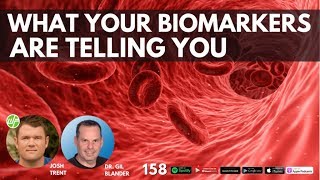
Podcast interview (Wellness Force Radio, episode 158, Jan 14, 2018) with Dr. Gil Blander (InsideTracker co‑founder/CSO) explaining what biomarkers are, how InsideTracker selects ~40 actionable blood biomarkers, and how combining blood, genetics and physiological data can enable personalized recommendations. Key themes: biomarker definition and analogy (internal 'selfie' / car dashboard), criteria for selecting biomarkers (health vs disease, population prevalence, modifiability), women-specific markers (iron, DHEAS, SHBG), male sexual-health markers (free testosterone, LDL/HDL, hsCRP, RBC magnesium), limitations and actionability of genetic/epigenetic/microbiome data, InsideTracker's coaching/coach-dashboard approach, and reported user improvements (study of ~1,000 users showing biomarker improvements after ~7 months).
Questions this video answers
About 40 blood biomarkers.
Iron (multiple related markers), DHEAS, and SHBG (sex hormone binding globulin).
Free testosterone, LDL/HDL (cholesterol), hsCRP (inflammation), and RBC magnesium.
In a study of ~1,000 users, almost all showed improvements in measured biomarkers at follow-up after about seven months following InsideTracker recommendations.
Chapters
So basically, biomarker is a way, unbiased way to reflect what's happening inside your body at a certain condition, at a certain time. You walk in the street and you can see everyone with the selfie stick taking pictures and they are trying to show everyone how do they look, but actually nobody, only a few of us are looking inside. What we are doing at insertracker, we are allowing you to see what's happening inside your body very similarly to what we are doing with the car. We are checking the machine, finding what are the issues that we have, and then we intervene and hopefully we'll improve the quality and the longevity of our Life.
That was Dr. Gil Blander, and this is episode 158 of Wellness Force Radio. What's up, my friend? It's your host, Josh Trent. And welcome back to another episode for your weekly access to global experts in all things wellness as we discover the physical and emotional intelligence we need to live life well. In this podcast, we're talking about what your biomarkers are trying to tell you. And if you've been following Wellness Force over the past year, you know that I've experimented quite heavily personally with biomarkers. It's something we can all learn so much from in 2018, as so many people right now in the middle of January are focused on diet and exercise and new training programs, you know, clean nutrition. How are we actually going to quantify this, though? How are we doing? In other words, what are we doing to track our progress so that we know the inspired actions we're taking in our eating and sleeping and moving? Are they actually paying off? Are they truly making a difference in our lives and our wellness? Because we know that the scale is complete bs and muscle is so much more dense than fat. So beyond getting a DEXA scan or a body pod or a hydrostatic water test, which is the real way to test lean body mass versus body fat? What can a blood test, an internal selfie tell you about your current state of health and wellness? What specific biomarkers will point you towards the lowest hanging fruits, the things that'll make the most difference, and in your current health program that you can actually act on. We're going deep into this topic today with Dr. Gil Blander so that men and women can learn their sex specific biomarkers that deserve attention, as well as how taking a full spectrum biomarker test can actually help someone noticeably improve their wellness. And speaking of wellness, it starts with our breath and the foods that we eat, not just the macros like proteins, carbs and fats, but the quality of our micronutrients. Micronutrients help prevent disease and fight off the signs of aging. And this is your breath break, brought to you by our show sponsor, Organifi. So take a deep breath. It might be the first time today you've been reminded to take that deep breath and know that great health starts in our cells in the mitochondria. And with those micronutrients fueling us that we're taking on a daily basis that unfortunately are missing from our food supply right now. Even if you're eating organic food, most people are not getting in their greens and their micronutrients. And the bigger challenge for parents or anyone that's super busy is taking the time and resources to buy all the fruits and veggies and cut them up and place them in a juicer and then also lose the fiber so organif come through. They made it super easy to get in your superfood powder with Organifi green juice that also has ashwagandha and beetroot and turmeric, all organic, no pesticides, dairy free, soy free, gluten free and vegan. Because you're a part of this show, you get 20% off from Organifi. They're hooking you up over@shoporganifi.com just enter code wellnessforce at checkout to pick up your green juice or the red juice or the turmeric, which I've been loving for getting quality sleep, getting that nutritious rest that we all deserve, especially right now as we're gearing up for the new year. Just hop over to shoporganified.com and enter your code wellnessforce to get your hookup. 20% off at checkout. Now onto the show. We are learning from Dr. Gil Blander, the chief scientist and co founder of InsideTracker, who you may have seen all over the media and online in 2017. They're working with some very big athletes, professional athletes. I saw many of them at the Spartan race last year. If you heard some of those podcasts and everyday weekend warriors like you and me who just want to know what's going on with our blood so we can make actionable changes and strategic movements in our lifestyles every single day. We're also talking about the correlations between gut health and 23 and meat testing and genetics, what these epigenetics are doing to our health and how we can adjust those so that they're stacked in our favor. I know you're going to love this conversation from a Very intelligent mind and special announcement. Make sure you head over to the show notes page. Dr. Gill was kind enough, generous enough to give us 15% off. We had a conversation about how important this was for people to really know what their biomarkers are telling them. And this is so important. I mean, I can't think of something more pivotal when you can look inside and see what's going on with your blood. So the team at InsideTracker has given our audience, the entire Wellness Force community, 15% off of any service. Over at InsideTracker, all you have to do is go to the show notes page@wellnessforce.com 158 now, no further waiting. Let's step in with Dr. Gil Blander. So as we move into the new year, a lot of people right now are focusing on, you know, getting a six pack and all these not necessarily deep topics. But today we are diving deep into something that truly matters for your long term health and that is biomarkers, those things in your blood that really constitute so much around the structure of your health and your wellness in this new year, this 2018. We're talking on the show today with Dr. Gil Blander about what our biomarkers are actually trying to tell us. Now I got to meet Dr. Gil in San Francisco. We're going to talk about that today. What's changed in the quantified self landscape and digital health and what we can actually learn from all these biomarkers in our blood now. Dr. Goblender is the chief scientific officer of InsideTracker. He's also an internationally recognized man for his research in the basic biology of aging and translating research discoveries into some new ways for detecting and preventing age related conditions. He leads a team of biology, nutrition and exercise physiology experts and computer scientists at InsideTracker. And he's been featured on CNN Money, the new York Times, Forbes, Financial Times and the Boston Globe, among many others. Dr. Gillbander, welcome to Wellness Force Radio.
Thank you, Josh. It is exciting for me to be there.
I've been so looking forward to this. You know, so many people right now, Dr. Gill, are thinking about how do I get my health in better shape? How do I improve my wellness? There's this typical kind of 30 day focus for so many people in the beginning of 2018 to get fit. But I can't think of a more powerful way to learn about how we're actually doing than by looking inside. And I want to read something from your home screen. We'll talk about InsideTracker a lot today on your home screen at the side it says, what if you could take a selfie from the inside? And I think this is a great way to start our conversation here. Why do you believe that InsideTracker chose this metaphor? What do you mean by what if you could take a selfie from the inside?
Yeah, because today if you look around, everyone is taking selfies. You walk in the street and you can see everyone with the selfie stick taking pictures, and they are trying to show everyone how do they look, but actually nobody, only a few of us are looking inside and trying to understand what is happening inside our most important machine, which called our body. So what we are doing at Instant Tracker, we are allowing you to see what's happening inside your body. And after that, we are giving you an actionable recommendation to improve your health, wellness and performance. Very similar to what is happening for your car when you take it to the technician. Because when you take the car to the technician, he plug a computer into the car and the computer telling the technician exactly what are the issues that the car suffers today? Does he need to replace the oil filter or any other part of the car? He do that, and then the car is good for another 5,000 miles. Then after 5,000 miles, you take the car to the technician again. You do it again. And there is research that showed that the lifespan of the car increased significantly from the moment that we introduced the routine maintenance. So I see inside tracker or a biomarker testing with a recommendation very similarly to what we are doing with the car. We are checking the machine, finding what are the issues that we have, and then we intervene and hopefully we'll improve the quality and the longevity of our life.
What I love most about this, and I'll talk about my experience on the show Today too, with InsideTracker, I've been doing biomarker testing, gosh, probably since 2009. I love when you said it's like a dashboard on a car. I mean, most of us drive, we've been in Ubers, right? So there's a dashboard for a reason. It tells you how fast you're going. It tells you what's going on with your fuel and your oil and your temperature. And it's so funny that we haven't really accepted this in mass adoption yet as something where every human, all citizens in every country just get to have this checkup, really, this dashboard, so they could see how they're actually showing up. So if people don't know, Dr. Gill, what a biomarker is, I think it's a term that's thrown around what is your definition of an actual biomarker that.
Basically reflect and indicate a situation that happened in the body. So you can look at a blood glucose. It's basically resembles a level of a specific molecule in the body, which is a glucose. But you can look at another molecule like cortisol, which is reflect the amount of stress that you have in the body. You can look at other markers, like markers of liver health that can sometimes reflect the amount of alcohol that you drink. So basically, biomarker is a way, unbiased way to reflect what's happening inside your body at a certain condition, at a certain time.
And we had some specific questions around, you know, what are the best biomarker tests to have for men, for women, we're also gonna talk about erectile dysfunction, which, you know, there's many studies talking about. One in four men are suffering from this. There are some specific things that we can look at here, but I'd love to learn just in a quick snapshot, what even got you interested in all of this science regarding biomarkers in the first place?
Yeah, that's a very good question. So you can hear from my accent that I'm not a native American. And I actually was born and raised in Israel. And at a very young age, a relative of mine passed away. And instead of being sad about her that she passed away, I was sad about myself because I realized that I won't live forever. So at that time, that was at age 12, I decided to dedicate my life to try to understand why do we age? How can we live forever? How can we improve the quality of life? That's why I decided to study biology. I done my graduate study at the Weizmann Institute of Science in Israel. And then I moved here to the US to mit and spent five years in the best lab that studied aging. My goal was to go back to the academia and be a professor in the academia and basically publish papers, do what a professor in academia do. But when I arrived here, to mit, to Boston, I started to be exposed to the what is called Kendall Square environment. A lot of biotech, high tech, pharmaceutical companies. And I started to realize that maybe I can contribute more to humanity if I will start my own company and try to help people to live longer, better life. So after five years at mit, I left the academia, moved to the industry, worked in a couple of biotech companies. In 2009, I came to the idea of INSERT tracker together with two other scientists. And the idea of INSERT is very simple in order to allow us to Live better, longer life. We need to understand what are the issues that we have in our body. And that's why we're using biomarkers. And then based on that, prescribe an intervention of changes that we need to do. And hopefully by that we can improve the quality and the longevity of the human being. So that was the beginning of Instant Tracker. And long story short, here we are around eight years later and we are still doing it. And I'm very, very excited to do that. And I'm very, very excited to talk with you, Josh and your people because I think that the change of the healthcare will come from outside of the health care system because the healthcare system is very fragmented, very hard to make changes there. I think that us as a human being, the quantified self community, can make the change that a community will follow us because we are the pioneers.
Thank you so much for sharing that. I was, you know, I was Picturing you at 12, just getting that hit of consciousness and understanding, hey, you know what? We're not going to live forever. And I really enjoyed how you kind of took that ethos of I really care about people, I cared about my family member that I lost. That's what's driving you. Do you feel like that's the undercurrent of everything you're doing?
I am, and it's very exciting. And sometimes on Sunday dinner I meet with my friends and I say, oh, it's Sunday, tomorrow is Monday and we need to go to work. And I'm saying, oh, it's Sunday. I'm so excited because tomorrow is Monday, I'm going back to work. I'm fortunate in a way that I'm really loving my job and doing the best that I can to help people to live a better, longer life.
Well, it's obvious and I felt the same way when I met you almost three years ago. And I look at your career so far and everything you've created with your team at InsideTracker, you know, 20 years for you personally, experience in systems biology, computational biology, which I'd love to learn what that is. Aging, metabolism, caloric restriction, research, mit. I mean, you have everything that anyone could ever ask for when we look at academic research and experience. Yet as we understand the landscape now, I think you're right, it's not going to come from the companies in health themselves. It's going to come from practitioners and quantified self and everyone else who maybe not has your level of academic experts and experience. What do you believe is going to happen now in 2018 as we look at how biomarkers are going to shift the health of people, how does this uplevel human optimization?
Yeah, I think that the next level is a system biology, meaning that we will combine a lot of different biomarkers, not only from one source. So right now instatracker is a have an expertise in blood biomarkers, but now we are adding also some other inputs. For example, we just very recently added genetic biomarkers. So we are looking at single nucleotide polymorphism and how your genetic or your potential influence the level of your biomarkers or a lot of other part of your day to day life. So that's one example. Another example is physiological markers. So I assume that most of us are wearing right now either Apple Watch, Fitbit, Garmin or any other smartwatch that measure our steps, measure our sleep, measure our heart rate and so on, so forth. But at the end of the day we get a lot, a lot of data, but it's not actionable. What can we do with the fact that I walked 14,000 steps today? Not a lot. So what we are trying to do right now, and actually that will happen in 2018, is to integrate this data into Instant tracker and then give you an actionable recommendation. For example, your resting heart rate was X yesterday. That means that you need to eat more of that food or you need to exercise less or more that day, or you need to change your behavior. The same with the weight and the same with the sleep. So basically we're trying to have combine a lot of inputs inside, insert tracker and then based on all of them using our algorithm to run all the possible intervention that you can take and supply to you. The most personalized intervention that fits for you based on your blood, genetics and physiological markers.
And you dialed it down. There are literally thousands of things that anyone could measure on their body, but I think there's around 40 or 41 that InsideTracker really focuses on. Can we talk about this here? Because there's so many things that we could dive into, but we. Why did you choose the ones that are actually listed on the site? What did those mean for the longevity and the health and the human optimization of people? How many actual biomarkers do you test?
Yeah, so we are testing around 40 blood biomarkers. When I started the company in 2009, actually I spent a couple of years looking at the battery of blood biomarkers that are publicly available or available at labs such as Quest Diagnostic and we found that there are a few thousands of those. So what we tried to do is to narrow down the list to the markers that are most important for a healthy population. So we done that by developing a few criteria. Criteria number one was that those biomarkers should be biomarker of health and not a disease. So basically we are not looking at psa, which is a marker of prostate cancer, but we are looking at cortisol, which is a marker of stress, or looking at glucose, which is a marker of carbohydrate level in your blood. So that was the first level. The second one was that we wanted to find a biomarker that at least 1% of the population is out of the optimal zone. So basically, if there is a biomarker that only one in a million is not optimized, I don't think that it's a good service to ask someone to pay so much money and then to see that it's optimized. So we were trying to focus on the ones that are mostly unoptimized in the general population. Last but not least, we are looking at biomarkers that you can modulate using a simple intervention such as food, supplement, exercise and lifestyle changes. So if you cannot modulate them using those interventions, we are not measuring them.
I so enjoy this, Gil, because I'm thinking about the database. There must be a massive database, not just with InsightTracker, but with any company that's using data driven analytics to help people's health. I mean, I can't even imagine the landscape right now of how many actual data points are measured. But I think what the clear differentiator is is that with Inside Tracker you actually get a report that tells you here's what you can do, here's the lifestyle recommendations based on your data. It creates a bridge between the data and the long term behavior change. Is that what you see as a big difference with InsideTracker?
Exactly. As you said, there are a lot of companies today that they take a blood data or any other data, present it in a nice way, I would say print it on the screen with nice colors and show you that you are in the normal range or outside the normal range. But there is no other company that first apply a personalized optimal zone for you based on your age, gender, ethnicity and other level and then you get the optimal zone. Because nobody want to be normal. I don't want to be normal. Josh, I'm sure that you don't want to be normal. Nobody would like to be normal. We would like to be optimal. We like to be the best that we can be. So we try to make the optimal zone as a subset of the normal zone and try to push you as hard as you can to be optimized. Because if you will be optimized, there is a better chance that you won't be sick later and you will continue to be the best that you can be. So that's fast. And then if you are out of the optimal zone, we develop a database with thousands of recommendations and then we apply the right recommendation for the right person at the right time, based on his blood biomarkers, based on his demographic information, based on his preferences to find the right food, the right exercise, the right supplement, the right lifestyle that he can change in order to optimize himself.
I so enjoy hearing you say that in such a simplistic way. Because really what we're seeing here is it's a window to look inside and once you see what's there, what is the actual plan? What's the bridge to take something that you know and then actually execute on it. I'm thinking about last year we had Dan Pardee on the show and he talked about this. Dr. Gill, it's having knowledge is one thing, doing something with it is another. How have you seen this grow within your core base with your users, also with your staff around the coaching aspect, around walking people through? Hey, once you've gotten your results, once you understand who you are from a data level, then what's the human connection that actually drives the long term change?
Very, very good question. I strongly believe that everything should be automated in order to serve everyone. I want to serve the 7 billion people in the world. I don't want to serve only a few thousands that are very excited about that. So we built this tool in a way that it will be completely automated and completely scalable that can serve as many pockets of users as possible. Saying that we know that there is a big percent of the population that like to have the human interaction. So what we done, we developed what we call a coach dashboard that allow a coach and the coach can be a physician, it can be a nutritionist, it can be a health coach, coach of a professional team that can look at a cohort of people and he can drill down into a specific person and give him a specific consultation. He can look at the team as a whole. For example, if you look at the professional team, they spend most of the time together and they have a chef that cook their meal. So we can give you a holistic solution for all the team, for all the 55 player in the team, what is the most common issue that they are suffering with and then give you five foods that we call them focus foods that if you introduce them into the meal of those team, you can actually optimize all the team at once. So we developed a lot of tools to allow a coach to manage and consult his followers.
I can't think of anything more personal than how our blood reacts to the food we eat. So looking at personalized nutrition, this is big. And I think people might be thinking, oh my gosh, there's so many things to look at. What should I be looking at? Let's simplify it a little bit. When compared to men, is there some, you know, handfuls of tests that women should really be looking at?
Yeah. So women, especially perimenopausal women, they have a tendency to have a pretty low level of iron. That's a very big issue with premenopausal women, especially for the athletic, active population of them and especially for runners. Because what the science show is, when you run, you sometimes tend to have a micro bleeding from your gut and you tend to lose some blood. As we know, perimenopausal women, usually they lose blood once a month and sometimes it can be high amount. So women have a high tendency to have low iron. So I will strongly recommend for women to test for iron. Actually in our panel, we have almost 10 different blood biomarkers related to iron because it's so complex and the iron regulation is so complex. So it's very, very important for women to look at iron. So that's one biomarker. So definitely is the one that is most important for women, but also for men. A few other biomarkers that are important for women to test, one of them is dheas, which is actually a molecule that is a precursor of sex hormones. And what is interesting about this molecule that is declined with age, so basically from around the age of 20, this molecule started to decline. And especially for postmenopausal women, all the sex hormones that women have after the menopause arrive, they stop receiving those hormones from the sex organs. And the only source for that is dheas. So it's very important to look at it and monitor it. I think that those two are markers that are very specific for women. There is another very interesting marker called sex hormone binding globulin, or shbg. And SHBG is a molecule that binds to sex hormones such as testosterone, estradiol and other. Basically, when it's bind to those molecules, it basically stabilizes them, but also inactivate them. So Having the right level of SHBG is very important for women, but also it's very important for men.
Oh, wow, thank you. I know all the women listening, so appreciate that. Differentiation, iron, dheas and the sex hormone binding globulin, you know, for men. I was reading an article in preparation for our talk today and I understood that ED is not just for people in their 50s, 60s and 70s. And actually there are some studies, recent studies, that one in four men, Gil, are seeking treatment for ED under the age of 40. This is not normal. This is really a crisis because look, I mean sex is a healthy part of life. If we're not functioning sexually with one another, then everything else starts to decline as well. Let's start with some basics here. You know, erectile dysfunction for men, it's not necessarily something that you can just eat a certain food and all of a sudden you'll have this long term change. Tell us about the biomarkers for ed. Are there anything that we can look at as men specifically to decrease our risk of ed?
Definitely and not surprisingly, testosterone is very important and especially free testosterone. So we discussed two minutes ago about sex hormone binding globulin and sex hormone binding. Globalin is a molecule that interacts with with testosterone and stabilize it, but also inactivate it. So it's very important to measure the free testosterone, which is meaning that is the active part of the testosterone in your bloodstream. So free testosterone is definitely very important. Having the right amount of free testosterone is important to prevent or improve the symptom of ed. Another few biomarkers that are less, I would think about them less, but actually they have been shown recently to be related to ED cholesterol and basically LDL and hdl. And the issue is in our penis, the blood vessels are starting to play a very important role in the process. Cholesterol as we know, can actually clog some of the blood vessels. So the right level of HDL and LDL is very important in order to most optimized sex activity for males. Other markers that are important are inflammation markers such as hscrp and very recently magnesium have been shown to be related to ed. It's still very preliminary, but we have seen some data that show that optimize magnesium level in the body, specifically what we call RBC magnesium or red blood cells magnesium, because that measures the amount of magnesium in the cell is very important to the right sexual function of the male as well.
Now these tests for ed, I'm so glad we're talking about this because I think it's something people don't want to talk about. It's kind of like anything that involves our poop or sex people just get scared of. But look, we're going to talk about it here on the show because total cholesterol, HDL, free testosterone, C reactive protein and magnesium. I really enjoyed that you mentioned magnesium because I'm thinking about our episode with Dr. David Minkoff and we looked at the data, we looked at the research. Most people, over 80% of people are magnesium deficient. What are some magnesium rich foods that we can eat? Also, how do we rise the level of free testosterone? Is that something that just with age we have to accept that it is what it is? Or are there certain foods or things we can do to raise naturally our free testosterone? I'd love for you to talk about the free testosterone and the magnesium.
Testosterone is very interesting in a way that food plays less important role in testosterone than in other markers because the regulation of testosterone is mainly via some more lifestyle changes that you do. For example, if you sleep more or sleep better, you have a better chance that your testosterone will be more optimized. If you become less stressful, your testosterone can be much more optimized. Exercise is also very important for the level of testosterone. A lot of research shows that exercise can be positive and negative for testosterone. So if you are a gym rat and you spend a lot of time in the gym, it could be that because you are exercising too much, your testosterone is low. But for most of the population, actually exercise will improve the level of testosterone. So it depends whether you are exercising too much or too low. You can actually regulate the level of the testosterone. So that's about testosterone or free testosterone. If you look at the level of magnesium, different kind of food that are relatively rich in magnesium. Muesli is one example. A snail is another example. If you don't like snail, eat salmon, some beans and some seeds. A spinach is relatively high with magnesium. So I can continue and continue. But there are a lot of alternative for magnesium.
And my favorite too is dark chocolate. One ounce serving is 16% of our RDA for magnesium there. And I want to go back too, because you talked about cholesterol. You know, the hdl, the ldl. We actually had a question for you, Gil, in our group from Amber. Interested to hear these blood test differentiations between men and women and specifically what are the real ranges of cholesterol we can shoot for.
I cannot tell you exactly what is it because what we are doing is we are customizing or personalize it. For each person based on his age, gender, ethnicity and athletic activity. What I can say is that for example, women tend to have much higher level of HDL than men. Very frequent that there are some women that have HDL in the level of 100, which is great, but it's very rarely that you can see a male in that level for LDL talking generally not for a specific person. There are some research that show that having LDL below 70 is considered to be good. But what I want to say again, that depending on your age and gender, ethnicity and athletic activity, we are assigning a personalized zone for each of our users.
Are you cross referencing that with any 23andMe or how much plays into that? When we look at genetic testing in combination with quote, the best reference ranges for hdl, ldl, we just soft launched.
A product that is our genetic product and very soon it will be combined to our blood data or blood product. You can see that some people, as you said, might be predisposed for a high level of cholesterol or high level of LDL or low level of hdl. So what we are doing is we are informing you right now that you have a genetic predisposition, sorry, high LDL or high cholesterol or low hdl. In some cases you can even quantify it and come and say because you have this predisposition, you might have 10 units level higher of a specific marker. So we are trying to integrate that into our solution. But I want to say that genetic or your potential is just one part of the equation. Lifestyle is a very important one and there is plenty of data of looking at identical twins. One of them is diabetic and the other is not. And the reason for that is that the lifestyle environment, exercise is very important as well. So we are trying to do is to combine the genetic with the blood and hopefully soon with physiological markers and based on that, give you the best recommendation that fits for you.
We have a way of eating that's great for us. We're going down an exercise path. We're doing all these things that seem to be doing the right thing. But yet unless there's some kind of measurement, unless we're understanding how we're actually showing up in these unique biomarkers, then we can't always go off of just what we think is common knowledge about how to improve our health, especially when we look at epigenetics, you know, this long term behavior change. Can you talk a little bit about for your understanding of epigenetics and how that applies to People that are interested in biomarkers.
First, let's define epigenetics. And again, there are a lot of different definitions of epigenetics. So I'll give you my definition, and it might be different than yours. Epigenetics is modification to the DNA. Basically, we have the DNA and we have the sequence of DNA hd, T and C that a sequence of a lot of those. And there are some enzyme or protein that actually adds some molecules to those nucleotide, which is the building block of the DNA. And that can be acetylation, methylation, or any other modification. Those modifications mostly change the accessibility of the DNA to produce RNA and then to produce protein that will behave as the enzyme and can basically build our body. So I just want to mention that at mit, when I worked there, I worked on a protein called SIRT1 or SIR2, which are protein or also DNA deacetyls that remove acetyl group from the DNA and then basically regulate the transcription of the genes. Epigenetic is very, very exciting, and I think that it's something that for sure will play a very important role in the future. But in my opinion right now, it's still more like a research tool than something that I can come to you, Josh, and say, hey, you have 20% of your DNA is at satellite. And actually it's not the percent, it's more the location. Because of that, you need to do X or Y. I don't think that it's there yet, but I think that it will be there in definitely in a few years.
And it's natural. Epigenetics is a very natural thing, but it's influenced by a lot of different factors. You know, how old we are if we're in an environment where there's a lot of air toxicity. Also if we have people around us that kind of load us down emotionally. These epigenetic modifications, I'm sure, can manifest commonly by disease or even other things that end up like in their skin or in our liver or in our brain. What have you seen in your research then? Because you talked about epigenetics being really just a research angle right now. Have you seen anything that fascinates you personally about epigenetics and the human optimization?
There is the data that actually epigenetics is a transfer from old generation to the next generation. So there are some epigenetic changes that not only happen because you spend time next to a power plant and you got polluted. It's also something that might happen to your grandma or grandfather. That transfer to you. So there are some epigenetic molecules transferring from old generation to the next generation, which is very exciting. Again, I'm not sure what can you do about it. So I'm not sure how actionable it is, but it's definitely very exciting.
I think it's really just awareness. I'm, you know, referencing the work of Paul Cech here. He talked about in his studies, he found that many women that were fighting with their husbands and they were kind of setting up the fetus, the new baby, to have more cortisol, wiring for stress, literally wiring the baby for war. Coming into the world with a nervous system that is wired for fight and flight. Do you feel like that could be an arm of epigenetics, just that awareness? I think the actionable piece is what do we do once we're aware. So there's emotional work and healing we can do. But have you seen this in your research or in conversations with colleagues? You know, the parents behaviors can actually alter literally the path of the child's life.
It's not my own research, but we have seen a lot of parents that spending a lot of time next to a computer with specific music or a specific audiobook and just playing it for the baby to try to make him smarter in the future, transfer to the baby via the epigenetics. So definitely there are a lot of possibilities. Again, I'm not sure that we are there yet, but it could come very soon. Very similarly to what happened with the microbiome. Microbiome is so exciting. Like five years ago we knew nothing about it. Nobody cared about microbiome and all the bacteria that we have in our body. And actually we have more bacteria in our body than our own cells. Now there is a lot of data that show that microbiota is super important. And I think that it's definitely going to be as big as genetics and as big as blood biomarkers. But again, I think that today is still a research tool and it's not very clear what can you do about it other than to know that you have X percent of this kind of bacteria and Y percent of the other kind of bacteria, which is interesting. And I think that a lot of your audience assumes are a quantified sulfur. So it's interesting to know. Just knowledge is a power. So I'm not saying that it's wrong to do it. And there are plenty of companies that are doing it. Some of them I know very well, like Eubiome, which is a great company. I think that we are in the stage of a microbiome, like the stage that we have been with 23andMe, I don't know, 10 years ago. It's very exciting, it's new. We are collecting data. And just today I read an article about 23andMe that now they have a few million people that are using 23andMe, so they are doing a research of how genetic influence weight loss because they are going to take 100,000 people and tell them, hey, you will do this diet. You will do this diet and then combine the data of the weight loss and the kind of diet that they done with the genetic data that they have at 23andMe, and then hopefully they will find new genes that related to weight loss, which is very exciting. So I think that with the microbiome and I assume with the epigenetics, we are in the stage of 23andMe, like 10 years ago. It's great that we are doing it because if we won't have data, we cannot do the experiment that Wenisu and me are doing today. So definitely, if you are interested, do the microbiome test help the scientific community to have enough data to start having recommendations for that?
You know, I tried the ubiome test and I'm sure that from an academic perspective, it's a great test. But I'll tell you where they missed the mark. And I have no qualms about saying this because I really believe people need the truth here. I didn't get any actionable coaching. When I look at InsideTracker, you guys told me exactly what to do you biome. I didn't get any direction. They're so kind of, I think, afraid of giving people, you know, suggestions. They basically say, here's your results. Now go to a physician. When we look at, you know, people wanting to be their own citizen scientists, we need more direction there. And I'm thinking about this dream dashboard that I've always wanted to have. And it's our gut, our activity, our blood, our emotions, our sleep and our food. If we can get all those things into a dashboard and then integrate AI with that dashboard, can you imagine, Gil, in the next three to five years with all of those things on a dashboard, literally having a personal coach in our ear through an earbud, I completely.
Agree with you and that's what we are trying to do. But in defense of you, biome, I want to say that they don't know. So they are collecting the data and they don't know more than that. So they cannot give you a guidance because There is not enough knowledge to tell you what to do, so they do what they can.
Oh, such a good point. We had another question since we're talking about gut health and epigenetics. Sandy asks, what is your take, Dr. Gill on Actionable health behaviors when looking at a tool like 23andMe? What can I actually learn when I cross reference 23andMe with InsideTracker?
I think that that's a very, very good question. Actually we are getting into the comparison of what can I get from blood testing versus genetic testing. A few criteria that are very important to distinguish between blood and genetics. And actually there are five very important points. The first one is the actionability. Blood is extremely actionable. For example, if there is a low level of vitamin B12 in your blood, you need to consume a vitamin B12 rich food in order to increase the vitamin B12 or take supplements. So it's very straightforward in genetic testing. It's not actionable. So what I'm saying is let's assume that you have a SNP that suggests that you might have low vitamin B12. First, you don't know if you really have low vitamin B12 right now because you have a risk to have vitamin B12. But even if you have it, and let's assume that you supplemented or consume a food high with vitamin B12. You don't know if you improved it. You need to go to the blood in order to see the action reaction. Second is actually a point that already discussed is view of progress with blood. You can see video progress. You can test today, find that you have low B12, supplement with B12 and in six months test again and see whether the supplementation worked or not. With genetic you cannot do it. The next point is the scientific support. We need to remember that the first time that we sequenced the full genome was in the year 2000. So it's only around 17 years ago. Because of that there is not as much scientific support for genetic markers as much as you have for blood biomarkers. Because blood biomarkers are with us for the last 100 years or so. We have a lot of information about it. For each biomarker that you have in the blood, you have maybe thousand or maybe ten thousand different peer review scientific publications that support a specific intervention. While for agenetics Most of the SNPs you might have a paper or half a paper, maybe two papers that discuss it. A very young field that we are not really sure of the full picture.
Wow. So the jury is still out on the cross Reference of both. I want to shift here because we're getting towards the end of the show. We always look at the emerging trends. Some of them, Gil, we know they're just fringe. I think a lot of people in the digital health space, the wellness space, just any area, really, in regards to human optimization, there's people that are predatory. They're trying to just make money off of others. And that's the part where we really want to vet them out. But when I look at the changes that are coming from crispr, this new technology, C R, I, S P R. It's this super long name that I can't even pronounce myself. But this is literally something where we're looking at these clusters inside of people's bodies where there can be actual changes. They're repairing the DNA in bodies so we can have something like Gattaca, the movie Gattaca that came out 20 years ago. We're gonna have designer babies out there soon. Can you talk a little bit about crispr for people that don't know? I'd love to get your scientific take on crispr.
It's a very, very young technology. Basically, it's used repetitive sequences that a complex can identify, and then this complex can come and remove a cassette and insert a new cassette that replace it. So there are some diseases, specific diseases that maybe only one change in the DNA can cause disease, like sickle cell anemia, for example. For such a disease, we can actually define specific sequences that this CRISPR will recognize potentially in the future. Inject or introduce to the body this specific agent, and then it will come and cut and paste a new part of a sequence to the DNA of this patient and theoretically change his life and make his example of sickle cell anemia. His red blood cells will become normal. And there are a lot of diseases like that, that one nucleotide, two nucleotide, few nucleotide. And theoretically you can cure those diseases. Also in cancer, sometimes you find a specific gene mutated. Again, I don't want to go too deep into biology, but there is a protein called p53, which is a tumor suppressor, that maybe 50% of the cancer patient have mutation there, and most of the mutation occur in a specific location. So. So theoretically, we can come sequence the p53 gene for those patients, find where is the mutation, then introduce CRISPR and fix it. And hopefully you will cure them from cancer.
Oh, man, no big deal. We're just editing genes and then cutting and pasting tiny snippets of genetic code. Are you personally Excited about this or are you still taking your time to research it? I mean, does this bring up any kind of emotion or any kind of real shock value for you that this actually exists now with crispr?
No. It's amazing because it's like the plumber in your house. He finds a clog somewhere, he come, he cut it, paste a new part, and that's it. It's good. So think about it. If we can do it to our body, it's really, really exciting. I think that it can be a great revolution. But again, it's not ready yet to do that. It might be ready in five to 10 years. I done some research at the Weizmann Institute in science on DNA repair. It's really exciting. It can be a big, big revolution. It's early, so I don't know yet if it will work or not.
And there are some people out there, Gil, that don't want it to come out, because once this tech comes out, there's really no way to reverse it, especially when we look at how it multiplies. But that is another podcast, and this is almost the end of ours. This is our last section of the show. It's seven fast questions for seven of your truths. The first question is the misconceptions that many people understand for blood tests. What are a couple that you see on a regular basis, these misconceptions in our public about blood tests and human optimization that simply are not true.
Most of us see blood tests as something that is only for the physician. It's too complex. We don't understand it. And I think that each of us can use it to learn a lot about himself. It personalizes a lifestyle and nutrition based off it. So I think that is very actionable, very important for each of us to use this data to allow us to live longer, better life.
And a lot of These tests through InsideTracker are geared towards someone who really is that citizen scientist. They want to understand for themselves, not just going to the doctor, getting a routine panel. This is a very specific panel. So what's the most scientific path, though, when we look at food sensitivities? Is there a test or test that you prefer? We had a question about this for food sensitivities. Do you have a go to test for that?
Yeah. So food sensitivity. And again, sorry to say it, but I think that is mainly a fiction. There is a food intolerance, which means that basically when you eat nuts or peanuts, you have a rash all over the body and you almost dying. Food sensitivity, it's Usually more in your brain than in your body. A lot of companies that develop kits for that and testing for what we call igg, which is a specific antibody related to that. But the scientific research is not there. So basically they are selling it just to move kids. If you really want to understand if you have a food sensitivity, the best way to do it is to look at your genetics. In genetic testing, you can test and see whether you have a correlation that say that you might be a peanut intolerant or a gluten intolerant or lactone intolerance. The caveat of that is that it will tell you, hey, Josh, instead of having a 1% chance to be gluten intolerant, you have 6% chance. So it still doesn't say that you are intolerant. It's saying that you have a higher chance to be intolerant. And you still need to at the end of the day to go and eat food with gluten and see whether you get an allergic reaction. If you really want to be sure, if you have a food intolerant, the best way to do it today is still to go to your doctor.
And at the doctor they would do.
What at the doctor? Again, that's still not 100%. They can do some testing of antibodies. Sometimes they are scrapping the antigen on your skin and try to do it. But still, the food sensitivity raises a lot of curiosity in the public. I'm not sure that there is a great essay to come in. 100% say you have it or you don't. There is a lot of gray area there.
We had another question from Alison about cross referencing celiac. She says there's 23 chromosomes that react in proteins. But it's unclear to her if there's a good test to determine what to eliminate. In other words, is there a marker we can look at for celiac or is that blood test specific outside of just markers that you tested inside tracker with celiac?
I'm not sure that there is something you need to discuss it with your physician. Again, I don't want to get into that because we are getting into a specific disease and I don't want to claim that I'm treating or diagnosing a disease.
Like you said in the beginning of the show, this is a health focused marker investigation with InsideTracker. Now, when you look at the panel, the barrage of knowledge that you've accumulated over the past 30 plus years, what continues to fascinate you in your field of work?
I discover a new fact every day. Basically I'm learning a lot. So it's an interesting occupation. Like being a scientist is an occupation that you learn every day. You are like going to school every day. So that's very exciting for me to learn a lot and more than that to help people to be better. So I can tell you that we ran a study around 1,000 of our users. What we found was amazing that almost, almost all of them improve the value of blood biomarkers from the baseline to the follow up. After following, insert tracker in a timeframe of around seven months. So basically we have seen people that had high glucose at the beginning and become normal, people that had high cholesterol and become normal, high inflammation and decrease it significantly, high stress using cortisol. So very, very nice data that show that indeed you can use simple and natural interventions such as food, supplement, exercise, lifestyle changes that are personalized for you. So basically my plan will be completely different than your plan, Josh. And at the end of the day I can improve my blood biomarkers, which is very, very exciting because those markers are markers of your health and performance and longevity.
The changes we've seen in the past few years. I met you in 2015 in San Francisco. What do you think's changed the most in digital health? In wellness, technology and science, what's changed that's really not necessarily shocked you, but that has impressed you about the progress of where we're going.
So first of all, digital health is now a mainstream. When I started the company in 2009, it was a few crazy guys that trying to do something. Now you have hundreds of companies, a lot of funding, a lot of progress there. So that's very, very exciting. Also you can start seeing some big companies going into that. You can see Apple and Google and Microsoft and Samsung. Everyone understands that digital health is big, is huge and there is a lot of opportunities there. I think that that will be very exciting for the average Joe and Jane because we will start to receive a better treatment. Because when you go to your physician at the end of the day, and you know what he learned in Medical School 20 years ago, no physician, even the smartest one, can have the knowledge that you have in a computer. So basically allowing the physician, but allowing also the patient, or in our case the users or the clients to have the data and intervene, will allow us at the end to live a longer, better life. Because the analogy of the car coming again, when you take care of the most sophisticated machine that we have, which is us, and help them to optimize themselves, hopefully we'll Live a longer, better life.
Yes. And it's going to be such a more enjoyable process, too. Where do you see the future of digital health and medicine taking us in 2018, 2019, 2020, we'll start to have.
An integration of a lot of different inputs, and based on that, we start to have a very, very personalized recommendation for each of us. So it's not like when you will go to your physician and you will say that you have a specific symptom. They will take care only of that symptom. They will look at you as a full organism, and based on that, give you a recommendation that will help you not only to take care of that symptom, but we help you to optimize yourself and be the best that you can be.
Wow, Gil, it's obvious that you're so passionate about what you do, man. But when things get challenging, you know, no matter what we're doing, whether we're working on a dream or being a dedicated parent or just being a great human, there are days when things get really challenging. What's the inspiration that you pull from when your days get challenging yourself?
Yeah, I always remember what is my mission. And my mission is to allow all of us to live longer, healthier, and better life. And that's what keep me awake at night. And that's why I'm so passionate about it, because I feel like we can do it in our generation. It's not easy. As you said, nothing is easy. And to succeed, you need to work hard and long hours. So I'm very excited about that.
Well, this has been such a great conversation. We explored a lot of ground in this past hour. My last question for you, Gil, is Wellness in 2018. With everything you've accomplished, what do you do for wellness? How do you define wellness in your.
Life to be your personal best? Based on your potential, you should try to extract the best from the short time you will be alive on this amazing blue planet. So try to do the best and try to optimize yourself in human optimization and wellness.
They meet at such a fun intersection. We've really enjoyed learning from you on today's podcast. Where can wellness force our community? Learn more about InsideTracker and what you have coming in 2018.
Yeah, they can go to insatracker.com and find out. Find all the information there.
You are supporting so many. We're looking at supporting our health, our best health in 2018. But how do we do both? How do we support our best health and your mission to help globally everyone live this longer and more full life.
Yeah, we should work together. We should do our quantified self experiment of n of 1. That's very exciting. And we should continue do that and try to optimize ourselves. And we should try to use the state of the art platform such as insertwracker, but a lot of others to improve our overall health.
And there's no real ambiguity in the data. The data speaks volumes of truth. Gil, this has been such a great conversation. Is there anything that we missed when we look at human optimization and biomarkers? Really, is there anything we missed when we look at what our biomarkers are trying to tell us?
Yeah. I think that the most important lesson is that it's not easy and there is no silver bullet. So if you want to optimize yourself, it's a lifetime struggle and you need to work hard for it. So it's not enough to do it for 30 days. You need to do it most of the year. All of us have some good days and bad days. So sometimes you need to eat the candy or eat the chocolate or eat the ice cream. That's okay. But try to as most as you can to feed your body the best oil and gasoline that you can because that's your body and you need to keep it as good as you can.
Wow. This is great. Thank you so much for coming on the show and I just wanna let everyone know this is your opportunity. This is your chance to just get curious, just get excited about what you're creating this year for your body. And it starts from the inside out. You know, we talked about taking this selfie from the beginning. This is a great chance to take a breath and take an inventory of what's going on with your blood so that you can make those changes and actually track, that's the key word, track how you're going to show up in better health. So have a beautiful day out there. Make sure that you're being conscious and you're taking care of everyone around you and we'll talk to you soon. Hey my friend, thank you for hanging out and growing with me on today's show. Remember to hit subscribe. Share this podcast with somebody you care about that you think gets to hear this message. Support the show by leaving a five star review for the podcast right now simply by tapping on your show artwork. On your iPhone, click that purple link that says review this podcast. It helps the show reach more conscious and smart people like you and your voice will attract more world class guests that want to come on the show. So let them hear your voice. For all the downloads, videos, links and free resources mentioned on the episode, go to wellnessforce.com radio. And while you're at my house on the web, join us in the Wellness Force Community newsletter on that page and I'll send you 40 free guides around staying healthy with your eating, moving and sleeping while you travel. Join a group of people like you over at the Wellness Force Community Facebook page. This is where we talk about the things that really matter. We share our wins, inspirations, struggles and a lot more. So join us. Tap on the show artwork on your phone and hit that purple link that says join the Facebook group and I will welcome you at the door. Okay. Now you get to go out into your world and create impact for the people that you care about. So until till I see you again real soon, I'm wishing you love and wellness.
More from Josh






Your child's future start before pregnancy... and even before conception! #podcast

MD Reveals: Your Healing Creates Your Child's Reality (The Souls Coming In Need Strong Bodies)



