176 Ted Ryce: How To Deal With Stress & Overwhelm
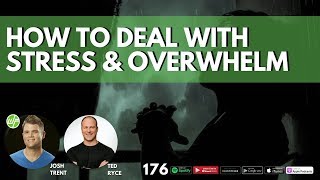
Episode 176 of Wellness Force Radio (host Josh Trent interviewing Ted Ryce). The conversation explores stress and overwhelm through personal stories and practical strategies: the role of environment and community in health (Blue Zones, microbiome example), daily movement and NEAT (under-desk CUBII elliptical, 'second heart' calf activation), the limits of high-intensity training for long-term health, diet effects on anxiety (low-carb/very-low-carb linked to panic/insomnia for Ted), injury and recovery (Ted's back/nerve injury forced two months of immobility), minimalism and relocation as behavior-change tactics (Ted moving to Thailand), and tactical tools like monthly emotional inventories, box breathing, and scheduling play. The tone blends candid vulnerability with pragmatic self-care recommendations.
Questions this video answers
176
March 9, 2018
Two months (could not walk for two months).
37
22% (reported by Josh).
Chapters
A perspective shift that's happening is we're starting to realize that we're not in control like we believe to be. We're not the autonomous free willed human beings that we'd like to believe. There's constant pressure from our wiring to stop that person who cut us off on the road or, you know, those donuts smell good. No, we're fighting ourselves all the time. And then you add into that a stressful modern life where, you know, if you're paying attention to politics, it's going to infuriate you. Where you live has an incredible impact on your health. So much so that you can go read Dan Bootner's Blue Zones, which is a book about these people who live to 100 and beyond in these places all over the world. It's these environments that they're in.
That's Ted Rice and this is episode 176 of Wellness Force Radio. What's up, my friend? It's your host, Josh Trent. And welcome back to another episode for your weekly access to global experts in all things wellness. As we discover the physical and emotional intelligence we need to live life well. In this episode, we're welcoming the return of Mr. Legendary life himself, Ted Rice. This is an in depth, pragmatic and practical driven podcast to bring you behavioral strategies you can put into your life not next week, but today. Grow stronger and to learn how to better deal with stress and overwhelm. Now, if you haven't heard our last episodes with Ted, make sure you bookmark not just one, but two previous shows, episodes 99 and 49. We'll link those in our show notes today to learn more about Ted's incredible journey, what he's been through and how he created legendary life. Now, by the end of this episode, you're going to be equipped with the best of the best wellness and self care practices to support better living and to grow your physical and emotional intelligence. Now this podcast is brought to you by our partners over at intelliskin, creators of Smart Compression. This human technology. This is our standtallseries. Check it out on Instagram and online. If you're looking for better posture, how you're slumping forward, how do you pull your shoulders back? Well, you can do this with IntelliSkin Smart Compression. At the desk, check out IntelliSkin.net or head over to WellnessForce.com, click the sidebar where it says stand tall. Give this Smart Compression a test drive. It's actually been used by some of the greatest athletes on the planet and I know it's gonna help you in, in your physical intelligence as well as your posture. Now they partner with us so you get the hookup 20% off. Just use code WF20. That's WF20 over@intelliskin.net for 20% off. Now question for you. Are you like me? Do you hate the word busy? Do you hate being busy? Quote, quote all the time? Let's reframe that with this episode. Let's start saying full instead of busy. It just feels lighter. And people like you and me that have creative minds that care about these exterior frameworks for, for accountability and behavior change and creativity as you and I grow our businesses and our company, either inside of a company or as an entrepreneur, Ted's going to give us some strategies on how to transcend the waterfall of overwhelm and stress that many of us feel every day. He's also gonna show us how he lays his day out for breaks and free time, and how he came back from an injury and actually drove him to move from Miami beach, pack up his whole life with he and Gisele, and move to Thailand. This is a crazy story. I cannot wait for you to hear it. Ted also shares why stress doesn't have to define you, why your environment and the people you're around are one of the biggest impacts on your health and wellness. I talk about my body composition goals, why my body fat right now isn't exactly where I want it to be, and vulnerably share some of the things that I believe are the cause of it. This is a no holes barred back and forth dialogue with Ted and myself on why I take myself for dates and what I believe that's the perfect time for to take an emotional inventory. Because, my friend, this is it. If we don't take the emotional inventory in our business, in our finance, or even in our cupboard, they'll fail. People won't get fed. Things won't survive. Well, when was the last time you took an emotional inventory for yourself? This podcast we're talking about that, this powerful inventory as well as the power of now, and not just the book with Eckhart Tolle, but how we can do that in our modern, full and busy world. If you've ever dealt with injury or overwhelm or stress that made you want to quit, this might be the time not just to give up, but to take a deep breath and give in to a new solution. Because at the end of the day, none of us are in control. Ted says despite our beliefs, we're not in control. We're not these autonomous, free willed human beings that we like to believe we are. There's constant pressure from our wiring to react in certain ways to different scenarios. We're actually fighting ourselves all the time. So now let's explore this. How do we fight ourselves less? Do what's natural for us. Understanding the ancient brain and learning these new strategies about how we transcend stress and overwhelm. Right here with Ted Rice. Ted, like, you, in my opinion, are one of these podcasters out there. Like, you are always creating. You're always on the move. You're about to make a big move across the world. How are you, man?
Yeah, I'm doing great, brother. And I feel the same way about you. I always pay attention to what you're doing. I'm always happy to see, like, you're one of the people who always steps up their game like me. And I feel the same way about you. And what's interesting is when we connected and talked about, like, my big move just to put it out there. I'm moving to Thailand for a little while. I'm getting out of the States. And when I shared that with you, and I also was like, hey, Josh, I love what you're doing with the promotion. We both got into this conversation about how things look great as an entrepreneur, but there's this secret struggle that we all go through. And it's secret because everybody sees the social media posts and they hear us here, which is, I love doing this, and so do you, Josh. That's why we, you know, connect so well and why you have such a successful show. But they don't see us when we're not on, you know, and when we're struggling to like, okay, how am I gonna pay all the bills? What am I gonna do here? How do I enjoy my life? You know, it's super hard. People don't realize with the podcast, they think like, oh, hey, these guys just come on for an hour and talk some smack.
That's it.
Then they' go, that's such an easy job. They only work like, maybe a couple hours a week, max, tops.
Yeah.
Do you want to talk? Why don't you talk a little bit about, like, what you're going through, I.
Would say over the past five years. And I don't even have kids, man. So a lot of parents listen to podcasts. Like, they're just probably laughing at me going, you don't even know what it's like. But I'm 37 and I'm feeling like, wow, the past five years have been the most work I've ever done. And I'm also curious too. Just in human evolution, like looking at human evolution as a continuum is. Is our 30s and 40s, the time where we just learn truly what stress is, truly how to produce results, even if we feel overwhelmed. Because I felt like when I look back on my life, my 20s were kind of like play and party, you know, I spent the majority of my 20s, like being in the gym, like training clients and like having fun, but not really thinking about my future. And then I went through this transition in my 30s, and now I'm just thinking, okay, every single day is literally a waterfall of activity. My calendar, it's like I was telling our team member Mary the other day, like, look at my calendar. It's like 1312 hours every day, just like lockdown. Boom, boom, boom, boom, boom. And I realized that I've chosen that. It was like this choice that I've made, a conscious or unconscious choice. And for me, it's just been like watching my body change, Ted, over the past year, man. Like my physical body. Because I spend so much time here at the desk taking movement snacks. And really like a download of all the knowledge that I have, it still isn't as clean as knowing and doing so for me. I might know the value of movement snacks. I might know how important it is to get time, sedentary version versus active, to be like at least so many steps per hour. But it still comes down to me having self worth and having self love, to really value my humanity, me as a human being. To take the fricking breaks, to take the breath breaks, to take the movement breaks, to go out in the world and not just be working. And it's funny, cause you and I are in the health and wellness industry, right? But yet we're so much time at the desk. I think that's hilarious. But this is the path I've chosen. And so I guess really what I'm dealing with right now, man, is what's next for me, what's next for this podcast, what's next for Ted, and what's next for Legendary life? I think people really deserve the truth when it comes to like, maybe like, we can pull up the kimono and talk about what's really going on. I'm down if you are.
Absolutely. And I think it's so important to address this. And I don't think it gets shared enough because like what you said, you put in 12, 13 hour days. So do I on my end. And in fact, that's not Unusual at all in this space, we're not unusual at all.
Totally.
This is like, this is the norm for this type of thing. Because one of the benefits of working online is that you don't have to travel to and from your business so you can put in more hours. And there's always that to do list that just keeps growing, never gets done for sure. I mean, people who have kids, of course, they have a busy lifestyle and some people are just amazing at productivity. They really have it handled. But on the other hand, this is our child, so to speak. We are raising and cultivating our businesses. You with wellness force, me with legendary life. And the reason why I don't have a kid is on purpose because I would not want to bring a kid into the environment that is currently in. I don't think someone would have to take second place and I definitely wouldn't put a child in that position. So this is. And I know legendary life is what I need to do with my life. I know that is the path that I want to take. One thing I think that's important to mention is, yeah, you said that we're both fitness professionals and my steps are pretty low too. I've got to really force myself to get up and get some steps in or I have my weight workouts, no problem. Because it's just. I'm kind of like wired for that.
But it's that neat factor, man. It's that non exercise activity thermogenesis. Right. That's the one where I actually. We did a Wednesday Facebook live with Allison and there was a study from NIH where they did this huge meta analysis and the group that did like HIIT training versus the group that did the neat factor, they kept their neat factor super high. The people that did neat factor had lower cortisol. They had more weight loss. It was crazy. And I thought to myself, this is what Jay Tita talks about. Like, this is what I've heard you talk about. Like, it's so true. We're seeing the research now come up more and more, man, that it's actually like continuous activity throughout the day. And how does that plug into fricking overwhelm? It's a beautiful excuse to get away from the desk and move around.
Absolutely. And I think that's such an important shift perspective wise. Because high intensity interval training isn't the answer. Nor is doing steady state cardio. If we're really talking about just being happier, healthier, it's really about getting that movement throughout the day that doesn't put a Lot of stress on our joints. Like running may or doing like, you know, burpees for 20 seconds on, 10 seconds off for like eight minutes.
You know, that sounds like lethal kill. That sounds so hard.
You can. And then your form gets sloppy and you end up, you know, pulling a, pulling something or tweaking your knee. Which actually happened to a client of mine, not with me on my workout program. He was going to a boxing class. And it's just all like hard effort, hard work, which is cool, but when you're in your 40s, 50s and beyond, you really have to be smarter and neat, man. It's like you said they had lower cortisol. I have not seen that study. You gotta share it with me. But I've seen, you know, so many studies like just showing, hey, listen, you can burn way more calories. You can get that, you know, get that daily movement in. And it's important people notice the difference, man. When you get them to do it, they notice the difference. Do you know what a cubi is by any chance? Have you seen that? No.
How do you spell that?
It's C, U, B, I, I. It's a company that we connected with. It's an under desk elliptical machine. And I got it to try it out, test it and do a review on it. And I was like, man, who is this for? And what I ended up doing was I brought it to my 74 year old dad who has an arthritic right hip. He's got a knee replacement on the left side. He's not going to be doing high intensity interval training or steady state cardio running at his heart rate in between 130 and 150 beats per minute.
Right?
But he's got to get some movement in. And it's this under desk elliptical. And it was just amazing. We showed up his congestive heart failure. He was in bad state. This just happened this weekend. We brought the cubie over, he was just in a bad way. And then we had him try it out. And just in a few days of using it for just 5 minutes the first day, 8 minutes and 10 minutes the next day, it was a complete turnaround just because he wasn't getting enough stimulation to his muscles. Our heart beats and pumps blood through our body. But what tends not to be appreciated is that our muscles aid in that, in the pumping of our blood along with our lymph. I mean, it's so important, you know, we got to get more movement and it's definitely part of why we feel more stressed.
God, man, I'M thinking about. I had the guy, Nick Bartolotta, just probably when I say the guy, I mean like the movement guy. He's the creator of DCT and he talked about where the soleus and gastroc connect on the back of the leg. It's actually a second heart. You know, it increases venous return heart. A second heart. And so like when you're talking about the cubi, which is fascinating. Fascinating. I'm totally gonna check that out. I think about how many people are listening and like they work at the desk. Okay, so how do we increase this neat factor throughout the day? And how does that, like, honestly address stress and overwhelm? I know for me, when I move my second heart, like AKA when I'm moving my calf, when I'm walking around, I have these cool trails by my house that I go on. I come back after like five minutes and I just feel different. My physiology has changed, my state has changed. And I'd love to dig in with you here, man. Like, let's go back and forth. Let's figure out, like, what are the tools and tactics that you and I both use in our own lives. And I'm down to share what's really stressing me out and then how I'm actually alleviating that. I feel like stress is a battery and we're just kind of like looking to put out energy all day. But back to Nick's work. It's like that state change. That state change for me is everything. Sometimes I'll do breathing. I have the power plate in my room. I have a foam roller. You know, I use a standing desk. I have all these tricks and everything else, but it really comes down to the night before for me. Ted, I don't know how you feel about planning in the snacks from your day, your movement, your breathing and all that. Or do you just approach it each morning and plan it out in the morning? How do you set up your day? Man?
I'm on a schedule with my workouts for sure, and I have it very planned out. But as far as I'm going to let down all the super hardcore. Plan your schedule. I have free time that I take out of my day. I'm just like, you know what? If I'm feeling fried, I stop. I don't keep pushing through. If the quality of work starts dropping and I'll go and do something then. And that's how I kind of gauge things. But man, you know, like what you were saying, I want to talk a little bit deeper about some of the issues. I'll go first if you're cool with that. But let's go. This year is awesome. We're making this move to Thailand. Already got a speaking event set up. I've got a retreat probably set up with this guy who I've known for a while, who we've done business before out there with, and he lives in Thailand. He's going to be showing me around there and things are really just. This looks like an amazing year. It's already starting off amazing. However, Josh, last year, 2017, I injured. I don't know. We did talk about this.
Oh, yeah, I've been following you online.
I injured myself so badly that I couldn't walk for two months. And it was because I was like, hey, putting pressure on myself to get in better shape, adding in. And I got hurt doing not a 600 pound deadlift or anything that would be cool to brag about, like, oh, yeah, or doing a spartan race or anything like that. It was doing a stretching in between these multiple workouts that I was doing. The straw that broke the camel's back. My man.
Oh, my gosh.
Yeah, it coincided with my 40th birthday. Man, it was just like, it was miserable. I spent my Christmas that I wanted to spend with family and friends and my Thanksgiving that I always spend with my dad. I had to spend that by myself with Gisele. Not by myself, but with Gisele on the couch. Just miserable. I couldn't sleep at night because the pain was so bad. I had to take painkillers. And I've been in a lot of pain in my life, Josh. I got a brown belt in jiu jitsu, been in martial arts, been kicked, punched, have my limbs hyperextended. But this, man, I've never felt like anything like this nerve pain. Anyone listening who's been in that situation can attest to just how debilitating and intense it can be. Man, I couldn't sleep at night. It was just terrible. And it set me off to where I couldn't work. I had to do physical therapy. Gisele had to drive me there, so she wasn't working. I was on the edge of kind of losing everything. I've got a lot of good relationships and I'm sure I could have reached out if I really needed money. I trained a lot of people who are pretty well off financially here in Miami beach that have good relationships with for years. But, man, it just, it made me realize, like, this life that I'm living, although it's got so much cool, so Many cool things to it. Doing the podcast, doing speaking events, doing everything that I do, exercising a lot, focusing on my health, or really, we shouldn't say, or I shouldn't say health, focusing on the way I look, to market myself a certain way. And it came down crashing and burning. And I realized I needed a huge change. That was something that I dealt with. And another thing that I've been dealing with is that in Miami Beach, I've been living here for 20 years now. I'm from Miami. But what ended me up here after my 21st birthday was that period of time after my brother was kidnapped and murdered. And I've been here since then. It's been a great experience. But I also feel like I've been staying here. I've been comfortable and I haven't been challenging myself. And I've slowly been more and more negative about where I live, and not so much that this place is terrible. I think it's great for what it is, if you like to go out, party or go to the beach, but really just not feeling like I'm in the right place. And for all the talk about, like, it's not about the environment, it's about you. I think that's kind of a bit of bs, my friend.
I agree.
It's a bit of bs. And I said to myself, I've got to get out of here. It's really tearing me apart. Cost of living is high. So I don't live in a particularly nice place, Miami beach, because I spend all my money on my business. It goes back into the business. I sold my BMW, my X5 BMW. I got rid of a lot of my stuff so I could focus on what I know is truly going to make me happy. Legendary life. But it's been a lot of sacrifice to do it. Now we're finally taking the action that we need to and moving to an entirely different place for new perspective, a fresh start. And that's my story, man.
Ted, like, I am so enthralled with what you're doing. We got to connect on the phone. When I was actually driving to a meeting and I was in this frenetic pace. And you said, hey, buddy, I'm moving across the world. And I was like, I wanna come. Cause I think everyone who's listening can relate to these undulations of stress in life. You said, for 20 years, man. For 20 years you've been in this space. And it's almost like when water kind of builds all the sediment to a dam. Eventually the dam and the sediment has to be flushed out, and everyone can relate to this. It's like, we go through these undulations of stress, and, like, everything kind of builds up, and then it's only natural. Don't you think, Ted, that it's only natural in life that we allow the change to occur? And I think probably, man, what really goes down where stress and overwhelm builds up for most is that they're just not willing to let the dam break. They're, like, not willing to make the change, and that actually refracts more stress on top of one another. And people realize, like, wow, my body's gonna give me messages. I'm either gonna listen or not. In your case, you had this back issue that floored you for how long? Two months?
Yeah, two months. I couldn't walk. Literally could not walk for two months.
This is such a beautiful way that you, like, your body gave you not just like a tickle of a feather, but like a sledgehammer. It was like, ted, listen. You get to listen to me now. And I feel like that's kind of where I'm at, too. Like, I haven't talked about this yet, but I'll go on record. Like, I got my body fat tested, and I'm a health and wellness professional, and I'm doing interviews, and I'm doing all these things. I was 22%. I was 22% body fat. And it feels good to just say that out loud because, like, that's my truth now. I'm not gonna be there forever. I know what I have to do. I've already gotten my DEXA scan appointment redone, and I'm working with SteadyMD on some nutritional protocols, and, like, I've, you know, instituted two wearables. I'm using my aura and Fitbit, and I've built my community, you know, so I'm taking the actions for this. But I think we all go through this. Like, no matter what you do, sometimes our greatest fear can be our greatest teacher. And for me, like, my greatest fear was, what if I have too much body fat and people won't take me seriously as a podcast host for Wellness Force, because when they look at me, I won't be perceived as well. Well, I'm doing the best that I can. Just, like, everyone listening. I mean, I'm teaching what I also get to learn. Now, you might look at me. Most people might look at me, and they'd be like, he looks really healthy. Like, what's wrong with this guy? But I think you and I hold ourselves to a Different standard, you know what I mean? And this is the undercurrent of our industry. If your body looks a certain way, if you have perfect six pack abs, if your Instagram is awesome and your glute line is perfect and your back has the bulges wherever it should have, it's all bullshit really. What are we trying to have here? We're trying to have this industry of wellness and I don't know, Ted. There's just so much focus right now and I don't see it going away. Unfortunately, there is somewhat of a movement for body acceptance. But I think the body dysmorphia conversation, it's affected me. When I was a trainer, it made me literally not eat at night sometimes. And I was just going through all these crazy transitions and I realized for me, man, it was really about finding my stillness. That's why I did my Vipassana last year. It was actually two years ago. I did my Vipassana and it's slowing down. This is what you're doing too, man. You're going across the world to slow down, to create more space. You're letting go. You're becoming honestly like more of a minimalist. I feel like. Do you feel like you and Gisele are becoming more minimalist and that's a tool to deal with the stress and overwhelm.
I've always been about that and really, you know, I've gotten to be less of a minimalist because I've got now this backdrop in front of me for videos and I got all this stuff, but you know, for the business and for exercise, because I've been working out at home for the past couple years now. But I want to say this. One thing that dawned on me is that, and this is probably in the past year, is that where you live has an incredible impact on your health, who you're around. And so much so that you can go read Dan Bouttner's Blue Zones, which is a book about these people who live to 100 and beyond in these pockets all over the world. In these places all over the world.
What are they? Ikaria, Greece, Okinawa, Sardinia.
Okinawa. There's a place in California where these Adventists, I don't remember. Alta Loma. That's right. So there's these pockets of places where people live to 100 and beyond. And what is the big thing there? It's not genetics, it's the environment or epigenetics, if you want to say something sciency and fancy. But it's these environments that they're in. I Read something else. Recently, there was a really cool article about this guy who went and lived with the Hadza tribe in Africa. And they did an assessment of his microbiome before he went, then while he was there. And it completely changed because of the types of foods he was eating. And I'm sure exercise helped as well as he was doing all the things that they do in a hunter gatherer society like that. And what you got to understand is that you may be in a place right now where yes, it's always possible, and I love taking responsibility and saying it's up to me to pull myself together and push through this. But you also have to say that the obstacles that you face, let's be specific and say to get in shape, are going to be much, much greater if you're in a situation where, and you and I are lucky, you're in California, I'm in Miami. You know, health and fitness is a thing here. But still there's this obstacle because you can go to the Paleo bakehouse down the way and get all these hyper palatable, but paleo ingredient foods that are still full of sugar. Still full of. Yeah, exactly. Still full of fat. And you can overeat and you still don't have to move that much. On top of that, the cost of living of where you are. I know San Diego is really expensive. So is Miami Beach. You don't get a lot for your money here unless you're spending three, four grand a month in a place. Especially in Miami beach, it's just incredibly difficult to grow something, to invest in something, but also have a high quality of life at the same time. And you got to ask yourself, is this environment that I'm living in, is this life that I'm living, is this helping me? Can I handle this or is it destroying me? And I felt like it's something I can handle. But in reality, judging by the bad decisions I end up making with exercising too much to the point that I get injured, or like you said with your, like, hey, I'm just not going to eat at night because that's the type of pressure I feel around here. Is it something that is destroying you? And I felt like, you know what, it's kind of taking me out a little bit. And I think I could. I'd like to believe I could stick it out. But the question is, why should I? Or do I even have to? And the answer for me was no. And so I'm outta here.
Man, I love talking with you, Ted. And I think people already Know you. Cause you've been on the show twice. I've been on your show as well. So I know your audience has heard us talk before, but I feel like right now. I feel like right now this is the most real. Not that the other ones weren't, but this is the most highest level of truth I've ever had with anybody on a podcast. Like what I just said about, like, my weight and how I'm, you know, my fear as my teacher and all these things. Like, I've never done this, man. Like, my hand was kind of trembling when I talked about it, but it's because I know that where I'm at right now, and this is for all of us as human beings, man, it does not define us forever. Like, these things come up and they're stress and they're overwhelm, which is what we're talking about today, but they're really beacons for behavior change. It's a beacon, it's a push, it's a message, whatever you want to call it from the universe or God, higher intelligence, whatever you believe. Like, these things come to us, Ted. Like we attract them in. We attract in these behavior change beacons so that we can take the next step. So that you can go across the world so that I can sell a bunch of things and actually look at getting a new space where my studio is a little bit smaller and I'm still doing what I love. I think that's the big thing. The more interviews I do, I understand that what really stresses people out the most is when they're doing something with their life that they hate. They're in an occupation they hate. They have existential stress all day long. It's like the constant drip, you know, that comes in. I'm sure you see this with training clients. Like people that are in the wrong relationship, Ted. Or like people that are in a career they hate, how much does that play into their stress and their overwhelm and then them not getting the body comp goals that they want?
Yeah, it's so true. And you gotta ask yourself, is going on a very strict diet the best thing to do? Even though, oh, I'm overweight, I know this is bad for my health, but is going on a super strict diet the best thing to do? Adding more stress to your situation, to your body? I've got a story about that too. I tried something really restrictive and it worked. But I ended up figuring out something, learning a very important lesson that for some people, like, I've suffered from anxiety in the past Social anxiety. In fact, the fact that I'm able to get on here and talk the way that I do and do speaking, it's like, whoa. I never thought I'd be doing this because my social anxiety and communication skills were so bad. But I learned earlier this year that with the ketogenic diet being so hot and low carb diets being so hot, I went on a very low carbohydrate diet. It ended up causing a lot of anxiety in me. And I wasn't able to directly link it to the diet and to the point. And it was very low carb. I don't say ketogenic because how many grams?
Like 75.
It was probably even lower than that, to be honest. I wasn't tracking. I was just eating a lot of fibrous vegetables. But what ended up happening and what I ended up learning is that in some people, the carbohydrates, we always say, like, oh, well, you know, you get. Right. They lower you. But we always think that, oh, well, you get tryptophan, which is the amino acid that ends up being used to make serotonin and melatonin in your body. You get that from protein, from eating turkey, right? Because that's what everybody says every year, the turkey coma. But what ends up happening is that the tryptophan in your protein has to compete for access through your blood brain barrier with all these other amino acids that get. They get the red. The VIP treatment. L. Tryptophan does not. And actually, you raise your serotonin levels better by having carbohydrates. So if you're someone like me who has a tendency. I don't necessarily have a tendency to get depressed unless I have really bad nights of sleep, but I have a tendency to get anxious easily. And if I drink too much coffee or whatever, and I went so low, I got anxiety so bad that it gave me insomnia to the point where I was maybe sleeping an hour or two or night and I wasn't able to figure it out. I went to the doctors, they couldn't figure it out. They were like, oh, maybe it's just a psychological thing. You're really, you know, you've had a tough life that my doctor told me that I'm like, motherfucker, Like, I've had a tough life for a long time and had some things happen for a long time. This is. This just happened recently. And there's no big issue happening other than me trying to get in shape. And. And I ended up learning about this thing because there's no hard research on it, but UCLA did a few case studies on low carb high protein diets, made the observation that it led to full blown panic attacks, which I forgot to mention. I actually went to the ER because I was having a panic attack. But I thought you always think that you're having a heart attack in the moment. If you get. Anyone who gets those knows what I'm talking about. You're just like, you think, oh, my heart is not going to be able to keep this up.
You know what's crazy? Last week, Jeff Sanders, I interviewed him. His interview is going to come out in a couple weeks here. He told me it happened to him recently. Do you see that online as well? It's like we have these people like you and like Jeff that are really on the bleeding edge of like personal growth and health and wellness and fitness and productivity. And you're serving all these like tens of thousands of people a month, but you're still a human too. Like you still need and you still deserve this like self love and self care, man. I gotta ask you, like, what went through your head when you were in the hospital?
I was scared of dying just to throw another personal thing on top of the pile. Like I've been. I didn't think anything about turning 40 when it was coming on, like when my birthday was coming on. But when I got injured and then I started having, then I went on this restricted diet because, you know, I'd gotten out of shape because I couldn't work out for two months. And I did lose weight, but it was obviously muscle and not fat. I put on some fat, man. I'm like, fuck, what am I doing with my life here? I need to do something different. Like you said, we could look at these bad events as like, oh, gosh, this thing just happened to me. Life isn't fair. Whatever. I wish I didn't have a brain that was prone to anxiety or we can say, you know what? But that's like you said, I love the way you put it, Josh. It was a beacon to do something different, to change my behavior. And for me it's like, man, I feel kind of like on death's door a little bit like I haven't ever felt in my life. And I'm like, even though I probably have a good, I don't know, 30, 40, 50, who knows? With all the technological advancements, living to.
110 is not far out from the future, man. Especially with Peter Diamandis work.
I still feel it though. And the feeling is Real as much as in reality, it may not be. It influences you. And I'm just like, man, in that hospital, I'm like, I don't want to die. And the reason why is, the biggest reason why is I haven't done enough, right? Haven't seen the things that I wanted to see. I haven't started a family. I haven't traveled the world. I haven't made a big enough impact on other people's lives. And that would crush me if I went out like that without at least getting close to doing all those things, even if not accomplishing them all.
Ted, you remind me of the way you spoke right there. The one question that I asked Mark Devine, that he kind of stuttered a little bit the whole interview. He's super confident. It's Mark Devine. But the one question I asked him, I was like, what are you most afraid of? And he kind of paused and he did a throat clear, and he was like, I just feel like I'm getting started. I feel like if I were to leave early, then I wouldn't be able to complete all my missions. I wouldn't be able to serve in the way that I want to serve. And I think, man, like, just knowing you, the solid human that you are, it's this legendary life that you're teaching other people to have to be, to embody. That is your message. But it's so interesting because the paradox is, is that you're still actually in the process, man, of learning what it is to have a legendary life. Would you say that's true?
Absolutely. And people ask me, like, oh, you're definitely living a legendary life. I'm like, really? Have you. You don't really know what my life is like then.
If that's what you think, it has moments of legend.
Absolutely. And I've inspired a lot of people. You know, I get a lot of emails telling me things, but at the same time, it's like, you know, legendary sounds better than legacy life, but legacy is the word that I think about. And what do you want to be remembered for? And for me, man, I want. Especially with everything that's happening in my family, I want people to feel like, well, love me, hate me, whatever, but feel like I really made an effort to make a positive impact. I want to leave a legacy. I want to have children. You know, I want to. And I haven't done those things yet. And it's just I'm struggling with all of this, but at the same time, I know that I'm on the right path, and I'm doing what I need to be doing. And this move, how do you know.
You'Re on the right path? I think that's a rad one for most people listening. Like, a lot of people, they lose touch with if they're on the right path or not.
Yeah. And to be honest, for one, it feels right in my gut. For two, it scares me a little bit what I'm doing. Right. Just picking up and moving to a different country. So whenever that happens. And you really. And third is you really do an assessment, like, am I moving to Syria to go, like, help the refugees in the middle of a war zone? I'm not doing that, man. I'm not going to the Ebola zone in Africa. But I'm doing something that I'm not a pioneer. I'm not doing anything. And now it sounds pretty crazy to some people, but at the same time, you look at how many people have done it, and it's like, people have done this and they've been successful. In fact, a lot of people. I was just looking on some people on Facebook today who are out there and they're doing online entrepreneurship. And those are how I know those three things, right? So the feeling I have, the fact that it scares me, and objective data, you know, how do you know I.
Feel like the majority of. Like we talked about earlier, the majority of stress is caused by uncertainty. You know, Tony Robbins has these human needs that he discusses all the time. One of them's certainty. Well, the other one's uncertainty. So we're always in this duality, these two edges that scrape against one another. Man of the feeling of being alive is honestly, in my opinion, more important than just living. Like living, you're gonna be safe, you're gonna stay alive. But to really feel alive, that's gonna produce anxiety, that's gonna produce stress, that's gonna produce moments of overwhelm. But I'd much rather have it that way. I would much rather have it that way where there's uncertainty and I'm at least moving in the direction I wanna move. And actually, man, tactically for everyone listening, what I've done is I've. I've instilled this practice once a month where I date myself for four hours. I take a morning once a month. It's in my calendar. It's a rolling meeting. This is tactical for everyone. And I do an emotional inventory. And this emotional inventory is, I work out, I eat, I shower, I clear my head, I turn off, I do a technology fast for two hours. I go to the park here locally, and I get a piece of paper, and on one side of the piece of paper, I draw a line. I list 10 things that I'm super in love with about my life. The people, the things, Wellness Force, everything else. On the other side, I do a deep, true inventory of what are 10 things that I know I can change, that I know are bothering me, that I know are like a festering splinter in my skin. And I just take the honest inventory. And before I do this, I forgot to mention it. I do the box breathing, which I know you've talked about in your show a lot. You know, this power of breath, it's tattooed on my arm. Seposo, respirare, poso, cheggiere. Breath for me is everything. It's like the only way that I've been able to reset my anxieties by breathing. And so I do the inventory, and then when I'm done, I pick one thing, I go through the phases, I do the inventory, and I pick one freaking thing that I am committed to in the next week to call in support for, either through the Wellness Force community or through my friends or through my family, whatever it is. And I do the work, man. Last month, the one thing for me that I found when I did my emotional inventory was that I was not scheduling in my play. I was not scheduling in my love and my connection. And the thing that I let go of was working past 10pm at night. I just let it go because it wasn't serving me, it wasn't serving who I was, it wasn't serving my wellness. And I know people can relate to this. I know if you're listening and you work late or you're an entrepreneur or maybe you're just a busy human, you get to let these things go, but you gotta take the inventory first. It's really the state of overwhelm that I think most people experience is because there's no inventory, there's no check in, there's no barometer of where you're actually going and where you are right now. And people wonder why they're stressed out and why they're going in a direction they don't want to go. Well, you haven't course corrected. You haven't talked to the captain and been like, hey, where is this ship actually sailing?
Yeah, no, I agree with you, man. I mean, if you. If you're just in autopilot in. In just this cycle that where you get up, go to work, come back, watch tv, or even if you exercise and you do things that are healthy for you. If you don't really have a clear vision of what you're working towards, I mean, yeah, you can't. Dude. You know, we talk a lot about exercise and stress, but exercise can also just be another band aid that you put on your problem, you know, can be another band aid. And for all those, it can actually.
Be a way to check out. I remember 2005, my first couple years of training in Las Vegas. I would see the same people coming in in the morning and at night, and I was like, you know, after six months, their body comp's not changing. Why are they here? So I would go up and talk to them and I realized, like, they didn't like their wife, they didn't like their husband. They're just using workouts as a way to check out. Like your workout should not be your checkout. Your workout should be your work in and your check in. Like, I look forward to my workouts, man, my yoga sessions. Maybe we can dive into this relationship as we wrapped had. How do we have this relationship with our exercise? This is something you're so skilled in, is this relationship with food and relationship with exercise. For me, it's been this continuum of learning.
Yeah. Well, I mean, you know, I wouldn't say I have like the ultimate or the best relationship with exercise and food. You know, I've injured myself so many times using exercise as a way to either check out or to, or to self medicate, you know, and too much of a good thing turns into a really bad thing, especially when it's something of a stressful nature. And with food. You know, I just talked about this recently about like how we're kind of all wired to be, why we're wired to eat the wrong things. Right. I mean, you know, it's out there now. Stephan Guillen and Rob Wolf and Wired E. Rob Wolf. Yeah. You know, our brains are just. Yeah, I like it. There you go. For those of you listening, he's showing me the Rob Wolf book that he has Wired Eat. And I love that message in something that is just. It's like a perspective shift that's happening is we're starting to realize that we're not in control like we believe to be. We're not the autonomous, free willed human beings that we'd like to believe. There's creative. There's constant pressure from our wiring to get out of the car and stop that person who cut us off on the road or those donuts smell good. But I know that I'm overweight and it's going to contribute to the fat that I have on my body.
Your biology is fighting you.
We're fighting ourselves all the time. And then you add into that a stressful modern life where even though the economy is getting better right now, where if you're paying attention to politics, it's going to infuriate you. If you're paying attention to. And if you're trying to get ahead of life and you don't have the skills to do it, it's going to infuriate you. And I think you and I are kind of like those artists that need to work to avoid becoming a starving artist. Because I know you love what you do, man. It shines. And it does for me as well. The issue is the people who do the best in financially speaking at least, are the people who really look at things as a hardcore business. And they'll make a business out of anything. It's just like, hey, give it to me. I'll find a way to make money. I got to screw a couple people over here and there or lie or do this. No big deal, because it'll keep things going. And you and I were a bit. We're like, I love what I do. I just want to help people. And trying to make that into a business that is financially successful to the extent that not you're going to have your own private yacht, but you're going to have a comfortable life where you can spend more time taking care of yourself and eating the right foods.
And I feel like this is a big Monopoly game anyways. We actually don't know, Ted, why the hell we're here on this rock in the middle of outer space, inside of a galaxy that's probably inside of another million galaxies or unlimited galaxies. We don't know, man. We don't know. And so I love that we've talked about stress and overwhelm and, like, some really personal things. Like, I felt really connected to you on this podcast today. And I'm also thinking about, like, what do we need as human beings to survive? I know you've dove into Maslow's work, the triangle, the Maslow's hierarchy of needs. So at the very base is safety. We have to have safety. And in this world, you know, Tim Ferriss talks about, like, money being the new spear. Back in the day, you and I, our value to a village and to our wife was what we could kill and hunt and drag back.
Absolutely.
Well, now what we can kill and hunt and drag back is the dollar. That's how we're judged as men. And unfortunately or fortunately, however you want to play the game or look at it, we get to have that new spear be really sharp. And so, yes, you and I are in this career and we're serving people and everything else, but my commitment this year actually to even more transcend my overwhelm is to take care of the bottom of Maslow's triangle. I know if I take care of that bottom and I have the safety and the security coming in, and even if I don't at all times, just knowing in my heart and in my mind's eye that it's coming and that it's here and that it's always going to be okay, I know I'm going to be able to serve more people. And I think that is our edge as all human beings is regardless of our current situation, our current circumstance, and when it comes to finance or career, which are, I believe, the two things that cause the most stress in the world, finance and career relationships, a close second. If we can just believe in every moment that it's here now and that we're on the right path, like you said, man, you just know it in your gut. And we have these conversations like you and I have, and we have the community to fortify those kind of thoughts, we're going to have a great life. We're going to have a legendary life. You know, we're going to take care of that bottom rung on the triangle and then after that comes love and belonging and esteem and self actualization and all these other ways that we can be of even more powerful service. I really feel connected to you, bro. I know everyone has on this podcast. I'm so stoked to get feedback from Legendary Life and from Wellness Force. How did you feel about where we went?
Man, I thought it was something that needed to be talked about. And we started off having some fun, but then both shared some pretty uncomfortable things to share.
Nerve wracking.
Yeah. The things that nobody else sees, like, oh, you guys sound like you're having such a good time. It's like, yeah, we are for that hour or every time that we step on get on the mic. But there's that dark side that more people should know about because everyone has it depending on it may change forms depending on their life. But no, I'm happy about this, Josh. And I want to speak more about and I want to have more conversations instead of next question. So.
So when you were a child, which is important too, and I mean, that is a crafting skill that you and I are continually working on. And I think people respect that, but this is just as important. It's like some people, they feel we can't reach everyone all the time with the exact same message. And so I think a conversation like you and I have had, it might reach some new hearts, some new souls. And I was thinking about this. I don't know if you've heard of Jordan Peterson or his work, but I've been really digging into his 12 rules for life. And there was a quote that I pulled, and it just makes sense for me, Ted. And I know as you go on your journey across the world, it might hit for you as well. And he says, alongside with our wish to be free of rules, we all search for structure. And I think that's that kind of stress and overwhelm that we're all fighting or flowing with all the time. We want freedom, ultimate freedom. Yet we know somewhere in our heart that the ultimate freedom is actually through the self discipline and through the self love. And that's the part where there is no finish line for that until we die. You know, it's a continuum. I want to be like 70 years old on the porch calling Ted Rice and saying, hey, did you read that new book about personal development? That's how I see my life. Like this thing ain't gonna stop.
You know, I hear that, man. And I know everyone listening to you, Josh. Anyone who's heard your interviews before can tell you just level up every time that we speak. And it's just awesome to see. And I feel like we're on this path together, my brother.
Yeah. And I'm looking forward to making a point on my calendar to come out and see you. Now. You're going to be broadcasting from Thailand.
That's correct.
You, Ted Rice, thanks so much for this time today, man. I really appreciate you.
Yeah, next time. And we need to get you out there. Maybe it's the thing that maybe you'll find that it's the right thing for you. Maybe you'll find that it's not the right thing for you and that where you are right now is exactly where you need to be. But, man, thanks so much for doing this, Josh. Thanks for sharing my message with your audience, and thank you so much for sharing yours with mine. And we've got to do this again soon, man.
You can teach me a lot about minimalizing life and what that might turn up for. More even abundance. Super stoked, man. Talk to you soon.
You got it. Josh, always a pleasure.
Hey, my friend. Thank you. For hanging out and growing with me on today's show. Remember to hit subscribe Share this podcast with somebody you care about that you think gets to hear this message. Support the show by leaving a five star review for the podcast right now simply by tapping on your show artwork. On your iPhone, click that purple link that says Review this Podcast. It helps the show reach more conscious and smart people like you and your voice will attract more world class guests that want to come on the show. So let them hear your voice. For all the downloads, videos, links and free resources mentioned on the episode, go to wellnessforce.com radio and while you're at my house on the web, join us in the Wellness Force Community newsletter on that page and I'll send you four free guides around staying healthy with your eating, moving and sleeping while you travel. Join a group of people like you over at the Wellness Force Community Facebook page. This is where we talk about the things that really matter. We share our wins, inspirations, struggles and a lot more. So join us. Tap on the show artwork on your phone and hit that purple link that says Join the Facebook group and I will welcome you at the door. Okay, now you get to go out into your world and create impact for the people that you care about. So until I see you again real soon, I'm wishing you love and wellness. Sam.
More from Josh






Your child's future start before pregnancy... and even before conception! #podcast

MD Reveals: Your Healing Creates Your Child's Reality (The Souls Coming In Need Strong Bodies)



