203 Brian Mackenzie: The Art Of The Breath
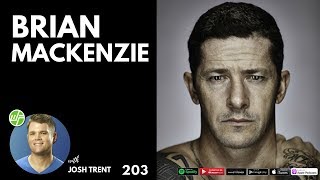
Episode 203 of Wellness Force Radio (host Josh Trent) interviews Brian Mackenzie about the central role of breathwork for mind–body regulation and high performance. Mackenzie frames breathing as a physiological ‘‘intercept’’ that can rapidly change state, improve movement mechanics, and reduce pathological stress. Topics covered include nasal-only training and mouth-taping, cueing breathing in high-pressure athletic moments, screening individuals for personalized breathing rhythms (IP developed), mindful use of technology (tools as mirrors, not replacements), and an app/partnership work with Dr. Andrew Huberman to deliver in-the-moment, non-meditative state-change tools for athletes and the general public. Practical takeaways: integrate brief breathing/visual/sound cues throughout the day and train nasal breathing in practice to make it a default.
Questions this video answers
Episode 203.
BrianMcKenzie.com
About a year.
Dr. Andrew (Andy) Huberman.
Chapters
We have a concept. It's something that's been passed down as everything is everything and it's all integrable. We believe that breathing is that physiological intercept to mechanics and to our state. And so if things are going haywire, I'm freaking out, I can turn back to that breathing and I can control the physiological reactions that are happening to that. If I'm moving poorly, I know that if I can get to a place where I can get a full breath, I'm actually moving better now. And so if I can take that step back and do that, I'm now fixing the entire system and working at that.
That's Brian McKenzie and this is episode 203 of Wellness Force Radio.
What's up my friend? It's your host, Josh Trent. And welcome back to another episode for your weekly access to global experts in all things wellness as we discover the physical and emotional intelligence we need to live life well.
In this episode we're continuing our Stand Tall series with our partner intelliskin, the best of the best in physical intelligence where you can learn more about human technology. Smart compression over@intelliskin.net today we're coming at you live from the Hurley Surf Movement Masterclass with intelliskin as well as so many other incredible movement leaders and people that are actually training the body for its deepest needs. Like Brian McKenzie intelligence, an expert in the development and application of custom protocols to optimize human health and performance. Brian's work harnesses and integrates respiratory, movement, strength conditioning, endurance and temperature based training approaches to elicit unprecedented positive results. Now Brian's protocols have been used to accelerate and raise both mental and physical performance in Olympians and pro athletes, top executives and elite special ops military, as well as the general public of people who suffer from various chronic illnesses. Everyday people have also used Brian's tools to reduce pathological stress and vastly heighten their mental and physical well being and performance.
I know you're going to love this episode.
We dove into some unique topics like what Brian is currently working on with breathwork and its correlation to the mind, how to be more mindful about the tech we use and how we can change our state of mind at any moment. We choose through smart technology, how to use non meditative methods to enhance your state of mind and the process of rewiring the subconscious mind through conscious training and heightened awareness. We're also talking about cueing nostril breath practices versus breathing through the mouth when one is more appropriate than the other for high performance and what you can gain and learn from training yourself only to breathe through your nose. Also, we're talking about sleeping. Have you seen these sleep tapes where you put the tape over your mouth and you get that more parasympathetic deep dive? I felt really fortunate to meet Brian in person because he was the third author of of Unplugged. We already had interviewed Dr. Andy Galpin on Wellness Force Radio and on a different podcast, I had interviewed Phil White. So Brian connected the trifecta of knowledge around how we use fitness, performance and consciousness and where technology plays into this.
And I know you're really going to.
Love this expertise of a guy who's really creating ripples in the athletic world, not just from a breath, work and physical training perspective, but also from a different kind of narrative where he's using these ancient practices of breathing to get people to perform at the highest levels in our modern world. I also want to give a quick shout out to Brian's healing. Recently I saw on Instagram that he went through a tremendous fall and he's currently in the hospital recovering with a contusion and subluxation in his spine. So take a moment, give a deep breath for Brian and make sure that he receives your best wishes as we listen to his expertise live right now from the Hurley Surf Movement Masterclass with partnership from Intelliskin. You can learn more obviously@intelliskin.net now let's drop in live and in person with Brian McKenzie.
Josh Trent with Wellness Force. We're here with Brian McKenzie, author, speaker, athlete. What else do you do, Brian? Fill us in.
Tech startup? No. Although maybe, yeah, I am involved in a startup right now. But yeah, just overall I'm kind of a tinker. I'm an N equals one scientist. And then I just kind of take that and extrapolate it out, use it on athletes or put it out to friends. And those friends are now like neuroscientists and legitimate, you know, science based people who are looking at things that we're doing and you know, know that there's some kind of validity in what we have been looking at.
If people don't know anything about you, tell us in a few sentences what you're all about right now. What are you working on?
Most of what I'm working on right now and where I'm at is we've centered a lot of our work around breath work. Right. But it's actually more. We're more focused on the mind, but we now know that there is an integrated piece in the body. I mean, we've always known, but Science is now proving and showing that breathing is a byproduct of what's going on in the brain. So our emotions, our pain, whatever's going on cognitively, they're thinking about. There's actually a respiration rate coming off of that if I'm not consciously aware of my breath. And so we're really looking at the connections of that not only within fear and anxiety and all byproducts of those things, but we're looking at movement and how people are doing things and vision components and what's happening with the visual system, and can we use cueing for that, and can we alter the state and what's going on with all of that? So it's really kind of. We're kind of at this. The spearhead of where a lot of things are going and thinking sometimes a little bit over the top, but you have to do that in order to kind of refine that down.
Yes.
And I loved how you said you're an n equals 1, because that's what I felt when I read Unplugged. I interviewed Phil Wyatt, I interviewed Dr. Andy Galpin on the podcast. And I think about the way you guys explore this intersection of mindful technology, which technology can be a crutch. You guys write about that a lot. And then also tapping back into these natural ways of eating, moving, and sleeping that we've been doing for millennia. Why do you think people are using, especially fitness professionals right now, using technology kind of as a crutch, almost a replacement for that sensory awareness we have?
Well, by design, we want comfort, we want easy. We. I mean, look at the world we live in. I mean, hell, and I mean in. In Orange county or, you know, down here in. In Costa Mesa, it is so easy to get food. It's so easy to get whatever you want at any time you want, anytime you want it. And go back 100 years. Nope. Like, that was a very difficult task. But we've created this way of getting there. Not. I'm not saying it's wrong.
Yeah.
But we get so focused on what is making things easy and comfort that we forget that the only reason we make change is because of discomfort. And so getting caught in that, we get. We get kind of afraid of this stepping outside that comfort complex. So the technology becomes. I can just be on my phone. I don't need to go anywhere. I don't need to do this. And that's not actually it.
Do you use any technology at all?
Totally. I've got. My phone's back here. I thought it was right here. No, it's right back here.
My phone is maybe the wrong area to store your phone.
I know catch myself daily on it too much and I know. But, you know, I know what I need to do as a result of that. So if I've been on my phone for too long, I know I need to take a visual break because my visual system actually works with my physiology. And so I'm getting these reactions to that. And I know that there's a breathing pattern for that. So I could take and look 20ft or get outside and I can change what I'm doing for a few minutes.
Yes.
If I've got a full workday ahead of me and I can actually use a breathing pattern, I can use some visual stuff. I could even use some sound. Like take music when you were a kid, that made you happy. Right. Put it on any point anywhere, and you remove people from the room and you change instantly. Right. And you just let it go and you're like, yeah, right. And you feel that thing. Well, you can do that at any point. And sound, there's infinite plays with that.
But you know that changing our state is our responsibility.
It is.
And you have this app that you're in production of state. Yes. Dr. Andrew Huberman, the professor of neuroscience at Stanford. Tell us about this partnership. What's this mean to you? Why are you so jazzed on this?
Well, we're all about what meditation is, but breathing is actually a form of meditation. And so we're actually trying to cue into the non meditative ways of altering state or enhancing state. And because of the world I'm working in, you can't. Like for instance, we're here with surf. This is the surf community. You can't get off your board and go sit on the beach and just meditate something out and refocus. Right. Meditation is a practice that you put into place that becomes a part of what you're doing. But I can breathe and I am breathing. I can look at my visual system. I could focus in on some sounds or things I'm looking for. I could, I can do a lot of things in the moment. And this is what we're really trying to teach. And this is where I'm actually working with a lot of professional athletes, is where in the moment we can start to make these changes so that I can stay focused on what I need to or open to what I need to.
When the house is burning down, when the pressure's on, when everything is at stake, there's nothing more important Than the breath.
Correct.
If they forget to breathe. Let's talk about this then. How are you cueing these high performance to breathe in these moments where everything's at stake?
Well, like meditation, it might take a simple 5 or 10 minute session in the morning, in the evening. Right. Like just to integrate by itself. But that skill training in itself becomes part of a day. A whole day. Right?
Yeah.
Because it's integrated throughout the process of your day. Because you've now rewired something to some degree. But, but when we start to integrate it even into training sessions, like you need, I want you to hold a specific pattern, I want you to be doing it a specific way and this is what we're doing, then it becomes, I go into competition and it's become something that's just click, click, click. I naturally start to pick this up. Where we're working with the conscious mind, which is not a lot of. Which is maybe 5% of our day. Right. And that subconscious becomes that 9, 95%. Right. And you've got all these other places in there, the subconscious. But I start to rewire all the subconscious stuff through the conscious training and through this awareness of what it is I'm doing. So that when I'm in that moment, whether I'm surfing 100 foot wave, whether I'm in a contest or whether I'm playing beach volleyball or whether I'm an Olympic wrestler or a UFC fighter, I know that when that breathing pattern, if I come back to that breathing pattern, what am I doing? I can control part of that state. I can control what's going on.
This is really personal for me because tattooed on my arm is seposo resperare poso, which means if I can breathe, I can choose.
Yes.
It's our breath that unlocks this choice for whatever state we can be in for wherever we want to go. What do you see as a common thread between improper breathing and poor performance?
Oh, wow. A lot of things we see, you know, we see poor positions. Like we see the positions from technology. Like I'm on a computer, I'm on my phone all day. I mean, this is one of the slides I had up. There's this kid who's like this at his desk, right. And he's just slouched and it's like, I can tell you what, what's going to happen with this kid, not only when he moves, but psychologically what's going to be going on. He's probably not somebody who's confident where. When we start to see people who are confident and, and engage. We start to see different postures. When we see people who move well, we know they're breathing well. So we start to see these every. We have a concept that, you know, it's not our concept, but it's. It's something that's been passed down as everything is everything and it's all integratable and the physiologic. And we think, we, we believe that, that breathing is that physiological intercept to mechanics and to our state. And so if I'm in a, like things are going haywire, I'm freaking out. I can turn back to that breathing and I can control the physiological reactions that are happening to that. If I'm moving poorly, I know that if I can get to a place where I can get a full breath that I can actually. I'm actually moving better now. And so if I can take that step back and do that, I'm now fixing the entire system and working at that.
And I'm thinking about. I interviewed the founder of the breath sensor where you actually place on your waistband and it can track your breathing patterns. It was Dr. Nima Morveggi and this device. Do you think that technology takes the place of our awareness, of our internal awareness? No technology even help us breathe?
No, I think it's tool. I think what we're going to find out when this is all done and it'll be many years after you and I are gone. Right? Is that technology is only being used to get us back to what it is we're capable of actually doing ourselves. Now it's going to help us. It's going to allow for us to do a lot more. But like you, you go out, like I went out and went shark diving, right? Got out of the cage with great white sharks and you experience this thing of fear. Whether you like it or not. You're in. You're in the water with a dinosaur that could tear you to shreds in a moment. And you're not in a cage.
Yeah.
And, and you're supposed to. If the shark comes after you go at it with a camera and it's like, wait a second, what? Like this is going against everything I'm thinking about. But the fact is, is that shark is picking up on my behavioral patterns and my physiological responses. They're hardwired for it. But you and I are hardwired for it too. Like you walk into a room, you know, if somebody's mood's off, you know, somebody who's not right. You know things that are going on. But how far are we removing ourselves from these basic things, this basic, these. These basic physiological responses, the biology of our system that's in it, that's allow to get to where we're at. Technology is trying to do that for us. And I think that what technology's purpose is, is to get us back to that place.
It's almost like a mirror of mindfulness. But it's our job, just like it is to change our state, to make our mindfulness something that we pay attention to very much so. So these tools can support and they can complement, but at the end of the day, like, it's our responsibility. What are you most excited about? Then we look at this partnership. Let's go back to this. Stanford. How long have you been working there?
About. About a year.
Yeah.
So in this year, what have you come up with?
Well, I developed the ip, some of the IP around looking, screening people for coming in because we figured out that not everybody has the same breathing rhythm. Right. Like if I give you, you know, an inhale, exhale or you know, that same in inhale exhale is going to have a different response with me based off of a number of things that we're starting to pick up on, whether it's CO2 tolerance, whether it's my own anxiousness or physiology. Right. Whether my own emotions, These all play an integral role in it. So we had to screen people coming in to understand what breathing rhythm is going to work best for them. Prior to getting into a VR, that's going to be looking at getting into a cage or getting out of a cage with a great white shark or getting in front of a dog attacking you or a heights thing. So we started to look at all this stuff, and this is where I think it's really important is everybody has a response to fear. We've seen Navy seals go into these things and they have that same exact response that you and I have.
Right.
And these are some of the people that are supposed to be the least afraid in the world right now. It's all the same thing. We all have that reaction. It's how fast they actually come back to baseline. And the rest of us are kind of hanging up here, freaking out a little bit. And then we come down or we continue to be in that kind of anxious state for longer periods of time or that sympathetic state longer. And this is what we're seeing is it's not necessarily what's happening after you train or you compete or you do something. It's what's happening between reps what's happening between footsteps? Are you actually coming back to baseline? And are you reacting to that? And that's where I think the breathing actually is playing the biggest role.
Let's talk really quick about the mechanics. So mouth taping is something we're seeing explode on social media. Do you do mouth taping? And then also, can you talk to us about the cueing nostril breath versus breathing through the mouth. When is one appropriate? When is one not appropriate for high performance?
Yeah, I don't actually mouth tape because I. I've trained it kind of out of me. So when I sleep at night, I wake up. If my mouth opens, I will wait. It automatically sets me off. Right. But that was because I invested about a month of strictly nasal only training. So nothing I did training wise, whether it was yoga, whether it was strength and conditioning, whether it was on my bike or running, it didn't matter. It was all nasal breathing. And if I had to revert to mouth breathing, I stopped. And so this process allowed me to kind of really figure out or it allowed things to adapt in a way to where I found the efficiency in it and where I actually was performing better with it and felt it became this default. So I do think there's validity in mouth taping for a lot of people, and you should try it. If you haven't. Your. What we've found is amazing. Like my. One of my partners and what we teach with the art of breath under speed endurance, he used to get seasonal allergies. He no longer gets them. And is it odd that he changed to nasal breathing and got his sinuses working, which is inevitably the first line of defense for your immune system? Anyway. So if I'm not nasal breathing, I don't actually have a, like, mouth breathing. There's no. There's nothing. There's no immune system response for breathing in air that has bacteria or poor things in it.
This is fascinating because when I was 15 to conception under that, I had chronic sinusitis and I had polyps, and I breathe through my nose for the first 15 years of my life, which is why breathing's so important to me now.
Yeah.
So it's so incredible to be able to contrast this, how many physiological changes there can be from just taking a deep breath at the right time.
It's crazy.
Why do you think more people aren't focusing on this?
It's difficult, it's not easy. And that whole comfort thing is I'm. I'm perfectly fine mouth breathing like I can get. Yeah. Yes, you are. It's easier, but you're, you're, you're actually more in, you're more sympathetic, dominant, you're carrying more sympathetic tone that way the tissue, your tissue is tighter, is not relaxing as much. All of these things are not happening. There's so much that's not happening as a result of that. And this is where people in yoga go, well, yeah, duh, we've been talking about this for thousands of years.
We've been doing pranayama since the day came.
Totally. But there's definitely a separation between the yoga world and the general population. And part of that has been the language and part of that has been the, you know, it's just like the CrossFit world. Like we've got a definite differentiation between the CrossFit world and the rest of the population. So how do we show the rest of the population what might be good for them that CrossFit is actually doing? And we found out that intensity is a great thing and it can help you, but it doesn't need to be in everything. Right. But the same thing is with yoga is it's like, why have they been doing this for thousands of years? Well, here's one of the things, here's one of the reasons why. Yes, you know, and it just so happens it's a massive, it has a massive impact on just about everything we do.
Thank you for reminding us how important the breath is. Where can people learn more about your work? We just did a scratch of the surface on you, so where can they dig in more?
The easiest place is go to Brian McKenzie.com and it has my bio and information and websites to everything that I'm talking about and I've talked about.
Excellent. Thank you so much. Brian McKenzie, Josh Trent saying goodbye from the Surf Movement Masterclass live at Hurley headquarters. We'll talk to you soon.
Thanks, Josh.
Hey my friend, thank you for hanging out and growing with me on today's show. Remember to hit subscribe. Share this podcast with somebody you care about that you think gets to hear this message. Support the show by leaving a five star review for the podcast right now simply by tapping on your show artwork. On your iPhone, click that purple link that says review this podcast. It helps the show reach more conscious and smart people like you. And your voice will attract more world class guests that want to come on the show.
So let them hear your voice.
For all the downloads, videos, links and free resources mentioned on the episode, go to wellnessforce.com radio. And while you're at my house on the web, join us in the Wellness Force Community newsletter on that page, and I'll send you four free guides around staying healthy with your eating, moving, and sleeping while you travel. But don't let this conversation stop here. Join a group of people like you over at the Wellness Force Community Facebook page. This is where we talk about the things that really matter. We share our wins, inspirations, struggles, and a lot more. So join us. Tap on the show artwork on your phone and hit that purple link that says join the Facebook group and I will welcome you at the door. Okay. Now you get to go out into your world and create impact for the people that you care about. So until I see you again real soon, I'm wishing you love and wellness.
More from Josh






Your child's future start before pregnancy... and even before conception! #podcast

MD Reveals: Your Healing Creates Your Child's Reality (The Souls Coming In Need Strong Bodies)



