223 Dr. Michael Ruscio: Healthy Gut, Healthy You
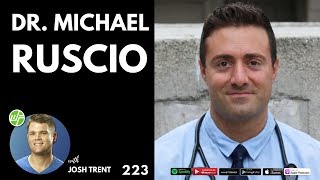
Podcast interview (Wellness Force Radio episode 223, Aug 10, 2018) with Dr. Michael Ruscio about his book Healthy Gut, Healthy You. Major points: foundational diet/lifestyle steps should precede testing and aggressive microbiome 'feeding'; feeding prebiotics/fermentable foods can flare symptoms for many with digestive issues; probiotics fall into three usable categories (lacto/bifido blends; Saccharomyces boulardii; soil-based/spore-forming Bacillus strains) with storage guidance; many commercial microbiome mapping tests currently lack actionable clinical utility; early-life factors (vaginal birth, breastfeeding, maternal exposures) shape immune/gut development; Dr. Ruscio proposes an 8-step practical action plan (reset diet/lifestyle, probiotics/enzymes, antimicrobials, rebalance, reintroduce foods, feed good bacteria, wean supplements, maintain). Interview emphasizes critical thinking, cautious use of tests, and pragmatic, stepwise clinical care.
Chapters
What I'm trying to get people to do is think critically, right, and not just fall into the bandwagon of you can never have gluten in the US because of glycophosphate, period. End of story. Because that's not true and it's not what the data show. And again, I'm perfectly open to updating my opinion on this, but my opinion has actually swung. I was very liberal with my doling out of a fully gluten free diet up until the point where a I saw it hurting people and some people actually improving quite a bit when they were actually told they could experiment and find what their own reaction to gluten was. And that took an immense amount of psychosocial stress off of them and they started to feel much better because of it. A and then B when you look at what the research literature is showing, it's not supporting this ethos of no one can have any gluten, but it's rather more of a middle of the road perspective that's skewed more so toward the majority probably can at least have some when they clean up their guts.
That's Dr. Michael Ruscio and this is episode 223 of Wellness Force Radio. What's up my friend? It's your host, Josh Trent. And welcome back to another episode for your weekly access to global experts in all things wellness as we discover the physical and emotional intelligence we need to live life well. In this podcast, we're talking with return guests, my good friend and world renowned gut health expert, Dr. Michael Ruscio to discuss how the gut and microbiome affect our mood, energy, sleep, skin metabolism and digestion. That's a mouthful. But the most important part about this podcast, which I'm so thrilled to finally share with you, I've been really looking forward to releasing this episode, is that Dr. Ruscio's take is actually against the grain when it comes to gut health testing. This is going to be quite a polarizing podcast and piss a lot of people off in the health and wellness industry. But Dr. Ruscio has learned through his thousands of hours working with patients that the majority, the far majority of gut health tests out there, for lack of a better term, are full of shit. But he's going to share exactly why this is in the show. So as you listen, keep an open mind, pay close attention to the examples and clinical experience that Dr. Ruscio uncovers for us about an incredibly confusing and mismarketed topic of gut health. Learn why viome youbiome23andme and many other testing companies when it comes to our gut health and our genetics are actually more often just looking at your data rather than your health. And before we get into the interview, I wanna thank Intelliskin, our show sponsor. For these past 12 months, every single Friday has been giving you our physical intelligence shows. As you know, Intelskin makes a smart compression human technology that is used by professional athletes in the NFL, NHL mvp, anywhere you look, athletes of all fields and sports. This is what pulls their should shoulders back when they're in high competition levels. And it can pull your shoulders back through a tactile response all throughout the day by giving you that sensory perception to actually pull your shoulders back from this patented smart compression human technology. It's been incredible to partner with Dr. Tim Brown and the team at Intelliscan who truly care about our posture and our breathing. So to celebrate 12 months, we're giving away hundreds of dollars next week in product for free as a thank you for you the Wellness Force community, for tuning into the podcast. So coming up Monday, August 13th through Friday, August 17th, we're giving away free product to the community. Compression tights for women and smart human technology Compression tops for men and women. Whether you're doing yoga or weight training or trail running, anything else, maybe even just working at your desk, your sitting desk, your standing desk, every single day for five days next week you can get the chance to win free product. All you have to do. This is super easy. Go to the Wellness Force Facebook page or the Instagram page and download every single day. We'll post a photograph of whatever you're gonna win, whatever the message is for that day. Just download the photograph, repost it to your Facebook or Instagram, tag wellnessforce and intelliskin and that's it. You're automatically entered to win. Be sure to subscribe to the WellnessForce Facebook page and our Instagram channel for notifications so you can repost and tag us and your friends to win some free gear. Do not miss this opportunity to win. We will not be doing this again. This is the last time to give you hundreds of dollars in in free product. Now there's no purchase necessary. All entries will be chosen by a random computer drawing mechanism. So take a deep breath because you can win some free gear. And breathing from our belly deep we know is how we can get the downregulation of our stress response in the nervous system. So when it comes to gut health, there is no greater resource out there from my network than Dr. Michael Ruscio. You're about to learn why overfeeding your gut microbiome might not actually be the right path. We understand fermented foods and their relation to fodmaps. We talk about non celiac gland gluten sensitivity and the nuances and confusion that surround that. The great innate action plan that Dr. Ruscio writes about in his new book Healthy Gut, Healthy eight Steps We Can all do every single day to reset our microbiome, our diet and our lifestyle. Pick up this book. It's on our Show Notes page which we'll talk about in just a second. We also explore the myths and debunk misappropriated facts about probiotics. Do we actually need them? And if so, what kind of probiotics should we truly be purchasing? We explore three categories of these probiotics and so much more. The relationship between our blood, gut, brain and why less testing might actually be the better path. And a return to the fundamentals of eating. How we were designed to is actually the most powerful solution. Show notes from today are@wellnessforce.com 223. You can learn more about Dr. Michael Ruscio on his podcast and his website. Do yourself a favor, go over to wellnessforce.com223. Check out the show notes that our content manager Lauren so diligently creates every single single week. Now it's time to drop deep into our gut with Dr. Michael Ruscio. So exactly one year ago today, during the recording of this podcast, July 5, 2017, 365 days ago, Wellness Force Radio learned about Dr. Michael Ruscio in our podcast called the Orthorexia Connection where we explored this over obsession with health research and chasing the symptom rabbit down the black hole which actually creates more disease and stress than sometimes the underlying root cause itself. But today on the show, Dr. Ruscio returns to talk about his new book Healthy Gut, Healthy youy the Personalized Plan to Transform youm Health from the inside out. Dr. Michael Ruscio, welcome back to the show my friend.
Hey man, thanks for having me back.
We've had like 20 questions. Actually more from Instagram and Facebook and the private group. We're gonna dive deep today. 3 years plus in the making. 300 pages for this book, this modern day guide for gut health. Was there a piece of research that was new or anything that fascinated you the most in the creation of this book?
You know what the one major observation that I learned through writing this book and it was a very contentious point that took a lot of time, reflection, study and kind of rinse and repeat to figure this out and when you break it Down. It's not very complicated, but it was a while in getting there, which is that feeding gut bacteria can actually be a bad idea for people with digestive symptoms. And it was kind of the opposite of the logic three years ago when there was this big boom in the microbiota and all this research was coming out showing that you should feed your healthy gut bacteria. And we want to have maximal diversity in the gastrointestinal tract, which is all very interesting, but there was clear clinical, both anecdotal observations out of clinical practices and clinical research contradictions to that. And it took me a while to kind of figure out that it's not an absolutist sort of navigation. But for people with digestive symptoms, they are more prone to being flared if they overly feed their bacteria. And people with less, ironically, digestive symptoms and who are in a bit better health stand more of a chance to benefit. So feeding your gut bugs for many people is not a great, at least starting point in attempts to improve their gut health.
Wow. And this is fascinating because we always hear about, you know, eat lots of kimchi and fermented foods and get it in there and your probiotics, but it's actually different than what you've been learning in the creation of the book.
It is a little different. And fermented foods and foods that are rich in prebiotics or known as fermentable foods are actually a little bit different. So fermented foods are things that have been fermented and have live probiotic cultures. They're different than high prebiotic or high fodmap foods. And these are foods that just have carbohydrate structures that make them very powerful at feeding bacteria. So not every fermented food is going to be powerful at feeding bacteria and be rich in prebiotics and fodmaps, although some are. But what's paradoxical here is a food like asparagus or broccoli or cauliflower are all high in these fodmaps or these prebiotics that feed bacteria. And those can ironically, again, be problematic for people with digestive imbalances and digestive symptoms. So for some people, again, paradoxically, to get to where they want to be, they actually have to reduce the consumption of some of these foods, at least in the short term.
And this can be so confusing for so many people. I can't think of one subject out there online that is more mismarketed and misinterpreted than the gut. I mean, you know, looking at everything.
A key point There is marketing. And I think that's one of the problems is that people are trying to market products and services and they're unfortunately, and this isn't everyone, but some people are just finding whatever data point, whatever study supports what they want to think or what they want to sell and then just jam it out into the marketplace and the consumer is confronted with all these different factoids trying to sift through them and they can't make heads or tails of it. And that's exactly one of the key items I wanted to help dispel with this book, which is, okay, let's cut through all the BS and just give you a guide that weighs the evidence and helps you determine what's going to work for your gut, not what's going to work for the gut. That's what's behind that. Masquerading as science is actually someone trying to sell a prebiotic. Let's just get you to some practical and pragmatic steps after carefully weighing the evidence that will help heal your gut.
This is 300 pages. I went through it over the past month. The six sections that are on the COVID Mood, energy, sleep, skin, metabolism, digestion. This is what I'm looking forward to in the conversation today. And I know so many people have just a general curiosity about what does the gut actually do? Let's start there because we could go so many different directions in this conversation, man. How does the gut actually work and what is a simple way to explain its role in our body?
Well, probably the two main functions will be digestion and absorption of nutrients, which of course is a key fundamental to health. The other that's a little bit less appreciated is it's an immensely dense immune barrier and immunoactive barrier. And if inflammation is the instrument of the immune system, then we can connect these dots and, and conclude that one of the key sources of either immune or inflammatory conditions can be emanating from imbalances in the gut. And this isn't just a far reaching inference. We do know that the highest density of immune cells is contained in the small intestine. So this is serious. And we also see clinical literature showing that various autoimmune conditions to one extent or another may improve and other inflammatory conditions as well may improve after various interventions that can help to improve one's gut health. There's one study, for example, showing that a gut friendly diet can reduce thyroid antibodies. There's some literature now showing that people can reduce thyroid medication because they may not have before been adequately absorbing their medication. And when they Improve the health of their gut. They can actually feel better and be on less thyroid medication. There's improvements shown in joint pain, skin conditions, neurological conditions like brain fog, fatigue and anxiety. So, you know, this goes far, this connection of these two fundamental actions of the gut, both nutrient absorption and inflammation, slash the immune system can manifest, like you said a moment ago, as many different symptoms. Mood, energy, sleep, skin metabolism and digestion. Of course.
Now this gut health component, when it's interesting, we use the word health because when we're born, if it's a natural process, and I know that on our last podcast we talked about your depression and digestion being off. You guys can go over to the podcast and listen to that, that one, it's episode 119 where Mike tells a lot more of his story. But I've also been through it too, and maybe we can start at conception, you know, when the child comes out of the womb. What is the research showing and what is your academic literature showing us about natural birth versus cesarean? Because that's really the starting point for the window of gut health for the child's life.
It's absolutely one of the key moments early in life. We actually interestingly see some literature being published that the programming of the child's immune system may even start while they're in utero. So what mom is exposed to may actually have an impact. And some studies show that mothers who are exposed to more farm animals, who work on a farm for the more farm animals are exposed to, we see a correlating decrease in inflammatory and immune conditions later in life in the child. So some of this goes back even to before the child works his way out. Wow. But that's. The birthing process is a key step. And there is literature, fairly uncontestable literature showing that children who are cesarean birth have a higher incidence of mostly inflammatory conditions. It's the marker that's most often studied in these longer term observational follow up studies. So the incidence of various inflammatory disorders does significantly go up in children who are cesarean birth. But I should also mention that sometimes you have no other option. Right. So if you're a parent, I wouldn't be beating yourself up over this. And if you're someone struggling with your health, I also would not beat yourself up over this. There are steps you can take to try to turn the tide in your favor, so to speak. So I don't want to paint this as, oh man, there's nothing that I can do. But yes, that that's a problem. And, and we should be using. I was going to say circumstance.
We should be using the other operation.
We should be using. What I was going to say is you should be using C sections with great circumspection and not handing or doling out that recommendation in a un, carefully considered fashion. Some hospitals now are actually taking a vaginal swab of the mother and then coating the child with that swab. And part of what happens and part of the reason why the vaginal birth is protective is because that is a powerful coating and inoculation of the child with mom's bacteria. And that's one of the ways we start populating the child with these healthy bacteria that come from mom. And then the next step of that is really breastfeeding versus formula feeding. And we see the same continuation of the findings where children tend to generally have less inflammatory conditions who are breastfed compared to those who are formula fed. So early life is a very important point in time for establishing a healthy microbiota and a healthy immune system. Wow.
I can attest to this because the first 15 years of my life were very poor in health. Now, my parents did the best they could, and like you said, we're not trying to demonize anyone, but if, you know, if you have the knowledge, then you can be a better parent, you can have a better healthy child. So this is really important, and we're going to link a specific resource for that. In a study that I actually found on your website, one of the questions that came up was around starting points. Okay, so your book, it takes these huge concepts and it walks people step by step through each one of these processes. Let's start at the beginning, though. Before we recorded, I actually was laughing because you said, you know, I was talking to Rob Wolfe, and he said, you know, for the first time in my life, I'm pooping like a teenager. And I love that because we all want to have really good poops. It's something that maybe is uncomfortable for some people, but look, everyone poops if somebody is on a budget and they're having some gut issues. We had 13 votes. Votes for this question in our private group. What are the steps to begin if someone's on a budget and they're having gut issues?
And now I'm going to stick a pin in the Rob Wolf comment for later because we should definitely make sure to touch on probiotics with Rob, unfortunately, he had just overlooked one key maneuver you can make with a probiotic protocol, and that was the really big game changer for him. But in terms of where to start, really, you start with diet. And the diet doesn't have to be that complicated or that rigorous. I think one of the challenges that people are confronted with is whatever diet change they're thinking about making, they're thinking about making it 100%. So they have to be all grass fed, all organic, everything fresh. And whatever diet they're following, they have to be adherent 100% to the dictates of the diet. And that makes it much more difficult to really get started and certainly to feel like you're being quote, unquote successful. And this is one of the concepts that's interwoven into the tapestry of the book. And it's very kind of in alignment with our last conversation, which is not making yourself afraid of food. And it's one of the things I really wanted to make sure to inculcate into the book was food is not the enemy. We can use food strategically and we don't have to make the rules of your diet so rigid that you feel like you're failing unless you're putting in this, you know, daunting amount of effort. Now for, for starting points, specifically, there are really two starting points for diet. A paleo diet or a low fodmap diet. And the beauty here is that two to three weeks, two to three weeks really is all that's needed to get a sense for if the diet is working. Now, it's not to say the diet will fully heal all your symptoms and you will feel 100% improved after two to three weeks, but you will be able to say, yes, I'm clearly improved or I can't really tell if you're going, eh, I can't really tell. That means it's not working, move to the next diet. So I would say start with Paleo and then go to low fodmap. And within the rules of either paleo or low fodmap, you don't have to be 100% compliant. I expect people to miss a few meals. There might be a social function, a work thing, a wedding, whatever. You can have a drink, have a little bit of off plan food, do the best you can with what you have available to you. But a few misses will not be their make or break between success and failure. You will still be able to tell if the diet is working for you. And one of the other things, again, just to touch on my earlier comment a little bit more robustly, if you can't get grass fed beef all the time, don't worry about it. And if you can't get organic. Don't worry about it. Start with just eating the foods that we're going to use as part of this experiment. If you're Paleo, Paleo compliant foods, if you're low fodmap, low fodmap compliant foods, start there. You can work on filling in all the other items, like getting rid of your Teflon and having only filtered water all the time, and trying to focus on organic and trying to focus on well sourced meats. You can fill those in later. But to make this as easy as possible, do the best you can with the resources that you have and start working through the experiments. Because one of the biggest, I think, stumbling blocks or items that prevent people from starting is feeling like it has to be so hard. And it really doesn't have to be that hard. You can make this a gradual process where you're going to be cultivating a perfect diet over time, but you're starting with kind of the 80% of lowest hanging fruit, so to speak.
Yeah. And it's interesting because so many people will say, well, if I can't do it to the template of perfection, then it's not worth me taking little baby steps. And it's like, hello, like, pick up the phone. I think really what we're talking about here is the road to perfection is paved with impact, imperfection. And honestly, Mike, like, when it comes to diet, do you really believe that we should always be wanting to eat perfectly? Isn't that disadvantageous?
I totally agree with you. And it's funny. Sometimes I go to various conferences and some people look at me funny like, oh, you're having a slice of pizza or you're having a regular sandwich. And it's like, yes, you know, when, when did becoming healthy and becoming a hypochondriac become synonymous with one another? They really shouldn't be. I mean, I think the whole point of becoming healthier is so that you're more resilient so you can do these things again. Not all the time, but if I want to have a regular sandwich, I can have a regular sandwich. If I want to have ice cream, I can have ice cream. Because I've built up a robust enough level of health, including gut health, to allow me to have those indulgences. A, and then also B, sometimes people don't even have a problem with the food, but they've been indoctrinated into thinking that they do. And that's another thing that I think really needs to stop because gluten probably being the chief Example here, people have unnecessary fear around food that precludes them from having as much fun socially as they'd like to have, because they always have this worry in the background running about, oh my God, I'm going to go here, can I have gluten free? Will I be weird? And now some people do need to be diligent with gluten free, yes, but it's so important to qualify that. And as one example, there was recently a multi center study published in Italy looking at over 12,000 patients. And they found that about 30% of the patients in this study who are non celiac gluten sensitive were able to eat gluten after addressing a different underlying problem in the gut, like a fodmap sensitivity or something like small intestinal bacterial overgrowth. So if you have a healthy perspective on food and you have a good plan for healing your gut, there's a fairly high probability, in my opinion, that you'll be able to eat some of the bad foods like gluten without much repercussions. And again, that's important because of the psychosocial aspect of diet.
I love this. And we actually linked this already in the show notes. I was going to ask you about this Italian study. It was non celiac gluten sensitivity still being kind of an undefined syndrome with several unsettled issues despite the increasing awareness of its existence. This study, can you talk about the findings of this for people where their mind was really exacerbating the fear around the food?
Well, I don't know that we can fully say that their mind was exacerbating the fear on the food. That more so is my interpretation from what I've seen in the healthcare community that we reside in, which is people being educated about all the ills of gluten and therefore, again, kind of becoming indoctrinated into thinking that they have a problem, even if they never have qualified for themselves that they have. But this study was, I think, the most important study in non celiac gluten sensitivity to date. The group of doctors who participated in the study comprised a 60 point assessment, including lab testing, physical examination and symptomatic assessment. So they really did the most robust job they could with trying to suss out if non celiac gluten sensitivity was present, and they were trying to see what the prevalence of non celiac gluten sensitivity was, and then what were the other symptoms or comorbidities or diseases that accompanied non celiac gluten sensitivity. And they came up with many interesting findings. Now, they found that about 3% of the study population had non celiac gluten sensitivity. Now, for the people who are very staunch gluten free advocates, they will be saying, well, gluten is different in the U.S. okay? And I think that's a fair argument. I think the data there are very inferential, where we don't have a lot of great comparative data to answer that question. But I understand the premise of the argument. And when we look at some of the data again reported in this study, they were reporting on other studies in the US to provide a juxtaposition of their finding. Studies in the US find a prevalence of non celiac gluten sensitivity from 0.6% all the way up to 6%. So the best really carefully documented evidence that we have for prevalence of non celiac gluten sensitivity suggests as high as maybe 6%. Might it be higher than that? Yes. But the point is it's likely not to be incredibly far from that number. You could even say if it was double, which would be very unlikely that the initial research would be underestimating by half. But even if you wanted to be generous and say, okay, the actual prevalence is double that, that would only be at best 12% of the population. Now, why that's important is because it runs counter to what some would have you believe in in natural and alternative medicine, which is no one can ever have gluten anytime, ever. Now, the other things that they found that were interesting, they found that there could be a litany of symptoms that were elucidated from eating gluten. And again, by the way, let me just clarify. I'm trying to make the case that gluten is something to definitely consider taking out of your diet. But I'm also trying to give people reasonable and carefully constructed information or a carefully constructed argument so that they don't overestimate the impact of gluten on their bodies. Right. So I'm just trying to be very honest here. And they found that you could have anything from depression or anxiety through a skin condition, through joint pain, through gastrointestinal symptoms. And this reinforces what I think many of us have known for a while, which is people can have non digestive manifestations of digestive tract inflammation. In this case, it's the gluten causing the inflammation in the gut, and that's manifesting solely as brain fog or fatigue or joint pain in some people. So that was very validating, I think, for a lot of people.
Well, and I think also on top of this, too, we look at glyphosate. You know, we had an episode with Dr. Perlmutter and we really talked about how, you know, 50 plus countries, I think most of Europe, they don't allow glyphosate. And that's the part where, don't you think if somebody is going to entertain eating wheat and they're going to eat organic, you know, maybe like a sprouted grain or a sourdough, they're not going to have glyphosate sprayed on that wheat?
Yeah, I think that's an excellent point. And that's why I always provide the, the contrasting data from the U.S. right. And that. So that's why I always mention when this Italian study found a 3% prevalence that U.S. studies have found from 0.6 to 6, because that would account for the glycophosphate use. Right? Now, if you're eating organic grains, that also could have a positive impact. But I think there may be an aspect of this where people believe that they'll be able to eat gluten when they go to Italy or Europe, really anywhere in Europe. So part of this may be a confirmation bias or a placebo effect, and part of this may also be that they're on vacation. I'm not trying to say that the glycophosphate use doesn't have an impact. I think it likely does. But there are other variables here that need to be accounted for. And I can tell you that there are a remarkable number of patients who I see in the clinic who can go on gluten and don't have a problem with it. And so I'm assuming that if that same thing happens in the U.S. what may be happening is when people think they can go to Europe and eat gluten, they're finally running the gluten reintroduction they otherwise would have been fine with. But they're only not afraid to do it when they're in Europe.
They're also on vacation. Right. They're in a non stressed environment. Their natural kind of stress hormones are not being released as frequently. Don't you think that also plays into the fact that their digestion improves?
Absolutely. And that's why I was saying a moment ago that they're on vacation most of the time when they go to Europe. And so between the placebo effect, the vacation effect and the glycophosphate, all of those likely lead to some of these observations. Again, it's not to say that glycophosphate is not having a role, but what I'm trying to get people to do is think critically and not just fall into the bandwagon of you can never have gluten in the US because of glycophosphate, period. End of story. Because that's not true and that's not what the data show. And again, I'm perfectly open to updating my opinion on this, but my opinion has actually swung. I was very liberal with my doling out of a glucose fully gluten free diet up until the point where A I saw it hurting people and some people actually improving quite a bit. Like remarkably actually, when they were actually told they could experiment and find what their own reaction to gluten was. And lo and behold, they actually were able to have some gluten and that took an immense amount of psychosocial stress off of them and they started to feel much better because of it. A and then B, when you look at what the research literature is showing, it's not supporting this ethos of no one can have any gluten, but it's rather more of a middle of the road perspective that's skewed more so toward the majority probably can at least have some when they clean up their guts. And so again, sometimes people have a hard time swallowing that pill, as if I'm swinging the other way and saying no one needs to avoid gluten. It's funny how we have sometimes a hard time of not depicting everything into a dichotomy, but in this case, you know, you want to just try to find out what your own relationship with gluten should be really. And I'm sorry, the last point regarding the study that I thought was noteworthy, actually two, two really quick. Over 90% of the people who had a reaction to gluten, so who were non celiac gluten sensitive had a discernible symptomatic reaction within 24 hours. And why that is important is because sometimes people are advised that, well, you can never have gluten because you could be fueling this silent inflammatory process in your body that won't manifest symptomatically for weeks or months or years. Again, I am perfectly open to that concept, but I need some proof and I'll be one of the first people to update and amend my opinion once that proof is produced. But for right now, it seems that most people with a gluten reaction will have a reaction within 24 hours and that seems perfectly logical. If you are fueling inflammation and damage in your body, it's likely that you're going to Notice something, right? Something. Brain fog, fatigue, anxiety, your skin breaks out, you have some joint pain, you have some reflux, you have some bloating, you have some diarrhea. It doesn't make much sense to say that you're fueling an autoimmune or inflammatory process in your body, yet you feel nothing. Again, I'm open on that. But I think this study helps us be confident in the observation that, okay, I'm going to eliminate and then reintroduce gluten, and if I don't notice anything within 24 hours, I can rest fairly well assured that that means I likely don't have a problem with gluten.
I think where most people get kind of stopped up and confused is the order of operations. And this is why in your book you have this system, it's called the Grading 8 Action Plan. Maybe we could run through all eight of those very quickly. We're probably not going to have time to go into depth, but I to contrast this of going down the rabbit hole and chasing like, am I gluten sensitive? And everything else, there is a better starting point and that's where people truly need to begin. What is the starting point? With this? Your first step is reset your diet and lifestyle.
Right? So the first step and the way I like to envision this is a pyramid. And we have the foundational rung on the pyramid, the lowest level. And this is where we look at diet and lifestyle. So we start off with a two to four day modified liquid fast. And what this does is it helps give the body a chance to de inflame, to not have any non liquid calories to process. So it's kind of like a gut reset. It's not something that you can do in the long term. Right? You can't do a liquid diet.
Forever. I think I would cry.
Right. But for a couple days, this can actually be a nice chance to reset people. And then they start into the process of determining what diet works best for them. So we start off with a quick liquid fast. There are calories, it is doable. It's not as hard as I would have thought before I did it. And we start people there. That little reset kind of pushes the reset button, so to speak. And now we have them do a trial preliminarily, either on a paleo diet or on a low fodmap diet. And that's only two to three weeks for each. And they fairly quickly can navigate through determining what diet would work best for them. And at the same time, we make sure that People understand the importance of time in the sun. And we actually lay out some very detailed sun dosing instructions that are a derivative of the 2011 Endocrine Society's position paper on obtaining healthy sun exposure. And we provide, you know, a goal for if you're deficient in vitamin D, here's how much sun exposure you should obtain. If you're trying to achieve a maintenance dose, here's how much sun exposure you should achieve. And we also talk about exercise, the importance of time in nature, and the importance of social time and friendship. And not to forget about your hobbies, your family, your friends at the expense of your health and just fall into this black hole of Internet research. But to get some time in the sun, outside being active with a friend in nature, if you can do that, if you can plan a walk with a friend two times a week outside nature, that can have a massive therapeutic benefit that's been documented and is probably more documented than the most fancy adrenal support.
Oh, man, I'm smiling right now because I think about resetting your diet and lifestyle for these eight steps. We're going to link everything about the book in here, but I look at a reset, really, we're going back to what's real. Not to do too much semantics here, but it's like if we can live our life how we were designed to live, which is being in the. The sun, walking with friends, human connection. Do you feel like that has just as much of an impact on gut health as any supplementation protocol?
Well, I mean, it has a very powerful and important impact. And I would certainly say start there before undergoing a probiotic protocol or experimenting with enzymes or using herbal antimicrobials, because that foundational rung has proven health benefits that supersede even the impact of the gut. So, you know, we don't want to. We don't want to have an inverted pyramid. Right. That would fall over very easily. So, I don't know, you could say they're necessarily better, but they're more foundational and they should definitely be done first.
Number two, support your gut with probiotics and digestive enzymes. You know, on my shelf right now, I have the Now Food super enzymes. I also have this new supplement from Biome and I know there's ubiome viome. We have some questions for you later on about that. What is your view on this? Number number two, supporting the gut with digestive enzymes. Is there a particular type of enzyme in probiotics we should be looking for.
With probiotics, I think the biggest miss is that people are navigating the probiotic landscape, going from product to product to product with no undergirding philosophy to help guide them. And that's what I try to lay out in the book, which is we can organize almost all probiotic products really into three or four categories. And for simplicity's sake, I'll just list the three in our conversation here. Category one would be a Lactobacillus Bifidobacterium predominated blend. So when you look on the ingredient section of the label, you will see mainly Lactobacillus or Bifidobacterium type species listed. There may be one or two others, but you'll see again predominantly lacto and bifido. Category two, Saccharomyces boulardii, which is the healthy fungus. And then category three are sometimes termed either as soil based probiotics or spore forming probiotics. And these typically contain Bacillus strains, Bacillus subtilis, Bacillus coagulans, Bacillus Leucriniformis, Bacillus claussii, and you know, any one, or up to four or five of those is what you usually find and is absolutely permissible. Now, why this is helpful is because, you know, for Rob as an example, I believe Rob had never used a Saccharomyces boulardii probiotic. And the moment he did, just the lights came back on. So he had tried a bunch of other probiotic formulas, right? You know, Probiotic seven, Gut Healing Probiotic five, you know, John Special Probate Probiotic. He tried all these different names, but he never pieced together that he was trying different iterations of the same category of probiotic. So what we lay out in the book is here are the three different categories and yes, we provide a specific product that someone can use for each category. But when you understand the category system, you no longer have to just arbitrarily jump from product to product to product. But you can rather say, okay, I'm going to do a trial on a category one, see how I do. If I feel better, I'll keep it in my regimen. If I feel nothing or feel worse, I know that I should avoid that and that doesn't work well for my system. And then you can quickly work through the three different categories of probiotics.
This leads us to a question from the Facebook group. And we're going to stay on point with this probiotics and enzyme question here. Is there a shelf life? Susan asks, is there a certain shelf life for Probiotics and do I actually have to refrigerate them?
Good question. So the short answer is that for category one and two probiotics, the Lactobacillus Bifidobacterium and Saccharomyces boulardii probiotics, they should be stored refrigerated, but they can be out of the refrigerator for a few days either in one stent or, you know, you leave it out for an hour or two at a time here and there. As long as you're not leaving the probiotic for more than a few days out of the refrigerator, in my opinion, it doesn't seem to have much of an impact on the probiotic. The storage is what's really important. If you are not going to be using your probiotic for three weeks, you want to keep the probiotic in the fridge. If you're actively using your probiotic and it's going to be gone in three weeks, then you have some liberty to not keep it in the refrigerator. Now one, that's because there doesn't seem to be a huge effect on viability if there's only short periods outside of the refrigeration. And two, there have been other studies done. I discuss this in the book where researchers have heated up and literally killed the probiotics. So now you have essentially dead bacteria and then administer those and they still produce the benefits in the subjects who use them. So it's not all about them being alive. I would store them in the fridge. Yes. But do not freak out if you're a probiotic of category one or category two, spend a short amount of time out of the fridge, an aggregate total of maybe a couple days.
Man, nature always wins. So these compounds were here long before we were. Honestly, don't you feel like we're just trying to get out of the way of them and support them so they can do what they naturally do? Because I think about the way that you've talked about the three different, you know, the lacto, the fungus and the soil based aspects. Is there a clinical view that you have when using these supplements in correlation with a ubiome or a viome or something like that? That was a big question that came up, Mike, around cleavage your clinical aspect of eubiome, biome and specific gut testing.
Yep, that's a great question. And just really briefly, category 3 probiotics do not require any refrigeration at all. But to the question of testing, the short summary is that the utility of testing and improving your gut health is vastly, vastly overstated. You can go through the entire protocol in my book and not perform one test, and there's a chance you may actually get, with all due respect to my cohort, clinicians, you may get better results than many of the clinicians that you work with. And there are a multitude of reasons why that is. One is most of the microbiota mapping assays have demonstrated and have no clinical utility at all, Period. Full stop. American Gut youbiome, I believe. You know, I'm not sure if there's a pathogen aspect of viome, but the companies that are claiming to map your microbiota and give you actionable data from that, there is no data to substantiate that. And if you want to hear that from the horse's mouth, listen to our podcast with Professor Rob Knight, who is one of the leading researchers in this area specifically, and he has very clearly said on our podcast that you should, should not be using these tests for guiding the clinical process now. You should support them to support research and so that we can aggregate data so that we can learn more and eventually get there to where we have the ability to say, your eubiome showed this, so you should use this probiotic. But doing that today is absolutely a fool's errand. There is no data showing, for example, if you're low in lactobacillus, that you should and or you would benefit from using a certain lactobacillus strain supplementally. And I can't drive that point home enough. The thing that I see thwart people that really is disheartening is they go out and they spend 2, 3, 4, $500 on a stool test and they get nowhere. We also should factor into this that there are things that cannot be tested readily that we know exist, like small intestinal fungal overgrowth, like hydrogen sulfide sibo. So imbalances can be occurring, yet you can be totally unable to identify them on testing.
You just blew my mind. And I think you also polarize like half of our audience because I know a lot of people are like, you know, really, really passionate about testing because, you know, we look at our blood testing, but blood is much different than testing the gut. What would you say the biggest difference is from 23andMe and blood testing with someone like InsideTracker or wellness effects to the gut health testing? I mean, what's the clear line of demarcation between blood and gut testing?
Well, blood testing and gut testing are very broad. There are many, many, many, many, many different blood tests you can run. Right. So I don't think we can make that broad of a statement. But we do have blood tests that are very well defined in terms of if you have this on your blood tests, we. We know that you will respond to this treatment. Right. And so those tests are ones that would be tenable to recommend. But there's also this thing known as, as I term it, a meaningless measure, right, to show that someone has an inverted firmicutes to bacteroides ratio. There's nothing that we can do about that. It doesn't change what you would do. And, and I really hope I reach people who think that you should, because I can say this as someone who's been in clinical practice now for about eight years. We're in the process of publishing one study. We have IRB approval for another study, both in digestive health. And I've looked at this from both sides, and I've tried to find testing to advance my clinical skills as much as I can. And what I can tell you is doing less testing, I'm actually getting better results because there's this hubris that we think what we're able to measure is going to achieve the clinical endpoint that we're looking to achieve. There are a small number of cases where that's true, but the gut is such a complex ecosystem that we cannot test everything that matters. And we also can't use a certain marker to say this person will respond to this treatment. Which is why one of the fundamental premises I established in the book early on is that your gut is like an ecosystem. It's vastly complex. So what we're going to do in the book protocol is provide a number of stimuli and see how you respond. And once we've achieved the most optimal blend of stimuli for the gut, we should see the most optimal symptomatic resolution in the host. Now, again, yes, there's a time and a place for testing, but what most people think and what is the actual reality are vastly different. Most people think that the more testing you do, the better results that you get. And I can say now, you know, when patients come into my office, they think that, oh, boy, you know, I'm seeing Dr. Ruscio, I'm seeing the expert, we're going to roll up our sleeves. It's going to be super intense with lots of testing. And they're. Sometimes they're flabbergasted that it's actually not that complicated. And I think the more experienced a clinician is, again, with all due respect, the more experienced a clinician is, usually the less they do there's. This old saying, he who is the best can do the most with the least. I can tell you that eight years ago, I was doing way more testing because I didn't know what worked and what didn't work. And I didn't have the time to run these tests, reflect on them, notice if they had any impact, go into the scientific literature and verify if any of these tests have actually been shown to have predictive value. So the bottom line, I think, is you want to get healthy. Yes, we're all in agreement on that. What I'm saying is for some people, when they end up treating their test results, they actually become worse. And that definitely happens, especially when people use interventions to feed bacteria because they're seeing low counts on a new biome or American gut or whatever, and they don't realize that it's. That we've already done this. Right. Clinical trials have already shown that high levels of prebiotic intake for those with IBS and IBD have more of a tendency to flare than to help them. There are some exceptions to that rule, but we want to make sure not to look at a mechanism and then forego the clinical data. And this is why again, in my book, there's just under a thousand medical references, most of these clinical trials, to help guide us.
Well, then why, why so many people might do these tests? I mean, what's really going on here? Are we just stockpiling data so that companies can harvest it?
Marketing? I think it's mostly marketing. No, well, let me clarify that. So it depends on the intent behind the test. So I think there are some companies that are not marketing themselves as providing the keys to healing. I think some companies are saying, let's participate in this citizen science movements, let's amass our data. Let's see what the association between your gut and any symptoms you have is. That's responsible, that's reasonable. And I would totally advocate that. But there are other companies and I've begrudgingly seen these Facebook ads or Instagram ads. You know, what if disease was no longer an option? What if you could control your genetics? What? You know, these very lofty health claims and then the product is a microbiota mapping assessment. And that is just, you know, that's abhorrent. I find that absolutely abhorrent.
Is it playing to people's fears around. If they knew the data, then they could take whatever steps the data tell them to.
I mean, absolutely. And the huge thing that's being left out of that is there's no data showing that their Claim is actually supported and it's very, very frustrating.
Yeah, you just pissed off definitely a few people in the investor space. But I want to move on because we could spend a lot of the show there. Let's go to the next sections here so we can run through these quickly here. So the next step is removing the gut bacteria, the unwanted gut bacteria, with antimicrobial herbs. What are antimicrobial herbs?
Antimicrobial herbs function similar to antibiotics or antifungal agents. But the beauty of the antimicrobial herbs is that they can provide many different antimicrobial stimuli in one treatment. So an herb like oregano can function in an antibacterial, antifungal and antiparasitic nature. And coming back to my earlier point, there are some patients that all of their testing, and I'm talking if you had to pay out of pocket, three, four thousand dollars worth of testing, now we use insurance in my office so that, that would be no expense to a patient. But I'm talking a very comprehensive gut assessment. Everything comes back normal.
Hmm.
What do you do? This is a question that's very hard for the testing fanatics to answer. Well, what that probably means is what I was saying earlier is that as helpful as testing can be when used by a responsible clinician in the right place at the right time, testing can't tell you everything. So these patients who come in with symptoms, yet they have nothing found on their testing oftentimes will respond to antimicrobial therapy because we're able to give the colony of bacteria, fungus and other like life in the gut a nudge. And sometimes all that's needed is a nudge to allow a healthier equilibrium to re establish itself. And I think that's the best way to think about antimicrobialists. It's not that, oh, we're going to force down this one population. It's, you know, you, you can't. And another point I make in the book, you can't micromanage an ecosystem, right? You can try to prod it and try to, I guess, create the healthiest environment for that ecosystem so the ecosystem can thrive, but you can't. Could you go into a rainforest and say, well, I don't like how many tulips there are, so we're going to go on a campaign to reduce. You can't do that. And that's the same thing that we see in the gut. You have a thousand some odd bacteria, not mentioning the fungus and protozoa. So again, thinking that the testing is going to tell you everything. It's really, it's a bit, I think, arrogant to think that we know so much and we can control so much, but rather, if we have a more humble approach and we look at this more like a gardener. But I don't mean this in an airy fairy analogy. I mean when we use a high level scientific analysis of clinical trials, we come up with an approach that's more like a gardener, where we are going to try to find the environmental variables that will produce the healthiest host. And we can assume ostensibly that when we see the healthiest symptomatic outcome, we've achieved the healthiest microbiota or the healthiest gut. And so the antimicrobials are a stimulus that can help if there are overgrowths or imbalances, give a nudge to the ecosystem. And then if that's leverage already with healthy diet, healthy lifestyle, time with friends, time in the sun, all these factors, now the ecosystem can re establish itself at a healthier equilibrium.
The building blocks are listed in the book. And we had a specific question when we look at antimicrobial because we see a lot of people in the same space talking about candida. Donovan asks Dr. Ruscio, how often should I be doing a candida cleanse?
So a candida cleanse, I'm assuming what they mean. There is an assortment of antimicrobial herbs. And again, that truly wouldn't be a candida cleanse. It's probably being marketed to this person or described as a candida cleanse. And that may be well intentioned and no nefariousness may be at play. But oftentimes the candida herbs are also antibacterial and may also be antiparasitic. So again, what we would term a quote unquote, candida cleanse may be an antimicrobial nudge to the microbiota. How often you do that really depends on a number of factors. And I talk about this in the book. But essentially what the take home here is once someone has built up to the antimicrobial phase of the treatment protocol, some people after that phase will maintain all their improvements and never look back. Other people may have a tendency to regress. And so for these people, there are a number of there's probably three maneuvers that can be used to help get them to a prolonged level of improvement. For some people, they just need to do a little bit more antimicrobial treatment for a little bit longer. They just needed a little more stimulus to allow the ecosystem to get over the hump into equilibrium. For other people, we can combine the antimicrobial agents along with anti inflammatory and antibiofilm film agents. And the biofilms are essentially these protective coatings that bacteria and fungus can form over themselves and make them somewhat impervious to antimicrobial treatment. So sometimes the recurring again here it would be presumed candida because I'm assuming they're not doing lab testing every time. And again we have to be careful the amount of presumptions that we make. But the presumed resurgence of symptoms that is likely underlied by some kind of dysbiosis recurrent may be a byproduct of a biofilm that's not allowing that colony to be adequately nudged by the stimulus of the antimicrobial. So when you co administer an anti biofilm agent, you have a more successful nudge and it allows you to achieve equilibrium on the other side. So those are just two of the techniques that can be used. Real briefly, Elemental diets, which are liquid meal replacement diets, can be very helpful for people who've failed out of other strategies. And then for other people they need to finish their antimicrobial, their formal antimicrobial phase with a tail of a lower dose, longer term administration. And what I've noticed for some people is they had their knee surgery, they did their rehab, and some people have to wear the brace longer than others. That's the analogy I would use. Some people can be out of the brace in a month. Some people need to be in the brace for six months. And so for some, some people, the big myth that eludes people and they get so despondent when this happens is all you need to do is just have a little bit longer of a lower dose of antimicrobials and try to wean off at a later date. And that fixes everything up for them. So sometimes what can feel like this unimaginably difficult problem to solve can be solved fairly easily. And this is a quote I share in the book. The difference between knowledge and wisdom is experience, right? You can get the knowledge of an antifungal protocol on the Internet in two seconds. But the wisdom for how to properly apply that is accrued after years and years of diligent study and reflection.
What's one of the biggest pushbacks you get? Because I think honestly you have quite a bit of a polarizing view when it comes to testing. What's some of the pushback you've gotten from the health and wellness communities in regards to your stance on testing?
Well, you know, I've actually been generally well, you know, well supported in my stance. And you'd be surprised how many patients, they have no inclination to do any more testing than they have to. And when someone steps up in a confident way and says, hey, we can fix you for half the cost because we're going to cut out a third of the testing, they say, I'm all on board.
Easy answer.
So it's not a hard self for most of the patients. And most of the providers are actually the same way because they're saying, well, my patients don't love this huge lab bill. And sometimes I'm having a really hard time reconciling these lab results not matching with what the patient presentation is showing or the patient response. You have some people who push back. And I think mainly the people who push back feel like I'm attacking them and I'm not. And again, I should maybe clarify here that I think any clinician or health coach or provider, they are doing the best they can with the education they've been given. I think the problem is that the education has been. We've been a bit overzealous. And I think as a field we're maturing. And part of maturity is efficiency. Just like a cell phone 10 years ago costs a lot and didn't do much. Same thing with functional medicine, right. As we go forward in time, it will cost less and it will be able to. To do more. And that is what is going to allow us to reach the masses. This elitist, very expensive hypertesting model selects for only the people who are the highest motivated or have the highest level of disposable income. There are really no losers here. Even the lab companies, you could say, well, maybe it will cost the lab companies money. Not really. Not if this movement is able to broaden out and reach more people. They will have less money per individual, but they will have vast, lastly, more individuals they can service.
Man, this is awesome. So we're not going to have time to get too deep on the other half of the steps. They are in the book. They're at the show notes page. Wellnessforce.com radio rebalance the gut bacteria after treatment with these herbs, then reintroducing foods, then feeding the good bacteria, then weaning yourself off the supplements, and then finally maintaining your improvements and enjoying your newfound health. And I think the enjoy word is what I want to focus on with you because obviously you're a clinician and the academic literature that you have listed in the book is vast. Thousands and thousands of studies. But from an emotional intelligence standpoint, for people that want to understand this more on an energetic level, what are the ways that people can enjoy their life, regardless of their symptoms, with their gut health?
Well, you know, I think one of the things that can be helpful to that endpoint is just written into the tapestry of the book, which is trying to look at diet in an empowering way, in a non fearful way. And I'm hopeful that that's come across thus far. And the same thing with supplements. As you mentioned a second ago, the long term objective is not to have people feel dependent on supplements and on a lot of supplements in the long term, the objective is to have them on the broadest diet and on the minimal amount of supplements. But part of what I try to indoctrinate into people is a responsible and a pragmatic view on these things. So part of being able to enjoy your life, I think is just having a health paradigm that's conducive to that. And I think that really goes a long way because part of the enjoyment is social and part of social revolves around food. And so if your health paradigm is not very confining from a food perspective, I think that that can be helpful.
We had a question from Daniel. Daniel asks if I have a night of binging and drinking, what is the most health oriented thing I can do next day? And I think in other words, what he's asking is if he goes off the rails, if he does have a night of social interaction and he eats some inflammatory foods, what's the optimal steps the next day?
I mean, if you're, if you've built yourself up to a healthy point, you don't necessarily have to do anything. Right. And so you may not have to do anything. And that may be the healthiest thing for you to do, is not think you have to do anything because you had a little bit of fun. Right. That's a b. If you notice symptoms. Symptoms, Right. If you're a bit more sensitive, well then one, I would go through the health protocol in the book because that may get you to a point where you're more resilient. For example, I can go out and have a few slices of pizza, a few beers with friends and there's no recourse the next day. But Was I there 10 years ago? Absolutely not. Right. I would have a problem even eating eggs. So I've come a long way. But with a good health approach and a good gut healing approach, many people can get there. There's always going to be a smaller subset of people who are very sensitive and have to work very hard. For those people. If you notice you're not feeling as well the next day. One thing that can be helpful and is very easy to do is fasting or a modified liquid or juice fast. For some people that's all they need is just some time away from any type of food and they may feel much better. And upping your dose of a probiotic can also be helpful. Helpful. Those are probably two of the simplest, most helpful things are either fasting or upping your dose of probiotics. And you can make an argument for using ginger or some anti inflammatories. Sure. I think the best thing would be intermittent fast or a liquid fast and maybe increasing a dose of a probiotic in the short term for a couple.
Days so you wake up in the morning after a night of drinking and maybe just some bone broth for like 12 hours. That sounds like a pretty good option to me. Mike. This has been such a great mini masterclass. Thank you so much for sharing your wisdom. The book is Healthy Gut Healthy youy last two questions before we say goodbye. This is a big one. We've seen this a lot recently in Health Activated charcoal. Jennifer asks Dr. Ruscio, should I be using activated charcoal on a daily basis for my gut health?
You know, it's not something that I've really gotten into. I've heard about activated charcoal. I understand the mechanism of being able to bind toxins and I believe in Brian Walsh's detox protocol, which in my mind is the only detox protocol that I trust. I think he recommends activated charcoal, but I'm not sure. I would say quite simply do some experimentation. If you notice you feel better with it. I would continue but try to use only the minimal effective dose. That's an important concept. Also, if you haven't gone through a comprehensive gut healing plan, I would go through the plan in Healthy Gut Healthy youy because that may enable you to come off the charcoal because it may heal whatever it is that underlies the need for that.
Man, I so enjoy your viewpoint because I really believe you combine this emotional and the academic for the physical, you know, understanding the nuance, the just literally stacked resources that are so confusing for people out there. I believe this guide, this Healthy Gut Healthy you is going to be my go to. There is like 15 different pages that I've dog eared and you should see my copy. I'm actually going to post my copy on social so you guys can see that I'm telling the truth here. The last question for you today, man, is wellness. Now you answered this question a year ago and it was around wellness and defining that how has wellness changed for you in the past year and how do you see wellness in your life now?
Well, I don't remember exactly what I said a year ago, but I think the definition will probably be fairly consistent, which is in my mind, wellness is building yourself up so that you have enough energy and a high enough of a sense of well being so that you feel like you're bringing your best self to all aspects of your life and you have enough juice in the tank to do all the things that you want to do. And you'll see in there that doesn't, you know, wellness to me is not defined by eating 100% organic or what have you. The real end game is trying to be able to live the life you want to live unencumbered by fatigue, anxiety, brain fog, bloating, urgent bowel, or the inability to feel like at the end of the day when you have an hour to play guitar because you're trying to learn that you're just so tired that you can't play the guitar and you just end up sitting on the couch and watching TV instead. So that's how I look at wellness. The other thing, I guess I would wrap into that because that's the fundamental pillar. But I think you need to have something that you're trying to do with your life. And there's this quote by Nietzsche I always reference which is he who has a why to live can overcome almost any how. So I think it's important to cultivate that well being so that you can then exercise it to effectuate something you're trying to do that's bigger than yourself. And so I think those two things are the two fundamental kind of pillars that I see in my mind when I picture what is wellness.
Thank you for your definition man, and thank you for sharing your wisdom on the show. Everything's in our show notes today and I want to pause for a breath and acknowledge you man. This powerful work of cutting through honestly the bullshit that's out there. There's so much misleading marketing. So thank you for taking the time, three plus years, man, to create this book and everybody gets to pick up a copy of Healthy gut Healthy youy. Dr. Ruscio, thanks for coming on the show man.
Thank you my friend.
Hey my friend. Thank you for hanging out and growing with me on today's show. Remember to hit subscribe share this podcast with somebody you care about that you think gets to hear this message. Support the show by leaving a five star review for the podcast right now simply by tapping on your show artwork. On your iPhone, click that purple link that says Review this podcast. It helps the show reach more conscious and smart people like you and your voice will attract more world class guests that want to come on the show. So let them hear your voice. For all the downloads, videos, links and free resources mentioned on the episode, go to wellnessforce.com radio. And while you're at my house on the web, join us in the Wellness Force Community newsletter on that page and I'll send you four free guides around staying healthy with your eating, moving and and sleeping while you travel. But don't let this conversation stop here. Join a group of people like you over at the Wellness Forest Community Facebook page. This is where we talk about the things that really matter. We share our wins, inspirations, struggles and a lot more. So join us. Tap on the show artwork on your phone and hit that purple link that says Join the Facebook group and I will welcome you at the door. Okay, now you get to go out into your world and create impact for the people that you care about. So until I see you again real soon, I'm wishing you love and wellness.
More from Josh






Your child's future start before pregnancy... and even before conception! #podcast

MD Reveals: Your Healing Creates Your Child's Reality (The Souls Coming In Need Strong Bodies)



