245 Peter Sage: How To Reinvent Yourself
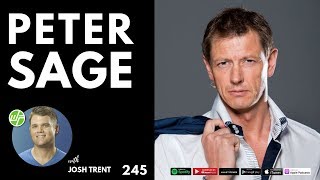
This is a recorded interview (Wellness Force Radio, episode 245) in which Josh Trent talks with Peter Sage about reinventing oneself. Central themes: the skill of surrender (interpreted by Sage across levels of consciousness, from victimhood to empowered flow), following potential rather than passion, the distinction between freedom (state of mind) and liberty (external constraints), and practical strategies for changing inner meaning to reduce stress. Sage relates personal stories — leaving school early and discovering personal development at 17, a six-month imprisonment (used as a "graduation event"), and completing/extending endurance challenges (Marathon Des Sables) — to illustrate emotional resilience, service-oriented motivation (inspiration vs. motivation), and the importance of caring for the "hardware" (brain/body) while cultivating higher-level consciousness. The episode closes with Sage's core values (authenticity, humility, serving others) and his definition of wellness as fulfillment arising when heart and action align.
Questions this video answers
Episode 245
November 20, 2018
Six months
Pentonville (described as one of the toughest jails in the UK)
Marathon Des Sables: seven consecutive days (marathon per day), day four is a double marathon; competitors carry ~20 kg (30 lb); temperatures up to ~52°C; water rations ~9 liters per day
Chapters
When you've really got nothing to lose, there's not a lot that you're afraid of. And when you start getting stuff, you probably become more hesitant because now you don't want to go back to where you started. But when you started with nothing, it's like, well, I can swing the bat in any direction because if I strike out, I'm no worse off. We have no right to change the world. We have no right to walk into somebody else's movie and start telling them how they should write their script. The only thing that we can do is to become the best example of who we can be acting in our movie.
That's Peter Sage. And this is episode 245 of Wellness Force Radio, where we discover the physical and emotional intelligence to live life well. In this podcast, we're talking with world renowned TEDx speaker, author of the Inside Track, and sought after coach and entrepreneur, the one and only Peter Sage. Now, I have to tell you guys, this was an introduction from our previous guest and our friend, Mr. Ted Rice. Thank you, Ted, for the much appreciated introduction to Peter Sage, because I was really blown away, and I don't say that lightly. I was absolutely blown away by Peter's presence, his articulation of thought, quite frankly, his immovable heart, his unstoppable mind. To take from David Zapozzotti, we talk about this highly nuanced concept today on the show of reinventing yourself. You know, a lot of us are taking inventory of, like, what's worked in 2018, what hasn't worked, and. And what do I actually want in 2019? Well, this skill set of surrendering that Peter talks about today through different layers and levels of consciousness. This is a gem that you can take and apply right when you're done with this show. We also talk about following our potential rather than just our passion. So many people in the world have a narrative, you know, just do your passion, chase your passion. Your life will unfold. Peter says it a different way, and we also learn from him why. One of the biggest fears for men especially is this false belief that our self worth is tied to our net worth. You know, my bank account is actually who I am as a person. No, this is something we uncovered today as just societal programming. We also learned that the process of recontextualizing our negative thoughts when our outer world doesn't fit our inner world is possible. Peter describes how we can do this. I love Peter. He is a powerhouse human being. This is one of my favorite conversations at an intersection of spirituality, consciousness and emotional Intelligence. You know, I've always felt that when we're practicing this art of trust and letting go and seeing the lesson in the pain, then pain can be our greatest teacher. And I want to ask you this right now. If you look back and take a big deep breath. Let's do that together. Let's take a deep breath. This is your breath break. Breathe out all your air right now. Put your hands on your belly. Take a big breath in for five seconds. Hold it at the top. And as you're holding at the top, feel your chest stretch. When you let this go, let go of all the stress. Let the stress melt out of your mouth at the bottom. Hold that for five. This box, breath this, five in, five hold, five out, five hold. You can do this any time of day, anywhere you are, and just know it's always there for you. This is what viscerally resets our nervous system, the breath break. And in that state, then after the deep breath, you can give yourself permission to truly be present and listen to this podcast, to absorb the messages, to see what resonates with you. I wanna know, what did you take from this episode? We're talking about this today and in the next week in the Wellness Force Group, our private group. You get to be a part of this too. It's wellnessforce.com group. Come join us. We'll talk about Peter as well as all things physical and emotional wellness. And you can share what you thought and felt from this show, maybe even something that you let go of through this teaching show. Notes from today are at wellnessforce.com 245. We can dig in about Peter and get all the links, videos and resources mentioned on the show. All right, now let's dig in to the inside track of how we can reinvent ourselves in this modern world as we approach the new year. I am Josh Trent. This is Wellness Force. My guest today is an international speaker, serial entrepreneur, author, philosopher and teacher. But paradoxically, he was also a high school dropout, which led him on a hero's journey two decades later become the embodiment of what's possible in personal development. After 25 years in business and personal development, his passion is now to help people through spreading his messages, insights and philosophy. His unique way of looking at and relating to it has inspired tens of thousands of people worldwide to reinvent themselves. Now, whether it's by turning around a business or developing a new empowering psychology method, this practical yet profound shift in awareness that he represents his insights and teachings, they offer a special blend of value and higher Consciousness to those who seek it. Welcome to Wellness Force. Peter Sage.
Wow, what an introduction. Josh, thank you so much. Great to be here, and I'm loving your energy already.
Thank you. You know, it was really cool. Before we started this record button, we realized that sometimes in life, things can get in the way. And so beautiful. As a metaphor for reinventing ourselves, we all find ourselves in a situation where our surroundings don't match what we know is possible. And yet this perfect mirror of you and I that experienced this, where you were at the hotel, everything was going great. We're about to record, and then, boom, the Internet goes out. How is this a perfect metaphor for the construct of our conversation?
Because whether you like it or not, you're in the river of life, and there isn't a river on the planet that flows straight. Every river winds. And what the left brain is programmed to do is to think in straight lines, but there's no straight lines in nature. So your river is going to bend left and it's going to bend right. And unless you learn how to go with the flow and not resist the current, and you're going to have a hard time. So, you know, complaining about the fact the Internet's gone down is futile. Dealing with the fact the Internet's gone down and finding out a way to be able to get through that or deal with it is being a good sailor in the river.
Yes. And, you know, there's the phrase I've heard, smooth seas don't make skilled sailors. And I think that for some reason, we're going to talk about not only personal development and your rules for success, but also this navigation, this north star that you've had. Peter, it seems like coming from this earlier life of leaving high school, dropping out of high school, there's such an incredible story that led you from leaving high school early to now helping tens of thousands of men and women, being one of the leading people on this bleeding edge of personal development. When you were in high school, what were you not receiving? Like, what guidance was missing for you to be able to leave high school? And was it something you felt inside of you, or was your environment something where you're like, you know what? I need to leave school right now. What was that like?
Well, I. From an early age, I recognized essentially that school teaches you two things. It teaches you how to pass tests and work for somebody else. And none of that was really going to be serving me. None of that was resonating in my DNA as part of what I wanted to do. I was a born Entrepreneur. I wanted to be able to go out. And the very definition of the word entrepreneur, which I get asked a lot, how do you define it? Is simply being independent. Do you rely on someone or something else in order to be able to get what it is that you need to move forward, or are you able to be able to create that? And that's the essence of entrepreneurship. Whether that's as a parent, as a mother, as a business owner, yeah, it doesn't matter. So for me, I always had that sense of understanding that the ultimate resource is resourcefulness. And I wasn't very smart at school. School was very good for. And people knock the school system. And I want to defend it to some extent because the school system is absolutely perfect for doing what it was designed to do. But what it was designed to do has no basis in 21st century reality. What it was designed to do was very simple. It was to take a essentially emerging industrial nation out of a feudal system and get people to sit in rows, show up on time, not question authority, press the right button so they didn't get hurt or hurt somebody else in new machinery they didn't know how to figure out and basically breed out any form of creativity or independence. And as a method of doing that, the school system does a great job. But we live in the 21st century where we need to know how to get creative, to push buttons that make different things happen than what we've settled for up to this point, which is on a 110% certainty course for destroying humanity. So I got out of there as quick as I could, like a rat up a drainpipe. I wasn't very smart academically. I couldn't spell mba. I'm just not one of those kind of people that are gifted when it comes to being book smart. Luckily, I stumbled across and there's no stumbling. When the teacher's ready, the student appears, and all the rest of it, teacher appears and vice versa. So I came across personal growth When I was 17, I was out of school and I was playing pool in a bar for a living. And I met a guy at the bar and we got chatting and he said, oh, I see something in you, young man. And he was one of these things that I always wanted to be. He was an entrepreneur. And yeah, he was much older than me. He was like 22. Yeah.
Yes.
He turned around one day, he says, listen, I'm going to leave something behind the bar for you, which I think you'll, you'll enjoy, you'll appreciate. And true to his word, I came back a couple of days later and the landlord turned around and said, hey, somebody's left something. And it was a six cassette. You know, back in the old days, before CDs even show my age. Yeah, it was a six cassette program of, you know, impersonal growth. Some seminar recorded from somewhere, some Amway type of, you know, winning psychology type. I even forget what it was, but it blew me away for a very specific reason. And I'm like, whoa, hang on a minute. Having been told by my parents, by my peers, by my friends that dropping out of school at 16 and quitting and never going to college means that I'm destined for a life of destitution and sleeping on park benches and emptying trash cans. And here's an industry that actually teaches you how to be successful without needing a piece of paper. Yeah. Signed by somebody you've never met. That validates my ability to memorize stuff that's not very useful in everyday life that I can stick on a wall and brag about. Wow, where was this at school? Because this is what I wanted to learn. How do you be successful? How do you relate to people? How do you get up in the morning excited or not excited? How do you develop a gift and give it to the world? That's what. Wow. I mean, that's what I want to learn. Not algebra and the periodic table. So I was captivated at 17 by personal growth. And it became my passion, my hobby. Every spare cent that I made, I reinvested in another book, another tape, and I consumed. I became a voracious learner of the art of success. Now I will say one thing, that a lot of the initial driving behind that did not have its basis in how do I build a legacy and give my gift and all the rest of it. No, it had its basis in where most people have their basis in being an entrepreneur, which is avoiding the fear that they're not good enough if they don't. And for me, I was driven by success because I thought that if I spent my life chasing success, it will be a life worth living. Wow. Having seen and spent so much time with entrepreneurs, that is a lie. Yeah. And there is a massive difference between spending your life chasing success and spending your life chasing fulfillment.
I got to pause you right there because so many questions already. You know, I'm. I'm visualizing you with kind of a 22 year old Yoda in the pool hall. And there you are, you're experiencing this new life paradigm, this new vision. And I think all of Us, we go through phases in life, Peter, where we crave mentorship, we crave the answers. We want the PDF, we want the guide, we want something that'll give us insight as to what breath or next step we can take. Did you feel at that time that when you're in the pool hall you got that download from the 22 year old Yoda? Did you know that that was the beginning of what your life would unfold to be?
Not necessarily. And I think as Steve Jobs said, it's very hard to join the dots going forward. You really can only join the dots. Looking back, I'm very grateful for that gentleman. His name was Dell. I actually ended up seeing him several years later and he was essentially at exactly the same place. And he wasn't really so much an entrepreneur as unfortunately a wantrepreneur. And there's a lot of those around and because they don't have the understanding, as you said, of the emotional intelligence to apply the actual book smart level of intelligence or even the street smart. So it was funny because I came across him and I ended up taking him and his nephew for a ride in my then Ferrari that I just bought at 25 years old. And it was almost like the student had become a master and there was no ego there. It was more disappointment. It's like, wow, I held this guy on such a pedestal and all he essentially did was give me a set of tapes, which I'm so grateful for introducing me into that industry. But it was like he wasn't applying what he was telling me to learn. And that was a big uh huh.
This is beautiful because I've always felt, especially in my own life, and I know this is what you teach too. Knowing is one thing, doing is another. A lot of us in the United States specifically there's personal development courses. You know, you mentioned tapes. I know what tapes are too. I'm 38 years old, so like I know what it's, it's like to put a tape in a car. But we've, we, you know, personal development and Tony Robbins and all the masters, Wallace Wattles, Napoleon Hill. We've all understood for so many years now that the gathering information is one piece of the recipe. I'm curious, when you were that age, what do you think the ingredients were for you that allowed you to apply and to gather instead of your mentor who just did most of his time applying or just did most of his time gathering?
Well, part of it was realizing I had nothing to lose. Yeah, I started with nothing. I wasn't Born with a silver spoon. And so when you've really got nothing to lose, there's not a lot that you're afraid of. And when you start getting stuff, you probably become more hesitant because now you don't want to go back to where you started. But when you started with nothing, it's like, well, I can swing the bat in any direction because if I strike out, I'm no worse off.
Yeah, yeah. And the big piece about that, too is that many people in their later life, you know, 40s, 50s, 60s, they don't want to go through kind of like that fear of the flinch moment where they have to actually reinvent themselves. And the risk is that they're going to be, you know, going through humility in some way. Right. They're going to have to actually reinvent themselves by looking deep within this inventory process. There's so many videos of you online. I was. I was scrolling through YouTube before we recorded here, and I just saw hundreds and hundreds of videos of you, not only on the TEDx stage, but also people that have done compilations of rules about you. And one of the rules that I saw, which fascinated me, was surrender. Now, we're not going to have time to go into all 10 of the rules. That's a podcast of its own. But surrendering this skill of surrendering. Can we talk about this as it relates to being an entrepreneur? And by the way, I feel like being an entrepreneur is just a man or woman that has the ability to take risk. How does that surrendering piece of emotional intelligence play into life? And how did you come up with this surrendering metaphor?
Well, there's several different aspects to that. And when it comes to taking risk, I think the way that I phrase that is now the ability to handle uncertainty, because some people are not entrepreneurs but are forced to take risks, it still doesn't make them an entrepreneur. It makes them somebody that's been forced into a position where they've got to do something that they didn't want to do. So your ability to handle that uncertainty and have it being as normal or as comfortable in terms of past the salt, then that's really the defining characteristic that I see as entrepreneurs. But when it comes to surrender, there are different ways of hearing, and I want to sort of, I guess, put a backdrop on this of what I would call different levels of consciousness. Now, when you speak about consciousness, a lot of people can get caught up in or wrap around the axle about the different levels of meaning around that, because it can be a little nebulous. You Know, on one side of the fence you've got the biologist, Newtonian paradigm that still believe the outdated and unproven model that is a biological byproducts of brain function which never has been, never will be, you know, that's like a saying, a television creates its own programs, whereas you know, a. On the other side of the fence you've got the extreme of the esotericism, sort of, you know, sit around, sink by R and you know, give it up to the divine without any associations to what you think that is. So yes, yeah, you've got to. So I want to sort of bring it down a little bit yet. Your level of conscious awareness is really the level of emotional maturity and spiritual maturity that you bring to the table. And you can call it a vibrational match, you can call it depending on what level of experience you've had. But if you go from the sort of lowest level, the victim mode of what I call to me, where everything happens to me and you're into the blame game, right up to the spiritual level of unity or oneness, where you see yourself in everything and you have non duality and there's a whole gambit between that. But depending on where you sit on that journey, that progressive level, the word surrender is going to come in at different levels of meaning. If you're in a lower vibrational aspect or lower state of consciousness, you're going to hear the word surrender from a place of acquiesce, from a place of giving up, from a place of being dominated. You turn around to a U.S. marine and say, what is the association to the word surrender? I've got news for you, right? He's not going to apply it in business. Yes, it's like no effing way. So that's. If you're coming from a place of force, if you're trying to force your outcome, surrender means you're giving up. But if you're coming from a place of power, if you're coming from a place of flowing with the river of life rather than swimming against the current, then you can come from a place of surrendering to a place of where you're allowing yourself to be taken from something that's greater than you. A benevolent power, a benevolent level of understanding where you trust in life, the universe, God, doesn't matter what label you put onto it. In fact, the biggest travesty of humanity is that we go to war and kill each other over who's labeled for the, you know, whatever. The metaphysical level of intelligence that built.
This game, this is so profound, Peter. This is so profound because so much violence has been created by saying the way that I love and connect to higher power is the only way. And if you don't believe me, I'll kill you. And I think that's an interesting way to look at this lens of growth and surrendering. Because how many times in our own lives have we been so certain that in a situation of relationship dynamics we have to be right? And if the person across from us can't see that we're right, well then we're willing to actually let the relationship go. But yet we do have this other state of awareness that doesn't care about being right, you know, and you've done videos on this, I've seen a few pieces of work that you've done about relationship dynamics. And I'd love for you to paint a picture of how you see the modern day relationships between men and women. It's on topic, but it's a little bit off topic, however it intertwines because surrendering is part of this relational dynamic between men and women. How do you see that? And then what does that look like for you personally?
Well, as you said, it's, it does tie in because whether you're arguing over religion or whether you're arguing over which channel to watch on the tv, the impetus comes from the same place. It's an egocentric, dominant, forceful position of I need to feel right in order to feel validated. Now if you are externally validated, which means I need external agreement with whatever I think, then you are always going to set yourself up in conflict. And that has nothing to do with love. Has nothing to do with. Certainly unconditional love has everything to do with. Yeah, I am so insecure in my, my own model of the world that I don't even believe it unless I get other people to agree with it or I'm willing to defend it. Because you questioning it, I take as a personal affront, which is just complete, you know, as I say, it's, it's complete mismanaged imagination. So whether it's in relationships or whether it's in say, wars or religion or arguing politics, it doesn't matter. When you know that you know and you're comfortable with that. But you're also open to the fact that you know that you may not know. In other words, you don't know everything, you just have. Because what is a belief? A belief is nothing more than a feeling of certainty about something. That's it. And beliefs change in a heartbeat. Yeah. At one Point, we believe the earth was flat. At one point, you know, we believed the moon shone. Rather than realize it's a black rock that doesn't give off a photon, it just reflects sunlight. So at one point we believe that we need to be right about something. Well, that sets up a positionality where now I'm engaged in the game of attack and defend. But when you have nothing to defend, nothing to conquer and nothing to prove, you just know there's an equanimity about that that comes with a level of, say, emotional maturity where you're okay with somebody not agreeing with you because you realize that their opinion of you is none of your damn business.
And to go even deeper down the rabbit hole, our beliefs before the belief comes, even the health of our brain, because, you know, we're half beast, half spirit. Peter, as I know you have this connection between entrepreneurship and spirituality. So to understand that we're a meat suit on a rock in the middle of outer space. Consciousness does not happen in the brain. I loved your metaphor of. Yeah, TV doesn't have its own programs. It gets sent the programs from some type of a download protocol. If we're not taking care of the brain, if we're not taking care of our body, well, then any kind of dynamic in relationships, in relationship to ourself, the way that we love people in our communities, our business. If the brain isn't healthy, if we don't have a healthy brain, there's no way we're going to be able to receive proper downloads or disseminate love and empowerment to other people around us. How much about the brain do you talk about in your work? And how do you care for your own brain?
Well, you're starting to mix the sort of physical and metaphysical here, which I'm thrilled to talk about because ultimately, yeah, I'm. I subscribe to the virtual reality model. Yeah, it's a virtual brain, but it falls under a subset of the of consciousness called physical matter reality.
What do you mean by I subscribe to the virtual reality?
Right. I subscribe to the model that, you know, we live in a virtual reality, a simulation, a computed reality. That's what physics is now essentially telling us or screaming at us. And we can prove it at every level. It's what quantum Mechanics discovered in 1929 and materialists have ignored ever since. But when it comes to understanding the brain, you're talking about the physical aspect. Now let's just bridge the metaphysical for a second. Every thought and thought is non physical. Every thought creates a chemical, a neuropeptide, that creates something in the brain that produces a chemical. So you think happy thoughts, you think positive thoughts, and you're going to produce biochemicals and neuropeptides that are correlated with that, whether it's oxytocin, whether it's dopamine, whether it's serotonin. And that is going to form a biochemical soup in the body that your cells are going to start getting used to. Just like the outer cell called the big cell, let's call it, the body itself gets used to weather. So you live in a sunny climate. I've got news for you. You're going to adapt to that sunny climate. You then go somewhere cold and you're going to have local people walking around in T shirts and you're going to feel cold in jumpers because you haven't acclimatized to that. So if you think positive thoughts consistently, you are bathing your entire biochemistry in a positive soup. Let's just call it that. And that weather, let's call it the sunny weather. Your cells are going to adapt. The receptor sites on all of your hundred trillion odd cells are going to adapt to that new wardrobe or get a wardrobe that adapts to that weather. So they're going to start wearing sunbathing suits and sunglasses and all of that kind of stuff. Now, if you think negative thoughts, you are going to be producing negative biochemicals. Whether that's adrenaline, whether it's cortisol, that doesn't matter. You're going to have a negative soup that your cells are swimming around in. Now, their job is not to question the weather. Their job is to adapt to the weather. So if you consistently think negative thoughts, your brain chemistry is consistently producing a chemical soup that your cells are now wrapping up in hats and scarves for. Yeah. Now here's the challenge. And this also ties into why people don't apply what they know, even though they know what to do. And that is that because if you have 50 trillion cells that are used to negative thinking in a lifetime of being told you can't do it, and your parents, you know, telling you, you know, you should go to college, otherwise you're going to be a dropout or you, whatever it is, you know, the listening to the media telling you why the world doesn't work, then you've got cells that are wearing hats and scarves. You go to a positive seminar and you read a book and you're like, wow, this is amazing stuff. And you start thinking positive chemicals thoughts, and you stop dumping that into the Bloodstream, Your cells are going to. You feel better in the moment because it's a better feeling. But your cells are going to follow a universal law called the path of least resistance. We see this all the while in electricity. How does a short circuit happen? Because electricity takes the path of least resistance. So why does it do it? We don't know, it just does deal with it. So yes, we know that nature doesn't waste energy in vain. Let's call it that.
I've also heard nature doesn't. Nature doesn't like a vacuum. We see this in sodium and potassium, high, low pressure. I think it's a universal law in nature that things from high always are attracted to low because there's rest there.
Yep. Well, that you're getting into second law, thermodynamics and entropy. But for the purposes of this, I want to reveal something to people that'll be quite enlightening if they grasp this, which, you know, based on the nature of your audience, I almost certainly will. And that is that if you have 50, 100 trillion cells that are wearing hats and scarves, is it better or easier for them to go and change their entire wardrobe or for you to simply start thinking winter thoughts? So what happens is your body, based on previous programming, wages biochemical warfare against the brain. And it sends signals through specific neural pathways that essentially say, whoa, hang on a minute, what's all this positive thinking crap? Right? You've got a lifetime of telling us that we should be wearing, you know, adapting our biochemistry here to, you know, the receptor sites in into a negative feeling. Whoa. Someone sending negative thoughts. And you start getting an arising in the mind, self doubt, criticism, negative thoughts. And you try to battle through it, but now you're forcing the game. And it takes about three weeks to a month sometimes of consistently just recognizing, you know, that's just my body just doing what it should do. Perfectly natural path of least resistance. I've got all of these cells need convincing that I'm in here for the long haul because they've just been out and spent a lifetime wrapping up and now I'm telling them to throw out their winter wardrobe and buy a swimsuit.
I love these metaphors. Peter, this has been really, really interesting, this area that we've wound up in, because I feel like in this cul de sac of awareness to which you speak, where there's hardware and there's software, to use the VR analogy, what do we actually do then to take care of this hardware? Because today actually, it's beautiful timing. We're Talking about this, we just came out with an interview with Dr. Michael Ruscio. He's a leading expert in gut health. We talked about the enteric nervous system. And in this enteric nervous system, it operates completely separate from the cns, right? So parasympathetic and sympathetic. We understand your lens of life being VR. How do you personally take care of the hardware, your gut, your brain? To circle back around to that question where we are talking about a state of consciousness, but we're also talking about the receiver that receives it. How do you see that?
Well, there's a rule set. And the rule set is, governs what happens in the physical body. And that physical body, you can't sidestep the rule set completely. It is able to be sidestepped through having certain connections to consciousness. If you have very strong beliefs, if you align the heart and the mind together, you create a powerful force that has the ability to influence the body. Now, we know this because it's enshrined in law. It's called the placebo effect. You have science that basically says there's no such thing outside of material matter, reality, and the laws of physics. Yet, you know, if your thinking can outperform a drug better than a sugar with a sugar pill, then, you know, we'll give you a license. And if it can't, it won't. I mean, give me a break, right? So, you know, it's enshrined in law, but you do have to take care of the physical rules. You know, if I stop breathing, I'm going to die. Now, I can train myself to an extent to make sure that I can have some level of, I guess, sidestep around that. But there's limits. So when it comes to the brain, one has to take care of the brain. Now, what is the brain made of? Well, it's 60% fat, and it's largely water. And so from that perspective, if we have a situation where we're ignoring the basics, we're not hydrating properly, we're drinking sodas, we're thinking negative thoughts, then it's pretty common sense that the body is a 247 adaptation machine. Now, its job is not to care or critique which environment you put it. You can put it in McDonald's, you can put it in the gym. It doesn't care. Its job is to faithfully adapt. Yeah, yeah. And that goes for the inside of the body as well as the outside of the body. It doesn't care if you think negative thoughts because you can't get over the death of your parents 10 years ago or your last divorce. Its job is to make sure that your cells adapt to a high cortisol based environment which is going to create stress, wear out the adrenals. It doesn't care that you're going to die 10 years early or more. It's not his job to care. His job is to follow the instructions. You get in a car and the car's job is to follow the instructions. If you turn left and it takes you off a cliff, the car's job is not to say, oi, hang on a minute. Really, you should be turning right. No car's job is to you turn the wheel left to go left.
I think all of us can relate to this too, because this car analogy, everyone is coming from some type of genetic coding though as well. And if we look at the science of epigenetics, the way that someone might be attuned or coming in with more, more, more of a line where they're always going down a negativity path because that was their parental example. I understand you and I, and I receive your message and I think all of us can connect with. If we're feeding the mind negative thoughts, then of course we're going to put out toxic beliefs and toxic everything. However, what has been this little inflection point between you personally and, and the people that you help to get out of the negative feedback loops? Because if that was their example, the breakaway from that parental example can be so incredibly challenging. So the baseline for all human beings to thrive is nutrition, what we put in our mouth. But with so many people living in food deserts and the speed of life increasing, it seems like almost every week how we stack our environment in our favor, yes, there's produce delivery companies and ready made meals, but our environment every single day, the things that we do when no one's watching, this is what really breaks down to living our life well. So we get to see stack our environment, the environment that we have at our home and in our work and in our car, we just stack this in our favor. This is why I'm a huge fan every single day. I'm personally taking the organifi red green and at nighttime the gold juice. Let me break this down for you. This is an entire day system. This is not just a one hit wonder. You take the green in the morning with ashwagandha and all the other adaptogens to give you that morning clarity and the boost. And then in the afternoon without coffee. And this is true. I haven't had coffee in Three weeks. I'm doing an experiment right now with no caffeine. I know you're probably like, what, no coffee? Check this out though. I'm doing a double dose of red in the afternoon to give me that boost. And then of course at night I'm doing the lemon balm and the turmeric with the gold so that I can have that be part of my nighttime ritual. You can do this too. Give this a test drive for just a few bucks a day. You can get yours@Organifi.com WellnessForce just use code WellnessForce. You get 20% off the big discount over at Organifi.com WellnessForce and use code WellnessForce today and every day. Tell your friends this is something that gets to be a part of your healthy lifestyle. All right, let's tune in back with Peter Sage.
The fastest way to be able to do that, it's a great question, is to recontextualize the meaning. See, most people are thinking negative because the outer world doesn't fit the pictures of what their inner world is saying it should look like. That's pretty much it. All stress comes from the outer world not fitting the pictures of what I think it should look like in the inner world. Usually linked to the fact that because of that it triggers the fear that I'm not good enough or not enough. So at some level, depending on how many layers of the onion you want to pull back. So if you want to help somebody, the first thing one has to do is not try to do what they've spent their life trying to do and probably given up on, which is to change the outer circumstances to fit their inner pictures. One has to shift the meaning of the outer circumstances so that those inner pictures and those fears no longer get triggered. And I'll give you an example. You probably saw the book that I recently put out, the Inside Track and my adventure last year where I spent six months in one of the toughest jails in the uk and that was an incredible journey. I was the only non criminal never been accused or charged of a crime and I found myself wound up in there through a contempt of court application that I didn't see coming. It was masterful, engineered by the universe and to what I give me what I call a graduation event. But it allowed me to go in and I remember when, when I was in court and I was just arguing the toss over a business deal in court that happened six years ago and with a major multinational multi billion dollar company, which was my first mistake, they had a lot More money than I did.
And this was hp, correct?
It was indeed. You know, and I thought it'd be left out of court. In five minutes, they spun a contempt of court application. I gave it no credence. I thought it'd be left out of court. As I didn't, I had no idea that they would spin it to the judge. And I ended up serving six months. And when it looked like it was going the wrong way, I said to my fiance, I says, wow, honey, it looks like there's an outside chance here I could even take a holiday. What's going on? She says, oh my goodness. What do you think's happening? Yeah. I says, well, look, if the river of life wants to bend that way, let's think about it. My mission has been publicly stated for a long time. I'm here to raise the global consciousness of humanity. That's why I was sent. And I'm very fortunate. Many people around the world for the last many years have seen my work and been impacted by it. But there may be many people that would benefit, that could never see it because they're in a place like that. If life wants to send me in there and let me go do my work, then, honey, let me go do my work. And I went in not with the identity of a prisoner, but with the identity of a secret agent of change. And that gave me a phenomenal laboratory of working with people at the lowest end of society. I'd never had the chance to work with at that level, that consistently and in that level of concentrated environment. You know, I spent 15 years going around the world working as a trainer with Tony Robbins. And I was very grateful that, you know, I got the opportunity to work with all sorts of people in, in that environment, from drug addicts to homeless to abuse cases, suicide, you know, right up to $100 million CEOs who ironically were usually the most drug addicted and suicidal. Yeah, but, yeah, when I was in place like Pentonville and think of a cross between Shawshank Redemption and Prison Break, that was pretty much Pentonville, one of the most violent, outdated, 200 year old prisons in Europe. And one of the ways I got to shift people's mind initially that had the most success was to get them to understand the difference between freedom and liberty. See, they were walking around under the impression that had their freedom taken away and their freedom taken away. Freedom is a state of mind. The only thing that had been reduced is liberty. Liberty. You know, you can have your liberty reduced, you know, because your parents have just grounded you somebody without a passport can feel that their liberty is reduced. Somebody that doesn't have the legs to run after a bus can feel that their liberty is reduced. But freedom, it's a state of mind. And nobody can ever take your freedom away.
Why do you call this a graduation event? What does that mean?
A graduation event is essentially ways in the. In the script of the movie of your life that are engineered by, let's call it, the producer and the director, whatever label you want to use that are essentially sent to you to validate the fact that you can apply what it is that you should know. If you spend your life teaching something, if you spend your life as a relationship coach, expect a messy divorce to see how you deal with it. If you're a fitness professional and you preach about fitness, expect a chronic illness to be able to give you the opportunity to demonstrate how you've been coaching everybody else for the last 10 years so you can walk your talk. And so for me, I saw it as an exciting opportunity that I've been teaching positive thinking for the last 15, 20 years with some incredible content. But what happens when you put a motivational guy in jail and take away his business and hit him with hundreds of thousands of dollars in legal fees and not tell his fan base so they have no idea what's going on? What happens? How do you show up? That's your test. And that was my graduation then. And I wrote to my fans every two weeks. I wrote to my coaching clients saying, come on the journey with me on my first letter. Come on the journey. This is a brilliant case study for being able to see how things show up.
I love so much how you described whatever your profession is, whatever your calling is, whatever higher power brought you here for, expect these very powerful and very challenging thresholds to actually expand you, to actually stretch you. It's the analogy of someone being pulled back in the bow. And right when it feels like you can't stretch anymore, you're shot out and you'll go even further than you ever were before. And it brings me to something you actually posted on Facebook. And it's this difference, this key difference between motivation and inspiration. Let's face it, being in a jail cell is not freaking inspiring and it's not motivating at all. So in this paradigm, and by the way, that can be an example or a metaphor for anyone who's experiencing maybe their own kind of jail cell. How did you shift from staying in inspiration to not dabbling in oh, poor me, or how do I get motivated today? It seemed like while you were there, you stayed in that channel of deep inspiration. How did you do that?
But the biggest factor when it comes to that is having a mission, an outcome, a focus that is bigger than you. When you're focused on yourself, it's going to get you so far. When you're focused on others, you're going to go further. It's just if you have a calling to be able to give. Tony Robbins taught me a phrase many years ago. He said, power moves to those in direct proportion to their willingness to serve. Powerful phrase. And I found it to be 100% true. I ran a crazy race a few years ago called the Marathon Desalination Up. It's an ultramarathon across the Sahara desert. It's basically a marathon. A day, back to back for seven days. Day four is a double marathon. You're carrying 20 kilos, 30 pounds on your back. You're running in soft sand at 52 Celsius, 135 degrees. Water's ration to nine liters a day. That's for washing, cooking, hydrating and running a marathon. Don't do it. And I learned a big lesson on that. I went there because it was the toughest foot race in the world. I mean, why do you climb Mount Everest? Because it's there. Shouts every ego. And so did mine. And I remember on the day of the double marathon, I woke up with food poisoning. I couldn't walk. Yeah, I could barely lift up my rucksack. And I've got 52 miles to run that day across some of the toughest terrain in the world. 84 kilometer stage, and I was retching out of both ends. I had food poisoning. I couldn't. I was dehydrated. The gun went off and 600 people ran and I trudged. And there's a camel that starts at the same time and if the camel overtakes you, you're out of the race. That's kind of the benchmark. And so I had to kept going and I wanted to get going. And by 8 o' clock that night, I. I was done. Yeah, I got nothing left. There was no positive talk, There was nothing. And I basically sat down on a rock and I started to cry. Sun was setting, temperature drops below zero at night in the desert, it's freezing. So I've got another pretty much 20 miles to run through the night. And I've got to run just to stay warm and I can't. There's nothing left. And as the sun was setting, I heard this Noise. Trudging through the sand. And I looked up and I saw this blind old Korean guy in his late 60s tied at the wrist to his guide. He was a competitor and he was trudging through the sand. And I looked at him, I thought, wow, what possesses somebody who's not an athlete? He's a pensioner, can't even see where to place his feet. Want to run the toughest race in the world? I thought, I've got. I've got to find out. I'm a student of human behavior. And I went and found. I ran after him and I caught up and I found out through his guide, Josh, that every year he ran this race for one reason. Years ago, his brother died of cancer, and he raised money every year for the hospice that looked after his dying brother. And I'm like, whoa, hang on a minute. If ever I needed a reminder that this shouldn't have been about me and my ego and bragging to girls in bars, I could run a frickin ultramarathon across the desert and all of that. But. But I wanted to make this about somebody else, something else, anybody else, but something bigger than me. And I felt a rush of energy now. I felt it inspired me. I ran. I finished the race that day. I ran another 26.2 miles the day after. I finished the race the day after that. And it just taught me the biggest lesson out of the entire experience was that if you really want to get inspired, not motivated, See, motivated got me as far as sitting on a rock, crying my eyes out, thinking I was about to quit it. Inspiration started when I started thinking that maybe I'm here to serve, not here to take. And that, I think, is the tipping point of emotional maturity.
This makes me take a deep breath because in your post you said, motivations temporary, like gas in a car. It burns hot, applies good energy in the moment, but always runs out and needs topping up. Inspiration's different, however. Inspiration does not have a finite fuel tank that is subject to the temporary states and vicissitudes of motivation and willpower. Let's talk about willpower, because I'm thinking about you crying in the cold darkness of the desert and then seeing this gentleman who's blind, like, doing it for something way greater than himself. How have you fueled this inspiration for so many years? Has it changed? Has this inspirational fuel changed for you since you started out the journey of Team Sage?
Yeah, absolutely. And I think it should, because you evolve. You become a different person. And the more you evolve, the more you have to give the more you have your own graduation events. I believe we're here in Earth School, and what happens? You go to grade five, you pass grade five. After your graduation exam, you go to grade six. Now, are the questions harder in grade six? Well, of course. Meant to be. You pass grade six, you go to grade seven, and it goes on. So for me, what really has fueled my journey? As I mentioned earlier, my mission is to help raise the global consciousness of humanity. That's not a platitude. That's, you know, I had a very honest and open conversation with my fiance last week. You know, we're talking about. I should have got married, by the way, while I was inside. I mean, the wedding was canceled. I mean, it just. It was a curveball across every part of my life. The wedding was paid for in Portofino in Italy. And, yeah, again, the groom was absent. Yeah. At Her Majesty.
Wow. Talk about a lesson in the school. Geez. This is a very, very strong lesson. How challenging did that feel to know that you were going to get married and then know.
Nope.
Universe snatches it away.
Yeah. And my business was just starting to help hundreds of thousands of people. We're doing six figures a month, and we just sold, I think, 50 tickets that month at $1,000 each to my business school. That was happening a couple of weeks later. Of course, everybody wants refunds. I mean, it's just like. It was an absolute nightmare. And I've got my hands tied, literally. Yeah. In a place where I can't even make a phone call. And it was just so bad. But, yeah, I accepted it. I realized that. I'll give you another metaphor which I think people may find useful now. I think we all star in the movie of our life. Everybody is the star of the movie of their life because we're the only person that acts in every single scene. Now, everybody else in your movie plays one of two roles. Either they're a supporting cast. If you're lucky, you may get, count them on one hand, a wife, a spouse, a son, daughter, a business partner, whatever. Or 99% of people in your life are going to be film extras in your movie. That's just how it shows up. Now, the biggest challenge, by the way, and this is why people are driven by the good opinion of others so much. What I call goop, the good opinion of other people. Most people spend their life swimming in goop because they walk around under the false belief and the illusion that everybody sees them as the star in their movie. But of course, they don't. Nobody cares about you being the star in your movie. They're too busy being worried about what they think. You think of them as the star in their movie. And we adapt ourselves into changing our behavior to get approval and likes and opinions and good opinions of others. When they don't really give a cat, you know, it's with nothing but a film action in everybody else's movie. So when it came to creating the best movie of your life, what kind of movie do you want to create? Well, I want to create a movie that people want to pay to watch. What does that have? It has drama and intrigue and comedy and tragedy and wonder and all of that stuff. You don't want to pay good money to go to the cinema to watch James Bond rescue a kitten out of a tree for 90 minutes?
No, that's not as exciting. I love this because we had Paul Check, who's, I think, one of the top leading voices in wellness on the show. And he said, you know, if you ask the universe what kind of a story we want to create, there would have to be some dark duality and some really bright white light. There has to be this pendulum swinging at all times. And I think about the role of money in this. Peter, how does money play such a powerful role? How much wounding is there for people around money? I think it's probably one of the deepest, if not the deepest wound for people in this movie. Money, however, we know, is energy. Many people have talked about this. I know you have probably courses and ways that you take people through different types of money consciousness in your work. How did money for you? How does this apply to the VR simulation money?
Well, the biggest challenge with money when it comes to the frustration and the wounding that you mentioned, is down to one false belief. And that is the belief that most people have their. Their net worth tied to their self worth. And because the biggest fear that we have as human beings is the fear that we're not enough. That if your net worth is down, that triggers your self worth down and triggers the fear that you're not good enough. And all sorts of stuff and fears and wounds and everything get triggered for that. So most people will compromise their values around money faster than anything else to avoid the fear that they're not enough. That's pretty much it. And of course, we've conceptualized money. How do you conceptualize something that isn't conceptual? Money doesn't exist. Yeah, it's pieces of paper with dead people on it. You know, it's shiny metal and hard rocks. I mean, let's be honest. It's conceptual. I think the cryptocurrency world taught us that, right? Fiat currency. I mean, you want the biggest money scam on the planet, it's government paper. So if you have an understanding that money is simply nothing more, it's a way that we measure perceived value. That's it. And it's a way that if you add value and the perception of that value, depending on how great it is, determines how that exchange of money is then facilitated. So I spent a lot of my early life chasing money, which is kind of like going to the gym, chasing strength without lifting the weights. Well, no, forget chasing money. Chase adding value. Because money is nothing more than a byproduct or a consequence of adding value. You add value, you get money, because that's what it is. It's a measure of that. But if you're chasing the actual measure and not doing the result, that requires to trigger that exchange again. It's like walking into a cold room and saying to the fire, hey, give me some heat and I'll go fetch you some wood. Well, that doesn't work. Yes, yes, some strength, and then I'll. Then I'll lift the weights.
Doing what? Doing the work. Sometimes, though, it seems like people are ready to do the work, but yet the path of this almost inventory process of what you're saying, you know, don't chase the money, chase adding value, but deciphering and deciding how to actually find the thing within oneself that is being downloaded that we want to add value to. There's no PDF for that. You know, the inventory process of figuring out, okay, I'm not going to chase the money, however, I am going to chase, where can I add the most massive value in the world from me, as a conduit, what does that process look like for people? I think that's one of the biggest questions we get, Peter, is I have all this energy. I want to change the world, I want to do big things. But where do I actually start? And how do I figure out what channel that I want to put all of this value in?
Great question. And I'd address it this way. There's a big difference between following your passion, which is kind of in vogue throughout the whole personal growth aspect, which I'm not a fan of. I'm a fan of following your potential, not your passion. And the challenge with following your passion is a lot of people can get confused with what they think is a comfort zone. Oh, I feel good doing this, because there's no challenge. Whereas following your Potential will automatically require you to step outside of your comfort zone because you have to grow bigger than where you are right now. Otherwise you, you would have already have that potential realized. So it's a two way sword. By giving my gift to the world, by having to grow, by having to step out of my comfort zone and stepping up, then by the very nature, passion is usually released in that process. That's where following your passion comes from. Now there are certain things where the heart will definitely say, this ain't for you. I'm unemployable, as I'm sure you are. I'm never going to get a job. I'm never going to be a 9 to 5, I'm never going to go back to school and study book. That's just not who I am. So my heart's going to shut down. So there are aspects of, of the path that will be lit when I look at them. And ask yourself the question, how to find that? What lights you up? What, what makes you happy? If you could only do one thing in your life for the rest of your life, what would it be? Yeah. If you knew it was impossible to fail, what would you do? I mean, they're basic questions, right? But it steers you on track. And then rather than following your passion because, oh, I love horses. Well, yeah, but you may not know the first thing about running a business that adds value with horses, but follow your potential. You may be the best potential person that can, you know, create a different kind of aspect around something that involves horses.
And I think there's clues that makes perfect sense. I love where we are because there's clues when it comes to our potential. And I, and I really enjoy the way you say that. In current, kind of modern day, you know, downloads and books and rah rah rah speeches, there is this message of following your passion. And I'll tell you, like, if I would have ever just followed only my passion, I probably would have just been eating like really bad food, sitting on a couch, not exercising. Like, hey, who's not passionate about eating pizza? Like we all are passionate about good food, right? But on the other side of the coin, you know, this paradigm flip of passion versus potential, when someone's starting out on the road to potential, there are clues. The universe leaves clues as to what someone's potential might be. So for example, in my life, for as long as I can remember, people said, wow, you really care and you really take things like, you know, you wear your emotions on your sleeve, Josh, and you really put all Your heart and everything. And I thought, okay, what am I gonna do? Like, what kind of clue pathway can I go down? And that led me to podcasting. That led me to being a fitness professional, which, by the way, I experienced the challenges with my own weight. Hundred pounds, to actually move through that threshold. So the little strings from my heart that are connected to this conversation are very special to me. And I think that the way you've explained this passion and this potential, if somebody in this very moment is feeling like, you know what? I think Peter's right. I am going to go down the road and figure out what my potential actually is. Could you give them any guidance on that? Specifically, yes.
What are you most scared of? Is always a great place to look because it's the last place we tend to look. And because we have a context for life, or most people have a context for life where they don't realize why we are here. Here. We're here to grow up. We're here to grow emotionally. We're here to grow spiritually. We're not here to engineer ourselves into a comfort zone. But if you don't have a context for school, I mean, imagine going to school and not having a context for it. It's like, why am I being told to sit here? Why am I being given these exams? Why am I being told to walk down the corridor and go to that next room and sit on my ass for 40 minutes and answer questions? Yeah, that's. You know, you would try to do your best to engineer the path of least resistance and skip class or, you know, duck when there's a question, or the rest of it, because you wouldn't have a context for understanding. And if the teachers turn around one day and said, hey, guess what? Great news, you don't have to come to school. You don't have to take exams. You can do whatever you like. We love you. Oh, by the way, nobody graduates. You were like, oh, hang on a minute. But, no, I'm here because I want to get my mba. I'm here because I want to get my degree. I'm here because I want to have a career in X. So if you don't have a context for why we're here, we're here to grow up. We're here to basically become higher versions of conscious beings that come from a place of how do we contribute, how do we add value, how do we get along? Not how do we segregate, how do we come from fear, how do we dominate, how do we control? Now, is that just happy Words and platitudes and. Sounds good. And no, let me give you a scientific basis for that. You look at 400 million years of fossil records, you take evolution as we observe it, and it has a very clear, distinct pattern math that's not up for debate. And that is it is continually evolving into higher forms of complexity. You take an amoeba and you take a fifty hundred trillion cell human body, there's an enormous amount of complexity. Now, what's the difference? You put 50 separate. 50 trillion separate amoebas and one fuel source, and you've got a war. You put a human body on a fuel source, and you need to have cooperation. You don't want the liver cells going on strike against the heart cells because they want more oxygen. That's. That doesn't work. So if you look at evolution, we're here to design, to be evolved. And what does evolve mean? It means we need to have higher levels of cooperation to handle complexity. That's it. Now, what's the ultimate extrapolation, Josh, of the word cooperation? Love. We're here to be evolved into higher levels of love. Yeah. Like it or not. And until we get that, the universe will keep giving us a slap around the head to get our attention.
I remember I was in Austin when Michael Pollan's book came out, and I got to meet him and hear his talk about his book, and he said, you know, the reason that love is all there is has become such a abused platitude is because the most powerful truths usually hide in plain sight. So the fact that you said love is actually cooperation, that's the whole definition. That's the bridge. I think that's really what we need right now in the world. And as we wind down this incredible conversation, I want to ask you this question about our evolution. In evolution, there is the word love. So think about that flipping if you were to read it backwards, right? This love revolution that we're all kind of in this world of wellness and personal development and health, wanting to flourish. What is your role in that? And how do you see that unfolding from a societal perspective?
My role is the same as your role, Josh. We can only be the example. We have no right to change the world. We have no right to walk into somebody else's movie and start telling them how they should write their script. The only thing that we can do is to become the best example of who we can be in acting, in our movie, and that's it. And wish everybody well and do the right thing. I mean, ask yourself the Question. You talk about relationships earlier. What would love do? Would love argue over whether you're right and I'm wrong? Again? You can imagine that between a lung cell and a brain cell. Yeah. You'd be out of oxygen in 20 seconds. That doesn't end well. So what would love do? It's a primary question that really forces us to get our ego in check and see what the bigger picture is here. So what's my role? I want to spread my message. I have absolutely no association as to who listens to it or what they do with that message. That's not my role. My role is to try to inspire people in a way that hopefully adds some value that they can choose to take into their movie. But, you know, and when I was in prison, I was simply on location for six months filming the prison scene in my movie. And that's. That's how I saw. Saw it. I was able to recontextualize the whole event, but I was there still to be loving as much as I could. Not argue, not complain, not resist. That's futile. Yeah. And I think that's a lesson for all of us. Certainly was for me.
The values that you have for Team Sage, core values. Authenticity, humility, inspiring leaders to magnify the greatness of others, to leave people better for having crossed our path. But this one specifically, this last core value, is what I'd like to leave people with, to be an open channel for higher wisdom. How do you personally, and how can we, as the Wellness Force Collective, be this open channel for higher wisdom?
It's all about, again, asking better questions. What would love do right now? What serves the greater good? Is this serving my ego, or is it serving my growth and being able to say, look, I don't need to take credit for the stuff that comes through me. I am a conduit for that. That. And if I was to give one final invitation, it would be to stop playing the game of how do I raise my own significance? Which is where, you know, most people are in life, trying to prove how they're good enough or justify themselves and start playing the game of raising the significance of others and see the magic show up.
This conversation was magic for me. And thank you so much for showing up so profoundly, so strongly and giving us all these deep metaphors to explore. My friend listening. Go to the show notes right now. Petersage.com is the website. We're talking about this in the Wellness Force group. Wellnessforce.com group. Peter, to say goodbye. How would you define wellness? You know, we Explore this intersection of physical and emotional on the show. In the middle, I believe, is this connection to spirituality and a higher power. Knowing those three, what does wellness mean to you? How would you define wellness?
I would say fulfillment. Yeah, it's when it comes to understanding fulfillment, you can't lie over what your heart is telling you. You, your brain can increase its volume and therefore justify, which is what the brain's job is to do. But you can't lie over the top of an unresolved issue that the heart's trying to bring to your attention. So if you are content in your heart that you've done the right thing, you've said the right thing, not because your ego's there, then you experience wellness and the heart will react to that, your body will react to that. Do what's right, not what scores the most points on the ego ladder, but just do what's right and the universe will always come back and wellness will be a byproduct of that.
Wwld. What would love do? Peter Sage, thanks for coming on the show. Appreciate you so much.
Pleasure's mine. Thank you so much yourself, Josh. You bring an amazing gift to the world.
Hey my friend. Thank you for hanging out and growing with me today. Everything you learn on this podcast starts with your morning practices. So from over 200 world class guests and counting, we've distilled the gems, the best, best of the best science backed practices down into a 21 minute morning system guaranteed to increase the positive flow in your day. Get this free and powerful 21 minute life changing system over@wellnessforce.com M21 if you enjoyed this episode, tap your phone, share it with someone you care about because that is how we all get better together. Supporting the show is easy. Leave us a five star review right now from your phone. It helps us reach other smart and conscious people like you. Either tap your phone and hit the link in purple that says review this podcast or go to wellnessforce.com review. And this show doesn't stop here. We're continuing the discovering process in our private Facebook group. You can be a part of it. All you have to do is go to wellnessforce.com group and I'll welcome you at the door. Okay, now you get to go out into your world and live your life well. So until I see you again real soon, I'm wishing you love and wellness.
More from Josh






Your child's future start before pregnancy... and even before conception! #podcast

MD Reveals: Your Healing Creates Your Child's Reality (The Souls Coming In Need Strong Bodies)



