258 Boysen Hodgson | "Toxic" Femininity & Masculinity: How The Establishment Divides Us
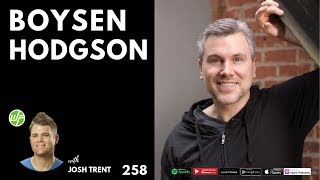
Transcript of episode 258 of the Wellness Force Radio podcast (host Josh Trent) featuring Boysen Hodgson of the Mankind Project. The conversation covers men's emotional development, critiques of “toxic masculinity/femininity” narratives, MKP’s programs (New Warrior Training Adventure, men's groups), archetypes (King/sovereign, Warrior, Lover, Magician), practices (meditation, moving meditation, breathwork), and cultural drivers of male disconnection, suicide risk, and the need for role models and safe spaces for processing trauma. The guest shares personal history, MKP initiatives (I Am Responsible campaign), and practical guidance for men and allies to ‘answer the call’ to inner work.
Chapters
It is about getting to men and knocking hard enough on the shell that they become willing to see it. Like, are you in enough pain? Or do you need a little more pain before you become willing to open up to get to what actually needs to be processed? Because these are long, slow, pain, painful conversations that lead us to the places that we want to be.
That's Boysen Hodgson from the Mankind Project, and this is episode 258 of Wellness Force Radio, where we discover the physical and emotional intelligence to live life. Well, in this podcast, we're talking about a different side of wellness, and that is the awareness, which is the most important thing. The awareness of what's actually going on right now in our lives, in our consciousness and on the planet, especially here in the United States, between men and women, the masculine, the feminine. Where do we go from here? That's the big question. And it's a question we're exploring with Boysen Hodgson, a leader at the Mankind Project, which is a men's community for the 21st century. Now, if you haven't heard of the Mankind Project, it's a nonprofit global training and education organization with over three decades of proven success, hosting a life changing experience across the world for personal development programs for men. But this podcast is for the men and the women. You both have probably been noticing, maybe even feeling the anger and the edge from so many people in our society. On Facebook, with the shifting roles of masculine and feminine and women changing so quickly, it seems like not a day goes by where there isn't headlines about, quote, toxic femininity and toxic masculinity posted everywhere. But this really begs the question, what exactly is toxic masculinity or toxic femininity? Does that even exist? Does it actually even exist? It's so easy for the mass media to use these terms to divide us. Think about it. Democrat, Republican, pro life, pro choice, man versus woman. What a joke. I've been feeling this negativity in this divisional language which is really meant to control and divide us, to keep us angry at one another, to keep us in conflict. But all we get to do right now in this episode is take a deep breath. Because the us versus them is a narrative that's really just meant to get clicks, sell books and push traffic to websites. We're going to take a massive deep breath together today because really, what this conversation with Boyzen is about is the universal connection we all share as men and women. And that is the love. Yes, the love, the four letter word that's overused on memes and is trite with little hearts on social media. But the true definition of love is at least what I see it as, is the energy and the force that creates all things. And there's so much negativity in the world that this podcast has been and always will be a way to dilute that toxicity and negativity in the world. That's why you're here. That's why we bond together as modern day wellness warriors, because we believe in this new narrative where we're talking about what's possible. We're not focused on the division, the conflict and the anger with one another, because that's if you look at loa or if you just look at the law of reciprocity, any kind of energy just breeds more of that energy. So, yes, there's a time and a place to explore conflict, but let's face it, when it comes to the war of the sexes, it's only the war of the sexes because people keep holding the swords. It's time for us all to put down the shields, put down the swords, and have a roundtable conversation about what really matters. And that's what we're doing with Boysen on this podcast. Boysen's gonna share with us about how teaching men to express their emotions, being vulnerable and to be nurturing is actually part of the healing this world needs. We'll talk about how the modern world is affecting men in the workplace with higher rates of depression and su suicide. We also talk about the concept of emotional intelligence and epigenetics, the long legacies of trauma that has been inflicted on portions of our society, and the powerful practical practices of moving Zen and sitting meditation that men can use to up level to meet the rising of the feminine that we're experiencing as a collective. And as a collective, our immune systems, its cold season were under attack. This is why I've been depending so much on my organifi green juice, the ashwagandha, the adaptogens that help me burn through viruses and colds. If you're not feeling great or if you have an immune system that's weakened right now, the only way to support that immune system is with proper rest, sleep, hydration, care through your medical practitioner, but also through micronutrients. Even more powerfully, the micronutrient adaptogen blends found in the organifi green juice. We've been a huge supporter and even me personally, I've been taking organifi for almost two years now, every single day, specifically the chlorella, the ashwagandha, and and the other Superfood blends. They give me this internal energy that I can operate my entire day with. And best of all, it tastes good. I'm not gonna do something unless it tastes good. So if you've been struggling with low energy, maybe too many cups of coffee in the afternoon. Give yourself a gift of energy from the inside out today. Don't wait any longer. You're here on this podcast. You get the huge hookup 20% off Organifi.com wellnessforce use code wellnessforce you will not find a bigger discount anywhere else. Organifi partnered with Wellnessforce to give you 20 off your entire order@organifi.com WellnessForce pick up that green juice. Feel better today? Get more energy. Use code wellnessforce at checkout and make sure you click over to wellnessforce.com258 for the show notes Today learn all about Boyzen, the Mankind Project. We always take copious and detailed notes for you so you can listen to this podcast and be fully present. So now let's talk about this new narrative where with Boysen Hodgson from the Mankind Project right here, right now on Wellness Force. My guest today lives at the intersection of emotional intelligence and leadership. And he has been working with men, facilitating men's social emotional development work and building bridges for cultural transformation for over a decade. His work both as the communications director with the Mankind Project and other progressive personal development organizations. But in 2010, he wrote a book called the New Macho, A Credo for Healthy Masculinity that polarized many minds and struck a chord with with some people. It's been shared over 50,000 times and republished in numerous blogs, magazines and books. But even with all this impact across the world, he describes himself as a consummately and utterly imperfect human. His daily work includes being a dedicated husband, a present and supportive adoptive dad, and an urban homesteader who sometimes mows the lawn. And a wistful cyclist. Boys and Hodgson, welcome to Wellness Force.
Thank you. Great introduction. Good to be here.
What's a urban homesteader? What is that?
It's a person who doesn't invest all of their energy in a toxic monoculture in their yard. Yes. So that's the raised beds and the garden boxes in the backyard and mulch and the composting and growing stuff that I can eat in my urban yard.
How long have you been doing this multiple growth areas in your yard?
Oh God. Since my wife and I. I had a garden where I used to live. I lived in a in a two room cabin on 65 acres for a couple of years and did some gardening there. And that's when my wife and I met. We moved to Springfield, very urban neighborhood, living in a little neighborhood. And we ripped up most of our front yard and it was all flowers, raised garden beds. We had raised gardens in the backyard. So growing food is a thing. 15 years.
Anyway, yes, it's a cool segue because I think about tending to a garden, planting the right kind of seeds, and really this diversity that we're kind of experiencing a shortage of right now with the media. And I've been really excited for this conversation. I just first want to acknowledge this 10 plus years that you've had with Mankind Project serving men right now in 2019. It is so necessary. So I've been really kind of fanning out, like, fan geeking out for this conversation because as we were talking about before we recorded, you know, six years ago, I started stepping kind of timidly into men's work. And I think a lot of men right now might see circles of men or groups of men getting together, and there's a bit of an arm's distance of what are they doing? Are these guys gay? Are they talking about their feelings? And there's this really negative narrative about men's work. But really what I see you and the Mankind Project doing is you're turning the script, you're flipping it to this new narrative, and I'd love for you to just tell people in a few sentences, man, what actually is mkp? What is the Mankind Project?
We're a nonprofit, so we're Brotherhood of nonprofits. We have 11 training regions around the world. We have a presence in about 22 countries with men's groups. We've been around for almost 35 years. And we really do two things. We do intensive men's experiential programming, modern initiation for men, and we do men's groups. So we have over 700 men's groups in the United States meeting weekly or bi weekly. We run about 150 training programs a year around the globe. The new Warrior Training Adventure. So intensive trainings, this emotional intelligence stuff. We're talking about overcoming barriers, looking at limiting beliefs, and integration. Men's group, a place to go to say the things that I don't say anywhere else in my life.
I like that because that is true for me. Some of the deepest and most healing moments I've had have been in men's groups. And we were actually chatting before the record button got hit. And we're talking about David Data. Curious before we even launch into this conversation, about men's work specifically early on for you, what was some of the influences that you started to really glean knowledge from in your own men's work? Was it Augustus Masters? Was it Deida? Like, how did that start for you? Even wanting to learn more about men's work?
Data has been present for me for quite a long time and I've definitely gotten some juice there. One of the books that you held up before by Mauren Gillette, King, Warrior, Lover, Magician, is a book that influences a lot of the work that's done in the Mankind Project. We use this kind of archetypal model. It's infused into what we do. The new warrior training adventure has a roots in kind of Iron John work, mythopoetic work of the 70s and 80s, and that's still, I believe, valuable even for me as a young guy. Never heard of Iron John, never heard of Robert Bly, but going in and connecting to something that felt core and archetypal and ritual and that's beautiful. And I think, you know, if you don't know how to dance, there's a Rumi poem, right? Like, if you don't know how to dance, then how can I trust you to fight along by my side? It's like, don't trust a man who can't dance or who isn't willing to, you know?
Yeah. And also this expression element too, with the lack of expression, you know, its polar opposite is depression. So many years ago, three or four years ago, I was listening to the Art of Charm podcast and there was a gentleman who was speaking on there about the second leading cause of death in the uk, and it was actually men who had CHD because of loneliness. There's a lot of science out there, specifically for men in their 40s and 50s that go through this emotional disconnection, and through that disconnection, it causes extra disease. Do you feel like for on your side. I love this. You said that this is a men's group for the 21st century. Do you feel like really what MKP is, is a medicine for men to themselves to finally figure out what the hell is going on in there?
Medicine's a beautiful word for it. It's a. It's a reclamation of some of the best of what we may have had more than 200 years ago into, in a new environment, into a new society, a new culture that doesn't need from men some of the things that we used to need from men. Right. There aren't a whole lot of tigers at the gates these days. Most of Us, the vast majority of us, spend our time sitting on our asses in front of computer screens doing something else. And yet there is wildness. There is need for men who have a very healthy and integrated sense of aggression, sense of competition, sense of get shit done, sense of boundary. All of these things that we kind of associate with older, traditional in quotations, masculinity that are needed in their healthiest, most beautiful forms today. And we need all of that stuff that We've spent over 100 years, especially in the rise of advertising culture and consumer culture, telling men that they can't be. We need emotional expression. We need vulnerability. We need softness. We need men as nurturers. What the hell is a farmer if not a nurturer? Tens of thousands of years of human history with our hands in the dirt. Right? That's nurturing. We need that in our world today.
Yeah, this nurturing. I love the word nurturing. And I love how we started out this conversation with the garden in your backyard. Because I feel like everything that we do in the way that we consume media, the way that we consume information, we're kind of eating from a garden. But right now, boys, and I feel like the garden that most of America is eating from is they're eating from this garden of division, where the media has a narrative, and it's like, oh, we have this toxic masculinity. We have this toxic femininity. And honestly, what I see it as is the same conversation that's talked about with, are you a Democrat or are you Republican? It's this division conversation. And I love this because yesterday we had a ton of people ask you questions. We may not get to all of them because there was, like, 15 questions, but you actually responded on Facebook and you said, you know, first of all, it's not new. This narrative is not new. And second, the division is in us. I'd love for you to talk about that.
Yeah, this is not a new conversation. It's really not the term toxic masculinity. The original was from a dude named Shepard Bliss who was a part of the early men's movement, mythopoetic men's movement. He used the term toxic masculinity as a counterpoint to what he described as deep masculinity. This is in the 80s. This conversation has been around, you know, the whole kind of battle of the sexes conversation that gets replayed over and over every time. There's, you know, there's a new book about whatever, about the end of men was a big one a couple of years ago. Right. But the conversation has been going on for a long time, so it's not new. And the idea of gender as we understand it is something that has been fluid and shifting. What a man is, what the ultimate ideal of a man is, has shifted vastly over time. But what we have as models for that more and more, you've already said it. More and more gets integrated into popular media, gets integrated into what we see. We're not working alongside our dads. We don't have a whole lot of role models that are out there just on a day to day 247 basis modeling what a full, the full expanse of man is. So we get a very dumbed down version through media and then that gets polarized. So you've got the hyper masculine, you know, Schwarzenegger and you've got the Simpsons, you've got Homer Simpson. Right. Neither of those are true. And then here's the second point. It's in us. Both of them are true. So this division, the way I see it and the way that I've been reading so much about this with the Gillette ad and toxic masculinity and those things and we can dive into toxic masculinity even further if you want. And the defensive reaction from some men and then the over aggressive reaction of other men, if you're not this, if you don't believe this, if you don't buy into this, then you're this, this and this. Right? That's the division that you're kind of talking about. If you're not foolish, if you're not with me, you're against me, then you're my enemy. Yeah, it's in you, which is such bullshit.
I mean, listen, there's such a middle part of this Boysen, where nobody really talks about this. And this is the fluidity that you mentioned. You know the phrase I didn't know that. So thank you for talking about this. The Death of masculinity. What was that book that came out three, four years ago.
Hannah? Oh my goodness. The End of Men.
The End of Men. I mean just that title alone is like clickbait. So I'm thinking about this narrative and why things move people to and move traffic. We live in this era of digital connection, but yet on the other side of that digital connection, I believe. And if you look at the research, we're the most disconnected we've ever been. Yet it seems online that we're connected. No one's meeting in circles, no one's having dance parties, no one's really doing the Things that for so many years in our lineage, we have done this. Toxic masculinity. I'd love for you to contrast that to female and the toxic femininity, because there's so many different upper waves of the feminist movement. And by the way, you're a feminist, so we're not talking any kind of smack about feminism. I also am a feminist as well. But there is a side, There is a dark side to the MeToo movement. There's a dark side to any movement. And I'd love for you to contrast that because I think coming from your voice through mkp, it would be very powerful.
Yeah. And I absolutely. Yeah, I absolutely identify as a. As a feminist. And I believe that this whole conversation is somewhat premised on the work of feminism over the last 50 years. The fact that we have a conversation going that is starting to peel apart gender from sex from biology. The fact that there is so much inquiry into wholeness, wellness. Here we go. There is something there that has emerged out of social justice movements and all of the intersections of all of these movements that have sought to bring full humanity and human expression to all of us. Right. So, yes, props to that. And so toxic masculinity. I like berries. Do you like berries?
I'm a huge fan of boysenberries.
Beautiful. I can tell you a whole history of boysenberries, right? So boysenberries, delicious.
Blackberries too.
Big, juicy, yummy, great berries. I'm going to hand you a bowl of those. Eat them all. Great. Berries are great. Now I'm going to hand you a bowl of nightshade. Little red berries. They're beautiful. You want these? No, they're fucking toxic. Toxic berries. Masculinity. Beautiful, big, juicy, big hearted men. The things that we've gained from kind of traditional masculinity in the culture and in the world. Beautiful. In collaboration and cooperation. How we have all functioned together as a system to create what we have. There are some things about the expression of that masculinity that are either no longer needed, we no longer need to nurture them so much in the culture because of the changes in society, or the expression of them has gotten distorted into a way that does what that is toxic to us, that hurts us. We are three times as likely to commit suicide. Suicide is In a top 10 cause of death now in multiple age brackets for men. The world of work has changed, the world of economics has changed, the place of men and family has changed. So many things have changed systems systemically in our culture. And rather than trying to blame feminism or blame women or blame something else. Let's look at the entire cultural situation in which we are all born and raised and say, what parts of this are no longer serving us well? What parts of it do we need? And what's the most beautiful expression of those things that we need? Right. So for me, toxic masculinity has gotten, you know, as soon as the words are said, there's an immediate reaction, there's blowback, there's all of this stuff to that when parsed in a longer, slower conversation. I think we agree, we don't need men out there committing senseless acts of violence on themselves or on their families or on each other. And yet we need the Jocko Willinks who have been the men standing on the walls at the edge of society. Both are needed in their right place. Right? So. And if we talk about toxic femininity, which is a conversation that I'm. I have not written about, that I've watched with wonder as some other men have written, have done some nice writing about that, and other women have done some nice writing about that, but same thing. So femininity is beautiful. Femininity is needed for men and for women.
Right.
You know, I need to integrate all that in me, too. And what parts of that become toxic either to families or to individual women or to anyone? You know, overindulgence in just about anything is going to become toxic. So, you know, toxic femininity. I'm going to look at. I'm going to look at eating disorders and objectification, both by men and by women, and the ways in which women are trained in our society to shame men. Not your fault, woman. You've been trained. Yeah, not my fault, man. I've been trained. So let's look at that and say, what do we want as a society and a culture?
Man, I love the way you explain that, because the berry analogy, we can eat from any bowl we want. It's our choice to take in the calories and the kind of nutrients that really will make us live life well. And I think about the toxic masculine, the toxic feminine conversation, it's almost like I really want to get a little one layer deeper so that we can then move on from that piece of our time together. Because good. The narrative of it and the focus on what we don't want, which is this toxicity. How long can I focus on the berries I don't want to eat before I find myself eating them just because they're around me? The environment that we live in is so conditioned, and we are taught From a very young age that this is the way men are, this is the way women are. And I can say for me, a big trigger that I'm. That I'm working on is a sensitivity to feminine criticism. This is my work in men's group. This is my work stemming from my pieces of childhood that I'm re imprinting, doing my state change work on. And so a lot of people can understand that when we see an example of a parental model where the woman is chastising the man in public, the woman is taught by her mother by watching that parental example to take down the confidence to demasculate her men. This is a big issue right now because there is this upper wave of this toxic feminine, feminine, whatever you want to say. And we see examples of this where the pain body is coming out. What do you think about the healing aspect of this? To kind of move forward with this, letting go of this toxic conversation? Where does the healing come from? Woo.
That was all beautifully said, man. The state change work that you're doing and the actual healing of your own self. So here's another way that it's within us that defensiveness. My shadow is mine. My hidden, repressed and denied emotions, beliefs, all of that stuff, everything that I took in as a child that became toxic in my own psyche that I then project onto everyone around me. So that if I get criticism from, and it's not even criticism, right? We are hair triggered. Where hair trigger a lot as a society. If I get the wrong sideways glance from a woman that I care about in my life, right. My wife gives me the wrong sideways glance. The reactivity is mine. Has nothing to do with her. Has nothing to do with what her intent is. Has nothing to do with what she's actually bringing me, which is probably to say some constructive thing. Hey, we talked about this before. This recycling goes in this thing, right? Everything else that's on me.
Yes.
And we're all carrying that around. Women are carrying that around as well. So now let's look at epigenetics. Let's look at legacies of trauma inflicted upon whole portions of our society. Let's look at all the intersections. Let's look at race, let's look at gender, let's look at sexuality. Let's look at all of these things, right? We are a culture that is steeped in legacies of trauma. In order to begin to heal that trauma, we have to take 100% ownership of it. Stop projecting our trauma onto everyone around us to cut the ties in the drama triangle to cut the ties in victim, perpetrator, rescuer. In order to get out of the victim, perpetrator, rescuer, I have to take responsibility and stop blaming. So then what do we want? You know, when I've been asked about what do you think the response to toxic masculinity in the culture should be? My response to that is, we need a whole lot more examples and role models for positive masculinity being celebrated, touted and taught everywhere.
Let's pause right there, because I think this is exactly the kind of. Whether you believe in Law of Attraction or not, this is the kind of vibration, this is the kind of conversation that's actually going to give us men and women, the results that we're seeking. And I love the way you said this. The victim, the perpetrator and the rescuer. Yeah, that is a really interesting triad. I've never heard that before. I think about the way that people say one thing and then they want to, like, absorb another. Really. This toxicity, I think, comes from the unhealed wounds. So if someone's being, quote, toxic, whether they're man or woman, it's because they're angry. And then below the anger is sadness really about exploring that lower level of sadness, this sadness exploration. Is this some of the ethos, Is this some of the systems of understanding within the Mankind Project?
Absolutely, yes. And that it's our responsibility. So MKP has launched a campaign called I am Responsible. In response to MeToo. In response to MeToo. And it's not that, hey, brother, I'm responsible for your actions, but I am responsible 100% for mine. And I'm also responsible for creating the kind of culture that I want to live in, for creating what masculinity looks like today with all of that beauty. And so the triangle I'm just going to say is called the Karpman K A R P M A N. The Karpman Drama triangle. So that's the kind of stuff that gets integrated into the Mankind Project and into our work through the weekend, which is really about this emotional exploration. It is about getting to men and knocking hard enough on the shell that they become willing to see it. Like, you know, are you in enough pain or do you need a little more pain before you become willing to open up?
Yeah.
To get to what actually needs to be processed. Because those are. And this is another thing that I'm saying a lot. These are long, slow, painful conversations that lead us to the places that we want to be. Right. I can't do that sitting on a couch Watching tv. I can't do that. Those are intentional spaces. And just in the speed of our lives, just in the speed of society, less and less, and in the transactionality of our society. I give you this, you give me this. I give you this, you give me this. We got to slow down and get present and be quiet. And it's only in that quiet that I can hear my soul or that I can create the possibility to hear yours.
I wanted to let that sit for a moment because the silence is something that we talked about so much on Wellness Force, my own meditative and breath work practice. I'm curious if, when we look at state change, being in that state that you just described, that silent state, where then we can actually hear our soul and be open to the message of someone else's soul, what types of state change practices are within mkp? Do you guys do breath work? Obviously you do meditation. I mean, that's a given. What are the other states that you explore in mkp?
Yeah, very nice. I've heard you say all kinds of stuff. So I heard the pain body also. So there's. Thank you, Master Eichardt.
Yes.
Yeah. So meditation is absolutely. And we've actually got. The Mankind Project is partnered with Integral Mondo Zen. So integral theory connected to Mondo Zen practice in intentional moving meditation and sitting meditation. Zen meditation.
Is that through Ken Wilber as well? Because I haven't explored any of his work. Is that where the Integral comes from?
Integral connected to Ken Wilber. Yes, and connected. There's kind of a. There's a longer history there for Integral theory and integral philosophy. That's way bigger than we're going to have in this conversation. But. But kind of. Yeah. And states is one part of Integral Theory and Integral philosophy. So, you know, waking state, sleeping state, deep, dreamless, formless state. Right. As ways of experiencing the world. So how do I bring a meditative state, a causal state into my awareness in my waking state? And that's meditation. Right. There's lots of beautiful research out there. Right. More and more research being done about the powerful influence and positive influence of meditation. So that's one. Breathwork gets incorporated not directly in the new warrior training adventure, but into the kind of being of what we do. Breathe is probably the first and most powerful incantation that I can do with a man doing emotional process work. Where are you breathing? How are you breathing into your body? Where do I see you inhabiting breath in your body? How fully are you bringing breath into your body? And when you stop breathing, that tells Me something about where you're going through. Right. So all of those things integrated. And then. So we talk about it in terms of archetypes. We use the archetypes as kind of a model and framework in mkp in terms of embodying energies. How do I embody a warrior archetype from my feet to the top of my head? What is the embodiment of the sovereign in me? How does that feel in my body? Where does it express? How can I bring more of it? Where do I embody the lover? The receptive, open, nurturing, passionate, fiery lover? And where do I embody the magician going into the dark, the alchemist, transformative energy? And then looking at, from a Jungian perspective, looking at the golden shadow of all of those things, how do I inhabit the golden warrior within myself? How do I inhabit a shadow warrior within myself, knowing that it's all in me, Right. And turning to face all of these things within myself so that I can get to, and I might say a next stage of development for myself.
And.
Stabilize at a next stage of development and then keep cross training, intellectual, spiritual, physical, cross training to get to my next stage and stay.
I love that you brought up sovereignty too. I was really feeling that word about what you just said, being sovereign. One of our ambassadors, Amber, in the Wellness Force team, she actually has programs about sovereignty. This word sovereignty, one of the archetypes. Why is that so important? How would you define that? Actually, how would you define sovereignty for the masculine and the feminine?
Beautiful. Yeah. And I think absolutely connected. So in the Mankind Project, we talk about the king archetype, the sovereign archetype, as the big picture, connected to the above, connected to from the crown of my head to infinite possibility, Sky, Father, Sky, Energy. Right. In a native tradition, indigenous tradition, kind of way of thinking about it, that is the part of me that knows. That is the part of me holding the intention of the entire kingdom, my kingdom, internal and external. That is the part of me that is informed with purpose to make decisions in the best interest of indigenous. The seven generations. Right. That is the sovereign. When I disconnect from the Sovereign, what do I become? Usually I'm a ronin. I'm a warrior without a master. How many warriors without masters do we see running around out there in the world?
Everywhere.
Yeah. So purpose, right? The purpose conversation is another. And there's some amazing work being done out there right now. Brandon Peel, who's a new Warrior guy and Mankind Project guy, Planet on Purpose is his new book. And the Science of Purpose, that's like A big section of his book, the Science of Purpose. Having purpose just brings everything alive. Having purpose influences your health, influences how much money you'll make, influences how satisfied you are, influences how satisfactory your relationships are going to be. All of these things, right? That sovereign energy. What am I in service to?
Yeah, yeah. The sovereignty conversation, too, is big for me. Because without purpose, without having that will, that then follows a deeper kind of external framework for fulfillment of that purpose. For so many men myself in my twenties, I think you in your twenties, men in our twenties, we, I'll speak for myself, have a disillusion of purpose because there really isn't enough life for most men to establish that purpose being really connected to our soul. So I think many of us in our 20s, men, myself included, were kind of lost, kind of chasing validation from the feminine. How many women could I have sex with? What is my job? How much money am I making? That's not sovereign activity. That's kind of like this warrior, this ronin, running around looking for somewhere to place his sword. And I think this would actually be really interesting for me. I'd love it if you'd share, like, where were you at the end of your 20s? You're in a really interesting space. I've heard you talk about this, and I was in a very. I guess you could say interesting space as well. Personally, where were you as a man in your late 20s? And how do you think that led you to mankind?
Woo. This is really fun. In my late through my twenties, much of my twenties, I spent in a relationship with a woman. I put away the kind of sword chasing after women earlier in my life and spent a lot of my twenties in a relationship where, you know, I was trying to spiritually right the wrongs of the generations of men before me. Yeah, I was trying to pay for the sins of my father, literally, figuratively, by being all into a relationship that was not healthy. Not healthy for me, certainly not healthy for her. And what that meant is. And taking 100% responsibility for myself. What that meant was because some part of me knew that it was unhealthy, I started doing everything in my power to sabotage that relationship. So I was hidden, masked, dishonest, in secret, small, shrunken. By the time I got to the end of my 20s, I was a man in a relationship with a woman. I had almost no close friends. I had almost no close connections. I had no connection to a sense of my higher purpose or bigger, what I wanted in the world and everything that I had been connected to from my teens in Personal development, you know, way the peaceful warrior and road less traveled and all that stuff. I started reading as a teenager. I was disconnected from me. My world was tiny. And it took that much, took a lot of pain for me to recognize that my environment had become toxic enough to me and to her that it needed to change.
What was the sins of your father? I mean, that's such a beautiful way to explain. I've never heard that before. What were you paying the debts of the sins of your father for? What was that?
My dad is a. My dad's alive. My dad and I have a very good relationship. He's a beautiful man. And do you know the term pu er? My dad is the eternal Peter Pan.
I see. Yes.
My dad is a Peter Pan figure. My dad has been in love with being in love for his whole life. And what that meant was that when my parents got divorced When I was 11, my dad was remarried within a year and divorced again in a year and a half and remarried within another year and a half and divorced again in six years. And so this was, you know, this was what I saw as a model of masculinity, was a man who was in love with being in love and disloyal. So I made a vow, deep belief vow, that I would never be that. And when I committed to this relationship, I committed to this relationship in this unhealthy relationship in a way that. That ate me alive and was soul destroying for her as well. That's what I had to get to before I was willing to let go of everything that I had taken on before I was willing to actually step into who I am, who I was, the fullness of myself. And what I needed to do in the new warrior training adventure was take off the beautiful good guy mask that I had been wearing for so long that had hidden all the shit in my shadow and get honest about all the stuff that was in my shadow that I was carrying around with me and inhabit my own sense of power and inhabit my own anger and rage in a way that I could get angry at my dad and the beliefs that I got from my dad without hating my dad. I had to process that. Once I processed that, then I processed all my shit with my mom and all the beliefs that I had taken on there. And it's not about my mom, it's about what I took on from my mom. Right? So I had to be willing to bring enough energy and fire and heat to burn away all of that stuff I needed to burn away so that I could inhabit Myself, I love this.
Because I know and to be a man. Augustus Master's work, he talks about men being truly. And I'm not just figuratively, like actually physically, viscerally, emotionally. Head, heart, stomach, everything connected to our anger. And I think so many men right now, they're sitting in this cesspool of anger and they have no outlet to let their anger go in a healthy way. This connection to your anger, that's what transcended you. And looking back, I mean, that's what pulled you out of that. That realm where you're paying for the sins of your father and took you to mkp, was your connection to anger, which is this beautiful metaphor for what is really lacking right now and how we can shift this conversation to healthy men loving and connecting with healthy women, women and men. The connection to anger. How do we do this as a society? It's a big question.
Yeah. And I think intentional. God forbid I'm gonna say it. I'm gonna say it. Safe spaces to do the process work that we need to do, and that's both men and women individually, together in groups. Let's trust each other enough to let us do that work. I'm going to trust my sisters enough to go off into the woods and do that rage work that they need to do, that they are justified in doing. And trust that they'll get far enough through that to find their loving hearts. And let's trust that men can get together, create the kinds of spaces needed to process this, to process anger, to process grief. You talked about sadness, right? Men are grieving the loss of a lot. Society has changed. We're not going backwards. We're not going backwards. What the world needs from us as men is different than what the world needed from us. Then grieve the loss and move toward the evolution. Move toward the beautiful thing that we're going to create together in a new way. Right? But trust us to go away and do that work. Trust organizations like the Mankind Project and others to hold men so that they can get to the next place, which is their beautiful hearts that want to be connected and share, that have love and protective. That have that protective and providing energy in a healthy way. Right. That can bring that. I had to get through my anger to get through. To get to my shame and then that shame. I had a group of men, all the guys in my first men's group were all older than me and they just loved the shit out of me for a year and a half until I could see and accept myself and let go of my shame, to tell the truth, to be accountable. So that when I got into my relationship with my wife, the woman Kendra, who's now been my wife for 13 and a half years, I could lay it all out on the table for her as an open book. And I did. And it scared the shit out of her and scared the shit out of me.
That's honest, right?
Yeah. This is my open book. Here's all the ways that I have fucked up my life. Here's what I want to be. Here's where I fall short. This is who I am.
I really. I really enjoy where we are because we talk about emotional inventory on the show a lot. It's actually part of our M21 guide, part of our morning practice for the Wellness Force community. And within this emotional inventory, we're having an honest conversation. Not with anyone else, with ourselves. And it completely takes away from the normal monkey mind conversation that society kind of perpetuates. Where it's like, is my money okay? Is my safety okay? Is my environment okay? Is everything okay? When there's that space of silence like you talked about, this is one of the most powerful tools to actually take the deeper emotional inventory with ourselves. We're not telling anyone else. We're actually just writing it down on a piece of paper. Amber, the woman I want to bring up again, she's one of our ambassadors. She actually asked you a question. I think it's perfect and timely. Great, boys. And what are some practical ways we can encourage men to support each other, to heal their traumas and become their whole self, the masculine and the feminine aspects, so they can realign in relationships with women who've also done the work.
Yeah. Wouldn't that be a sexy world?
Let's do work together, right?
Yeah. Right. And we can get. We can get there. We do get there. So what are some practices? You know, it sucks to say it this way, and I'm going to stick to it, is that the environment has to be painful enough to motivate a guy to take action. Guys are way less likely to seek help statistically. Right. And for most guys who get involved in the Mankind project, their stories are not all like mine, but there's something going on that gives them the sense in their gut that they need to do something, that they need to take action, that they need to take a step. Right. So what we can all do as men is create the spaces where. When you see a man in your life who you know is in that space, who's experiencing that, you create enough space in the room and presence in the room to hold it. And, brother, to learn how to do that, you're going to have to do your own work, because otherwise we're going to do what we normally do with each other, which is I'm going to come in first, I'm going to shut you down, then I'm going to tell you what you should do, then I'm going to give you evidence of how I've already done it and I'm better than you, right? Bullshit. Stop. Create enough presence with each other to be able to hold the space for what's coming up and create spaces of emptiness with a. Silence is a big part of our conversation here. Create spaces of emptiness where a man can actually see himself. See in the mirror.
Yep.
Right. And I've learned back to the shadow idea. I've learned over the past 14 years that it takes the bright light of another man shining on me for me to see my shadow clearly. Shadow is, by default, by definition, is what's unconscious to me, and it gets brought up in my interactions. Then I can maybe catch a glimpse of it out of the corner of my eye and slowly learn to face it.
I'm thinking about. I almost got a little emotional there because I'm thinking about when there's a lack of influence from the masculine, when there's someone who possibly doesn't have that influence growing up, that ability to hold space, that ability to, you know, be the oak as has been talked about in so many men's conversations. Luke from the LifeStylist podcast actually asked you this. Considering the vast majority of men are raised and schooled by women, perhaps the issue with some men being toxic or assholes is a lack of masculine, trusting influence. What are your thoughts on that?
I absolutely believe that that's true and it's systemic. So this is. Here's how I'm going to. So I am not going to go to the place of blame, the masculation and feminization of culture and that kind of stuff. I'm not going there. 150 years ago, there were changes in our economic and market structures that meant that women started stepping in as teachers and men started leaving the teaching professions. And now those are the pink collar jobs. Right. And what are we taught as men? Don't be fucking pink. So men don't go to those professions because they're not manly enough. This is what our culture teaches us. This is what the system teaches us. Those are not manly professions don't go that way. Women go that way. And. And so it creates this divide. And over the last 150 years, that divide has just gotten very big. So when my kids were in elementary school, there were two men in the entire inner city elementary school that they were seeing. And one of them was the technology guy and the other was like the hall monitor, guard the hall guy. Right. And yeah, we need more beautiful men of all kinds to break through that pink collar wall, whatever the hell that is, you know, to be those models and influencers there. Spence, a beautiful. Just quick story. Have you seen the Internet meme about the school says they need more male mentors because there are lots of boys in the school who don't have male father figures at home. And 600 men show up. No men will show up. Men are hungry to be those. There are beautiful, good men out there and men are hungry to be those healthy influences and healthy models. We're not going to fix the marriage system, but we can fix what our community looks like by showing up as men.
Yeah, that's the key word, showing up, isn't it? Actually being there. There's so many phrases out there. Showing up is like 80% of the work that might be true. Percentage aside. I mean, yeah, showing up is important, but what do we do when we actually get there? I think there's an intelligence aspect, there's the embodiment aspect. Just showing up is, is key. It's necessary. So I'm not saying that in any way that showing up is a bad thing. It has to be the first step. But once we actually get there, there's another question about this work, and it's from actually a. A man who's really close to me. It's Johnny Blackburn. He's been on the show, he's been a guest before. He actually has led men here in Encinitas for 10 years. He's the one that introduced me to men's work. And he asked you boysen, when it comes to patterns or beliefs that most limits the masculine from being open to growing, what are those.
Patterns or belief that most limit the masculine to growing? Yeah, don't show your weakness. That might be at the core. And keep hidden the fact that I think almost every man that I have worked with at some core level, there is this human not good enough belief imposter syndrome or just not good enough. Right down, down, down, down there in the belly, way down low. And then we all run around the world doing everything we possibly can to hide that from each other. When if. Imagine turning to the guy next to you and just saying, hey, I got a belief that I'm not good enough. Sometimes it shows up and it gets in my way and I do stupid things because I have this belief that I'm not good enough. How about you? Oh, shit, right? Imagine if we could just let go of that with each other. The reasons that we are afraid of each other are. I'm afraid of you because you might see me. What if we let go of that?
And how much freedom would that actually be?
How much more energy do we have?
It's the ultimate freedom, isn't it? Just to go into the truth as quickly as possible. Yet there's so much built in. It's almost like the Creator. And I don't care who you believe in, higher intelligence, Buddha. There's something out there that controls everything or not, but we know there is. Especially when you look at some of the conversations we've had on the show. I think that this connection to just the mystery of life, this beauty of life, we don't exactly know why, for some reason, so many millions of people have this lack built in, but yet maybe that's part of our unfolding and maybe that's part of our grace as human beings to figure out how to transcend that. And that's what this work is all about with mankind. That's maybe our work here is as a human being is to transcend this lack of. This feeling of I'm not good enough. What is this? This feeling of I'm not good enough. Do you feel like men right now are really having to take a deeper look at that than any time before? Because that's where the, quote, toxicity is coming from.
Yeah, absolutely. Because what. All the ways that we've been taught, the ways that culture and society have been teaching us are the cores of being a man, are more and more and more irrelevant to what we need as a species. What the fuck am I supposed to do now? Everything that I've been told I was supposed to do that would make me successful and get laid and have lots of money and blah, blah, blah, blah, blah, are falling away. So what is my worth? And I think that there's a crisis of purpose and there's a crisis of worth for men. And we are in the process of discovering what that can be.
Now, I could talk to you about this and all these nuances for probably two more hours, but I want to respect your time. There is this piece of the conversation that I've been really looking forward to with you, and it's this conversation about the inner young man I was A guest on the Order of Man podcast and I talked about my work in letting my childhood and letting my inner young man actually have a voice. Because when I silence my inner young man, the grown man inside of me doesn't know where he's going. This contrast between the inner young man and the grown man that is listening to this podcast and the women who are there to support and vice versa, how have you tapped into your inner young man? And what does that look like for you now at your age as a father?
Woo. Yeah, that's great. And integration is the word that I'll go back to. So part of the process that we take men on the journey of the new warrior training adventure. And if you haven't done it, just go and do it, man. It's a person. Yeah. Are you invested in your personal growth? So go do it. It's an experiment is to really embody that. And we talk about it in psychological terms. Development terms is like the golden child. Right. All of us have got a golden child within us. We came into this world like shining like stars and then we start piling on it and bury that down. And what that means to me now, having done the integration process and being able to kind of tap into. Oh, I remember what that feels like. I can embody that. I can feel that in me. I can feel the golden child in me. It's not directing the show, you know, that's, I think, a fear that men have. Like it's going to run away with them. Like any energy is going to run away with them. It's not directing the show, but I can tap into it. So what that means to me now, today, as a dad to a 14 year old and a 12 year old, is that I can tap into that playfulness. And it also means I don't get hooked in as much to the stuff. I'm the adult. I'm not as hooked into like being the adult. I can be the father figure. I can draw and hold boundaries. I can be that loving oak. And that's beautiful that you said that. I can be the wall that you, that my kids can push against as hard as they want. I'm not going to attack them, I'm not going to hurt them. And then we can play because I know. And they get to see that. They get to see the twinkle in my eye. And that's, you know, that's a gift that men have to offer.
Have you had conversations in state with your inner young man?
Not in a while. And yes, yes. So, yeah, taking that Getting that little boy right out in the room to talk about where he's been hurt and what gifts he has to give and what advice he needs to give to the old man. And also what love and holding, what nurturance can me, I as 48 year old man give to that 8 year old. That's how he shows up about 8 most of the time. What do I have to give to help him feel safe so that I can keep pushing myself out into the boundaries of my world? Right.
I was just in Thailand for a month which is why we had to push our interview. And I had a breathwork session where I had a moment with my 6 year old self and I realized that for my whole life all I've ever wanted to do boys and I've just wanted to be a connector. But that fuel source came from a place of lack. It came from, well, if I connect to other people and if I'm doing great for other people, then I'll be okay. But it's actually the opposite and this was this massive breakthrough that I had in Thailand. If I'm okay and I'm doing my work to just be a grounded oak of okayness, well then people can reverberate that feeling. They know, they just sense it when they're around me, like this guy's okay and it gives them the permission to be okay as well. And I think that's really where I want to take the conversation with you and with all men that I talk to, which is this, everything's okay because we say so. And that energy is what people feel around us. And I believe that is the new narrative. That's what's going to change the narrative from toxicity to vulnerability and connection. This has been such a great conversation with you, man. We got to have you on the show to do a deeper dive some other time about more of the variables of the mkp. But I'd love for you to give a strong call for the men out there and also the women that support these men to get involved with mkp. I'm just going to raise my hand right now. This is on video. I will be in the MK project this weekend, this warrior weekend at some point this year. So make sure you're in our group, wellnessforce.com group. I am going to do the project. We'll probably have somebody filming this whole thing. We'll have a videographer there as well. Give the men a strong call to join me in this mkp.
The first part of that's good. The second part we still Maintain the Mystery School here. So we have yet 35 years to have a video camera inside the new warrior training adventure.
Okay, well, we'll do it at the gates.
We'll figure. Yeah, we'll figure something else. Yeah. So here's the call. And I say this in a lot of places, so. So you know that there is something in you that's probably around your hara, right above your pelvis, in that center of motion, there's a red phone ringing. There is a call. And you'll know it when you hear it, when you're still enough to hear it. And good news, bad news, it's not going to stop ringing. And the good news is it's got incredible gifts when you answer it, answer the call. You'll have to step into mystery. You'll have to step into uncertainty. You'll have to step into discomfort. And what you might get out of that process is worth all the discomfort you're going to go through.
The phone may be ringing for thousands of people in this very moment. Boysen, thank you for coming on the show, man. As we say goodbye, I'd love for you to just share with us what's your definition? We look at this wellness, this physical, this emotional. That's where the intersection we talk from really lives. How would you define wellness? What does wellness mean to you in this stage of your life?
Wow. It's always the same. The same word always arises for me. And I know I am in my full potential in presence, in 100% presence that I can achieve for moments only at a time. Mostly because my monkey mind is crazy and wild chimpanzees throwing shit at each other. When I am fully present, I know what I need to be fully well. I know what my body needs, what my heart needs, what my mind needs.
And on that note, we will say goodbye. Thank you so much for coming on the show. Mankindproject.org, you can sign up, join me. We're gonna be doing so many Q&As in our group. Make sure you go to wellnessforce.com group boyzen. Thank you again. Just honoring and acknowledging the work that you've done for over a decade with MKP. What a joy to spotlight this mission on WellnessForce.
Woo. I'm psyched. Thank you man.
Hey my friend, thank you for hanging out and growing with me today. Everything you learned on this podcast starts with your morning practices. So from over 200 world class guests and counting, we've distilled the gems, the best of the best science backed practices down into a 21 minute morning system guaranteed to increase the positive flow in your day. Get this free and powerful 21 minute life changing system over@wellnessforce.com if you enjoyed this episode, tap your phone. Share it with someone you care about because that is how we all get better together. Supporting the show is easy. Leave us a five star review right now from your phone. It helps us reach other smart and conscious people like you. Either tap your phone and hit the link in purple that says review this podcast or go to wellnessforce.com review. And this show doesn't stop here. We're continuing the discovering process and our priority private Facebook group. You can be a part of it. All you have to do is go to wellnessforce.com group and I'll welcome you at the door. Okay, now you get to go out into your world and live your life well. So until I see you again real soon, I'm wishing you love and wellness.
More from Josh






Your child's future start before pregnancy... and even before conception! #podcast

MD Reveals: Your Healing Creates Your Child's Reality (The Souls Coming In Need Strong Bodies)



