Breaking Free From Chronic Thinking With Jeff Agostinelli
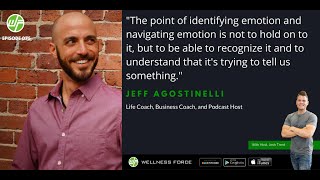
This is a transcript of Wellness Force Radio episode 75 (YouTube) hosted by Josh Trent with guest Jeff Agostinelli, a life and business coach. The conversation traces Jeff's path from pre-med to macrobiotic chef to vipassana meditation and coaching, and centers on breaking free from chronic negative thinking by shifting habits: movement, meditation, and journaling/writing. Topics include emotional awareness (locating feelings in the body), habit formation (moving one node to reorganize behavior), examples from Jeff's clients, and practical takeaways (a self-check process and three daily practices). The episode also mentions Jeff's Next Level podcast and website jeffagostinelli.com.
Chapters
Wellness Force Radio Feelings are essential, but they can't dictate our actions. We literally inspect each other with our emotions.
We came here for a special purpose. Let the purpose unveil itself. Knowing without doing is the same thing as not knowing.
They're not just trackers.
I'm gonna wear this and it's gonna help me do the right thing.
Wellness force radio episode 75 with life and Business coach Jeff Agostinelli.
There's an em, a thought, there's an action, there's a behavior, there's a habit. And they're all connected. Who's to say that we can't just move one of those things around and everything else will change our frameworks or reality around Love our frameworks and reality around work. You move one of those pieces around, you reorganize the entire thing.
Welcome back to another episode, my friend. I am your host and wellness coach, Josh Trent. Thank you for spending your time with me here on the podcast. This is where every week I bring you access to global experts in wellness, technology and behavior change. On this podcast you'll learn from exceptional people who are dedicating their lives to driving real transformations in physical and emotional wellness. My intention with the show is that together we'll discover the connections between your emotions and healthy habits to live your best life and enjoy the process. This episode is brought to you by Perfect Supplements, a company I'm honored to stand with who walks the talk with their values of non GMO pesticide free real food supplements that support us all on the wellness journey. Hop on over to perfectsupplements.com wellnessforce Enter code wellnessforce to save 10% off your entire order at checkout. Wellnessforce picked up another five star review last week. This is from listener B. Noonan 18. B. Noonan says I love listening to Josh's Wellness Force radio podcast. I am new in the fitness and wellness field and this podcast offers a brilliant spectrum of interviews with successful and talented people who really get to the truth of the matter. When it comes to health, healing and happiness, Josh is genuine, funny, personal and honest. Keep up the good work Josh. I continue to be inspired by you man. You should see my face right now. I'm smiling and I'm feeling so received by you. Thank you so much for your powerful voice. Be Noonan18 I so appreciate that you can support the show and get your shout out all over the itunes airwaves@wellnessforce.com review this week's podcast. I am so excited you're here hanging out with me for the next 45 minutes with Jeff Agostinelli. A little bit about Jeff. He is a life and business coach and also hosts the Next Level podcast. I met Jeff actually through a podcasting paradise group online last year. This is the power of social media and connections and growth we can all have through technology. You know, this podcast would not be available if it wasn't for the technology that we all depend on. So, yes, technology has the two sides of the sword, but on this show, we're cutting with the sharp side that helps everyone else. Jeff and have a similar passion when it comes to consciousness and what it's like to be a conscious man and have real conscious conversations about the things that actually matter in this life, how this relates to our health and our wellness and all the goals we have around our body. Composition and letting go of weight cannot be a more clear mirror because on today's show, we're talking about how to break free from chronic thinking. Jeff works with clients all over the world. He specializes in helping new habits and new habit formations for his clientele. And what's really unique about today's show is the depth of this man. I mean, typically we peel the onion five layers back, but in this conversation with Jeff, I feel like we went 10 layers to the core of the onion. We'll learn from Jeff about the three ways that he gets back into his body and out of his head. How to stop that chronic negative thinking and how to replace it with something that serves us. How movement and the type of specific movements have helped Jeff create the life he loves. And all the stories from his clients from what really holds them back so that we can choose to end the optional suffering and accept the gift that's wrapped up in the pain. Let's get deep and get well with Jeff Agostinelli. Jeff Agostinelli, welcome to the show.
Thanks, Josh. Thanks for having me on, man.
I am so excited to talk about transformation, habits, and everything else under the sun from a guy that I've really respected. You know, I've been seeing your work over the past six months. You've interviewed some amazing people on your podcast. We're gonna talk about your podcast. But, Jeff, before we get into the show, man, tell us something that we don't know about you. Something fun. That'.
I'm 100% Italian and my family is all extremely loud. And if you're in a room with all of us at once, you'll likely be very overwhelmed.
That kind of sounds like my upbringing. I remember there was, like, a big table My grandma would make raviolis, and there was a lot of yelling. And that's kind of the culture. And it's interesting because when we're kids, we pick up certain habits, right? Certain ways of being, certain ways of looking at life and experiencing that. I'm curious, man. When we look at your early years, you know, before you became a business coach and a life coach, entrepreneurs and business owners, what did that look like? I mean, how did the behaviors that you learned as a kid, which ones did you keep? Which ones did you let go? Kind of break that down for us.
Oh, wow. Interesting question. So habits as a teenage into late 20s, early 20s, late 20s. I was kind of a rebel kid, actually. I had detention every single day, freshman year of high school, plus Saturdays. I had a problem with authority. I also disagreed, decided that I would be the class clown. So I kind of put myself in the way of trouble. Not really sure why. I mean, I've got insights into it, but as far as what I did when I was younger to what I do now, it's literally a 180. Many people that I knew back in the day see me now, and they go, who are you? So I haven't really kept much. What I have kept, I guess you can say, is the ability to set my sights on something and stay committed. And as you've also interviewed Gretchen Rubin on your show, so when it comes to habits, I'm an upholder. So as far as, like, doing and accomplishing, I don't really have to have accountability per se, although it's fun. But I just have great habits. I always can make and break habits with ease, and I've done that for as long as I can remember. So I would say if there's one thing that I kept for a long time, it's that other than that, most of my habits from the early days have fallen away, either consciously or as a side effect of adopting better habits along the way.
Man, you upholders. I kind of have a little part of me that's jealous that you're an upholder, because I'm an obliger. And this is actually a really good point. Since we've both interviewed, I'm gonna put your interview with Gretchen on the show notes for this episode because I think that there's always extra gems from different conversations with the same person. But when I look at habits, we learn really early. I mean, I picked up that food was medication for me. So I had a lot of bad habits around food when I was a kid. Personally, were there a handful of Things that you learned before you set off to college, we're gonna talk about a little bit.
Your story.
You became a macrobio and you're actually pre med. So what are these handfuls that you let go of so that people can relate to you?
Wow. I partied like you wouldn't believe. So that was one thing that I definitely let go of after college. So that's one thing. I played a lot of sports, so I didn't play, or I did play Division 1 lacrosse in college, but after that I didn't do any sports. So that was. I just shifted that into individual sports instead of team sports. But then I picked that back up in business. I love working on teams. I've tried to, I'll say it this way, the challenging authority and having to be right. I think those two kind of go hand in hand. And I do my best daily to let go of having to be right. And I'd say as where I was with that when I was younger and where I am now, I'm doing much, much better. And it definitely still shows up from here to there time and time again. So that's one that I've put a little bit of effort into letting go of. Other than that, the main things were around being completely unconscious in terms of my actions and repercussions of actions and just doing, I guess you could say, stupid stuff that teenagers and rebels would do. I did a lot of shenanigans, if you will, pranks, partied a lot. Was very, a very colorful past, I guess you could say.
On your website you speak about as a result of seeking better and wanting to help people. You set the course from what you knew. So you were like, oh, okay, I'll just be a doctor. And you went to pre med. What happened in college and in pre med studies to then transition you to be a macrobiotic chef. How do you go from wanting to be a doctor to a macrobiotic chef?
Well, I was originally, originally extremely interested in the brain. And at one point, I know now for me I'm more interested in emotion and feeling in the heart. And at that point I thought the brain was the master of the body. So I was into neuroscience. I took a class called neurobiology. I believe it was senior year in college and I was in love. So naturally I said, I'll be a neurosurgeon. And that was my obsession at the time. And what happened was my cousin in law, my cousin, her husband had stage 3 ish, stage 4 prostate cancer. If you know anything about like the Tests, they do a PSA test which is prostate specific antigen. And if it's really high, that means that there's something in that area of the body that's fighting something which usually indicates that there's cancer or growth in that region of the body. He had the high psa. He was diagnosed, they gave him X number of months. And what my cousin did was she started cooking a macrobiotic diet for him 24 7, three meals a day. The snacks, the remnants, like just the whole nine yards. And within a very short time period, he started to look better, he started to feel better. And he's still alive today. They're no longer married. But it was one of those things that I saw his transformation happen so, so, so, so fast. I said, okay, I'm gonna go to California, graduated college, packed up my car and drove out there and I said, I'm gonna explore this thing. So I was up at early hours of the day in the kitchen with her and then I saw it and I said, you know what, there's information here. I need to learn this. Got on a plane, flew to Massachusetts and went to the cushy Institute for Macrobiotics. And just like anything else I've done, really once I believe something has, I guess you could say the potential for transformation or breakthrough. I can see the light at the end of the tunnel as that being the solution, maybe the cure all, the end all be all like the thing at that moment. I just went all in and started learning everything I possibly could and went that direction in terms of, of what they call alternative medicine, which for me is hilarious because it's like, really, natural foods is alternative, eh? Since when? So I just went in that direction full bore. Macrobiotics, raw food consciousness. It just got, I went, I went off the deep end.
They would say, you know, it's interesting too, Jeff, when we look at the actual definition from Webster's of medicine. It's the science or practice of the diagnosis, treatment and prevention of disease. I love that medicine definition has prevention because macrobiotics just unpack that for people that might not know what that is.
Yeah, so macrobiotics was a traditional Japanese ish diet, was brought over to the States by Michio Kushi and George Osawa. And what it is, it's beans, legumes, rice grains, seaweeds, vegetables. And a lot of the principles of macrobiotics are based on the, I guess you could say like traditional Chinese medicine or the oriental model of yin and yang. Right. So expansive and contractive. And if there's One thing that I learned through macrobiotics, it's how to understand the operation of expansion and contraction in anything and everything. But when it comes to food and macrobiotics, down to the nitty gritty, I'll give you an example. Right? So when cooking addition macrobiotics, if you pressure cook rice, it's said to be a lot more strong and yin than if you were to steam rice or slowly cook rice over more gentle means. Right. So pressure cookers, like apply a lot of pressure. It's contained, it's closed, it's heavy, it's tight, very yang. If you were to use a bamboo steamer and steam rice, wood, soft, yin, steam, no pressure. So the effects of those foods through a macrobiotic theory would say that one is more contracting and one is more expanding. And based on the condition of somebody, if they had more of like a yang or yang type cancer, they would be prescribed more things on the yin side to bring the energy up the body instead of the downward force to bring that up. So it's about achieving harmony and about achieving balance through means of what I would say a traditional Japanese diet, we've woven in with other things. I mean, like anything over time, it adopts certain principles based on time and development and evolution, if you will. So what macrobiotics looked like, wow, 10ish plus years ago and what it looks like now is very different.
Well, I love the fact that you have these layers of death, Jeff. You know, you had this kind of traditional schooling, then you were pre med and then you transitioned over to what I feel is a more holistic way of living and being through being a macrobiotic chef and then your next phase of your life, which everything set you up for before you went through that you actually went on a vipassana. And I think this relates because in the last episode I mentioned that by the time our talk comes out to the Wellness Force audience, I will be done with my 10 day Vipassana. And I'm honestly really nervous about it. So I'm curious for two things, Jeff, you know, share, share what you did as a chef with your silent meditation process and then how that kind of transformed and bolstered you up to be this successful life and business coach.
Yeah, so vipassana was a huge turning point for me in my life, personally and professionally. Because first off, Yasha, I told you part of the story is that I didn't even know what I was doing. Like, I didn't know I was going to a ten day silent meditation retreat. I mean, I did know on Some level. Meaning that, okay, I was on a retreat and I was going to go there, but when I was told, my girlfriend at the time said, hey, do you want to go on a 10 day silent meditation retreat? And I'm the kind of guy that's like, yeah, of course, honey, let's do it.
You almost got kind of quasi tricked into doing this silent meditation by your girlfriend. Did she say the word silent? Did you know it was going to be silent?
But you know, it's like, I guess I just didn't hear.
Sure, babe.
Yeah. My definition of silent was like, of course you're not going to talk while you're meditating, right? I mean, geez, what does that mean? So, you know, for me, it takes another level of detail sometimes to really drive a point home. And the fact was that when we got there, no notebooks, no audios, no phones, no nothing. Silent completely for 10 days, which is a whole other level of conversation or non conversation, another story entirely than I thought it was. But at the end of those 10 days, I had not only a brand new perspective, but it was as if my senses and the way that I take in information and process it had a complete overhaul. Mindfulness on steroids, times a bajillion was really a way to say it because there would be things that would come into my reality and I would be able to witness a conversation brand new than I did before. So at this point, the family I was cooking for in Boston, the husband of the family, I would hang out with them, we'd have whiskey, we would have wine, we'd have whatever. And I remember when I got back, he was like, hey, do you want a glass of wine? I was just like, no, I don't really feel like it. He's like, what, you kidding me? I was like, nah, I just don't feel like it. And that was the first time where I just could tune in and be like, you know, that's not going to support my consciousness right now and make a choice instead of be like, yeah, okay, we always do that. I'm going to have that. That's the normal. That's what we do. That's who I am. Right? We get into this habit of defining who we are now based on who we were instead of what's new in this moment. So for me, every moment became a choice. I was like, wow, this is really weird. And I started making choices differently than I had before. And in the beginning, it was more of like a perfect storm. Like a lot of things happened. I kind of Fell out of love with cooking. As far as a profession, it was fun, but it wasn't the relationship I was in. Maybe two, three, four months after that fell away, I started going in different directions with my life and with work and with all kinds of stuff. And instead of food, I found, of course, the next natural evolution when you have your diet in order is I found consciousness. I found that there were more deeper universal principles and laws that the universe operates on. And I know I'm running the risk of sounding a little on the woo woo side, but you know what, that's perfect.
We are totally used to woo woo.
That term is going to sound so normal in the next couple of years. Because we operate on an industrial revolution mindset. We operate on a very assembly line type linear conversation of time where it takes a certain amount of time to do things. And this is how the world works. And when I got into the conversation of consciousness, it wasn't, oh, this is the way the world works. This was, how does the world work? Does it really work this way? And is it malleable? Is it bendable? Can I bend reality as I know it? Can I make choices and changes and look for the confirmation of that thing showing up in my life as small as it may be, and honor, acknowledge and appreciate that small sign that my desire is already here and coming to me more and more every single day. Yes. And it just literally catapulted me, like trampoline style, like just rocket style, into an entirely different echelon of thinking and being and what's possible.
And now on this Next Level podcast, I love the Next level because that's actually what you did from being a chef to a life and business coach. What are the things, Jeff, that you have seen in your practice as a coach, engineering these amazing solutions based on changing entrepreneurs habits, business owners habits. What are the things that you see at the top of the pile that always come up for people that are just a stick in the spoke of the wheel? What are the things that block people typically in the beginning, when you start working with people, when it comes to creating their new story and changing some habits that might be deleterious, this simple.
Notion that there's habitual language that we use and the habitual language usually sounds like I can't or it's not that way, or it's not there yet, or duh, duh duh, there's a very short period of time from when someone's introduced to an idea where they shortly thereafter will confirm what they already believe is true. So what happens most of the time is, is a lot of these people will reach out and they're stuck in a pattern of thought. And it's really all it is at its point of inception. Because what happens is we have a thought, right? And we have an emotion. And what came first, the chicken or the egg? The conversation is, does it really fricking matter what came first? No, it doesn't. There's an emotion, there's a thought, there's an action, there's a behavior, there's a habit, and they're all connected. Who's to say that we can't just move one of those things around and everything else will change, right? Like Alan Watts talks about. And the taboo, I think it's called the Art of the Taboo. The book Against Knowing Yourself or something of that nature. Fantastic book. I just finished it a little while ago. But he talks about models of reality, and he talks about dimensions, right? So there's. You have three particles. They form a triangle. You have a fourth. It's like the observer effect. If you take one of those things out, do you hear the tree that falls in the woods? If you take one piece out of the whole picture, does the rest of the picture even exist? It's the same thing when it comes to habits, when it comes to beliefs, when it comes to behaviors, when it comes to our frameworks or reality around love, our frameworks and reality around work. You move one of those pieces around, you reorganize the entire thing. So the number one common thing is more, I guess you could say, like a global thought form within most of us is that we think that our lives are the way it is. And on some level, we really don't think it can change. And we're stuck in a certain chronic thought. And that thought operates. And it takes somebody really having us look at it, either ourselves or somebody outside of us continually and consistently changing it. But the number one thing, Josh, is being stuck in a chronic way of thought. And the people who are moving forward in business and moving forward in their life synonymously are the ones who continually question their thoughts or continually question their habits on a daily or weekly basis, really, and look at it and say, am I really satisfied in this department of my life? Like, do I really love my environment? Do I really love my relationships? And if the reality is no, then those people look for solutions to make.
Them better or they don't. And I find that the majority of people that are going through some type of health change, you know, wellness, a lot of what we Talk about on the show, Jeff, is behavior change. How do we live our life in a wellness abundance? What are the things that we can do? And I believe that we take an emotional inventory of what's not working first. And I think this emotional inventory looks like, let's have the real honest and uncomfortable conversation about the people, the experiences, and the foods and everything else that's not giving us that feeling that we want. I mean, when you work with your clients, how important is tapping into their feelings? How do you get people to tap into their feelings and not just mash down their feelings, which for a lot of people in America, it's not necessarily a culture, especially for men, where we're allowed to feel our feelings and allow them to direct us.
Dude, if there was one thing that I had to say, everybody can continually learn how to. I'm going to use the word manipulate, right? Like alchemize more. It's emotion. And emotion is literally, in my personal opinion, for me personally and those that I've helped worked with, even family, it's the number one thing that we can utilize and need to utilize in order to help ourselves move forward. Because emotion makes the world go around, dude. I mean, it's really, you know, emotion. Tony Robbins says it's great. You know, it's like. It's that moment of emotion, right, where it's like, no more. You know, this is done. Let's start, let's begin. It's that moment of emotion that literally sets the cadence for the rest of whatever that choice sets in motion.
Yeah.
So as far as emotion goes, in ways that I help people access emotion is by having a conversation about it first and foremost. I'm going to preface this a little bit first, right? Like, talk therapy has its place here and there. I'm not 1 million percent in agreements that we can always, quote, unquote, talk things out. I think that talk can be cheap and that we require having communication and conversation sometimes to access what's true, because it's in the form of language, because that's the frame of reality we operate on. But I also believe that, again, in the model of all these moving pieces that define a situation, there's a language pattern, there's a behavior, there's an emotion. And the emotion is usually what keeps the thing locked in place. So when it comes to accessing emotion, we can access it from a number of different places. We can look at someone's environment, and if they're constantly dealing with quote, unquote, angry people coming at them, they're the common denominator. So then I help people if they're like, oh, I'm always dealing with these angry people. It's like, okay, how do you feel about that? Look at the situation for real. Like, slow down enough and stop pointing the finger to realize that the one who's experiencing all of these outliers, all of these satellites of reality and all these satellites of feeling is you and is me, in my experience. And then be able to tap into what that feeling or emotion really is. Can be as simple as just sitting there for a moment and feeling, wow, I'm involved in all of these situations. And then just sitting there and doing nothing for a moment and then being, okay, where in your body do you feel that? Maybe in the solar plexus. It may be in the stomach, maybe in the throat. It may be somewhere. But that also gives us a clue as to what emotion or what's going on. And the point of identifying emotions and being able to navigate emotion is not to hold onto it, but it's to be able to recognize it and understand that it's trying to tell us something. It's like this thing or this experience may not be in alignment with my true values. So then it may become a conversation about values. It may become a conversation about vocation, it may become a conversation about relationship, about intimate relationship, about family, relationship, about work relationship. It's so other than a linear conversation. It's not the assembly line. It's the quantum conversation of, you know, there's things that are constantly trying to give us clues. There's constantly signals and signs being presented in our face based on the quality of our questions. So our emotions color our questions. If we hate our experience, we usually ask shitty questions. We're usually asked, like, you know, like, why the heck does this keep happening to me? Or, why can't I find someone who loves me? Or, like, what the heck is going on? Like, everybody I work with is a pain in the ass. Those questions, those statements don't really bring us the best replies or responses from, you know, cosmic Google, if you will.
I love your rant so much. Jake Doocy came to my house this week, and there's this quote that's painted on a rock in his house. And on the rock it says, you don't get what you want, you get what you are. And I feel like that's what you're talking about, you know, whether you want to go to quantum level vibrationally or just energetically. We all know we've been around people in our lives that we enjoy their presence. And then we've been around people where it's a drain for us, it feels heavy for us. So are you saying that we get to actually turn the mirror at us and see how we're being so that we can take an inventory of the people and the experiences that we're actually living out?
Yeah, for sure, a lot of the time. And there's a catch to this, as always, right? It's like. Like the personal development industry. Some facets of it have taken this to the. To the degree where people will use that and kind of use it to judge themselves. Like, oh, well, it's all my fault. They'll, like, take on the martyr syndrome, right? They'll be like, the burden be like, oh, well. They'll be like, it's gotta be me. It's gotta be me. It's gotta be me. No, some people you need to just say, look, I don't want to be around you, and this relationship doesn't serve me. But that's by turning the lens inward, we get to figure that out. We have to have inward action or insight. We have to see inside to be able to make that choice on the outside and be like, look, this has served me. This has had its purpose. I may have to have a momentary phase of pain to be able to move through this, but this is complete. This is done.
I love the fact that you said momentary phase of pain because as we know, everything's temporary. One of my mantras that I say to myself is, this too shall pass. And I know a lot of people use that as a mantra. I'm curious, you know, with the clients you work with, what do you think they experience when they're mashing down pain and they don't want to feel the pain? What's the gift, Jeff? What's the gift in pain that people aren't unwrapping?
Well, I mean, the funny thing about pain is I'll answer that from two sides, right? There's gifts in pain that people think they're receiving, which is comfort. Like pain. Emotion begets emotion. If people are used to experiencing pain, when they start to experience joy, they may have an oh, shit moment. Moment. They may be like, anxiety may strike in the terms of, what is this feeling? Is it okay to feel good? So on one side, pain is supplying something to keep something existing. On the other side, the gift inside of pain is the true expression of what the pain is meant to wake us up to. So if we're experiencing pain in a certain area of our life, It's a momentary thing to let us know, look, this needs to change. So whatever the gift in the pain is, is the unique expression that's coming through us of that situation in its divine expression. So it's the thing that we dream of, it's the thing that we want, it's the thing we desire trying to come into fruition, but we've placed pain on it.
And I'm almost feeling like when I've had lessons of pain in my life, one of them being, you know, I had a relationship that didn't work this weekend. I know if you're listening and you' gone through a breakup, I think we've all gone through relationship issues, right? If we're a human being and we breathe. And so I. I had a lesson where, you know, three, four months after I was feeling lonely, and I caught myself adding in extra workout here and there, maybe having, like, some extra food in the evenings. And just these little habits that started to creep in that I used my awareness to say, hey, why am I really doing these habits? Why am I really executing these habits? Oh, it's because I'm lonely. Well, why don't I just actually use the loneliness as this beacon of truth to realize that I'm enough anyways, to realize that, hey, my relationship didn't work out, but it has no reflection on my value or my worth. And I think we all can get caught up in this, in our human experience, where the habits creep in, and if we're not mindful enough, the habits can take over. Jeff, so what do you do as far as getting clarity, maybe in your own life or with your clients? To allow ourselves to be the observer, to allow ourselves to remove the thing that don't really serve us. I mean, what works for you in your life and the people that you work with?
Well, I think everyone's different. We all have something that we utilize the most, right? And I know for me, that's movement. And I think you may have some that we may have that in common, just from what I know about you. But for me, I know that I use my movement as an indicator. If I get. I have to move my body. Otherwise I feel stuck, stagnant, cranky. Just me moving is medicine, period. So I also know that when I'm moving, I get to be creative about my movement. And using my body to perform acrobatics or, like, gymnastics, or using my body in a way that challenges gravity is the best for me personally. So I know that when anything is awry in my life, I Know that I look into my habits and I go, am I really giving myself the time I need to explore my body? Right. To go to class or to get on the rings or to go to the Paralympics, to do whatever I need to do to take myself personally into my next level of expression. So that's one way. But I also know that it's important to stay on things because I also believe, let me just preface this with something, is that we shouldn't wait until the stuff hits the fan in order to do something. Finding out what works for us and maintaining a state of evolution is important. Realizing that pain comes up and what to do when we're in pain is to look at our habits and say, maybe there's something that I'm doing too much of, something I'm doing too little of. So to get back to your question directly is I help people look at and I look at personally what my top priorities are. And I know for me, most of the time that has to do with number one, my relationship. That's always number one. Number two is business, Number three is family. But kind of like blanketing that whole thing is movement. For me, I have to be moving my body and I know that's a daily ritual no matter what. So that's kind of like eating, breathing and sleeping. I add moving in there as well. Yeah, but I think getting clear on our values is number one. And then realizing that if we're not giving one of those departments the most, it's not really effort, but it's feeding. Right? So if we're not feeding that department to its utmost, we know that something in our life is going to show up to say like, look dude, reassess. So in that moment, I think it's important. Just like the sell cycle has checks and balances, an uncontrolled cell cycle, as you know, is called cancer or any other dis ease. So it's the same like why should we not change? You know, it's like not changing the oil in your car. It's like not gonna work. Human beings, conscious beings, we require tuning in and finding out what's working and what isn't. So having a self check process for myself and for everybody else is number one. Like if you don't have a way that you sit down and really look into your life and understand what's working, what isn't, then you'll never be able to change people, period.
We'll get right back to the conversation with Jeff. You know, on our wellness journey. It's so important now more than ever with our jam packed schedules, the practice of self care and self love for both the body and mind. We're talking a lot on this episode about how to drop into that self care listening to what the body needs to give our bodies what they deserve and need. I've hand selected three of my top superfoods from Perfect Supplements in a Wellness Bundle specifically designed for the Wellness Force Radio audience. Inside the bundle bundle you'll receive Rhodiola Rosea to elevate mood and calm stress Prescript Assist prebiotic and probiotic to keep our guts healthy and squeaky clean and 100% grass fed hydrolyzed collagen for satiety, skin and joint health. You know, we've talked a lot about if you're on a Paleo or a Weston A. Price diet, you're probably familiar with bone broth. Bone broth is that nutrient dense food because of the gelatin. It's produced when you cook the bones. Well. Gelatin is just cooked collagen. It's an abundant source of protein. It's included in the Wellness Bundle. Hop on over to perfectsupplements.com wellnessforce click on the Wellness Bundle and save 10% off your already heavily discounted package. Get some good health and save some money in the process. Let's get back to the layers with Jeff. So powerful. What are three ways then? I love how you put that man. This self check process. What are three ways that you've seen be really great for people to start.
Practicing, set up a habit. Meditation is, is bar none for me, one of the best because it gives you that sensation of being able to witness and sit. But also writing, even if you're not a writer, journaling. You've probably heard people say this before, but I actually was not a writer and I've had to train myself to write. And it's the most therapeutic thing on the planet to be able to one see what comes out of your mouth through your hand. Right? Like being able to put your thoughts down onto paper instead of just talk them because it's a little bit difficult. Different and journaling, writing down, finding different ways. Everyone's got a different method. For me personally, I write and when I'm writing for reasons of getting things out, I just write exactly as it's coming up for me in that moment. And sometimes there's f bombs prolific throughout the whole thing. Sometimes it's like a fit of this and other times it's great expression. So having a writing practice is definitely a huge thing. And then and the third thing, so meditation, writing and movement. Even if movement is not your thing, having a practice where you move your body gives you what you're meant to do. Like, we're not meant to sit all day long, we're not even meant to stand all day long. Standing desks are fantastic, but they did that. There was assembly lines, people stood all day long. Chairs came from the fact that factory workers were standing all day long and they needed to sit down. I know, right? A different way of life. But these are what I would call indirect self check processes. Because meditation gives you the awareness to see, wow, I've got a lot of thoughts happening right now. Maybe I should sit down and write. If that's your thing. Writing gives you the process of self check of your writing, so you're figuring out what's going on. Moving your body gives your body what it requires to be able to calm down. If you're constantly forcing yourself to sit all day long or constantly forcing yourself to do something your body's not meant to do, giving your body the chance to move organically, do some yoga, do some movement, get into a dance class, R and B class, a break dancing class, do some capoeira, do some budokan, do some movements, do something that gives your body an ability to express, will let you tap into a level of self check that you'll have nowhere else. Because, yeah, you can do self check. Like sit down, like, oh, is this working? That's great. But what better self check is there? To be able to sit with your own thoughts for 20 minutes a day through meditation and find out, wow, I really can't be with myself. That's something to explore, to sit down and write and be like, wow, I'm having a challenge writing. Maybe there's something to that. Or to go and move and be like, wow, I really don't know how to move my body. I don't know how to use this vehicle that somebody gave me in a way other than to sit or type. So those are, for me personally, those are the top three ways to inadvertently, I guess you could say, or indirectly get into that self check.
Love that, Jeff. Movement, meditation, writing, these are all ways for us to check in to what's going on with the story that we're creating, the current story that we're creating. And I use this paradigm of story creation because there's so many different levels of development, personal development. And I'm curious for you, man. You've been through a lot of work working on Jeff, helping other people work on Themselves. Has there been one or two things that you've done from a personal development standpoint, either a conference or a book or a coach, that's really moved you up to the next level?
Well, I can give you two. I can give you one that is just a huge champion of mine just because of what he's accomplished in the world. And Tony Robbins just came out with a documentary. I mean, the guy is just.
It's so good, Jeff, I am not your guru. It's so good.
I've watched it twice.
Everyone gets to watch that.
Yes, absolutely, yes. But just as like an icon as far as what's humanly possible. Like that man has the reins on his consciousness, quote, unquote, his thought process, his body, his physiology, everything, more than anybody, I think in the world other than like those people who are off in the mountains, like controlling their heartbeat, of course. But Tony Robbins is one. And then currently, so that's like all time influence as far as from the beginning to now. Currently. I actually just interviewed him a couple days ago. The episode is going to be going live. Not sure when this is going live, but that one is going to be August 29th, I believe. And it's with Jesse Elder. I just went and saw him in Atlanta. He's just a great, great, great guy. Got a huge heart, but he's fun. And I have this soft spot for people who are doing things new and different and getting results because they're just being themselves. And he's someone for me. I don't know, Josh, if you've experienced interacting with someone and they almost give you like the invisible permission slip to be yourself, and they remind you that you're enough. And they remind you that you're okay and they remind you that you don't need to be fixed. And they remind you that you have everything you need. For me right now, Jesse is one of those guys that's just like a beacon, a lighthouse and just. He's awesome.
So those two, Very cool, man. I want to transition, Jeff. This has been such a fun conversation and this is the fun part of the show. It's where we get to know you seven layers deeper. And this is just seven quick questions for seven amazing, mind blowing answers. No perfection expected. Are you ready?
Yes, sir.
What's the first thing that you think about when you smile? What makes you laugh the most in life?
My daughter.
What's one of the biggest things that society might have called a failure, but that's happened for you, that you define as one of your greatest lessons.
Deciding not to go to medical school.
What about life gives you the most awe or gives you the most gratitude that you get to experience?
Two things, actually. Nature and my wife.
If you got the chance to be on every TV station, every news station in the entire country all at once, you know, it could be a minute, maybe two minutes. What would you share? What message would you share? If everyone's ears in America were listening?
I would share a message of, I guess what my friends and wife call me standing on a soapbox, saying how much potential we all have, how much transformation is possible. And I would let people know to just question everything, to really validate for themselves and to look in the world and see just because everything is everywhere. McDonald's is everywhere. Just talk about food. Burger King is everywhere. That that's not food. That there's ways that we're living and being that are not coherent with the way that the universe and nature grow and expand, that they're actually in the opposite direction and would then deliver a lightning rod of inspiration and a lightning rod of hope for people to literally transform their lives in a moment.
What do you think is the biggest piece? And this is in the same question. I still have two more questions for you, but what do you think is the biggest piece? When you talk about untapped potential, there's many categories of potential, but what are the ones that you see that are the most untapped right now in our species, in our civilization?
Our capacity to love without condition, to just love, just universal love, the concept of loving just because love. I think that's the number one most untapped potential in humanity. And the potential, on the same note, I guess you could say the potential to care. To be able to walk by somebody and not look down at the ground, to look up and exchange even just that energy of an eye glance of I care.
Such a great answer, man. What's a monster? What's a message that you might tell yourself if life presents you a struggle or a strain? Do you have something you tell yourself?
There's a couple. There's two versions. There's the version of soft and gentle. It's okay. And then there's the version inspired by another guy. That episode's gonna be going live this Monday, Mark Manson. And it's something along the lines of, I just don't give a F. And it has a very different emotion. Back to it is that I care so much that sometimes I just have to not give a, you know, what about some things? And I have to give a huge, you know, what about other things?
I love that dude. Last question. This is unique because everyone comes on the show and this is my absolute number one favorite question, and it's what is wellness to you? If you had to define your definition of wellness, what is that?
Personally, it's visual. So being able to lay my head on the pillow at night knowing that that today and every day that I do, that was the best day ever. That I loved to the point where I could literally burst if I loved anymore. That I supported my wife and my children to the best of my ability. That I served everyone that day with the utmost respect and grace, and that I'm going to wake up tomorrow and do the same.
Jeff, so enjoyed our conversation. People can learn more about you at Jeffa Co. Right? And the Next Level podcast is on itunes. Is there anywhere else where we can discover more about Jeff?
Yeah, the website's got it all. And as you said, that's Jeffa Co, which brings you to jeffagustinelli.com, obvious reasons for the Jeff A. Co and I'm on Facebook, I'm on Instagram, I'm on Snapchat, and if you go to my website, website, it's all there.
Jeff, I want to read this quote from your about page. This is perfect to wrap the show. I found that health, peace of mind and business acumen isn't the result of doing things the right way. It's understanding why you are doing what you're doing. Such a great quote. Thank you for your work and giving people this window into why they're doing what they're doing, man. So I really appreciate your work.
Awesome. Thanks, Josh.
That wraps episode 75 with Jeff Agustinelli. I love this, man. Did you just enjoy so much the depth and the layers of the conversation we pulled back on? If anything about today's show made you curious about Jeff's work, hop over to wellnessforce.com next level and you can get all the information about Jeff there. Also, check out Jeff's website, jeffa Co. It'll forward you over to Jeff Agostinelli. If you're scared about the Italian pronunciation takeaways from today's show, giving your body the space for what it needs. Second, secondly, having the emotion and locating it in your body. Is it in your solar plexus? Is it in your throat? Is it in your belly? Let that feeling be there. There's gifts in the feeling of actually seeing where that emotion will take your brain. And lastly, the three specific ways that Jeff turns down the volume on the head and turns up the volume for his body to break free from those chronic thoughts. Intuitive movement, moving for what feels good for you. Meditation, even if it's 5 or 10. 10 minutes, 20 minutes being the sweet spot. And lastly, but not least, journaling and writing the thoughts, allowing those thoughts to go out of the mind onto the paper so you can get back into stepping into your life. Now, although simple, these action steps can provide massive benefits. So this week, if you're looking for a sign on how to get more in touch with the body and quiet down the volume in the head, this is your sign and I'm happy you're here. Now all you get to do is go out and create an amazing week week with all the tools from Jeff and every guest that's been on the show. So until I see you again real soon, I'm wishing you love and wellness.
More from Josh






Your child's future start before pregnancy... and even before conception! #podcast

MD Reveals: Your Healing Creates Your Child's Reality (The Souls Coming In Need Strong Bodies)



